Lightweight Directory Access Protocol, commonly known as LDAP, is a communication protocol designed to help applications and systems access and manage directory information in a structured way. Rather than being a standalone software product, LDAP functions as a standardized method for organizing, searching, and modifying information stored in a directory service.
In most enterprise environments, LDAP plays a central role in identity and access management. It helps systems maintain a centralized database of users, devices, permissions, and organizational structures. This centralized approach eliminates the need to manage credentials and user data separately on every machine, making administration more efficient and less error-prone.
At its core, LDAP organizes information in a hierarchical structure similar to a tree. This structure allows data to be stored in a logical format where each entry has a unique identifier known as a Distinguished Name (DN). These entries can represent users, groups, printers, or even application-specific objects. Because of this structure, LDAP is highly scalable and suitable for both small organizations and large distributed enterprises.
LDAP is also widely used for authentication and directory lookups. When a user attempts to log in to a system, LDAP can verify credentials against a centralized directory. Similarly, applications such as email clients or collaboration tools use LDAP to locate users and retrieve contact information efficiently.
However, while LDAP defines how data is accessed and managed, it does not inherently define how that data is transmitted securely. That responsibility falls to the ports and protocols used during communication, which is where port 389 and port 636 become critical.
LDAP Port 389: Unencrypted Communication and Its Role
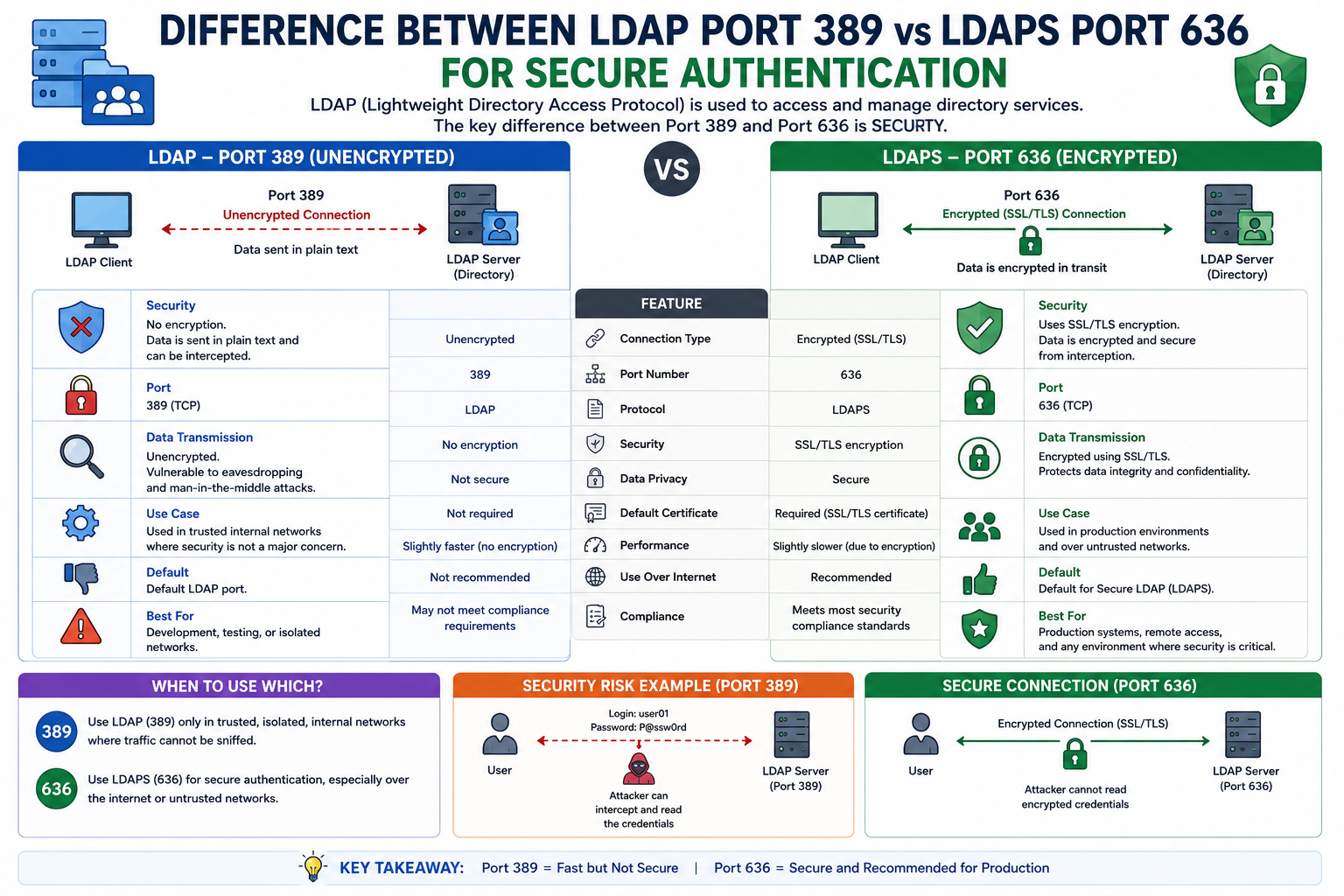
LDAP port 389 is the default communication port used for directory services that rely on unencrypted transmission. It is often referred to as the “clear text” LDAP port because data exchanged through it is not encrypted during transit. This means that any information sent between a client and an LDAP server can potentially be intercepted and read if captured on the network.
Despite its lack of encryption, port 389 remains widely used in internal environments where security risks are considered low or where encryption is handled at another layer. For example, some closed corporate networks may use port 389 for internal authentication services where traffic does not traverse untrusted networks. In such environments, administrators may prioritize performance and simplicity over encryption overhead.
Port 389 supports a wide range of LDAP operations, including binding (authentication), searching directory entries, adding or modifying user information, and deleting objects from the directory. Because these operations are fundamental to directory services, port 389 is often enabled by default in many LDAP implementations and directory platforms.
One important characteristic of port 389 is its flexibility. It can operate in both anonymous and authenticated modes, and it can also support upgrading to encrypted communication through mechanisms such as StartTLS. In this case, a session initially begins in plain text and is later upgraded to encryption if both client and server support it.
However, relying solely on unencrypted communication introduces significant risks. Sensitive information such as usernames, passwords, and organizational data may be exposed if intercepted. Attackers with access to network traffic can analyze LDAP queries and potentially exploit this information for unauthorized access or phishing attacks.
Because of these vulnerabilities, the use of port 389 in modern environments is increasingly limited to controlled or legacy systems. Security-conscious organizations typically avoid transmitting sensitive authentication data over this port without encryption.
LDAP Port 636: Secure LDAP and Encrypted Communication
LDAP port 636 is designed specifically for secure communication using encryption. It is commonly associated with LDAPS, which stands for LDAP over SSL/TLS. Unlike port 389, which begins communication in plain text, port 636 establishes a secure encrypted connection from the start.
When a client connects through port 636, a TLS (Transport Layer Security) handshake occurs immediately. This process ensures that both the client and server agree on encryption methods before any directory data is transmitted. Once the secure connection is established, all LDAP traffic is encrypted, protecting it from interception or tampering.
The use of encryption on port 636 provides several important security benefits. First, it ensures confidentiality, meaning that sensitive data such as login credentials cannot be easily read by unauthorized parties. Second, it ensures integrity, meaning that data cannot be altered during transmission without detection. Third, it helps establish authentication of the server itself through digital certificates, reducing the risk of man-in-the-middle attacks.
Port 636 is especially important in environments where LDAP traffic travels across untrusted networks or where compliance requirements demand strict data protection. This includes cloud-based systems, hybrid networks, and organizations handling sensitive user data.
Unlike port 389, port 636 typically requires proper certificate management. The server must be configured with a valid digital certificate, and clients must trust this certificate in order to establish a secure connection. This introduces additional administrative overhead but significantly improves security posture.
While port 636 is considered the preferred method for LDAP communication in modern systems, it does require careful configuration. Expired or misconfigured certificates can lead to connection failures, and improper trust settings can prevent clients from establishing secure sessions. Despite these challenges, the security benefits far outweigh the operational complexity in most environments.
Key Differences, Operational Considerations, and Security Implications
The primary difference between LDAP port 389 and port 636 lies in encryption. Port 389 transmits data in clear text unless explicitly upgraded using mechanisms like StartTLS, while port 636 enforces encryption from the beginning of the session.
From an operational perspective, port 389 is simpler to configure and may be sufficient in isolated or internal networks where traffic is tightly controlled. It also introduces less computational overhead since encryption and decryption processes are not always active. However, this simplicity comes at the cost of security exposure.
Port 636, on the other hand, introduces encryption as a default requirement. This ensures that all LDAP traffic is protected but also requires proper certificate management and secure configuration practices. As a result, it is more commonly used in production environments where security is a priority.
Another important distinction is how each port handles trust and authentication. Port 389 may rely on external security layers to protect data, while port 636 integrates security directly into the communication process. This makes LDAPS more robust against interception attacks and unauthorized data access.
In modern network design, the choice between these ports is less about functionality and more about security posture. Most organizations prefer port 636 for authentication systems, directory queries, and user management operations. Port 389 is often reserved for legacy systems or controlled administrative tasks where encryption is handled separately.
Ultimately, understanding both ports is essential for network professionals, as LDAP remains a foundational protocol in identity management systems. Knowing when to use secure versus unsecure communication directly impacts system security, performance, and compliance.
To further expand on the importance of LDAP ports 389 and 636, it is also useful to understand how real-world environments balance compatibility and security when implementing directory services. Many legacy systems were originally built around port 389, which means they still depend on unencrypted LDAP communication to function correctly. Because of this, organizations often face the challenge of maintaining backward compatibility while gradually improving security standards.
In practice, administrators may run both ports simultaneously during migration phases. Port 389 can remain active for internal applications or systems that do not support encryption upgrades, while port 636 is introduced for all modern authentication and directory traffic. This dual-port approach allows organizations to transition smoothly without disrupting critical services.
Another important consideration is performance. While encryption on port 636 introduces a small amount of overhead due to TLS handshake and encryption processing, modern hardware and optimized protocols have significantly reduced this impact. In most cases, the performance difference between encrypted and unencrypted LDAP traffic is negligible compared to the security benefits gained.
From a security governance perspective, regulatory frameworks and best practices increasingly require encryption for any system handling authentication data. This means port 636 is not just recommended but often mandatory in compliant environments.
Ultimately, the continued use of LDAP highlights the importance of balancing legacy support, operational efficiency, and modern security requirements within network infrastructure.
Conclusion
LDAP ports 389 and 636 represent two different approaches to directory communication: one prioritizing simplicity and legacy compatibility, and the other prioritizing security through encryption. Port 389 operates in unencrypted form and may still be used in controlled internal environments or legacy systems, but it exposes data to potential interception if not properly secured. Port 636, in contrast, ensures that all LDAP traffic is encrypted using TLS, providing confidentiality, integrity, and stronger authentication mechanisms.
In modern network environments, security expectations have shifted significantly, making encrypted communication the standard rather than the exception. While port 389 still plays a role in specific scenarios, most production systems now rely on port 636 to protect sensitive directory information such as user credentials and organizational data.
Understanding the difference between these two ports is essential for anyone working with identity management, directory services, or network administration. The choice between them directly affects how securely information is transmitted across systems and how resilient a network is against interception or misuse.