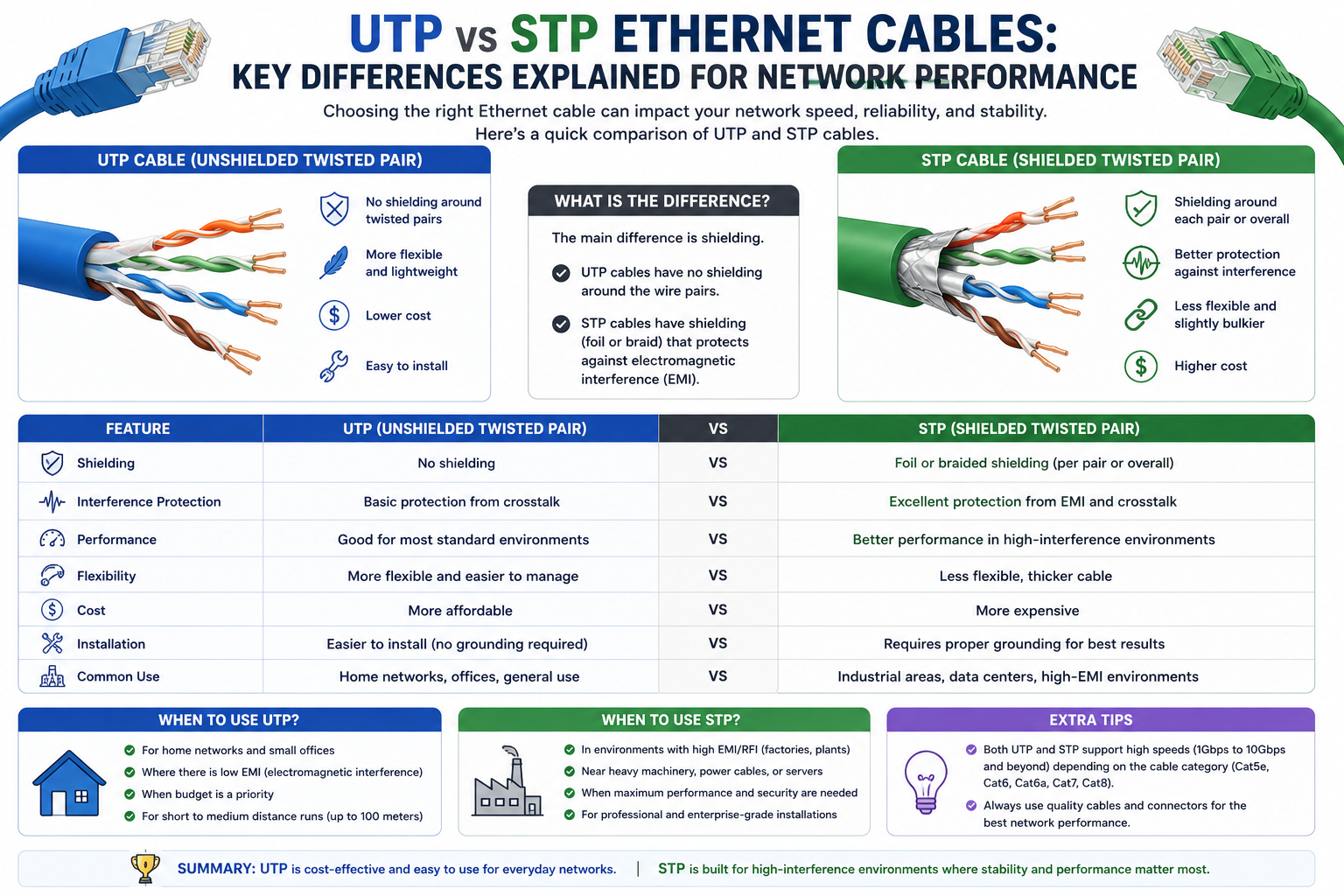
In modern networking, Ethernet cables remain one of the most essential components for establishing reliable wired communication between devices. Whether in homes, offices, industrial environments, or large-scale data centers, structured cabling forms the backbone of data transmission. Among the most commonly used cable types are Unshielded Twisted Pair (UTP) and Shielded Twisted Pair (STP) cables. While both serve the same fundamental purpose—transmitting data through twisted copper wires—their construction, performance characteristics, and ideal use cases differ significantly.
At a basic level, both UTP and STP cables consist of pairs of copper wires twisted together. This twisting helps reduce electromagnetic interference and crosstalk, ensuring that signals remain clean and stable during transmission. However, the key difference lies in the presence or absence of additional shielding. UTP cables rely solely on the twisting of wires and external insulation, while STP cables include an extra layer of metallic shielding designed to protect against external interference.
Understanding these differences is important because the choice between UTP and STP can directly affect network performance, cost, installation complexity, and long-term reliability. In environments where interference is minimal, a simpler and more cost-effective UTP cable may be sufficient. On the other hand, in environments filled with electrical noise—such as factories or server-heavy infrastructures—STP cables may be necessary to maintain signal integrity.
As networks continue to evolve with higher speeds and greater data demands, selecting the correct cable type has become more critical than ever. A poorly chosen cable can result in packet loss, reduced speeds, and inconsistent connectivity, while the right choice ensures stable and efficient communication across all connected devices.
Understanding Unshielded Twisted Pair (UTP) Cables
Unshielded Twisted Pair cables are the most widely used Ethernet cables in the world, primarily due to their affordability, flexibility, and ease of installation. As the name suggests, UTP cables do not include any metallic shielding around the wire pairs. Instead, they rely on the physical twisting of copper wire pairs to minimize electromagnetic interference and crosstalk.
The twisting pattern is carefully designed so that each pair of wires carries signals in opposite directions, which helps cancel out external noise. This simple yet effective design is one of the reasons UTP cables have become the standard choice for residential and office networking.
UTP cables are categorized into different performance classes, commonly known as categories or “Cat” ratings. These categories determine the cable’s speed, frequency range, and maximum transmission distance. Lower categories such as Cat5e are suitable for basic gigabit connections, while higher categories like Cat6 and Cat6a support faster speeds and improved resistance to interference.
One of the major advantages of UTP cables is their flexibility. Because they lack additional shielding layers, they are thinner, lighter, and easier to bend compared to shielded alternatives. This makes them particularly useful for installations in tight spaces, such as office walls, ceiling conduits, and desktop setups. Their ease of handling also reduces installation time and labor costs.
Another benefit is cost-effectiveness. UTP cables are generally cheaper to produce and purchase, making them ideal for large-scale deployments where budget constraints are important. The connectors used with UTP cables are also simple and widely available, contributing to their overall affordability.
However, UTP cables do have limitations. Their lack of shielding makes them more vulnerable to electromagnetic interference, especially in environments with heavy electrical equipment or long cable runs. This can result in signal degradation, reduced performance, or data loss. For this reason, UTP cables are best suited for environments where interference is minimal, such as homes, small offices, and standard business networks.
Despite these limitations, UTP cables remain the foundation of most modern Ethernet networks due to their balance of performance, simplicity, and cost efficiency.
Understanding Shielded Twisted Pair (STP) Cables
Shielded Twisted Pair cables are designed to overcome one of the main weaknesses of UTP cables: susceptibility to electromagnetic interference. STP cables include an additional protective layer, typically made of foil or braided metal, that surrounds the twisted wire pairs. This shielding acts as a barrier, preventing external electrical noise from disrupting the signal transmission.
There are different types of shielding used in STP cables. Some designs use individual shielding around each pair of wires, while others use a single shield that covers all pairs inside the cable. In more advanced configurations, both methods are combined for maximum protection. This layered shielding significantly reduces crosstalk and improves signal stability, especially in electrically noisy environments.
The primary advantage of STP cables is their ability to maintain data integrity in challenging conditions. In environments where large machinery, power lines, or radio frequency interference is present, STP cables help ensure that network communication remains stable and reliable. This makes them particularly useful in industrial settings, manufacturing plants, and high-density server environments.
Another advantage is improved performance over longer distances in high-interference environments. While both UTP and STP cables are subject to signal degradation over distance, STP cables are better equipped to maintain consistent performance when external noise is a factor.
However, these benefits come with trade-offs. STP cables are generally more expensive than UTP cables due to their additional materials and complex construction. They are also thicker and less flexible, which can make installation more difficult, especially in tight or complex routing environments.
Proper grounding is another critical requirement for STP cables. Without correct grounding, the shielding can actually become ineffective or even introduce new interference issues. This means installation must be done carefully and often requires more technical expertise.
Despite these challenges, STP cables are indispensable in environments where network reliability is critical and interference levels are high.
Key Differences Between UTP and STP Cables
Although UTP and STP cables serve the same fundamental purpose, their differences become clear when examining performance, cost, installation, and application environments.
The most significant difference is shielding. UTP cables rely solely on twisted wire pairs and insulation to reduce interference, while STP cables include additional metallic shielding for enhanced protection. This makes STP cables more suitable for environments with high electromagnetic activity.
Cost is another important distinction. UTP cables are more affordable and widely available, making them the preferred choice for most general-purpose networking setups. STP cables, on the other hand, are more expensive due to their additional materials and manufacturing complexity.
Installation complexity also varies. UTP cables are easier to install because they are lighter, thinner, and more flexible. STP cables require more careful handling and proper grounding, which increases installation time and technical requirements.
Performance differences are largely dependent on the environment. In low-interference settings, both cable types perform similarly. However, in high-interference environments, STP cables provide more stable and reliable performance by reducing noise and signal degradation.
Choosing Between UTP and STP in Real-World Applications
Selecting the right Ethernet cable requires a clear understanding of the environment and performance expectations. In most residential and small office setups, UTP cables are more than sufficient. They provide reliable connectivity for internet browsing, streaming, file sharing, and general networking needs without adding unnecessary cost or complexity.
In corporate environments, UTP cables are also commonly used for desktop connections, office workstations, and standard network infrastructure. Their flexibility and low cost make them ideal for large-scale installations where hundreds or thousands of connections are required.
However, in environments where electrical interference is present, STP cables become more important. Industrial facilities, manufacturing plants, and data centers often contain equipment that generates significant electromagnetic noise. In such cases, STP cables help ensure that network communication remains stable and unaffected by external disruptions.
High-performance server environments may also benefit from STP cabling, especially when dealing with high-speed data transfer over longer distances. The additional shielding helps maintain signal quality and reduces the risk of data corruption.
It is also common for networks to use a combination of both cable types. For example, UTP may be used for internal office connections, while STP is deployed for critical backbone links or areas with high interference.
The decision ultimately depends on a careful assessment of cost, environment, and performance needs. Understanding where each cable type excels allows for more efficient and reliable network design.
Conclusion
UTP and STP Ethernet cables each play a vital role in modern networking, offering distinct advantages depending on the environment in which they are used. UTP cables provide a cost-effective, flexible, and easy-to-install solution that is well-suited for most home and office networks. Their simplicity and wide availability make them the default choice for general networking needs where electromagnetic interference is minimal.
STP cables, on the other hand, are designed for more demanding environments where external interference can significantly impact network performance. Their additional shielding provides stronger protection against noise, making them ideal for industrial settings, data centers, and high-interference areas. While they are more expensive and require careful installation, their ability to maintain stable and reliable connections in challenging conditions makes them essential for mission-critical systems.
Choosing between UTP and STP is not about determining which is universally better, but rather about selecting the right tool for the right environment. A well-designed network often uses both types strategically to balance performance, cost, and reliability. By understanding the strengths and limitations of each cable type, network designers and users can build more efficient, stable, and future-ready communication systems.