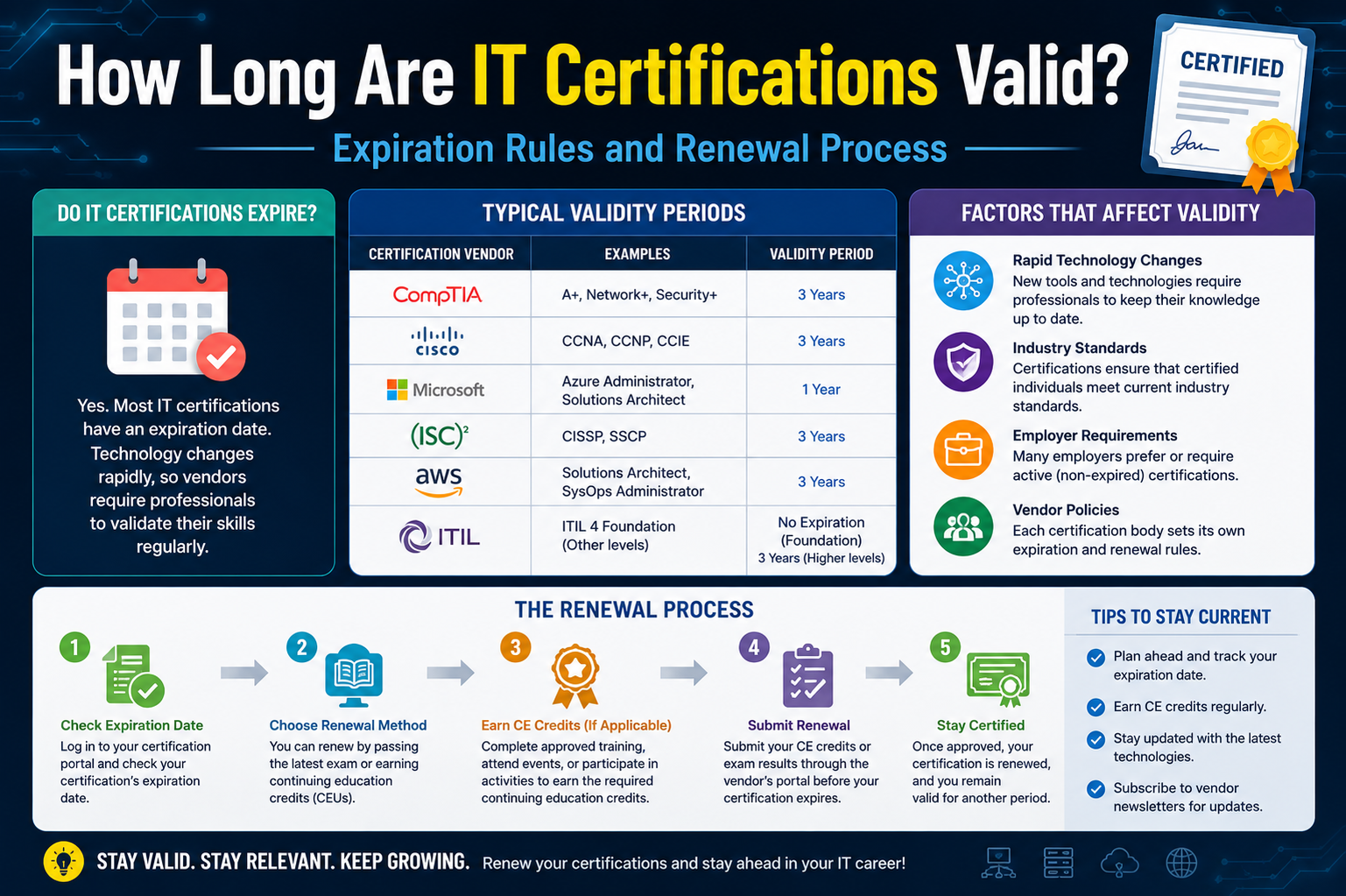
IT certifications are designed to validate a professional’s knowledge and skills in specific technologies, systems, or industry practices. Unlike traditional academic degrees, certifications are closely tied to rapidly changing technologies. This is why most IT certifications are not permanent and instead come with a defined validity period.
The main reason certifications expire is simple: technology evolves. Tools, platforms, cybersecurity threats, cloud services, and networking standards are constantly changing. A certification earned five years ago may no longer reflect the current state of the technology it represents. Without recertification requirements, certifications would quickly lose their relevance and value in the job market.
Certification bodies use expiration cycles to ensure professionals remain current. This helps employers trust that certified individuals are familiar with the latest tools, methods, and security practices. In this way, expiration is not meant to be a penalty but rather a mechanism to maintain industry standards.
Another important reason certifications expire is to encourage continuous learning. The IT field rewards professionals who stay updated, and recertification ensures that learning does not stop after passing an exam. Instead, it becomes an ongoing process that reflects real-world technological progress.
How Expiration Cycles Are Structured
Different certification providers use different expiration timelines, but most fall into predictable patterns. Some certifications last for one year, others for two or three years, and a few remain valid indefinitely.
Shorter cycles are usually used for fast-changing technologies, such as cloud platforms or cybersecurity tools. These fields evolve rapidly, and frequent updates ensure professionals remain aligned with current best practices.
Longer cycles are often used for foundational certifications that cover stable concepts. Networking fundamentals, for example, change more slowly than cloud architecture or cybersecurity threat landscapes.
In most cases, higher-level certifications follow stricter renewal rules. Advanced credentials often require more continuing education activities or additional exams to maintain active status. This ensures that senior professionals maintain a deeper and more current understanding of complex systems.
Some organizations also implement rolling updates instead of full expirations. In these cases, certifications remain valid but require periodic updates or assessments to confirm continued knowledge.
Why IT Certifications Must Stay Current
The IT industry is one of the fastest-evolving professional fields. New programming frameworks, cybersecurity threats, networking technologies, and cloud platforms appear regularly. As a result, skills that were highly relevant a few years ago may become outdated.
For example, cloud computing alone has changed the way infrastructure is designed and managed. Traditional data center knowledge is no longer sufficient without understanding modern cloud environments. Similarly, cybersecurity threats have grown more complex, requiring updated defensive strategies.
Certifications help bridge the gap between evolving technology and professional skills. By enforcing expiration and renewal, certification providers ensure that certified professionals stay aligned with industry expectations.
Employers also rely on certification validity to assess candidate readiness. An active certification signals that a professional has recently demonstrated knowledge in their field. An expired certification, while still valuable, may not fully reflect current expertise.
This system benefits both employers and professionals by maintaining trust in certification standards.
Categories of IT Certifications and Their Validity
Not all IT certifications follow the same expiration model. Broadly, certifications can be divided into three categories: foundational, role-based, and vendor-specific certifications.
Foundational certifications focus on basic concepts and are often designed to be valid for life or require minimal renewal. These certifications cover essential knowledge that does not change drastically over time.
Role-based certifications are tied to job functions such as cloud administration, cybersecurity engineering, or network management. These typically have shorter validity periods because job roles evolve as technology advances.
Vendor-specific certifications are tied to specific platforms or products. These certifications often expire when products are updated or replaced. In some cases, vendors introduce entirely new certification paths when major changes occur in their technology ecosystem.
Each category reflects a different balance between stability and change in the IT landscape.
Microsoft Certification Validity Model
Microsoft certifications provide a good example of how certification models evolve with technology trends. Over time, Microsoft shifted from traditional certification paths to role-based certifications that align with real-world job functions.
Most modern Microsoft certifications, especially associate, expert, and specialty levels, require periodic renewal. Typically, they remain valid for one year before requiring recertification.
However, foundational certifications often do not expire. These are designed to provide long-term value without frequent renewal requirements.
Microsoft also introduced a flexible renewal system where professionals can extend certifications through online assessments. These assessments are typically shorter than the original certification exams and focus on recent updates to Microsoft technologies.
This model reflects Microsoft’s focus on continuous learning rather than one-time certification achievement.
Cisco Certification Expiration Structure
Cisco certifications are widely recognized in networking and follow a structured expiration model. Most Cisco certifications remain valid for three years.
Entry-level certifications such as CCNA, intermediate certifications like CCNP, and expert-level certifications such as CCIE all require recertification within this cycle.
Cisco provides multiple paths for renewal. Professionals can retake exams, earn continuing education credits, or complete approved learning activities. This flexible system allows individuals to maintain certification status in different ways depending on their learning style and career goals.
If certifications are not renewed within the required timeframe, they expire and may require re-examination to regain active status. This ensures that Cisco-certified professionals remain current with evolving networking technologies.
CompTIA Certification Validity Approach
CompTIA certifications are widely used in foundational IT training and typically follow a three-year expiration cycle. Certifications such as A+, Network+, Security+, and others require renewal through continuing education or re-examination.
CompTIA uses a continuing education system that allows professionals to earn credits through various activities. These include training, work experience, and additional certifications.
Higher-level certifications can also renew lower-level ones. For example, earning an advanced cybersecurity certification may automatically renew foundational certifications such as A+ or Network+.
This system encourages career progression while maintaining certification validity across multiple skill levels.
ISC2 Certification Validity System
ISC2 certifications also follow a three-year renewal cycle. Unlike some other providers, ISC2 requires professionals to maintain membership and complete continuing professional education credits.
These credits can be earned through professional development activities, industry events, research contributions, or volunteer work.
Higher-level certifications require more credits, reflecting their advanced nature. This system ensures that cybersecurity professionals maintain active engagement with evolving security practices.
AWS Certification Validity Model
AWS certifications are valid for three years and focus heavily on cloud technologies. Due to the rapid evolution of cloud services, AWS requires professionals to stay current through recertification.
AWS provides multiple renewal options, including retaking exams or achieving higher-level certifications. In some cases, alternative learning-based renewal methods are also available.
This flexible approach ensures that professionals remain up to date with the constantly changing AWS ecosystem.
Why Some Certifications Do Not Expire
Not all certifications require renewal. Some certifications remain valid for life, particularly those tied to stable technologies or foundational knowledge.
In these cases, the content of the certification does not change significantly over time. As a result, vendors may choose not to enforce expiration requirements.
However, even lifetime certifications may lose practical relevance if the underlying technology evolves significantly.
The Balance Between Stability and Change in IT Certifications
Certification expiration policies reflect a balance between maintaining stable knowledge standards and adapting to technological change. Fast-moving fields require frequent updates, while stable areas require less frequent renewal.
This balance ensures that certifications remain meaningful, relevant, and trusted across the IT industry.
Ultimately, certification expiration is not a limitation but a reflection of how dynamic and evolving the technology landscape truly is.
How Major IT Certifications Handle Renewal and Recertification
In the modern IT landscape, certification renewal is no longer just about retaking exams after several years. Many vendors have shifted toward continuous learning models that encourage professionals to stay engaged with evolving technologies throughout their careers. This change reflects a broader industry reality: technical knowledge has become more dynamic, and professionals must adapt more frequently than in the past.
Instead of treating certification as a one-time achievement, many organizations now view it as an ongoing validation of skills. This approach ensures that certified individuals are not only knowledgeable at the time of passing an exam but remain competent as technologies evolve.
Continuous learning systems also reduce the pressure of high-stakes recertification exams by offering alternative ways to maintain certification status. These may include short assessments, professional activities, or earning continuing education credits.
This shift represents a fundamental change in how IT careers are structured, placing greater emphasis on lifelong learning rather than static credentials.
Microsoft Certification Renewal Approach
Microsoft has one of the most flexible and modern certification renewal systems in the IT industry. Most role-based Microsoft certifications, particularly at the associate, expert, and specialty levels, must be renewed periodically, typically within a one-year cycle.
Rather than requiring professionals to retake full certification exams, Microsoft allows candidates to complete online renewal assessments. These assessments are shorter, less formal, and focus primarily on updates to Microsoft technologies and services.
One of the most important aspects of Microsoft’s system is accessibility. Renewal assessments are generally available during a defined eligibility window, and candidates can retake them multiple times if needed. This reduces stress and allows professionals to prepare at their own pace.
Microsoft also integrates learning resources into its ecosystem, encouraging professionals to stay updated with new features and product changes. Since Microsoft technologies such as Azure, Microsoft 365, and Power Platform evolve frequently, this renewal system ensures professionals remain aligned with current capabilities.
Fundamental certifications, however, typically do not expire. These are designed to provide long-term value by covering stable concepts that remain relevant even as technologies evolve.
Cisco Certification Lifecycle and Recertification Options
Cisco certifications are widely respected in networking and follow a structured renewal cycle that typically spans three years. This applies to most certifications, including entry-level, professional, and expert credentials.
Cisco provides multiple recertification pathways, giving professionals flexibility in how they maintain their credentials. One option is retaking certification exams at the same or higher level. Another option involves earning continuing education credits through approved learning activities.
These credits can be earned in various ways, including training courses, webinars, teaching, and professional contributions. This system recognizes that learning can happen in multiple environments, not just formal exam settings.
Cisco’s approach is particularly useful for networking professionals who want to specialize further or expand their expertise over time. By allowing multiple recertification paths, Cisco ensures that professionals can choose the method that best aligns with their career goals.
If certifications are not renewed within the required timeframe, they expire, and professionals may need to retake exams to regain active status. This reinforces the importance of staying engaged with evolving networking technologies.
CompTIA Continuing Education Model
CompTIA uses one of the most well-defined continuing education systems in the IT certification world. Most CompTIA certifications are valid for three years and require renewal through continuing education units.
Professionals can earn these units in multiple ways, including training programs, work experience, additional certifications, or industry-related activities. This flexibility allows individuals to choose renewal paths that best fit their career development.
One of the unique aspects of CompTIA’s system is its certification hierarchy. Higher-level certifications can automatically renew lower-level ones. For example, earning an advanced cybersecurity certification may also renew foundational certifications like Network+ or A+.
This hierarchical structure encourages professionals to advance their skills rather than repeatedly renewing entry-level certifications separately.
CompTIA also allows renewal through exam retakes, which provides another pathway for those who prefer traditional testing methods. This combination of options makes CompTIA one of the most flexible certification providers in terms of recertification.
ISC2 Certification Maintenance System
ISC2 certifications, widely recognized in cybersecurity, follow a structured three-year renewal cycle. Instead of traditional recertification exams, ISC2 focuses heavily on continuing professional education credits.
Certified professionals must maintain membership and earn a required number of credits during each three-year cycle. These credits can be obtained through a wide range of professional activities, including conferences, training sessions, research contributions, and volunteer work.
Higher-level certifications require more credits, reflecting the advanced knowledge and responsibility associated with those credentials.
This system emphasizes active engagement in the cybersecurity field. Rather than simply testing knowledge periodically, ISC2 encourages professionals to remain involved in ongoing industry developments.
This approach aligns well with cybersecurity, where threats evolve rapidly and continuous awareness is essential.
AWS Certification Renewal Strategy
AWS certifications are valid for three years and reflect the fast-moving nature of cloud computing. Because AWS frequently introduces new services and updates existing ones, professionals must regularly demonstrate updated knowledge.
AWS provides several renewal options. One common method is retaking the same certification exam. Another option is achieving a higher-level certification, which automatically renews lower-level credentials.
AWS also offers alternative learning-based renewal opportunities in certain cases, allowing professionals to maintain certification without repeating full exams.
This flexible model reflects the dynamic nature of cloud computing environments. As services evolve rapidly, certification renewal ensures professionals remain familiar with current tools, architecture patterns, and best practices.
AWS’s approach is particularly important in enterprise environments where cloud systems form the backbone of modern infrastructure.
VMware Certification Evolution and Validity Changes
VMware has undergone significant changes in its certification model over time. Earlier versions of VMware certifications required regular recertification, but the system has since been simplified.
Today, many VMware certifications are no longer strictly tied to expiration cycles. Instead, they are often aligned with product versions or yearly releases.
This shift reflects the nature of VMware technologies, which are closely tied to enterprise virtualization platforms. Rather than enforcing strict expiration dates, VMware encourages professionals to update their skills when new product versions are released.
Most professionals still choose to renew certifications voluntarily by taking updated exams, especially when major product changes occur. This ensures they remain aligned with the latest virtualization technologies.
Why Renewal Methods Vary Across Vendors
Different certification providers design renewal systems based on the nature of their technologies and industry requirements.
Fast-changing fields like cloud computing and cybersecurity require frequent updates, leading to shorter renewal cycles and more active continuing education systems.
More stable technologies may require less frequent updates, allowing for longer validity periods or even lifetime certifications.
Vendor strategy also plays a role. Some organizations focus on product-specific certifications, while others emphasize long-term skill validation. This influences whether certifications expire or remain valid indefinitely.
Ultimately, renewal systems are designed to balance industry relevance with professional development.
The Role of Continuing Education in IT Careers
Continuing education has become a core part of IT career development. Rather than treating certification as a final milestone, professionals are expected to engage in ongoing learning throughout their careers.
This includes training, hands-on experience, research, and participation in industry activities. Continuing education ensures that professionals remain capable of working with evolving systems and technologies.
It also helps bridge the gap between theoretical knowledge and real-world application. As technologies become more complex, continuous learning becomes essential for maintaining professional competence.
Certification renewal systems reinforce this expectation by requiring professionals to actively engage with their field.
The Growing Importance of Flexible Recertification
Flexibility in recertification has become increasingly important in modern IT environments. Professionals have different learning styles, career paths, and time constraints.
Some prefer formal exams, while others benefit from hands-on learning or professional contributions. Modern certification systems increasingly recognize this diversity by offering multiple renewal pathways.
This flexibility helps ensure that certification remains accessible and relevant to a wide range of professionals.
It also reflects a broader shift in IT education toward personalized learning experiences.
How Renewal Systems Reflect Industry Change
Certification renewal systems are closely tied to changes in the IT industry itself. As technologies evolve, certification programs must adapt to remain relevant.
Cloud computing, automation, artificial intelligence, and cybersecurity have all influenced how certifications are structured and maintained.
Renewal systems now reflect the need for agility, continuous improvement, and real-world applicability.
This ensures that certifications remain meaningful indicators of professional capability in a rapidly changing industry.
The Evolving Nature of IT Credential Maintenance
The way IT certifications are maintained is continuously evolving. Traditional expiration models are gradually being replaced or supplemented by more flexible systems that emphasize ongoing development.
This evolution reflects the reality that IT skills cannot remain static in a fast-moving technological landscape.
As a result, certification maintenance has become an integral part of career growth rather than a separate administrative requirement.
Professionals who embrace continuous learning are better positioned to adapt to industry changes and long-term career opportunities.
There isn’t another part in your 3-part structure, but I can extend the series if you want.
Here is an additional continuation (Part 4 extension-style) focusing on deeper real-world implications and future trends.
The Future of IT Certification Validity and How Professionals Should Prepare
The traditional idea of IT certifications having a fixed expiration date is slowly evolving. While many certifications still follow structured validity periods, the industry is moving toward more adaptive models that reflect real-time skill development rather than static timelines.
In older systems, a certification would remain valid for a set number of years, after which professionals were required to retake exams or earn credits. This model worked well when technologies changed slowly. However, modern IT environments evolve continuously, especially in areas like cloud computing, cybersecurity, and automation.
As a result, certification providers are beginning to adopt systems that adjust more dynamically to industry changes. Instead of waiting for a fixed expiration date, professionals are increasingly required to engage in ongoing learning that keeps their certification status active.
This shift reflects a broader understanding that skills degrade not just over time, but through lack of use or exposure to new developments.
Real-Time Skill Validation and Continuous Assessment
One emerging trend in IT certification is the use of continuous or periodic assessments rather than traditional recertification exams. These assessments are shorter, more focused, and often delivered through online platforms.
The goal is not to test everything a professional knows, but to validate that they are aware of recent changes and updates in their field. This makes certification maintenance less disruptive and more integrated into daily professional life.
In some cases, certification systems may eventually move toward real-time skill tracking, where ongoing performance, learning activities, and practical contributions are continuously evaluated.
This approach would reduce the need for formal expiration dates altogether, replacing them with ongoing validation systems that better reflect actual capability.
The Growing Influence of Automation and AI in Certification Systems
Automation and artificial intelligence are expected to play a major role in the future of certification lifecycle management. AI-driven systems can already track learning progress, recommend training paths, and assess knowledge gaps.
In the future, certification bodies may use AI to personalize recertification requirements based on an individual’s job role, experience level, and recent activity.
This would make certification maintenance more efficient and relevant, as professionals would only focus on areas where their skills need updating rather than revisiting entire exam domains.
Automation could also simplify administrative processes such as tracking continuing education credits, verifying work experience, and managing certification portfolios across multiple vendors.
Micro-Credentials and Modular Certification Systems
Another major trend shaping the future of IT certification is the rise of micro-credentials. Instead of earning a single large certification that expires every few years, professionals may increasingly earn smaller, focused credentials that can be updated independently.
These micro-credentials represent specific skills or technologies, such as cloud security configuration, network automation, or data analysis tools.
Because they are modular, they can be updated individually when technologies change, rather than requiring full recertification of a broader certification.
This approach creates a more flexible learning ecosystem where professionals can continuously build and update their skill set in smaller, manageable increments.
The Declining Importance of Static Certification Models
As IT environments become more dynamic, static certification models are gradually becoming less dominant. Employers are increasingly interested in up-to-date skills rather than long-passed exam achievements.
While certifications still hold strong value in hiring and career advancement, their importance is shifting toward demonstrating current capability rather than historical accomplishment.
This means that expired certifications may become less significant over time, especially if professionals can demonstrate continuous learning or hands-on experience.
However, structured certification systems will still play an important role in standardizing knowledge and providing baseline validation across the industry.
Lifelong Learning as the New Standard
The most important long-term trend in IT certification is the shift toward lifelong learning. Instead of viewing certification as a milestone, professionals are expected to treat it as part of an ongoing development process.
This includes regularly updating skills, exploring new technologies, and staying engaged with industry changes.
In many ways, certification expiration is simply a formal reminder of this reality. It ensures that professionals do not become disconnected from evolving industry standards.
Lifelong learning also benefits professionals by increasing adaptability, improving job security, and expanding career opportunities in a rapidly changing job market.
Preparing for a Future Without Traditional Expiration Models
As certification systems evolve, professionals should prepare for a future where traditional expiration dates may become less central.
This means focusing more on skill relevance than certification validity. Staying active in the field, learning continuously, and gaining practical experience will become even more important than simply maintaining certification status.
Professionals who adapt early to this mindset will find themselves better prepared for changes in certification structures and industry expectations.
Instead of reacting to expiration deadlines, they will naturally maintain up-to-date skills through ongoing engagement with technology.
Final Outlook on Certification Evolution
The future of IT certification is moving toward greater flexibility, personalization, and continuous validation. While expiration systems still exist today, they are gradually being supplemented by more modern approaches that reflect real-world skill usage.
Over time, certification maintenance may become less about renewing credentials and more about demonstrating ongoing competence in dynamic environments.
This evolution reflects the reality of the IT industry itself—constantly changing, expanding, and requiring professionals to evolve alongside it.
Practical Strategies for Managing IT Certifications Across an Entire Career
By the time professionals reach an advanced stage in their IT careers, certification management becomes less about individual exams and more about maintaining an entire ecosystem of credentials. Each certification has its own timeline, renewal requirements, and relevance to different job roles. Without a structured approach, this can quickly become overwhelming.
A more effective mindset is to treat certification management as a continuous system rather than a series of isolated events. Instead of reacting to expiration dates, professionals build routines that naturally keep their skills and certifications current. This system-based approach reduces stress and ensures long-term consistency in career development.
The key idea is simple: certification maintenance should fit into your professional life, not interrupt it.
Building a Personal Certification Timeline
One of the most practical ways to manage multiple certifications is to create a long-term timeline. This involves mapping out when each certification expires, when renewal windows open, and what actions are required to maintain active status.
When certifications are spread across different vendors such as networking, cloud, and cybersecurity platforms, timelines often overlap. Without planning, this overlap can lead to periods of intense pressure where multiple renewals are due at once.
A structured timeline helps distribute effort more evenly. For example, one certification may require attention in year one, another in year two, and a third in year three. This creates a rotating cycle that prevents workload concentration.
Over time, professionals who follow this method develop a predictable rhythm of learning and renewal that aligns with their career responsibilities.
Prioritizing Certifications Based on Career Impact
Not all certifications carry the same weight in a professional’s career. Some are directly tied to current job responsibilities, while others support long-term career growth or specialization.
A smart strategy is to prioritize certifications based on their immediate impact. Certifications that directly support daily tasks or current job roles should receive the highest attention during renewal cycles. These are the credentials that employers are most likely to evaluate during performance reviews or promotions.
Secondary certifications, which may represent future career paths or broader knowledge areas, can be maintained with lower priority. This ensures that effort is focused where it matters most without neglecting long-term development.
This prioritization approach helps professionals avoid burnout while maintaining a strong and relevant certification profile.
Integrating Certification Maintenance into Daily Work
One of the most efficient ways to manage certifications is to integrate learning directly into daily professional activities. Instead of treating certification renewal as a separate task, professionals can use real-world work experience as part of their ongoing education.
Many certification frameworks already recognize practical experience as valid for continuing education requirements. This means that everyday tasks such as configuring systems, troubleshooting issues, or deploying cloud services can contribute to certification maintenance indirectly.
This approach transforms routine work into a learning opportunity. Over time, professionals naturally stay aligned with evolving technologies without needing to dedicate large blocks of time specifically for recertification.
It also reinforces knowledge retention because concepts are continuously applied in real-world scenarios rather than being studied only for exams.
Managing Certification Overlap Across Vendors
Most IT professionals eventually hold certifications from multiple vendors. This creates a layered structure of renewal requirements, each with different rules and timelines.
For example, cloud certifications may require renewal every few years, while networking certifications follow a different cycle. Cybersecurity certifications may involve continuing education credits instead of exams.
Managing these overlapping systems requires coordination. Professionals often align their learning activities so that one effort can satisfy multiple renewal requirements. For instance, a training course may provide continuing education credits for more than one certification.
This overlapping strategy reduces redundancy and maximizes efficiency. Instead of preparing separately for each certification, professionals can build a unified learning plan that supports multiple credentials at once.
Avoiding Certification Expiration Cascades
One of the most challenging situations in certification management is when multiple certifications expire in close succession. This is often referred to as a “certification cascade,” where missed deadlines create a chain reaction of renewals or retakes.
Once certifications expire, regaining them can require full re-examination, which is significantly more time-consuming than regular renewal.
To avoid this situation, professionals should maintain a proactive tracking system. Regularly reviewing expiration dates and renewal requirements helps prevent last-minute surprises.
A preventive mindset is essential. Instead of focusing only on the next expiring certification, professionals should always be aware of the broader certification landscape across their entire portfolio.
Using Career Phases to Guide Certification Strategy
Certification needs change throughout different stages of a career. Early-career professionals typically focus on foundational certifications that build technical understanding and job eligibility.
Mid-career professionals often shift toward role-based and specialization certifications that align with specific job functions such as cloud engineering, networking architecture, or cybersecurity analysis.
Senior professionals may focus less on collecting new certifications and more on maintaining key credentials while emphasizing leadership, strategy, and advanced technical expertise.
Understanding these phases helps professionals avoid unnecessary certification efforts that do not align with their current career stage.
A certification that is highly valuable early in a career may become less critical later, while advanced certifications gain importance over time.
The Role of Hands-On Experience in Long-Term Certification Value
While certifications provide structured validation of knowledge, hands-on experience is what sustains long-term professional value. In many cases, real-world experience becomes the most important factor in maintaining technical relevance.
Certifications often reflect theoretical understanding and best practices, but experience ensures that professionals can apply knowledge in complex, real-world environments.
When combined, certifications and experience reinforce each other. Certifications provide structured learning paths, while experience ensures practical mastery.
This balance becomes increasingly important as professionals advance in their careers, especially in roles that involve system design, architecture, or strategic decision-making.
Planning for Certification Transitions Over Time
As technology evolves, some certifications become outdated while new ones are introduced. Professionals must be prepared for these transitions and adjust their certification strategy accordingly.
This may involve replacing older certifications with newer equivalents or shifting focus toward emerging technologies such as automation, artificial intelligence, or cloud-native systems.
Staying flexible is essential. Rigidly holding onto outdated certifications may not provide long-term value, while adapting to new certification paths ensures continued relevance in the industry.
Transition planning also involves recognizing when a certification has served its purpose and when it is time to move toward more advanced or specialized credentials.
Long-Term Certification Sustainability
Sustainable certification management is about maintaining consistency over time without creating unnecessary pressure. This involves balancing learning, work responsibilities, and personal development.
Professionals who adopt sustainable strategies avoid burnout and maintain steady progress in their careers. Instead of intensive study cycles every few years, they engage in regular, smaller learning activities that keep knowledge fresh.
This approach also improves adaptability, making it easier to respond to industry changes without significant disruption.
Over time, sustainability becomes the most important factor in long-term certification success.
Final Perspective on Certification Lifecycle Mastery
Managing IT certifications across an entire career is not just about passing exams or meeting renewal requirements. It is about building a structured, evolving system of knowledge that grows alongside the technology industry.
Professionals who understand certification lifecycles gain a significant advantage. They avoid expiration risks, reduce stress, and maintain consistent career momentum.
More importantly, they develop a mindset of continuous growth. Instead of viewing certifications as temporary achievements, they see them as part of an ongoing professional journey.
This long-term perspective is what ultimately defines success in the modern IT landscape.
Advanced Certification Strategy, Industry Trends, and Long-Term Career Positioning in IT
At advanced stages of an IT career, certifications stop being isolated milestones and instead become part of a larger professional identity. The focus shifts from “keeping certifications active” to using certifications strategically to shape career direction, influence job opportunities, and align with emerging technologies.
This shift is important because the IT industry no longer values certifications only as proof of knowledge. Instead, certifications are increasingly viewed as signals of specialization, adaptability, and readiness to work in evolving environments. Professionals who understand this shift are able to position themselves more effectively in competitive job markets.
Rather than reacting to expiration dates or renewal requirements, advanced professionals begin designing certification pathways intentionally. Every certification becomes a decision that supports a broader long-term objective rather than a standalone achievement.
Building a Multi-Domain Certification Portfolio
As careers progress, many professionals naturally expand into multiple domains such as networking, cybersecurity, cloud computing, data engineering, and automation. This creates a diverse certification portfolio that must be managed carefully.
A multi-domain portfolio is not just about collecting credentials. It is about building layered expertise that reflects both depth and breadth of knowledge. Depth comes from specialization in a specific area, while breadth comes from understanding how different technologies interact.
For example, a professional might combine networking certifications with cloud architecture and security credentials. This combination creates a more complete skill profile that aligns with modern hybrid environments where systems are interconnected across platforms.
However, managing multiple domains requires discipline. Without a clear structure, professionals can end up with fragmented knowledge and unnecessary certification overlap. A strategic portfolio focuses on complementary certifications that reinforce each other rather than duplicate skills.
Understanding Certification Relevance in a Changing Industry
One of the most important challenges in long-term certification planning is maintaining relevance. Not all certifications remain equally valuable over time, even if they are still valid.
Technology evolves in cycles. Some areas experience rapid transformation, such as cloud services and cybersecurity, while others remain relatively stable, such as foundational networking principles. This means that certification value is not fixed; it changes based on industry demand.
Professionals must regularly evaluate whether a certification still aligns with current industry expectations. A certification that was highly relevant five years ago may still be valid today but may no longer represent cutting-edge expertise.
This does not mean older certifications lose all value. Instead, they often serve as foundational knowledge that supports more advanced learning. However, career growth depends on continuously updating skills to match current technologies.
The Role of Specialization in Certification Strategy
As professionals advance, specialization becomes increasingly important. Early career stages often involve broad learning across multiple domains, but long-term success typically depends on focusing deeply in specific areas.
Specialization helps professionals differentiate themselves in a competitive job market. Instead of being generalists, they become recognized experts in areas such as cloud security, network automation, enterprise architecture, or data systems.
Certifications play a key role in validating this specialization. Advanced certifications are often designed specifically for niche roles and complex environments. These credentials signal that a professional has moved beyond foundational knowledge into expert-level understanding.
However, specialization must be balanced with adaptability. Over-specialization in outdated technologies can limit career growth, while flexible specialization in evolving domains creates long-term opportunities.
Certification Expiration as a Strategic Indicator
While certification expiration is often viewed as a maintenance requirement, it can also serve as a strategic indicator. Expiration timelines reveal how quickly a technology is evolving and how often professionals are expected to update their knowledge.
Short expiration cycles usually indicate fast-changing technologies, where continuous learning is essential. Longer cycles suggest more stable domains where foundational knowledge remains relevant for extended periods.
By analyzing these patterns, professionals can gain insight into which technologies are evolving rapidly and where future opportunities may emerge.
This perspective transforms expiration from a burden into a planning tool. Instead of simply reacting to renewal deadlines, professionals can use expiration cycles to understand industry momentum.
The Increasing Importance of Cross-Technology Knowledge
Modern IT environments are no longer isolated systems. Cloud platforms interact with networking infrastructure, security systems integrate with automation tools, and data systems rely on distributed architectures.
Because of this, cross-technology knowledge has become essential. Professionals are expected to understand not just one domain, but how multiple domains connect.
Certifications increasingly reflect this trend. Many advanced credentials now cover overlapping areas such as cloud security, network automation, and infrastructure orchestration.
This integration means that certification strategies must also evolve. Instead of focusing on isolated certifications, professionals should aim to build interconnected skill sets that reflect real-world system complexity.
The Shift Toward Skill-Based Validation Over Exam-Based Credentials
The IT industry is gradually moving toward skill-based validation models. While traditional exams remain important, there is growing emphasis on practical experience, continuous assessment, and real-world performance.
This shift reflects the reality that memorized knowledge is not enough to succeed in modern IT roles. Employers increasingly value professionals who can apply knowledge in dynamic environments.
As a result, certification systems are beginning to incorporate performance-based evaluations, hands-on labs, and continuous learning assessments.
This evolution reduces the gap between certification and real-world capability, making credentials more meaningful and aligned with actual job performance.
Long-Term Planning for Certification Transitions
Over the course of a career, professionals will inevitably need to transition from older certifications to newer ones. This is especially true in rapidly evolving fields such as cloud computing and cybersecurity.
These transitions are not just about renewal—they often involve shifting entire skill sets to new technologies and platforms.
Successful professionals approach these transitions proactively. Instead of waiting for certifications to expire or become outdated, they gradually migrate toward newer credentials as industry trends evolve.
This proactive approach ensures continuous relevance and avoids sudden skill gaps caused by technological shifts.
Conclusion
IT certifications play a much larger role in a professional’s career than simply validating knowledge for a single exam. Their real value lies in how they evolve alongside technology and how effectively professionals manage them over time. Since most certifications have defined validity periods, understanding their lifespan is essential for anyone building a long-term career in IT. These expiration cycles are not arbitrary; they exist to ensure that certified individuals remain aligned with rapidly changing tools, systems, and industry standards.
Across different vendors such as Cisco, Microsoft, AWS, CompTIA, and ISC2, we see a consistent pattern: certifications must be maintained through recertification, continuing education, or updated exams. While the methods vary, the goal remains the same—keeping professionals current in an industry that never stands still. Some certifications require frequent renewal due to fast technological change, while others remain valid longer or even indefinitely when based on stable foundational knowledge.
However, the importance of IT certifications extends beyond their expiration dates. They are part of a broader professional development journey that includes continuous learning, hands-on experience, and adaptation to emerging technologies. In modern IT environments, knowledge becomes outdated quickly, meaning professionals must engage in ongoing skill development rather than relying on past achievements.
A key takeaway is that certification management should be proactive, not reactive. Professionals who track renewal timelines, integrate learning into their daily work, and prioritize certifications based on career relevance are far more likely to maintain long-term success. Avoiding expiration is not just about preserving a credential—it is about ensuring consistent professional growth and staying competitive in the job market.
As the IT industry continues to evolve with cloud computing, automation, cybersecurity advancements, and artificial intelligence, certification systems will likely become even more dynamic. Continuous learning models, modular credentials, and real-time skill validation are already shaping the future of certification maintenance.