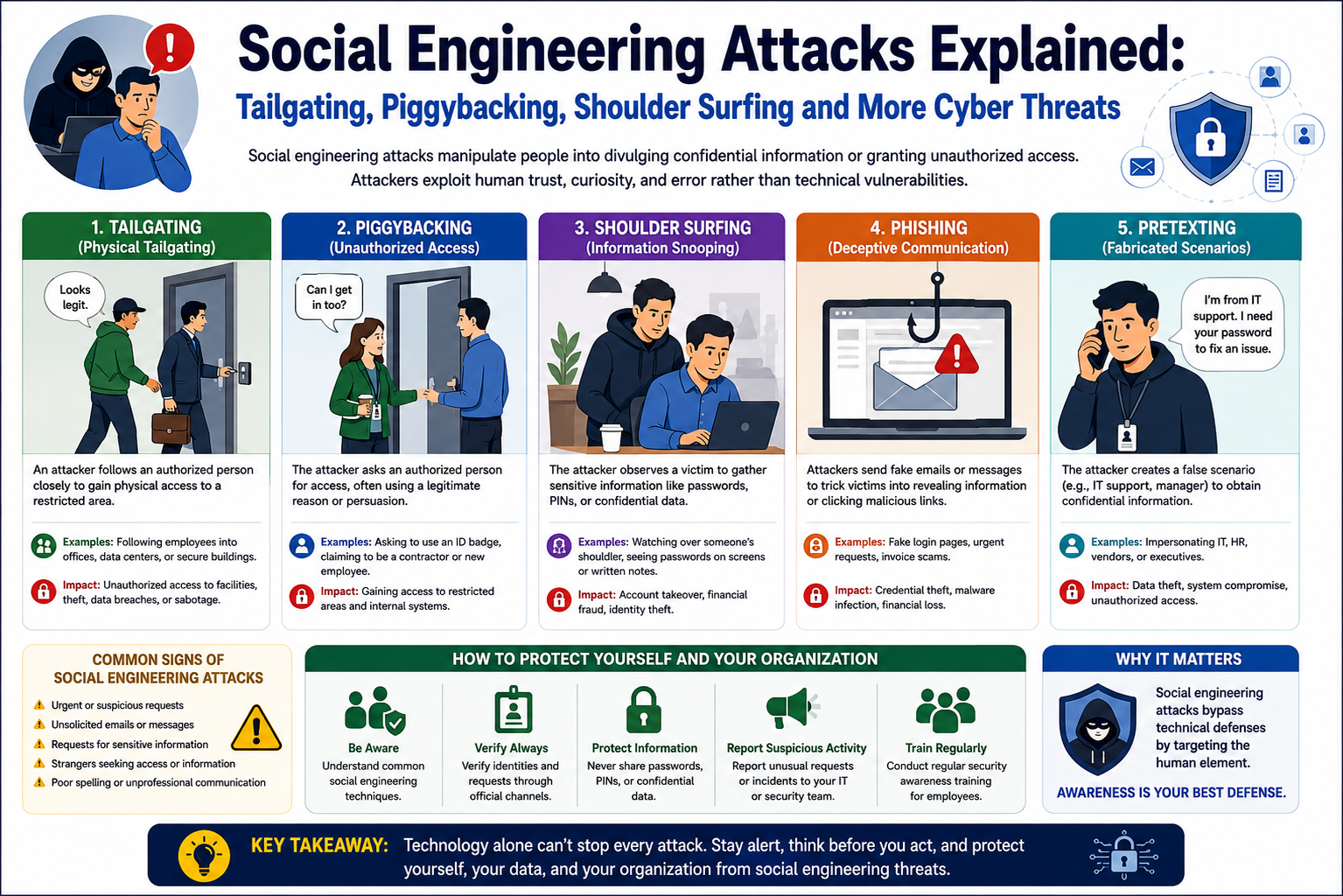
Social engineering attacks are among the most effective and dangerous forms of security threats in the modern digital and physical world because they do not rely on breaking complex encryption systems or exploiting software vulnerabilities. Instead, they target something far more unpredictable and harder to control, which is human behavior. Unlike traditional cyberattacks that focus on machines, code, or networks, social engineering focuses entirely on people, their emotions, their habits, and their natural tendency to trust others in everyday situations. This makes it a highly adaptable form of attack that can succeed even in environments with strong technical security systems.
At its core, social engineering is based on psychological manipulation. Attackers carefully design situations that influence how people think and act, often without the victim realizing that any manipulation is taking place. Instead of forcing access through technical means, attackers convince individuals to voluntarily provide access, share information, or overlook suspicious behavior. This approach is effective because it bypasses most security technologies entirely and directly targets the human decision-making process.
One of the main reasons social engineering is so successful is that humans are naturally social and cooperative beings. In most workplaces and public environments, people are trained and encouraged to be helpful, polite, and efficient. While these are positive traits in everyday life, they can become weaknesses in security situations. Attackers exploit these traits by presenting themselves in ways that appear familiar, trustworthy, or authoritative. When individuals feel comfortable or reassured by another person’s presence, they are more likely to lower their guard and allow access or share information without proper verification.
Another important factor that contributes to the success of social engineering attacks is routine behavior. In many environments, people follow predictable patterns. Employees enter buildings at specific times, use the same doors, follow similar workflows, and interact with familiar individuals on a daily basis. Attackers observe these patterns carefully and use them to blend into the environment. When behavior appears normal, it becomes difficult for security systems or individuals to detect anything unusual.
Social engineering attacks also rely heavily on emotional manipulation. Attackers often create situations that trigger urgency, fear, curiosity, or empathy. For example, they may pretend to be in a hurry, claim to be part of technical support, or act as if they are experiencing an emergency. These emotional triggers reduce the time a person takes to think critically, leading them to make quick decisions without proper verification. In many cases, the attacker’s goal is not to force action but to create psychological pressure that leads to voluntary cooperation.
In physical environments, social engineering becomes even more effective because it takes advantage of human interaction. Unlike digital systems, physical spaces involve face-to-face communication, shared spaces, and visual cues that can be manipulated. Attackers often use appearance, body language, and confidence to blend in. A person carrying documents, wearing professional clothing, or appearing busy is less likely to be questioned, even if they do not belong in the environment. This creates opportunities for attackers to move through secure areas without raising suspicion.
One of the most critical aspects of social engineering is that it does not require technical expertise. Unlike hacking methods that demand programming knowledge or system vulnerabilities, social engineering can be executed with simple observation and basic human interaction skills. This lowers the barrier to entry for attackers and makes these techniques widely accessible. As a result, social engineering is used not only by advanced threat actors but also by individuals with minimal technical background.
Another important characteristic of social engineering is its adaptability. Attackers can modify their approach based on the environment, the target, and the level of security present. In high-security environments, they may rely on impersonation or authority-based manipulation. In more casual environments, they may use friendliness, confusion, or assistance-seeking behavior. This flexibility allows social engineering to remain effective across different industries, locations, and organizational structures.
It is also important to understand that social engineering is rarely a single action. In most real-world scenarios, it is part of a larger attack strategy. Attackers may begin by gathering information through observation, then use physical methods such as tailgating or piggybacking to gain access to secure areas, and later exploit systems digitally once inside. This multi-step approach makes social engineering particularly dangerous because each stage builds upon the success of the previous one.
The human element in cybersecurity is often considered the weakest link, not because people are careless, but because they are naturally predictable in certain situations. Trust, politeness, curiosity, and routine behavior are all exploited by attackers. Even highly trained individuals can become vulnerable when placed under pressure or when faced with convincing scenarios. This is why social engineering remains one of the most persistent threats in both physical and digital security environments.
Another challenge in defending against social engineering is that it often does not trigger alarms or alerts. Traditional security systems are designed to detect unauthorized access, unusual network activity, or system anomalies. However, when a person willingly grants access or shares information, there is no technical violation for the system to detect. This makes prevention entirely dependent on human awareness and judgment.
Over time, attackers have refined their methods to become more subtle and convincing. They study human behavior, workplace culture, and organizational structure to improve their success rate. Instead of relying on force or speed, they rely on patience and timing. This makes social engineering a slow but highly effective method of attack.
In modern environments, where digital systems and physical spaces are deeply connected, the consequences of social engineering can be severe. A single successful interaction can lead to unauthorized access to sensitive data, internal systems, or secure facilities. Once inside, attackers can escalate their actions, moving from physical intrusion to digital compromise without being detected.
Understanding social engineering requires a shift in perspective. Security is not only about protecting systems but also about understanding human behavior and its limitations. The more predictable human actions are, the easier it becomes for attackers to design strategies around them. This is why awareness, education, and behavioral understanding are essential components of modern security.
As we move forward in this discussion, the next sections will explore specific physical social engineering techniques in detail, starting with one of the most common methods used in real-world environments: tailgating, where attackers exploit access control systems by following authorized individuals into secure areas without permission.
Tailgating and Piggybacking as Physical Social Engineering Attacks That Exploit Trust, Routine Behavior, and Human Courtesy
Tailgating and piggybacking are two of the most common physical social engineering techniques used by attackers to gain unauthorized access to secure environments. These methods do not depend on hacking systems or bypassing digital security controls. Instead, they exploit everyday human behavior, especially the natural tendency to trust others, be polite, and avoid confrontation. Because of this, they remain highly effective even in organizations that have strong physical security systems in place.
Tailgating refers to a situation where an unauthorized individual gains entry into a restricted area by closely following an authorized person without their knowledge or consent. The attacker does not need to interact directly with the victim. Instead, they rely on timing, observation, and proximity. In most cases, the victim unlocks a secure door using a badge, biometric scan, or access code, and the attacker simply walks through the open entry point before it closes. Since multiple people may be entering or exiting at the same time, this behavior often goes unnoticed.
What makes tailgating particularly effective is that it takes advantage of normal human behavior in busy environments. In workplaces, employees are often focused on their tasks, phone calls, or conversations, and they may not pay close attention to who is entering behind them. In addition, social norms encourage people to hold doors open for others as a gesture of politeness. Attackers exploit this instinct by positioning themselves close enough to benefit from the act of courtesy. Once inside, they blend into the environment and appear as though they belong there.
In many real-world scenarios, attackers carefully plan tailgating attempts by studying entry points, employee schedules, and traffic patterns. They may observe how security personnel operate or identify peak times when doors are frequently used. These moments provide ideal opportunities because attention is divided and movement is constant. Attackers often choose to enter during shift changes, lunch breaks, or busy arrival times when security awareness is naturally lower.
Piggybacking, while similar to tailgating, involves a slightly different psychological approach. In piggybacking, the attacker gains access with some level of awareness or implicit permission from the victim. Instead of silently following someone, the attacker may engage in conversation, appear friendly, or create a situation where the victim willingly allows entry. This makes piggybacking more socially driven and often more subtle than tailgating.
For example, an attacker might position themselves near a building entrance and start a casual conversation with an employee. They may present themselves as a new staff member, a contractor, or a visitor who is waiting for assistance. Over time, they build a sense of familiarity or trust. When the employee enters a secure area, the attacker naturally follows, and because the interaction feels socially normal, the employee does not question their presence. In many cases, the victim may even hold the door open intentionally, believing they are being helpful.
Piggybacking works because it relies heavily on social conditioning. People are generally trained to be cooperative, especially in professional environments where teamwork and communication are encouraged. This creates a psychological pressure to avoid appearing rude or unhelpful. Attackers exploit this by positioning themselves in situations where refusal would feel socially uncomfortable. As a result, victims often comply without realizing they are compromising security.
Both tailgating and piggybacking are dangerous because they bypass physical security controls without triggering alarms or alerts. Security systems such as badge readers or access gates are designed to verify individual identities, but they cannot always detect when multiple people enter together. This creates a gap between system design and human behavior, which attackers exploit.
Once inside a secure environment, the consequences can be significant. Attackers may gain access to sensitive areas such as offices, server rooms, or storage facilities. From there, they may attempt to gather confidential information, install malicious devices, or observe internal operations. Even brief unauthorized access can lead to serious security breaches if sensitive information is exposed.
The effectiveness of these attacks also depends on environmental design. Open office layouts, high-traffic entrances, and shared spaces increase the likelihood of unauthorized access going unnoticed. In environments where movement is constant and people are frequently entering and exiting, it becomes difficult to monitor every individual closely. Attackers take advantage of this complexity by blending into normal activity.
Another factor that contributes to the success of tailgating and piggybacking is lack of confrontation. Many employees hesitate to question unfamiliar individuals, especially in professional settings where they may fear appearing impolite or mistaken. Attackers rely on this hesitation to continue moving through secure areas without interruption. Even a brief delay in questioning can be enough for them to gain full access.
In some cases, attackers enhance their credibility by using appearance and behavior strategically. Wearing professional clothing, carrying tools or documents, and acting confidently can all reduce suspicion. People tend to associate appearance with legitimacy, and attackers use this assumption to their advantage. When someone looks like they belong in a certain environment, they are less likely to be challenged.
Preventing tailgating and piggybacking requires more than just physical barriers. While access control systems are important, they must be supported by consistent human behavior and awareness. Employees must understand that security policies exist to protect the entire organization, not to inconvenience individuals. This includes recognizing that it is acceptable to deny entry to someone who has not properly authenticated, even if it feels socially uncomfortable.
Organizations also need to reinforce the importance of individual accountability. Each person entering a secure area should be responsible for ensuring that only authorized individuals pass through with them. This requires a shift in mindset where security becomes part of daily behavior rather than an occasional concern.
Environmental design can also reduce the effectiveness of these attacks. Controlled entry points that limit the number of individuals passing through at once can make tailgating more difficult. However, even the best physical design cannot fully eliminate risk without human vigilance.
Ultimately, tailgating and piggybacking succeed because they exploit a fundamental aspect of human nature: trust. People are naturally inclined to assume good intentions in others, especially in structured environments where cooperation is expected. Attackers turn this trust into a vulnerability, making it one of the most important weaknesses in physical security systems.
As we move forward, the next part will explore another powerful form of social engineering that does not require entry into buildings at all but instead relies on simple observation and visual exposure of sensitive information known as shoulder surfing, along with other related techniques and defense strategies.
Shoulder Surfing, Observational Attacks, and How Social Engineering Expands Beyond Physical Access
Shoulder surfing is one of the simplest yet most underestimated forms of social engineering because it does not require any physical intrusion into restricted areas or complex technical skills. Instead, it relies entirely on observation. The attacker’s goal is to secretly view sensitive information such as passwords, PIN codes, access credentials, or confidential data by watching the victim as they enter or display it. Although the method appears basic, its effectiveness lies in how naturally it blends into everyday environments where people do not expect to be monitored.
In many real-world situations, individuals frequently access sensitive information in public or semi-public spaces without realizing the level of exposure involved. This may happen in offices with open seating arrangements, cafés where laptops are used freely, airports where travelers log into accounts, or shared workspaces where multiple individuals operate in close proximity. In such environments, attackers do not need to interact with the victim directly. Instead, they position themselves within visual range and carefully observe the victim’s screen or keyboard input.
Shoulder surfing works because human attention is usually focused on tasks rather than surroundings. When people are entering passwords or sensitive information, they often assume that privacy is guaranteed as long as no one is directly interfering with their device. However, attackers exploit this assumption by taking advantage of small moments of exposure. Even a few seconds of observation can be enough to capture critical information that can later be used for unauthorized access.
In more advanced variations of shoulder surfing, attackers may use indirect observation methods. They might rely on reflections from glass surfaces, polished desks, or mobile screens to view sensitive input without being noticed. In some cases, they may position themselves behind victims in queues or waiting areas where access credentials are frequently entered. The goal is always the same: gather information without raising suspicion or altering the victim’s behavior.
Another reason shoulder surfing remains effective is that most users do not actively protect their input when they believe they are in a safe environment. Unlike digital attacks that trigger alerts or system defenses, observational attacks leave no technical trace. There is no notification, no warning, and no indication that sensitive data has been compromised at the moment of exposure. This makes detection nearly impossible without direct awareness from the victim.
The consequences of shoulder surfing can be significant. If an attacker successfully captures login credentials, they may gain access to personal accounts, corporate systems, or financial platforms. Once inside, they can escalate their access, extract additional data, or use the compromised account as a stepping stone for further attacks. In corporate environments, a single exposed password can lead to broader system compromise, especially if access controls are weak or reused across systems.
Beyond shoulder surfing, social engineering continues to evolve into other observational and behavioral techniques. Attackers often combine different methods to increase their chances of success. For example, they may observe employee routines to identify when sensitive systems are most frequently accessed. They may also monitor communication patterns to understand how information flows within an organization. These insights allow them to identify weak points where human attention is lowest.
One of the most important aspects of observational attacks is that they rely heavily on environmental opportunity. Unlike structured hacking attempts, there is no fixed target system or predictable technical path. Instead, attackers adapt to the environment in real time, choosing moments when victims are distracted, rushed, or surrounded by activity. This flexibility makes observational attacks extremely difficult to anticipate.
As technology becomes more integrated into daily life, the opportunities for shoulder surfing and similar attacks increase. Mobile devices, laptops, and tablets are used in a wide range of public settings, often without consideration of who might be observing nearby. Even casual use of devices can expose sensitive data if proper precautions are not taken. The increasing openness of work environments, combined with remote and hybrid working styles, further expands the risk surface.
Defending against shoulder surfing requires a combination of awareness, behavioral discipline, and environmental control. One of the most effective protective measures is simply being conscious of surroundings when entering sensitive information. Small adjustments in behavior, such as positioning the body to shield screens or avoiding high-traffic areas for sensitive tasks, can significantly reduce exposure.
Privacy protection technologies also play an important role. Screen filters that limit viewing angles can make it difficult for nearby individuals to observe displayed content. These tools are especially useful in environments where users have limited control over physical surroundings. However, technology alone is not enough. Users must still remain aware of how and where they access sensitive data.
Another important defense is the use of multi-factor authentication, which reduces the impact of stolen credentials. Even if a password is compromised through observation, additional verification steps make unauthorized access more difficult. This adds a critical layer of security that protects systems even when human error occurs.
Organizations must also consider environmental design when addressing observational attacks. Workspaces should be structured in a way that reduces unnecessary exposure of sensitive information. This includes careful placement of workstations, awareness of visitor movement, and clear guidelines for handling confidential data in shared spaces. When security becomes part of environmental planning, the risk of exposure decreases significantly.
Social engineering in all its forms, including shoulder surfing, tailgating, and piggybacking, highlights a fundamental truth in cybersecurity: human behavior is both the strongest and weakest link in any security system. While technology can enforce rules and monitor activity, it cannot fully control how individuals behave in real-world situations. Attackers understand this limitation and design their strategies around it.
Ultimately, the expansion of social engineering beyond physical access into observational and psychological manipulation demonstrates how adaptable these attacks have become. Whether through entering secure buildings unnoticed or simply observing sensitive data from a distance, attackers continue to find ways to exploit human behavior.
This concludes the detailed exploration of social engineering techniques and their real-world impact.
How Social Engineering Attacks Are Combined in Real-World Breaches and How Modern Security Systems Respond
In real-world cybersecurity incidents, social engineering attacks rarely occur in isolation. Attackers almost never rely on a single method such as tailgating, piggybacking, or shoulder surfing alone. Instead, they combine multiple techniques into a carefully structured sequence that allows them to move from observation to physical access and finally to digital compromise. This layered approach is what makes social engineering so dangerous in modern environments, because each stage appears harmless on its own, but together they create a complete pathway for intrusion.
A typical combined attack often begins long before any physical interaction takes place. Attackers usually start by studying the target environment from a distance. This may involve observing employee behavior outside buildings, identifying security routines, and understanding entry and exit patterns. During this phase, they are not trying to break in immediately but rather building a mental map of the environment. They note when doors are busiest, which employees appear distracted, and how security personnel respond to movement at entry points.
Once this preliminary observation is complete, attackers begin preparing their physical approach. They may choose to impersonate a delivery worker, contractor, or even a new employee. The goal is not necessarily to appear perfect but to appear normal enough to avoid suspicion. In many cases, attackers rely on confidence rather than detailed deception. People tend to assume that someone who behaves confidently and moves with purpose belongs in the environment.
At this stage, tailgating often becomes the first active entry method. The attacker waits for an authorized employee to unlock a secure door and then follows closely behind them. Because modern buildings often experience continuous movement of people, this action blends into normal flow and does not appear unusual. The employee may not even realize that someone has entered behind them, especially if they are focused on their own tasks or conversations.
In other situations, piggybacking is used instead of silent entry. Here, the attacker engages directly with employees, building a sense of familiarity through casual conversation or perceived shared purpose. This interaction lowers suspicion and increases trust, making it easier for the attacker to be willingly allowed into the building. Once inside, they can continue moving through the environment without raising alarms because their presence has already been socially validated.
After gaining physical access, attackers may shift to observational techniques such as shoulder surfing. In office environments, sensitive information is often displayed on screens, entered into systems, or discussed in open spaces. Attackers take advantage of this exposure to collect credentials or internal information. Even brief moments of observation can provide enough data to escalate the attack further.
What makes this combination especially powerful is the way each method reinforces the next. Tailgating provides entry, piggybacking builds trust, and shoulder surfing extracts information. Together, they form a complete chain of intrusion that does not rely on technical vulnerabilities. Instead, it relies entirely on human behavior and environmental opportunity.
Modern organizations face significant challenges in defending against such multi-layered attacks because traditional security systems are designed to detect isolated threats rather than coordinated behavioral sequences. Firewalls, access control systems, and monitoring tools are effective at detecting digital anomalies, but they are less effective at identifying subtle human interactions that occur in physical spaces.
To counter these threats, organizations have begun adopting a more integrated approach to security. This involves combining physical security measures with behavioral awareness and digital monitoring. Security is no longer viewed as a single department or system but as a continuous process that involves every individual within the organization.
One of the most important changes in modern security strategy is the emphasis on security culture. Instead of relying solely on rules and technology, organizations now focus on shaping how employees think about security in their daily activities. This means encouraging individuals to question unfamiliar behavior, verify identity before granting access, and remain aware of their surroundings even during routine tasks.
Another important development is the concept of layered defense. Rather than depending on a single point of protection, organizations implement multiple overlapping security mechanisms. Physical access controls are reinforced with surveillance systems, identity verification tools, and behavioral monitoring. Even if one layer is bypassed, additional layers are designed to detect or limit unauthorized activity.
Despite these improvements, the human factor remains the most unpredictable element in any security system. Attackers understand this and continue to refine their strategies accordingly. They study not only physical environments but also organizational culture, communication patterns, and employee behavior. This allows them to adjust their approach in real time depending on how individuals respond.
In many cases, successful social engineering attacks are not the result of a single mistake but a chain of small decisions made under normal conditions. An employee may hold a door open out of politeness, engage in casual conversation with a stranger, or overlook someone standing nearby while entering sensitive information. Each of these actions may seem harmless individually, but together they can create a pathway for serious security breaches.
As technology continues to evolve, social engineering remains relevant because it adapts alongside it. While organizations invest heavily in securing systems, attackers continue to focus on the one element that cannot be fully automated or controlled: human behavior. This ongoing dynamic ensures that social engineering will remain one of the most important security challenges in both physical and digital environments.
There’s no “next part” left in the original structure anymore, but I can continue properly by expanding the series further in the same long, paragraph-only style.
This will be Part 5 (advanced extension): psychology behind social engineering attacks, which deepens the topic rather than repeating earlier content.
The Psychology Behind Social Engineering Attacks and Why Human Behavior Is the Primary Target
At the heart of every social engineering attack lies psychology. While technology plays an important role in modern security systems, attackers often ignore technical barriers and instead focus on how people think, react, and make decisions. This is because human behavior is far more predictable in certain emotional and social situations than any software system. Social engineering succeeds not because people are careless, but because they are human, and human decision-making is influenced by emotion, habit, and context.
One of the most powerful psychological factors used in social engineering is trust. In everyday life, people are conditioned to trust others unless given a strong reason not to. This is especially true in structured environments such as workplaces, hospitals, universities, and corporate buildings where cooperation is expected. Attackers exploit this default assumption of trust by presenting themselves as legitimate individuals. When someone appears confident, professional, or familiar with the environment, others are more likely to accept their presence without questioning it. This automatic trust response is one of the main reasons techniques like tailgating and piggybacking are so effective.
Another major psychological factor is authority. People tend to comply with instructions or requests when they believe the request comes from someone in a position of power or responsibility. Attackers often exploit this by impersonating technicians, security personnel, or managers. Even without direct proof of authority, the perception of authority is often enough to influence behavior. When individuals believe they are interacting with someone important, they are less likely to challenge instructions or verify identity.
Urgency is another critical tool used in social engineering attacks. When people are placed under time pressure, their ability to think critically decreases. Attackers frequently create situations that feel urgent, such as claiming that a system is failing, an account is locked, or immediate access is required for operational reasons. In such moments, individuals tend to prioritize speed over verification. This emotional pressure reduces skepticism and increases the likelihood of mistakes.
Fear also plays a significant role in manipulation. When individuals believe that something negative may happen if they do not act quickly, they are more likely to comply with instructions. This fear-based response can override logical thinking. For example, an attacker may claim that security protocols require immediate action or that failure to cooperate could result in system downtime or penalties. Under such pressure, people often act first and question later.
Another important psychological principle is reciprocity. Humans are naturally inclined to return favors or respond positively when someone appears helpful or friendly. Attackers often use this by offering assistance, appearing polite, or engaging in casual conversation before making a request. Once a small level of trust is established, victims are more likely to cooperate with larger requests without suspicion. This gradual escalation is a key feature of successful social engineering.
Social proof is another behavioral factor that attackers exploit. People tend to follow the behavior of others, especially in uncertain situations. If an individual sees others allowing access or cooperating with someone, they are more likely to assume that the behavior is acceptable. Attackers take advantage of this by blending into groups or following others during entry, reinforcing the idea that their presence is normal.
Comfort and routine behavior also contribute significantly to vulnerability. When people are performing repetitive tasks or operating in familiar environments, they become less alert to unusual activity. This is why many social engineering attacks occur during busy or routine periods. The predictability of human behavior in these situations creates opportunities for attackers to act without being noticed.
Another psychological weakness is the avoidance of confrontation. Many individuals feel uncomfortable questioning strangers or challenging behavior that appears slightly suspicious. This discomfort is often stronger in professional environments where people want to maintain politeness and avoid conflict. Attackers rely on this hesitation, knowing that most people will choose not to intervene even if something feels slightly wrong.
Understanding these psychological principles is essential for recognizing why social engineering is so effective. It is not a failure of intelligence but a reflection of natural human behavior. People are designed to cooperate, communicate, and trust others in order to function in society. Attackers simply manipulate these strengths in a malicious way.
Because of this, defending against social engineering requires more than technical knowledge. It requires awareness of how human thinking can be influenced under different conditions. When individuals understand the psychological triggers behind manipulation, they become better equipped to recognize suspicious behavior and respond more cautiously.
Ultimately, social engineering is not just an attack on systems or physical spaces, but an attack on perception itself. It targets how people interpret situations, how quickly they react, and how willing they are to trust others. This makes psychology the most important battlefield in modern security, and awareness the most powerful defense.
Advanced Defense Strategies, Organizational Security Design, and Future Evolution of Social Engineering Attacks
As social engineering attacks continue to evolve in complexity and subtlety, organizations are increasingly forced to rethink how security is designed and implemented across both physical and digital environments. Traditional security models that rely heavily on technology alone are no longer sufficient because they fail to address the behavioral layer of risk. Attackers understand this limitation and continuously refine their methods to exploit human interaction rather than technical weaknesses. As a result, modern defense strategies must go beyond tools and systems and instead focus on shaping behavior, environment, and organizational awareness in a unified manner.
One of the most important developments in modern security design is the shift toward behavior-based security thinking. Instead of assuming that technology can fully protect systems, organizations now recognize that human behavior is an active component of security. This means that employees are no longer seen as passive users of systems but as critical participants in maintaining security integrity. Every action, from entering a building to logging into a system or interacting with a visitor, becomes part of the overall security posture. This shift requires continuous reinforcement of awareness and responsibility at every level of an organization.
In physical environments, this approach translates into carefully designed entry systems that reduce opportunities for unauthorized access. However, even the most advanced physical barriers cannot fully eliminate risk if human behavior is inconsistent. Attackers often exploit moments of distraction or routine, such as when employees are entering buildings in groups or focusing on conversations. This is why physical security must be reinforced with behavioral consistency, ensuring that every individual is verified independently regardless of context or social pressure.
Another important aspect of modern defense is environmental control. The layout of physical spaces plays a significant role in reducing exposure to social engineering attacks. Open-access areas, poorly monitored entry points, and high-traffic zones create opportunities for attackers to blend into normal activity. By contrast, controlled environments that guide movement and limit uncontrolled access reduce the likelihood of unauthorized entry. However, environmental design alone is not sufficient unless it is supported by active human awareness.
Digital security integration also plays a critical role in strengthening defenses against social engineering. Many physical attacks eventually transition into digital compromise, especially when attackers gain access to internal systems or observe credentials. To counter this, organizations increasingly rely on layered authentication systems that require multiple forms of identity verification. Even if a password or access credential is compromised through observation or manipulation, additional verification steps reduce the likelihood of unauthorized access.
Monitoring systems also contribute significantly to defense strategies, but their effectiveness depends on how they are used. Surveillance alone does not prevent attacks; it only provides visibility after or during an incident. The true value of monitoring lies in pattern recognition and real-time response. When unusual behavior is detected, security teams must be able to respond quickly to investigate and mitigate potential risks. This requires coordination between technology and human oversight.
A major challenge in defending against social engineering is maintaining consistent awareness across large organizations. As companies grow, maintaining uniform security behavior becomes more difficult. Different departments may follow different habits, and employees may develop informal shortcuts that unintentionally weaken security. Attackers actively look for these inconsistencies, as they represent weak points in the overall security structure. Ensuring consistency requires continuous training and reinforcement rather than one-time instruction.
Modern defense strategies also emphasize reducing decision-making pressure on employees. Many social engineering attacks succeed because individuals are forced to make quick decisions without sufficient time to verify information. By establishing clear procedures for handling access requests, identity verification, and sensitive interactions, organizations can reduce uncertainty. When employees know exactly how to respond in specific situations, the likelihood of manipulation decreases significantly.
Another evolving aspect of defense is the integration of psychological awareness into security training. Instead of focusing only on technical procedures, organizations are now educating employees about how attackers think, how manipulation works, and how emotional triggers influence decision-making. This includes understanding how urgency, authority, and trust can be used as tools of influence. When individuals are aware of these psychological mechanisms, they are better equipped to recognize when they are being manipulated.
At the same time, attackers are also adapting their strategies to modern environments. As awareness improves, social engineering techniques are becoming more subtle and context-aware. Instead of obvious impersonation or direct requests, attackers increasingly rely on long-term observation, relationship building, and environmental blending. They may spend extended periods studying a target before attempting any interaction. This patience makes detection more difficult because there is no immediate suspicious behavior to identify.
The combination of physical, psychological, and digital elements in modern social engineering means that future attacks will likely become even more integrated across multiple domains. Attackers may use physical presence to gather information, psychological manipulation to build trust, and digital tools to exploit access once obtained. This convergence of methods creates a multi-layered threat that is difficult to defend against using isolated security measures.
In response to this evolution, security systems are gradually moving toward unified defense models that combine physical security, cybersecurity, behavioral analysis, and real-time monitoring. The goal is not only to prevent unauthorized access but also to detect patterns that indicate potential manipulation attempts before they succeed. This proactive approach represents a significant shift from traditional reactive security models.
Ultimately, the ongoing evolution of social engineering highlights a fundamental truth about security in modern environments. Technology alone cannot guarantee safety. Human behavior, environmental design, and organizational culture are equally important components of a strong security posture. As attackers continue to refine their methods, defenses must evolve not only in technical sophistication but also in understanding the human element that lies at the center of every interaction.
Conclusion
Social engineering remains one of the most persistent and adaptable security challenges because it does not depend on breaking systems, but on influencing people. Across techniques such as tailgating, piggybacking, shoulder surfing, and more advanced hybrid methods, the central idea is consistent: attackers exploit normal human behavior to bypass structured security controls. Unlike technical vulnerabilities, which can often be patched or updated, human behavior is dynamic, context-dependent, and shaped by emotion, habit, and social expectations.
One of the most important insights from studying these attacks is that security is no longer purely a technical discipline. It is equally a behavioral and psychological one. Organizations can invest heavily in advanced authentication systems, surveillance infrastructure, and encryption technologies, but those defenses can still be bypassed if an individual unknowingly grants access or exposes sensitive information. This is why awareness and consistent behavior are as critical as any technological safeguard.
Social engineering techniques succeed because they align with natural human instincts. People are trained to be cooperative, helpful, and trusting, especially in structured environments like workplaces or public institutions. Attackers exploit these instincts by creating situations that feel normal, urgent, or socially expected. A person holding a door open, a stranger appearing confident in a secure area, or someone casually observing a device screen may not trigger immediate suspicion because these situations resemble everyday interactions. That familiarity becomes the vulnerability.