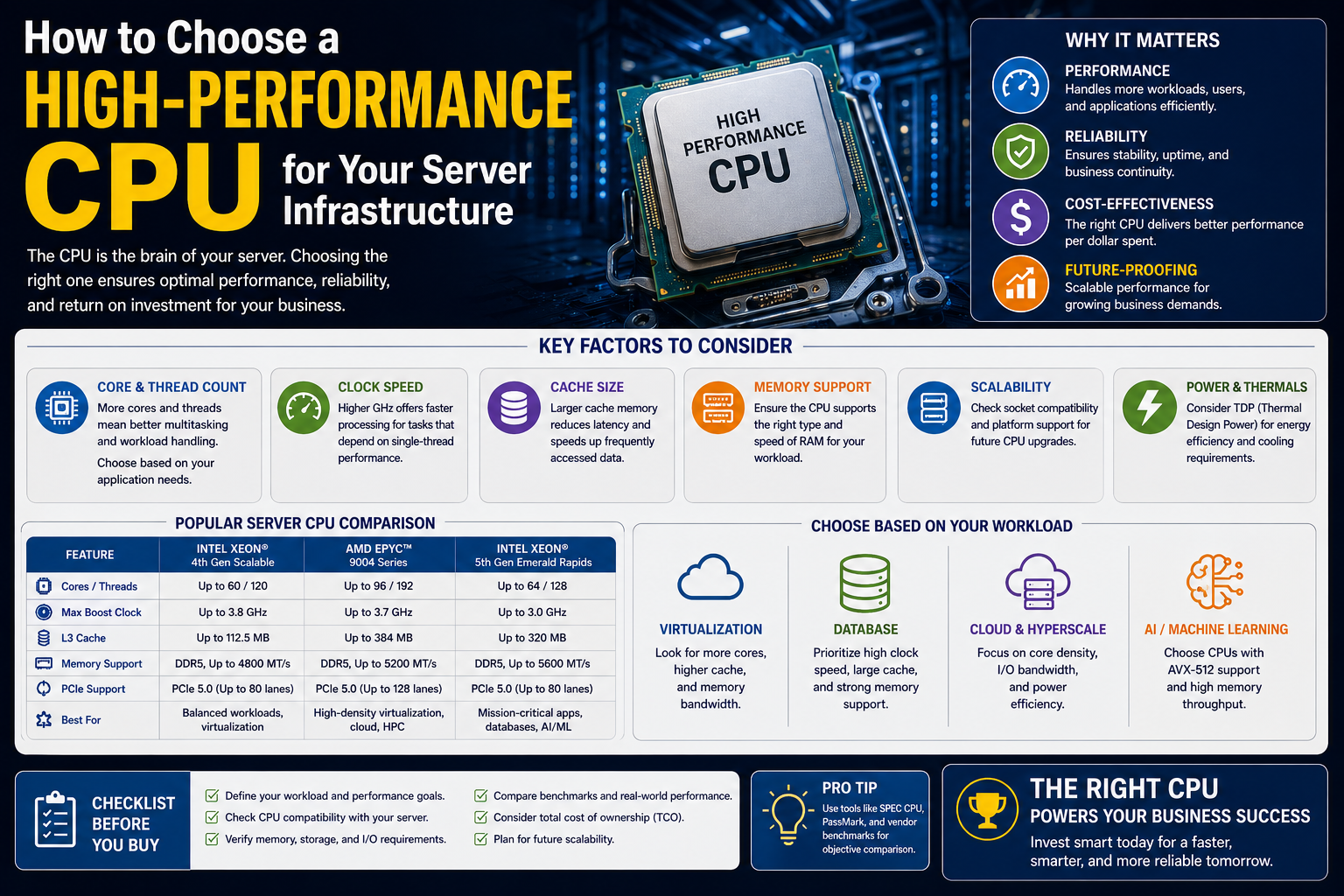
The central processing unit, commonly referred to as the CPU, sits at the very heart of every server system and determines how efficiently that system can perform under varying workloads. In modern computing environments, servers are no longer limited to single-purpose tasks. Instead, they handle a complex mix of responsibilities such as hosting applications, managing databases, running virtual machines, supporting cloud services, and processing real-time analytics. All of these operations rely heavily on the CPU’s ability to process instructions quickly and efficiently.
Unlike other components in a server, the CPU does not simply store or display information; it actively executes the instructions that define how software behaves. Every request made to a server—whether it comes from a user browsing a website, a device syncing data, or a background system performing scheduled tasks—must pass through the CPU for processing. This makes the processor the primary determinant of system responsiveness and overall performance consistency.
In earlier computing systems, CPU performance was relatively easy to understand because workloads were simpler and processors had limited capabilities. Today, however, servers must handle highly dynamic and unpredictable workloads. This means the CPU must be capable of adapting to fluctuating demand without causing delays or bottlenecks. As a result, choosing the right processor is no longer just about raw speed; it is about balancing multiple performance factors that influence real-world efficiency.
Modern CPUs also act as coordinators between multiple hardware components, including memory, storage, and network interfaces. When data is requested, the CPU determines how quickly it can be retrieved, processed, and delivered. This coordination role becomes even more critical in virtualized environments where multiple systems run simultaneously on a single physical server. In such cases, the CPU must divide its resources intelligently to ensure smooth operation across all workloads.
The importance of the CPU is further amplified by the increasing reliance on data-driven applications. Businesses and individuals alike now depend on servers for tasks that require rapid computation and real-time processing. Whether it is handling financial transactions, streaming media, or powering artificial intelligence models, the CPU is responsible for ensuring that computations are executed accurately and without delay.
Because of this central role, understanding how different CPU characteristics influence performance is essential. A well-chosen processor can significantly extend the lifespan of a server system, improve scalability, and reduce the need for frequent hardware upgrades. On the other hand, an inadequate CPU can quickly become a bottleneck, limiting system performance regardless of how advanced other components may be.
Understanding Workload Requirements Before Choosing a Processor
Before evaluating technical specifications, it is essential to understand the type of workload a server will handle. Workload requirements form the foundation of CPU selection because they determine which performance characteristics matter most. Different server applications place different demands on processing resources, and failing to align CPU capabilities with workload needs often leads to inefficiency or underperformance.
Workloads can generally be categorized into compute-intensive, memory-intensive, storage-intensive, and mixed-use environments. Compute-intensive workloads involve tasks that require continuous processing power, such as scientific simulations, rendering, and artificial intelligence computations. These environments benefit from CPUs with high core counts and strong parallel processing capabilities.
Memory-intensive workloads, on the other hand, rely heavily on fast data access and large memory capacity. Examples include large-scale databases and in-memory caching systems. In these cases, CPU efficiency is closely tied to memory bandwidth and latency handling rather than just raw processing power.
Storage-intensive workloads involve frequent reading and writing of data, often seen in file servers and data archival systems. While storage performance is important, the CPU still plays a key role in managing data flow, indexing, and request handling. A balanced processor is typically preferred in such environments to avoid unnecessary bottlenecks.
Mixed-use workloads are the most common in modern server deployments. These environments combine multiple types of tasks, such as hosting applications while simultaneously running background analytics and virtual machines. In these cases, flexibility becomes more important than specialization. The CPU must handle a wide variety of instructions efficiently without favoring one type of workload too heavily.
Another important aspect of workload analysis is concurrency. Some servers handle a small number of highly complex tasks, while others manage thousands of lightweight operations simultaneously. High-concurrency environments require processors with strong multi-threading capabilities and efficient task scheduling.
Scalability is also an important consideration. Workloads tend to grow over time as applications expand and user demand increases. Choosing a processor that can accommodate future growth helps avoid early hardware replacement and ensures long-term system stability.
Understanding workload behavior also involves identifying peak usage patterns. Some servers experience consistent demand throughout the day, while others face sudden spikes in activity. CPUs that handle burst workloads efficiently often include features such as dynamic frequency scaling and intelligent caching strategies.
Ultimately, workload analysis provides the blueprint for CPU selection. Without a clear understanding of how a server will be used, it becomes nearly impossible to evaluate whether a processor is suitable or over- or under-provisioned.
CPU Architecture and How It Impacts Real-World Performance
CPU architecture refers to the internal design and structure that determines how a processor executes instructions. While specifications like clock speed and core count are important, architecture plays a deeper role in shaping overall performance. Two processors with similar specifications can deliver very different results depending on their underlying architecture.
Modern CPU architectures are designed to maximize instruction throughput while minimizing delays in data processing. This is achieved through techniques such as instruction pipelining, branch prediction, and parallel execution. These mechanisms allow CPUs to process multiple instructions at different stages simultaneously, improving efficiency without necessarily increasing clock speed.
One of the key architectural improvements in modern processors is increased instruction per cycle (IPC) performance. IPC measures how many instructions a CPU can execute in a single clock cycle. A higher IPC means better performance even at lower clock speeds. This is particularly important in server environments where efficiency often matters more than peak frequency.
Another important architectural factor is how well a CPU handles parallel processing. Modern processors are designed with multiple execution units that allow different types of operations to occur simultaneously. This reduces idle time and ensures that computational resources are used effectively.
Cache design is also deeply tied to CPU architecture. Efficient architectures include optimized cache hierarchies that reduce memory access delays. When data is readily available in cache memory, the CPU can process instructions significantly faster than when retrieving data from main memory.
Modern architectures also focus heavily on energy efficiency. As server environments scale, power consumption becomes a major concern. Efficient CPU designs aim to deliver higher performance per watt, reducing operational costs while maintaining computing power.
Security features are increasingly integrated into CPU architecture as well. Hardware-level protections help mitigate vulnerabilities and improve system reliability. These features are especially important in multi-tenant environments where multiple users or applications share the same hardware resources.
Overall, CPU architecture determines how effectively all other specifications come together. It is not just about how fast a processor can run, but how intelligently it executes tasks under real-world conditions.
Clock Speed and Instruction Processing Efficiency
Clock speed is one of the most commonly referenced CPU specifications and is typically measured in gigahertz. It represents the number of cycles a processor can execute per second. While higher clock speeds generally indicate faster performance, they do not tell the full story of how a CPU will behave under load.
In server environments, clock speed primarily influences how quickly individual tasks can be processed. Applications that rely on single-threaded performance tend to benefit the most from higher clock speeds. However, modern server workloads are rarely limited to single-thread execution, making clock speed only one part of the performance equation.
Instruction processing efficiency is equally important. A CPU with a lower clock speed but higher efficiency can outperform a faster processor with weaker architecture. This is because modern processors are capable of executing more instructions per cycle, reducing the need for extremely high frequencies.
Thermal constraints also affect clock speed performance. CPUs generate heat as they operate, and sustained high-frequency operation can lead to thermal throttling. This means the processor automatically reduces its speed to prevent overheating, which can impact performance consistency in demanding environments.
Dynamic frequency scaling technologies allow CPUs to adjust their clock speeds based on workload demand. During low usage periods, the processor operates at reduced speeds to conserve energy. When demand increases, it boosts performance temporarily to handle the workload efficiently. This balance helps optimize both performance and power consumption.
Another important factor is the relationship between clock speed and core count. Higher clock speeds may benefit fewer tasks, while lower speeds combined with more cores can improve multitasking performance. The ideal balance depends entirely on the nature of the server workload.
In virtualization-heavy environments, consistent performance across multiple cores is often more important than peak clock speed. In contrast, applications that require rapid sequential processing may benefit more from higher frequencies.
Understanding clock speed in isolation can be misleading. It must always be evaluated alongside architectural efficiency, core design, and workload requirements to accurately determine real-world performance.
Multi-Core Design and Parallel Computing Demands
Modern CPUs rely heavily on multi-core design to meet the increasing demands of parallel computing. A core is essentially an independent processing unit within the CPU, capable of executing instructions on its own. By incorporating multiple cores into a single processor, systems can handle multiple tasks simultaneously, significantly improving performance in multi-threaded environments.
In server applications, multi-core processors are essential because most workloads involve concurrent operations. For example, web servers must handle multiple user requests at the same time, while databases process numerous queries simultaneously. Without multiple cores, these tasks would need to be executed sequentially, leading to delays and inefficiencies.
The effectiveness of multi-core processing depends on how well software is optimized to distribute workloads across available cores. Modern operating systems and server applications are designed to take advantage of parallel processing, but not all tasks scale equally well. Some workloads benefit greatly from additional cores, while others experience diminishing returns after a certain point.
Core efficiency is also important. Not all cores are identical in performance, especially in processors that use hybrid architectures. Some cores are designed for high-performance tasks, while others focus on energy efficiency. This combination allows systems to balance performance and power consumption dynamically.
In virtualized environments, each virtual machine can be assigned specific cores or portions of CPU resources. This makes multi-core processors especially valuable in data centers and cloud computing platforms, where resource allocation must be both flexible and efficient.
However, simply increasing core count does not guarantee better performance. If other components such as memory bandwidth or storage speed cannot keep up, additional cores may remain underutilized. This is why balanced system design is critical.
Multi-core design continues to evolve as applications become more parallel in nature. Emerging technologies such as artificial intelligence and big data analytics rely heavily on distributed processing, making high core counts increasingly important in modern server CPUs.
Threads, SMT, and How Virtual Execution Improves Throughput
Threads represent the smallest sequence of programmed instructions that a CPU can manage independently. While cores represent physical processing units, threads operate as virtual pathways that allow a core to handle multiple instruction streams. This concept is often enhanced through technologies such as simultaneous multithreading (SMT), which enables a single core to execute multiple threads at once.
The primary advantage of multithreading is improved resource utilization. In many cases, a CPU core may not be fully occupied while waiting for data from memory or other system components. Multithreading allows the core to switch between tasks efficiently, reducing idle time and increasing overall throughput.
In server environments, multithreading is particularly useful for handling large numbers of simultaneous connections. Web servers, application servers, and database systems all benefit from the ability to process multiple requests in parallel without requiring additional physical cores.
However, threads are not equivalent to cores in terms of performance. While a single core can handle multiple threads, they still share underlying physical resources. This means that performance gains from multithreading are often incremental rather than proportional.
Efficient thread management depends heavily on CPU architecture and scheduling algorithms. Modern processors are designed to dynamically allocate resources between threads based on workload demand. This ensures that critical tasks receive priority while maintaining overall system balance.
In virtualization environments, threads play an important role in maximizing hardware utilization. Virtual machines can be assigned virtual CPUs, which are often mapped to threads rather than physical cores. This allows multiple virtual systems to run concurrently on a single physical processor.
Despite its advantages, multithreading is not universally beneficial for all workloads. Applications that require intensive, uninterrupted processing may not gain significant advantages from additional threads. In some cases, excessive threading can even introduce overhead due to context switching.
Understanding the relationship between cores and threads is essential for selecting the right CPU. The ideal balance depends on workload type, concurrency requirements, and system architecture.
The Role of Cache Memory in Server Processor Efficiency
Cache memory is one of the most critical yet often overlooked elements of a server processor. While clock speed and core count tend to receive most of the attention, cache plays a fundamental role in determining how quickly a CPU can access and process data. In server environments where performance consistency is essential, cache efficiency can significantly influence overall system responsiveness.
Cache memory is designed to reduce the time it takes for a processor to access frequently used data. Instead of retrieving information from main system memory, which is relatively slower, the CPU stores temporary data in smaller, faster memory located closer to the processing cores. This reduces latency and improves execution speed for repetitive tasks.
Modern processors typically use a multi-level cache hierarchy. Each level serves a different purpose and operates at varying speeds and capacities. The closest cache to the core is designed for speed, while higher levels provide larger storage capacity with slightly increased latency. This layered approach allows CPUs to balance speed and storage efficiency effectively.
In server workloads, cache performance becomes especially important when dealing with repetitive instructions or frequently accessed datasets. Applications such as database queries, virtualization workloads, and web services often rely heavily on cache efficiency to maintain smooth performance under heavy load.
When cache memory is insufficient, the processor must rely more frequently on main memory access, which introduces delays. These delays may seem small on an individual operation basis, but they accumulate significantly in high-demand environments. Over time, poor cache utilization can lead to noticeable performance degradation.
Cache design is closely tied to CPU architecture, and modern processors are engineered to optimize cache hit rates. A cache hit occurs when the required data is already available in cache memory, while a cache miss requires fetching data from slower memory sources. High-performance server CPUs aim to maximize cache hits through intelligent data prediction and preloading mechanisms.
As workloads become more complex, cache optimization becomes increasingly important. Servers running multiple applications simultaneously benefit greatly from larger and more efficient cache structures, which reduce contention between competing processes and improve overall throughput.
Memory Subsystems and CPU Interaction with RAM
The relationship between a server CPU and system memory is one of the most important aspects of performance design. While the processor executes instructions, it constantly relies on RAM to store and retrieve working data. The efficiency of this interaction directly impacts system speed and responsiveness.
Modern server processors are designed with integrated memory controllers that allow direct communication with RAM. This reduces latency compared to older architectures where memory access required intermediary components. Direct memory access improves both speed and efficiency, especially in high-performance computing environments.
Memory capacity and speed both play important roles in server performance. Larger memory capacity allows systems to handle more simultaneous tasks, while faster memory speeds reduce the time required to move data between CPU and RAM. The balance between these two factors is critical for maintaining stable performance under load.
In server environments, memory is often configured in multiple channels. Multi-channel memory architecture allows the CPU to access multiple memory modules simultaneously, increasing bandwidth and improving data throughput. This is particularly beneficial for applications that require large-scale data processing or real-time analytics.
Another important aspect of server memory is error correction capability. Enterprise-grade systems often rely on error-correcting memory to detect and fix data corruption automatically. This ensures system stability and reduces the risk of data integrity issues, which is essential in mission-critical environments.
The CPU’s ability to efficiently manage memory access patterns also affects performance. Poorly optimized memory usage can lead to bottlenecks, even if the processor itself is highly powerful. This is why memory bandwidth and latency are just as important as raw CPU specifications in server planning.
Memory Bandwidth, Latency, and Performance Balance
Memory bandwidth refers to the rate at which data can be transferred between the CPU and RAM, while latency measures the delay before data transfer begins. Both factors work together to determine how efficiently a server handles data-intensive workloads.
High memory bandwidth is essential for applications that process large datasets simultaneously. These include virtualization platforms, scientific computing systems, and large-scale database operations. When bandwidth is limited, the CPU may spend significant time waiting for data, reducing overall efficiency.
Latency, on the other hand, plays a crucial role in tasks that require rapid access to small amounts of data. Even minor delays in memory response can impact system responsiveness in real-time applications. Low-latency memory systems ensure that the CPU receives data quickly, improving execution speed.
Modern server CPUs are designed to optimize both bandwidth and latency through advanced memory controllers and architecture improvements. However, achieving an ideal balance often depends on system configuration rather than processor design alone.
Memory performance is also influenced by how data is structured and accessed by applications. Sequential data access patterns tend to perform better than random access patterns, as they allow memory systems to prefetch data more efficiently.
In multi-core environments, memory contention can become a significant issue. When multiple cores attempt to access memory simultaneously, bandwidth limitations may arise. Proper memory configuration and CPU selection help mitigate these challenges and ensure consistent performance.
NUMA Architecture and Multi-Socket Server Systems
Non-Uniform Memory Access (NUMA) architecture is commonly used in multi-processor server systems to improve scalability and performance. In NUMA systems, each CPU has its own local memory, but can also access memory attached to other processors in the system.
The key advantage of NUMA architecture is reduced memory latency for local operations. When a processor accesses its own memory, data transfer is faster compared to accessing remote memory attached to another CPU. This improves efficiency in multi-socket server environments.
However, NUMA also introduces complexity in system design. Applications and operating systems must be aware of memory locality to optimize performance. Poor memory allocation can lead to increased latency and reduced efficiency, especially when processes frequently access remote memory regions.
Modern server processors include built-in NUMA optimization features that help manage memory distribution automatically. These features aim to minimize cross-processor memory access and improve workload balancing across multiple CPUs.
Multi-socket systems are commonly used in enterprise environments where extremely high processing power is required. These systems combine multiple CPUs within a single server chassis, effectively increasing total core count and memory capacity.
The scalability offered by NUMA architecture makes it ideal for large-scale applications such as virtualization clusters, database servers, and cloud computing platforms. However, it requires careful planning to ensure that workloads are distributed efficiently across available resources.
CPU Interconnects and Internal Data Communication
CPU interconnect technology plays a crucial role in enabling communication between different components of a server system. These interconnects include pathways between cores, memory controllers, and external devices such as storage and networking hardware.
Modern processors use high-speed interconnects to ensure rapid data transfer between internal components. These interconnects are designed to reduce latency and improve bandwidth, allowing the CPU to handle large volumes of data efficiently.
In multi-processor systems, interconnects also enable communication between different CPUs. This is essential in NUMA architectures where processors must share memory and workload responsibilities. Efficient interconnect design ensures that data flows smoothly across the system without creating bottlenecks.
Peripheral interconnects such as PCIe also play an important role in server performance. These connections allow CPUs to communicate with GPUs, storage devices, and network adapters. The number and speed of available lanes directly impact system expandability and performance potential.
Modern server CPUs often include integrated interconnect technologies that improve scalability and reduce communication overhead. These advancements allow systems to support larger workloads without significant performance degradation.
Virtualization and CPU Resource Allocation Strategies
Virtualization has become a core component of modern server infrastructure, allowing multiple virtual machines to run on a single physical server. The CPU plays a central role in enabling this capability by allocating processing resources dynamically across virtual environments.
Each virtual machine is assigned a portion of CPU resources known as virtual CPUs. These virtual CPUs are mapped to physical cores or threads depending on system configuration. Efficient allocation ensures that all virtual machines receive adequate processing power without overloading the system.
Hypervisor software manages CPU distribution and ensures that workloads are balanced across available resources. This includes scheduling tasks, managing thread execution, and optimizing resource utilization.
Virtualization introduces additional overhead because the CPU must manage both physical and virtual instructions. However, modern processors include hardware-level virtualization support that reduces this overhead and improves performance.
Workload isolation is another important aspect of virtualization. CPUs must ensure that processes running in different virtual machines do not interfere with each other. This is achieved through strict resource management and memory protection mechanisms.
In high-density virtual environments, CPU efficiency becomes a limiting factor. Selecting a processor with strong multi-threading capabilities and efficient cache management is essential for maintaining performance stability.
Power Consumption and Energy Efficiency in Server CPUs
Power efficiency is a critical factor in server processor design. As data centers scale and computational demands increase, energy consumption becomes a significant operational concern. CPUs must therefore balance performance with power efficiency to maintain sustainable operation.
Modern processors are designed with dynamic power management features that adjust energy usage based on workload demand. When demand is low, the CPU reduces its operating frequency and voltage to conserve power. When demand increases, it scales performance accordingly.
Thermal design power, commonly referred to as TDP, represents the maximum amount of heat a processor is expected to generate under load. While not a direct measure of power consumption, TDP provides an indication of cooling requirements and energy efficiency.
Efficient CPU designs aim to deliver higher performance per watt, allowing servers to handle more workloads without increasing energy costs significantly. This is particularly important in large-scale deployments where hundreds or thousands of servers operate simultaneously.
Power efficiency also impacts system longevity. Excessive heat generation can reduce component lifespan and increase maintenance requirements. Efficient thermal and power management helps maintain system reliability over time.
Thermal Management and Sustained Performance Stability
Thermal management is closely tied to CPU performance, especially in high-load server environments. As processors operate, they generate heat, and without proper cooling, this heat can negatively affect performance and stability.
Modern CPUs include built-in thermal monitoring systems that adjust performance dynamically to prevent overheating. When temperatures rise beyond safe limits, the processor may reduce clock speed to maintain stability. This process is known as thermal throttling.
Effective cooling solutions are essential for maintaining consistent CPU performance. Server environments typically use advanced cooling systems that ensure stable operating temperatures even under heavy workloads.
Thermal efficiency also influences long-term reliability. Consistently high operating temperatures can degrade processor components over time, reducing system lifespan and increasing failure risk.
Balancing performance and temperature is therefore a critical aspect of server design. Efficient processors are designed to deliver maximum performance while maintaining safe thermal thresholds.
Server CPU Categories and Performance Scaling Considerations
Server processors are typically designed to meet different levels of computational demand. While all CPUs perform similar fundamental functions, their capabilities vary significantly depending on design focus and target environment.
Entry-level processors are generally suited for lightweight workloads and small-scale deployments. These systems are often used in development environments or low-traffic applications where extreme performance is not required.
Mid-range processors provide a balance between performance and efficiency. They are commonly used in business environments where workloads are moderate but still require consistent reliability and scalability.
High-end enterprise processors are designed for demanding environments such as large data centers, cloud computing platforms, and artificial intelligence workloads. These CPUs offer high core counts, large cache sizes, and advanced memory support.
Scalability is a key consideration when selecting a server CPU. As workloads grow, systems must be able to handle increased demand without requiring complete hardware replacement. Choosing a processor with sufficient headroom ensures smoother long-term scalability.
Performance scaling is not only determined by CPU specifications but also by how well the system architecture supports growth. Memory capacity, storage speed, and interconnect efficiency all contribute to overall scalability.
Server environments continue to evolve rapidly, and CPU design must keep pace with increasing computational demands. As applications become more complex and data-intensive, the importance of selecting the right processor continues to grow steadily.
Evaluating Server CPU Performance Beyond Basic Specifications
When selecting a processor for a server, many people initially focus on familiar specifications such as clock speed, core count, and cache size. While these factors are important, they only represent part of the overall performance picture. In real-world server environments, performance is influenced by a much broader set of characteristics that determine how efficiently a CPU handles sustained workloads over time.
One of the most important considerations is how a processor performs under continuous load rather than short bursts of activity. Servers are typically expected to run for long periods without interruption, often handling fluctuating workloads that change throughout the day. A CPU that performs well in short benchmarks may not necessarily maintain that performance under extended operational stress.
Another important aspect is workload consistency. Some processors may deliver high peak performance but experience variability when handling mixed workloads. In contrast, server-grade CPUs are designed to maintain stable performance across a wide range of tasks, ensuring predictable behavior in production environments.
Thermal behavior also plays a critical role in sustained performance. A processor that runs efficiently under ideal conditions may throttle under heat stress if cooling is insufficient. This makes thermal stability just as important as raw performance metrics when evaluating server CPUs.
Power efficiency under load is another key factor. Servers often operate continuously, meaning even small differences in energy consumption can have a significant impact on long-term operational costs. Efficient processors reduce energy waste while maintaining performance levels, making them more suitable for large-scale deployments.
Understanding CPU Benchmarking and Real-World Performance Metrics
Benchmarking is often used as a reference point when comparing processors, but it is important to understand what these tests actually measure. Synthetic benchmarks are designed to evaluate specific aspects of CPU performance under controlled conditions. While useful, they do not always reflect real-world workloads.
Different benchmarking tools focus on different performance areas. Some measure single-thread performance, while others evaluate multi-thread scalability or memory throughput. A balanced server CPU should perform well across multiple benchmark categories rather than excelling in only one area.
Real-world performance is influenced by workload behavior, system configuration, and software optimization. For example, a database server may prioritize memory access efficiency, while a virtualization host may depend heavily on multi-core scaling.
Another limitation of benchmarks is that they often represent short-duration tests. Server workloads, however, are continuous and dynamic. This means that sustained performance over time is often more important than peak benchmark scores.
It is also important to consider how well a processor maintains performance consistency under varying loads. Some CPUs may show high benchmark results but experience performance drops when handling mixed or unpredictable workloads.
Ultimately, benchmarking should be used as a guide rather than a definitive measure of suitability. Real-world testing and workload simulation provide a more accurate understanding of how a processor will behave in production environments.
CPU Selection for Virtualization Density and Scalability
Virtualization has become a fundamental part of modern server infrastructure, allowing multiple operating systems and applications to run on a single physical machine. In this context, CPU selection plays a crucial role in determining how many virtual machines a server can support efficiently.
Virtualization density refers to the number of virtual machines that can operate simultaneously on a single host without performance degradation. Higher-density environments require CPUs with strong multi-core performance, efficient thread handling, and stable memory management.
Each virtual machine consumes a portion of CPU resources, which must be carefully allocated to avoid resource contention. Overcommitting CPU resources can lead to performance bottlenecks if not managed properly. This makes CPU efficiency and predictability essential in virtualized environments.
Scalability is another important consideration. As demand grows, servers must be able to accommodate additional virtual machines without requiring complete hardware replacement. CPUs with higher core counts and better parallel processing capabilities provide more flexibility in scaling workloads.
Hypervisor efficiency also influences CPU performance in virtual environments. Modern processors include hardware-assisted virtualization features that reduce overhead and improve efficiency. These features allow virtual machines to run closer to native performance levels.
Workload isolation is equally important. In multi-tenant environments, CPUs must ensure that one virtual machine does not negatively impact another. Proper resource scheduling and core allocation help maintain system stability and fairness across workloads.
The Importance of I/O Performance and PCIe Lane Configuration
While CPU performance is often the primary focus in server design, input/output performance plays an equally important role in overall system efficiency. The CPU is responsible for managing data flow between storage devices, memory, and external peripherals, making I/O capabilities a critical factor in system performance.
One of the key components influencing I/O performance is the number of PCIe lanes supported by the processor. PCIe lanes determine how much data can be transferred between the CPU and connected devices such as storage controllers, network cards, and GPUs.
A higher number of PCIe lanes allows for greater expandability and higher data throughput. This is particularly important in data-intensive environments where multiple high-speed devices must operate simultaneously.
Storage performance is heavily influenced by PCIe bandwidth. Modern solid-state storage devices rely on high-speed PCIe connections to achieve optimal performance. If the CPU does not provide sufficient lanes or bandwidth, storage performance may become a bottleneck.
Networking performance is also affected by PCIe availability. High-speed network interfaces require dedicated bandwidth to handle large volumes of data traffic. Inadequate PCIe resources can limit network throughput and increase latency.
In advanced server configurations, multiple PCIe devices may operate simultaneously. This requires careful balancing of available lanes to ensure that no single component monopolizes system resources.
Storage Subsystem Interaction with Server Processors
Storage systems are a critical part of server infrastructure, and their performance is closely tied to CPU efficiency. While storage devices handle data persistence, the CPU is responsible for managing data requests, indexing, and transfer operations.
Modern storage solutions, particularly solid-state drives, rely on fast communication with the CPU to achieve optimal performance. Any delays in processing storage requests can impact application responsiveness.
The CPU also plays a role in managing storage protocols and data structures. File systems, database engines, and caching mechanisms all rely on processor resources to function efficiently.
In high-performance environments, storage workloads can generate significant CPU overhead. Efficient processors are designed to minimize this overhead by optimizing data handling and reducing unnecessary processing cycles.
Storage performance is also influenced by parallelism. Multiple storage requests must be handled simultaneously in modern systems, requiring CPUs to manage concurrent operations efficiently.
Network Processing and CPU Offloading Techniques
Networking is another area where CPU performance plays a significant role. Servers must handle incoming and outgoing data traffic efficiently, often under heavy load conditions. The CPU is responsible for processing network packets, managing connections, and ensuring data integrity.
In high-traffic environments, network processing can consume a significant portion of CPU resources. To address this, modern systems often use offloading techniques that transfer certain networking tasks to specialized hardware.
Network interface controllers can handle tasks such as packet segmentation and checksum calculation, reducing CPU workload. This allows the processor to focus on higher-level tasks such as application logic and data processing.
Despite offloading capabilities, the CPU still plays a central role in network performance. Connection management, routing decisions, and security processing all rely on processor resources.
Efficient CPUs are designed to handle network-intensive workloads without becoming a bottleneck. This is particularly important in cloud environments and large-scale web applications where network traffic is constant and unpredictable.
Security Features in Modern Server CPUs
Security has become an integral part of CPU design in modern server environments. Processors now include hardware-level security features that help protect against vulnerabilities and unauthorized access.
One important aspect of CPU security is memory protection. Modern processors include mechanisms that isolate memory regions between different applications and virtual machines. This prevents unauthorized data access and improves system stability.
Encryption acceleration is another key feature found in modern CPUs. Hardware-based encryption allows data to be processed securely without significant performance overhead. This is particularly important for servers handling sensitive information.
Some processors also include secure execution environments that isolate critical operations from the main system. These environments provide additional protection against certain types of attacks.
Security features are especially important in multi-tenant environments where multiple users or organizations share the same hardware. Proper isolation ensures that workloads remain secure and independent.
CPU Considerations for AI, Machine Learning, and Data Processing
Artificial intelligence and machine learning workloads have introduced new demands on server processors. While GPUs are often used for heavy computational tasks, CPUs still play a crucial role in data preprocessing, task coordination, and system management.
AI workloads often involve large datasets that must be prepared and structured before processing. The CPU handles these tasks, ensuring that data is efficiently delivered to accelerators or processing units.
In machine learning pipelines, CPUs are responsible for managing training workflows, distributing tasks, and handling input/output operations. Efficient CPU performance ensures that the entire pipeline runs smoothly.
Data processing workloads also benefit from high core counts and strong memory bandwidth. These applications often involve parallel operations that require efficient CPU resource allocation.
As AI systems become more complex, the interaction between CPUs and specialized accelerators continues to evolve. Modern server CPUs are designed to work alongside these accelerators, providing coordination and support for large-scale computations.
Conclusion
Choosing the right processor for a server is ultimately about understanding balance rather than chasing maximum specifications. While it is easy to focus on individual metrics such as clock speed or core count, real-world performance depends on how all CPU components work together under sustained and varied workloads. A well-matched processor aligns with the specific demands of the environment it serves, whether that involves virtualization, data processing, web hosting, or computational analysis.
As server workloads continue to grow in complexity, processors are expected to do far more than simply execute instructions quickly. They must manage multiple concurrent tasks, handle large volumes of data efficiently, maintain stability under continuous load, and interact seamlessly with memory, storage, and network systems. This makes architectural efficiency, cache design, memory bandwidth, and power optimization just as important as raw processing power.
Another key takeaway is that server planning should always include a forward-looking perspective. Modern computing environments evolve rapidly, and workloads that seem manageable today can expand significantly over time. Selecting a processor with sufficient scalability helps ensure that infrastructure remains capable of handling future demands without immediate replacement or costly redesigns. At the same time, energy efficiency and thermal performance play a growing role in long-term operational sustainability, especially as systems operate continuously in data center environments.
Ultimately, the best server processor is not defined by being the most powerful on paper, but by how effectively it meets real operational needs. It should provide consistent performance, adapt to changing workloads, and integrate smoothly within the broader system architecture. When these factors are carefully considered together, the result is a server platform that delivers reliability, efficiency, and longevity in equal measure, supporting both current operations and future technological growth.