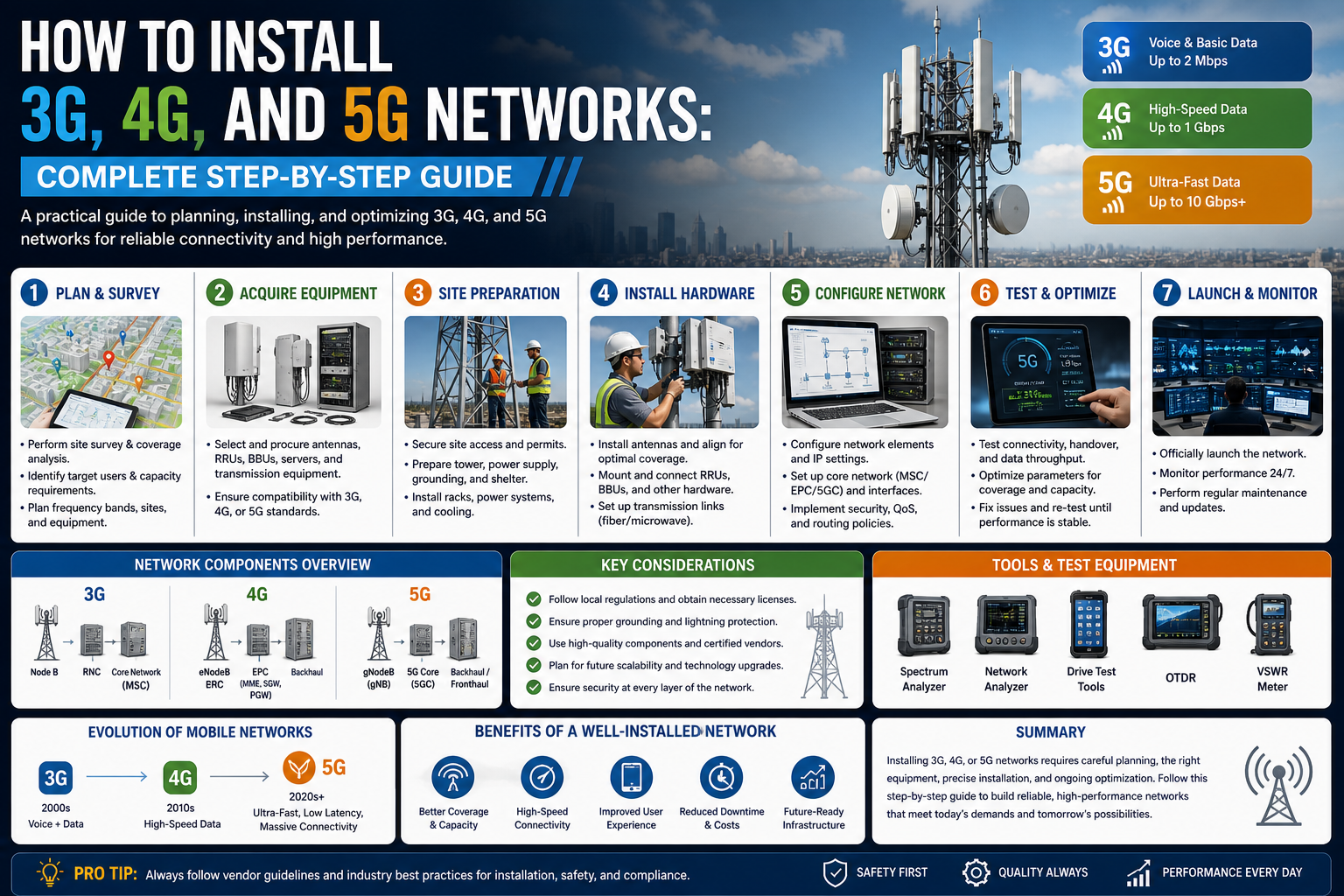
Cellular networks have developed through several generations, each bringing major improvements in speed, reliability, and overall capability. The transition from 2G to 3G, then 4G, and now 5G reflects how communication systems have evolved to support growing demand for mobile data, smart devices, and always-connected services.
At a basic level, all cellular networks serve the same purpose: to connect mobile devices to a communication system that allows voice calls, messaging, and internet access. However, each generation introduces new technologies and architectural changes that make networks faster and more efficient.
Understanding how these systems are installed and configured requires more than just technical knowledge. It involves planning infrastructure, selecting appropriate hardware, ensuring compatibility between components, and maintaining long-term performance through monitoring and optimization.
This article focuses on the foundational layer of cellular networking by exploring how 3G systems are installed and configured, while also setting the stage for understanding how newer generations like 4G and 5G build upon the same principles.
Overview of 3G Cellular Network Architecture
Third-generation networks, commonly known as 3G, marked a significant shift from earlier systems by introducing mobile internet access at usable speeds. While 3G is no longer the dominant technology in many regions, it remains relevant in certain environments where older infrastructure is still in use or where basic connectivity is sufficient.
A 3G network is built using several interconnected components that work together to manage communication between mobile devices and the core network.
The most important structural element is the radio access network, which connects mobile devices to the system. This includes base stations that transmit and receive signals. These base stations are managed by control systems that coordinate communication and ensure that users remain connected as they move.
Beyond the radio layer, the core network handles tasks such as call routing, user authentication, mobility tracking, and data management. It acts as the central intelligence of the network, ensuring that communication is delivered correctly and securely.
Together, these components form a complete ecosystem that allows mobile devices to function across large geographic areas.
Core Components Used in 3G Deployment
A 3G installation depends on several key hardware and software elements. Each one plays a specific role in ensuring that communication flows smoothly across the network.
Base stations are the physical units responsible for transmitting radio signals to mobile devices. These stations are typically installed on towers, rooftops, or elevated structures to maximize coverage. They serve as the first point of contact between users and the network.
Control systems manage how base stations operate. They coordinate frequency usage, allocate resources, and ensure that devices can move between coverage zones without losing connection.
The core switching system is responsible for routing voice calls and data traffic. It ensures that communication reaches the correct destination and that users remain connected as they move between different areas.
Subscriber databases store important user information, including authentication credentials and service permissions. These databases allow the network to verify user identity and manage access to services.
Supporting these systems is a range of software tools that monitor network performance, manage billing operations in commercial environments, and enforce security protocols.
Planning a 3G Network Installation
Before any physical installation begins, careful planning is required. This stage determines how effectively the network will perform once it becomes operational.
The first step involves analyzing the target coverage area. Engineers study population density, geographic features, building structures, and potential sources of interference. This helps determine where base stations should be placed to ensure maximum coverage.
Environmental factors also play a major role. Natural obstacles such as hills, trees, and valleys can affect signal propagation. Urban environments introduce additional challenges due to tall buildings and electromagnetic interference from other systems.
Once the area has been assessed, planners design a network layout that balances coverage and capacity. This includes deciding how many base stations are required and how they will be distributed across the region.
Regulatory compliance is another important part of planning. Governments often require permits for tower installation, frequency usage, and equipment deployment. These approvals must be secured before installation can proceed.
Physical Installation of 3G Base Stations
The installation phase involves setting up the physical infrastructure that supports the network. This includes base stations, antennas, and supporting equipment.
Base stations are installed at selected locations based on the planning phase. These units are typically mounted on towers or buildings at a height that allows clear signal transmission.
Antennas are attached to the base stations and carefully oriented to provide optimal coverage. The direction and tilt of antennas are adjusted to control signal reach and strength.
Power systems are installed to ensure continuous operation. These systems often include backup batteries or generators to maintain service during power outages.
Cooling systems are also important because network equipment generates heat during operation. Proper ventilation or climate control helps maintain stable performance and prevents hardware damage.
Once physical installation is complete, the system is connected to the wider network through wired or wireless backhaul links.
Backhaul Connectivity and Network Integration
Backhaul connections form the link between base stations and the core network. These connections carry large volumes of data and must be reliable and high-capacity.
In many cases, fiber optic cables are used because they provide fast and stable communication. In areas where fiber installation is not feasible, microwave links may be used as an alternative.
Once connectivity is established, base stations are integrated into the core network. This process involves configuring communication protocols and ensuring that all components can exchange data correctly.
At this stage, network controllers begin managing traffic between base stations and user devices. Proper configuration ensures that users can move between coverage areas without dropping connections.
Software Configuration and System Setup
After hardware installation, the next step is software configuration. This is where the network becomes fully operational.
Network management systems are configured to monitor performance and control operations. These systems provide real-time information about traffic levels, signal quality, and system health.
Security protocols are also implemented during this phase. Authentication systems ensure that only authorized users can access the network, while encryption protects data during transmission.
Service configurations are defined to determine how users interact with the network. This includes setting data limits, call routing rules, and quality standards.
Billing systems may also be configured in commercial environments to track usage and generate charges based on service consumption.
Frequency Planning and Signal Optimization in 3G Systems
One of the most important aspects of 3G configuration is frequency planning. This process ensures that signals do not interfere with each other and that available spectrum is used efficiently.
Each base station is assigned a specific frequency range. These ranges are carefully planned to avoid overlap with neighboring cells.
Signal strength is also adjusted to ensure consistent coverage. If signals are too strong, they may cause interference in nearby cells. If they are too weak, coverage gaps may occur.
Handover settings are configured to allow devices to switch between base stations without interruption. This is especially important for users moving between different coverage areas.
Quality of service settings are applied to prioritize different types of traffic. For example, voice calls may be given higher priority than data downloads to ensure stable communication.
Security Considerations in 3G Networks
Security is an essential part of any cellular network. In 3G systems, several mechanisms are used to protect users and data.
Authentication systems verify user identity before allowing access to the network. This prevents unauthorized usage and helps maintain system integrity.
Encryption is used to protect data as it travels between devices and base stations. This ensures that sensitive information cannot be intercepted easily.
Access control systems restrict administrative functions to authorized personnel only. This helps prevent unauthorized changes to network settings.
Monitoring tools are used to detect unusual activity, which may indicate security threats or system failures.
Common Challenges During 3G Deployment
Installing a 3G network is not without challenges. Several issues can arise during deployment and operation.
Coverage gaps may occur if base stations are not properly positioned. This can result in areas with weak or no signal.
Interference from other electronic systems can degrade signal quality. This requires careful frequency planning and adjustment.
Capacity limitations may arise when too many users connect to a single base station. This can slow down network performance.
Handover failures may occur if devices cannot smoothly switch between base stations. This can lead to dropped calls or interrupted data sessions.
Each of these challenges requires careful monitoring and adjustment to maintain network quality.
Transition Toward Modern Cellular Systems
While 3G networks laid the foundation for mobile connectivity, newer technologies like 4G and 5G have introduced significant improvements in speed, efficiency, and flexibility.
These newer systems build upon the same basic principles but use more advanced architectures, higher frequency bands, and more sophisticated management systems.
Understanding 3G installation provides a strong foundation for learning how modern networks operate and evolve over time.
Shift from 3G to 4G Network Architecture
The introduction of 4G LTE (Long Term Evolution) marked a major transformation in mobile communication systems. Unlike 3G, which relied heavily on circuit-switched architecture for voice and packet-switched systems for data, 4G is built entirely on an all-IP (Internet Protocol) network. This means every type of communication—voice, video, messaging, and internet traffic—is transmitted as data packets.
This shift simplified the overall architecture while significantly improving speed, latency, and scalability. It also allowed mobile networks to behave more like traditional internet systems, enabling seamless integration with modern digital services.
4G networks are designed to handle high-bandwidth applications such as video streaming, cloud computing, online gaming, and real-time communication. This required a redesign of both radio access and core network components.
The structure of a 4G system is divided into two main parts: the radio access network and the evolved packet core. These two layers work together to ensure efficient communication between users and services.
LTE Radio Access Network and eNodeB Functionality
In 4G systems, the radio access network is built around a key component called the eNodeB (evolved Node B). This replaces the older base station and controller structure used in 3G networks.
The eNodeB combines the functions of both radio transmission and control management into a single unit. This simplifies the architecture and reduces latency in communication.
Each eNodeB is responsible for managing radio communication with mobile devices within its coverage area. It handles tasks such as signal transmission, resource allocation, scheduling, and mobility management.
Unlike 3G systems where a separate controller manages multiple base stations, 4G distributes intelligence directly into each eNodeB. This decentralized approach improves efficiency and reduces communication delays within the network.
eNodeBs are typically installed on towers, rooftops, and other elevated structures to maximize coverage. They are connected to the core network using high-speed backhaul links.
Evolved Packet Core and Its Key Elements
The Evolved Packet Core (EPC) is the central backbone of a 4G network. It is responsible for managing all data traffic, user sessions, mobility, and policy enforcement.
The EPC consists of several important components, each with a specific role in network operation.
The Mobility Management Entity (MME) handles signaling and control functions. It is responsible for tracking user devices, managing authentication, and coordinating handovers between eNodeBs.
The Serving Gateway (S-GW) acts as a routing point for user data. It forwards packets between the radio access network and the core network.
The Packet Data Network Gateway (P-GW) connects the mobile network to external data networks such as the internet. It also enforces policies related to data usage, quality of service, and security.
These components work together to ensure that users experience uninterrupted connectivity while moving across different coverage areas.
Planning a 4G LTE Network Deployment
Deploying a 4G network requires careful planning and analysis. The process begins with understanding the geographic area where the network will operate.
Engineers study population distribution, user density, terrain, and existing infrastructure. This helps determine how many eNodeBs are needed and where they should be placed.
Urban environments typically require a higher density of base stations due to building interference and high user demand. Rural areas, on the other hand, require wider coverage with fewer installations.
Spectrum availability is also an important consideration. Different frequency bands offer different trade-offs between coverage and capacity.
Lower frequency bands provide wider coverage but lower data capacity, while higher frequencies offer faster speeds but shorter range.
The planning stage also includes regulatory coordination to ensure compliance with national communication standards and licensing requirements.
Installation of LTE Base Stations and Antennas
Once planning is complete, the physical installation of LTE infrastructure begins. This includes setting up eNodeBs, antennas, and supporting equipment.
Each eNodeB is installed at a carefully selected location to maximize coverage efficiency. Installation sites are chosen based on elevation, accessibility, and proximity to user clusters.
Antennas are mounted on towers or rooftops and aligned to provide optimal signal distribution. In many cases, multi-band antennas are used to support different frequency ranges simultaneously.
Power systems are installed to ensure continuous operation. These often include backup batteries or generators to maintain service during outages.
Cooling systems are essential for maintaining equipment stability, especially in high-temperature environments. Proper airflow and thermal management help prevent system failures.
After installation, all hardware components are physically connected to the network backhaul system.
Backhaul Connectivity and Transport Networks
Backhaul connectivity is the link between eNodeBs and the EPC. It plays a critical role in ensuring that data moves efficiently across the network.
Fiber optic connections are commonly used due to their high speed and reliability. In areas where fiber deployment is difficult, microwave links provide an alternative solution.
Backhaul networks must be carefully designed to avoid bottlenecks. If backhaul capacity is insufficient, it can limit overall network performance regardless of radio coverage quality.
Transport networks are also configured to prioritize different types of traffic. For example, real-time applications such as voice calls may be given higher priority than background data transfers.
Proper backhaul design ensures that the network can handle increasing traffic demands over time.
LTE Network Configuration and Parameter Setup
After physical installation, the next step involves configuring the network elements. This is where the system becomes operational.
Each eNodeB is configured with parameters such as frequency allocation, transmission power, and neighbor cell relationships.
The EPC components are also configured to handle user sessions, authentication, and routing.
Mobility management settings are defined to ensure smooth handovers between cells. This allows users to move without experiencing dropped connections or service interruptions.
Quality of Service (QoS) profiles are established to manage different types of traffic. These profiles determine how bandwidth is allocated to voice, video, and data services.
Network synchronization is also important to ensure that all components operate in coordination. This prevents timing errors and improves overall efficiency.
Frequency Management and Interference Control in 4G Systems
Frequency management plays a key role in LTE network performance. Each cell is assigned a specific frequency range to minimize interference.
In dense environments, frequency reuse strategies are used to maximize spectrum efficiency. However, this must be carefully managed to avoid overlapping signals.
Interference can occur when signals from nearby cells overlap or when external sources disrupt communication. To address this, power levels are adjusted and antenna directions are fine-tuned.
Advanced interference coordination techniques are also used to improve signal quality in congested areas.
These include scheduling adjustments and dynamic resource allocation based on real-time network conditions.
Security Implementation in LTE Networks
Security in 4G networks is built on multiple layers of protection. Authentication is the first step, ensuring that only authorized devices can connect to the network.
Encryption is applied to both user data and signaling information. This prevents unauthorized access and protects sensitive communication.
IP-based security protocols are used to secure data transmission across the network, especially in backhaul connections.
Network access control systems restrict administrative functions to authorized personnel only.
Monitoring systems continuously scan for unusual activity, helping to detect and respond to potential threats.
Security policies are enforced across both radio and core network layers to maintain end-to-end protection.
Optimization and Performance Enhancement in 4G Networks
Once the network is operational, continuous optimization is required to maintain performance.
Network performance is measured using key indicators such as throughput, latency, and packet loss.
Load balancing techniques are used to distribute traffic evenly across multiple cells. This prevents congestion and improves user experience.
Handover optimization ensures that devices move smoothly between cells without interruptions.
Self-optimizing network features allow systems to automatically adjust parameters based on real-time conditions.
These adjustments help improve efficiency without requiring manual intervention.
Troubleshooting Common LTE Network Issues
Despite careful planning, issues can arise in 4G networks that require troubleshooting and resolution.
One common issue is poor signal coverage in certain areas. This can be caused by physical obstacles, incorrect antenna placement, or insufficient infrastructure density.
Another issue is network congestion, which occurs when too many users access the same cell. This can lead to reduced speeds and poor performance.
Handover failures may also occur if neighbor cell configurations are incorrect or if timing parameters are not properly aligned.
Backhaul congestion can limit data flow between eNodeBs and the core network, affecting overall performance.
Each issue requires systematic diagnosis and adjustment of network parameters.
Mobility Management and User Experience in LTE Systems
Mobility management is a critical function in 4G networks. It ensures that users can move freely while maintaining continuous connectivity.
The network tracks the location of each device and manages transitions between cells.
Handover processes are optimized to minimize delays and prevent dropped connections.
Paging systems are used to locate devices when incoming communication is initiated.
These mechanisms work together to provide a seamless user experience, even in highly mobile environments such as highways and urban areas.
As users move across different coverage zones, the network continuously updates their connection path to ensure stability and performance.
Introduction to 5G Network Transformation
The transition to 5G represents the most significant leap in cellular technology since the introduction of mobile communication itself. Unlike earlier generations that mainly improved speed and coverage, 5G fundamentally changes how networks are built, managed, and used.
5G is designed to support not only smartphones but also massive numbers of connected devices, including autonomous vehicles, smart cities, industrial automation systems, and real-time remote control applications. This requires a highly flexible, intelligent, and scalable network architecture.
At its core, 5G focuses on three major improvements: extremely high data speeds, ultra-low latency, and massive device connectivity. These goals are achieved through new radio technologies, advanced core network design, and virtualization techniques.
Understanding how 5G is installed and configured requires looking at both physical infrastructure and software-defined systems that operate together in real time.
5G Network Architecture and Key Design Principles
5G architecture is built on a cloud-native and software-driven model. Unlike previous generations, where hardware played a dominant role, 5G relies heavily on virtualization and distributed computing.
The network is divided into two main components: the radio access network and the 5G core network. However, both layers are far more flexible and dynamic compared to earlier systems.
The radio access network uses next-generation base stations called gNodeB, which support advanced antenna technologies and multiple frequency bands.
The core network is fully virtualized and consists of modular functions that can be deployed in centralized data centers or distributed at the network edge.
This architecture allows operators to scale services dynamically based on demand and deploy specialized network slices for different applications.
5G Radio Access Network and gNodeB Deployment
The gNodeB is the central element of the 5G radio access network. It replaces the LTE eNodeB and introduces significantly more advanced capabilities.
Each gNodeB is responsible for handling radio communication with devices in its coverage area. It supports multiple frequency ranges, including both sub-6 GHz and millimeter wave bands.
Unlike previous generations, gNodeBs rely heavily on beamforming technology. This allows signals to be directed precisely toward users instead of being broadcast in all directions.
This targeted approach improves efficiency, reduces interference, and increases overall network capacity.
Installing gNodeBs requires careful planning because higher frequency bands used in 5G have shorter range and are more sensitive to physical obstacles.
As a result, 5G networks often require a higher density of base stations compared to 4G or 3G systems.
Sub-6 GHz and Millimeter Wave Technology
5G networks operate across two primary frequency ranges: sub-6 GHz and millimeter wave (mmWave).
Sub-6 GHz frequencies offer a balance between coverage and speed. They can travel longer distances and penetrate buildings more effectively, making them suitable for general mobile coverage.
Millimeter wave frequencies provide extremely high data speeds but have limited range and are easily blocked by obstacles such as walls, trees, and even weather conditions.
Because of these limitations, mmWave is typically used in dense urban environments, stadiums, airports, and other high-traffic areas where ultra-fast connectivity is required.
Network planners must carefully balance these frequency types to ensure consistent coverage and performance.
Massive MIMO and Beamforming Technology
One of the most important innovations in 5G is Massive MIMO (Multiple Input Multiple Output) technology.
Massive MIMO uses large arrays of antennas, sometimes consisting of dozens or even hundreds of elements, to transmit and receive signals simultaneously.
This allows the network to serve multiple users at the same time using the same frequency band, significantly increasing capacity.
Beamforming is a complementary technology that works alongside Massive MIMO. Instead of broadcasting signals in all directions, beamforming focuses the signal directly toward the user device.
This improves signal strength, reduces interference, and enhances overall network efficiency.
Together, these technologies form the foundation of 5G performance improvements.
5G Core Network and Virtualized Architecture
The 5G core network is fundamentally different from earlier generations. It is fully software-based and built using cloud-native principles.
Instead of relying on fixed hardware components, the 5G core is composed of virtual network functions that can run on general-purpose servers.
Key functions include the Access and Mobility Management Function, which handles device connectivity and mobility; the Session Management Function, which manages data sessions; and the User Plane Function, which handles data routing.
This modular design allows network operators to scale services independently and deploy functions closer to users when needed.
It also enables faster updates, improved flexibility, and better resource utilization.
Network Slicing and Service Customization
One of the most powerful features of 5G is network slicing. This allows a single physical network to be divided into multiple virtual networks, each designed for a specific purpose.
For example, one slice may be optimized for high-speed mobile broadband, another for industrial automation requiring ultra-low latency, and another for massive IoT deployments with low power devices.
Each slice operates independently with its own performance characteristics, security policies, and resource allocation.
This approach allows 5G networks to serve very different types of applications simultaneously without compromising performance.
Network slicing is managed through orchestration systems that dynamically allocate resources based on demand.
Edge Computing and Latency Reduction
Edge computing is a critical part of 5G infrastructure. It involves moving computing resources closer to users instead of relying solely on centralized data centers.
By processing data at the edge of the network, latency is significantly reduced. This is essential for applications that require real-time responsiveness, such as autonomous vehicles, remote surgery, and industrial automation.
Edge nodes are distributed throughout the network and work in coordination with the central core.
This distributed architecture improves performance, reduces congestion, and enhances user experience.
5G Installation Planning and Infrastructure Requirements
Deploying a 5G network requires extensive planning and coordination. The process begins with analyzing coverage requirements, user density, and application demands.
Urban environments require dense deployment of small cells, while rural areas rely more on macro cells using sub-6 GHz frequencies.
Site selection is critical because 5G performance depends heavily on line-of-sight conditions, especially for millimeter wave deployments.
Power availability, physical accessibility, and backhaul connectivity must also be considered during planning.
Regulatory approval is required for spectrum usage, tower installation, and environmental compliance.
Small Cells and Network Densification
Small cells are low-power base stations used to enhance coverage and capacity in specific areas.
They are especially important in 5G networks because of the limited range of high-frequency signals.
Small cells can be installed on streetlights, buildings, and other urban infrastructure to improve coverage in dense environments.
Network densification involves strategically placing these small cells to ensure continuous connectivity and reduce congestion in high-demand areas.
This approach allows operators to significantly increase network capacity without relying solely on large macro towers.
5G Backhaul and Transport Network Design
Backhaul networks connect base stations to the core network and play a critical role in overall performance.
Because 5G generates extremely high data traffic, backhaul infrastructure must support very high capacity and low latency.
Fiber optic connections are the preferred solution due to their speed and reliability. In some cases, high-capacity microwave links are used as alternatives.
Transport networks must be carefully designed to avoid bottlenecks and ensure smooth data flow across all network layers.
Security Architecture in 5G Systems
Security in 5G is significantly more advanced than in previous generations due to increased complexity and the use of virtualization.
Strong encryption is applied to both data and signaling traffic to prevent unauthorized access.
Subscriber identity protection mechanisms are used to conceal user information and prevent tracking.
The network follows a zero-trust security model, meaning that every device and connection must be continuously authenticated and verified.
Virtualized network functions are isolated from each other to prevent cross-contamination in case of security breaches.
Security policies are enforced across all layers of the network, including radio access, core, and edge systems.
Performance Optimization in 5G Networks
5G networks require continuous optimization to maintain high performance under varying conditions.
Network performance is monitored using metrics such as latency, throughput, jitter, and packet loss.
Artificial intelligence and machine learning are increasingly used to analyze network behavior and automatically adjust parameters.
Load balancing ensures that traffic is distributed evenly across available resources.
Self-organizing network features allow systems to automatically optimize coverage, capacity, and interference management.
These techniques help maintain consistent performance even under heavy usage.
Mobility Management and Seamless Connectivity
Mobility management in 5G ensures that users remain connected while moving across different network areas.
Handover processes are faster and more efficient compared to previous generations, reducing the risk of dropped connections.
Advanced signaling mechanisms allow devices to switch between cells and frequency bands seamlessly.
This is especially important for applications such as connected vehicles and mobile robotics, where continuous connectivity is critical.
The network continuously tracks device location and adjusts routing paths dynamically.
Evolution Toward Future Cellular Systems
5G is not the final stage of cellular evolution. Research is already underway for next-generation systems often referred to as 6G.
Future networks are expected to deliver even higher speeds, potentially reaching terabit-level data rates.
They will likely integrate advanced artificial intelligence, holographic communication, and seamless connectivity across land, air, sea, and space.
Terahertz frequency bands may be used to enable ultra-high bandwidth communication.
While these technologies are still in development, they represent the direction in which cellular networks are evolving.
Continuous Development of Cellular Infrastructure
Modern cellular networks are no longer static systems. They continuously evolve through software updates, infrastructure upgrades, and dynamic optimization.
The combination of virtualization, cloud computing, and advanced radio technologies allows networks to adapt quickly to changing demands.
As mobile communication continues to grow in importance, cellular systems will become even more integrated into everyday life, supporting not just communication but entire digital ecosystems.
Advanced Automation and AI-Driven Optimization in 5G Networks
One of the most important developments in modern 5G systems is the integration of artificial intelligence and machine learning into network operations. Unlike earlier generations, where optimization relied heavily on manual tuning by engineers, 5G networks are increasingly self-managing.
AI-driven systems continuously analyze massive volumes of network data in real time. This includes user behavior patterns, traffic loads, signal quality, and device mobility trends. By processing this information, the network can make automatic adjustments without human intervention.
For example, if a specific area experiences sudden traffic spikes—such as during a sports event or public gathering—the system can automatically allocate additional resources to that region. This may involve activating additional small cells, adjusting beamforming directions, or reallocating spectrum resources.
Machine learning models also help predict network congestion before it occurs. By analyzing historical data, the system can anticipate high-demand periods and pre-configure resources in advance.
This level of automation reduces operational costs, improves user experience, and increases overall efficiency. It also allows operators to manage extremely complex networks with millions of connected devices more effectively.
Open RAN and the Shift Toward Disaggregated Networks
Another major innovation in 5G deployment is the concept of Open RAN (Radio Access Network). Traditionally, mobile networks were built using tightly integrated hardware and software from a single vendor. This made systems less flexible and often expensive to upgrade or expand.
Open RAN changes this model by separating hardware and software components, allowing operators to mix and match equipment from different vendors. This disaggregated approach increases flexibility and encourages innovation.
In an Open RAN architecture, the radio unit, distributed unit, and centralized unit can be developed independently and connected through standardized interfaces. This allows operators to deploy more cost-effective solutions and customize network design based on specific requirements.
Open RAN also enables greater use of cloud infrastructure. Network functions can be virtualized and deployed on general-purpose servers instead of specialized hardware.
This shift supports faster deployment cycles, easier upgrades, and improved scalability, making it a key part of future 5G evolution.
Private 5G Networks and Enterprise Deployment
While public 5G networks are designed for mass consumer use, private 5G networks are becoming increasingly important in industrial and enterprise environments.
A private 5G network is a dedicated cellular system built for a specific organization, such as a factory, airport, port, or hospital. These networks operate independently from public mobile operators and provide full control over performance, security, and coverage.
One of the main advantages of private 5G is ultra-reliable low-latency communication. This is critical for environments where real-time decision-making is essential, such as robotic manufacturing lines or automated logistics systems.
Private networks also allow organizations to customize network slicing according to their internal needs. For example, a factory may prioritize machine-to-machine communication over general internet access.
Deployment of private 5G systems typically involves small cells, local edge computing resources, and dedicated core network functions. This ensures that data processing happens close to the source, minimizing delays.
As industries continue to digitalize, private 5G is expected to play a major role in enabling smart manufacturing and connected infrastructure.
Virtualization and Cloud-Native Network Functions
5G networks are built on cloud-native principles, meaning that network functions are designed to run in virtualized environments rather than fixed hardware systems.
Network Function Virtualization (NFV) allows traditional network components to be implemented as software instances running on standard servers. This dramatically increases flexibility and reduces dependency on specialized hardware.
Cloud-native design takes this further by breaking network functions into smaller microservices. These microservices can be independently deployed, scaled, and updated without affecting the entire system.
This architecture enables continuous integration and continuous deployment models, allowing operators to roll out updates more quickly and efficiently.
It also supports dynamic scaling, where network resources can expand or shrink automatically based on real-time demand.
The combination of NFV and cloud-native design is essential for handling the complexity and scale of modern 5G networks.
Spectrum Management and Dynamic Resource Allocation
Efficient spectrum usage is critical in 5G networks due to the wide range of frequencies involved. Unlike previous generations, 5G uses a combination of low, mid, and high-frequency bands.
Dynamic spectrum sharing allows operators to use the same frequency bands for both 4G and 5G services simultaneously. This improves efficiency and allows for smoother transitions between technologies.
The network dynamically allocates spectrum based on demand, ensuring that high-priority services receive the necessary bandwidth.
Carrier aggregation is another technique used to combine multiple frequency bands into a single data stream. This increases throughput and improves user experience.
Spectrum management systems continuously monitor usage patterns and adjust allocations in real time to optimize performance.
Real-World Use Cases Driving 5G Expansion
5G technology is not only about faster mobile internet. It enables entirely new applications across various industries.
In healthcare, 5G supports remote surgery and real-time patient monitoring. High reliability and low latency are critical in these scenarios.
In transportation, 5G enables connected vehicles and autonomous driving systems that rely on instant communication between vehicles and infrastructure.
In manufacturing, 5G powers smart factories where machines communicate with each other to optimize production processes and reduce downtime.
In entertainment, 5G supports immersive experiences such as augmented reality and virtual reality streaming with minimal delay.
These applications require networks that are highly reliable, scalable, and capable of handling massive amounts of data simultaneously.
Testing, Deployment Validation, and Network Calibration
Before a 5G network becomes fully operational, extensive testing is required to ensure performance and reliability.
Drive testing is commonly used to measure signal strength, coverage, and handover performance across different geographic areas. This involves collecting real-world data while moving through the network environment.
Network simulation tools are also used to model traffic conditions and identify potential issues before deployment.
Calibration involves adjusting parameters such as antenna tilt, power levels, and beamforming configurations to optimize coverage and reduce interference.
Testing is an ongoing process even after deployment, as networks must continuously adapt to changing usage patterns and environmental conditions.
Challenges in Large-Scale 5G Deployment
Despite its advantages, deploying 5G networks comes with several challenges.
One major challenge is infrastructure density. Because high-frequency signals have limited range, more base stations are required compared to previous generations.
This increases installation costs and requires more complex planning.
Another challenge is energy consumption. Advanced technologies like Massive MIMO and dense small cell networks require significant power resources.
Integration with existing 4G and legacy systems is also complex, as operators must ensure backward compatibility while transitioning to new architecture.
Security remains a continuous concern due to the increased number of connected devices and virtualized network functions.
Each of these challenges requires careful engineering and long-term planning to ensure successful deployment.
Continuous Evolution of Intelligent Cellular Networks
Modern cellular systems are no longer static communication infrastructures. They are evolving into intelligent, adaptive ecosystems capable of self-optimization and autonomous decision-making.
The combination of AI, cloud computing, virtualization, and advanced radio technologies is transforming how networks operate at every level.
Future developments will likely focus on even deeper integration between communication systems and digital intelligence, enabling networks to respond dynamically to human behavior and environmental changes.
As this evolution continues, cellular networks will become foundational platforms supporting not just communication but entire digital societies.
Conclusion
Cellular network technology has evolved through a remarkable journey, moving from the relatively simple structures of 3G systems to the highly advanced and intelligent architecture of 5G networks. Each generation has introduced significant improvements in speed, capacity, reliability, and flexibility, while also reshaping how networks are designed, deployed, and managed.
3G networks laid the foundation for mobile internet access and introduced the concept of always-connected communication. Although limited by today’s standards, they played a crucial role in establishing core principles such as base station coordination, mobility management, and centralized network control. These systems demonstrated how large-scale wireless communication could be organized and maintained across wide geographic areas.
4G LTE brought a major transformation by shifting to an all-IP architecture. This change enabled faster data transmission, reduced latency, and supported modern digital applications such as video streaming and real-time communication. The introduction of evolved packet core systems and decentralized radio access networks significantly improved efficiency and scalability.
5G takes this evolution even further by introducing virtualization, network slicing, edge computing, and AI-driven optimization. It is no longer just a communication system but a flexible digital platform capable of supporting diverse applications across industries. From autonomous vehicles to smart factories and immersive digital experiences, 5G is designed to meet the demands of a highly connected world.
Across all generations, the core principles remain consistent: careful planning, efficient infrastructure deployment, reliable connectivity, and continuous optimization. However, the tools and technologies used to achieve these goals have become increasingly sophisticated.
As cellular networks continue to evolve, they are moving toward more intelligent, adaptive, and automated systems. This ongoing progression ensures that future communication networks will not only be faster and more efficient but also more deeply integrated into everyday life and global digital ecosystems.