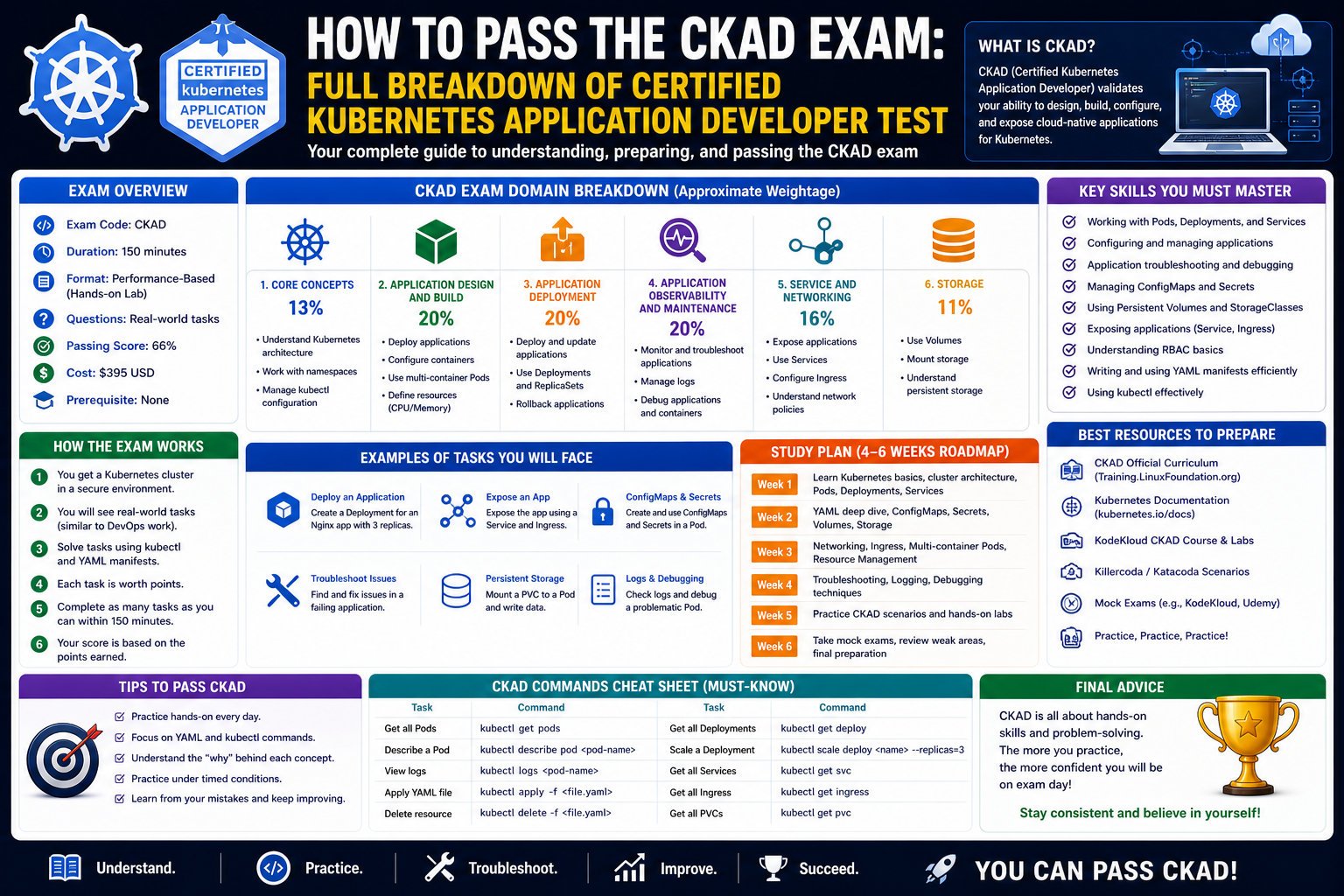
The Certified Kubernetes Application Developer (CKAD) certification is widely recognized as a benchmark for validating practical skills in building and managing applications within Kubernetes environments. Unlike theoretical certifications that focus heavily on concepts, CKAD is designed to measure hands-on ability. It reflects how well a candidate can work with Kubernetes in real-world scenarios where speed, accuracy, and familiarity with command-line operations matter more than memorized definitions.
Kubernetes itself has become a foundational technology in modern cloud-native computing. Organizations increasingly rely on it to manage containerized applications at scale. As a result, professionals who can demonstrate competency in designing and maintaining applications on Kubernetes are in high demand. CKAD serves as a structured way to confirm those skills, particularly for developers, system engineers, and administrators who work directly with application workloads.
What makes CKAD distinct is its emphasis on application-level understanding rather than cluster administration. Candidates are not tested on how to install or manage Kubernetes clusters. Instead, the focus is on how applications behave inside a cluster—how they are deployed, exposed, monitored, and secured. This distinction is important because it shapes how candidates must prepare. The exam evaluates whether someone can think like an application engineer operating in a distributed system environment.
The certification also reflects the broader evolution of software development. Modern applications are no longer monolithic systems deployed on single servers. Instead, they are composed of multiple microservices running in containers, communicating over networks, and scaling dynamically based on demand. Kubernetes acts as the orchestration layer that manages this complexity. CKAD ensures that professionals understand how to build applications that fit naturally into this ecosystem.
Another key aspect of CKAD is its practical orientation. The exam is not about answering theoretical questions or selecting options from a list. It is about performing tasks directly in a live environment. This means candidates must be comfortable with command-line interfaces, YAML configurations, and Kubernetes resource definitions. The ability to translate requirements into working configurations quickly is central to success.
Because of this hands-on nature, CKAD is often seen as a test of real competence rather than academic knowledge. It rewards experience and practice more than rote learning. Candidates who regularly work with Kubernetes tend to find the exam more intuitive, while those who only study theory may struggle with its practical demands.
Structure and Expectations of the CKAD Exam Environment
The CKAD exam is conducted in a controlled, remote environment where candidates are given access to a live Kubernetes setup. Instead of traditional multiple-choice questions, the exam consists entirely of practical tasks that must be completed using the command line. This format is intentional, as it reflects the real-world responsibilities of application developers working with Kubernetes.
The duration of the exam is limited, requiring candidates to manage their time carefully. Each task is independent, and candidates must switch between different Kubernetes contexts, namespaces, and resources. The environment is designed to simulate the unpredictability of real operational work, where tasks often need to be solved under time pressure.
One of the defining characteristics of the CKAD exam is its strict scoring system. Each task carries a specific weight, and the total score determines whether a candidate passes. There is no partial credit for incomplete solutions, which makes precision extremely important. Even small mistakes, such as working in the wrong namespace or misconfiguring a resource, can lead to lost points.
The exam interface typically presents instructions on one side and a terminal on the other. Candidates must interpret the requirements carefully before executing commands. This split-screen setup reinforces the importance of reading comprehension alongside technical ability. Misunderstanding a requirement can result in wasted time and incorrect configurations.
Another important aspect of the exam environment is its emphasis on efficiency. Candidates are expected to know how to perform tasks quickly without relying on external references. While Kubernetes documentation is available during the exam, excessive dependency on it can significantly slow progress. This is why familiarity with core commands and resource structures is essential.
The exam also tests adaptability. Kubernetes environments can vary in configuration, and tasks may require modifying existing resources rather than creating them from scratch. This requires candidates to understand not only how to build resources but also how to interpret and adjust existing ones effectively.
Overall, the CKAD exam environment is designed to replicate real operational conditions where developers must work under constraints, interpret requirements accurately, and deliver working solutions quickly.
Core Philosophy Behind CKAD Assessment
At its core, CKAD is built around the philosophy of practical cloud-native application development. It does not aim to test memorization of Kubernetes documentation but rather the ability to apply Kubernetes concepts in meaningful ways. This approach aligns with how modern software systems are built and maintained.
One of the central ideas behind CKAD is that developers should understand how their applications behave in distributed systems. This includes understanding how containers interact, how services communicate, and how configurations influence runtime behavior. Kubernetes acts as the framework that ties these components together, and CKAD ensures candidates can operate effectively within that framework.
Another important philosophy is automation and declarative thinking. Kubernetes encourages users to define desired states rather than manually controlling every step of execution. CKAD reflects this by requiring candidates to work with declarative configurations such as resource definitions. Even though the exam allows imperative commands for speed, understanding declarative structures remains essential.
The certification also emphasizes resilience and observability. Applications in Kubernetes are expected to self-heal, scale, and respond to changing conditions. CKAD ensures that candidates understand how to configure health checks, resource limits, and monitoring mechanisms. These concepts are critical in ensuring that applications remain stable in production environments.
Security is another foundational principle. While CKAD does not focus on deep security administration, it does require familiarity with basic security constructs such as configuration management and controlled access to sensitive data. This reflects the reality that application developers must consider security implications when designing systems.
The exam also promotes efficiency in problem-solving. Kubernetes environments can be complex, and tasks often require combining multiple concepts. CKAD encourages candidates to think in terms of reusable patterns and modular configurations. This helps in building scalable and maintainable applications.
Overall, the philosophy behind CKAD is to ensure that certified individuals are not just familiar with Kubernetes but are capable of using it effectively to solve real application challenges.
Application Design and Build Concepts in Kubernetes
One of the most important areas covered in CKAD is application design and build. This domain focuses on how applications are structured and deployed within a Kubernetes environment. It requires an understanding of how containers are defined, how pods are structured, and how applications interact with underlying infrastructure resources.
At the heart of this domain is the concept of a pod. A pod represents the smallest deployable unit in Kubernetes and typically contains one or more containers that share networking and storage resources. Understanding how pods are created and configured is essential because they form the foundation of all application deployments.
Application design in Kubernetes also involves defining how containers behave when they start. This includes specifying commands, environment variables, and runtime configurations. These settings determine how the application initializes and operates within the cluster. Misconfiguration at this stage can lead to failed deployments or unstable behavior.
Resource management is another key aspect. Applications must be designed with appropriate CPU and memory allocations to ensure stability and performance. Kubernetes allows developers to define resource requests and limits, which help the system allocate resources efficiently. CKAD tests the ability to configure these parameters correctly.
Ingress and service configuration also play a major role in application design. Applications often need to be accessible from outside the cluster, and Kubernetes provides mechanisms for routing traffic through services and ingress controllers. Understanding how these components work together is essential for building accessible applications.
Another important concept is the ability to modify existing resources. In real-world environments, applications are rarely built from scratch every time. Instead, developers often need to adjust configurations, update deployments, or troubleshoot issues. CKAD reflects this reality by including tasks that require modifying existing Kubernetes objects.
Application design in Kubernetes is also closely tied to scalability. Applications must be able to handle varying levels of demand, which means understanding how replicas and scaling mechanisms work. Kubernetes provides built-in tools for scaling applications horizontally, and CKAD ensures candidates understand how to use them effectively.
Overall, this domain focuses on building a strong foundation in how applications are structured, deployed, and managed within Kubernetes environments.
Application Deployment Strategies and Lifecycle Management
Application deployment is another critical domain in CKAD, focusing on how applications are released, updated, and maintained within a Kubernetes cluster. This involves understanding deployment objects, rollout strategies, and version control mechanisms.
Deployments in Kubernetes provide a structured way to manage application updates. They ensure that changes to an application are applied in a controlled manner, reducing downtime and maintaining stability. CKAD requires candidates to understand how to create and manage these deployment objects effectively.
One of the key concepts in this area is rolling updates. Instead of shutting down an application completely during an update, Kubernetes gradually replaces old versions with new ones. This ensures continuous availability. Candidates must understand how to configure and monitor these updates.
Rollback strategies are equally important. In cases where a new deployment introduces issues, Kubernetes allows reverting to a previous stable version. CKAD tests the ability to manage these scenarios, ensuring that candidates can maintain application reliability.
Scaling is another important aspect of deployment management. Applications often need to handle fluctuating traffic, and Kubernetes provides mechanisms to adjust the number of running instances dynamically. Understanding how to scale deployments up or down is a core requirement.
This domain also touches on package management tools used in Kubernetes environments. While not heavily emphasized, familiarity with deployment automation tools helps in understanding how applications are packaged and deployed in real-world systems.
Another important consideration is deployment consistency. Applications must behave predictably across different environments. This requires careful configuration management and understanding how deployment definitions influence runtime behavior.
Lifecycle management in Kubernetes is not just about initial deployment but also about ongoing maintenance. Applications must be updated, patched, and monitored continuously. CKAD ensures candidates understand this full lifecycle approach.
Overall, application deployment in CKAD focuses on maintaining stability, ensuring smooth updates, and managing application versions effectively within Kubernetes environments.
Working with Observability in Kubernetes Applications
Observability in Kubernetes is centered around understanding how applications behave once they are running inside a cluster. Unlike traditional environments where logs and metrics might be collected from a single machine, Kubernetes introduces a distributed system where multiple containers run across different nodes. This makes visibility into application behavior significantly more complex, and CKAD places strong emphasis on whether a candidate can interpret and work with that complexity.
At the application level, observability typically begins with understanding runtime signals. These include whether a container is running, whether it is restarting frequently, and whether it is responding correctly to requests. Kubernetes provides built-in mechanisms to monitor these signals, but the real skill lies in interpreting what they mean in context. A container restarting repeatedly, for example, might indicate a configuration error, a missing dependency, or a resource limitation.
Health checks play a major role in observability. Applications in Kubernetes are expected to expose signals that indicate whether they are functioning correctly. These signals are used by the system to determine when to restart containers or remove them from service routing. Understanding how these checks influence application stability is essential for anyone working with Kubernetes workloads.
Logging is another critical component. In a Kubernetes environment, logs are not stored in a single centralized location by default. Instead, they are tied to individual containers. This means developers must know how to access logs from specific workloads and interpret them in relation to application behavior. CKAD expects candidates to be comfortable navigating these logs to identify issues quickly.
Observability also extends beyond immediate failures. It includes understanding how applications perform under load, how they respond to changes in traffic, and whether they degrade gracefully when resources are constrained. These behaviors are often subtle and require careful interpretation of system signals.
The key challenge in observability is connecting symptoms to causes. A failing application may present multiple signals, such as slow response times, restart loops, or failed readiness checks. The ability to correlate these symptoms with configuration or environmental issues is a defining skill in Kubernetes application development.
Troubleshooting Application Behavior in Real Cluster Environments
Troubleshooting in Kubernetes is not a linear process. It requires a structured way of thinking that begins with identifying what is wrong and progressively narrowing down the possible causes. CKAD evaluates whether candidates can follow this type of reasoning under time constraints.
One of the first steps in troubleshooting is understanding the state of the application. This includes checking whether pods are running, pending, or failing. Each state provides a different clue about what might be happening. For example, a pending state might indicate resource constraints or scheduling issues, while a failed state might point to configuration errors.
Once the state is understood, the next step is examining configuration details. Kubernetes applications are highly dependent on configuration files, and even small mistakes can cause significant issues. This includes incorrect environment variables, missing configuration references, or invalid resource definitions.
Another important aspect of troubleshooting is understanding dependency relationships. Applications often rely on services, databases, or external endpoints. If any of these dependencies fail, the application may behave unexpectedly. Identifying these relationships is key to isolating the root cause of a problem.
Resource limitations are also a common source of issues. If an application requests more CPU or memory than is available in the cluster, it may not start or may be terminated unexpectedly. Understanding how Kubernetes schedules workloads helps in diagnosing these types of problems.
Networking issues can also lead to application failures. If a service is not reachable, it may be due to misconfigured network policies, incorrect service definitions, or routing problems. Troubleshooting these issues requires understanding how traffic flows within the cluster.
A strong troubleshooting mindset involves working systematically rather than randomly changing configurations. It requires testing hypotheses, validating assumptions, and narrowing down potential causes step by step. This structured approach is essential for success in CKAD scenarios.
Services in Kubernetes and Communication Between Components
Services in Kubernetes act as stable interfaces for accessing application workloads. Since pods are ephemeral and can be created or destroyed dynamically, services provide a consistent way to communicate with them. This abstraction is critical in ensuring that applications remain accessible even as their underlying components change.
There are different types of services, each designed for specific communication needs. Some services are used for internal communication within the cluster, while others expose applications externally. Understanding these differences is essential for building functional systems.
Internal services allow communication between components inside the cluster. For example, a frontend application might communicate with a backend service using an internal service endpoint. This ensures that communication remains stable even if backend pods are replaced or scaled.
External services, on the other hand, allow applications to be accessed from outside the cluster. These services are typically used when applications need to be exposed to users or external systems. Configuring these services correctly is essential for application accessibility.
Services also play a role in load balancing. When multiple instances of an application are running, services distribute traffic across them. This ensures that no single instance becomes overloaded, improving performance and reliability.
Another important concept is service discovery. In Kubernetes, services provide a way for applications to locate each other without needing to know specific IP addresses. This abstraction simplifies application design and improves flexibility.
Understanding how services interact with pods and endpoints is critical for CKAD. It requires recognizing how labels and selectors are used to connect services to the correct workloads. Misconfiguration in this area can lead to broken communication between components.
Networking Fundamentals Inside Kubernetes Clusters
Networking in Kubernetes is one of the most important yet complex aspects of the system. It defines how applications communicate with each other and with external systems. Unlike traditional networking environments, Kubernetes abstracts much of the underlying infrastructure, requiring developers to understand higher-level concepts.
Each pod in Kubernetes receives its own network identity. This means that every container can communicate directly with others using a flat networking model. There is no need for manual network address translation between pods, which simplifies communication.
However, this simplicity introduces new challenges. Since pods are dynamic, their network identities can change. This is why services are used to provide stable communication endpoints. Understanding this relationship is essential for working with Kubernetes networking.
Network policies add another layer of complexity. These policies define which components are allowed to communicate with each other. They are used to enforce security boundaries within the cluster. Misconfigured policies can lead to blocked communication or unintended access.
DNS also plays a key role in Kubernetes networking. Services are typically accessed using DNS names rather than IP addresses. This allows applications to remain decoupled from underlying infrastructure changes.
Traffic routing within the cluster is handled by Kubernetes networking components that ensure requests reach the correct destination. Understanding how this routing works helps in diagnosing connectivity issues.
Networking in Kubernetes is not just about connectivity but also about isolation, security, and scalability. CKAD evaluates whether candidates understand these principles and can apply them when configuring applications.
Ingress and Traffic Routing for Application Exposure
Ingress is a mechanism used to manage external access to services within a Kubernetes cluster. It acts as a gateway that routes external traffic to internal services based on defined rules. This allows multiple applications to be exposed through a single entry point.
The primary role of ingress is to simplify external access. Instead of exposing multiple services individually, ingress consolidates routing logic into a single resource. This makes management easier and improves scalability.
Ingress rules define how traffic should be directed. These rules can be based on URL paths, hostnames, or other request attributes. Understanding how to configure these rules is essential for controlling application exposure.
Another important aspect of ingress is load balancing. Traffic entering the cluster can be distributed across multiple services or pods, ensuring efficient resource utilization.
SSL termination is also commonly handled through ingress configurations. This allows secure communication between external clients and internal services without modifying application code.
Ingress controllers are responsible for implementing ingress rules. These controllers interpret configurations and manage traffic routing accordingly. Understanding their role helps in diagnosing issues related to external access.
CKAD requires candidates to understand how ingress integrates with services and networking components to create a complete traffic flow from external clients to internal applications.
Configuration Management with ConfigMaps and Runtime Flexibility
Configuration management in Kubernetes is handled primarily through ConfigMaps. These allow applications to separate configuration data from application code, improving flexibility and maintainability.
ConfigMaps store non-sensitive configuration data that can be injected into applications at runtime. This allows applications to behave differently depending on the environment without requiring code changes.
One of the key benefits of ConfigMaps is decoupling configuration from deployment. This means the same application image can be used across multiple environments with different configurations applied dynamically.
Applications can consume configuration data in different ways. It can be passed as environment variables or mounted as files inside containers. Understanding these methods is important for effective application design.
Runtime flexibility is a major advantage of using ConfigMaps. It allows changes to be applied without rebuilding or redeploying applications. This improves efficiency and reduces downtime.
ConfigMaps also play a role in scalability. As applications grow, managing configuration separately becomes essential for maintaining consistency across multiple instances.
CKAD evaluates the ability to create and use ConfigMaps effectively within application deployments. This includes understanding how configuration data influences application behavior.
Handling Secrets and Secure Data in Application Workloads
Secrets in Kubernetes are used to manage sensitive information such as credentials, tokens, and keys. Unlike ConfigMaps, secrets are designed specifically to handle data that requires protection.
Secrets are encoded rather than stored in plain text. This provides a basic level of security while ensuring that applications can still access the data when needed. However, understanding how secrets are managed is crucial for secure application design.
Applications can access secrets in similar ways to ConfigMaps, either through environment variables or mounted files. The choice depends on how the application is designed to consume sensitive data.
Security in Kubernetes is not just about encryption but also about access control. Ensuring that only authorized applications can access specific secrets is an important part of system design.
Secrets also need to be managed carefully in deployment pipelines. Improper handling can lead to exposure of sensitive information, which can compromise the entire system.
CKAD expects candidates to understand how secrets integrate with application workloads and how they differ from general configuration data.
Security Mindset for Application Developers in Kubernetes
Security in Kubernetes is closely tied to application design. Developers must consider security implications when defining how applications interact with the system.
One important aspect is limiting access to resources. Applications should only have access to the components they need to function. This reduces the risk of unintended interactions.
Another key principle is minimizing privilege levels. Applications should run with the lowest level of access required for their operation.
Network segmentation also plays a role in security. By controlling how components communicate, it is possible to reduce exposure to potential threats.
Security is not an isolated concept in Kubernetes. It is integrated into configuration, networking, and deployment practices. CKAD ensures candidates understand this interconnected nature.
Debugging Workflows and an Efficient Problem-Solving Approach in the CKAD Context
Debugging in Kubernetes requires a structured workflow that focuses on isolating problems quickly. This involves examining application states, reviewing configurations, and testing assumptions systematically.
Efficiency is critical due to time constraints. Candidates must be able to identify likely causes of issues without unnecessary exploration.
A strong debugging approach involves breaking problems into smaller parts. Instead of analyzing the entire system at once, it is more effective to isolate individual components.
Understanding common failure patterns also helps in speeding up debugging. Many issues in Kubernetes follow predictable patterns related to configuration or resource constraints.
Common Misinterpretations Candidates Face in Practical Kubernetes Tasks
Many candidates struggle not because of a lack of knowledge but due to a misinterpretation of requirements. Small misunderstandings can lead to incorrect implementations.
One common issue is working in the wrong context or namespace. Since Kubernetes environments are segmented, this can lead to valid configurations being applied in the wrong place.
Another frequent misunderstanding involves configuration scope. Candidates may assume changes apply globally when they are actually limited to specific resources.
Time mismanagement is also a challenge. Spending too long on one task can reduce the ability to complete the exam.
Understanding instructions carefully and translating them accurately into actions is one of the most important skills in CKAD environments.
Application Environment Configuration and Runtime Behavior in Kubernetes
Application environment configuration in Kubernetes is one of the most critical areas for building stable, portable, and scalable workloads. It determines how an application behaves once deployed inside a cluster and directly influences reliability, performance, and maintainability. In CKAD scenarios, this area is not just about knowing configuration objects, but about understanding how those configurations shape runtime behavior in real systems.
At a high level, Kubernetes encourages separating configuration from application code. This separation allows the same application image to run in different environments without modification. Instead of embedding values directly into the application, Kubernetes provides mechanisms to inject configuration dynamically at runtime. This approach reduces duplication and improves consistency across environments.
Environment variables are one of the most common ways to pass configuration into containers. These variables allow applications to adjust behavior based on external input. For example, an application might change logging levels, database connections, or feature flags depending on the environment variables provided at runtime.
Another important method is file-based configuration injection. In this approach, configuration data is mounted into a container as files. Applications then read these files at startup or during execution. This method is often preferred for complex configuration structures or when applications expect configuration in structured formats.
Kubernetes ensures that configuration is decoupled from deployment logic. This means updates to the configuration do not necessarily require rebuilding or redeploying application images. Instead, configuration can be modified independently, allowing faster iteration and reduced downtime.
However, this flexibility also introduces complexity. Misconfigured environment settings can lead to unexpected application behavior. A missing variable or incorrect value can prevent an application from starting or cause runtime failures that are difficult to diagnose.
Understanding how configuration propagates through the system is essential. When a pod starts, it pulls configuration from defined sources and applies it before the application begins execution. This timing is critical because some applications only read configuration at startup, while others support dynamic updates.
CKAD evaluates whether candidates understand these mechanisms and can apply them effectively in practical scenarios. This includes creating configurations, injecting them into pods, and verifying their effects on application behavior.
ConfigMaps and Their Role in Flexible Application Design
ConfigMaps are a core Kubernetes object used to store non-sensitive configuration data. They provide a structured way to separate configuration from application logic, enabling greater flexibility and portability.
A ConfigMap typically contains key-value pairs that define application settings. These settings can include environment-specific values such as URLs, feature toggles, or runtime parameters. By externalizing these values, applications become easier to manage across multiple environments.
One of the most important advantages of ConfigMaps is reusability. The same application image can be deployed in development, testing, and production environments with different ConfigMaps applied. This reduces duplication and ensures consistency in deployment processes.
ConfigMaps can be consumed in multiple ways. One approach is to inject them as environment variables. In this case, each key in the ConfigMap becomes an environment variable inside the container. Another approach is mounting the ConfigMap as a volume, allowing applications to read configuration from files.
The choice between these methods depends on application design. Some applications are built to read environment variables, while others expect configuration files. Kubernetes supports both approaches to accommodate different application architectures.
Another important aspect of ConfigMaps is update behavior. When a ConfigMap is updated, the changes may or may not immediately reflect inside running pods, depending on how the configuration is consumed. This introduces important considerations around application reload strategies.
In some cases, applications must be restarted to pick up configuration changes. In other cases, they can detect changes dynamically. Understanding this behavior is important for maintaining consistency in production systems.
ConfigMaps also help reduce hardcoding of values in application code. This improves maintainability and allows operations teams to adjust configurations without modifying application logic.
From a CKAD perspective, candidates are expected to understand how to create ConfigMaps, how to reference them in workloads, and how they influence runtime behavior.
Secrets and Secure Configuration Handling in Kubernetes
Secrets in Kubernetes serve a similar purpose to ConfigMaps but are specifically designed for sensitive data. This includes credentials, authentication tokens, API keys, and certificates. Unlike ConfigMaps, Secrets are intended to add a layer of protection around sensitive information.
At a structural level, Secrets stores data in an encoded format. While this encoding is not true encryption by default, it provides a basic level of obfuscation. More importantly, Kubernetes treats Secrets differently in terms of access control and handling.
Applications consume Secrets in much the same way as ConfigMaps. They can be injected as environment variables or mounted as files. However, the sensitive nature of the data requires more careful handling.
One of the key considerations with Secrets is access control. Not all workloads should have access to all Secrets. Kubernetes provides mechanisms to restrict access based on namespaces and permissions. This ensures that sensitive data is only available to authorized components.
Another important aspect is lifecycle management. Secrets must be updated carefully to avoid exposing credentials or breaking application connectivity. Changes to Secrets may require pod restarts depending on how they are consumed.
Secrets also play a role in external system integration. Many applications rely on external services that require authentication. Secrets provide a standardized way to manage these credentials within Kubernetes.
A common challenge is ensuring that Secrets are not exposed unintentionally through logs, environment dumps, or misconfigured access policies. Developers must be careful not to treat Secrets as regular configuration data.
CKAD evaluates whether candidates understand how to create and use Secrets, and how they differ from ConfigMaps in both purpose and handling.
Runtime Behavior of Applications in Distributed Environments
Applications running in Kubernetes behave differently from traditional monolithic applications. Instead of running in a single environment, they operate across multiple containers and nodes. This distributed nature introduces complexity in how applications behave at runtime.
One key characteristic of distributed applications is variability. Different instances of the same application may behave differently depending on their environment, resource allocation, or network conditions.
Kubernetes manages this variability through abstraction. It ensures that applications are deployed consistently while still allowing flexibility in execution. However, developers must understand how this abstraction impacts behavior.
Resource constraints are a major factor in runtime behavior. Applications are limited by CPU and memory allocations defined in their configuration. If these limits are reached, applications may slow down or be terminated.
Another important factor is scheduling. Kubernetes decides where to run each pod based on available resources and constraints. This means that application performance can vary depending on node capacity and workload distribution.
Network latency is also a key consideration. Since applications may run across multiple nodes, communication between services can introduce delays. Understanding these delays is important for designing efficient systems.
State management is another challenge. Kubernetes is designed for stateless applications, meaning that applications should not rely on local storage for persistent data. Instead, external storage systems are used for persistence.
These runtime characteristics require developers to think differently about application design. CKAD ensures that candidates understand these behaviors and can design applications that operate effectively in distributed environments.
Observability at Runtime and Understanding Application Signals
Observability in Kubernetes is closely tied to runtime signals produced by applications. These signals provide insight into the health and performance of workloads.
One of the most important signals is container status. Containers can be in different states, such as running, pending, or failed. Each state provides information about the underlying issue.
Restart behavior is another key indicator. Frequent restarts often indicate configuration problems, resource exhaustion, or application errors.
Health probes are used to monitor application readiness and liveness. These probes help Kubernetes determine whether an application is functioning correctly and whether it should receive traffic.
Logs are another critical source of information. They provide detailed insights into application behavior and help diagnose issues. However, logs must be interpreted in context to be useful.
Metrics provide quantitative data about application performance. These include CPU usage, memory consumption, and request latency.
Understanding how to interpret these signals is essential for maintaining application reliability. CKAD evaluates whether candidates can use these signals to understand system behavior.
Scaling Applications and Managing Workload Demand
Scaling is a fundamental concept in Kubernetes that allows applications to handle varying levels of demand. Instead of manually adjusting resources, Kubernetes provides automated mechanisms for scaling workloads.
Horizontal scaling involves increasing or decreasing the number of application instances. This allows systems to handle more traffic by distributing load across multiple pods.
Scaling decisions are often based on metrics such as CPU usage or request volume. When demand increases, additional instances are created automatically.
Conversely, when demand decreases, unnecessary instances are removed to conserve resources.
Scaling must be carefully managed to avoid instability. Rapid scaling can lead to resource contention, while insufficient scaling can cause performance degradation.
CKAD requires understanding how scaling mechanisms work and how they affect application performance.
Maintenance Strategies for Running Applications
Maintaining applications in Kubernetes involves ensuring that they remain stable, secure, and up to date. This includes monitoring performance, applying updates, and handling failures.
One important aspect of maintenance is rolling updates. These updates allow applications to be modified without downtime by gradually replacing old instances with new ones.
Rollback strategies are also important. If an update causes issues, systems must be able to revert to a previous stable version.
Monitoring is essential for ongoing maintenance. It allows teams to detect issues early and respond before they affect users.
Resource optimization is another maintenance activity. Applications may need adjustments to resource allocations based on observed usage patterns.
CKAD evaluates whether candidates understand how to maintain applications in a dynamic environment.
Handling Failure Scenarios and Recovery Mechanisms
Failures are inevitable in distributed systems, and Kubernetes is designed to handle them gracefully. Understanding failure scenarios is critical for building resilient applications.
One common failure scenario is pod crashes. When a container fails, Kubernetes attempts to restart it automatically.
Node failures can also occur, causing pods to be rescheduled on other nodes.
Network failures may prevent communication between services, leading to degraded functionality.
Recovery mechanisms ensure that applications continue to operate despite these failures. These mechanisms include replication, self-healing, and automated restarts.
CKAD assesses whether candidates understand how these recovery processes work and how applications respond to failures.
Advanced Application Design Considerations in Kubernetes
Advanced application design involves thinking beyond basic deployment and considering long-term scalability, maintainability, and resilience.
One consideration is modular architecture. Applications should be broken into smaller services that can be managed independently.
Another consideration is stateless design. Stateless applications are easier to scale and recover from failures.
Dependency management is also important. Applications should minimize tight coupling to external services.
Performance optimization plays a role in advanced design. Efficient resource usage improves system stability and reduces costs.
CKAD ensures candidates understand these principles at a practical level.
Real-World Thinking Patterns for Kubernetes Application Developers
Working with Kubernetes requires a shift in thinking from traditional application development. Instead of focusing on single systems, developers must think in terms of distributed components.
This includes understanding how services interact, how configurations propagate, and how failures are handled.
It also involves thinking in terms of automation. Manual processes are replaced with declarative configurations that define desired outcomes.
Finally, it requires adaptability. Kubernetes environments are dynamic, and applications must be designed to operate reliably under changing conditions.
CKAD reflects these thinking patterns by testing practical application skills in realistic scenarios.
Conclusion
The CKAD certification represents more than just a technical credential; it reflects a practical understanding of how modern cloud-native applications are designed, deployed, and maintained within Kubernetes environments. Throughout the exam, the emphasis is consistently placed on real-world skills rather than theoretical knowledge, requiring candidates to demonstrate their ability to work directly with live systems under time constraints.
What makes CKAD particularly valuable is its focus on application development within distributed systems. Candidates are expected to understand how containers behave, how services communicate, and how configurations influence runtime behavior. These skills are not isolated concepts but interconnected parts of a larger ecosystem that defines how Kubernetes applications operate in production environments.
The exam also highlights the importance of efficiency and accuracy. With limited time and task-based evaluation, candidates must be able to interpret requirements quickly and translate them into working solutions. This requires both technical familiarity and structured problem-solving skills. Mistakes such as misconfigured namespaces or incorrect resource definitions can significantly impact outcomes, reinforcing the need for precision.
Beyond the exam itself, the knowledge gained through CKAD preparation has lasting value. It builds a strong foundation in Kubernetes fundamentals, including application deployment, observability, networking, configuration management, and security principles. These concepts are essential for anyone working in modern infrastructure or cloud-native development environments.
Ultimately, CKAD serves as a benchmark for practical competency in Kubernetes application development. It encourages professionals to think in terms of distributed systems, automation, and resilience. As organizations continue to adopt containerized architectures, the ability to design and manage applications effectively in Kubernetes becomes increasingly important.
For those pursuing a career in cloud-native technologies, CKAD provides both validation of existing skills and a structured path for a deeper understanding of how modern applications are built and operated at scale.