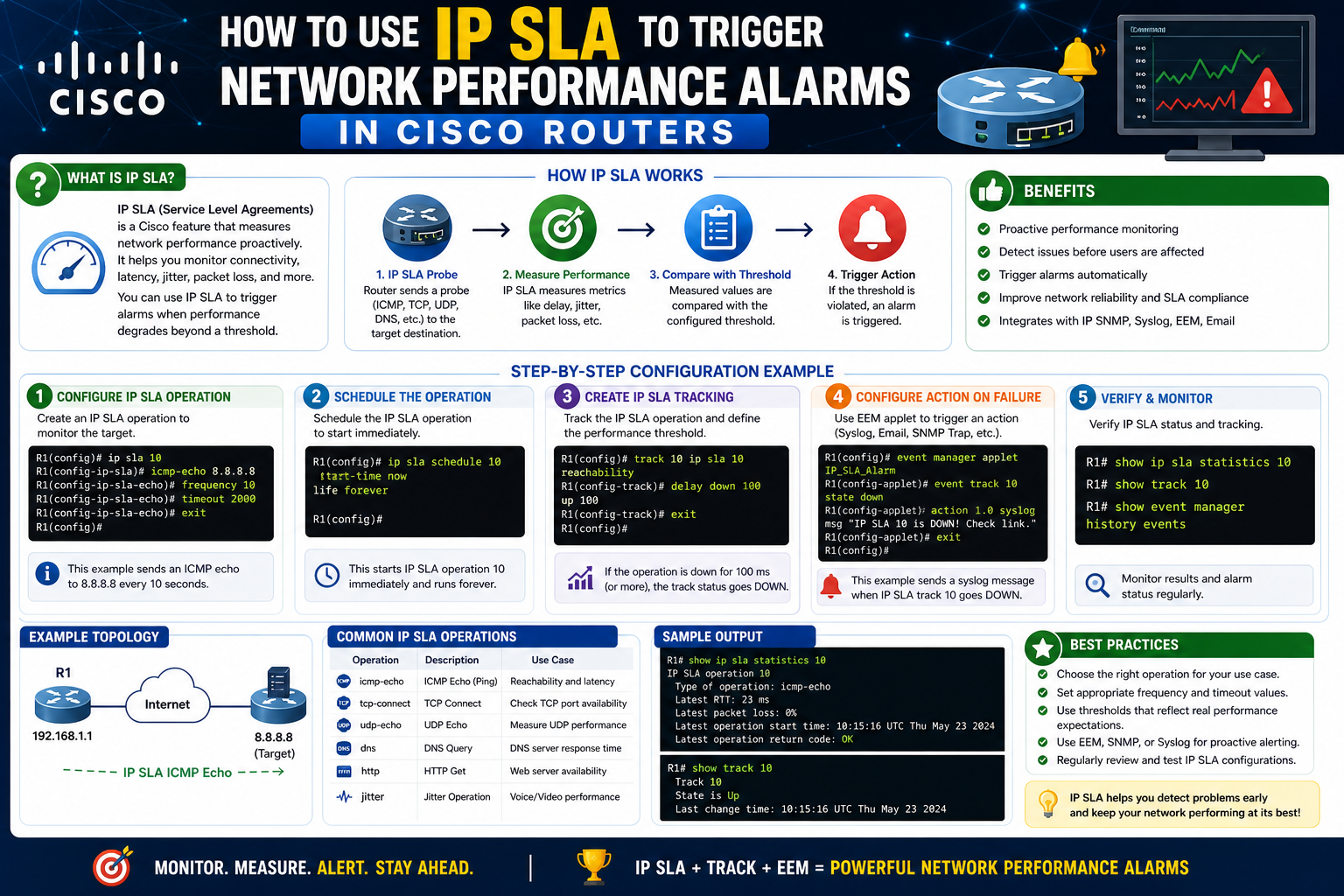
Network administration has traditionally been a reactive discipline. In many environments, administrators only become aware of issues when users start reporting them. Slow applications, dropped voice calls, and intermittent connectivity problems usually trigger a chain of troubleshooting efforts that consume time and resources. This reactive cycle often leads to pressure on IT teams, especially when the root cause of a problem is difficult to trace across multiple network segments.
Modern enterprise networks are far more complex than in the past. With cloud integration, remote users, virtualized infrastructure, and real-time applications, the margin for error has become extremely small. Even brief performance degradation can affect business operations. Because of this, network professionals increasingly rely on tools that provide continuous visibility into network behavior before users notice anything unusual.
This is where proactive monitoring becomes essential. Instead of waiting for incidents, administrators aim to measure network performance in real time and detect early warning signs. IP SLA is one of the technologies designed specifically to support this shift. It allows network teams to simulate traffic and observe how the network responds under controlled conditions, helping them identify performance issues before they escalate into outages.
What IP SLA Represents in Cisco Networking
IP SLA stands for Internet Protocol Service Level Agreement. It is a built-in feature in Cisco networking devices that enables administrators to actively monitor network performance by generating synthetic traffic. Unlike passive monitoring tools that only observe existing traffic, IP SLA creates controlled traffic flows to test specific network paths, services, or behaviors.
The purpose of IP SLA is not just to measure connectivity but to understand performance quality. It focuses on metrics such as latency, jitter, packet loss, and availability. These metrics are critical for applications that depend on consistent network behavior, especially real-time services like voice and video communication.
IP SLA operates by sending test packets from a source device to a destination device or responder. These packets simulate real application traffic, allowing administrators to measure how the network handles specific types of load. Because the traffic is synthetic, it can be controlled precisely in terms of frequency, size, protocol type, and destination behavior.
This makes IP SLA a powerful diagnostic and planning tool. It is widely used in enterprise environments where service reliability is a priority and where even minor performance fluctuations can have significant operational impact.
Evolution of IP SLA in Cisco Systems
The concept behind IP SLA has evolved over time. In earlier Cisco operating systems, similar functionality was known under different names such as the Real-Time Responder and Service Assurance Agent. These earlier implementations laid the groundwork for more advanced monitoring capabilities.
As Cisco IOS matured, the functionality was unified under the IP SLA framework. This transition allowed for a more standardized approach to performance measurement across different network environments. Since its formal introduction, IP SLA has become a core feature in Cisco devices, continuously expanding to support new protocols, applications, and performance metrics.
Today, IP SLA is not limited to simple reachability tests. It supports complex performance simulations, including voice traffic behavior, application response times, and multi-path network analysis. Its evolution reflects the growing need for precision in network performance monitoring.
Core Concept of Synthetic Traffic Generation
At the heart of IP SLA is the idea of synthetic traffic. Unlike real user-generated traffic, synthetic traffic is artificially created by network devices for the purpose of measurement. This traffic mimics real application behavior but is controlled entirely by the administrator.
The advantage of synthetic traffic is that it allows consistent and repeatable testing. Because the traffic is generated under controlled conditions, administrators can isolate specific variables such as path quality or device performance. This makes it easier to identify whether a problem is caused by the network itself or by application behavior.
Synthetic traffic can be customized to resemble different types of applications. For example, voice traffic can be simulated using specific codecs, while data traffic can be tested using different packet sizes or transmission intervals. This flexibility allows IP SLA to be used across a wide range of network scenarios.
The Role of IP SLA Source and Responder
IP SLA operations rely on two primary components: the source device and the responder.
The source device is responsible for generating synthetic traffic. It initiates test packets and collects performance data based on how those packets travel through the network. This device is typically a router or switch configured with IP SLA operations.
The responder is an optional but highly valuable component. It is configured on the destination device to provide enhanced measurement accuracy. When enabled, the responder helps isolate network delay from device processing delay. This ensures that performance metrics reflect the actual network behavior rather than internal device processing time.
In environments where precision is critical, especially in voice and video networks, using a responder significantly improves the accuracy of measurements. However, IP SLA can still function without a responder, although with slightly reduced precision.
Key Performance Metrics Measured by IP SLA
IP SLA is designed to measure several important network performance indicators. These metrics help administrators understand not just whether the network is functioning, but how well it is functioning.
Latency is one of the primary metrics. It measures the time it takes for a packet to travel from source to destination. High latency can negatively impact real-time applications and user experience.
Jitter is another critical metric. It refers to the variation in packet delay over time. Even if latency is acceptable on average, inconsistent delivery times can disrupt voice and video communication. Jitter is especially important in VoIP environments.
Packet loss measures how many packets fail to reach their destination. Even small amounts of packet loss can degrade application performance significantly, particularly in streaming or interactive services.
Availability is also tracked, representing whether the destination is reachable during a given period. This metric helps determine service reliability over time.
Together, these metrics provide a comprehensive view of network health and performance trends.
Why Jitter Matters in Real-Time Applications
Among all IP SLA metrics, jitter is particularly important for modern communication systems. Unlike traditional data transfers, voice and video applications rely on consistent packet timing.
When packets arrive at irregular intervals, audio and video streams can become distorted. This results in choppy calls, frozen video frames, or synchronization issues. Even if the network has sufficient bandwidth, high jitter can still degrade user experience.
IP SLA helps detect jitter by sending controlled streams of packets and measuring variation in their arrival times. This allows administrators to identify unstable network paths or overloaded links.
By monitoring jitter proactively, network teams can adjust routing, upgrade infrastructure, or apply quality of service policies to maintain stable performance for critical applications.
How IP SLA Integrates into Network Infrastructure
IP SLA is typically integrated directly into routers and switches within the network infrastructure. Because it is embedded at the device level, it does not require external monitoring systems to function.
Once configured, IP SLA operations run continuously or at scheduled intervals. They can be designed to test specific paths between branches, data centers, or cloud services. This makes IP SLA especially useful in distributed networks where visibility across multiple segments is required.
The results generated by IP SLA can be analyzed locally or exported to monitoring systems using standard protocols. This allows administrators to centralize performance data and correlate it with other network events.
Operational Flexibility of IP SLA
One of the strengths of IP SLA is its flexibility. It supports a wide variety of test types, including ICMP echo tests, UDP jitter tests, TCP connectivity checks, and application-specific simulations.
This flexibility allows administrators to tailor monitoring strategies based on specific network requirements. For example, a financial organization may prioritize latency and packet loss monitoring, while a media company may focus more heavily on jitter and streaming performance.
IP SLA can also be scheduled to run at different intervals, depending on how frequently performance data is needed. Some tests may run continuously, while others may run during peak usage hours to capture real-world conditions.
Limitations and Considerations in Real Deployments
While IP SLA is a powerful tool, it is not without limitations. One important consideration is that synthetic traffic does not always perfectly represent real user behavior. Although it simulates application traffic, it still operates under controlled conditions that may not reflect all real-world variables.
Another consideration is resource consumption. Frequent or complex IP SLA operations can add overhead to network devices, especially if they are already operating under heavy load. Careful planning is required to ensure that monitoring does not interfere with production traffic.
Additionally, interpreting IP SLA results requires experience. Raw performance data must be analyzed in context to be meaningful. Network topology, routing behavior, and application requirements all influence how results should be understood.
Despite these limitations, IP SLA remains one of the most effective tools for proactive network performance monitoring when used correctly.
The Strategic Role of IP SLA in Enterprise Networks
In modern enterprise environments, IP SLA plays a strategic role beyond simple troubleshooting. It supports capacity planning, service level validation, and performance optimization.
By continuously measuring network behavior, organizations can make informed decisions about infrastructure upgrades and configuration changes. IP SLA data can reveal trends over time, helping administrators anticipate congestion points before they become critical issues.
It also supports service level agreements by providing measurable performance data. This ensures that network services meet defined quality expectations and helps validate vendor performance in multi-provider environments.
As networks continue to grow in complexity, tools like IP SLA become essential for maintaining stability, performance, and reliability in mission-critical systems.
Operational Architecture Behind IP SLA Monitoring
IP SLA does not function as a single isolated feature; it operates as a structured measurement system embedded within network devices. At a high level, it relies on a coordinated interaction between configuration logic, packet generation engines, timers, and response evaluation mechanisms. This internal architecture allows it to continuously simulate traffic and interpret network behavior in a consistent manner.
When an IP SLA operation is defined, the device essentially creates a monitoring task that runs in the background. This task is bound to a specific type of test, a destination, and a set of performance expectations. Once activated, the system begins generating probe packets according to predefined parameters. These packets follow normal routing paths, allowing them to experience the same conditions as production traffic.
The results of these probes are then processed internally. The device compares expected performance behavior with actual observed behavior, producing measurable output such as delay variation, packet loss patterns, and reachability status. This entire process is automated and continuous, which is what makes IP SLA suitable for proactive monitoring environments.
The architecture is designed to minimize manual intervention. Instead of requiring constant administrator oversight, IP SLA runs as a scheduled intelligence layer within the network, quietly observing performance and generating structured data that can later be interpreted for decision-making.
Categories of IP SLA Operations in Real Networks
IP SLA supports multiple operation types, each designed to evaluate different aspects of network performance. These operations simulate different application behaviors so that administrators can understand how the network performs under varied conditions.
One of the most fundamental operation types is ICMP-based testing. This is commonly used to check basic reachability between two points in the network. Although simple in design, ICMP tests provide valuable baseline information about whether a path is available and how long it takes for packets to traverse it.
A more advanced and widely used operation type is UDP jitter testing. This operation is specifically designed to evaluate performance for real-time traffic such as voice communication. It measures not only delay but also variation in delay and packet loss behavior across a stream of packets. This makes it especially useful for assessing voice quality in enterprise environments.
TCP-based operations are also available. These are used to evaluate how the network handles connection-oriented traffic. By simulating TCP sessions, IP SLA can measure connection establishment time and response behavior from target systems. This is particularly useful for applications that rely on session-based communication rather than simple packet exchange.
Another important category includes application-layer tests such as HTTP or DNS operations. These tests simulate user-level behavior by measuring how long it takes for web services or name resolution processes to complete. This provides insight into how network performance impacts real application experience rather than just raw connectivity.
Each of these operation types contributes to a broader understanding of network health. Instead of relying on a single metric, IP SLA allows administrators to observe multiple dimensions of performance simultaneously.
Deep Behavior of UDP Jitter Testing
UDP jitter testing is one of the most sophisticated features within IP SLA because it closely models real-time traffic behavior. Unlike basic connectivity tests, jitter operations involve a continuous stream of packets sent at defined intervals. These packets are then analyzed based on how consistently they arrive at the destination.
The key concept behind jitter measurement is variation in delay. Even if packets arrive successfully, differences in arrival timing can significantly affect application performance. IP SLA captures this variation by comparing the expected transmission interval with the actual arrival interval at the destination.
During a jitter test, packets are sent in a controlled sequence. Each packet is timestamped, allowing the system to calculate delay differences between successive packets. When these differences fluctuate beyond acceptable thresholds, jitter is considered high, indicating potential instability in the network path.
In addition to jitter, packet loss is also measured. Loss occurs when packets fail to reach the destination within the expected time window. This is particularly critical in voice and video communication, where missing packets can result in audible distortion or visual disruption.
The combination of delay, jitter, and packet loss measurements makes UDP jitter testing one of the most reliable indicators of real-time application performance.
Scheduling Mechanisms and Execution Timing
IP SLA operations are not run randomly; they follow carefully defined scheduling rules. Scheduling determines when an operation starts, how long it runs, and how frequently it repeats. This allows administrators to control the balance between monitoring granularity and system overhead.
When an operation is scheduled, it can be configured to start immediately or at a specific time. Once active, it can run continuously or for a defined duration. Continuous monitoring is often used in critical environments where constant visibility is required, while time-limited tests are used for diagnostic or validation purposes.
Frequency settings determine how often probes are generated. Short intervals provide more granular data but increase system load, while longer intervals reduce overhead but may miss short-lived performance anomalies.
Scheduling also plays a role in historical analysis. By running tests at different times of day, administrators can compare performance during peak and off-peak hours. This helps identify congestion patterns and capacity limitations that might not be visible during short observation windows.
The scheduling system ensures that IP SLA remains both flexible and scalable, adapting to different monitoring strategies without requiring structural changes to the network.
Thresholds and Performance Reaction Mechanisms
One of the most powerful aspects of IP SLA is its ability to define performance thresholds. These thresholds represent acceptable limits for metrics such as delay, jitter, or packet loss. When these limits are exceeded, the system can trigger predefined reactions.
Threshold-based monitoring transforms IP SLA from a passive measurement tool into an active alerting system. Instead of simply recording performance data, it can detect when conditions become abnormal and initiate response actions.
For example, if latency exceeds a defined limit, the system may flag the condition as degraded performance. If packet loss rises beyond a critical threshold, the system may indicate a severe network issue requiring immediate attention.
These thresholds are essential for maintaining service quality in environments with strict performance requirements. They allow administrators to define what “acceptable” performance means for different types of traffic and applications.
Reaction mechanisms extend this concept further by allowing automated responses. When thresholds are crossed, IP SLA can trigger system-level notifications or integrate with other network management components. This creates a feedback loop where the network can actively signal when it is under stress.
SLA Alarms and Event-Based Network Awareness
IP SLA plays a key role in generating performance-based alarms. These alarms are not simple binary alerts; they are based on continuous analysis of network behavior over time.
An SLA alarm is triggered when monitored performance deviates from expected service levels. This deviation may be temporary or sustained, but it always indicates that network conditions are not meeting defined expectations.
Alarms can be categorized based on severity. Minor deviations may indicate early warning conditions, while major deviations may represent critical failures. This layered approach allows administrators to prioritize responses based on impact rather than reacting to every minor fluctuation.
What makes SLA alarms particularly powerful is their ability to reflect real application experience. Instead of alerting only when a device fails, they alert when performance degrades, even if the device is technically still operational.
This distinction is crucial in modern networks where availability alone is not sufficient. Users care about experience quality, not just connectivity. SLA alarms bridge this gap by translating raw performance data into meaningful operational signals.
Integration with Object Tracking Systems
IP SLA becomes significantly more powerful when combined with object tracking mechanisms. Object tracking allows the network to monitor specific conditions and make decisions based on those conditions.
When IP SLA detects a performance issue, object tracking can translate that information into actionable state changes. For example, a network route can be marked as undesirable if performance degrades beyond acceptable limits.
This integration allows dynamic decision-making within the network. Instead of relying solely on static routing configurations, the network can adapt based on real-time performance data.
Object tracking can also be used to monitor multiple IP SLA operations simultaneously. This allows complex decision logic where different performance metrics contribute to a single operational state.
By combining measurement and decision-making, IP SLA and object tracking create a responsive network environment that adjusts behavior based on actual conditions rather than predefined assumptions.
Route Influence and Path Optimization Behavior
One of the most practical uses of IP SLA is influencing routing decisions. In multi-path network environments, multiple routes may exist between two points. However, not all routes provide equal performance.
IP SLA can continuously evaluate these paths and determine which one offers the best performance based on real-time data. When a preferred path degrades, traffic can be shifted to an alternative route.
This dynamic behavior helps maintain application performance even when parts of the network experience issues. It also reduces downtime by avoiding reliance on a single static route.
Route optimization based on IP SLA is particularly valuable in wide-area networks where conditions can change frequently due to congestion, outages, or external dependencies.
Role in Enterprise Network Design Strategies
In enterprise environments, IP SLA is often incorporated into the foundational design of the network rather than added later as a monitoring tool. This allows organizations to build performance awareness directly into their infrastructure.
Designers use IP SLA to validate network paths before deploying critical applications. It helps ensure that selected routes meet performance requirements for latency-sensitive or bandwidth-intensive services.
It also plays a role in redundancy planning. By continuously monitoring primary and backup paths, IP SLA ensures that failover mechanisms are not only functional but also performance-optimized.
In large-scale environments, IP SLA data can be aggregated across multiple locations. This provides a global view of network health, allowing administrators to identify systemic issues rather than isolated incidents.
Troubleshooting Through Performance Correlation
IP SLA data becomes especially valuable during troubleshooting scenarios. Instead of relying on user complaints or isolated logs, administrators can use continuous performance data to identify when and where issues began.
Because IP SLA records historical performance trends, it is possible to correlate network degradation with specific events such as configuration changes, traffic spikes, or infrastructure failures.
This time-based correlation helps narrow down root causes more efficiently. Instead of investigating the entire network, administrators can focus on specific segments where performance deviated from normal behavior.
Over time, this leads to more efficient troubleshooting workflows and reduced mean time to resolution.
Common Operational Challenges in Real Deployments
Despite its capabilities, IP SLA requires careful planning to be effective. One challenge is ensuring that monitoring does not become too resource-intensive. Excessive testing can introduce unnecessary load on network devices.
Another challenge is interpretation of data. Raw performance metrics must be analyzed in context. Without understanding network topology and application requirements, data can be misleading.
Additionally, inconsistent configuration across devices can lead to incomplete visibility. For IP SLA to provide accurate insights, it must be deployed in a consistent and structured manner across the network.
Proper design and disciplined configuration practices are essential to avoid these issues and ensure reliable performance monitoring across the infrastructure.
Scaling IP SLA in Large Enterprise Networks
As networks expand across multiple sites, regions, and cloud environments, the role of IP SLA becomes more complex and significantly more valuable. In small networks, a few basic tests may be enough to monitor connectivity and performance. In large-scale environments, however, IP SLA evolves into a distributed performance intelligence system.
Scaling IP SLA effectively requires careful planning. Instead of deploying random tests across the network, administrators design structured monitoring topologies. These topologies reflect business-critical paths, application flows, and inter-site dependencies. Each IP SLA operation becomes part of a broader visibility framework rather than an isolated test.
In enterprise-scale deployments, IP SLA is often distributed across multiple routers and switches. Each device contributes localized performance data, which collectively forms a global view of network health. This distributed model ensures that performance issues can be detected regardless of where they originate.
Scaling also involves balancing measurement frequency with system efficiency. High-frequency tests provide more accurate real-time insights but increase processing overhead. Lower-frequency tests reduce load but may miss short-term anomalies. Enterprise design typically uses a hybrid approach, combining fast and slow intervals depending on the criticality of the monitored path.
Multi-Site Monitoring and WAN Visibility
Wide Area Networks introduce additional complexity because they span geographically distributed locations. Unlike local networks, WAN performance is influenced by multiple external factors such as ISP behavior, distance latency, congestion patterns, and routing variability.
IP SLA is particularly effective in WAN environments because it provides end-to-end visibility. Instead of relying on provider reports, administrators can independently measure real performance between sites.
For example, an enterprise may have branch offices connected to a central data center. IP SLA can continuously test the performance between these sites, measuring latency, jitter, and packet loss across long-distance links. This helps determine whether performance issues are caused by internal infrastructure or external service providers.
Multi-site monitoring also enables comparative analysis. If one branch experiences degraded performance while others remain stable, administrators can quickly isolate whether the issue is local or network-wide. This significantly reduces troubleshooting time and improves operational efficiency.
IP SLA in Hybrid and Cloud-Connected Environments
Modern networks are no longer limited to on-premises infrastructure. Many organizations now rely on hybrid environments that include cloud services, SaaS applications, and distributed workloads.
In these environments, IP SLA becomes a bridge between internal and external performance monitoring. It allows administrators to measure connectivity not just between internal devices but also toward cloud endpoints.
For example, IP SLA can be used to monitor latency between a branch office and a cloud-hosted application. This helps determine whether performance issues are caused by local network conditions or cloud provider infrastructure.
Hybrid environments also introduce variability in routing paths. Traffic may traverse different networks depending on load balancing, peering agreements, or cloud routing decisions. IP SLA helps maintain visibility across these dynamic paths by continuously testing performance rather than relying on static assumptions.
This capability is essential in modern architectures where application performance depends on both internal and external factors.
Automation of Network Response Using IP SLA
One of the most powerful aspects of IP SLA is its ability to trigger automated responses based on performance conditions. Instead of simply reporting issues, IP SLA can act as a decision input for network automation systems.
When integrated into automated workflows, IP SLA can influence routing behavior, adjust traffic distribution, or trigger failover mechanisms. This transforms the network from a static infrastructure into a dynamic system that adapts to real-time conditions.
For example, if IP SLA detects high latency on a primary path, the network can automatically redirect traffic to a backup route. If packet loss exceeds acceptable thresholds, quality of service policies can be adjusted to prioritize critical traffic.
Automation also extends to alerting systems. IP SLA results can be fed into centralized monitoring platforms that generate notifications, dashboards, or escalation workflows. This ensures that administrators are immediately informed when performance deviates from expected levels.
The combination of measurement and automation creates a closed-loop system where the network continuously monitors itself and responds intelligently to changing conditions.
IP SLA in Service Level Agreement Validation
Service Level Agreements (SLAs) define performance expectations between service providers and customers. These agreements typically specify metrics such as uptime, latency, and packet delivery guarantees.
IP SLA plays a crucial role in validating whether these agreements are being met. Because it generates independent performance data, it provides an objective measure of network behavior.
In service provider environments, IP SLA is often used to verify compliance with contractual obligations. It ensures that customers receive the level of service they are paying for and helps identify violations when performance falls below agreed thresholds.
In enterprise environments, IP SLA helps internal IT teams validate service quality across different departments or business units. This ensures that internal networks meet operational requirements and support business-critical applications effectively.
By providing continuous measurement, IP SLA transforms SLA validation from periodic reporting into real-time verification.
Application-Centric Performance Monitoring
Traditional network monitoring focuses on infrastructure metrics such as device status or interface utilization. IP SLA introduces a more application-centric approach by simulating real application behavior.
Instead of only measuring whether a link is up or down, IP SLA evaluates how well the network supports specific application types. This includes voice communication, video streaming, web browsing, and transactional systems.
This shift is important because modern users experience networks through applications rather than infrastructure. A network may appear operational at the device level while still delivering poor application performance.
IP SLA bridges this gap by measuring performance in terms of application experience. For example, jitter tests simulate voice traffic behavior, while HTTP tests simulate web browsing response times.
This application-centric perspective allows administrators to prioritize improvements based on user impact rather than purely technical metrics.
Long-Term Performance Trend Analysis
One of the most valuable aspects of IP SLA is its ability to generate historical performance data. Over time, this data can be used to identify trends and patterns that are not visible through short-term observation.
Trend analysis helps administrators understand how network performance evolves. For example, gradual increases in latency may indicate growing congestion or infrastructure limitations. Similarly, recurring spikes in packet loss may suggest hardware issues or misconfigurations.
By analyzing long-term data, organizations can move from reactive troubleshooting to strategic planning. Instead of responding to individual incidents, they can identify underlying causes and address systemic issues.
Trend data also supports capacity planning. If performance degradation correlates with increased usage, administrators can plan upgrades before users are impacted.
This predictive capability makes IP SLA not just a monitoring tool but a strategic planning resource.
Integration with Network Management Ecosystems
IP SLA does not operate in isolation. It is typically integrated into broader network management ecosystems that include monitoring platforms, analytics tools, and automation systems.
This integration allows IP SLA data to be combined with other sources of network information such as device logs, flow data, and application metrics. When correlated, these data sources provide a comprehensive view of network behavior.
For example, if IP SLA detects increased latency while flow data shows traffic spikes, administrators can correlate these events to identify congestion points. Similarly, if IP SLA indicates packet loss while device logs show interface errors, the root cause becomes easier to isolate.
Integration also enables centralized visualization. Performance metrics from multiple IP SLA operations can be displayed in dashboards, providing real-time visibility across the entire network.
This ecosystem approach ensures that IP SLA contributes to a larger framework of network intelligence rather than functioning as an isolated tool.
Security and Trust Considerations in IP SLA Deployment
Although IP SLA is primarily a performance monitoring tool, it also has implications for network security and trust. Because it generates synthetic traffic, it must be configured carefully to avoid unintended exposure or misuse.
One consideration is ensuring that test traffic does not interfere with production traffic. If improperly configured, IP SLA operations can generate excessive load or target sensitive systems unnecessarily.
Another consideration is access control. Only authorized administrators should be able to configure or modify IP SLA operations. Unauthorized changes could disrupt monitoring accuracy or introduce misleading data.
In secure environments, IP SLA traffic may also need to be isolated or marked appropriately to ensure it is not misinterpreted by security systems or intrusion detection tools.
Proper governance ensures that IP SLA contributes to network visibility without introducing operational risks.
Real-World Use Case: Voice Network Optimization
One of the most common real-world applications of IP SLA is voice network optimization. Voice over IP systems are highly sensitive to jitter, latency, and packet loss.
In a voice-enabled enterprise network, IP SLA can simulate voice traffic using specific codecs and measure how well the network supports call quality. If jitter levels increase, administrators can identify problematic links or congestion points.
This allows proactive optimization of routing paths and quality of service policies. Instead of waiting for users to report poor call quality, administrators can detect issues before they impact communication.
Over time, this leads to more stable and reliable voice infrastructure, improving overall communication quality across the organization.
Real-World Use Case: Multi-ISP Redundancy Management
Many enterprises use multiple internet service providers to ensure redundancy and resilience. However, not all ISP links perform equally at all times.
IP SLA can continuously monitor the performance of each ISP connection. If one provider experiences increased latency or packet loss, traffic can be automatically shifted to a better-performing link.
This ensures that external connectivity remains stable even when individual providers experience issues. It also provides objective data for evaluating ISP performance over time.
This use case highlights the importance of IP SLA in maintaining business continuity in multi-provider environments.
Real-World Use Case: Data Center Connectivity Assurance
In data center environments, IP SLA is often used to validate connectivity between critical infrastructure components. This includes server clusters, storage systems, and application delivery platforms.
By continuously measuring performance between these components, administrators can ensure that internal systems operate efficiently. Any degradation in performance can be quickly identified and resolved.
This is especially important in environments where even minor delays can affect application performance or transactional processing.
The Future Role of IP SLA in Intelligent Networks
As networks continue to evolve toward automation and artificial intelligence-driven management, IP SLA is expected to play an increasingly important role.
Its ability to generate structured, real-time performance data makes it a valuable input source for intelligent network systems. Future networks may use IP SLA data not just for monitoring but for autonomous decision-making.
In such environments, IP SLA becomes part of a broader feedback loop where networks continuously observe, analyze, and adjust their behavior without human intervention.
This evolution reflects the broader shift toward self-optimizing networks that prioritize performance, reliability, and user experience above static configuration models.
Fine-Tuning IP SLA for High-Precision Network Control
One of the lesser-discussed but highly practical aspects of IP SLA is how finely it can be tuned to reflect very specific network behaviors. While many administrators start with basic reachability or jitter tests, the real value of IP SLA appears when it is shaped around real application conditions rather than generic network metrics.
In advanced deployments, IP SLA operations are often designed to mirror exact production traffic patterns. This includes matching packet sizes, transmission intervals, and even traffic prioritization markings. The closer the synthetic traffic resembles real application traffic, the more meaningful the performance data becomes. For instance, a voice simulation test configured with a specific codec behaves very differently from a generic UDP stream, and that difference directly impacts how accurately the network’s voice quality can be evaluated.
Another important refinement is the use of directional testing. Instead of only measuring round-trip performance, IP SLA can evaluate forward and reverse paths separately. This is critical in modern asymmetric routing environments where upload and download paths may traverse different networks. By isolating each direction, administrators can identify whether performance issues are localized or distributed across multiple segments of the network.
Timing precision is another area where IP SLA becomes extremely powerful. In environments that depend on strict timing requirements—such as financial systems, industrial control networks, or real-time communication platforms—microsecond-level variations can matter. IP SLA allows careful control over probe intervals, enabling administrators to detect subtle performance shifts that would otherwise remain invisible in standard monitoring tools.
There is also a strategic advantage in combining multiple IP SLA operations simultaneously. Rather than relying on a single test, administrators can run a portfolio of tests targeting different services and paths. For example, one operation might monitor voice traffic, another might track DNS response time, and another might evaluate web application latency. When analyzed together, these operations create a layered performance profile that reflects the true experience of end users across different applications.
Over time, this multi-layered approach allows organizations to build what can be described as a performance baseline. This baseline represents the normal behavior of the network under typical conditions. Once established, any deviation from this baseline becomes significantly easier to detect and interpret. Instead of analyzing raw numbers in isolation, administrators compare current performance against expected behavior patterns.
Another important refinement involves the placement strategy of IP SLA sources. Where the test originates has a major influence on the interpretation of results. A test initiated from a core router may show different results compared to one initiated from an edge device, even when measuring the same destination. This is because each point in the network experiences different routing paths, congestion levels, and processing loads. Skilled network designers carefully select source points to ensure that measurements accurately reflect real user experience.
In highly optimized environments, IP SLA is also used as part of service assurance validation before deploying new applications or infrastructure changes. Before a new system goes live, administrators can simulate expected traffic patterns and verify that performance remains within acceptable thresholds. This reduces the risk of post-deployment issues and ensures smoother transitions during upgrades or migrations.
Finally, IP SLA contributes significantly to long-term network maturity. Organizations that consistently use performance measurement tools tend to develop more stable, predictable, and efficient networks. Over time, the accumulated data becomes a valuable asset that informs architecture decisions, vendor selection, and capacity planning. In this way, IP SLA evolves from a simple monitoring feature into a foundational component of network intelligence strategy.
Conclusion
IP SLA has become a fundamental component of modern network performance management because it shifts the focus from simple connectivity checks to meaningful service-quality measurement. Instead of waiting for users to report issues, network administrators can actively observe how traffic behaves under real conditions, making it possible to detect degradation long before it escalates into visible outages. This proactive approach is especially important in today’s environments, where applications depend heavily on consistent latency, low jitter, and minimal packet loss.
What makes IP SLA particularly valuable is its flexibility. It is not limited to a single type of test or protocol. Whether an organization needs to evaluate voice quality, monitor application response times, validate WAN links, or compare multiple routing paths, IP SLA can be adapted to reflect those specific requirements. This adaptability allows it to fit into a wide range of network designs, from small enterprise setups to large distributed infrastructures spanning multiple regions and cloud services.
Another important strength of IP SLA is its ability to generate actionable intelligence rather than raw data. By combining continuous monitoring with threshold-based alerts and integration into automated systems, it enables networks to respond dynamically to changing conditions. This turns performance monitoring into a living feedback system where decisions can be based on real-time evidence instead of assumptions.
Over time, the data collected through IP SLA becomes even more valuable. Historical performance trends help organizations understand long-term behavior, identify recurring issues, and plan capacity upgrades more effectively. This transforms IP SLA from a troubleshooting tool into a strategic asset for network planning and optimization.
In essence, IP SLA represents a bridge between visibility and control. It not only shows what is happening inside the network but also enables informed actions based on that insight. As networks continue to grow in complexity and importance, tools like IP SLA will remain essential for ensuring reliability, efficiency, and consistent user experience.