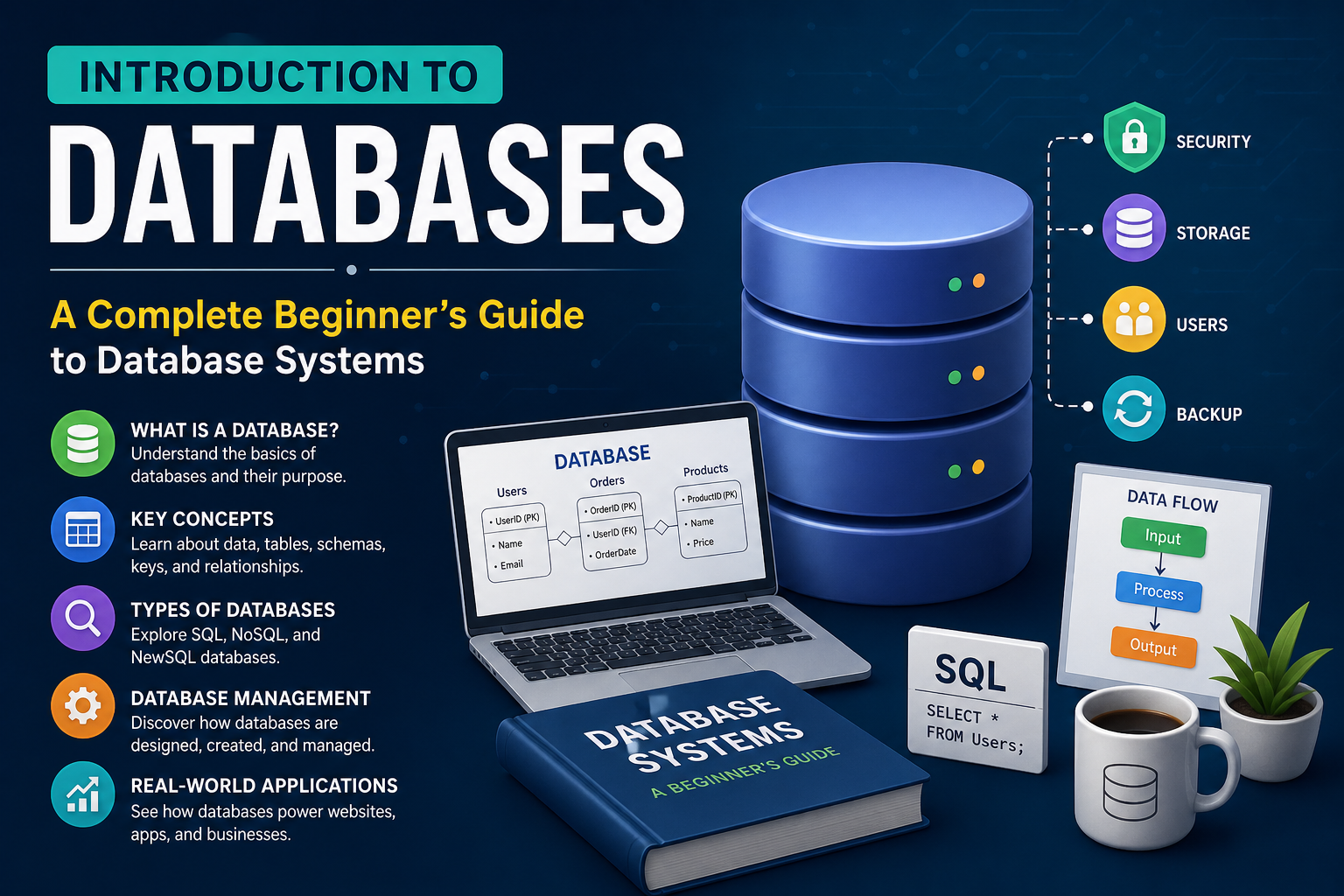
Modern life runs on data, even when we don’t notice it. Every time a message is sent, a payment is processed, a video is streamed, or a flight is booked, information is being created, updated, stored, and retrieved in the background. This constant flow of digital activity is made possible by systems designed to handle enormous volumes of information without breaking down. At the heart of these systems are databases.
Databases operate quietly behind the scenes, yet they influence almost everything in the digital world. They are responsible for organizing information in a way that makes it usable, reliable, and accessible at any moment. Without them, even simple digital services would become chaotic and unmanageable. Imagine trying to run an online store, a hospital system, or a banking platform without a structured way to store customer records, transactions, and operational data. The complexity would quickly become overwhelming.
What makes databases especially powerful is their ability to handle scale. They can support small applications with a few thousand records or massive global platforms with billions of entries being updated every second. This flexibility is one of the reasons databases are considered foundational to modern computing systems.
Why Modern Life Depends on Databases
The dependency on databases extends far beyond traditional computing environments. Nearly every industry relies on structured data management to function efficiently. In finance, databases track transactions and balances in real time. In healthcare, they store patient histories, diagnostic results, and treatment plans. In transportation, they coordinate logistics, schedules, and tracking systems. In education, they manage student records, enrollment systems, and performance data.
Even everyday digital experiences depend on databases. Social media platforms store user profiles, posts, comments, and interactions. Streaming services maintain vast libraries of content along with personalized recommendations. Mobile apps rely on backend databases to store settings, preferences, and usage history.
What makes this dependence even more significant is the expectation of instant access. Users expect information to load immediately, regardless of how large the dataset is or how many people are accessing it at the same time. Databases make this possible by optimizing how data is stored and retrieved.
In many ways, databases function like the memory system of the digital world. They ensure that information is not only stored but also organized in a way that allows systems to “remember” and respond intelligently. Without this capability, digital services would lose consistency, reliability, and functionality.
From Spreadsheets to Structured Systems
For many people, the first exposure to organizing data comes through spreadsheets. Spreadsheets are simple, flexible tools that allow users to enter information into rows and columns. They are often used for budgeting, tracking tasks, or managing small sets of data. While spreadsheets are useful, they have limitations when it comes to scale, complexity, and performance.
As the amount of data grows, spreadsheets become harder to manage. Multiple files may be needed, duplication becomes common, and errors can easily occur. Searching across large datasets becomes slow, and maintaining consistency across different sheets becomes difficult.
This is where databases provide a more structured and reliable approach. Instead of relying on multiple disconnected files, databases centralize information into a controlled system. They allow data to be linked, validated, and accessed efficiently without redundancy or confusion.
Unlike spreadsheets, databases are designed from the ground up to handle complexity. They are not just storage tools; they are systems that enforce rules, maintain relationships, and ensure data accuracy across multiple users and applications.
Understanding What a Database Really Is
A database is best understood as a structured system for storing and managing data. It is not simply a collection of files or documents. Instead, it is a carefully designed environment where information is organized according to specific rules.
At its core, a database is built to solve three fundamental problems: storing data efficiently, retrieving data quickly, and maintaining data accuracy over time. These goals are achieved through structured design and specialized software systems.
Data in a database can represent almost anything. It might include text such as names and descriptions, numerical values like prices or measurements, multimedia content such as images or videos, or even complex data generated by sensors and machines.
What makes databases unique is not just what they store, but how they store it. Data is arranged in structured formats that allow relationships to be defined and queries to be performed efficiently. This structure allows users and applications to interact with data in powerful ways without needing to understand how it is physically stored.
Core Building Blocks of Database Systems
Database systems are built from several essential components that work together to manage information effectively. These components define how data is organized, accessed, and maintained.
One of the most fundamental components is the table. Tables serve as containers for data and are organized into rows and columns. Each table represents a specific category of information, such as customers, products, or transactions.
Rows represent individual records within a table. Each row contains a complete set of information about a single entity. For example, a row in a customer table might include a customer’s name, contact information, and account details.
Columns define the structure of the data stored in each row. They specify what type of information is allowed in each field, such as text, numbers, or dates. Columns ensure consistency across all records in a table.
Another important component is the relationship between tables. Relationships allow data in one table to be connected to data in another. This is essential for reducing duplication and maintaining logical connections between different types of information.
Queries are also a key part of database systems. A query is a request for specific information from the database. It allows users or applications to search, filter, and retrieve data based on defined conditions.
Together, these components create a structured environment where data can be stored, organized, and accessed efficiently.
How Data Is Organized and Controlled
One of the most important aspects of databases is control. Unlike simple storage systems, databases enforce rules that govern how data is entered, updated, and retrieved. This ensures that information remains accurate and consistent over time.
Control mechanisms include constraints that define what kind of data is allowed in specific fields. For example, a column might only accept numeric values, or a field might require a unique identifier for each record. These rules prevent errors and maintain data integrity.
Databases also control how multiple users interact with the same data. In environments where many people or applications access the same system simultaneously, it is essential to prevent conflicts and inconsistencies. Databases use specialized techniques to manage concurrent access, ensuring that changes made by one user do not unintentionally overwrite or disrupt data being used by another.
Another important aspect of control is security. Databases often include mechanisms for restricting access to sensitive information. Different users may have different levels of permission, ensuring that only authorized individuals can view or modify specific data.
This combination of structure, rules, and access control makes databases reliable systems for managing critical information in a wide range of environments.
Structured vs Unstructured Data Explained
Data in the modern world does not always follow a predictable format. Some information is highly organized, while other types are more flexible and irregular. This distinction is often described as structured and unstructured data.
Structured data follows a defined format. It is organized into clear categories with consistent rules. Examples include financial records, inventory lists, and customer databases. Structured data is easy to search, analyze, and process because its format is predictable.
Unstructured data, on the other hand, does not follow a rigid structure. It includes content such as emails, videos, social media posts, images, and audio files. This type of data is more difficult to organize because it does not fit neatly into rows and columns.
Modern systems often deal with both structured and unstructured data. As a result, database technologies have evolved to accommodate different types of information. Some systems focus on strict structure and consistency, while others prioritize flexibility and scalability.
Understanding the difference between structured and unstructured data is essential for designing systems that can handle the diversity of information generated in today’s digital environment.
Introduction to Relational Databases
Relational databases are one of the most widely used types of database systems. They are built on the concept of organizing data into tables that can be connected through relationships.
Each table in a relational database represents a specific type of entity. These tables are linked using keys, which allow data from different tables to be related logically. For example, a customer table might be linked to an orders table through a unique customer identifier.
This structure allows data to be stored efficiently without unnecessary duplication. Instead of repeating information in multiple places, relational databases store data once and connect it through relationships.
Relational systems are particularly strong in environments where accuracy and consistency are important. They are widely used in financial systems, enterprise applications, and any environment where structured data management is critical.
The ability to define relationships between different types of data is one of the key strengths of relational databases. It allows complex information to be organized in a logical and scalable way.
The Rise of Non-Relational (NoSQL) Systems
As digital systems grew in complexity, traditional relational databases faced new challenges. Large-scale applications required systems that could handle massive volumes of data, rapid changes, and flexible structures. This led to the development of non-relational database systems.
Non-relational databases, often referred to as NoSQL systems, are designed to handle data that does not fit neatly into structured tables. They allow for more flexible data models, which can include documents, key-value pairs, graphs, and wide-column formats.
One of the main advantages of these systems is scalability. They are built to handle distributed environments where data is spread across multiple servers. This makes them well-suited for modern web applications, real-time analytics, and large-scale platforms.
Another advantage is flexibility. NoSQL systems can adapt to changing data requirements without requiring strict predefined structures. This makes them useful in environments where data is constantly evolving.
While they offer flexibility and scalability, they often trade off some of the strict consistency guarantees found in relational systems. As a result, the choice between relational and non-relational databases depends heavily on the specific requirements of the application.
How Database Management Systems Work
A Database Management System is the software layer that controls how databases operate. It acts as an interface between users, applications, and the stored data.
The DBMS is responsible for processing queries, managing data storage, enforcing rules, and ensuring security. When a user requests information, the DBMS interprets the request, retrieves the relevant data, and returns it in a usable format.
It also handles data organization at a deeper level, determining how information is physically stored on disk or memory. This optimization ensures that even large datasets can be accessed quickly and efficiently.
Another important function of a DBMS is backup and recovery. It ensures that data can be restored in case of system failures, errors, or unexpected disruptions. This is essential for maintaining reliability in critical systems.
Transactions and Data Integrity Concepts
In database systems, a transaction refers to a sequence of operations that must be completed as a single unit. If any part of the transaction fails, the entire operation is rolled back to maintain consistency.
This concept is essential in environments where accuracy is critical. For example, in financial systems, transferring money between accounts involves multiple steps. Each step must succeed to ensure that funds are correctly updated.
Data integrity refers to the accuracy and consistency of data over its lifecycle. Databases use various mechanisms to ensure that data remains reliable, even in complex and high-volume environments.
These mechanisms include validation rules, constraints, and transaction controls that prevent invalid or incomplete data from being stored.
Real-World Use of Databases in Everyday Applications
Databases are deeply embedded in everyday digital experiences. When users browse an online store, the products they see are retrieved from a database. When they log into an account, their credentials are verified against stored records. When they watch a video online, metadata and streaming data are managed through database systems.
In communication platforms, databases store messages, user profiles, and interaction histories. In transportation systems, they manage scheduling and tracking information. In entertainment platforms, they handle recommendations and content libraries.
Even systems that seem simple on the surface often rely on complex database structures behind the scenes. These systems ensure that data is available instantly, even when millions of users are accessing it simultaneously.
The Expanding Scale of Modern Data Systems
As technology continues to evolve, the scale of data generation continues to grow. Devices, applications, sensors, and systems are constantly producing new information. This creates a need for increasingly powerful and flexible database systems.
Modern databases must handle not only large volumes of data but also high speed, distributed environments, and diverse data types. They must support real-time processing, global access, and continuous availability.
This ongoing expansion is shaping how databases are designed and used. Systems are becoming more distributed, more automated, and more adaptable to changing demands.
How Database Architecture Shapes Everything Behind the Scenes
To understand how databases truly power modern systems, it helps to look beneath the surface of how they are built and structured. While users interact with simple applications and interfaces, the underlying database architecture is responsible for ensuring everything works smoothly, quickly, and reliably.
Database architecture refers to the overall design and organization of a database system. It defines how data is stored physically, how it is accessed logically, and how different components interact with each other. This includes storage engines, query processors, memory management systems, and communication layers between applications and data storage.
At a high level, most database systems are designed in layers. One layer handles how users or applications request data, another processes those requests, and another manages how data is physically stored on hardware. This separation of concerns allows each layer to be optimized independently, improving performance and reliability.
A well-designed architecture ensures that even as data grows in size and complexity, the system remains responsive. It also allows multiple users and applications to access the same database simultaneously without conflicts or data corruption.
Data Modeling and the Blueprint of Information
Before any data is stored in a database, it must be carefully structured through a process known as data modeling. Data modeling is essentially the blueprint stage of database design, where developers decide how information should be organized, connected, and constrained.
A data model defines entities, attributes, and relationships. Entities represent real-world objects such as customers, products, or orders. Attributes describe properties of those entities, such as a customer’s name or a product’s price. Relationships define how different entities are connected to each other.
This conceptual design is then translated into a logical structure, often represented through schemas. A schema defines how data is organized within a database system, including table structures, data types, constraints, and relationships.
Good data modeling is critical because it determines how efficiently a database will perform. Poor design can lead to redundancy, inconsistencies, and performance issues. Strong design, on the other hand, creates a system that is both efficient and scalable.
The Importance of Schema Design in Structured Systems
A schema acts as the formal definition of how data is stored in a database. It defines tables, columns, data types, and relationships in a structured format. In relational systems, the schema is strictly enforced, meaning all data must conform to predefined rules.
This strict structure provides consistency and predictability. Applications can rely on the fact that data will always follow a known format, which simplifies development and reduces errors.
However, schema design is not static. As applications evolve, schemas often need to be updated to accommodate new requirements. This process must be handled carefully to avoid disrupting existing data or breaking applications that rely on it.
In more flexible database systems, schemas may be dynamic or partially defined. This allows data structures to evolve more freely, but it can also introduce complexity in maintaining consistency across different datasets.
Normalization and the Logic of Clean Data Design
One of the most important principles in relational database design is normalization. Normalization is the process of organizing data in a way that reduces redundancy and improves integrity.
Without normalization, the same piece of information might be stored in multiple places, leading to inconsistencies. For example, if a customer’s address is stored in several tables, updating it in one place but not another can create conflicting data.
Normalization solves this problem by structuring data so that each piece of information is stored only once, in a single location. Related data is then connected through relationships rather than duplication.
This process involves dividing large tables into smaller, more focused ones and defining relationships between them. While this increases the number of tables in a database, it improves consistency and reduces storage inefficiency.
However, normalization is not always the final step. In some cases, databases are intentionally denormalized to improve performance. This means some redundancy is introduced to reduce the need for complex joins and speed up data retrieval.
Indexing and the Speed of Information Retrieval
As databases grow larger, finding specific information quickly becomes more challenging. Without optimization, searching through millions or billions of records would be extremely slow.
This is where indexing becomes essential. An index is a special data structure that improves the speed of data retrieval operations. It works similarly to an index in a book, allowing the system to quickly locate the relevant section without scanning everything.
Indexes are created on specific columns that are frequently used in search conditions or sorting operations. When a query is executed, the database can use the index to locate data much faster than scanning entire tables.
However, indexes come with trade-offs. While they improve read performance, they can slow down write operations because the index must be updated whenever data changes. They also require additional storage space.
Designing effective indexing strategies is a critical part of database optimization. Too few indexes can lead to slow queries, while too many can degrade overall system performance.
Query Processing and How Databases Understand Requests
When a user or application requests data, the database does not simply retrieve it directly. Instead, it goes through a process known as query processing.
A query is first parsed to ensure it follows the correct syntax. Then it is analyzed to determine what data is being requested. The system then creates an execution plan, which outlines the most efficient way to retrieve the data.
This execution plan is crucial because there are often multiple ways to obtain the same result. The database chooses the most efficient method based on factors such as available indexes, data size, and system load.
Once the plan is created, the database executes it and retrieves the requested data. Finally, the results are returned to the application in a structured format.
This entire process happens in fractions of a second, even for complex queries involving large datasets.
Storage Engines and How Data Physically Exists
Behind every database system is a storage engine responsible for how data is physically written, stored, and retrieved from disk or memory. The storage engine determines how information is organized at the lowest level.
Different storage engines use different methods for storing data. Some prioritize fast reads, others prioritize fast writes, and some aim for a balance between the two.
Data is typically stored in blocks or pages, which are fixed-size units of storage. These blocks are managed by the storage engine, which handles reading and writing operations efficiently.
The storage engine also plays a role in managing indexes, caching frequently accessed data, and ensuring durability in case of system failures.
Understanding storage engines is important because they directly impact performance. The same database design can behave very differently depending on the underlying storage system.
Transactions, ACID Properties, and Data Reliability
In database systems, a transaction represents a sequence of operations that must be completed together. If any part of the transaction fails, the entire process is reversed to maintain consistency.
To ensure reliability, database systems follow a set of principles known as ACID properties: Atomicity, Consistency, Isolation, and Durability.
Atomicity ensures that a transaction is treated as a single unit. Either all operations succeed or none do. Consistency ensures that data remains valid before and after a transaction. Isolation ensures that multiple transactions do not interfere with each other. Durability ensures that once a transaction is completed, it remains stored even in the event of system failure.
These principles are essential for maintaining trust in database systems, especially in environments where accuracy is critical, such as banking and healthcare.
Concurrency Control and Multi-User Environments
Modern databases often support thousands or even millions of users accessing data simultaneously. Managing this level of concurrency requires careful coordination.
Concurrency control mechanisms ensure that multiple users can read and write data without causing conflicts. Without these mechanisms, simultaneous operations could lead to inconsistent or corrupted data.
Databases use techniques such as locking and isolation levels to manage concurrency. Locking prevents multiple users from modifying the same data at the same time, while isolation levels define how transactions interact with each other.
Balancing performance and consistency is one of the key challenges in database design. Too much locking can slow down the system, while too little can lead to data inconsistencies.
Distributed Databases and Scaling Beyond a Single System
As data volumes continue to grow, many systems can no longer rely on a single machine to store and process information. This has led to the development of distributed databases.
In a distributed database, data is spread across multiple servers or locations. This allows systems to scale horizontally, meaning they can handle more data by adding more machines instead of upgrading a single one.
Distributed systems introduce new challenges, such as maintaining consistency across multiple nodes, handling network failures, and ensuring data synchronization.
To address these challenges, distributed databases use techniques such as replication and partitioning. Replication involves copying data across multiple nodes, while partitioning divides data into smaller segments distributed across systems.
Replication, Redundancy, and System Reliability
Replication is a key strategy used to improve both performance and reliability in database systems. By maintaining multiple copies of data across different locations, systems can continue functioning even if one node fails.
Replication also improves read performance by allowing queries to be distributed across multiple servers. This reduces load on individual systems and improves response times.
However, replication introduces complexity in ensuring that all copies of the data remain consistent. Changes made in one location must be propagated to all replicas, which can create delays or synchronization challenges.
Despite these challenges, replication is essential for building fault-tolerant systems that can operate reliably at scale.
Sharding and Breaking Data into Manageable Pieces
Sharding is another technique used to scale databases horizontally. Instead of copying entire datasets across multiple servers, sharding divides data into smaller pieces called shards.
Each shard contains a portion of the overall dataset and is stored on a separate server. This allows systems to distribute load more efficiently and handle larger volumes of data.
Sharding improves performance by reducing the amount of data each server needs to manage. However, it also introduces complexity in querying data across multiple shards.
Designing an effective sharding strategy requires careful planning to ensure balanced distribution and efficient access patterns.
The CAP Theorem and Trade-Offs in Distributed Systems
Distributed databases must often balance three important properties: consistency, availability, and partition tolerance. This balance is described by the CAP theorem.
Consistency ensures that all nodes see the same data at the same time. Availability ensures that the system remains operational even when parts of it fail. Partition tolerance ensures that the system continues to function even when network failures occur.
In practice, distributed systems can only fully guarantee two of these properties at the same time. This forces system designers to make trade-offs based on the needs of the application.
For example, some systems prioritize consistency over availability, while others prioritize availability over strict consistency.
Data Warehousing and Analytical Processing Systems
Not all databases are designed for real-time transactions. Some are optimized for analyzing large volumes of historical data. These systems are often referred to as data warehouses.
Data warehouses store aggregated and historical data for analysis rather than operational use. They are used for reporting, trend analysis, and business intelligence.
Unlike transactional systems, which focus on fast reads and writes, analytical systems focus on complex queries across large datasets.
This distinction allows organizations to separate operational workloads from analytical workloads, improving efficiency in both areas.
Security Layers in Database Systems
Security is a critical aspect of database design. Databases often store sensitive information such as personal records, financial data, and business operations.
To protect this information, databases use multiple layers of security. These include authentication systems that verify user identity, authorization systems that control access levels, and encryption systems that protect data at rest and in transit.
Security policies also define who can view, modify, or delete specific data. These controls help prevent unauthorized access and ensure compliance with regulations.
As cyber threats continue to evolve, database security remains a constantly developing field requiring continuous monitoring and improvement.
The Shift Toward Cloud-Native Database Systems
As computing infrastructure has evolved, one of the most significant changes in database technology has been the move toward cloud-based systems. Instead of relying on physical servers managed on-site, many modern databases now operate in cloud environments where resources are hosted, scaled, and maintained by distributed infrastructure providers.
Cloud databases remove much of the traditional burden of hardware management. Instead of provisioning servers, configuring storage, and maintaining uptime manually, organizations can deploy databases as managed services. These services handle scaling, backups, replication, and maintenance automatically or semi-automatically.
One of the most important advantages of cloud databases is elasticity. Traditional systems require careful planning to estimate how much storage and processing power will be needed. Cloud systems, by contrast, can expand or shrink dynamically based on demand. This is especially useful for applications with unpredictable traffic patterns.
Another key benefit is global accessibility. Cloud databases can be deployed across multiple geographic regions, allowing applications to serve users with low latency regardless of location. This distributed nature improves performance and reliability for global systems.
Cloud-native databases also integrate tightly with other cloud services such as analytics engines, machine learning platforms, and application hosting environments. This integration allows data to flow seamlessly between different systems without complex manual configuration.
The Evolution of NoSQL and Flexible Data Models
As data types became more diverse, traditional relational models began to show limitations in certain use cases. This led to the rise of NoSQL systems, which prioritize flexibility, scalability, and performance over strict structure.
NoSQL databases are not a single type of system but rather a category that includes several different models. Document-based systems store data in structured documents, often using formats similar to JSON. Key-value stores use simple pairs of keys and values for extremely fast retrieval. Column-family systems organize data into flexible columns, and graph databases represent relationships as interconnected nodes and edges.
Each of these models is designed to solve specific types of problems. For example, document databases are well-suited for content management systems, while graph databases excel in scenarios involving complex relationships, such as social networks or recommendation engines.
The flexibility of NoSQL systems allows developers to evolve data structures without rigid schema constraints. This makes them particularly useful in fast-changing environments where requirements are constantly shifting.
However, this flexibility often comes with trade-offs. In many cases, NoSQL systems sacrifice strict consistency guarantees in favor of availability and scalability. As a result, system designers must carefully choose the right model based on application needs.
Real-Time Data Processing and Streaming Systems
Modern applications increasingly require real-time data processing capabilities. Unlike traditional systems that process data in batches, real-time systems handle information continuously as it is generated.
Streaming databases and processing systems are designed to ingest, process, and analyze data in motion. This is essential for use cases such as fraud detection, live analytics, sensor monitoring, and financial trading systems.
In a streaming architecture, data flows through pipelines where it is processed incrementally. Instead of waiting for large datasets to accumulate, systems analyze each event as it arrives. This allows organizations to respond to changes instantly rather than after delays.
Real-time systems often rely on event-driven architectures, where changes in data trigger automated responses. This model is widely used in modern distributed applications where speed and responsiveness are critical.
Data Pipelines and the Flow of Information
Behind every modern data-driven system is a pipeline that moves information from one stage to another. Data pipelines are responsible for collecting, transforming, and delivering data to its final destination.
A typical pipeline begins with data ingestion, where raw information is collected from various sources such as applications, sensors, or external systems. This data is then processed and cleaned to ensure consistency and quality.
After processing, data is often transformed into a format suitable for storage or analysis. Finally, it is loaded into databases, data warehouses, or analytics systems where it can be accessed by applications or analysts.
Data pipelines can be batch-based or real-time. Batch pipelines process large sets of data at scheduled intervals, while real-time pipelines handle continuous streams of information.
The design of data pipelines is critical for ensuring that information flows efficiently and reliably across systems. Poorly designed pipelines can lead to delays, inconsistencies, or data loss.
Performance Optimization and Query Efficiency
As databases scale, performance optimization becomes increasingly important. Even small inefficiencies in query design or system configuration can lead to significant slowdowns when dealing with large datasets.
One of the key aspects of performance tuning is query optimization. Databases analyze queries and attempt to find the most efficient execution path. However, poorly written queries can still cause performance issues if they require unnecessary data scans or complex operations.
Indexing strategies also play a major role in performance. Properly designed indexes can dramatically speed up data retrieval, while poorly designed ones can slow down write operations and increase storage overhead.
Caching is another important optimization technique. Frequently accessed data is stored in memory to reduce the need for repeated disk access. This significantly improves response times for common queries.
Database administrators often monitor performance metrics such as query execution time, resource utilization, and throughput to identify bottlenecks and optimize system behavior.
Backup Strategies and Data Recovery Systems
Data loss can have serious consequences, making backup and recovery systems essential components of any database architecture.
Backups involve creating copies of data that can be restored in case of failure, corruption, or accidental deletion. These backups can be full, incremental, or differential depending on how much data is copied and how frequently backups are taken.
Recovery systems are responsible for restoring data from backups when needed. This process must be carefully managed to ensure that data is restored accurately and consistently.
In addition to backups, modern systems often use replication as a form of real-time data redundancy. This ensures that multiple copies of data exist across different systems, reducing the risk of total data loss.
Disaster recovery planning is a broader concept that includes not only backups but also system restoration procedures, failover mechanisms, and redundancy strategies. These systems are designed to ensure business continuity even in extreme scenarios.
Monitoring, Logging, and System Observability
As database systems grow in complexity, monitoring becomes essential for maintaining reliability and performance. Observability refers to the ability to understand the internal state of a system based on its outputs.
Databases generate a wide range of logs and metrics that provide insight into system behavior. These include query logs, error logs, performance metrics, and resource utilization data.
Monitoring tools analyze this information to detect anomalies, identify bottlenecks, and alert administrators to potential issues. This proactive approach helps prevent failures before they impact users.
Logging also plays a critical role in debugging and auditing. By examining logs, administrators can trace the sequence of events leading to a problem and identify its root cause.
In large-scale systems, observability is not optional. It is a fundamental requirement for maintaining stability across distributed environments where problems may arise in complex and unexpected ways.
Automation in Database Management
Modern database systems increasingly rely on automation to reduce manual intervention and improve efficiency. Automated systems handle tasks such as scaling, backups, updates, and performance tuning.
Automatic scaling allows databases to adjust resources dynamically based on workload. When demand increases, additional resources are allocated automatically. When demand decreases, resources are reduced to optimize cost.
Automated backup systems ensure that data is regularly saved without requiring manual scheduling. Similarly, automated recovery systems can restore data quickly in the event of failure.
Automation also extends to performance optimization. Some systems can automatically adjust indexes, cache configurations, and query execution strategies based on observed usage patterns.
This shift toward automation reduces operational complexity and allows database administrators to focus on higher-level design and optimization tasks rather than routine maintenance.
Artificial Intelligence in Database Systems
Artificial intelligence is increasingly being integrated into database systems to improve efficiency, performance, and decision-making.
AI-driven databases can analyze workload patterns and automatically optimize query execution. They can predict resource usage and adjust system configurations proactively.
Machine learning models are also used in areas such as anomaly detection, where systems identify unusual behavior that may indicate performance issues or security threats.
In some cases, AI is used to assist in query generation and optimization, helping users interact with databases more naturally and efficiently.
As AI continues to evolve, databases are becoming more intelligent, adaptive, and self-managing.
Vector Databases and Modern Data Representation
A newer development in database technology is the rise of vector databases. These systems are designed to store and process high-dimensional data representations known as vectors.
Vectors are commonly used in machine learning applications, particularly in areas such as natural language processing, image recognition, and recommendation systems.
Unlike traditional databases that store structured or semi-structured data, vector databases focus on similarity search. Instead of looking for exact matches, they find data points that are mathematically similar.
This capability is essential for modern AI systems that rely on semantic understanding rather than strict keyword matching. It allows applications to interpret meaning, context, and relationships between data points in more advanced ways.
Event-Driven Architectures and Reactive Systems
Many modern applications are built around event-driven architectures, where systems respond to changes in real time. In this model, events such as user actions, system updates, or external inputs trigger automatic responses.
Databases play a central role in storing and processing these events. Event logs can be used to reconstruct system behavior, analyze trends, and trigger workflows.
Reactive systems are designed to respond immediately to changes in data. This makes them ideal for applications that require real-time responsiveness, such as messaging platforms, monitoring systems, and live dashboards.
Event-driven design also improves scalability by decoupling system components, allowing them to operate independently while still communicating through events.
Conclusion
Databases form the quiet backbone of the digital world, shaping how information is stored, accessed, and used across nearly every modern system. From simple applications to global platforms handling billions of transactions, they ensure that data remains organized, consistent, and available whenever it is needed. Without databases, the complexity of today’s digital environment would quickly become unmanageable, as there would be no reliable way to structure or retrieve the vast amounts of information constantly being generated.
What makes databases especially powerful is their ability to adapt to different needs. Some systems prioritize strict structure and accuracy, while others focus on flexibility and scalability to handle rapidly changing data. This balance allows databases to support everything from financial systems and healthcare records to social media platforms and real-time analytics engines. As technology continues to evolve, databases have expanded beyond traditional models into cloud-native environments, distributed architectures, and intelligent systems powered by automation and artificial intelligence.
Despite their complexity, the core purpose of databases remains simple: to transform raw data into meaningful, usable information. They provide the foundation that allows applications to function reliably and efficiently, even at massive scale. Understanding how databases work offers valuable insight into how modern technology operates behind the scenes and why data has become one of the most important assets in the digital age.
As data continues to grow in volume, speed, and variety, databases will remain central to innovation. Their evolution will continue to shape how systems are built, how decisions are made, and how the digital world continues to expand.