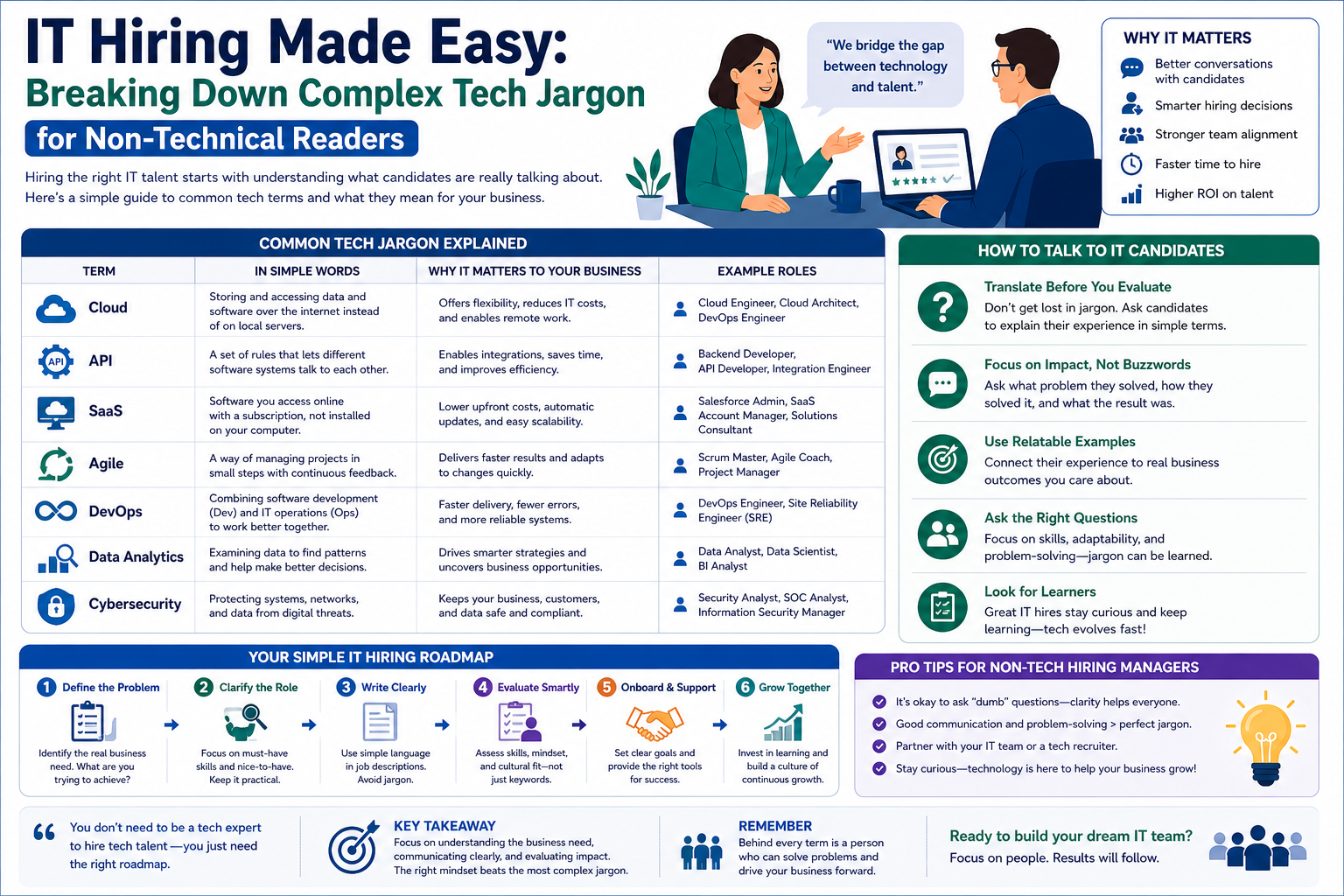
Hiring for IT roles often feels less like a standard recruitment process and more like trying to interpret a technical language that was never designed for general audiences. For many hiring managers and HR professionals, job descriptions filled with acronyms and specialized terminology can create confusion before the hiring process even begins. This gap between technical language and everyday communication is one of the biggest barriers in making confident hiring decisions.
The reality is that IT professionals operate in a highly specialized environment where precision matters. A small difference in terminology can represent an entirely different skill set or responsibility. While this level of specificity is essential for technical teams, it can unintentionally create a disconnect for those responsible for recruiting talent. Understanding this gap is the first step toward bridging it effectively.
When hiring teams encounter terms like APIs, DevOps pipelines, cloud infrastructure, or container orchestration, the instinct is often to either ignore the details or rely completely on technical team members for interpretation. While collaboration with IT teams is important, hiring professionals also benefit significantly from building their own foundational understanding. This doesn’t mean becoming an engineer—it means learning enough to interpret requirements accurately and ask the right questions.
The language gap becomes especially noticeable when job descriptions are written directly by technical teams without translation into more accessible language. Engineers may naturally focus on tools, frameworks, and systems rather than outcomes or responsibilities. As a result, job listings can become overly technical and difficult to interpret from a hiring perspective.
Bridging this gap requires reframing technical language into practical meaning. Instead of viewing IT terminology as an obstacle, it becomes more useful to see it as a structured vocabulary that describes how digital systems are built, maintained, and improved. Once this shift happens, the hiring process becomes significantly more intuitive.
Why IT Terminology Feels Overwhelming for Non-Technical Teams
One of the main reasons IT language feels intimidating is its density. Acronyms are used constantly, and many of them overlap across different domains. For example, a single acronym might have multiple meanings depending on context, which can lead to confusion if the surrounding technical framework is not fully understood.
Another factor is the rapid evolution of the technology industry. New tools, frameworks, and methodologies emerge frequently, each bringing its own terminology. Even experienced professionals in non-technical roles may struggle to keep up with the pace of change. This creates a perception that IT language is constantly shifting and therefore difficult to master.
Additionally, IT communication often assumes baseline familiarity with concepts that are not universally known outside the field. Terms such as “deployment,” “scaling,” or “architecture” may sound familiar in general usage, but in IT contexts, they carry specific meanings tied to system design and functionality. Without context, these terms can easily be misinterpreted.
There is also a psychological factor at play. Technical jargon can create a sense of exclusivity, making non-technical professionals feel like they are missing essential knowledge. This can lead to hesitation when evaluating candidates or job descriptions, even when the underlying concepts are not as complex as they initially appear.
Understanding why the terminology feels overwhelming helps reduce that barrier. Once it becomes clear that IT language is simply a structured way of describing systems and processes, it becomes easier to approach it logically rather than emotionally.
Building a Practical Mindset for Technical Hiring Decisions
Developing confidence in IT hiring does not require deep technical expertise. Instead, it requires a practical mindset focused on clarity, outcomes, and communication. Rather than trying to memorize every technical term, it is more effective to understand the purpose behind those terms.
A practical mindset starts with asking simple but meaningful questions. What problem does this role solve? What systems will this person interact with? What outcomes are expected from their work? By focusing on these questions, hiring decisions become more grounded in business needs rather than technical complexity.
Collaboration with technical teams also plays a key role in building this mindset. Engineers and IT staff can help translate complex requirements into functional responsibilities. However, it is important that hiring teams remain active participants in this translation process rather than passive recipients of information. This ensures that job descriptions remain aligned with both technical accuracy and organizational clarity.
Another important aspect of this mindset is learning to separate tools from skills. In IT roles, tools change frequently, but core skills often remain consistent. For example, programming languages may vary, but problem-solving, logical thinking, and system understanding remain essential across most technical roles. Recognizing this distinction helps prevent overemphasis on specific technologies during hiring.
Ultimately, a practical mindset helps shift the focus from “understanding everything technically” to “understanding enough to make informed decisions.” This approach makes IT hiring more accessible and less intimidating.
Core Building Blocks of Modern Software Development Language
Software development forms the backbone of most IT operations, and its terminology often appears frequently in job descriptions. Understanding the foundational building blocks of this language can significantly improve hiring clarity.
At its core, software development involves creating applications that perform specific tasks or solve particular problems. These applications are built using programming languages, which act as the medium of instruction between humans and machines. While there are many programming languages in use, they generally serve similar purposes: translating logic into executable instructions.
One important concept in this domain is the idea of application programming interfaces, commonly referred to as APIs. These define how different software systems communicate with each other. Rather than building everything from scratch, developers often rely on APIs to connect existing systems, making development faster and more efficient.
Another essential concept is version control. In software development, multiple people often work on the same codebase simultaneously. Version control systems allow teams to track changes, manage updates, and avoid conflicts. This ensures that development remains organized and traceable over time.
Development methodologies also play a significant role in shaping how software is built. Agile development, for instance, emphasizes iterative progress and collaboration. Instead of delivering a complete product all at once, teams work in smaller cycles, continuously improving the product based on feedback.
These foundational concepts help define how modern software systems are created and maintained. Understanding them provides hiring teams with a clearer picture of what developers actually do on a day-to-day basis.
Understanding Software Creation Roles in Real Workplace Context
Software-related job titles can often appear similar on the surface but represent different responsibilities in practice. Understanding these distinctions helps prevent misalignment during hiring.
Software developers typically focus on building specific features or applications. Their work is often hands-on, involving writing code, testing functionality, and implementing features based on requirements. They tend to work on defined tasks within larger projects.
Software engineers, on the other hand, often take a broader view. Their responsibilities may include designing system architecture, ensuring scalability, and making decisions about how different components interact. While they also write code, their focus extends to system-level thinking and long-term design considerations.
In real workplace environments, these roles often overlap, but the distinction lies in perspective. Developers are typically more focused on execution, while engineers are more involved in planning and system design. Understanding this difference helps hiring teams align job descriptions with actual business needs.
It is also important to recognize that role definitions can vary between organizations. One company’s definition of a software engineer may be similar to another’s definition of a developer. This variability makes it even more important to focus on responsibilities rather than titles alone.
By focusing on what the role actually requires—problem-solving, coding, system design, or feature development—hiring teams can avoid confusion caused by inconsistent job titles.
How Infrastructure Teams Keep Systems Running Behind the Scenes
Beyond software development, IT systems rely heavily on infrastructure teams that ensure everything runs smoothly. These professionals are responsible for maintaining the environments where applications operate.
Infrastructure roles involve managing servers, networks, and system configurations. These components form the foundation that allows software applications to function reliably. Without proper infrastructure management, even well-built applications can experience downtime or performance issues.
A key part of this domain involves system maintenance. This includes updating software components, monitoring system performance, and ensuring that resources are allocated efficiently. These tasks are essential for maintaining stability across digital environments.
Another important aspect is user management. Infrastructure teams often handle permissions, access controls, and system security configurations. This ensures that only authorized users can access specific systems or data.
Monitoring is also a critical responsibility. Infrastructure professionals continuously track system performance to detect issues before they escalate. This proactive approach helps maintain uptime and prevents disruptions.
Understanding the role of infrastructure teams helps hiring professionals appreciate the behind-the-scenes complexity of IT environments. These roles are essential for ensuring that digital systems remain reliable and secure.
The Rise of Automation-Focused IT Roles
Modern IT environments increasingly rely on automation to improve efficiency and reduce manual effort. This shift has led to the emergence of roles focused specifically on automating processes and optimizing workflows.
Automation in IT involves using tools and scripts to perform repetitive tasks without human intervention. This can include deploying software updates, managing system configurations, or monitoring performance metrics.
The goal of automation is not just speed but consistency. Automated processes reduce the likelihood of human error and ensure that tasks are performed uniformly across systems.
In many organizations, automation-focused roles also involve integrating different systems. This ensures that tools and platforms can communicate effectively, creating smoother workflows across teams.
These roles require a combination of technical knowledge and process understanding. Professionals in this area must not only know how systems work but also how they should work together.
Understanding automation-focused roles helps hiring teams recognize candidates who can improve operational efficiency and reduce manual workload within IT environments.
Data-Driven Roles and Why They Matter in Hiring Decisions
Data has become one of the most valuable assets in modern organizations, and roles centered around data analysis and interpretation are increasingly important.
Data-focused professionals work with large sets of information to identify patterns, trends, and insights. These insights are then used to support decision-making across different departments.
Some roles focus on analyzing existing data to understand what has already happened, while others focus on predicting future outcomes using statistical models and algorithms. Both approaches play a crucial role in shaping business strategies.
Working with data often involves cleaning and organizing information before analysis. Raw data is rarely usable in its initial form, so preparation is a key part of the process.
These roles also rely heavily on structured query systems and programming languages designed for data manipulation. Understanding how data is stored and accessed is essential for effective analysis.
Recognizing the importance of data-driven roles helps hiring teams prioritize candidates who can translate information into actionable insights.
Translating Technical Job Requirements into Human Language
One of the most valuable skills in IT hiring is the ability to translate technical requirements into clear, understandable language. This process involves breaking down complex descriptions into practical responsibilities.
Instead of focusing on tools and technologies alone, it is more effective to describe what the role actually accomplishes. For example, rather than listing multiple systems and platforms, it is more useful to explain the outcomes the role is responsible for achieving.
This approach not only improves clarity but also helps attract a wider range of candidates. Many qualified professionals may be discouraged by overly technical job descriptions, even if they possess the necessary skills.
Translation also involves removing unnecessary jargon that does not add meaningful information. While technical terms are sometimes necessary, they should be used only when they contribute to understanding rather than creating complexity.
By focusing on clarity and purpose, job descriptions become more accessible and effective.
Common Misinterpretations in IT Job Descriptions
Misunderstandings in IT hiring often arise when technical terms are interpreted too literally or without context. For example, listing specific tools may lead candidates or hiring teams to assume that only those tools are acceptable, even when alternatives could be equally effective.
Another common issue is overemphasizing experience with specific technologies. While familiarity is important, adaptability and problem-solving skills are often more valuable in fast-changing IT environments.
Job descriptions can also unintentionally blur the distinction between different roles, leading to unrealistic expectations. Without clear definitions, candidates may apply for positions that do not align with their actual skills.
Recognizing these misinterpretations helps improve both job design and candidate evaluation.
Essential Cloud Concepts That Shape Modern Hiring
Cloud computing has become a foundational element of modern IT infrastructure. It allows organizations to access computing resources over the internet rather than relying solely on local systems.
Cloud environments are typically categorized based on how services are delivered. Some platforms provide ready-to-use applications, while others offer tools for building and managing custom applications. There are also models that provide access to virtual infrastructure such as servers and storage.
Different cloud models serve different purposes, but they all share the goal of increasing flexibility and scalability. Organizations can adjust resources based on demand, which improves efficiency and reduces costs.
Understanding cloud concepts helps hiring teams evaluate candidates for roles that involve modern infrastructure management and application deployment.
Networking Fundamentals That Influence Every IT Role
Networking is a foundational concept in IT that affects nearly every system and application. It refers to how devices connect and communicate within and between systems.
Every device connected to a network has a unique identifier that allows it to be recognized and located. This enables communication between systems across different environments.
Networks rely on structured systems to translate human-readable addresses into machine-readable formats. This ensures that data is delivered to the correct destination.
Security also plays a major role in networking. Systems are designed to protect data and control access to resources, ensuring that only authorized users can interact with sensitive information.
Understanding networking fundamentals helps hiring teams appreciate how digital systems communicate and operate behind the scenes.
Cybersecurity Language Every Hiring Manager Should Recognize
Cybersecurity is a critical area in IT that focuses on protecting systems, networks, and data from unauthorized access or damage.
One key concept in cybersecurity is encryption, which involves transforming data into a secure format that can only be read with the correct key. This ensures that sensitive information remains protected during transmission or storage.
Authentication methods are also essential. Many systems require multiple forms of verification to confirm a user’s identity, adding an extra layer of security.
Malicious software is another concern in cybersecurity. It refers to programs designed to disrupt systems or gain unauthorized access to data.
Testing for vulnerabilities is also a common practice. This involves simulating attacks to identify weaknesses before they can be exploited.
Understanding cybersecurity language helps hiring teams evaluate candidates responsible for protecting organizational systems and data.
Interpreting Cloud Computing Language in Modern IT Hiring
Cloud computing has become one of the most frequently mentioned areas in IT job descriptions, and for non-technical hiring teams, it can feel like an entirely separate language. However, at its core, cloud computing is simply a way of delivering computing services—like storage, servers, databases, networking, and software—over the internet instead of relying on physical infrastructure managed on-site.
What makes cloud-related hiring challenging is not the concept itself, but the layered terminology that surrounds it. Job descriptions often include references to service models, deployment strategies, automation tools, and scaling techniques. Without a structured understanding of these terms, it becomes difficult to distinguish between essential requirements and optional technical preferences.
A helpful way to approach cloud computing language is to focus on what the system is trying to achieve rather than how it is technically implemented. Cloud environments exist to provide flexibility, scalability, and efficiency. These three outcomes remain consistent regardless of the specific platform or vendor being used.
When hiring for cloud-related roles, it is important to recognize that most responsibilities fall into three broad categories: managing cloud resources, deploying applications, and ensuring system performance. Each of these areas may involve different tools, but the underlying goals remain consistent across organizations.
Understanding Cloud Service Models Without Technical Complexity
Cloud service models are often presented using technical acronyms, but they can be understood in a more practical way by focusing on responsibility distribution.
In one model, organizations use ready-made software applications accessed through the internet. In this case, the service provider manages everything behind the scenes, including infrastructure, updates, and maintenance. Users simply interact with the application.
In another model, organizations are provided with platforms that allow them to build and deploy their own applications. Here, the service provider manages the underlying infrastructure, while the organization focuses on application development.
A third model provides virtual infrastructure, such as servers and storage, that organizations can configure and manage themselves. This model offers the most control but also requires the most technical involvement.
Understanding these models helps hiring teams interpret job descriptions more accurately. When a role mentions cloud platforms, it is useful to identify whether the focus is on application usage, application development, or infrastructure management.
Why Cloud Skills Appear in Almost Every IT Job Description
One of the reasons cloud terminology appears so frequently in IT hiring is that most modern systems now rely on cloud-based infrastructure in some form. Even organizations that still maintain local systems often integrate cloud services for storage, communication, or application hosting.
This widespread adoption means that cloud knowledge is no longer limited to specialized roles. Instead, it has become a foundational skill across many IT positions. However, the depth of knowledge required varies significantly depending on the role.
For example, a developer may only need to understand how to deploy applications to a cloud environment, while an infrastructure specialist may need to manage entire cloud ecosystems. A security professional, on the other hand, may focus on protecting cloud-based systems from unauthorized access.
This variation is why job descriptions can sometimes appear inconsistent or overly broad. The same cloud-related term may be used across different roles, but the expectations behind it can be very different.
Breaking Down Networking Concepts in Practical Hiring Terms
Networking is another core area of IT that often appears complex due to its technical language. However, at a practical level, networking is simply about how devices communicate with each other and share information.
Every device connected to a network needs a way to be identified. This is typically done through unique numerical identifiers that allow systems to locate and communicate with each other. These identifiers function like digital addresses, ensuring that information reaches the correct destination.
Networks also rely on systems that translate human-friendly names into machine-readable formats. This allows users to access websites and services without needing to understand underlying numerical structures.
Security is deeply embedded in networking. Systems are designed to control access, prevent unauthorized entry, and ensure that data is transmitted safely. This includes protective barriers that monitor incoming and outgoing traffic.
Bandwidth is another important concept in networking. It refers to the amount of data that can be transmitted over a network within a given time. Higher bandwidth allows for faster communication and better system performance.
Understanding these networking fundamentals helps hiring teams interpret job descriptions that involve system connectivity, infrastructure management, or IT support roles.
The Role of Cybersecurity in Modern IT Job Requirements
Cybersecurity has become a central component of nearly every IT role due to the increasing importance of protecting digital systems and sensitive information. As organizations rely more heavily on digital infrastructure, the need for security-focused skills has expanded across multiple job functions.
At a basic level, cybersecurity involves protecting systems from unauthorized access, damage, or disruption. This includes both external threats and internal vulnerabilities.
One of the most important concepts in cybersecurity is data protection. This involves ensuring that sensitive information is stored and transmitted securely. Techniques such as encryption are used to transform data into formats that cannot be easily understood without proper authorization.
Authentication systems also play a critical role. These systems verify the identity of users before granting access to resources. Multi-layered authentication methods are increasingly common, requiring users to provide multiple forms of verification.
Another key area is threat detection. Security systems continuously monitor activity to identify unusual behavior that may indicate a potential threat. This proactive approach helps prevent issues before they escalate.
Cybersecurity also involves testing systems for weaknesses. This process helps organizations identify vulnerabilities and strengthen their defenses before they can be exploited.
Understanding these concepts allows hiring teams to better evaluate candidates for security-related roles, even without deep technical expertise.
How DevOps Translates Into Real Workplace Responsibilities
DevOps is one of the most commonly misunderstood terms in IT hiring because it combines two traditionally separate areas: software development and system operations. However, rather than being a single role, DevOps represents a way of working that emphasizes collaboration, automation, and continuous improvement.
At its core, DevOps is about reducing the gap between building software and running it in production environments. Traditionally, development teams and operations teams worked separately, which often led to delays and communication challenges. DevOps addresses this by encouraging shared responsibility.
One of the key components of DevOps is automation. Repetitive tasks such as testing, deployment, and system updates are automated to improve efficiency and reduce errors. This allows teams to focus more on development and problem-solving rather than manual processes.
Another important aspect is continuous integration and continuous delivery. This approach ensures that software changes are regularly tested and deployed, allowing for faster updates and more reliable systems.
DevOps professionals often work with tools that manage infrastructure, monitor system performance, and automate workflows. However, the specific tools used can vary widely between organizations.
From a hiring perspective, DevOps roles should be understood as hybrid positions that require both technical knowledge and strong communication skills. These professionals act as connectors between different technical teams, ensuring that systems are built, tested, and deployed efficiently.
Understanding Data Roles Without Overcomplicating Terminology
Data-related roles are increasingly important in modern organizations because they help convert raw information into actionable insights. However, the terminology used in these roles can often feel complex or abstract.
At a practical level, data professionals work with information collected from various systems. This data is rarely usable in its raw form, so it must first be cleaned, organized, and structured.
Once data is prepared, it can be analyzed to identify patterns, trends, and relationships. These insights are then used to support decision-making across different business areas.
Some data professionals focus on understanding historical information. They analyze what has already happened to help organizations improve future decisions. Others focus on predicting future outcomes using statistical methods and computational models.
Data roles also involve working with databases, which are structured systems designed to store and manage large volumes of information. Query languages are used to retrieve and manipulate this data efficiently.
Programming languages are often used in data roles to automate analysis and build models. However, the specific tools used can vary depending on the organization and the nature of the work.
Understanding data roles helps hiring teams identify candidates who can translate information into meaningful insights, even if they do not have deep technical backgrounds.
Reading Between the Lines of IT Job Descriptions
IT job descriptions often contain a mix of technical terms, tool names, and general responsibilities. For non-technical hiring teams, the challenge lies in interpreting what is actually required versus what is simply preferred.
One common issue is the overuse of tool-specific language. Job descriptions may list multiple platforms or technologies, but not all of them are equally important. In many cases, organizations are flexible about specific tools as long as candidates understand the underlying concepts.
Another challenge is the use of broad or ambiguous terms such as “expert,” “proficient,” or “familiar.” These terms can be subjective and may not clearly indicate the level of expertise required.
It is also common for job descriptions to combine multiple roles into a single position. This can lead to unrealistic expectations if not carefully structured.
A useful approach when reviewing job descriptions is to separate responsibilities into three categories: essential tasks, secondary tasks, and optional skills. This helps clarify what the role truly requires.
Common IT Acronyms and Their Practical Meaning in Hiring
IT communication is heavily dependent on acronyms, many of which appear frequently in job descriptions. While they may seem intimidating at first, most acronyms represent straightforward concepts once they are broken down.
For example, APIs refer to systems that allow different software applications to communicate with each other. CI/CD refers to processes that automate software integration and deployment. SaaS refers to software accessed over the internet without local installation.
Understanding these acronyms in practical terms helps hiring teams interpret job descriptions more effectively. Instead of viewing them as isolated technical terms, it is more useful to see them as descriptions of system behavior or functionality.
Many acronyms also overlap across different domains, which can add to confusion. However, context usually determines their meaning. For example, the same acronym may refer to different concepts in networking, development, or security.
Building familiarity with common acronyms gradually improves confidence in interpreting technical requirements without needing deep technical expertise.
How IT Teams Think About Problems and Solutions
One of the most important aspects of understanding IT hiring is recognizing how technical professionals approach problem-solving. IT teams typically think in terms of systems, processes, and dependencies.
When faced with a problem, they often break it down into smaller components to identify the root cause. This structured approach allows them to isolate issues and implement targeted solutions.
IT professionals also tend to think in terms of scalability and efficiency. Solutions are not just designed to work in the short term but are built to handle future growth and increased demand.
Another key aspect is automation. Wherever possible, IT teams aim to reduce manual intervention by creating systems that can manage themselves or require minimal oversight.
Understanding this mindset helps hiring teams better evaluate candidates, especially when assessing problem-solving abilities and technical reasoning.
Why Soft Skills Matter Even in Highly Technical Roles
While technical skills are essential in IT roles, soft skills play an equally important role in overall job performance. Communication, teamwork, and adaptability are critical in environments where collaboration between technical and non-technical teams is common.
IT professionals often need to explain complex concepts to individuals who do not have technical backgrounds. The ability to translate technical information into clear, understandable language is highly valuable.
Teamwork is also essential because most IT projects involve collaboration between multiple specialists. Effective coordination ensures that systems are built and maintained efficiently.
Adaptability is another important skill due to the rapidly changing nature of technology. Tools and platforms evolve frequently, so professionals must be willing to learn and adjust continuously.
Recognizing the importance of soft skills helps hiring teams evaluate candidates more holistically rather than focusing solely on technical expertise.
Aligning IT Job Titles with Real-World Responsibilities
IT job titles often create confusion long before a candidate is interviewed. The same title can mean very different things across organizations, and sometimes even within the same company. This inconsistency is one of the biggest challenges for non-technical hiring teams trying to interpret roles accurately.
A “systems engineer” in one organization might focus heavily on infrastructure and server management, while in another it could involve automation scripting and cloud deployments. Similarly, a “developer” might work purely on frontend interfaces in one company but handle full-stack responsibilities elsewhere.
This variation exists because IT job titles are often shaped more by company culture and internal structure than by a universal standard. Unlike regulated professions, IT roles are fluid, evolving with technology and organizational needs.
For hiring teams, the key is not to rely solely on job titles but to examine responsibilities in detail. A useful approach is to focus on three questions: what systems does this role interact with, what problems does it solve, and what outcomes is it responsible for delivering.
By shifting attention away from labels and toward functional responsibilities, hiring becomes more accurate and less dependent on assumptions tied to job titles.
Understanding Full-Stack Development Without Technical Depth
Full-stack development is one of the most frequently mentioned concepts in IT hiring, but it is also one of the most misunderstood. The term refers to professionals who work across both the “front” and “back” of an application.
The frontend is what users interact with directly. It includes everything visible on a screen, such as layouts, buttons, menus, and visual design. It focuses on user experience and accessibility.
The backend is where the logic, data processing, and system operations happen. It handles how information is stored, retrieved, and processed behind the scenes. Users typically do not see this layer, but it powers everything they interact with.
A full-stack professional works across both layers, bridging the gap between user-facing design and backend functionality. This requires a broad understanding of how systems interact rather than deep specialization in only one area.
From a hiring perspective, full-stack roles are valuable because they offer flexibility. These professionals can contribute to multiple parts of a project, which is especially useful in smaller teams or fast-moving environments.
However, it is important to understand that “full-stack” does not always mean equal expertise in all areas. Some professionals may be stronger in frontend work, while others may lean more toward backend systems. The term generally indicates versatility rather than complete mastery of every layer.
Breaking Down Software Deployment and Release Language
Software deployment is another area filled with technical language that can be confusing for non-technical hiring teams. However, the concept itself is relatively straightforward: deployment refers to the process of making software available for use.
When developers create or update software, those changes must be transferred from a development environment into a live environment where users can access them. This process involves multiple steps to ensure stability and reliability.
Before deployment, software typically goes through testing phases. These tests are designed to identify bugs, performance issues, or compatibility problems. Only after successful testing is the software prepared for release.
Deployment strategies can vary depending on organizational needs. Some companies release updates gradually, allowing a small group of users to access changes first. Others deploy updates to all users at once.
A key concept in this process is rollback capability. If something goes wrong during deployment, systems must be able to revert to a previous stable version quickly. This ensures minimal disruption to users.
Understanding deployment language helps hiring teams evaluate candidates involved in software release processes, even without technical expertise.
The Meaning Behind Common Infrastructure Terminology
Infrastructure is one of the foundational pillars of IT systems, yet its terminology often feels abstract. At its simplest level, infrastructure refers to the physical and virtual resources that support software applications and digital services.
This includes servers, storage systems, networking equipment, and cloud environments. These components work together to ensure that applications run smoothly and reliably.
One important concept in infrastructure is virtualization. This involves creating virtual versions of physical systems, allowing multiple environments to run on a single physical machine. This improves efficiency and resource utilization.
Another key concept is redundancy. In IT systems, redundancy refers to having backup systems in place to ensure continuity in case of failure. If one component fails, another can take over without disrupting service.
Infrastructure teams also focus heavily on monitoring. Continuous monitoring helps identify performance issues, security risks, and system failures before they affect users.
Understanding infrastructure terminology helps hiring teams recognize the importance of roles responsible for maintaining system stability and performance.
How IT Support Roles Fit Into the Larger Technology Ecosystem
IT support roles are often the first point of contact when technical issues arise within an organization. While these roles may appear less complex compared to development or engineering positions, they play a critical role in maintaining operational continuity.
Support professionals assist users with technical problems, ranging from login issues to system errors. They also help configure devices, install software, and troubleshoot network problems.
One of the key responsibilities in support roles is problem diagnosis. This involves identifying the cause of an issue and determining the appropriate solution. In many cases, support professionals act as intermediaries between end users and technical teams.
Support roles also require strong communication skills. Since they often interact with non-technical users, the ability to explain solutions clearly is essential.
From a hiring perspective, IT support roles are important entry points into the technology field. They often serve as foundational positions that lead to more specialized technical careers.
Understanding APIs as Digital Communication Pathways
Application Programming Interfaces, commonly known as APIs, are one of the most important concepts in modern software systems. At a practical level, APIs allow different software applications to communicate with each other.
Instead of building all functionality from scratch, developers can use APIs to connect existing systems. This reduces development time and improves efficiency.
APIs function like structured communication channels. One system sends a request, and another system responds with the required information or action. This interaction happens continuously in modern applications.
For example, when a mobile application retrieves weather data, it often uses an API to request information from a remote server. The server then sends back the relevant data, which is displayed in the application.
Understanding APIs helps hiring teams interpret job descriptions that involve system integration, software development, or data exchange between platforms.
The Role of Automation in IT Efficiency
Automation has become a central theme in modern IT environments due to its ability to reduce manual effort and improve consistency. It involves using tools, scripts, or systems to perform tasks without direct human intervention.
In IT operations, automation can be used for a wide range of activities, including software deployment, system monitoring, data processing, and security checks.
One of the main benefits of automation is efficiency. Tasks that once required manual execution can now be completed faster and more reliably through automated systems.
Another important benefit is accuracy. Automated processes reduce the likelihood of human error, especially in repetitive tasks.
Automation also supports scalability. As organizations grow, automated systems can handle increased workloads without requiring proportional increases in human resources.
Understanding automation helps hiring teams recognize candidates who can contribute to operational efficiency and system optimization.
Interpreting Technical Skill Requirements in Job Descriptions
Technical skill requirements in job descriptions can often appear overwhelming due to the number of tools, platforms, and technologies listed. However, these lists are usually broader than they appear.
In many cases, organizations list multiple technologies to indicate familiarity rather than mastery. Candidates are not expected to be experts in every listed tool but should have exposure to similar systems.
It is also common for job descriptions to group similar technologies together. For example, multiple cloud platforms may be listed to indicate that experience in any cloud environment is acceptable.
A useful approach for hiring teams is to identify the core skill behind each tool. For instance, different programming languages may be listed, but the underlying skill is problem-solving and logical thinking.
This perspective helps reduce unnecessary complexity when evaluating candidates.
Conclusion
Understanding IT hiring language is less about mastering technical depth and more about developing clarity in interpretation. Across software development, cloud computing, networking, cybersecurity, and data roles, the terminology may appear complex at first, but it consistently describes how digital systems are built, connected, secured, and maintained. Once these patterns are recognized, the language becomes far more approachable and structured.
For non-technical hiring teams, the key takeaway is that IT jargon is not meant to exclude—it is meant to precisely describe systems that rely on accuracy and coordination. However, job titles, acronyms, and tool names often create unnecessary confusion when taken at face value. Focusing instead on responsibilities, outcomes, and problem-solving needs helps transform technical descriptions into practical hiring decisions.
Equally important is collaboration with technical teams, not as passive support but as active translation partners. When hiring professionals and IT specialists work together to simplify requirements, job descriptions become clearer, interviews become more effective, and candidate selection becomes more aligned with real business needs.
Ultimately, effective IT hiring is not about knowing every acronym or technology. It is about understanding enough to ask meaningful questions, evaluate skills fairly, and identify candidates who can adapt and contribute in a rapidly evolving digital environment.