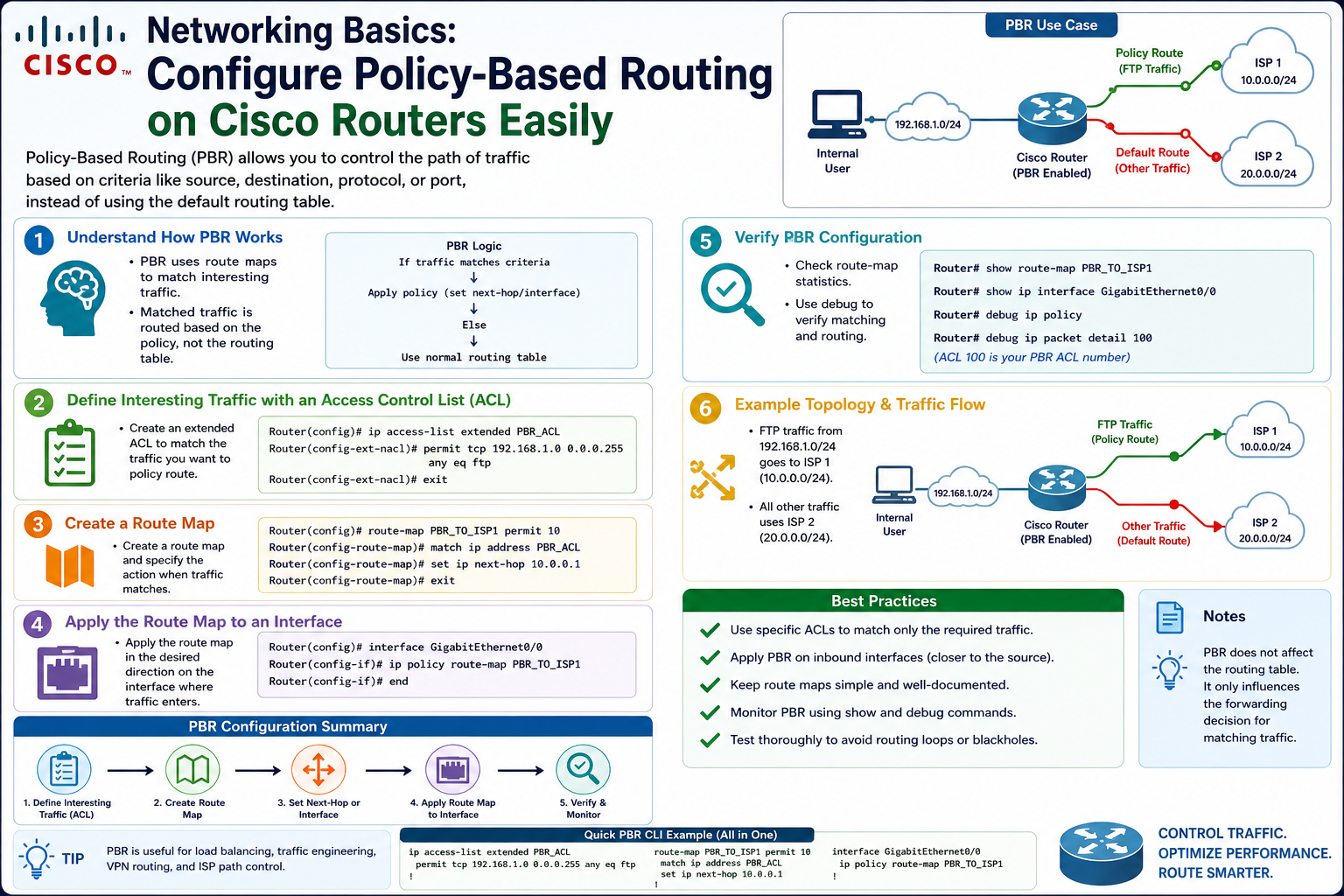
In today’s enterprise environments, network traffic is no longer simple or predictable. Organizations rely on a mix of cloud applications, real-time communication tools, video conferencing systems, file transfers, and web-based platforms—all competing for bandwidth at the same time. Traditional routing, which typically forwards traffic based only on destination IP addresses, is often not enough to handle these diverse requirements efficiently.
This is where policy-based routing becomes important. Policy-based routing allows network administrators to go beyond standard routing logic and make forwarding decisions based on customized rules. Instead of simply asking “where should this packet go based on its destination?”, the router is instructed to consider additional conditions such as the source network, type of application traffic, or even organizational departments.
This level of flexibility is especially valuable in large organizations where different departments have different performance needs. For example, an engineering team running critical applications may require faster and more reliable paths, while guest or background traffic can be directed through less expensive or lower-priority links. Policy-based routing enables this level of control without requiring complex redesigns of the entire network topology.
At its core, policy-based routing is about control and predictability. It allows administrators to shape traffic behavior in a way that aligns with business priorities rather than relying solely on automatic routing decisions.
Why Traditional Routing Is Not Always Enough
Traditional routing protocols are designed to be efficient, not intelligent in a business-aware sense. Protocols such as OSPF or EIGRP evaluate network paths based on metrics like cost, hop count, or bandwidth. While these methods ensure connectivity and general optimization, they do not account for application-level priorities or organizational requirements.
For example, if two paths exist between a source and a destination, a traditional routing protocol will choose the “best” path based on its metric calculations. However, it will not differentiate between a video call and a simple email. Both types of traffic are treated equally, even though one is far more sensitive to delay and jitter.
In modern networks, this limitation becomes increasingly visible. Organizations often operate multiple internet links, such as a high-speed primary connection and a secondary backup line. Without policy-based routing, the network cannot easily decide that certain traffic should always prefer the high-speed link while other traffic is sent through the backup path to save cost or reduce congestion.
This gap between technical routing logic and business needs is the primary reason policy-based routing exists. It provides a mechanism to align traffic flow with organizational intent rather than purely technical metrics.
The Role of Cisco Routers in Policy-Based Routing
Policy-based routing is widely implemented on enterprise-grade devices, and it is strongly associated with routing platforms provided by Cisco Systems. Cisco routers are commonly used in enterprise networks because they support advanced traffic control features and flexible configuration options.
Within Cisco networking environments, policy-based routing is typically configured using advanced features available in Cisco IOS, the operating system that runs on many Cisco routing and switching devices. This operating system provides the building blocks required to define traffic-matching rules, routing behaviors, and interface-level policies.
Cisco routers allow administrators to define very specific traffic handling rules that can override default routing behavior. This is particularly useful in scenarios where network traffic must be segmented based on department, application type, or service quality requirements.
For example, an organization might want to ensure that all traffic from its finance department always travels through a secure and monitored connection, while general user traffic can be routed through a different path. Cisco routers make this level of control possible without requiring separate physical networks for each requirement.
Concept of Traffic Classification in Policy-Based Routing
Before a router can make intelligent forwarding decisions, it must first be able to identify and classify traffic. This process is known as traffic classification, and it is the foundation of policy-based routing.
Traffic classification involves identifying packets based on certain attributes. These attributes may include source IP address ranges, destination networks, or specific application types. Once traffic is classified, it can be grouped into categories that will later be used to define routing behavior.
For example, an organization might classify traffic into categories such as internal department traffic, guest internet access, and business-critical application traffic. Each category represents a different priority level or routing requirement.
This classification process is not inherently automatic. The network administrator must define the logic that determines how traffic is grouped. This is typically done using rule-based mechanisms inside the router configuration.
Once traffic is classified, the router can apply different routing policies depending on which category the traffic belongs to. This is what transforms a standard router into a policy-aware decision-making device.
Access Lists as the Foundation of Traffic Identification
One of the most fundamental components used in policy-based routing is the access list. Access lists are used to identify and filter traffic based on defined criteria, most commonly IP addresses.
In policy-based routing, access lists act as the first step in defining which traffic should be affected by a routing policy. They do not perform routing themselves; instead, they serve as a matching mechanism that helps the router recognize specific traffic patterns.
For example, an administrator might define a rule that identifies all traffic originating from a specific subnet assigned to a department. This allows the router to recognize that traffic as belonging to a particular group, which can later be associated with a routing decision.
Access lists are highly flexible and can be tailored to match a wide range of traffic patterns. This flexibility makes them a critical component in building policy-based routing rules.
In a typical Cisco environment, access lists are combined with route maps to create a complete policy. The access list identifies the traffic, and the route map determines what happens to it.
Route Maps and Their Decision-Making Structure
Once traffic has been identified using access lists, the next step is to define what should happen to it. This is handled through a mechanism known as a route map.
A route map functions as a decision-making structure that evaluates traffic and applies specific actions based on defined conditions. It operates in a logical sequence, similar to a series of conditional rules.
Each route map consists of entries that evaluate traffic and determine how it should be processed. These entries can match specific traffic patterns and then assign routing actions accordingly.
A key characteristic of route maps is their flexibility. They allow multiple conditions and actions to be defined within a single structure, enabling highly customized routing behavior.
For example, a route map can be configured to direct one type of traffic through a high-speed connection while sending all other traffic through a different path. This level of granularity is what makes policy-based routing so powerful.
Route maps are evaluated in sequence, meaning that traffic is checked against each rule in order until a match is found. Once a match occurs, the associated action is applied.
Match and Set Logic in Routing Decisions
Within route maps, two core concepts define how traffic is handled: matching and setting. These two functions work together to create a decision-making flow.
The match function is responsible for identifying whether a packet meets specific criteria. This could include matching an access list, identifying a source network, or recognizing a particular traffic type.
Once a match is found, the set function determines what action should be taken. This could involve directing traffic to a specific interface, modifying routing behavior, or selecting a preferred path.
This combination of match and set logic allows policy-based routing to function like a programmable decision engine. It evaluates traffic based on conditions and then applies predefined outcomes.
In practical terms, this means a router can be instructed to behave differently depending on the type of traffic it receives. This is a significant departure from traditional routing methods, which do not offer this level of customization.
Sequencing and Rule Prioritization in Route Maps
Route maps are not flat structures; they operate in a sequence. Each sequence represents a specific rule or condition that is evaluated in order.
Sequencing is important because it determines the priority of routing decisions. The router evaluates each sequence in numerical order, starting from the lowest number. Once a match is found, subsequent sequences may or may not be evaluated depending on the configuration.
This structure allows administrators to build layered routing policies. For example, high-priority traffic can be evaluated first, while general traffic is handled later in the sequence.
If no match is found in earlier sequences, traffic will eventually fall through to later rules, which often serve as default handling paths. This ensures that all traffic is accounted for within the policy structure.
Sequencing adds predictability to policy-based routing, allowing administrators to design structured decision flows rather than random or overlapping rules.
Applying Policy-Based Routing at the Interface Level
After defining traffic classification rules and routing behaviors, the final step is applying the policy to a specific network interface.
This is a critical step because policy-based routing is not automatically active across the entire router. Instead, it must be explicitly applied to the point where traffic enters the device.
When applied to an interface, the router evaluates incoming packets against the defined policy rules before making a routing decision. This allows traffic to be redirected based on the configured logic rather than the default routing table.
This interface-level application ensures that policy-based routing is both targeted and efficient. Only traffic entering the specified interface is processed by the policy, reducing unnecessary processing overhead elsewhere in the network.
In practical deployments, this approach allows organizations to control traffic at key network entry points, such as distribution routers or edge devices.
Real-World Traffic Segmentation Scenarios
Policy-based routing is commonly used in environments where multiple network paths exist and traffic must be intelligently distributed.
A typical scenario involves separating traffic based on departmental needs. For instance, engineering or development teams may require high-speed, low-latency connections for critical applications. At the same time, administrative or guest traffic may not require the same level of performance.
In such cases, policy-based routing allows administrators to direct high-priority traffic through premium links while sending less critical traffic through secondary connections. This improves overall network efficiency and ensures that critical applications receive the resources they need.
Another common scenario involves cost optimization. Organizations may have multiple internet connections with different pricing models. Policy-based routing allows traffic to be distributed in a way that balances performance and cost.
Interaction with Underlying Routing Tables
It is important to understand that policy-based routing does not replace traditional routing. Instead, it works alongside it.
Even when policy-based routing is active, the router still maintains its standard routing table. If traffic does not match any policy conditions, it will be processed using normal routing behavior.
This dual-layer approach ensures that policy-based routing enhances flexibility without disrupting existing routing logic. It acts as an override mechanism rather than a replacement.
This design allows administrators to gradually introduce policy-based routing into existing networks without requiring major structural changes.
Troubleshooting and Operational Considerations
While policy-based routing provides significant flexibility, it also introduces additional complexity. Proper planning and testing are essential to ensure correct behavior.
One common issue is misclassification of traffic, often caused by incorrectly defined access rules. If traffic is not properly identified, it may not follow the intended routing path.
Another consideration is rule ordering. Because route maps are evaluated sequentially, incorrect sequencing can lead to unexpected routing behavior.
Performance is also a factor. Since policy-based routing requires packet inspection and rule evaluation, it can introduce additional processing overhead on routers, especially in high-traffic environments.
Careful design, clear documentation, and incremental deployment are important practices when implementing policy-based routing in production networks.
Expanding Policy-Based Routing into Multi-Link Network Architectures
As networks evolve, policy-based routing becomes significantly more valuable when organizations move beyond simple single-link connectivity. Modern enterprise environments rarely rely on just one internet connection or one internal path. Instead, they use multiple WAN links, redundant uplinks, cloud interconnects, and segmented internal networks. In such environments, policy-based routing becomes a strategic tool for controlling how traffic flows across a distributed infrastructure.
When multiple paths exist between a source and destination, traditional routing protocols typically select the best path based on metrics. However, “best” in a technical sense does not always match “best” in a business sense. Policy-based routing introduces a layer of intent-driven decision-making, allowing administrators to decide how traffic should be distributed across available links.
This becomes especially important in environments where different connections have different characteristics. One link might be high-speed but expensive, while another might be slower but cost-effective. Without policy-based routing, the network cannot distinguish between traffic types when making forwarding decisions.
By introducing policy-based rules, administrators can align traffic flow with business priorities, ensuring that critical applications always receive preferred treatment while less sensitive traffic uses alternative paths.
Designing Traffic Flow Strategies in Complex Networks
Designing policy-based routing in a multi-link environment requires a structured approach to traffic flow planning. Instead of focusing only on connectivity, administrators must think in terms of traffic behavior and service requirements.
Traffic flow design begins by identifying categories of network usage. These categories might include real-time communication, bulk data transfers, cloud application traffic, internal database synchronization, and general browsing activity. Each category behaves differently in terms of latency sensitivity, bandwidth requirements, and reliability expectations.
Once these categories are defined, administrators can begin mapping them to available network paths. For example, latency-sensitive traffic such as voice or video may be directed through the lowest-latency link, while bulk data transfers can be assigned to high-capacity but less responsive connections.
This mapping process is not static. It often changes depending on time of day, network load, or organizational priorities. Policy-based routing allows this flexibility by enabling rules that can be adjusted without redesigning the entire network topology.
In environments using equipment from Cisco Systems, these strategies are typically implemented using structured routing policies that interact with interface-level configurations and traffic classification mechanisms.
Hierarchical Decision-Making in Policy-Based Routing
One of the most important concepts in advanced policy-based routing is hierarchical decision-making. Instead of treating all traffic equally, the system evaluates traffic in layers, applying different rules depending on how specific the conditions are.
At the highest level, traffic is broadly classified into general groups. These groups might represent departments, application types, or security zones. At this level, routing decisions are relatively general and are used to separate major traffic categories.
At a more detailed level, additional rules can refine these decisions. For example, within a department, certain applications may require higher priority than others. Policy-based routing allows these distinctions to be made without changing the overall network structure.
This layered approach ensures that routing decisions remain organized and predictable. It also prevents rule conflicts by ensuring that more specific conditions are evaluated before broader ones.
Hierarchical decision-making is particularly useful in large organizations where network traffic patterns are complex and constantly changing.
Interaction Between Policy-Based Routing and Dynamic Routing Protocols
Policy-based routing does not operate in isolation. It interacts closely with dynamic routing protocols, which continue to manage baseline network connectivity.
Dynamic routing protocols are responsible for maintaining knowledge of network topology and selecting optimal paths based on metrics. Policy-based routing, on the other hand, overrides these decisions when specific conditions are met.
This interaction creates a dual-layer routing system. The dynamic routing protocol ensures that the network remains functional and efficient, while policy-based routing introduces business-driven control over specific traffic flows.
In some cases, policy-based routing may direct traffic along a path that is not the shortest or most efficient from a protocol perspective. This is intentional, as the goal is not always to choose the fastest route, but the most appropriate one for the traffic type.
Understanding how these two systems interact is essential for avoiding routing conflicts and ensuring consistent network behavior.
Traffic Engineering and Load Distribution Techniques
Policy-based routing plays a significant role in traffic engineering, which is the practice of controlling how traffic is distributed across a network.
In multi-link environments, traffic engineering is often used to balance load across available connections. Instead of allowing one link to become congested while others remain underutilized, policy-based routing can distribute traffic based on defined rules.
This distribution is not random. It is based on carefully designed policies that consider application requirements, bandwidth availability, and link performance characteristics.
For example, high-volume backup traffic might be routed through a secondary link, while interactive applications are prioritized on the primary connection. This ensures that critical services remain responsive even during peak usage periods.
Traffic engineering using policy-based routing also helps organizations optimize cost. Expensive high-performance links can be reserved for critical traffic, while lower-cost connections handle less sensitive data flows.
Failover Behavior and Redundancy Planning
One of the most important operational benefits of policy-based routing is its ability to support failover scenarios. When a primary link becomes unavailable, traffic must be redirected to an alternative path.
While traditional routing protocols handle failover automatically based on topology changes, policy-based routing allows for more controlled failover behavior. Instead of simply switching to a backup path, administrators can define exactly how traffic should behave during a failure.
For example, critical applications may be redirected to a backup high-priority link, while non-essential traffic is temporarily dropped or rerouted through a slower connection.
This level of control ensures that business-critical services remain operational even during network disruptions. It also allows organizations to prioritize recovery efforts based on service importance.
Failover design in policy-based routing environments requires careful planning. Rules must be structured to ensure that backup paths are correctly defined and that traffic does not unintentionally bypass intended policies.
Advanced Traffic Classification Methods
As networks become more complex, traffic classification within policy-based routing also becomes more sophisticated. While basic classification relies on IP addresses, advanced configurations may consider multiple attributes simultaneously.
These attributes can include source and destination networks, protocol types, port numbers, and application-level behaviors. By combining multiple criteria, administrators can create highly specific traffic groups.
This level of granularity is important in environments where multiple applications share the same network infrastructure. For example, web traffic, file transfers, and real-time communication may all originate from the same subnet but require different routing behavior.
Advanced classification allows these differences to be recognized and handled appropriately. It ensures that routing decisions are based on actual traffic behavior rather than broad network segments.
In enterprise environments using Cisco-based infrastructure, this classification process is often integrated into centralized policy frameworks that interact with multiple routing components.
Policy-Based Routing and Quality of Service Alignment
Policy-based routing often works alongside Quality of Service mechanisms to ensure that network performance aligns with application requirements.
While policy-based routing determines the path that traffic takes, Quality of Service determines how traffic is treated along that path. Together, they create a comprehensive traffic management system.
For example, policy-based routing might direct voice traffic through a low-latency link, while Quality of Service ensures that voice packets are prioritized over other traffic types once they are on that link.
This combination is especially important in converged networks where voice, video, and data share the same infrastructure. Without coordinated policy and QoS strategies, performance issues such as jitter, delay, and packet loss can occur.
By aligning routing decisions with traffic prioritization mechanisms, organizations can create more stable and predictable network performance.
Security Implications of Policy-Based Routing
Policy-based routing also has important security implications. Because it allows traffic to be directed based on source or type, it can be used to enforce security segmentation within a network.
For example, sensitive traffic from finance or administrative systems can be routed through more secure paths that pass through monitoring or inspection points. Less sensitive traffic can be routed through general-purpose connections.
This segmentation helps reduce the risk of unauthorized access and improves visibility into critical data flows.
However, policy-based routing must be carefully configured to avoid unintended security gaps. Incorrect rules could potentially bypass security devices or send sensitive traffic through less secure paths.
For this reason, policy design must always consider both performance and security requirements simultaneously.
Scaling Policy-Based Routing in Large Environments
As networks scale, policy-based routing configurations can become increasingly complex. Large enterprises may have dozens of routing rules governing different types of traffic across multiple locations and connections.
Scalability challenges arise when too many rules interact or when traffic classification becomes too granular. In such cases, maintaining consistency and predictability becomes difficult.
To address this, organizations often adopt structured design frameworks that group policies into logical categories. This helps maintain clarity and reduces the risk of conflicting rules.
Scaling also requires careful documentation and monitoring to ensure that policies continue to align with organizational needs over time.
In large-scale Cisco environments, policy-based routing is often integrated into broader network design strategies that include centralized management and automated configuration tools.
Monitoring and Observing Policy-Based Routing Behavior
Monitoring is an essential part of managing policy-based routing. Without visibility into how traffic is being processed, it becomes difficult to verify that policies are working as intended.
Monitoring involves tracking which routes are being used, how often specific policies are triggered, and whether traffic is following expected paths. This information helps administrators identify misconfigurations or inefficiencies.
In some cases, monitoring may reveal that certain rules are never being used, indicating that they are unnecessary or incorrectly defined. In other cases, unexpected traffic patterns may indicate that classification rules need adjustment.
Effective monitoring ensures that policy-based routing remains aligned with network behavior over time, especially in environments where traffic patterns change frequently.
Performance Considerations in High-Traffic Environments
Policy-based routing introduces additional processing overhead because each packet must be evaluated against a set of rules before forwarding decisions are made. In high-traffic environments, this can impact router performance if not properly designed.
To mitigate performance issues, policies should be designed efficiently, with clear and minimal rule sets. Overly complex or redundant rules can slow down processing and increase latency.
Hardware capabilities also play a role. Modern enterprise routers are optimized to handle policy-based routing more efficiently, but resource limitations can still become a factor in large-scale deployments.
Balancing functionality with performance is a key consideration when designing policy-based routing systems in production environments.
Integration with Multi-Site Network Architectures
In distributed organizations, policy-based routing is often used across multiple geographic locations. These environments include branch offices, data centers, and cloud connectivity points.
Each site may have different network characteristics, requiring localized policy adjustments. Policy-based routing allows these differences to be managed consistently while still maintaining centralized control over routing logic.
This is particularly important in organizations that rely heavily on distributed applications or cloud-based services. Traffic must be routed efficiently between sites while respecting performance and security requirements.
By applying consistent policy frameworks across multiple locations, organizations can maintain predictable network behavior even in highly distributed environments.
Behavioral Consistency Across Evolving Networks
One of the challenges in modern networking is maintaining consistent behavior as infrastructure evolves. New links, new applications, and changing traffic patterns can all affect how routing policies behave over time.
Policy-based routing provides a flexible mechanism to adapt to these changes without requiring major architectural redesigns. However, it requires ongoing adjustment to ensure that policies remain aligned with current network conditions.
As networks continue to evolve toward hybrid and cloud-integrated models, the role of policy-based routing becomes increasingly central in maintaining control over traffic behavior.
Advanced Policy-Based Routing Design in Enterprise Networks
As networks grow beyond simple branch-office connectivity into full-scale enterprise ecosystems, policy-based routing becomes less of a feature and more of a design philosophy. At this stage, routing decisions are no longer just about moving packets from one point to another. Instead, they become about enforcing business intent across distributed systems, hybrid cloud environments, and multi-layered infrastructure.
In large-scale deployments, policy-based routing is not implemented in isolation. It becomes part of a broader architecture that includes segmentation, redundancy, security enforcement, and application-aware networking. The complexity of such environments requires a disciplined approach to design, where every routing decision is tied to operational objectives rather than just technical efficiency.
Enterprises often rely on advanced routing platforms provided by Cisco Systems to implement these designs because of their support for flexible policy frameworks and integration with dynamic routing systems. These platforms allow administrators to build highly customized traffic flows that align with organizational priorities across multiple locations.
At this stage, policy-based routing is no longer just about selecting an interface. It becomes about shaping how the entire organization consumes network resources.
Multi-Tier Policy Architecture and Traffic Segmentation
In mature network environments, policy-based routing is typically implemented in multiple tiers. Each tier represents a different level of decision-making, starting from broad traffic classification and narrowing down to highly specific routing behavior.
The first tier focuses on macro-level segmentation. This involves dividing traffic into large categories such as internal corporate traffic, guest access, cloud applications, and external communication. These categories form the foundation of routing policy design and help establish overall traffic direction.
The second tier refines these categories further. For example, internal corporate traffic may be divided into departments such as finance, engineering, operations, and human resources. Each of these groups may have different performance requirements and security constraints.
The third tier introduces application-level awareness. Within a department, certain applications may require priority handling, such as real-time collaboration tools or database synchronization systems. Policy-based routing allows these distinctions to be enforced without altering the physical network structure.
This layered approach ensures that routing decisions remain structured and predictable even in highly complex environments. It also prevents rule conflicts by ensuring that more specific policies take precedence over general ones.
Intent-Driven Networking and Policy Alignment
Modern enterprise networks are increasingly moving toward intent-driven models, where administrators define what they want the network to achieve rather than manually configuring how it should behave. Policy-based routing plays a key role in enabling this shift.
Instead of focusing solely on IP addresses or routing tables, intent-driven networking focuses on outcomes such as “prioritize voice traffic,” “reduce latency for cloud applications,” or “route sensitive data through secure paths.” Policy-based routing translates these high-level intents into actionable routing rules.
This abstraction allows network administrators to focus on business requirements rather than low-level technical configurations. It also makes it easier to adapt network behavior as organizational priorities change.
In environments built around Cisco-based infrastructure, policy-based routing integrates with broader intent-based networking frameworks, allowing routing policies to be dynamically adjusted based on real-time conditions and predefined objectives.
Distributed Policy Enforcement Across Network Domains
In large organizations, networks are rarely centralized. Instead, they are distributed across multiple geographic locations, cloud environments, and data centers. Policy-based routing must therefore operate consistently across all of these domains.
Distributed policy enforcement ensures that routing behavior remains uniform regardless of where traffic originates or terminates. This requires careful synchronization of routing policies across all network devices.
In practice, this means that a routing policy defined at a headquarters location must behave consistently when applied at a branch office or remote site. Without this consistency, traffic flows can become unpredictable and difficult to manage.
Distributed enforcement also introduces challenges related to policy synchronization. As network conditions change, policies may need to be updated across multiple devices simultaneously. This requires careful coordination to avoid temporary inconsistencies in routing behavior.
Application-Aware Routing in Policy-Based Environments
One of the most significant advancements in modern policy-based routing is the ability to become application-aware. Instead of treating all traffic equally at the IP level, routers can identify and prioritize traffic based on application behavior.
Application-aware routing allows networks to distinguish between different types of traffic even if they originate from the same source or destination. For example, a user accessing a cloud storage service may generate both file transfer traffic and real-time synchronization traffic. Each of these may require different routing behavior.
By incorporating application awareness into routing decisions, networks can optimize performance for critical services while reducing unnecessary load on high-priority links.
This capability is particularly important in environments dominated by cloud applications, where traditional network boundaries are less defined and traffic patterns are highly dynamic.
Dynamic Policy Adjustment Based on Network Conditions
Static routing policies are often insufficient in modern environments where network conditions can change rapidly. Policy-based routing can be enhanced with dynamic adjustment mechanisms that modify routing behavior based on real-time conditions.
For example, if a primary link becomes congested, policy-based routing rules can redirect traffic to alternative paths. Similarly, if latency increases beyond acceptable thresholds, traffic can be automatically shifted to more optimal routes.
This dynamic behavior allows networks to adapt to changing conditions without manual intervention. It also improves resilience by ensuring that traffic continues to flow even under degraded network conditions.
Dynamic adjustment requires continuous monitoring of network performance metrics such as latency, packet loss, and bandwidth utilization. These metrics are then used to influence routing decisions in real time.
Integration with Redundant Network Topologies
Redundancy is a fundamental principle in enterprise network design, and policy-based routing plays a key role in making redundancy more intelligent.
In traditional redundant setups, backup links are typically used only when the primary link fails. However, policy-based routing allows both primary and secondary links to be actively utilized based on traffic type.
This approach is known as active-active redundancy, where multiple links are used simultaneously rather than waiting for failure events. Policy-based routing determines which traffic should use which link based on predefined rules.
This improves overall network efficiency by ensuring that all available resources are utilized effectively. It also reduces the impact of link failures because traffic distribution is already balanced across multiple paths.
Policy-Based Routing in Hybrid Cloud Environments
As organizations increasingly adopt hybrid cloud architectures, policy-based routing becomes essential for managing traffic between on-premises infrastructure and cloud services.
Hybrid environments introduce additional complexity because traffic may need to traverse multiple network domains, including private data centers, public cloud platforms, and internet-based connections.
Policy-based routing allows administrators to define how traffic should flow between these environments. For example, sensitive data may be routed through private connections, while non-sensitive workloads can use public internet paths.
This level of control is critical for maintaining security and performance consistency in hybrid architectures. It also helps organizations optimize cloud connectivity costs by intelligently routing traffic based on importance and sensitivity.
Security Policy Integration with Routing Decisions
In advanced network designs, routing decisions are often closely tied to security policies. Policy-based routing allows traffic to be directed through security inspection points such as firewalls, intrusion detection systems, and monitoring appliances.
By controlling the path that traffic takes through the network, administrators can ensure that all sensitive data passes through appropriate security layers.
This is particularly important in environments with strict compliance requirements, where data must be monitored and logged for regulatory purposes.
Policy-based routing can also be used to isolate sensitive traffic from general network traffic, reducing the risk of exposure or unauthorized access.
Performance Optimization in High-Density Networks
As traffic volume increases, performance optimization becomes a critical concern. Policy-based routing helps address this by distributing traffic more efficiently across available resources.
In high-density networks, even small inefficiencies can lead to congestion and performance degradation. Policy-based routing allows administrators to fine-tune traffic distribution to avoid bottlenecks.
This includes directing bulk traffic away from latency-sensitive links and ensuring that high-priority applications receive sufficient bandwidth.
Performance optimization also involves balancing load across multiple paths to prevent any single link from becoming overloaded.
Troubleshooting Complex Policy-Based Routing Environments
As policy-based routing configurations become more complex, troubleshooting becomes increasingly important. Issues can arise from misconfigured rules, incorrect traffic classification, or unintended interactions between policies.
Troubleshooting typically involves analyzing how traffic flows through the network and identifying where it deviates from expected behavior.
This requires visibility into routing decisions, interface utilization, and policy match statistics. Without this visibility, it can be difficult to determine whether issues are caused by routing logic or external network conditions.
In complex environments, even small configuration errors can have significant impacts on traffic behavior. Careful validation and incremental testing are essential to maintaining stability.
Operational Scalability and Policy Lifecycle Management
Managing policy-based routing at scale requires structured lifecycle management. Policies must be created, tested, deployed, monitored, and eventually updated or retired.
Without proper lifecycle management, policy configurations can become outdated or inconsistent, leading to unpredictable network behavior.
Scalability also requires standardization. Policies should be designed using consistent naming conventions and structured frameworks to ensure they remain manageable as the network grows.
In large organizations, policy management is often integrated into centralized network administration systems that coordinate changes across multiple devices and locations.
Long-Term Evolution of Policy-Based Routing
Policy-based routing continues to evolve as networks become more intelligent and automated. The traditional model of static rule-based configuration is gradually being supplemented by adaptive systems that respond to real-time conditions.
Future developments are likely to focus on greater integration with automation frameworks, machine learning-based traffic prediction, and deeper application-level awareness.
Despite these advancements, the core principle of policy-based routing remains the same: giving network administrators control over how traffic flows based on defined intent rather than default routing behavior.
As networks continue to expand across cloud, edge, and distributed environments, policy-based routing will remain a foundational tool for shaping traffic behavior in alignment with organizational goals.
Conclusion
Policy-based routing represents a major shift in how modern networks are designed and managed. Instead of relying purely on destination-based forwarding decisions, it introduces a layer of intelligence that allows network behavior to be shaped by organizational intent. This makes it one of the most practical tools for aligning technical infrastructure with real-world business needs.
In traditional networking models, routing decisions are largely automated and driven by protocols such as OSPF or EIGRP. These systems are highly efficient at finding the shortest or most optimal path based on metrics like hop count, bandwidth, or cost. However, they are not designed to understand the business significance of different types of traffic. As a result, critical applications and less important traffic are often treated the same, which can lead to inefficiencies in performance, cost, and user experience.
Policy-based routing solves this limitation by allowing administrators to define explicit rules for how traffic should be handled. These rules can be based on a wide range of factors, including source networks, application types, or organizational departments. This flexibility allows traffic to be directed in ways that reflect business priorities rather than just network topology.
One of the most important strengths of policy-based routing is its ability to support multi-link environments. Organizations that operate multiple WAN connections or hybrid cloud architectures can use policy-based rules to distribute traffic intelligently across available paths. This ensures that high-priority applications receive the best possible performance while lower-priority traffic is routed through alternative paths, improving both efficiency and cost management.
In addition to performance optimization, policy-based routing plays a significant role in network resilience. By defining controlled failover behaviors, it ensures that critical traffic can be redirected during outages without relying solely on automatic routing convergence. This level of control helps maintain service continuity even under adverse conditions.
Security is another key area where policy-based routing adds value. By directing sensitive traffic through specific paths, organizations can enforce inspection, monitoring, and compliance requirements more effectively. This ensures that important data flows are consistently protected without requiring separate physical infrastructure for each security policy.
However, the power of policy-based routing also introduces complexity. Poorly designed rules can lead to unexpected behavior, routing loops, or inefficient traffic distribution. For this reason, careful planning, structured design, and ongoing monitoring are essential. As networks scale, maintaining clarity and consistency in policy definitions becomes just as important as the technical configuration itself.
In enterprise environments, especially those built on platforms from Cisco Systems, policy-based routing is often integrated into broader network architectures that include dynamic routing, Quality of Service, and security frameworks. This integration allows organizations to build highly adaptive and responsive networks that can evolve alongside changing business requirements.
Ultimately, policy-based routing is not just a configuration feature—it is a strategic networking approach. It bridges the gap between technical routing logic and business-driven decision-making, enabling organizations to take full control of how their data moves across complex infrastructures. As networks continue to grow in scale and complexity, the importance of intelligent, policy-driven traffic management will only continue to increase, making policy-based routing a foundational concept in modern network engineering.