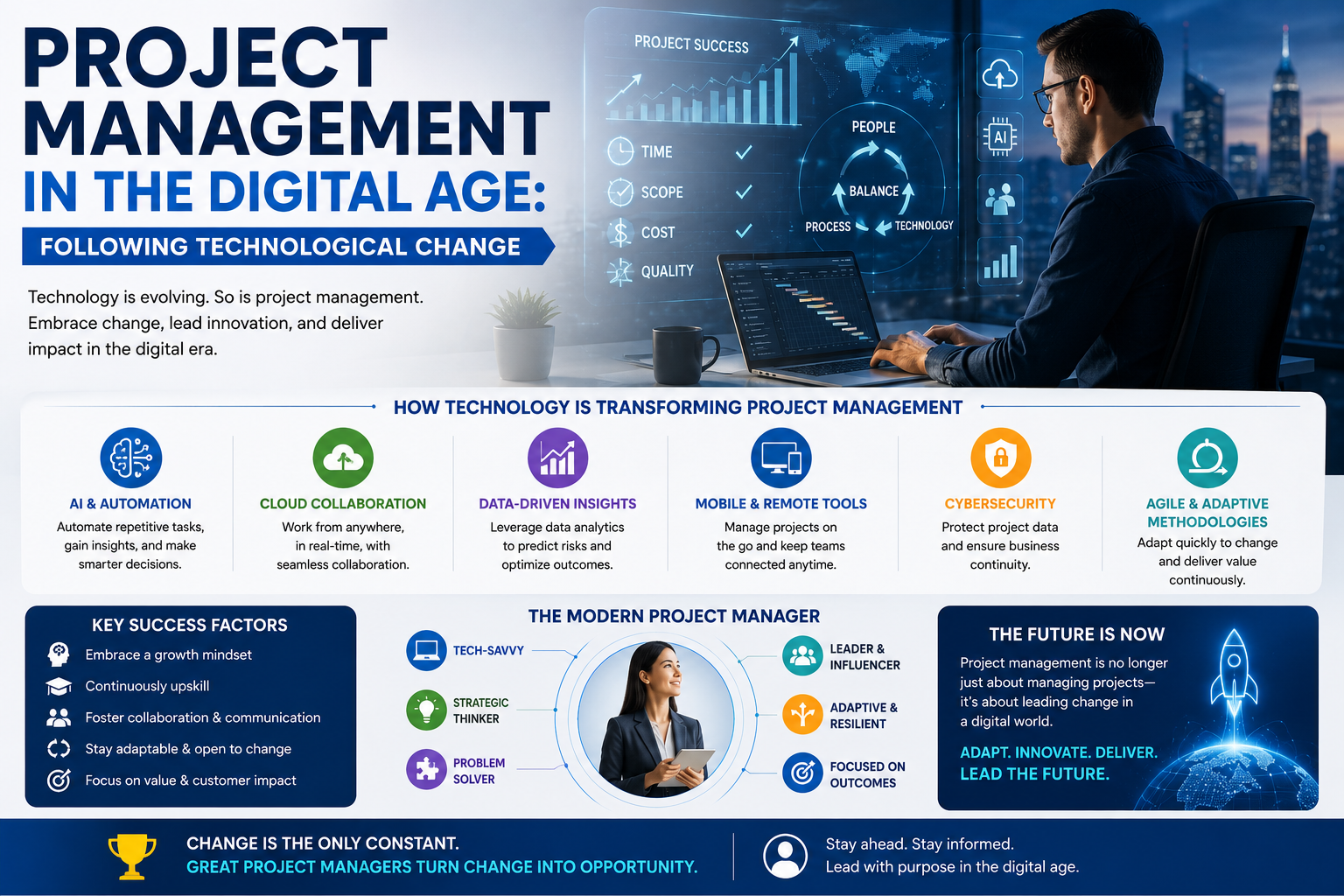
Project management has never existed in isolation. It has always evolved alongside the tools, systems, and technologies that shape how work is done. From early manufacturing systems to today’s digital ecosystems, every major leap in technology has forced organizations to rethink how they plan, execute, and deliver work. What began as informal coordination of labor has gradually transformed into a structured discipline supported by standardized methods, frameworks, and increasingly sophisticated digital tools.
In the modern context, project management is deeply intertwined with technology. Digital platforms manage timelines, automate reporting, analyze risks, and connect global teams in real time. This shift did not happen overnight; it is the result of more than a century of gradual transformation. As industries advanced, so did the need for more predictable, scalable, and efficient ways to manage complex initiatives.
Today’s project environments reflect this long history. Whether in construction, IT, healthcare, or manufacturing, project managers are expected to operate in technology-rich settings where data, automation, and communication tools play a central role. Understanding this evolution provides insight into why modern project management looks the way it does—and why technology is now considered a core part of the discipline rather than just a supporting element.
Early Foundations of Project Management Before Industrial Standardization
Before the rise of industrial systems, project management as a formal discipline did not exist. Work was largely organized through direct supervision, apprenticeship systems, and localized decision-making. Craftsmen, builders, and laborers relied on experience rather than structured methodologies. Each project was typically treated as a unique effort with limited documentation or standardized processes.
In this era, consistency was difficult to achieve. Two workshops producing similar goods could operate in completely different ways. There were no unified guidelines for scheduling, resource allocation, or quality control. Communication was often informal, and project outcomes depended heavily on individual skill rather than structured planning.
The absence of standardized tools meant that large-scale coordination was nearly impossible. Even ambitious construction or manufacturing efforts relied on simple hierarchies and direct oversight. While this approach worked for smaller operations, it struggled to support larger, more complex endeavors. As societies expanded and trade networks grew, the limitations of this informal system became increasingly apparent.
The seeds of modern project management began to form as thinkers and early industrial planners started recognizing the need for more predictable systems. The idea that work could be broken into structured phases, measured, and improved over time slowly gained attention. This shift laid the foundation for the more systematic approaches that would emerge during industrialization.
Industrialization and the Rise of Structured Project Coordination
The industrial revolution marked a turning point in how work was organized. Factories, mechanized production, and large-scale infrastructure projects introduced new levels of complexity. Managing hundreds or even thousands of workers required more than informal supervision—it demanded coordination, scheduling, and repeatable processes.
As industries expanded, the need for consistency became critical. Standardized parts, assembly lines, and mechanized production systems forced organizations to rethink how work flowed from one stage to another. Efficiency became a central concern, and managers began experimenting with ways to optimize productivity while reducing waste.
During this period, early forms of structured project coordination began to emerge. Work was divided into tasks, timelines became more important, and supervision shifted from purely observational to more analytical approaches. Although not yet formalized as “project management,” these practices introduced key principles such as planning, sequencing, and resource allocation.
Large infrastructure developments, including transportation networks and urban expansion projects, further accelerated this evolution. These initiatives required coordination across multiple teams and disciplines, highlighting the need for structured oversight. The complexity of such efforts made it clear that informal management methods were no longer sufficient.
By the early twentieth century, the foundations of modern project management were beginning to take shape. The combination of industrial growth and increasing organizational complexity pushed industries toward more systematic and predictable approaches to managing work.
Mid-20th Century Transformation and the Birth of Modern Practices
The mid-1900s represented a major shift in project management thinking. Global conflicts, large-scale engineering projects, and rapid technological development created an environment where structured planning became essential. Governments and industries were forced to coordinate massive operations involving logistics, manpower, and resource distribution on an unprecedented scale.
This period saw the introduction of more formalized techniques for planning and scheduling. Concepts such as task sequencing, critical path thinking, and milestone tracking became increasingly important. These innovations helped organizations manage complex initiatives more effectively and laid the groundwork for modern project frameworks.
As economies expanded after major global disruptions, industries began adopting more consistent management practices. The rise of corporate structures and multinational organizations further increased the demand for standardized approaches. Communication improvements, including early computing systems and improved transportation networks, made coordination more efficient and reliable.
By the latter half of the twentieth century, project management had become a recognized discipline. Training programs, professional standards, and structured methodologies began to appear. The focus shifted from simply completing tasks to optimizing how projects were planned and executed across multiple environments.
This era also introduced the idea that project management could be taught, refined, and standardized. It was no longer just a skill learned through experience but a discipline supported by frameworks and evolving best practices.
The Digital Revolution and the Integration of Technology
The rise of digital technology fundamentally changed the nature of project management. The introduction of computers, followed by the internet and cloud-based systems, transformed how teams communicated, planned, and executed projects. Information that once took days or weeks to share could now be transmitted instantly across continents.
This shift dramatically improved coordination. Project managers gained access to real-time data, automated reporting systems, and advanced scheduling tools. Tasks that once required manual tracking became streamlined through software platforms that could monitor progress, identify risks, and generate insights.
At the same time, new methodologies emerged to match this evolving environment. Approaches that emphasized flexibility, iterative development, and rapid feedback became increasingly popular, especially in technology-driven industries. These methods reflected the need to adapt quickly to changing requirements and evolving customer expectations.
The digital revolution also introduced a new level of global collaboration. Teams no longer needed to be physically located in the same place to work effectively. Virtual communication tools allowed organizations to operate across time zones and geographical boundaries with greater efficiency than ever before.
As technology continued to advance, project management became increasingly dependent on digital systems. Data analytics, automation, and integrated platforms became essential components of modern project environments, shaping how decisions were made and how success was measured.
Modern Project Management in a Technology-Driven Environment
Today’s project management landscape is defined by its deep integration with technology. Nearly every aspect of a project—from planning and execution to monitoring and reporting—is supported by digital tools. These systems enable greater accuracy, improved collaboration, and faster decision-making.
Modern project environments are highly dynamic. Projects often involve distributed teams, complex dependencies, and rapidly changing requirements. To manage this complexity, project managers rely on structured frameworks combined with technology-enabled insights. This combination allows for greater flexibility while maintaining control over project outcomes.
A key feature of modern practice is the emphasis on data-driven decision-making. Instead of relying solely on intuition or past experience, project managers now use real-time data to guide actions. Performance metrics, risk indicators, and predictive analytics help identify potential issues before they escalate.
Technology also plays a critical role in communication. Collaboration platforms enable continuous interaction between stakeholders, ensuring that everyone remains aligned throughout the project lifecycle. This reduces misunderstandings and improves overall efficiency.
In addition, automation has reduced the burden of repetitive tasks. Scheduling updates, progress tracking, and reporting can now be handled with minimal manual intervention, allowing project managers to focus more on strategic decision-making and problem-solving.
Modern project management reflects a balance between structured methodologies and technological adaptability. This balance ensures that organizations can respond quickly to change while maintaining consistency and control.
Conclusion
Project management has evolved from simple task coordination into a highly structured discipline shaped by centuries of technological progress. What once depended on manual effort and informal communication has transformed into a data-driven, technology-supported practice capable of managing complex global initiatives. Each stage of industrial and digital advancement has added new layers of efficiency, precision, and scalability to the way projects are executed.
Today, technology is not just a tool within project management—it is a defining force. Digital platforms, automation, and advanced analytics have reshaped expectations for speed, accuracy, and collaboration. As a result, project managers are no longer just organizers of tasks but strategic decision-makers operating within highly interconnected systems.
Looking ahead, emerging technologies such as artificial intelligence and predictive analytics will continue to expand what is possible in project execution and control. However, the foundational principles of project management will remain stable, providing structure amid constant change.
The ongoing relationship between technology and project management highlights a clear reality: as technology advances, project management evolves with it, continuously adapting to new challenges while maintaining its core purpose of delivering successful outcomes.