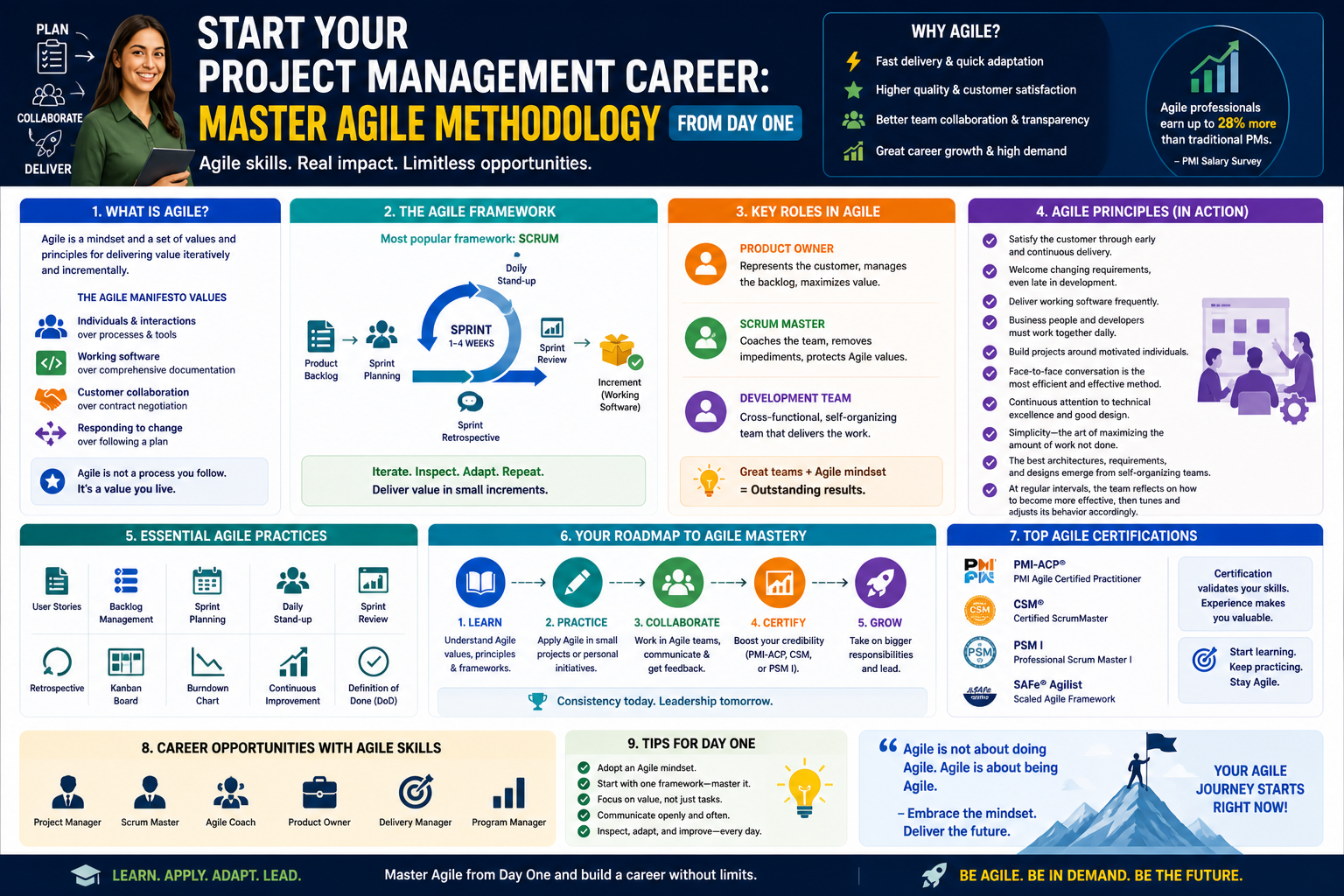
For many developers and IT professionals, the idea of moving into project management often begins with curiosity about leadership, coordination, and decision-making. Agile environments provide a natural entry point into this transition because they are structured in a way that encourages collaboration, shared responsibility, and continuous planning rather than rigid command-and-control oversight.
Unlike traditional project environments where roles are strictly separated, Agile teams operate with a high degree of interaction. Individuals are encouraged to participate in discussions about planning, progress, and problem-solving. This means that even those who do not hold formal management titles are still exposed to core management thinking from the beginning.
In an Agile setting, developers, testers, designers, and analysts often find themselves contributing to planning discussions, estimating work, and identifying risks. These activities mirror the foundational responsibilities of project management in a real-world context. Because Agile emphasizes adaptability and team ownership, it allows individuals to gradually develop management capabilities without immediately stepping away from technical responsibilities.
One of the most valuable aspects of Agile for career growth is its emphasis on learning through participation. Instead of being assigned purely technical execution tasks, team members are expected to think about how their work contributes to broader project goals. This creates a learning environment where management skills are developed organically over time.
The Structure of Agile Work and Why It Encourages Management Thinking
Agile methodologies are built around iterative development, collaboration, and continuous improvement. Work is divided into smaller cycles, often referred to as iterations or sprints, where teams plan, execute, review, and adjust their work regularly.
This structure inherently introduces many elements of project management in a simplified and accessible form. Planning is not a one-time activity but a recurring process. Teams continuously evaluate what needs to be done next, how long it might take, and what dependencies exist. This repeated exposure helps individuals understand how planning evolves in real projects.
Similarly, tracking progress is not reserved for managers alone. Everyone on the team is responsible for understanding where the project stands at any given moment. This creates familiarity with monitoring tools, progress indicators, and workflow visualization methods.
Another key characteristic of Agile is its emphasis on transparency. Work is visible to everyone, which encourages accountability and shared responsibility. When problems arise, they are discussed openly, allowing team members to participate in identifying solutions rather than simply following instructions.
Over time, this environment naturally develops a mindset aligned with project management. Team members begin to think in terms of priorities, constraints, timelines, and outcomes rather than just individual tasks.
How Agile Distributes Traditional Project Management Responsibilities
In traditional project management models, a single project manager is responsible for planning, organizing, leading, and controlling the entire project. Agile frameworks, however, distribute these responsibilities across multiple roles and the team as a whole.
Planning is not owned by a single authority. Instead, it is a collaborative activity where the team collectively decides what can be accomplished in a given iteration. This shared responsibility allows individuals to understand estimation techniques and workload balancing.
Organizing in Agile is less about assigning tasks from the top and more about enabling the team to self-organize. Team members decide how to approach their work, how to divide responsibilities, and how to coordinate with each other. This builds experience in coordination and resource awareness.
Leadership in Agile is more distributed and often emerges naturally. Rather than relying on authority, leadership is demonstrated through communication, facilitation, and influence. Individuals who help the team stay focused, resolve confusion, or support others begin to develop leadership qualities without formal titles.
Control is embedded into the process itself. Instead of periodic formal reporting, Agile uses continuous feedback loops. Teams regularly inspect their progress and adjust their approach based on what they learn. This creates familiarity with monitoring and adaptation processes that are central to project management.
Through this distribution of responsibilities, Agile creates an environment where project management skills are not isolated to one role but are experienced by the entire team in varying degrees.
The Role of Team Members in Building Project Management Skills
Team members in Agile environments play a far more dynamic role than simply executing assigned tasks. They actively participate in shaping how work is planned, executed, and reviewed.
One of the most important skills developed in this role is estimation. Rather than receiving fixed deadlines from a manager, team members collaborate to estimate how much effort a task will require. This process helps them understand how complexity, uncertainty, and technical challenges influence planning decisions.
Communication is another key area of development. Daily interactions require team members to clearly articulate progress, challenges, and dependencies. This builds the ability to report status effectively, which is a critical project management skill.
Problem-solving also becomes a shared responsibility. When obstacles arise, teams discuss them collectively rather than escalating every issue to a manager. This encourages analytical thinking and decision-making within a collaborative environment.
Agile also exposes team members to continuous improvement practices. After each iteration, teams reflect on what went well and what could be improved. This reflection process develops the ability to evaluate performance and implement changes systematically.
Over time, these experiences help team members build a foundation of project management awareness that extends beyond their technical roles.
Planning as a Continuous and Collaborative Activity
Planning in Agile is fundamentally different from traditional planning models. Instead of creating a detailed long-term plan at the beginning of a project, Agile focuses on short-term, adaptable planning cycles.
Each planning session involves evaluating priorities, estimating effort, and selecting tasks that align with the project’s current goals. This approach helps team members understand how planning must remain flexible in response to changing requirements.
Because planning occurs frequently, individuals gain repeated exposure to decision-making processes. They learn how to assess trade-offs, consider risks, and adjust expectations based on available resources.
This continuous planning model also teaches prioritization. Not all tasks can be completed at once, so teams must decide what delivers the most value at each stage. This develops an understanding of strategic thinking, which is essential in project management.
Additionally, planning sessions often involve discussions about dependencies between tasks. Understanding how one task affects another helps individuals see the broader structure of a project, rather than focusing only on isolated assignments.
Organizing Work in a Self-Managed Environment
Agile environments rely heavily on self-organization. Instead of having tasks assigned by a central authority, team members collectively decide how work will be distributed.
This requires individuals to understand not only their own capabilities but also the strengths and availability of others on the team. As a result, coordination becomes a shared responsibility.
Organizing work in this context also involves adapting to change. As new information emerges, teams may need to reassign tasks, adjust priorities, or restructure workflows. This builds flexibility and adaptability, both of which are important in project management roles.
Another important aspect of organizing in Agile is managing dependencies. Team members must coordinate their work to ensure that tasks align correctly and that progress is not blocked by unresolved issues. This teaches practical coordination skills that are directly applicable to managing larger projects.
Leading Without Formal Authority
Leadership in Agile is not tied to job titles but to behavior and contribution. Individuals who take initiative, support others, and help the team stay focused naturally begin to develop leadership experience.
This type of leadership is often referred to as servant leadership, where the focus is on enabling the team to succeed rather than directing them through authority. It involves removing obstacles, facilitating communication, and ensuring that the team has what it needs to progress.
Developing leadership skills in this environment helps individuals understand how influence can be more effective than control. It also builds emotional intelligence, as successful leadership requires awareness of team dynamics, motivation, and interpersonal relationships.
Over time, this experience becomes highly valuable for those transitioning into formal project management roles, where leadership is a central responsibility.
Understanding Control and Progress Tracking in Agile Teams
Control in Agile is embedded in daily activities rather than separated into formal reporting structures. Progress is continuously monitored through visible work tracking systems and regular team interactions.
This allows team members to see how their work contributes to overall project progress in real time. It also helps them identify issues early, before they escalate into larger problems.
Rather than relying on periodic reports, Agile encourages immediate feedback and adjustment. This helps individuals understand how to respond to changes quickly and effectively.
The ability to monitor progress, identify deviations, and make adjustments is a core project management skill that is naturally developed through participation in Agile teams.
Exposure to Agile Roles and Their Management Dimensions
Agile frameworks define several key roles, each of which contributes differently to project management learning.
The Scrum Master role focuses on facilitating the process and supporting the team. This role develops skills in communication, conflict resolution, and process management.
The Product Owner role focuses on prioritization and stakeholder needs. This role develops skills in decision-making, requirement management, and value delivery.
Team members focus on execution, estimation, and collaboration, gaining hands-on experience in planning and delivery processes.
Together, these roles create a distributed system of project management responsibilities that allows individuals to explore different aspects of leadership and coordination.
Developing a Foundation for Future Project Management Growth
Working in Agile environments provides a strong foundation for anyone considering a career in project management. It exposes individuals to real-world challenges such as prioritization, communication, estimation, and collaboration.
More importantly, it allows these skills to be developed gradually, without requiring an immediate transition into a formal management position. This makes Agile a practical and low-risk environment for exploring leadership potential.
As individuals gain experience, they begin to understand how projects are structured, how teams function, and how outcomes are achieved through coordination rather than isolated effort. This understanding becomes the groundwork for more advanced project management responsibilities in the future.
Moving from Technical Roles into Agile Leadership Pathways
For many developers and IT professionals, the shift toward project management does not happen suddenly. It evolves gradually through exposure to coordination, communication, and planning activities within Agile teams. This transition is often natural because Agile environments already blur the line between technical execution and management responsibility.
Instead of stepping directly into a traditional project manager role, individuals often begin by taking on informal leadership responsibilities. These may include helping the team coordinate work, supporting planning discussions, or assisting in resolving blockers. Over time, these small contributions build confidence and visibility within the team.
Agile environments make this transition smoother because they do not require a complete separation from technical work. A developer can continue contributing to coding tasks while also developing leadership and coordination skills. This dual exposure is one of the reasons Agile is often seen as a practical gateway into project management careers.
As individuals become more comfortable with team-level decision-making, they begin to understand how priorities are set, how trade-offs are evaluated, and how delivery timelines are managed. These experiences form the foundation for more formal leadership roles.
The Scrum Master Role as a Development Bridge for Project Management Skills
One of the most significant stepping stones into Agile leadership is the Scrum Master role. This role is not centered around authority but around facilitation, support, and process guidance. It provides an opportunity to develop project management thinking without directly owning the product or technical direction.
A Scrum Master works closely with the team to ensure that Agile practices are followed effectively. Instead of assigning tasks or dictating work, the Scrum Master focuses on enabling smooth collaboration. This includes helping the team stay organized, ensuring meetings are productive, and removing obstacles that slow progress.
This role is particularly valuable for aspiring project managers because it emphasizes servant leadership. Rather than managing people through authority, the Scrum Master learns to influence outcomes through communication, empathy, and facilitation.
In this environment, individuals develop critical soft skills such as active listening, negotiation, conflict resolution, and emotional awareness. These skills are often more important than technical expertise in many project management roles.
Another key aspect of the Scrum Master role is process stewardship. This involves ensuring that Agile principles are understood and applied correctly. Over time, this builds a deep understanding of how structured workflows can improve efficiency and collaboration.
Facilitating Agile Ceremonies and Learning Structured Communication
Agile frameworks rely on structured ceremonies that provide rhythm and consistency to team activities. These include planning sessions, daily coordination meetings, reviews, and reflection sessions. Each of these plays a role in developing project management capabilities.
Facilitating these ceremonies is one of the most practical ways to gain real experience in project coordination. During planning sessions, individuals learn how to guide discussions about scope, priorities, and workload. This helps develop the ability to manage group decision-making processes.
Daily coordination meetings provide practice in communication and progress tracking. These short interactions help teams stay aligned, identify blockers, and adjust plans as needed. Facilitating these discussions teaches how to extract meaningful updates efficiently without overwhelming the team.
Review sessions expose individuals to stakeholder communication. This is where completed work is demonstrated, and feedback is gathered. Managing these sessions builds confidence in presenting outcomes and handling external input.
Reflection sessions, often focused on process improvement, help individuals learn how to evaluate team performance objectively. This builds analytical thinking and encourages continuous improvement, which is essential in project management.
Through repeated exposure to these ceremonies, individuals develop structured communication habits that are directly applicable to managing larger projects.
Understanding the Product Owner Role and Strategic Decision Making
While the Scrum Master focuses on process and facilitation, the Product Owner role focuses on direction and value delivery. This role is centered on deciding what should be built and in what order it should be delivered.
For individuals interested in project management, the Product Owner role offers exposure to strategic thinking. It requires balancing stakeholder expectations, business priorities, and technical constraints.
One of the key responsibilities of this role is managing and prioritizing the work backlog. This involves evaluating which features or tasks deliver the most value and ensuring that the team is always working on the most important items.
This prioritization process helps individuals develop decision-making skills based on value, risk, and feasibility. Instead of focusing only on execution, they begin to think about outcomes and impact.
The Product Owner also interacts frequently with stakeholders. This builds experience in managing expectations, negotiating priorities, and communicating trade-offs. These interactions are essential in project management, where balancing different interests is a constant challenge.
By observing or participating in this role, individuals gain insight into how business goals are translated into actionable work.
Developing Estimation and Planning Skills Through Agile Practices
Estimation is one of the most important skills in project management, and Agile provides continuous opportunities to practice it. Unlike traditional methods where estimates are created once at the beginning, Agile encourages ongoing estimation throughout the project.
Teams often estimate work during planning sessions by discussing complexity, effort, and uncertainty. This collaborative approach helps individuals understand that estimation is not just a technical exercise but also a communication process.
Over time, team members learn that estimates are not fixed predictions but informed guesses that evolve as more information becomes available. This understanding is crucial for managing real-world projects where uncertainty is always present.
Planning in Agile also involves breaking down larger goals into smaller, manageable tasks. This helps individuals understand how complex projects are structured and how long-term goals are achieved through incremental progress.
By repeatedly participating in estimation and planning activities, individuals develop a stronger sense of time management, resource allocation, and scope control.
Learning to Manage Stakeholder Expectations in Agile Environments
Stakeholder management is a critical part of project management, and Agile environments provide continuous exposure to this responsibility.
Stakeholders may include clients, business leaders, users, or internal departments. Each group has different expectations, priorities, and levels of involvement. Managing these relationships requires clear communication and consistent engagement.
Agile frameworks support this by encouraging regular feedback loops. Stakeholders are often involved in reviewing progress at the end of each iteration. This creates transparency and reduces misunderstandings.
Through this process, individuals learn how to communicate progress in a way that is meaningful to non-technical audiences. They also learn how to handle changing requirements and shifting priorities without disrupting the entire project.
This experience builds confidence in managing expectations and navigating complex organizational dynamics.
Conflict Resolution and Team Dynamics in Agile Projects
Conflict is a natural part of any collaborative environment, and Agile teams are no exception. Differences in opinion may arise during planning, estimation, or prioritization.
Instead of avoiding conflict, Agile encourages open discussion and resolution through collaboration. This creates opportunities to develop conflict resolution skills in a structured environment.
Individuals learn how to listen to different perspectives, identify underlying concerns, and guide discussions toward constructive outcomes. This requires patience, empathy, and neutrality.
Understanding team dynamics is also an important part of this process. Each team member has different working styles, strengths, and communication preferences. Recognizing these differences helps improve collaboration and reduces friction.
Over time, exposure to these situations builds emotional intelligence, which is essential for any project management role.
Working with Metrics and Performance Indicators in Agile Teams
Agile teams rely on metrics to understand progress and improve performance. These metrics are not used for strict control but for insight and learning.
Common indicators include task completion rates, cycle times, and workload distribution. These metrics help teams identify inefficiencies and improve their processes.
Working with these indicators helps individuals understand how data can be used to guide decision-making. Instead of relying on intuition alone, they learn to interpret trends and patterns.
This analytical approach is important in project management, where decisions must often be supported by measurable evidence.
Exposure to metrics also helps individuals understand how performance is evaluated in real projects. This includes identifying bottlenecks, improving flow, and optimizing delivery processes.
Adapting to Kanban and Hybrid Agile Approaches
While Scrum is one of the most widely used Agile frameworks, many organizations also use Kanban or hybrid approaches that combine Agile with traditional methods.
Kanban focuses on visualizing work, limiting work in progress, and improving flow efficiency. It is less structured than Scrum but still highly effective for managing continuous delivery environments.
Working with Kanban helps individuals develop a strong understanding of workflow management and process optimization. It emphasizes visibility and continuous improvement.
Hybrid environments introduce additional complexity by combining Agile practices with traditional planning and reporting structures. This requires adaptability and the ability to work across different management styles.
Exposure to these variations prepares individuals for real-world project management environments, where no single methodology is applied universally.
Building Confidence Through Incremental Responsibility Growth
One of the most important aspects of transitioning into project management is gradual responsibility growth. Agile environments support this by allowing individuals to take on increasing levels of responsibility over time.
At first, individuals may focus primarily on technical tasks while participating in team discussions. As they gain experience, they may begin facilitating meetings, contributing to planning, or helping resolve issues.
Eventually, they may take on more formal leadership roles such as Scrum Master or coordination responsibilities within the team.
This gradual progression helps build confidence without overwhelming individuals with full management responsibilities too early.
Through continuous participation in Agile practices, individuals naturally develop the mindset, skills, and awareness required for project management roles in more complex environments.
Evolving from Agile Team Roles to Broader Project Ownership
As professionals gain experience in Agile environments, a natural progression begins to emerge toward broader project ownership. At this stage, individuals are no longer focused only on contributing within a team but are increasingly aware of how entire projects are structured, funded, and delivered across departments.
This shift is gradual. It often begins when someone who has worked as a developer, tester, or Scrum Master starts taking responsibility for coordinating multiple teams or aligning work with organizational goals. Unlike earlier stages where the focus is primarily on team-level execution, this phase requires understanding how multiple moving parts interact.
Project ownership in a broader sense involves balancing technical delivery with business expectations. It requires awareness of timelines, budgets, stakeholder priorities, and risk exposure. Agile experience provides a strong foundation for this because it trains individuals to think in iterative cycles and adaptive planning models.
However, expanding beyond Agile means learning how to operate in environments where not everything is iterative or flexible. Some projects still require structured planning, formal documentation, and long-term forecasting. Understanding both worlds becomes essential for full project management capability.
Integrating Agile Experience with Traditional Project Management Frameworks
While Agile provides flexibility and adaptability, traditional project management frameworks offer structure, predictability, and long-term planning capabilities. Professionals transitioning into full project management roles must understand how to integrate both approaches effectively.
Traditional project management often relies on detailed upfront planning. This includes defining scope, scheduling tasks, estimating costs, and identifying dependencies before execution begins. This approach is useful in environments where requirements are stable and changes are limited.
Agile, on the other hand, embraces change and focuses on delivering value incrementally. Instead of planning everything upfront, work evolves through continuous feedback and iteration.
In real-world environments, many organizations use a combination of both approaches. This is often referred to as a hybrid model. In such settings, project managers must decide when to apply structured planning and when to rely on adaptive execution.
For example, high-level budgeting and scheduling may be handled using traditional methods, while development and delivery teams operate using Agile practices. This requires strong coordination skills and the ability to translate between different working styles.
Understanding both frameworks allows professionals to adapt to different organizational environments and manage projects more effectively across varying levels of complexity.
Developing Strategic Thinking in Project Management Roles
One of the key differences between Agile team roles and full project management responsibilities is the level of strategic thinking required. While Agile team members focus on delivering specific tasks, project managers must consider the broader impact of those tasks on organizational goals.
Strategic thinking involves understanding why a project exists, how it supports business objectives, and what success looks like at a higher level. It requires the ability to connect day-to-day activities with long-term outcomes.
This shift in perspective is significant. Instead of focusing only on completing assigned work, project managers must evaluate whether the work being done is still aligned with business priorities.
Strategic thinking also involves anticipating future challenges. This includes identifying potential risks, market changes, resource constraints, and technological shifts that could impact project success.
Agile experience supports this development by encouraging continuous reflection and adaptation. However, full project management roles require a more proactive and forward-looking approach.
Professionals must learn how to make decisions not only based on current conditions but also on future implications. This requires analytical thinking, judgment, and experience across multiple projects.
Managing Complex Stakeholder Environments Across Organizations
As project responsibilities expand, so does the complexity of stakeholder management. In Agile teams, stakeholders are often closely involved and regularly engaged through iterative reviews. In broader project management roles, stakeholders may be distributed across departments, organizations, or even external partners.
This introduces additional challenges in communication and alignment. Different stakeholders may have conflicting priorities, expectations, or levels of understanding about the project.
Managing this complexity requires structured communication strategies. Project managers must ensure that stakeholders receive the right level of information at the right time. This may involve formal reporting, presentations, meetings, or documentation.
It also requires negotiation skills. Not all stakeholder requests can be accommodated, so project managers must balance competing demands while maintaining project objectives.
Agile experience helps in this area by building familiarity with iterative feedback cycles and transparency. However, traditional project environments often require more formalized communication structures and documentation practices.
Understanding how to tailor communication for different audiences is essential. Technical teams may require detailed specifications, while executives may prefer high-level summaries focused on outcomes and risks.
Risk Management and Decision Making at Scale
Risk management becomes significantly more important as projects grow in size and complexity. While Agile teams continuously address risks in real time, broader project management requires a more structured approach to identifying, analyzing, and mitigating risks.
Risks can include technical challenges, resource shortages, budget constraints, regulatory changes, or external dependencies. Project managers must anticipate these risks early and develop strategies to reduce their impact.
This involves creating risk assessments, prioritizing risks based on probability and impact, and developing contingency plans.
Decision making in this context becomes more complex. Project managers must often make decisions with incomplete information, balancing short-term needs with long-term consequences.
Agile experience contributes to this skill by encouraging adaptability and responsiveness. However, large-scale project management requires more formal risk frameworks and structured decision-making processes.
Professionals must learn how to evaluate multiple scenarios, consider trade-offs, and justify decisions based on evidence and strategic alignment.
Resource Management and Organizational Coordination
As projects scale, resource management becomes a critical responsibility. This includes managing people, time, budget, and tools across multiple teams or departments.
Unlike Agile team-level planning, where resources are managed within a single team, broader project management requires coordination across multiple groups. This may involve allocating resources between competing projects or ensuring that specialized skills are available when needed.
Resource management also involves capacity planning. Project managers must understand how much work can realistically be completed within a given timeframe and adjust expectations accordingly.
This requires collaboration with other managers, department heads, and stakeholders to ensure alignment. It also involves negotiating for resources and resolving conflicts when demand exceeds availability.
Agile experience provides a foundation in understanding team capacity and workload balancing, but larger organizational environments require more formal resource planning techniques.
Time, Scope, and Budget Control in Traditional Project Environments
One of the core responsibilities of project management is balancing time, scope, and budget. These three elements are often interconnected, and changes in one can affect the others.
In Agile environments, scope is flexible and evolves over time, while time is often fixed in iterations. In traditional project management, all three elements are typically defined more rigidly at the beginning of the project.
Managing these constraints requires careful planning and continuous monitoring. Project managers must ensure that work stays within approved budgets, deadlines are met, and scope changes are controlled.
This often involves trade-off decisions. For example, if additional features are requested, the project manager may need to extend the timeline or increase resources.
Understanding these constraints helps professionals develop a more disciplined approach to project delivery. It also reinforces the importance of prioritization and decision-making.
Documentation, Reporting, and Formal Communication Structures
While Agile emphasizes lightweight communication, traditional project management environments often require detailed documentation and formal reporting structures.
This may include project plans, status reports, risk logs, and stakeholder updates. These documents serve as official records of project progress and are often required for governance and compliance purposes.
Project managers must be able to create clear, structured documentation that communicates progress, risks, and decisions effectively.
Reporting also becomes more formalized. Instead of informal updates, project managers may be required to provide regular written reports or presentations to senior leadership.
This requires strong writing and communication skills, as well as the ability to summarize complex information clearly.
Agile experience helps with clarity and transparency, but formal project environments require additional discipline in documentation and reporting.
Leading Cross-Functional and Distributed Teams
Modern project environments often involve cross-functional and distributed teams. This means working with individuals who have different skill sets, cultural backgrounds, and time zones.
Managing such teams requires strong coordination and communication skills. Project managers must ensure that everyone is aligned despite physical or organizational separation.
This may involve using digital collaboration tools, scheduling across time zones, and establishing clear communication protocols.
Leadership in this context is less about direct supervision and more about influence, clarity, and consistency.
Agile experience provides a strong foundation for distributed teamwork, especially in remote or hybrid environments. However, larger-scale coordination requires more structured leadership approaches.
Continuous Professional Growth in Project Management Practice
Project management is not a static skill set. It evolves continuously as industries, technologies, and organizational structures change.
Professionals moving beyond Agile must commit to continuous learning and adaptation. This includes learning new frameworks, improving leadership capabilities, and gaining experience across different types of projects.
Over time, project managers develop a portfolio of experience that includes both Agile and traditional methodologies. This versatility becomes highly valuable in complex organizational environments.
The ability to adapt approaches based on context is one of the most important traits of effective project managers. It allows them to navigate uncertainty, manage complexity, and deliver successful outcomes across diverse situations.
As professionals continue to grow in their careers, they often find themselves taking on larger, more strategic responsibilities that go beyond individual projects and extend into program or portfolio management levels.
Extending Project Management Capability into Program-Level Thinking and Organizational Influence
As project management experience deepens, responsibilities often begin to extend beyond a single project. At this stage, professionals start engaging with broader organizational initiatives where multiple projects are interconnected and must be coordinated to achieve larger strategic outcomes. This is commonly referred to as program-level thinking, where the focus shifts from individual deliverables to long-term value delivery across multiple workstreams.
In Agile environments, professionals may already have some exposure to multi-team coordination, especially when scaling frameworks are used. However, program-level management introduces a new layer of complexity. Instead of focusing on one backlog or one delivery cycle, attention is distributed across several teams, each with its own priorities, dependencies, and timelines.
This requires a more advanced understanding of alignment. It is no longer enough to ensure that a single team is productive; the emphasis shifts toward ensuring that all teams are working toward a unified goal. Misalignment at this level can lead to duplicated effort, conflicting priorities, or delays in delivering overall business value.
Professionals in this stage must develop the ability to see both detail and the big picture simultaneously. They need to understand how individual tasks contribute to larger objectives while also recognizing how strategic decisions affect day-to-day execution across teams.
Coordinating Dependencies Across Multiple Workstreams
One of the most challenging aspects of program-level responsibility is managing dependencies between teams. In complex environments, no project exists in isolation. The output of one team may become the input for another, creating a chain of interdependent activities.
When dependencies are not managed effectively, delays in one area can cascade across the entire program. This makes dependency mapping and coordination a critical responsibility.
Professionals must learn to identify these relationships early and ensure they are accounted for in planning. This involves regular cross-team communication, shared planning sessions, and ongoing synchronization of priorities.
Unlike single-team Agile environments where dependencies are often internal and visible, program-level dependencies require coordination across organizational boundaries. This may include different departments, vendors, or external partners.
Managing these relationships requires strong negotiation skills and the ability to align diverse groups toward shared outcomes. It also requires patience, as progress in one area may depend on factors outside direct control.
Expanding Leadership Influence Beyond Direct Teams
As responsibilities grow, leadership becomes less about managing a specific team and more about influencing multiple groups without direct authority. This is a significant shift in mindset and capability.
Influence at this level is built through credibility, communication, and consistency. Professionals must be able to articulate vision clearly, align stakeholders around shared goals, and maintain trust across different teams.
Unlike earlier Agile roles where leadership is primarily exercised within a single team, program-level leadership requires navigating organizational politics, competing priorities, and varying levels of stakeholder engagement.
This type of leadership is often indirect. Instead of giving instructions, professionals guide decisions through alignment, negotiation, and shared understanding.
Emotional intelligence becomes even more important at this stage. Understanding how different stakeholders think, what motivates them, and how they perceive risk helps in building stronger collaboration.
Managing Strategic Alignment Across Business Objectives
At higher levels of project management, success is no longer measured only by delivery timelines or feature completion. Instead, it is evaluated based on strategic alignment with business goals.
This requires a deep understanding of organizational strategy. Professionals must be able to interpret business objectives and translate them into actionable initiatives across multiple projects.
Strategic alignment ensures that all work being done contributes meaningfully to the organization’s long-term direction. Without this alignment, teams may deliver outputs that do not create real value.
This level of thinking requires continuous engagement with senior stakeholders and decision-makers. It also involves regularly reviewing whether ongoing work still supports evolving business priorities.
Agile experience contributes to this capability by reinforcing iterative feedback and value-focused delivery. However, at the program level, the scale of alignment expands significantly, requiring more structured governance and oversight.
Governance, Compliance, and Structured Oversight
As project complexity increases, so does the need for governance. Governance refers to the frameworks, processes, and standards used to ensure that projects are executed properly and consistently across the organization.
This may include compliance with regulatory requirements, adherence to internal standards, and alignment with financial controls.
Program-level professionals often work closely with governance bodies to ensure that projects meet required standards. This includes providing documentation, attending review meetings, and ensuring that decision-making processes are properly recorded.
Unlike Agile team environments where flexibility is emphasized, governance introduces structure and accountability. This ensures that projects remain transparent and aligned with organizational expectations.
Understanding governance is essential for professionals moving into senior project management roles, as it ensures that delivery is not only effective but also compliant and auditable.
Financial Oversight and Value Delivery Measurement
At the program level, financial oversight becomes a critical responsibility. This includes managing budgets across multiple projects, tracking expenditure, and ensuring that investments are delivering expected value.
Professionals must understand how financial planning integrates with project execution. This includes forecasting costs, managing resource allocation, and adjusting budgets based on changing priorities.
Value delivery becomes a key measurement of success. Instead of focusing solely on outputs, attention shifts toward outcomes and business impact.
This requires defining metrics that go beyond technical delivery. For example, rather than measuring how many features are completed, organizations may evaluate how those features improve efficiency, customer satisfaction, or revenue generation.
Understanding value delivery helps professionals ensure that resources are being used effectively and that projects are contributing meaningfully to organizational goals.
Advanced Risk Management Across Programs and Portfolios
Risk management at the program level extends beyond individual project risks. It involves identifying systemic risks that can affect multiple projects simultaneously.
These risks may include market changes, technology shifts, regulatory updates, or resource shortages that impact multiple areas of the organization.
Managing these risks requires a broader perspective and more sophisticated analysis. Professionals must evaluate how risks interact across different projects and how mitigation strategies in one area may affect others.
This often involves working with senior leadership to prioritize risks and allocate resources for mitigation efforts.
At this stage, risk management becomes a strategic function rather than a tactical one. It influences decision-making at the organizational level and plays a key role in long-term planning.
Conclusion
Moving into project management from a technical or IT background is rarely a single step—it is a gradual shift in mindset, responsibility, and perspective. Agile environments make this transition more accessible by embedding many core project management activities directly into everyday team practices. Planning, coordination, communication, and continuous improvement are not separate management functions in Agile; they are shared responsibilities that allow individuals to learn by doing.
As experience grows, roles such as Scrum Master or Product Owner provide structured ways to develop leadership and decision-making skills without completely leaving technical work behind. These roles help bridge the gap between execution and management by focusing on facilitation, prioritization, and collaboration. Over time, professionals begin to understand how teams function beyond task delivery and how outcomes are shaped by communication, alignment, and adaptability.
Beyond the team level, exposure to broader project environments introduces additional dimensions such as stakeholder management, risk evaluation, resource planning, and strategic alignment. At this stage, project management becomes less about individual tasks and more about guiding complex systems toward meaningful outcomes. The ability to balance structure with flexibility becomes essential, especially when working across multiple teams or organizational layers.
Eventually, project management evolves into a strategic discipline that connects business goals with execution across programs and portfolios. Success is measured not only by delivery efficiency but by value creation and long-term impact.
Agile provides the foundation for this journey, but true project leadership requires continuous learning, adaptability, and the ability to operate across both structured and dynamic environments. For those willing to grow through each stage, the path from contributor to leader becomes a structured progression rather than an uncertain leap.