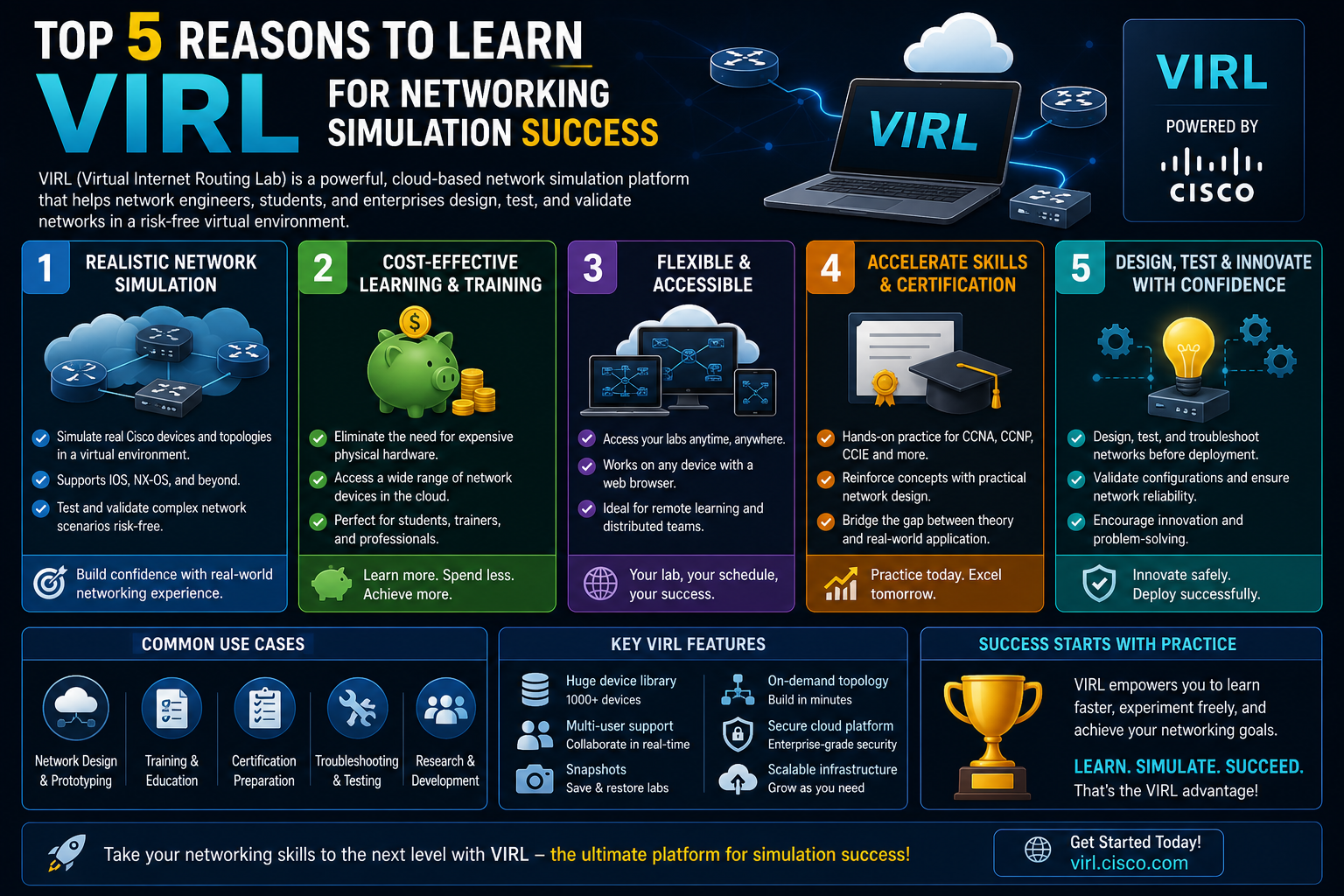
Learning networking often begins with theory: protocols, models, addressing schemes, routing logic, and switching behavior. These concepts are usually introduced in a structured way, where learners memorize definitions and study diagrams that represent how data is supposed to move through systems. While this foundation is necessary, it often creates a gap between knowing something on paper and truly understanding how it behaves in a live environment.
In real-world networks, behavior is rarely predictable in a textbook sense. Devices fail, configurations conflict, routing paths shift, and unexpected interactions occur between protocols. A learner who has only studied theory may understand what OSPF is or how VLANs function, but may struggle when asked to diagnose why two networks cannot communicate despite appearing correctly configured. This gap between knowledge and application is where many aspiring network professionals find themselves stuck.
Understanding networking requires more than memorizing commands or definitions. It requires exposure to dynamic environments where mistakes are not only possible but essential to learning. When learners can experiment, fail, troubleshoot, and rebuild systems in a safe space, they begin to develop intuition. This intuition is what separates someone who has studied networking from someone who can confidently work with it in real environments.
This is the underlying reason simulation-based platforms have become increasingly important in networking education. They allow learners to step beyond passive learning and enter an active environment where concepts become tangible.
The Role of Simulation in Building Practical Skills
Simulation environments bridge the gap between theory and practice by replicating real-world networking behavior without requiring physical hardware. Instead of relying on switches, routers, cables, and racks of equipment, learners interact with virtual devices that behave like their physical counterparts.
This approach offers several important advantages. First, it removes financial barriers. Traditional networking labs require significant investment in hardware, maintenance, and space. For many learners, especially beginners or students, this is not practical. Simulation environments eliminate that obstacle entirely.
Second, they allow repetition without risk. In a physical lab, a misconfiguration might disrupt an entire setup or require time-consuming resets. In a virtual environment, learners can experiment freely, reset topologies instantly, and test multiple scenarios without consequences beyond learning opportunities.
Third, simulation encourages exploration. Instead of following rigid instructions, learners can modify network topologies, introduce faults, and observe outcomes. This exploratory approach deepens understanding and encourages critical thinking.
Within this context, Cisco VIRL stands out as a platform designed specifically to support realistic and flexible network simulation. It is not just a visual tool but a functional environment that closely mirrors real Cisco networking behavior.
What Makes Cisco VIRL Different from Basic Network Simulators
Not all network simulation tools are created equally. Some focus on visual representation, while others simplify network behavior to make it easier for beginners. Cisco VIRL takes a more advanced approach by focusing on realism and depth.
One of its defining characteristics is its ability to run authentic Cisco device images. This means that the behavior learners observe in VIRL is closely aligned with what they would encounter on actual Cisco hardware. Commands behave the same way, routing protocols interact realistically, and configuration logic mirrors production environments.
This level of accuracy is critical for learners who intend to work in professional networking roles. It ensures that the skills developed in simulation translate directly into real-world competence.
Another important aspect is scalability. VIRL allows users to build complex topologies involving multiple routers, switches, and interconnected networks. These environments can replicate enterprise-level systems, enabling learners to understand how large-scale networks are structured and maintained.
Additionally, VIRL is designed to support experimentation with advanced features. This includes automation capabilities, visualization tools, and integration with external systems. These features go beyond basic simulation and provide learners with a deeper understanding of how modern networks operate.
The Importance of Realistic Network Behavior in Learning
One of the biggest challenges in networking education is abstraction. Many learning tools simplify network behavior to make concepts easier to understand. While this can be helpful in the early stages, it often creates a disconnect when learners transition to real environments.
Real networks are not simplified. They involve timing issues, protocol interactions, misconfigurations, and unexpected behavior. A routing table does not always update instantly. A configuration that works in one context may fail in another due to subtle differences in topology or protocol priority.
Cisco VIRL addresses this challenge by simulating network behavior as realistically as possible. When a learner configures a routing protocol, they are not just seeing a static representation. They are observing how routers exchange information, build neighbor relationships, and adapt to changes in topology.
This realism is essential for developing troubleshooting skills. In real-world networking, problems are rarely obvious. They require observation, analysis, and systematic elimination of possibilities. By working in a realistic simulation environment, learners begin to develop these investigative skills naturally.
Over time, this builds confidence. Instead of relying on memorized steps, learners begin to understand why certain behaviors occur. This deeper understanding is what enables them to adapt to new situations and technologies.
How Hands-On Practice Reinforces Networking Concepts
Networking is inherently practical. Concepts like routing, switching, and network segmentation only become meaningful when observed in action. For example, understanding how a routing protocol selects the best path is much easier when you can see it happen in real time.
Hands-on practice allows learners to connect abstract ideas with observable outcomes. When a configuration change leads to a network failure, the cause-and-effect relationship becomes clear. This direct feedback loop is one of the most powerful learning mechanisms in technical education.
Cisco VIRL enhances this process by allowing learners to build and modify entire network environments. They can create multiple routing domains, simulate traffic flows, and observe how different configurations impact performance.
This type of engagement encourages active learning. Instead of reading about concepts, learners interact with them. They make decisions, observe consequences, and refine their understanding through iteration.
Over time, this builds a mental model of how networks operate. Rather than thinking in isolated concepts, learners begin to see networks as interconnected systems where each component influences the others.
Exploring Network Behavior Through Experimentation
One of the most valuable aspects of simulation-based learning is the freedom to experiment. In traditional environments, experimentation is often limited due to cost, risk, or complexity. In a virtual environment like VIRL, those limitations are removed.
Learners can intentionally misconfigure systems to observe what happens. They can test edge cases, simulate failures, and explore scenarios that would be difficult or risky in a production environment. This type of experimentation is crucial for developing deep technical understanding.
For example, adjusting routing metrics, modifying interface settings, or introducing redundant paths can reveal how networks respond to change. These experiments help learners understand not just what works, but why it works.
This process also encourages curiosity. Instead of following predefined instructions, learners begin to ask questions. What happens if this link fails? How does traffic reroute under congestion? Why does one protocol outperform another in certain conditions?
Cisco VIRL supports this curiosity by providing a flexible environment where ideas can be tested quickly and safely. This encourages a mindset of exploration, which is essential for long-term growth in networking careers.
The Transition from Theoretical Learning to Applied Understanding
As learners progress in their networking journey, the goal shifts from memorization to application. At this stage, understanding how systems behave under real conditions becomes more important than recalling definitions.
Cisco VIRL plays a significant role in this transition. It provides a space where theoretical knowledge can be applied directly. Concepts that once seemed abstract become visible and interactive.
For example, understanding subnetting is one thing, but seeing how different subnet configurations affect communication between devices adds a new layer of clarity. Similarly, studying routing protocols becomes more meaningful when learners can observe how routes are dynamically selected and updated.
This applied learning approach helps reinforce knowledge in a lasting way. Instead of short-term memorization, learners develop long-term comprehension built on experience.
Building Confidence Through Controlled Complexity
One of the challenges in networking education is managing complexity. Real networks can be overwhelming, especially for beginners. Too much complexity too soon can lead to confusion and frustration.
Simulation environments like VIRL allow learners to control complexity. They can start with simple topologies and gradually introduce more advanced elements. This step-by-step progression helps build confidence.
As learners become more comfortable, they can expand their environments to include additional routers, protocols, and configurations. Each new layer of complexity builds on previous knowledge, reinforcing learning rather than overwhelming it.
This gradual approach mirrors natural learning progression. It ensures that learners develop a strong foundation before moving into advanced topics.
Developing Troubleshooting Mindsets in Virtual Environments
Troubleshooting is one of the most important skills in networking. It requires logical thinking, patience, and the ability to analyze complex systems. However, troubleshooting skills are difficult to develop through theory alone.
Cisco VIRL provides an ideal environment for practicing troubleshooting. Learners can introduce errors into their networks and attempt to identify and resolve them. This process builds analytical skills and encourages structured thinking.
Instead of guessing solutions, learners learn to observe symptoms, isolate variables, and test hypotheses. Over time, this approach becomes second nature.
This mindset is essential for real-world networking roles, where problems often appear without clear explanations. The ability to systematically diagnose issues is a key differentiator between entry-level understanding and professional expertise.
Moving Beyond Basic Simulation into Realistic Network Emulation
As networking education evolves, the demand for environments that closely resemble real infrastructure has increased significantly. Early simulation tools were useful for visualizing simple concepts, but they often fell short when it came to accurately representing enterprise-grade behavior. Modern learners need more than diagrams and simplified logic; they need environments where network behavior mirrors production systems as closely as possible.
Cisco VIRL addresses this need by functioning not just as a simulator but as an emulation platform. This distinction is important. While simulation tools often abstract away complexity, emulation focuses on replicating actual device behavior using real operating system images. This means that when learners configure routers or switches in VIRL, they are interacting with systems that behave almost identically to real Cisco hardware.
This realism changes the learning experience dramatically. Instead of learning isolated commands or theoretical concepts, users begin to understand how systems interact in practice. Routing tables update dynamically, protocols exchange real-time information, and configuration changes have immediate and observable effects. This creates a learning environment that is both immersive and technically accurate.
The result is a deeper form of understanding where learners are not just studying networking—they are experiencing it.
The Architecture Behind Cisco VIRL and Its Learning Power
At the core of VIRL is a virtualized infrastructure that allows multiple network devices to run simultaneously on a single physical machine or distributed system. Each device operates as an independent virtual instance, capable of running Cisco IOS images and other supported network operating systems.
This architecture is built around virtualization technology, which allocates computing resources such as CPU, memory, and storage to each simulated device. As a result, users can build complex network topologies that include routers, switches, firewalls, and end hosts without requiring physical hardware.
One of the most powerful aspects of this architecture is scalability. A learner can start with a small network consisting of two or three devices and gradually expand it into a large enterprise-style topology. This scalability allows users to explore everything from basic connectivity to advanced multi-domain routing environments.
Another important element is isolation. Each virtual network is contained within its own environment, meaning learners can experiment freely without affecting external systems. This isolation is critical for safe experimentation, especially when testing unstable configurations or intentionally introducing network faults.
The architecture also supports modularity. Users can design custom topologies tailored to specific learning objectives. Whether studying routing protocols, security configurations, or network segmentation, VIRL provides the flexibility needed to create targeted learning environments.
The Role of Authentic Cisco IOS Images in Realistic Learning
One of the defining strengths of VIRL is its use of authentic Cisco IOS images. Unlike simplified or generic network simulators, VIRL runs actual Cisco operating systems in a virtualized form. This ensures that the commands, behaviors, and outputs learners encounter are consistent with real-world environments.
This authenticity is critical for professional development. In real networking roles, engineers work directly with Cisco devices or systems that behave similarly. By learning in an environment that mirrors production systems, users develop familiarity with real command structures, configuration logic, and troubleshooting techniques.
This also reduces the learning curve when transitioning from training environments to real-world job roles. Instead of needing to relearn command syntax or adjust to different system behaviors, learners can apply their existing knowledge directly.
The presence of real IOS images also enables advanced feature exploration. Learners can experiment with routing protocols such as OSPF, EIGRP, and BGP in a realistic context. They can observe how these protocols exchange information, respond to network changes, and maintain stability under different conditions.
This level of realism is difficult to achieve with simplified tools and is one of the reasons VIRL is widely regarded as a powerful learning platform.
Network Topology Design and Its Impact on Understanding Systems
One of the most valuable aspects of working with VIRL is the ability to design custom network topologies. Unlike static learning environments, where learners follow predefined diagrams, VIRL allows full control over network structure.
This means learners can build networks that reflect real-world scenarios or design entirely experimental setups to test specific ideas. For example, a learner might create a multi-layer enterprise network with core, distribution, and access layers. Alternatively, they might simulate a service provider environment with multiple routing domains and external connections.
Designing these topologies requires learners to think critically about how networks are structured. Decisions about device placement, routing paths, and connectivity options become part of the learning process. This encourages a systems-level understanding of networking rather than a device-by-device perspective.
As learners build more complex topologies, they begin to see how different components interact. They understand how changes in one part of the network can affect performance elsewhere. This holistic perspective is essential for advanced networking roles, where systems must be designed for scalability, redundancy, and resilience.
AutoNetKit and the Power of Automated Network Configuration
One of the advanced features within VIRL is automation support through tools like AutoNetKit. This feature allows parts of the network configuration process to be automated based on predefined design rules.
Automation in networking is increasingly important in modern infrastructure environments. Large-scale networks often involve hundreds or thousands of devices, making manual configuration inefficient and error-prone. Tools like AutoNetKit introduce learners to the principles of network automation early in their training.
By using automated configuration generation, learners can observe how networks are structured programmatically. Instead of manually configuring every device, they can see how design inputs translate into working network configurations.
This not only saves time but also reinforces understanding of design logic. Learners begin to see how high-level network architecture decisions translate into low-level device configurations.
It also introduces the concept of consistency. Automated configurations reduce human error and ensure uniformity across devices, which is a critical requirement in enterprise environments.
Live Visualization and Understanding Network Behavior in Real Time
Another powerful feature of VIRL is live visualization. This tool provides a graphical representation of the network topology and allows learners to observe network behavior as it happens.
Instead of relying solely on command-line outputs, learners can see how devices are connected, how traffic flows, and how protocols interact in real time. This visual representation enhances comprehension, especially for complex topologies.
For example, when a routing protocol converges, learners can observe the changes in network paths visually. When a link fails, they can see how traffic is rerouted dynamically. This immediate feedback helps reinforce theoretical concepts through visual experience.
Live visualization also aids in troubleshooting. Instead of guessing where a problem might exist, learners can visually trace connections and identify potential points of failure. This reduces cognitive load and makes complex networks easier to understand.
The combination of visual and command-line data creates a multi-layered learning experience that appeals to different learning styles.
Connecting Virtual Networks to Real-World Systems
One of the most advanced capabilities of VIRL is its ability to connect virtual environments to real physical networks. This hybrid approach allows learners to test configurations in a controlled virtual environment before applying them to production systems.
This feature is particularly valuable for professionals who need to validate network designs before deployment. By simulating interactions between virtual and physical devices, learners can identify potential issues before they impact real systems.
This bridging of virtual and physical environments enhances confidence. It allows users to test changes safely and understand their implications before implementing them in real-world infrastructure.
It also supports gradual transition from learning to practice. Instead of moving abruptly from simulation to production, learners can integrate both environments, reducing risk and improving understanding.
Advanced Protocol Behavior in a Controlled Environment
Cisco VIRL allows learners to explore advanced networking protocols in depth. Routing protocols such as OSPF, EIGRP, and BGP can be configured and tested in realistic scenarios. Learners can observe how these protocols establish relationships, exchange routing information, and adapt to network changes.
This level of interaction is essential for understanding protocol behavior. For example, learners can see how OSPF forms neighbor adjacencies, how BGP selects best paths based on attributes, or how EIGRP responds to topology changes.
These behaviors are difficult to fully understand through theory alone. Seeing them in action helps learners develop a more intuitive understanding of how networks operate.
Additionally, VIRL allows for controlled experimentation with protocol parameters. Learners can modify timers, metrics, and configurations to observe how behavior changes under different conditions. This encourages deeper exploration and critical thinking.
Fault Simulation and the Development of Diagnostic Skills
One of the most important aspects of network engineering is troubleshooting. Real-world networks are rarely perfect, and engineers must constantly diagnose and resolve issues.
VIRL provides an ideal environment for developing these skills through fault simulation. Learners can intentionally introduce errors such as misconfigured routes, broken links, or incorrect settings.
Once a fault is introduced, learners must analyze the network, identify the root cause, and implement a solution. This process mirrors real-world troubleshooting scenarios and helps build practical diagnostic skills.
Over time, learners develop structured approaches to problem-solving. They learn to isolate variables, interpret logs, and test hypotheses systematically.
This experience is invaluable in professional environments where quick and accurate troubleshooting is essential.
The Importance of Iteration in Network Learning
One of the most effective learning strategies in networking is iteration. Instead of building a network once and moving on, learners benefit from repeatedly designing, testing, and refining their environments.
VIRL supports this iterative approach by allowing quick resets and modifications. Learners can rebuild topologies, adjust configurations, and test different scenarios with minimal effort.
This encourages continuous improvement. Each iteration reveals new insights and reinforces previous learning. Over time, learners develop more efficient designs and better understanding of network behavior.
Iteration also helps identify patterns. As learners repeat experiments, they begin to recognize consistent behaviors and outcomes, which strengthens long-term understanding.
Bridging Academic Learning and Professional Practice
A significant challenge in networking education is the transition from academic study to professional practice. Many learners understand theoretical concepts but struggle to apply them in real environments.
VIRL helps bridge this gap by providing a realistic practice environment that mirrors professional systems. The skills developed within VIRL are directly transferable to real-world networking roles.
This includes configuration skills, troubleshooting techniques, protocol understanding, and system design principles. Because the environment closely resembles production systems, learners are better prepared for real job responsibilities.
This alignment between learning and practice reduces the gap between education and industry expectations, making the transition smoother and more effective.
From Virtual Practice to Real-World Networking Confidence
One of the most significant challenges in networking education is the transition from controlled learning environments to unpredictable real-world systems. In theory, learners may understand routing protocols, switching behavior, and network design principles, but real infrastructure rarely behaves in a clean, predictable way. Production environments are shaped by legacy configurations, hardware differences, human error, scaling demands, and constant change.
Cisco VIRL plays a crucial role in bridging this gap by giving learners repeated exposure to realistic network behavior in a controlled yet flexible environment. Over time, this repeated exposure builds something more valuable than memorization: confidence. Not confidence in remembering commands, but confidence in understanding how systems behave under pressure.
When learners repeatedly configure networks, break them, repair them, and optimize them, they begin to recognize patterns. They understand not only what works, but why it works. This deeper awareness becomes essential when dealing with live systems where there is no “reset button” and every action can have immediate consequences.
This transition from theoretical knowledge to applied confidence is what ultimately defines readiness for professional networking roles.
Building Job-Ready Networking Skills Through Practice
Modern networking roles require more than exam knowledge. Employers expect engineers to handle real infrastructure, diagnose complex issues, and design scalable systems. These expectations cannot be fully met through reading or passive learning alone.
Cisco VIRL contributes to job readiness by simulating environments that mirror enterprise networks. Learners are exposed to the same types of configurations, protocols, and challenges they will encounter in professional settings. This includes multi-layer architectures, dynamic routing environments, redundant systems, and hybrid connectivity scenarios.
By working in these environments repeatedly, learners develop muscle memory for configuration tasks. They become comfortable navigating command-line interfaces, interpreting system outputs, and applying structured troubleshooting methods.
More importantly, they develop the ability to think like network engineers. Instead of focusing on individual commands, they begin to understand systems as interconnected structures where every decision has consequences.
This systems-thinking mindset is one of the most valuable outcomes of hands-on simulation-based learning.
Understanding Enterprise Network Complexity Through Simulation
Enterprise networks are rarely simple. They often consist of multiple interconnected systems spanning different locations, departments, and technologies. These environments may include multiple routing protocols, security policies, segmentation strategies, and redundant pathways designed for reliability.
For learners, this complexity can be overwhelming if introduced too quickly. However, in a simulation environment like VIRL, complexity can be introduced gradually and intentionally.
Learners can start with simple two-router topologies and progressively expand into multi-layer enterprise designs. As complexity increases, they begin to understand how large networks are structured and why certain design decisions are made.
For example, they may observe how core, distribution, and access layers interact in a hierarchical design. They may explore how routing protocols distribute information across domains or how redundancy mechanisms ensure network stability during failures.
By building these environments themselves, learners gain insight into not just how enterprise networks function, but why they are designed that way. This experiential learning is far more effective than studying static diagrams or theoretical explanations.
The Role of Failure in Developing Network Expertise
In traditional learning environments, failure is often minimized or avoided. However, in real networking practice, failure is one of the most powerful learning tools. Misconfigurations, outages, and unexpected behavior are common, and the ability to respond effectively is what defines an experienced engineer.
Cisco VIRL provides a safe space where failure can be intentionally introduced and studied. Learners can break networks on purpose, observe the effects, and work toward resolution without real-world consequences.
This controlled exposure to failure is critical for developing diagnostic skills. When a network stops functioning, learners must analyze symptoms, identify potential causes, and test solutions systematically.
Over time, this process builds a structured approach to problem-solving. Instead of guessing or randomly changing configurations, learners develop methodical troubleshooting habits.
They begin to ask the right questions: Where is the failure occurring? What changed before the issue appeared? Which layer of the network is affected? These questions reflect real-world engineering thinking.
This ability to handle failure calmly and logically is one of the most valuable professional skills in networking.
Developing Advanced Troubleshooting Intuition
Troubleshooting in networking is not just about following steps; it is about intuition developed through experience. Experienced engineers often identify problems quickly not because they memorized solutions, but because they recognize patterns.
Cisco VIRL helps develop this intuition by exposing learners to a wide variety of network behaviors. Each experiment, whether successful or not, adds to a mental library of cause-and-effect relationships.
For example, learners may observe how incorrect routing configurations lead to asymmetric paths, or how interface mismatches cause adjacency failures. Over time, these observations become internalized.
When similar issues arise in real environments, learners are able to recognize them more quickly. They do not need to start from scratch; they already have a mental framework for understanding what might be happening.
This pattern recognition is what separates beginners from experienced engineers. VIRL accelerates this development by providing a safe environment for repeated exposure to real network behavior.
Preparing for Certification Through Practical Experience
Networking certifications often require both theoretical knowledge and practical understanding. While exams test conceptual understanding, real-world success depends on the ability to apply that knowledge in dynamic environments.
Cisco VIRL supports certification preparation by allowing learners to build and test scenarios that mirror exam topics. Routing protocols, subnetting, switching behavior, and network design principles can all be explored in realistic configurations.
However, the true value lies not in memorizing exam answers, but in understanding how systems behave. When learners experiment with different configurations, they develop a deeper comprehension that goes beyond exam preparation.
This deeper understanding makes it easier to adapt to unexpected exam scenarios or variations in questions. Instead of relying on memorized answers, learners can reason through problems logically.
More importantly, this practical experience carries over into professional environments, where real networks rarely behave exactly like textbook examples.
Enhancing Career Mobility in Networking Roles
Networking is a broad field with many potential career paths, including network engineering, systems administration, security engineering, and infrastructure design. To succeed in these roles, professionals must demonstrate both theoretical understanding and practical ability.
Experience with simulation platforms like VIRL can significantly enhance career mobility. It demonstrates that a learner has engaged with realistic network environments and has developed hands-on skills beyond theoretical study.
This practical exposure is especially valuable for early-career professionals who may not yet have access to large enterprise systems. By working in simulated environments, they can build experience that closely mirrors real job responsibilities.
Over time, this experience becomes a foundation for more advanced roles. As learners gain confidence, they can move into positions involving larger networks, more complex systems, and greater responsibility.
Understanding Modern Network Design Principles
Modern networks are designed with scalability, reliability, and security in mind. These principles guide decisions about architecture, protocol selection, and system configuration.
Cisco VIRL allows learners to explore these design principles in practice. Instead of simply reading about redundancy or load balancing, they can build systems that implement these concepts and observe their effects.
For example, learners can design redundant network paths and observe how traffic is rerouted during failures. They can configure multiple routing protocols and analyze how they interact. They can segment networks to improve performance and security.
Through this process, design principles become more than abstract ideas. They become practical tools that can be applied in real-world situations.
This applied understanding is essential for network engineers who must design systems that are both efficient and resilient.
Exploring Scalability Through Layered Network Expansion
One of the most important challenges in networking is scalability. As organizations grow, their networks must expand without losing performance or stability.
Cisco VIRL allows learners to explore scalability by gradually expanding network topologies. A small network can evolve into a large, multi-domain system with complex routing and segmentation.
As this expansion occurs, learners begin to understand the challenges associated with scale. They may observe increased routing complexity, longer convergence times, or the need for more efficient design strategies.
This hands-on experience with scalability helps learners develop a practical understanding of how large networks are managed. It also prepares them for real-world environments where growth is continuous and unavoidable.
The Importance of Network Visualization in Complex Systems
As networks grow in size and complexity, understanding their structure becomes more difficult. Visualization plays a critical role in simplifying this complexity.
Cisco VIRL provides tools that allow learners to see network topology and behavior in real time. This visual representation helps make abstract systems more understandable.
Instead of relying solely on command-line outputs, learners can observe how devices are connected, how data flows through the network, and how changes affect overall behavior.
This visual understanding is especially helpful when dealing with large or multi-layered networks. It allows learners to quickly identify relationships between components and understand system-wide behavior.
Over time, this ability to visualize networks mentally becomes an important skill in professional practice.
Long-Term Skill Development Through Continuous Experimentation
Networking is not a field that can be mastered through a single course or certification. It requires continuous learning and adaptation as technologies evolve.
Cisco VIRL supports long-term skill development by providing an environment where experimentation can continue indefinitely. Learners can revisit concepts, test new ideas, and explore emerging technologies.
This continuous engagement reinforces knowledge and encourages curiosity. Instead of treating learning as a one-time event, learners develop a habit of ongoing exploration.
This habit is essential in networking, where technologies such as automation, virtualization, and cloud integration are constantly changing the landscape.
Developing a Professional Mindset in Network Engineering
Beyond technical skills, successful network engineers also develop a professional mindset. This includes problem-solving discipline, attention to detail, and the ability to think critically under pressure.
Working in simulation environments helps reinforce these qualities. Learners must approach problems systematically, test solutions carefully, and consider the impact of their decisions.
Over time, this builds a disciplined approach to engineering tasks. Instead of reacting impulsively to issues, learners develop structured workflows for analysis and resolution.
This professional mindset is one of the most important outcomes of practical networking experience.
Transitioning from Learning Environment to Real Infrastructure
Eventually, learners must transition from simulation environments to real-world systems. This transition can be challenging if experience is limited.
However, learners who have spent significant time in realistic simulation environments find this transition much smoother. The behaviors they have observed in VIRL closely match those in production systems.
They are already familiar with configuration patterns, troubleshooting techniques, and network design principles. This familiarity reduces uncertainty and increases confidence.
As a result, they are better prepared to handle real infrastructure challenges from the beginning of their careers.
The Long-Term Value of Practical Networking Experience
The value of hands-on networking experience extends far beyond initial learning. It shapes how professionals approach problems, design systems, and adapt to new technologies.
Cisco VIRL provides a foundation for this experience by offering a realistic, flexible, and scalable environment for experimentation. Over time, this experience becomes part of a learner’s professional identity.
It influences how they think, how they troubleshoot, and how they design networks. It becomes the basis for future growth and specialization in the field of networking.
Through continuous practice, experimentation, and exploration, learners develop not only technical skills but also the mindset required to succeed in complex, evolving network environments.
Extending Mastery Through Continuous Real-World Simulation Practice
As networking environments continue to evolve, the ability to adapt quickly becomes just as important as foundational knowledge. Technologies shift toward automation, cloud integration, and software-defined infrastructure, which means engineers are expected to understand not only traditional networking but also how modern systems behave in dynamic, programmable environments. Continuous practice in a realistic simulation platform like VIRL helps bridge this evolving gap by allowing learners to repeatedly engage with changing network conditions.
One of the most important aspects of long-term skill development is reinforcement through repetition. When learners repeatedly build, configure, and troubleshoot networks, their understanding becomes more intuitive. Instead of recalling steps mechanically, they begin to recognize patterns in system behavior. This pattern recognition is what enables faster diagnosis of network issues and more efficient design decisions in professional environments.
Another key benefit of ongoing simulation practice is exposure to layered complexity. In real-world networks, problems rarely exist in isolation. A single issue may cascade across multiple layers, affecting routing, switching, or connectivity in unexpected ways. By recreating similar layered scenarios in VIRL, learners gain experience in tracing issues across interconnected systems. This improves their ability to think holistically rather than focusing narrowly on individual devices.
Simulation environments also support experimentation with new technologies and configurations without risk. As networking evolves, engineers must continuously explore new protocols, tools, and architectures. VIRL provides a safe space to test these innovations, compare behaviors, and understand practical implications before applying them in production environments. This reduces uncertainty and builds confidence when adopting new technologies in real infrastructure.
Over time, consistent engagement with such environments leads to deeper technical maturity. Learners begin to anticipate how networks will behave under specific conditions, how failures will propagate, and how design decisions influence performance. This predictive ability is a hallmark of experienced network engineers and is developed primarily through repeated exposure to realistic systems.
Ultimately, sustained practice within a simulation-based environment helps transform theoretical knowledge into practical expertise. It strengthens decision-making, enhances troubleshooting speed, and builds the kind of adaptive thinking required in modern networking careers.
Conclusion
Networking is often introduced as a structured discipline built on protocols, models, and technical rules. While this foundation is essential, it does not automatically translate into real-world competence. The real challenge lies in applying that knowledge in environments that are unpredictable, layered, and constantly evolving. This is where the value of hands-on, realistic simulation becomes clear, and why tools like Cisco VIRL play such an important role in shaping capable network professionals.
Across all stages of learning, from beginner concepts to advanced enterprise design, the key difference between theoretical understanding and practical mastery is experience. Reading about routing protocols or network architectures provides awareness, but actually seeing how those systems behave under different conditions creates understanding. When learners configure networks, introduce changes, and observe outcomes, they begin to internalize how systems truly operate. This shift from passive learning to active experimentation is what builds lasting competence.
A major advantage of working in a simulated environment is the freedom to fail safely. In real networks, mistakes can lead to downtime, performance issues, or security risks. In a controlled environment, however, failure becomes a tool for learning rather than a source of damage. Learners can experiment with configurations, break systems intentionally, and analyze the results without fear of real-world consequences. This encourages curiosity and deeper exploration, both of which are essential for technical growth.
Another important outcome of simulation-based learning is the development of troubleshooting intuition. In professional environments, problems rarely come with clear explanations. Engineers must interpret symptoms, analyze logs, and identify root causes under time pressure. By repeatedly practicing these scenarios in a virtual environment, learners build structured thinking patterns. They learn to approach issues methodically rather than relying on guesswork, which significantly improves efficiency and accuracy in real situations.
Beyond troubleshooting, simulation environments also strengthen system design skills. Building networks from the ground up encourages learners to think about scalability, redundancy, and performance. They begin to understand how individual components contribute to overall system behavior and how design decisions impact long-term stability. This systems-level thinking is critical in modern networking roles, where infrastructure must support growing demands and evolving technologies.
Over time, consistent engagement with realistic network environments transforms how learners perceive networking itself. It is no longer just a theoretical subject but a dynamic field shaped by interaction, experimentation, and continuous learning. Each configuration, each test, and each failure contributes to a deeper understanding of how networks function in real-world conditions.
Ultimately, the true value of platforms like Cisco VIRL lies in their ability to bridge the gap between knowledge and application. They provide a space where learners can move beyond memorization and develop practical, transferable skills. This transformation is what prepares individuals not just to pass exams, but to operate confidently and effectively in real networking environments where expertise truly matters.