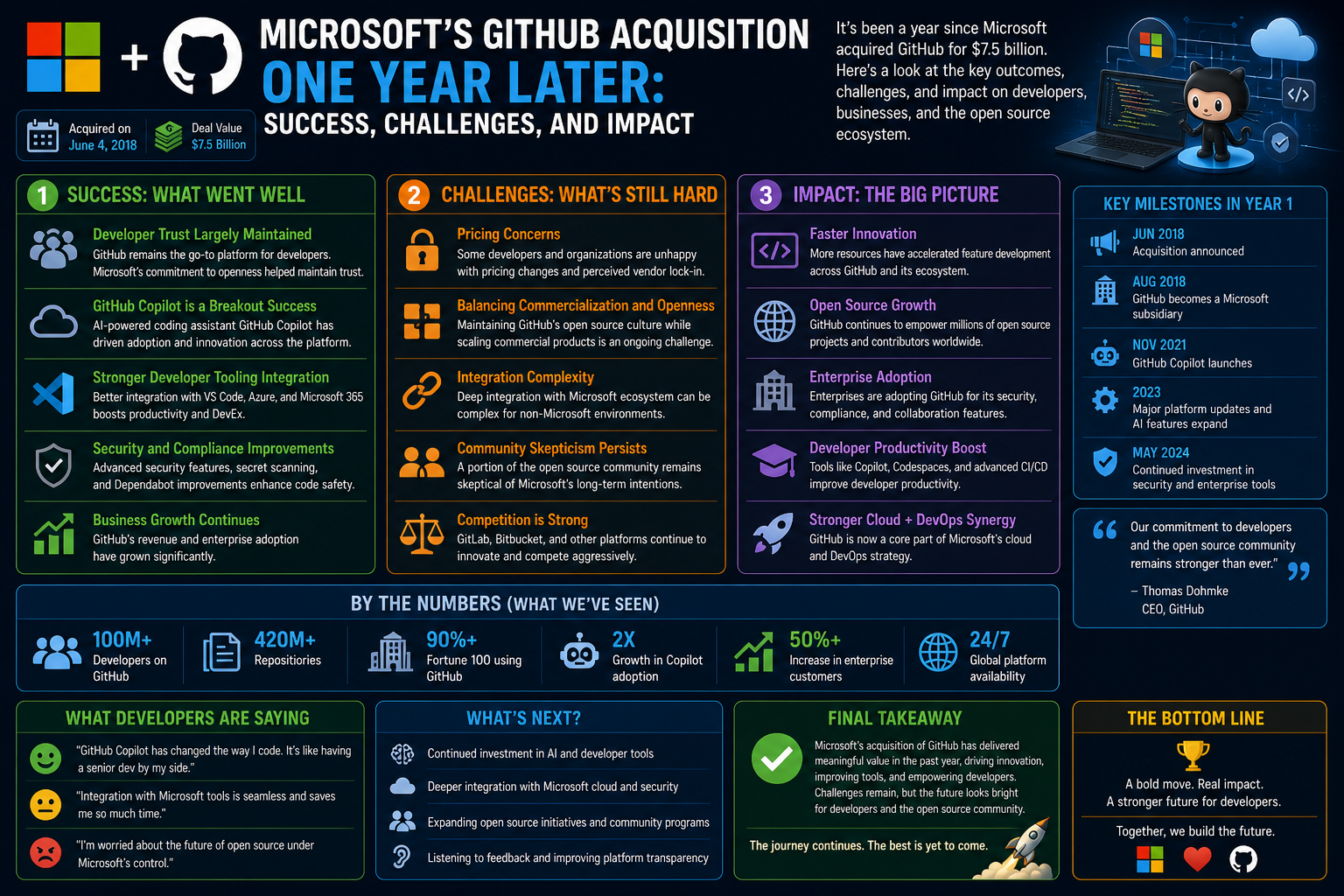
Before Microsoft entered the picture, GitHub had already become one of the most influential platforms in modern software development. It was widely regarded as the central hub for version control, collaboration, and open-source contribution. Developers across the world used it not only to store and manage code but also to build communities around shared projects. Over time, GitHub evolved from a simple hosting service into a critical part of the global software ecosystem.
At its core, GitHub’s success was tied to the growing adoption of distributed version control systems. Developers no longer wanted to rely on centralized systems that limited flexibility and slowed down collaboration. GitHub offered a smooth, intuitive interface built around Git, making it easier for developers to track changes, propose improvements, and manage contributions from multiple people at once. This simplicity, combined with powerful collaboration features, helped GitHub grow rapidly.
By the time discussions about acquisition began, GitHub had already reached millions of developers and hosted tens of millions of repositories. It had become the default choice for open-source projects, startups, and even large enterprises experimenting with public code sharing. Despite its popularity, GitHub had long struggled with profitability. Its revenue model relied heavily on paid private repositories and enterprise tools, but much of its value came from the free and open-source community.
This tension between widespread usage and limited profitability became an important part of the acquisition narrative. GitHub was extremely valuable in terms of influence and data, but it had not yet become a financially dominant company. That situation made it an attractive target for a larger organization capable of scaling its operations and integrating it into a broader ecosystem of tools.
Microsoft’s Evolving Relationship With Open Source
To understand why Microsoft’s acquisition of GitHub caused such intense debate, it is necessary to consider Microsoft’s historical relationship with open-source software. For many years, Microsoft was seen as one of the most vocal critics of open-source development. The company built its business around proprietary software and tightly controlled ecosystems, which stood in contrast to the open collaboration model embraced by communities like Linux.
In the early 2000s, Microsoft’s leadership openly dismissed open-source software as a threat to innovation and intellectual property. This created a long-lasting perception that Microsoft was fundamentally opposed to the principles that GitHub represented. As GitHub became the home of open-source collaboration, the idea of Microsoft owning it felt contradictory to many developers.
However, over time, Microsoft began to shift its approach. As cloud computing and modern development practices evolved, the company gradually embraced open-source technologies. This shift was not sudden, but rather the result of changing industry dynamics and internal strategic decisions. Microsoft started contributing to open-source projects, releasing its own tools under open licenses, and even integrating Linux into its ecosystem through new compatibility layers.
This transformation helped reshape the company’s identity in the tech world. By the time the GitHub acquisition was announced, Microsoft was already far more open-source friendly than it had been in previous decades. Still, skepticism remained, largely because trust in technology companies is built slowly and often influenced by historical actions.
The Announcement of the Acquisition
When Microsoft officially announced its intention to acquire GitHub, the reaction across the technology industry was immediate and intense. The deal, valued at approximately 7.5 billion dollars, signaled a major strategic move by Microsoft to deepen its involvement in the developer ecosystem.
The announcement raised several key questions. One of the most prominent concerns was whether GitHub would maintain its independence or gradually become absorbed into Microsoft’s broader ecosystem. GitHub had built its reputation on neutrality, serving developers across all platforms and programming languages without favoring any specific company or technology stack. Many feared that Microsoft ownership might compromise that neutrality.
Another concern centered on the future of open-source collaboration. GitHub hosted countless projects from competitors of Microsoft, including companies that directly competed in cloud computing, operating systems, and enterprise software. Developers worried that Microsoft might gain access to sensitive code or use its position to influence the direction of competing technologies.
At the same time, there were voices that viewed the acquisition more optimistically. They argued that GitHub needed stronger financial backing and infrastructure support to continue scaling. The platform had grown significantly, and maintaining its reliability and performance required substantial resources. Microsoft, with its vast cloud infrastructure and engineering capabilities, seemed well-positioned to provide that support.
Early Industry and Developer Reactions
The reaction from the developer community was deeply divided. A significant portion of users expressed concern and skepticism, driven largely by historical perceptions of Microsoft. Some developers openly discussed migrating their projects to alternative platforms, fearing potential changes in policies, pricing, or accessibility.
This uncertainty led to a noticeable spike in interest in competing services. Developers began evaluating alternatives and considering whether GitHub would remain aligned with their expectations for openness and stability. The fear was not necessarily based on immediate changes, but rather on what might happen in the long term under new ownership.
On the other hand, many developers adopted a more measured stance. They recognized that GitHub had faced challenges in scaling its infrastructure and monetization model. From this perspective, Microsoft’s acquisition represented an opportunity for stability and long-term growth. These users believed that Microsoft had both the financial resources and technical expertise to strengthen GitHub without fundamentally altering its core mission.
The divide in opinion highlighted a broader tension in the tech community: the balance between corporate ownership and open collaboration. GitHub was not just a product; it was a symbol of decentralized innovation. Any perceived shift in control raised emotional and strategic concerns for its users.
Regulatory Scrutiny and Approval Process
As with any acquisition of this scale, the deal required regulatory review. Authorities in various regions examined the potential implications of Microsoft owning one of the world’s largest code hosting platforms. The focus was primarily on competition, data control, and market influence.
Regulators assessed whether the acquisition would reduce competition in the developer tools market or give Microsoft an unfair advantage. Given GitHub’s widespread usage across industries and competitors, concerns were taken seriously, but ultimately, the acquisition did not present sufficient grounds for rejection.
The approval process highlighted an important aspect of modern technology acquisitions: ownership of platforms does not necessarily equate to control over the ecosystems built on them. GitHub’s structure, openness, and widespread integration across the industry made it difficult to classify as a traditional competitive bottleneck.
Once approval was granted, the acquisition moved forward and was officially completed. This marked the beginning of a new phase for both Microsoft and GitHub, setting the stage for the changes and observations that would follow in the months ahead.
Immediate Post-Acquisition Expectations
After the deal closed, attention shifted toward what Microsoft would do next. Industry observers began analyzing early signals, looking for indications of strategic direction. The central question was whether Microsoft would attempt to integrate GitHub into its ecosystem aggressively or maintain its independence as promised.
Microsoft publicly stated that GitHub would operate independently, retaining its brand, leadership structure, and open platform approach. This assurance was intended to address concerns about loss of neutrality. However, in the technology industry, such assurances are often viewed with cautious optimism rather than full trust.
At the same time, expectations were high that Microsoft would introduce deeper integration between GitHub and its own development tools and cloud services. This included potential improvements in enterprise offerings, identity management, and developer workflows. While these changes were seen as beneficial by some, others worried they might gradually shift GitHub’s focus toward Microsoft-centric environments.
Developers also paid close attention to pricing structures and access models. GitHub had historically offered a mix of free and paid services, and there was speculation about whether Microsoft would adjust this balance. Any changes in cost or access could significantly affect the open-source community that relied heavily on the platform.
Early Signs of Strategic Alignment
In the months following the acquisition, subtle integrations began to appear between GitHub and Microsoft’s broader ecosystem. These changes were not disruptive but indicated a long-term strategy of alignment rather than replacement.
Identity and authentication systems became more connected, allowing enterprise users to manage access across platforms more efficiently. Developer tools within Microsoft’s ecosystem started to integrate more smoothly with GitHub repositories, streamlining workflows for teams already using Microsoft technologies.
These developments suggested that Microsoft’s approach was not to overhaul GitHub, but rather to enhance it through gradual integration. The focus appeared to be on improving enterprise adoption and strengthening GitHub’s position as a central hub for development workflows.
Despite these integrations, GitHub’s core experience remained largely unchanged. The platform continued to operate in a familiar way for most users, reinforcing the idea that Microsoft was prioritizing stability over immediate transformation.
Concerns Around Data and Platform Control
One of the most persistent concerns following the acquisition involved data control. GitHub hosts a vast amount of source code, including both open-source projects and proprietary corporate repositories. This raised questions about how data would be managed under Microsoft ownership.
Some critics worried about potential access to sensitive information, particularly from organizations that competed with Microsoft in various sectors. Even though GitHub operates under strict access controls and privacy policies, the perception of risk remained a significant part of the public discussion.
Others argued that Microsoft’s infrastructure could actually enhance security and reliability. With access to advanced cloud systems and cybersecurity resources, GitHub could potentially benefit from improved protection against threats and vulnerabilities.
These contrasting perspectives reflected a broader debate about trust in large technology companies. While technical safeguards exist to separate data access from ownership, perceptions of influence often play a stronger role in shaping public opinion.
Early Stability and Continuity in GitHub’s Operations
Despite widespread speculation, GitHub’s day-to-day operations remained largely stable after the acquisition. Developers continued to use the platform without experiencing major disruptions. Repositories remained intact, workflows continued uninterrupted, and the platform’s core features remained consistent.
This continuity helped reduce some of the immediate anxiety surrounding the acquisition. While skepticism did not disappear entirely, the absence of negative changes provided a degree of reassurance to users who had feared rapid transformation.
GitHub also continued to support a wide range of programming languages, tools, and frameworks without introducing restrictions tied to Microsoft’s ecosystem. This reinforced its identity as a neutral platform for software development across industries and technologies.
The Beginning of a Longer Transition Period
As time progressed, it became clear that the acquisition was not about immediate change, but rather about long-term integration and strategic positioning. Microsoft’s approach appeared to focus on gradually strengthening GitHub’s infrastructure while preserving its community-driven nature.
This early phase set the tone for how the acquisition would be evaluated in the future. Rather than dramatic shifts, the impact would be measured through subtle improvements, integrations, and changes in developer experience over time.
The broader industry began to shift its attention from speculation to observation, waiting to see how GitHub would evolve under Microsoft’s stewardship in the years that followed.
Strengthening Integration Between Microsoft and GitHub Ecosystem
After the acquisition settled and initial reactions cooled, attention gradually shifted toward how GitHub would evolve under the ownership of Microsoft. Rather than making abrupt changes, Microsoft adopted a gradual integration strategy aimed at connecting GitHub more closely with its broader developer ecosystem. This approach was designed to avoid disrupting existing workflows while still unlocking long-term synergies between platforms.
One of the most noticeable developments during this period was the growing alignment between GitHub and Microsoft’s cloud and identity services. Enterprise users began to see smoother authentication experiences, especially in environments already using Microsoft tools. This shift was subtle but meaningful, particularly for organizations managing large development teams across distributed systems.
At the same time, GitHub continued to operate as a largely independent platform under GitHub. Its branding, interface, and core user experience remained familiar, reinforcing the idea that Microsoft was not attempting to absorb it into a single ecosystem. Instead, the strategy appeared to focus on interoperability rather than consolidation.
Evolution of Developer Workflow Tools
One of the most significant areas of development following the acquisition was the expansion of GitHub’s native developer tools. Over time, GitHub began evolving from a code repository service into a more complete development environment. This shift reflected broader industry trends toward integrated platforms that support the entire software lifecycle.
Features like automated workflows, continuous integration, and deployment pipelines became more central to the GitHub experience. These tools allowed developers to automate repetitive tasks such as testing, building, and deploying code. As a result, GitHub transformed from a passive storage system into an active development hub.
This evolution was particularly important for teams working in complex environments. Instead of relying on multiple disconnected tools, developers could now manage more of their workflow directly within GitHub. This reduced friction and improved productivity, especially for distributed teams working across time zones.
The expansion of these capabilities also positioned GitHub more competitively against other development platforms. While competitors continued to offer version control services, GitHub was increasingly becoming a full-scale development platform rather than just a repository host.
Changes in Pricing Structure and Accessibility
One of the most widely discussed changes following Microsoft’s acquisition involved GitHub’s pricing model. Prior to the acquisition, private repositories required paid subscriptions, which limited access for smaller teams and individual developers. However, in a major shift, GitHub introduced free private repositories for all users.
This change had a significant impact on the developer community. It lowered the barrier to entry for individuals and startups who previously had to choose between public visibility and financial cost. By removing this restriction, GitHub made it easier for developers to experiment, build private projects, and collaborate without immediate financial pressure.
The move also aligned with broader industry trends toward democratizing software development tools. As competition increased among development platforms, accessibility became a key differentiator. GitHub’s decision strengthened its position as the default platform for both open-source and private development.
While this change was widely welcomed, it also raised questions about long-term monetization strategies. Some observers wondered how GitHub would balance free access with the need for sustainable revenue generation under Microsoft’s ownership. This tension between openness and profitability remained an ongoing theme throughout the post-acquisition period.
Expansion of Enterprise-Focused Features
Alongside improvements for individual developers, GitHub also expanded its enterprise offerings significantly. Large organizations increasingly relied on GitHub to manage complex codebases, and Microsoft saw an opportunity to strengthen its position in the corporate development space.
Enterprise features focused on scalability, security, and compliance. Organizations were given more control over access management, audit logs, and integration with internal systems. These improvements made GitHub more attractive to regulated industries such as finance, healthcare, and government services.
The integration with Microsoft’s identity and access management systems further strengthened this enterprise focus. Companies already using Microsoft infrastructure found it easier to adopt GitHub as part of their existing workflows. This reduced friction during onboarding and improved consistency across development environments.
As enterprise adoption grew, GitHub’s role began to shift from a purely developer-focused platform to a central component of corporate software infrastructure. This transition marked an important milestone in its evolution under Microsoft’s ownership.
The Rise of GitHub Actions and Automation
One of the most transformative developments in the GitHub ecosystem was the rise of automation through GitHub Actions. This feature allowed developers to define workflows that automatically triggered based on specific events, such as code commits, pull requests, or issue updates.
Over time, GitHub Actions became a central part of modern development practices. It enabled continuous integration and continuous deployment pipelines directly within the platform, eliminating the need for external tooling in many cases. This shift significantly streamlined development workflows and reduced operational complexity.
The flexibility of GitHub Actions also encouraged a growing ecosystem of reusable components and community-driven workflows. Developers could share automation templates, making it easier for teams to adopt best practices without starting from scratch.
This focus on automation aligned closely with Microsoft’s broader vision of developer productivity. By embedding automation deeply into GitHub, the platform became more than just a repository—it became an active participant in the development lifecycle.
Growing Importance of Cloud Integration
As cloud computing continued to dominate the software industry, GitHub’s integration with cloud platforms became increasingly important. Microsoft’s leadership in cloud infrastructure provided a natural foundation for enhancing GitHub’s capabilities in this area.
Developers began to see tighter connections between GitHub repositories and cloud deployment environments. This allowed for more seamless transitions from code development to production deployment. The integration reduced manual steps and helped teams deliver software more efficiently.
For organizations already invested in Microsoft’s cloud ecosystem, these improvements were particularly valuable. GitHub became a bridge between code development and cloud execution, simplifying complex workflows and improving consistency across environments.
However, despite these integrations, GitHub maintained its compatibility with a wide range of cloud providers. This neutrality was important in preserving its appeal to developers who worked across multiple platforms and did not want to be locked into a single ecosystem.
Open Source Community Confidence and Concerns
The open-source community played a central role in GitHub’s identity, and maintaining trust within that community was critical after the acquisition. Initially, there was concern that corporate ownership might shift priorities away from community-driven development.
Over time, however, GitHub continued to support open-source projects at scale. Millions of repositories remained publicly accessible, and collaboration tools continued to evolve in ways that supported distributed contributions. This helped reassure many developers that the platform’s core mission had not changed.
Still, some concerns persisted. Open-source maintainers often emphasized the importance of neutrality and independence in infrastructure hosting. While GitHub remained open, its ownership by Microsoft meant that ultimate control rested with a large corporation, which continued to raise philosophical questions within parts of the community.
Despite these concerns, participation in open-source development on GitHub continued to grow. The platform remained the primary hub for collaborative software development, reinforcing its central role in the global tech ecosystem.
Security Enhancements and Infrastructure Stability
Security became an increasingly important focus after the acquisition. As the volume of code hosted on GitHub continued to grow, so did the importance of protecting that data from vulnerabilities and attacks.
Microsoft’s experience in enterprise security and cloud infrastructure contributed to a series of improvements in GitHub’s security posture. Enhanced authentication mechanisms, improved monitoring systems, and better vulnerability detection tools were gradually introduced.
These improvements were particularly valuable for enterprise users, who required strong assurances about data protection and compliance. GitHub’s ability to meet these requirements helped solidify its position in corporate environments.
Infrastructure stability also improved during this period. With access to Microsoft’s global cloud resources, GitHub was able to scale more effectively and handle increasing demand without significant performance issues. This reliability reinforced user confidence in the platform’s long-term viability.
Competitive Pressure from Alternative Platforms
Despite GitHub’s strong position, competition in the developer tools space remained active. Platforms such as GitLab and Bitbucket continued to offer alternative solutions for version control and DevOps workflows. These competitors often positioned themselves as more independent or specialized alternatives.
Some developers explored these platforms out of concern for centralization, while others were drawn by specific features or pricing models. However, GitHub’s network effects made it difficult for competitors to displace it as the dominant platform.
The sheer scale of GitHub’s developer community, combined with its deep integration into workflows and tools, created a strong barrier to migration. Even when developers experimented with alternatives, many projects ultimately remained anchored to GitHub due to collaboration and visibility advantages.
Microsoft’s continued investment in GitHub’s capabilities further strengthened its competitive position. Rather than relying solely on legacy dominance, GitHub evolved into a more comprehensive platform that addressed modern development needs.
Shifts in Developer Culture and Collaboration Patterns
The post-acquisition period also saw subtle changes in how developers collaborated on GitHub. The platform increasingly supported asynchronous collaboration, distributed teams, and automated workflows, reflecting broader shifts in software development culture.
Pull requests, code reviews, and issue tracking became more integrated into structured workflows. Teams were able to coordinate complex development processes without relying heavily on synchronous communication. This made GitHub particularly well-suited for remote and globally distributed teams.
The culture of open contribution also continued to evolve. More organizations began adopting open-source practices internally, using GitHub not only for public projects but also for internal collaboration. This blurred the line between open and private development environments.
These cultural shifts reinforced GitHub’s role as more than just a technical tool. It became a foundational part of how modern software teams organize, communicate, and build products.
Early Indicators of Long-Term Strategic Direction
As the first extended period following the acquisition unfolded, patterns began to emerge that hinted at Microsoft’s long-term strategy for GitHub. Rather than transforming it into a tightly controlled corporate product, the approach appeared to focus on expansion, integration, and ecosystem growth.
GitHub was increasingly positioned as a central platform in the software development lifecycle, connecting coding, automation, deployment, and collaboration into a unified experience. This direction aligned with broader trends in software engineering, where integrated platforms were becoming more valuable than fragmented toolchains.
At the same time, GitHub maintained its identity as an open and flexible platform. Developers continued to use it across different ecosystems, languages, and infrastructures, preserving its role as a neutral ground for collaboration.
The balance between integration and independence became one of the defining characteristics of GitHub’s evolution during this period, shaping how both developers and organizations interacted with the platform moving forward.
The Shift Toward AI-Driven Development Inside GitHub
In the years following Microsoft’s acquisition of GitHub, one of the most transformative developments was the increasing role of artificial intelligence in software creation. This shift did not happen abruptly but emerged gradually as development tools evolved to meet changing expectations around productivity, automation, and code quality.
A key milestone in this transformation was the introduction of AI-assisted coding tools integrated into GitHub’s ecosystem, particularly through GitHub Copilot. Built in collaboration with OpenAI, Copilot represented a major step toward embedding machine learning directly into the development workflow.
Rather than simply hosting code, GitHub began actively participating in how code was written. Developers could now receive real-time suggestions, auto-generated functions, and context-aware completions while working. This fundamentally changed the rhythm of programming, shifting it from purely manual writing to a hybrid model of human and machine collaboration.
The impact of this change extended beyond convenience. It raised deeper questions about authorship, originality, and the role of developers in an increasingly automated environment. Some saw it as a powerful productivity enhancer, while others viewed it as a shift that could redefine what it means to be a software engineer.
Within the broader Microsoft ecosystem, this AI-driven direction aligned with a larger strategy of embedding intelligence into every layer of productivity tools. GitHub became one of the most visible examples of this approach in action.
Expanding Role of Microsoft Cloud Infrastructure in GitHub’s Growth
As GitHub evolved under Microsoft’s ownership, its reliance on large-scale cloud infrastructure became increasingly important. The platform’s growth in repositories, users, and automated processes required a robust and scalable foundation capable of handling global demand.
This is where integration with Microsoft Azure played a central role. Azure’s global infrastructure provided the backbone for GitHub’s performance improvements, ensuring reliability even as usage expanded across millions of developers and organizations.
The relationship between GitHub and Azure was not simply technical but strategic. By aligning development workflows with cloud deployment environments, Microsoft created a more seamless path from code creation to production systems. Developers could build, test, and deploy applications with fewer external dependencies.
This integration also influenced how organizations structured their engineering pipelines. Instead of treating development and infrastructure as separate domains, teams increasingly adopted unified workflows that connected GitHub repositories directly to cloud environments.
Despite these deeper connections, GitHub maintained compatibility with multiple cloud providers. This decision was important in preserving its role as a neutral development platform, ensuring that developers were not locked into a single ecosystem.
Changing Patterns in Global Developer Collaboration
One of the most significant long-term effects of GitHub’s evolution was the way it reshaped global collaboration among developers. Over time, the platform became more than a code repository—it evolved into a social and organizational layer for software development.
Teams distributed across continents began relying heavily on asynchronous workflows. Contributions no longer required physical proximity or even shared working hours. Instead, pull requests, issue tracking, and automated checks allowed development to continue across time zones without interruption.
This shift was amplified by improvements in automation and continuous integration systems. Developers could submit changes, trigger automated testing, and receive feedback without direct human intervention. This reduced bottlenecks and accelerated development cycles.
GitHub’s interface and workflow design reinforced this model of distributed collaboration. The platform encouraged transparency, traceability, and structured communication around code changes. As a result, development teams became more modular and decentralized.
These changes were not limited to large organizations. Even small teams and independent developers benefited from the ability to collaborate globally, contributing to projects that spanned industries, technologies, and geographies.
Evolution of Open Source Governance on GitHub
As GitHub continued to grow under Microsoft, its role in open-source governance became increasingly important. The platform was no longer just a hosting service but a central coordination point for some of the largest open-source ecosystems in the world.
Open-source maintainers began adopting more structured governance models to manage growing communities. Decision-making processes became more formalized, with clear guidelines for contributions, code reviews, and release cycles.
GitHub supported this evolution by introducing tools that helped maintainers manage complexity. Features for project boards, dependency tracking, and automated workflows made it easier to coordinate large-scale contributions.
Despite concerns that corporate ownership might influence open-source direction, GitHub continued to support a wide range of independent projects. The diversity of repositories remained one of its defining characteristics, spanning everything from experimental research to production-grade software systems.
However, the increasing scale of open-source collaboration also introduced new challenges. Maintaining quality, security, and consistency across thousands of contributors required more sophisticated tools and governance frameworks.
Security, Trust, and Platform Responsibility
As GitHub became more deeply embedded in global software infrastructure, its responsibility around security grew significantly. Millions of applications relied on code hosted within the platform, making it a critical part of the digital supply chain.
Under Microsoft’s ownership, security enhancements became a major focus area. Continuous improvements were introduced in authentication systems, vulnerability scanning, and dependency management. These tools helped developers identify potential risks before they reached production environments.
One of the most important shifts was the increased emphasis on proactive security. Rather than reacting to vulnerabilities after they were discovered, GitHub began integrating systems that could detect risks early in the development lifecycle.
This approach reflected broader industry trends toward “shift-left” security practices, where security is integrated into development rather than treated as a separate stage. GitHub’s tools made it easier for developers to adopt these practices without significantly changing their workflows.
At the same time, trust remained a central concern. Because GitHub hosted both public and private repositories, organizations needed assurance that their code remained secure and isolated. Microsoft invested heavily in infrastructure hardening and compliance frameworks to address these concerns.
Enterprise Transformation and Large-Scale Adoption
Over time, GitHub’s role in enterprise environments expanded significantly. What had once been a platform primarily associated with open-source development became a core component of corporate software engineering strategies.
Large organizations adopted GitHub not only for version control but also for managing entire software delivery pipelines. This included planning, development, testing, deployment, and monitoring. The platform gradually evolved into a central coordination layer for enterprise engineering teams.
Integration with Microsoft’s identity and access systems made it easier for organizations to manage permissions at scale. This was particularly important for companies with complex internal structures and strict compliance requirements.
Enterprise adoption also influenced the direction of feature development. Tools for auditing, governance, and policy enforcement became increasingly important as organizations sought greater control over their development environments.
Despite this enterprise growth, GitHub continued to support individual developers and small teams. This dual focus—serving both large corporations and independent contributors—remained one of the platform’s defining characteristics.
Competitive Landscape and Platform Differentiation
Even as GitHub strengthened its position, competition in the developer tools space continued to evolve. Alternative platforms offered different approaches to version control, collaboration, and DevOps integration.
Some competitors emphasized simplicity and lightweight workflows, while others focused on deeply integrated DevOps pipelines or self-hosted solutions. This diversity reflected the fact that no single platform could perfectly serve all development needs.
GitHub’s advantage, however, lay in its network effects. The sheer scale of its developer community made it difficult for alternatives to achieve the same level of adoption. Projects, documentation, and collaboration patterns were already deeply embedded within its ecosystem.
Microsoft’s continued investment also helped GitHub maintain its leadership position. By expanding features, improving performance, and integrating advanced capabilities like AI-assisted development, GitHub remained at the forefront of innovation in developer tooling.
However, competition also served as a catalyst for improvement. The presence of alternative platforms pushed GitHub to continuously refine its offerings and adapt to changing developer expectations.
The Cultural Shift in Software Development Practices
Beyond technical changes, GitHub’s evolution under Microsoft contributed to broader cultural shifts in software development. The way developers approached collaboration, code quality, and project management continued to evolve.
One notable shift was the increasing normalization of distributed teams. Remote collaboration became a standard practice rather than an exception. GitHub’s asynchronous workflows supported this transition, enabling teams to function effectively without centralized offices.
Another cultural change involved the growing importance of transparency in development. Public repositories, issue tracking, and discussion threads created a level of visibility that encouraged accountability and shared learning.
The integration of automation further changed developer expectations. Tasks that were once manual and repetitive became automated, allowing developers to focus more on design, architecture, and problem-solving.
These cultural shifts were not imposed by the platform but emerged naturally from the tools and workflows it supported. GitHub’s design encouraged a particular style of development that prioritized openness, collaboration, and continuous improvement.
Long-Term Ecosystem Effects of the Acquisition
As time progressed, the broader effects of Microsoft’s acquisition of GitHub became more visible across the software industry. The platform’s continued growth reinforced its position as a foundational layer of modern development infrastructure.
One of the most significant long-term effects was the consolidation of developer workflows into centralized platforms. Instead of using multiple disconnected tools, teams increasingly relied on integrated environments that combined version control, automation, and collaboration.
This consolidation improved efficiency but also raised questions about dependency on centralized platforms. As more of the software development lifecycle moved into GitHub, its importance to global technology infrastructure increased substantially.
At the same time, the platform’s expansion helped accelerate innovation across industries. Faster development cycles, improved collaboration, and AI-assisted coding contributed to a more dynamic software ecosystem.
GitHub’s evolution under Microsoft also demonstrated how large-scale acquisitions could reshape not just individual products but entire development paradigms. The platform became a case study in how ownership, integration, and technological evolution interact over time.
Ongoing Evolution Without a Defined Endpoint
Even as GitHub continued to expand its capabilities and influence, its development remained an ongoing process rather than a fixed destination. New tools, integrations, and workflows continued to emerge as the software industry evolved.
AI integration, cloud connectivity, enterprise adoption, and open-source governance all continued to develop in parallel, shaping the platform’s trajectory in complex and interconnected ways.
Rather than reaching a final state, GitHub’s evolution reflected the broader nature of software development itself—continuous, adaptive, and responsive to technological change.
Continued Expansion of AI and Developer Productivity Models
As GitHub’s ecosystem continued to evolve under Microsoft’s ownership, artificial intelligence became more deeply embedded in everyday development practices. What began as optional assistance gradually shifted into a more foundational layer of the developer experience. Tools like GitHub Copilot started influencing not just how code was written, but how developers planned, structured, and reviewed their work.
This transition marked a subtle but important change in mindset. Developers were no longer relying solely on memory, documentation, or manual coding patterns. Instead, they were increasingly working alongside predictive systems that could anticipate intent and generate functional code structures. Over time, this changed the rhythm of software development, making it faster but also more reliant on machine interpretation.
In parallel, concerns around over-dependence on AI began to surface. Some developers questioned whether reliance on automated suggestions might reduce deep understanding of underlying systems. Others saw it as an evolution similar to previous shifts in computing history, where abstraction layers made complex systems more accessible without eliminating technical mastery.
Deepening Integration Across Microsoft’s Ecosystem
Another major development was the continued convergence between GitHub and broader Microsoft services. Integration with Microsoft Azure became more seamless, allowing developers to move from code repositories to deployment environments with minimal friction. This created a more unified development pipeline, especially for enterprise users who already operated within Microsoft’s ecosystem.
Identity management also became more centralized through Microsoft’s authentication systems. This made it easier for large organizations to control access across multiple development tools while maintaining security and compliance standards. The result was a more structured and governed development environment, particularly in regulated industries.
Despite these integrations, GitHub maintained its cross-platform identity. Developers working outside Microsoft technologies continued to use the platform extensively, reinforcing its position as a neutral development hub. This balance between integration and independence became a defining feature of its post-acquisition identity.
Increasing Importance of Software Supply Chain Security
As global reliance on software intensified, attention increasingly shifted toward the security of the software supply chain. GitHub became a central point in this discussion due to its role in hosting code that powers countless applications worldwide.
Security practices evolved from reactive patching to proactive prevention. Tools embedded within GitHub began analyzing dependencies, identifying vulnerabilities, and warning developers before insecure components were introduced into projects. This shift helped reduce systemic risks across the software ecosystem.
Organizations also began adopting stricter policies around code provenance and dependency management. GitHub’s growing security tooling made it easier to enforce these policies consistently across large teams. This was especially important for enterprises managing thousands of repositories simultaneously.
The emphasis on security also reinforced GitHub’s role as critical infrastructure. It was no longer just a collaboration platform; it had become a foundational component of global digital security practices.
Maturation of Open Source Ecosystems
Open-source development continued to thrive within GitHub’s environment, but it also matured significantly. Projects became more structured, with clearer governance models and formal contribution guidelines. This helped manage the complexity of large-scale collaborative development.
Maintainers increasingly relied on automation to handle repetitive tasks such as dependency updates, testing, and release management. This allowed them to focus more on architectural decisions and community coordination.
At the same time, the scale of open-source participation grew dramatically. More organizations contributed to public projects, and many companies began using open-source strategies as part of their core development processes.
GitHub played a central role in enabling this expansion by providing tools that supported both small experimental projects and large enterprise-grade open-source initiatives. This dual capability strengthened its position as the primary hub for global software collaboration.
Conclusion
Microsoft’s acquisition of GitHub ultimately marked a turning point in how modern software development platforms are built, scaled, and integrated into the wider technology ecosystem. What initially sparked uncertainty and debate gradually evolved into a longer-term story of stability, expansion, and strategic transformation. Over time, GitHub retained its identity as a neutral, developer-focused platform while simultaneously benefiting from Microsoft’s infrastructure, resources, and ecosystem alignment.
Rather than disrupting the platform, the acquisition led to a steady layering of new capabilities. Improvements in cloud integration through Microsoft Azure, enterprise features, and automation tools expanded GitHub’s role beyond simple version control. It became a central hub for collaboration, deployment, and increasingly, AI-assisted development through tools like GitHub Copilot.
At the same time, concerns about openness, independence, and data control did not disappear entirely, but they were largely balanced by GitHub’s continued support for open-source development and cross-platform accessibility. The platform’s growth demonstrated that corporate ownership does not necessarily eliminate openness when strategic incentives align with community value.
In the broader perspective, GitHub’s evolution reflects a larger shift in software engineering toward integrated, intelligent, and cloud-connected workflows. It shows how developer platforms are no longer passive repositories but active participants in the software lifecycle.
Ultimately, the post-acquisition years suggest a trajectory defined less by disruption and more by gradual transformation—where GitHub continues to function as both a cornerstone of open-source collaboration and a key component of Microsoft’s long-term vision for software development.