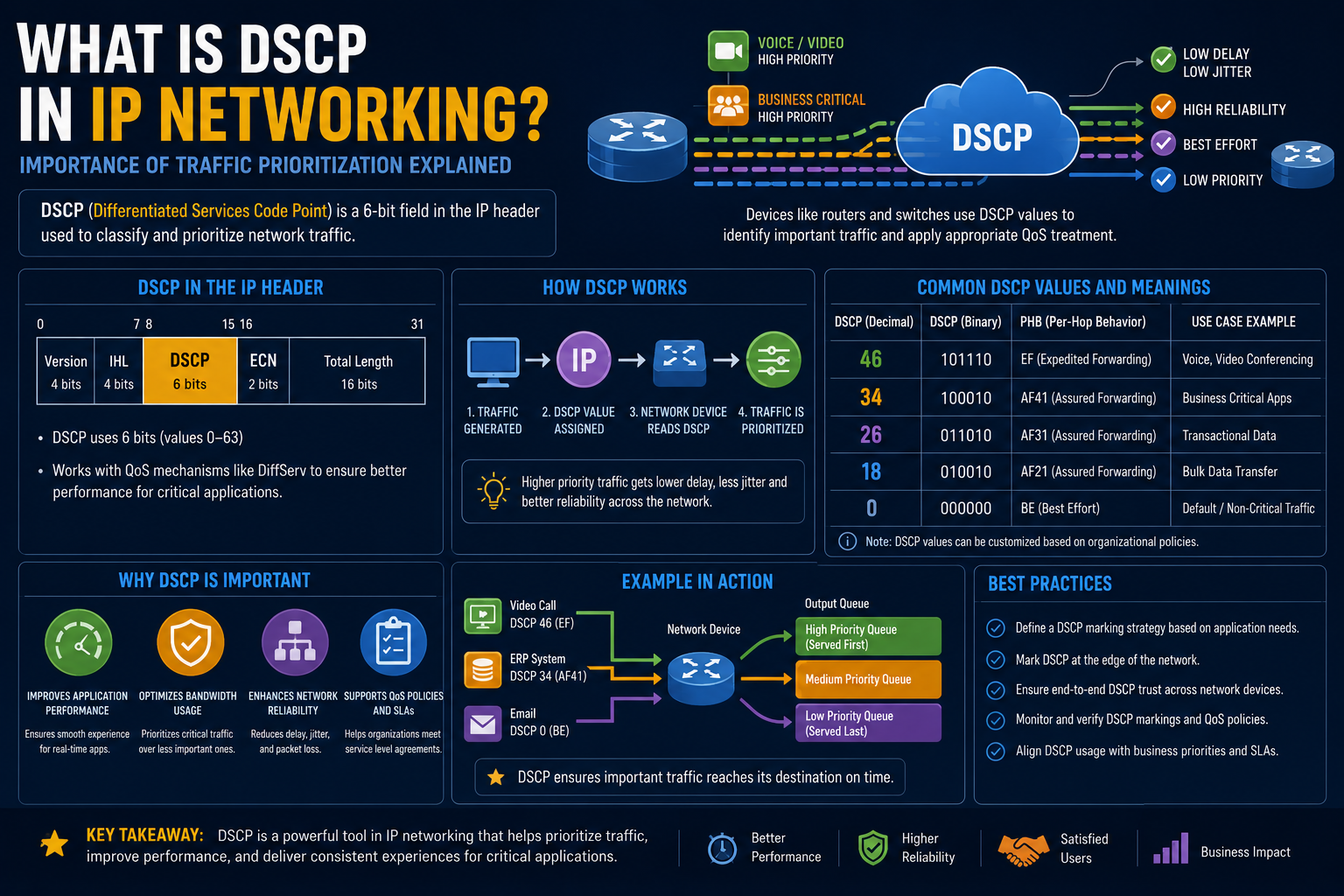
In modern computer networks, not all data is equally important. Some traffic, like voice calls or live video, requires immediate delivery with minimal delay, while other types of traffic, such as emails or file downloads, can tolerate slight delays without affecting user experience. To manage these differences efficiently, networks rely on a mechanism known as Differentiated Services Code Point (DSCP). DSCP is a key component of Quality of Service (QoS) and plays a critical role in controlling how data is handled as it moves across routers and switches.
At its core, DSCP is a field inside the IP packet header that allows network devices to identify the priority level of each packet. This prioritization ensures that important traffic is delivered faster and more reliably, while less critical traffic is handled with lower urgency. Despite its simplicity in structure, DSCP is one of the most powerful tools in traffic engineering, especially in enterprise networks, service provider infrastructures, and real-time communication systems.
Understanding the Purpose of DSCP in Modern Networking
The primary purpose of DSCP is to solve a fundamental problem in networking: congestion. When multiple types of data compete for limited bandwidth, routers must decide which packets to forward first. Without a prioritization system, all traffic is treated equally, which can lead to delays, jitter, and packet loss—especially for time-sensitive applications.
DSCP addresses this issue by classifying packets based on their service requirements. For example, a VoIP call requires continuous, real-time transmission. Even a small delay can result in poor call quality. On the other hand, downloading a file or loading a webpage does not require strict timing. DSCP allows the network to distinguish between these types of traffic and handle them accordingly.
This classification system is embedded directly into the IP header, meaning it travels with the packet across every network device it encounters. Each router reads the DSCP value and decides how to treat the packet based on predefined rules. This allows for consistent traffic behavior across complex networks.
Structure of the DSCP Field and Its Role in IP Packets
DSCP is a 6-bit field within the IPv4 and IPv6 header. Because it uses 6 bits, it can represent values from 0 to 63, giving a total of 64 possible classifications. These values determine the priority level assigned to each packet.
Originally, IP networks used a simpler system called Type of Service (ToS), which offered limited prioritization capabilities. As internet traffic grew more diverse and demanding, this system became insufficient. DSCP was introduced as part of the Differentiated Services (DiffServ) architecture, defined in RFC 2474, to provide a more scalable and flexible approach.
Even though DSCP only uses 6 bits, it is remarkably efficient. Instead of assigning a unique behavior to every possible value, DSCP groups values into classes of service. These classes determine how packets are queued, forwarded, or dropped during congestion. This allows networks to scale prioritization without requiring excessive complexity.
How DSCP Classifies and Marks Network Traffic
DSCP works by assigning a “mark” to each packet. This mark is written at the source of the traffic, usually by the sending device or a network edge router. Once marked, the packet retains this value throughout its journey across the network.
The DSCP system defines several categories of traffic handling behavior, known as Per-Hop Behaviors (PHBs). These behaviors determine how each router processes the packet. The three main DSCP categories include Expedited Forwarding, Assured Forwarding, and Best Effort.
Expedited Forwarding (EF): Highest Priority Traffic
Expedited Forwarding is the highest priority DSCP classification. It is designed for traffic that requires extremely low latency and minimal packet loss. The most common use case for EF is voice over IP (VoIP) and real-time communication applications such as video conferencing or online gaming.
EF is commonly represented by the DSCP value 46, which corresponds to the binary value 101110. Packets marked with EF are treated with the highest urgency by routers. They are placed at the front of the queue and are rarely dropped, even during congestion.
This ensures smooth, uninterrupted communication, making EF essential for applications where timing is critical.
Assured Forwarding (AF): Controlled Priority Levels
Assured Forwarding provides a flexible middle ground between high priority and standard traffic. It is designed to ensure that important data gets preferential treatment without guaranteeing strict delivery conditions like EF.
AF is divided into multiple classes, each with different levels of priority and drop probability. There are four main AF classes, and each class is further divided into three drop precedence levels. This creates a structured system that allows administrators to fine-tune traffic behavior.
Lower drop precedence means higher priority and lower chance of packet loss. Higher drop precedence means the packet is more likely to be discarded during congestion. This structure allows networks to handle business-critical applications more efficiently while still managing bandwidth constraints.
AF is widely used in enterprise environments where multiple applications compete for network resources but still require differentiated treatment.
Best Effort (BE): Default Traffic Handling
Best Effort is the simplest form of traffic handling in DSCP. It uses the value 0, meaning no special priority is assigned. Packets marked as Best Effort are treated equally and are delivered based on available network capacity.
This category includes general internet traffic such as web browsing, email, and file downloads. Since no guarantees are made regarding delivery speed or reliability, Best Effort traffic is the first to experience delays or drops during network congestion.
Despite being the lowest priority, Best Effort still plays an important role because it represents the majority of everyday network usage.
How DSCP Improves Network Performance and Efficiency
DSCP provides several important advantages that make it essential in modern network design. One of the most significant benefits is improved Quality of Service (QoS). By prioritizing critical traffic, DSCP ensures that essential applications perform reliably even under heavy network load.
Another major advantage is better bandwidth utilization. Instead of treating all traffic equally, DSCP allows networks to allocate resources intelligently. This reduces congestion and improves overall efficiency.
DSCP also enhances user experience. Applications such as video calls, streaming platforms, and online collaboration tools perform significantly better when traffic is properly prioritized.
In addition, DSCP supports scalability. Large networks with thousands of devices can maintain consistent traffic behavior because DSCP markings are standardized and universally recognized by network equipment.
Challenges and Limitations of DSCP in Real-World Networks
Despite its advantages, DSCP is not without challenges. One of the main issues is complexity. Configuring DSCP correctly across multiple devices requires careful planning and consistent policies. If different devices interpret DSCP values differently, it can lead to unpredictable network behavior.
Another limitation is trust. DSCP markings can be altered or misused if not properly controlled. Some devices may ignore or overwrite DSCP values, reducing effectiveness.
Additionally, DSCP does not guarantee bandwidth; it only influences priority. If a network is severely overloaded, even high-priority traffic may experience delays.
Finally, incorrect configuration can lead to unintended consequences, such as prioritizing non-critical traffic over important services, which can degrade performance instead of improving it.
DSCP in Modern Enterprise and Internet Infrastructure
In enterprise networks, DSCP is commonly used to support business-critical applications such as voice communication systems, video conferencing tools, and cloud-based services. Network administrators design policies that ensure these applications receive priority handling.
Internet service providers also use DSCP internally to manage large volumes of traffic across backbone networks. However, DSCP markings are often reset or modified when traffic crosses between different administrative domains, limiting end-to-end consistency across the public internet.
Despite these challenges, DSCP remains a foundational technology for traffic management. It is widely supported across routers, switches, firewalls, and operating systems, making it a universal standard in networking.
Conclusion
Differentiated Services Code Point (DSCP) is a fundamental mechanism in modern networking that enables efficient traffic prioritization and Quality of Service management. By using a compact 6-bit field in the IP header, DSCP provides a scalable way to classify and control how different types of data are handled as they move across networks. Its strength lies in its simplicity combined with flexibility, allowing network devices to distinguish between real-time traffic like voice and video and less time-sensitive data such as emails or file transfers.
Through its three major traffic handling models—Expedited Forwarding, Assured Forwarding, and Best Effort—DSCP ensures that critical applications receive the resources they need to perform reliably even under congestion. While it does not guarantee bandwidth or eliminate network bottlenecks entirely, it significantly improves overall performance and user experience when implemented correctly.
However, DSCP requires careful configuration and consistent policy enforcement across all network devices. Misconfigurations or inconsistent markings can reduce its effectiveness. Despite these challenges, DSCP remains a vital tool in enterprise and service provider networks, forming the backbone of modern QoS strategies and enabling smooth, efficient communication in increasingly complex digital environments.