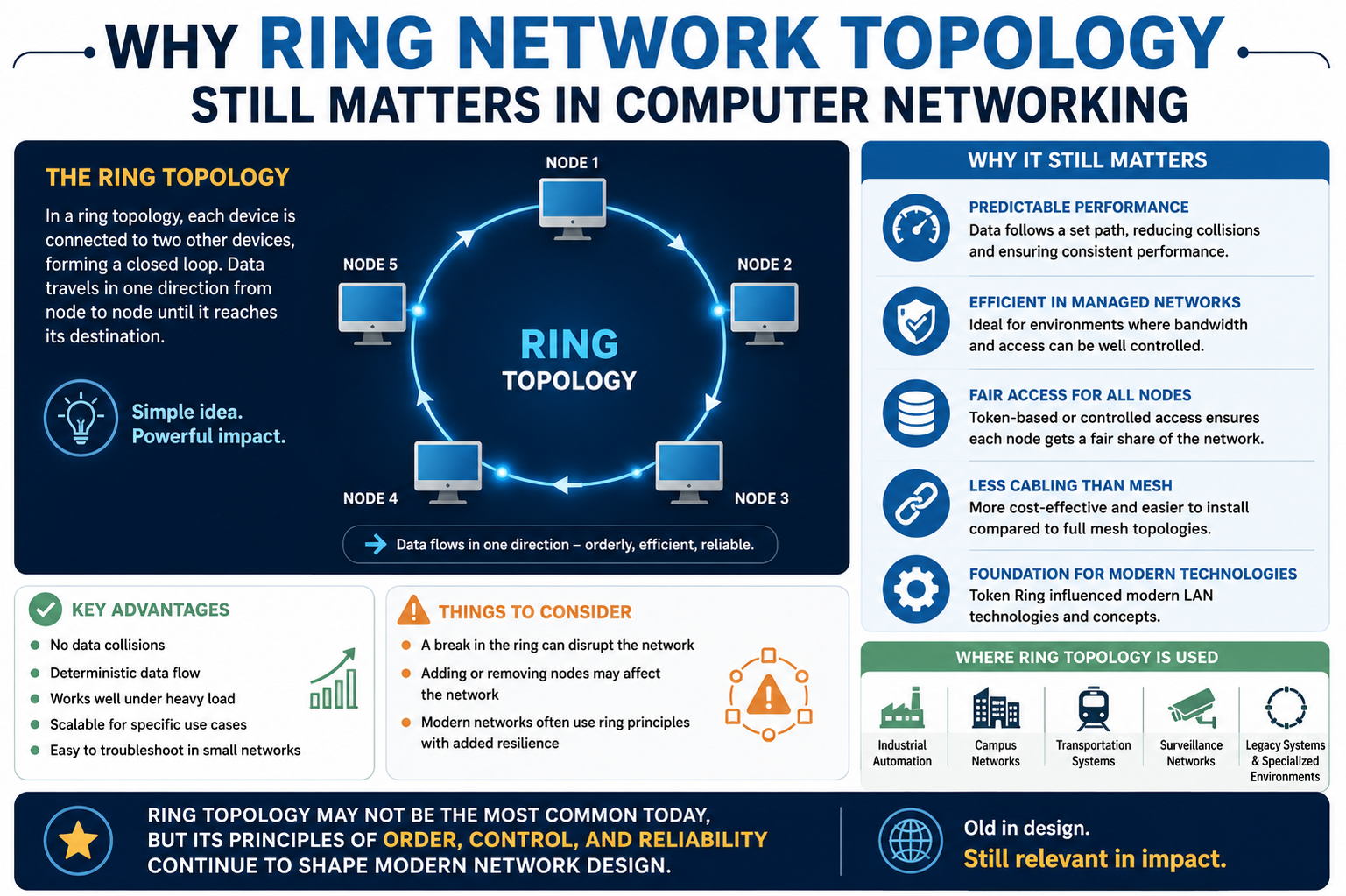
Computer networks are the backbone of modern communication. Every time people send an email, stream a video, or access information from a remote server, they rely on a network structure that determines how devices connect and communicate. One of the classic designs used in early networking environments is known as ring network topology. Although modern networks mostly use different architectures today, the ring topology remains an important concept because it shaped many of the ideas that influence networking systems even now.
A ring topology describes a network layout in which every device is connected to exactly two other devices, forming a continuous circular pathway for data. If someone were to draw the network, it would resemble a loop or ring where each computer links directly to its two neighbors. This circular design means that data travels along the ring from one device to the next until it reaches the intended destination.
The idea behind ring topology is relatively simple, yet the mechanism that controls how devices communicate makes it unique. In early networks, managing communication between multiple computers was a serious challenge. If several machines attempted to transmit data at the same time, the signals could interfere with each other. These situations, known as collisions, often resulted in lost data and the need to resend information. The ring topology introduced an organized method for handling communication so that devices could share the network efficiently.
To understand how this works, imagine a group of people sitting in a circle during a discussion. Only one person can speak at a time. If everyone begins talking simultaneously, no one can understand anything being said. To solve this, the group might pass around an object, such as a talking stick. Whoever holds the stick has the right to speak, and once they are finished, they pass it to the next person. The ring topology uses a similar principle through something called a token.
A token is a special control message that circulates around the network ring. It moves from one device to the next in a consistent order. When a computer receives the token, it checks whether it has data to send. If it does, it temporarily captures the token and uses it to transmit information. Once the data is sent, the token is released and continues traveling around the ring so that other devices get their opportunity to communicate.
This token-passing approach makes the network highly organized. Since only one device can transmit data at a time, the chance of data collisions is eliminated. Every computer knows it will eventually receive the token, ensuring fair access to the network. In environments where many devices compete for network bandwidth, this controlled process can create a more balanced system.
Early networking engineers valued this predictability. Unlike some other network designs where devices might constantly compete to send data, the ring topology provided a structured method for communication. Each node, or device on the network, had a clear role in passing data along the ring. Even if a device was not the final destination for a piece of information, it still participated in forwarding the message to the next device.
Data movement in a basic ring topology typically follows a single direction. When a computer sends data, the message travels around the ring through each device until it reaches the target machine. Every intermediate device acts like a relay point, examining the data and forwarding it onward. Once the message arrives at the correct destination, the receiving computer processes the data and removes it from the ring.
Because of this process, the network behaves like a circular highway where information flows smoothly in one direction. Each device plays a role in maintaining that flow, which helps ensure consistent communication across the entire system.
One of the most notable historical implementations of ring topology was a technology known as Token Ring networking. This system used the token-passing method to regulate communication across the network. It was widely used in corporate environments during the late twentieth century, particularly in organizations that required reliable and predictable network performance.
At the time, networking technology was still evolving. Many organizations relied on simpler structures such as bus topology, where all devices connected to a single communication line. While the bus design was straightforward, it suffered from frequent collisions because multiple devices could attempt to transmit data simultaneously. These collisions slowed down communication and reduced overall efficiency.
Ring topology addressed this issue by controlling access to the network through the token mechanism. Instead of devices competing to send data, each one waited for its turn. This simple yet effective approach helped maintain smooth communication even when multiple computers were connected to the same network.
Another important aspect of ring topology is how each device actively participates in the network’s operation. In some other network structures, devices simply send and receive data without influencing how messages move across the system. In a ring topology, however, every node is responsible for forwarding information. This means that the network relies on the cooperation of all connected devices to function properly.
The design also provides a predictable path for data. Because the network forms a closed loop, engineers know exactly how information travels from one device to another. This predictability made ring topology attractive in environments where consistent communication timing was important.
For small and medium-sized networks, this design could perform quite efficiently. The token-passing system ensured that each device had an equal opportunity to transmit data, which prevented certain computers from monopolizing the network’s bandwidth. In busy network environments, fairness like this was a valuable feature.
Despite these advantages, ring topology also introduced some challenges. Since each device is directly connected to its neighbors, a problem with a single connection can disrupt the entire network. If a cable is damaged or a device fails, the circular pathway may break, preventing data from traveling around the ring. When this happens, communication across the network may stop completely.
Engineers eventually developed ways to reduce this risk, such as creating dual ring systems where two circular paths exist instead of one. If one path fails, the other can continue carrying network traffic. This redundancy improves reliability but also increases the complexity and cost of the network.
Even with these challenges, ring topology played an important role in the development of computer networking. It demonstrated that carefully controlling how devices access the network could significantly improve performance and reliability. The token-based communication model introduced by ring networks helped engineers understand how structured data transmission could reduce conflicts and increase efficiency.
Understanding this topology also provides insight into how networking technology evolved over time. Early engineers had to experiment with different ways of connecting computers, each with its own strengths and weaknesses. The ring topology emerged as one of the creative solutions developed to address the limitations of earlier designs.
Although many modern networks use different architectures today, the ideas behind ring topology continue to influence networking concepts. The focus on organized communication, fairness among devices, and predictable data movement remains relevant in many modern networking technologies.
Learning about ring topology is therefore not simply about studying an outdated network design. It is about understanding an important chapter in the history of computer networking. By exploring how this topology works and why it was created, we gain a clearer picture of how networking technology progressed and how engineers solved the challenges of connecting computers together.
In the early days of networking, every new idea helped shape the systems that people rely on today. Ring topology was one of those ideas that brought structure and order to the complex task of sharing network resources. Its approach to managing communication showed that even simple designs can offer powerful solutions when they are carefully planned and implemented.
Advantages and Performance Characteristics of Ring Topology
When networking technologies were still developing, engineers faced a significant challenge: how to allow multiple computers to communicate across the same network without interfering with one another. Early systems struggled with issues such as data collisions, unfair bandwidth usage, and unpredictable performance. The ring network topology emerged as a solution that addressed many of these problems through a carefully controlled communication method.
One of the most notable strengths of ring topology lies in its structured approach to network access. Instead of allowing devices to transmit data whenever they wish, the network relies on a controlled process that determines exactly when each device can send information. This organized method significantly reduces the likelihood of communication conflicts and allows the network to operate in a predictable way.
At the center of this structured system is the token mechanism. The token acts as a form of permission that travels continuously around the ring. Each device receives the token in turn, and only the device holding the token is allowed to transmit data. Once the transmission is complete, the token continues its journey to the next device in the ring.
This system creates an orderly environment where every device knows it will eventually have a chance to communicate. The token ensures fairness by preventing any single computer from dominating the network. Each node waits patiently for the token to arrive, which distributes access evenly across all connected devices.
In many early networking environments, fairness was an important concern. Certain applications or systems could attempt to transmit large volumes of data, potentially occupying most of the network bandwidth. In designs without proper control mechanisms, this behavior could slow down communication for other devices on the network. Ring topology helps prevent this issue by ensuring that every device must wait its turn.
The predictable nature of token passing also contributes to stable network performance. Because the token moves through the network in a consistent sequence, engineers can estimate how long it will take for a device to gain access to the network. This predictability makes ring topology suitable for systems that require steady communication patterns rather than random bursts of traffic.
Another advantage of ring topology is the elimination of data collisions. In many early network designs, collisions occurred when two devices attempted to send data at the same time. When this happened, the signals interfered with one another, and both devices had to resend their data. This process wasted valuable network time and reduced efficiency.
The token system prevents this problem entirely. Since only the device with the token can transmit data, there is never a situation where two devices send information simultaneously. The absence of collisions means that the network spends more time successfully delivering data rather than recovering from communication errors.
This collision-free environment allows ring networks to maintain consistent data flow. Instead of dealing with unpredictable interruptions caused by competing transmissions, the network moves information along the ring in a smooth and orderly manner. Each message travels from one node to the next until it reaches its destination.
Another factor that contributes to efficient communication in ring topology is the directional movement of data. In most ring networks, data travels in a single direction around the loop. This approach simplifies the process of forwarding messages because each device knows exactly where the data should go next.
When a device receives a data packet, it examines the information to determine whether it is the intended recipient. If the data is not meant for that device, the packet is simply forwarded to the next node in the ring. This process continues until the message reaches the correct destination.
This method of data movement ensures that every device participates in maintaining the network. Each node acts as both a receiver and a relay point, helping transport data along the circular path. The shared responsibility among devices creates a collaborative system where the network functions as a coordinated whole.
Ring topology can also provide strong performance in networks of modest size. When the number of connected devices remains relatively small, the token travels quickly around the ring, giving each node frequent opportunities to transmit data. This leads to efficient communication with minimal waiting time.
In such environments, the predictable transmission process helps maintain steady network speeds. Since devices take turns sending data rather than competing for access, the network avoids sudden slowdowns caused by congestion. The orderly communication pattern helps maintain stable performance.
Another advantage lies in the reduced risk of signal reflection. In some other network designs, signals can bounce back along the communication line, creating interference that disrupts data transmission. The circular structure of a ring network reduces the likelihood of these reflections because data moves continuously in a controlled direction.
The combination of token passing and directional data flow allows ring networks to maintain reliable communication even under moderate network loads. Engineers appreciated this stability because it made network behavior easier to predict and manage.
Ring topology also demonstrates efficiency in terms of bandwidth usage. Since collisions do not occur, the network does not waste time retransmitting lost data. Every transmission that takes place is purposeful and controlled, which helps maximize the use of available bandwidth.
This efficiency becomes especially valuable in environments where network resources are limited. In early networking systems, bandwidth was often scarce, and efficient data transmission was essential. The structured communication process of ring topology allowed organizations to make better use of their network capacity.
Another positive aspect of ring networks is the balanced distribution of communication opportunities. Every node receives equal treatment in the network’s communication cycle. No device is given priority over others, which creates a fair environment for data exchange.
In practice, this fairness can prevent situations where certain computers experience long delays while others dominate the network. Each device knows that it will receive the token in turn, ensuring that all participants have a chance to communicate.
This characteristic can be particularly helpful in collaborative work environments where multiple systems share network resources. When devices must rely on the same communication infrastructure, equal access helps maintain productivity across the network.
Ring topology also introduced valuable ideas that influenced later networking technologies. The concept of controlled network access helped engineers explore new ways of managing communication in complex systems. The token-passing mechanism demonstrated that structured access methods could improve efficiency and reliability.
Over time, these ideas contributed to the development of more advanced networking protocols and communication strategies. Even though many modern networks use different architectures, the principles learned from ring topology continue to influence networking design.
In addition, the ring topology encouraged engineers to think carefully about how data flows through a network. Instead of focusing only on connecting devices, designers began considering how communication should be regulated to ensure smooth operation. This shift in perspective helped advance the overall field of network engineering.
The ring network also highlighted the importance of cooperation among devices. Each node in the network contributes to maintaining the communication pathway by forwarding data to the next device. This shared responsibility creates a distributed system where the network depends on the participation of every connected machine.
While modern networks often rely on centralized equipment such as switches and routers, the collaborative model of ring topology provided valuable insight into distributed communication systems.
For many years, ring networks served as reliable solutions in office environments, research facilities, and organizations that required stable local area networks. Their structured communication process helped address many of the challenges faced by early networking technologies.
Understanding the advantages of ring topology helps illustrate why this design was once widely adopted. The fairness provided by token passing, the elimination of collisions, the predictable performance, and the efficient use of bandwidth all contributed to its success during an important period in the history of computer networking.
These benefits show that even older networking designs can offer valuable lessons. The innovations introduced by ring topology helped shape the thinking of network engineers and paved the way for the advanced systems used in modern communication networks.
Limitations, Challenges, and the Legacy of Ring Topology
While ring topology once played a significant role in the development of computer networks, it also presented several limitations that eventually led to its decline in modern networking environments. Understanding these challenges helps explain why newer network designs replaced ring structures in many organizations, even though the underlying concepts remain historically important.
One of the most notable weaknesses of ring topology is its dependence on a continuous communication loop. Since the network forms a closed circular path, every device relies on the integrity of that loop to function properly. If any part of the ring is interrupted, data can no longer circulate through the network as intended.
This means that a single point of failure can potentially disrupt the entire network. If a cable becomes damaged, a connector fails, or a device stops functioning correctly, the ring may break. When this happens, the flow of data around the network is interrupted, and communication between devices may stop completely.
In early implementations of ring networks, this vulnerability created significant concerns for network administrators. Maintaining the physical integrity of the ring required careful monitoring of cables and devices. Even a minor hardware problem could bring down the entire network segment.
Another challenge arises from the role each device plays in forwarding data. In a ring topology, every node acts as a relay that passes information along to the next device. This means that the proper functioning of the network depends on each device performing its task correctly.
If a network interface card fails or a device becomes unresponsive, it may stop forwarding data to the next node. When this occurs, the data pathway is effectively blocked. Other devices on the network may be unable to send or receive information because the communication loop has been interrupted.
Troubleshooting such problems can be difficult. When a ring network experiences a failure, administrators must determine exactly where the break occurred. Since each device participates in the communication chain, identifying the faulty component can take time and careful investigation.
This diagnostic process may involve checking multiple devices and connections until the source of the issue is discovered. In larger networks with many nodes, locating the problem can become particularly challenging.
Another limitation of ring topology involves the direction of data transmission. In most ring networks, information travels in a single direction around the loop. While this design simplifies the forwarding process, it also creates potential inefficiencies.
If the destination device happens to be located near the sender but in the opposite direction of data flow, the message must still travel around the entire ring before reaching its target. This can introduce delays, particularly as the number of devices on the network increases.
As networks grow larger, the token must pass through more nodes before returning to its starting point. Each additional device increases the time required for the token to complete a full circuit of the ring. This delay can lead to increased latency, meaning that devices must wait longer before they are allowed to transmit data.
In small networks, this delay is often minimal and may not significantly affect performance. However, in larger networks with many nodes, the waiting time can become noticeable. Devices may experience slower communication because they must wait for the token to arrive before sending data.
Another issue related to ring topology is scalability. Expanding the network by adding new devices is not always a straightforward process. To insert a new node into the ring, the existing loop must be temporarily broken. The new device is then connected between two existing nodes before the ring is closed again.
This process can disrupt the network during installation. Administrators must carefully reconnect the ring to ensure that communication resumes properly. As more devices are added over time, managing the network becomes increasingly complex.
In contrast, other network topologies allow new devices to be connected more easily without interrupting existing communication. This difference made alternative designs more appealing as networks continued to grow in size and complexity.
The physical layout of ring topology can also present logistical challenges. Since each device must connect directly to two neighboring devices, careful planning is required when arranging network cables. Devices must be positioned in a way that allows the ring structure to be maintained.
In some environments, the nearest neighboring device may be located in a different room or area. Connecting these devices may require additional cabling, wall modifications, or infrastructure adjustments. These requirements can increase installation costs and complicate the network setup.
Another factor that contributed to the decline of ring topology was the cost of certain technologies used in its implementation. Some ring networks relied on specialized hardware and communication standards that were more expensive than competing solutions.
For example, certain high-performance ring systems used fiber optic communication technologies to overcome signal degradation issues associated with long cable distances. While these technologies offered improved reliability and speed, they also required specialized equipment and installation procedures that increased overall costs.
As networking technology advanced, alternative designs became more practical and cost-effective. One of the most significant developments was the widespread adoption of Ethernet-based networks. Ethernet systems offered flexible connectivity, easier expansion, and simpler troubleshooting processes.
Unlike ring networks, Ethernet designs often use central switching devices that manage communication between connected computers. This centralized approach reduces the dependency on each individual node to forward data. If a single device fails, it typically does not interrupt communication for the entire network.
The growing popularity of these alternative architectures gradually reduced the use of ring topology in modern networking environments. Organizations seeking scalability, reliability, and ease of maintenance often chose network designs that better supported expanding infrastructures.
Despite this shift, engineers did develop methods to improve the reliability of ring networks during their period of widespread use. One such solution was the dual ring topology.
In a dual ring system, two separate circular pathways exist instead of one. The primary ring carries normal network traffic, while the secondary ring acts as a backup. If a break occurs in the primary ring, the network can reroute communication through the secondary pathway.
This redundancy helps maintain network functionality even when part of the infrastructure fails. However, implementing dual ring systems increases the complexity of the network and requires additional hardware and cabling.
Even though ring topology is less common in modern networks, its influence remains visible in the history of networking technology. The structured communication model introduced by token passing demonstrated that controlled access to network resources could improve efficiency and fairness.
The design also highlighted the importance of balancing reliability, performance, and scalability when building network infrastructures. Engineers learned valuable lessons from both the strengths and weaknesses of ring topology.
Many of these lessons helped guide the development of newer technologies that combine efficient communication methods with flexible network designs. By studying ring topology, network professionals gain insight into how early engineers addressed the challenges of connecting multiple computers together.
The evolution of networking technology shows that each design contributes to the broader understanding of how communication systems function. Even architectures that are no longer widely used can provide valuable perspectives on problem-solving and innovation.
Ring topology represents an important stage in the progression of computer networking. Its organized approach to data transmission introduced concepts that influenced future technologies and helped shape the way networks are designed today.
Understanding this topology allows learners and professionals to appreciate the journey of networking technology—from simple experimental structures to the complex, high-speed communication systems that support modern digital life.
Practical Applications, Variations, and Modern Relevance of Ring Network Topology
Although ring network topology is often described as a legacy networking design, its influence has extended far beyond the early days of computer networking. The structure introduced a disciplined approach to managing communication between devices, and many of the ideas developed through ring networks have influenced modern networking technologies. Understanding how ring topology has been applied in real-world environments and how it evolved over time helps illustrate why it remains an important concept in networking education and engineering.
In its most basic form, a ring topology connects devices in a circular sequence, with each node linked directly to two neighbors. This design creates a continuous path through which data travels from one device to another. While this concept may appear simple, its practical use required thoughtful planning and engineering. Early network designers had to ensure that devices were arranged correctly and that the communication process remained stable as data circulated around the ring.
One of the earliest areas where ring networks were implemented was within office environments. Businesses that adopted computer systems in the late twentieth century often needed reliable ways for employees to share files, printers, and other network resources. At the time, networking technologies were still developing, and organizations were experimenting with different methods for connecting computers together.
Ring topology offered an attractive option because it allowed devices to communicate in an organized and predictable way. The token-based communication method helped prevent network congestion and ensured that every computer had equal access to the shared network resources. In workplaces where multiple employees relied on the same network infrastructure, fairness and stability were highly valued features.
Large corporations often used ring networks to connect computers across office floors or within departments. By forming a circular communication path, devices could pass information efficiently without competing for bandwidth. Each computer simply waited for its turn to transmit data, which created an orderly communication cycle that minimized disruptions.
In addition to office networks, ring topology also found use in industrial environments. Manufacturing facilities, research laboratories, and technical operations sometimes relied on network systems that required consistent communication timing. In such settings, predictable data transmission was more important than maximum speed.
The structured communication process of a ring network made it suitable for these situations. Since each device received the token in sequence, engineers could estimate how long it would take for a machine to gain access to the network. This predictability allowed industrial systems to coordinate activities more effectively, particularly when multiple machines needed to exchange information.
For example, automated production equipment might rely on network communication to synchronize operations across different stages of a manufacturing process. The organized nature of ring topology helped ensure that data messages were delivered in a steady and reliable pattern.
Another area where ring topology proved valuable was in specialized communication networks that required resilience. Engineers recognized that the circular structure of ring networks could be modified to improve reliability through redundancy. This led to the development of variations such as the dual ring topology.
In a dual ring configuration, two separate communication loops exist within the same network. One ring typically carries normal data traffic, while the second ring serves as a backup pathway. If a failure occurs in the primary ring, the network can redirect communication through the secondary ring.
This redundancy significantly improves the network’s fault tolerance. Instead of losing communication entirely when a single cable breaks, the network can continue operating by using the alternate path. Such systems were especially valuable in environments where uninterrupted communication was essential.
In some implementations, both rings were used simultaneously to increase network capacity. Data could travel in opposite directions on the two rings, allowing the network to handle larger volumes of traffic. This approach demonstrated how the basic ring concept could be expanded to support more complex communication needs.
Another variation of ring topology involved modifying the direction of data flow. While many ring networks transmitted data in a single direction, some designs allowed data to travel both ways around the ring. This adjustment reduced the distance data needed to travel to reach its destination.
Bidirectional communication could improve efficiency in certain situations. If a device needed to send information to a nearby node located in the opposite direction of the standard data flow, the network could route the message through the shorter path. This helped reduce transmission delays and improved overall performance.
Beyond traditional computer networks, the principles of ring topology have also influenced communication systems used in transportation and infrastructure management. Some metropolitan communication networks use ring-like structures to connect multiple facilities across a city or region.
In these systems, communication links form circular pathways that allow data to travel between different locations. If one segment of the network experiences a failure, traffic can often be rerouted around the ring through an alternate route. This ability to redirect communication helps maintain service continuity.
Such designs are particularly useful in systems that support essential services. For example, communication networks used in public transportation control systems or power grid monitoring often require dependable connectivity. Ring-based structures provide a level of resilience that helps protect against service disruptions.
Another interesting application of ring-inspired networking can be found in certain data communication technologies used for long-distance connections. Some fiber-optic communication systems employ ring-based designs to ensure that data can continue flowing even if part of the network becomes damaged.
In these networks, multiple communication nodes are connected through fiber cables arranged in a loop. If one section of the cable is cut or fails, the system can redirect traffic in the opposite direction around the ring. This design ensures that communication between distant locations remains active.
The adaptability of ring topology concepts demonstrates how foundational networking ideas can evolve over time. Even when the original form of a technology becomes less common, the principles behind it often continue to influence newer systems.
Modern networking environments tend to rely heavily on switched Ethernet architectures, which provide flexibility and scalability that early ring networks struggled to achieve. However, the lessons learned from ring topology continue to inform how engineers design reliable communication systems.
One of the most important ideas introduced by ring topology was the concept of controlled network access. The token-passing method showed that regulating when devices transmit data could significantly reduce communication conflicts. This concept encouraged engineers to explore other structured communication protocols that manage network traffic efficiently.
Another lasting contribution of ring topology is the idea of cooperative network operation. In a ring network, each device plays a role in maintaining the communication pathway by forwarding data to the next node. This distributed approach to communication helped engineers understand how networks could function without relying entirely on centralized control.
The cooperative model seen in ring networks has influenced the development of distributed systems where multiple devices share responsibility for maintaining network operations. While modern networks often use centralized switching equipment, the principles of distributed communication remain relevant in various technological fields.
Educational programs that teach networking concepts continue to include ring topology as part of their curriculum. Learning about this design helps students understand the historical progression of networking technology and the engineering decisions that shaped modern communication systems.
Studying ring topology also encourages critical thinking about the trade-offs involved in network design. Every topology offers certain advantages while presenting specific challenges. By analyzing these factors, network engineers can make informed decisions about which architecture best suits a particular environment.
For instance, ring topology emphasizes fairness and organized communication but faces limitations in scalability and fault tolerance. Other network designs may prioritize flexibility and resilience but introduce different types of complexity. Comparing these approaches helps learners develop a deeper understanding of networking principles.
Another reason ring topology remains relevant is that technological innovation often revisits earlier ideas and adapts them to new contexts. Concepts that once seemed outdated may find renewed usefulness when combined with modern technologies.
Advances in high-speed communication, intelligent network management, and automated monitoring systems have created opportunities to revisit older networking models. While traditional ring networks may not dominate today’s infrastructure, the underlying concepts can still inspire creative solutions for specific challenges.
Engineers sometimes draw upon ring-based structures when designing specialized communication systems that require redundancy and predictable data flow. The ability to route traffic around a circular pathway provides a level of reliability that can be valuable in critical applications.
The history of ring topology illustrates how networking technology evolves through experimentation and adaptation. Early engineers worked with the tools and knowledge available at the time, developing innovative solutions to address the communication challenges they faced.
As technology advanced, new designs emerged that improved upon earlier approaches. However, the contributions of ring topology remain an important part of networking history. The architecture demonstrated that structured communication methods could improve network efficiency and fairness.
Today’s high-speed global networks rely on sophisticated technologies that far exceed the capabilities of early computer networks. Yet the foundational principles established during those early years continue to influence how communication systems are designed and managed.
By studying ring topology and its applications, readers gain insight into the creative problem-solving that shaped the evolution of computer networking. The design may no longer dominate modern infrastructures, but its influence persists in the ideas and innovations that followed.
The story of ring topology serves as a reminder that technological progress is often built upon earlier discoveries. Each generation of engineers learns from the successes and challenges of previous designs, refining concepts and developing new solutions that push technology forward.
Conclusion
The development of computer networking has gone through many stages, with different network designs emerging to solve the technical challenges of their time. Among these designs, ring network topology holds a unique place in networking history. Although it is often considered a legacy topology today, its influence on the evolution of network architecture remains significant. Understanding ring topology provides valuable insight into how early engineers approached the challenge of connecting computers and managing communication across shared networks.
Ring topology introduced a structured and organized way for devices to communicate with one another. By arranging devices in a circular pattern and allowing data to travel around the ring, the design created a predictable pathway for information to move from sender to receiver. The introduction of token-based communication was one of the most innovative aspects of this topology. Instead of allowing devices to compete for network access, the token system ensured that each device had an equal opportunity to transmit data. This simple yet effective approach helped eliminate data collisions and improved the efficiency of early networks.
Another key strength of ring topology was the fairness it provided in network communication. Every device on the network had to wait its turn to transmit data, preventing any single node from monopolizing the network’s bandwidth. This balanced approach helped maintain consistent network performance and made ring networks suitable for environments where predictable communication patterns were important.
The topology also demonstrated how collaborative network operation could function effectively. Each node in the ring played an active role in forwarding data to the next device, ensuring that information could travel around the entire network. This shared responsibility created a distributed communication model that allowed networks to operate smoothly when all components functioned correctly.
However, like any network design, ring topology also faced limitations. The reliance on a continuous loop meant that a single break in the ring could disrupt communication across the entire network. Troubleshooting such failures could be time-consuming, and expanding the network often required temporarily interrupting the communication loop. These challenges made ring topology less practical as networks grew larger and more complex.
Over time, alternative network architectures emerged that offered greater flexibility, scalability, and resilience. Technologies based on switching and centralized network management gradually replaced many ring-based systems. Despite this shift, the lessons learned from ring topology continued to shape the development of modern networking technologies.
The ideas introduced through ring networks—such as controlled network access, fairness in data transmission, and structured communication pathways—remain relevant even in today’s advanced networking environments. Many modern technologies build upon these principles, adapting them to support faster speeds, larger infrastructures, and more sophisticated communication systems.
Studying ring topology therefore serves a purpose beyond understanding a historical networking design. It helps illustrate how engineering challenges were addressed during the early stages of computer networking and how innovative ideas contributed to the growth of the field. By examining both the advantages and limitations of ring topology, learners and professionals gain a deeper appreciation for the complex decisions involved in designing reliable communication systems.
As networking technology continues to evolve, the concepts developed through early designs like ring topology remain valuable reference points. They remind us that every advancement in technology builds upon earlier discoveries and that understanding the past often provides important insights for the future of network engineering.