In today’s business environment, managing customer relationships effectively has become one of the most important factors in achieving sustainable growth. Companies are no longer relying on memory, scattered spreadsheets, or disconnected communication tools to handle customer interactions. Instead, they are moving toward structured digital systems that help organize, track, and improve every stage of the customer journey. A customer relationship management platform plays a central role in this transformation, especially for businesses that are expanding and handling increasing volumes of data, communication, and sales opportunities.
As a business grows, the complexity of managing customers also grows. There are more leads to track, more conversations to follow up on, more opportunities to close, and more internal coordination required between teams. Without a centralized system, important details can easily be lost. Emails may go unanswered, sales opportunities may be forgotten, and customer interactions may become inconsistent. These small inefficiencies accumulate over time and can lead to missed revenue, reduced productivity, and a weaker customer experience.
Salesforce Lightning is designed to address these challenges by offering a more structured, modern, and flexible approach to customer relationship management. It helps businesses move away from fragmented processes and instead brings everything into one connected environment. This allows teams to work more efficiently, access information faster, and maintain better control over their daily operations.
Unlike older systems that rely heavily on static layouts and manual processes, modern CRM platforms focus on usability and adaptability. They are built to support dynamic workflows and allow users to interact with data in more meaningful ways. This includes tracking customer interactions, managing sales pipelines, automating repetitive tasks, and generating insights that support decision-making. The goal is not just to store information, but to make that information useful in real time.
For many organizations, the shift toward more advanced CRM systems is driven by the need to reduce inefficiencies. When teams spend too much time searching for information or manually updating records, they lose valuable time that could be spent on actual customer engagement. A well-structured CRM system helps eliminate these issues by centralizing data and automating routine tasks.
Another important aspect of modern CRM usage is accessibility. Businesses today are no longer confined to office desks. Sales teams often work remotely, meet clients in different locations, and need access to real-time information while on the move. A cloud-based CRM ensures that all data is available anytime and anywhere, making it easier for teams to stay connected and productive.
In addition to accessibility, visibility is another key benefit. Managers and team leaders need a clear understanding of what is happening across their sales pipeline. Without proper visibility, it becomes difficult to identify bottlenecks, measure performance, or forecast future growth. A structured CRM system provides dashboards and reporting tools that make this information easier to interpret.
Overall, the shift toward modern CRM platforms represents a broader change in how businesses operate. It reflects a move toward efficiency, automation, and data-driven decision-making. In this context, understanding when and why to adopt a more advanced CRM system becomes essential for any growing organization.
Salesforce Classic versus Salesforce Lightning: Understanding the Key Differences
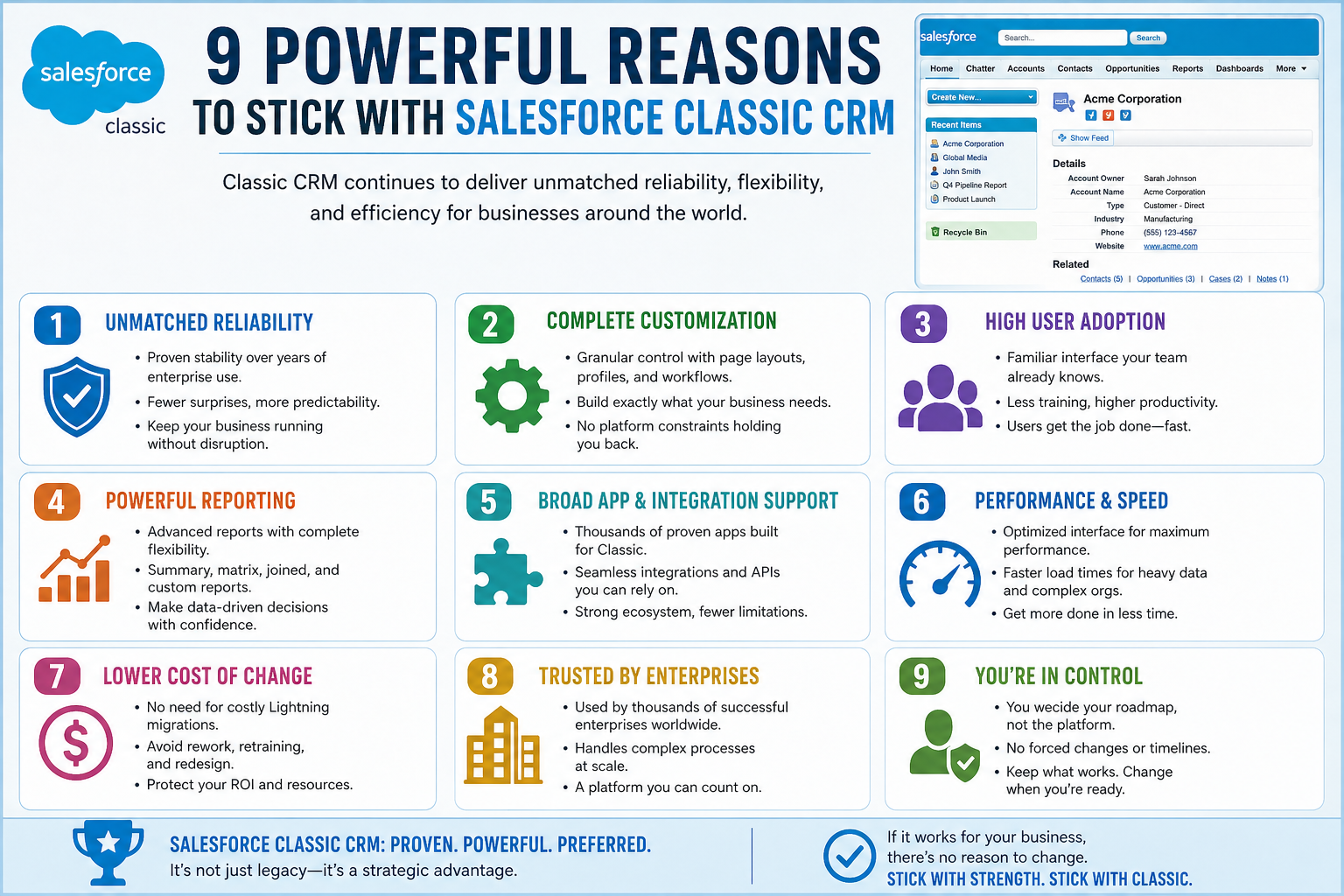
Salesforce Classic represents an earlier generation of CRM interface design. It is primarily text-based and follows a more traditional layout structure. While it has been widely used for many years and continues to function reliably, its design reflects an older approach to user interaction. The interface is straightforward but lacks the flexibility and modern usability features that newer systems provide. Users often interact with data more linearly, navigating through menus and pages that are not highly customizable.
Salesforce Lightning, on the other hand, introduces a more modern and responsive user experience. It is designed with usability and efficiency in mind, offering a visually enhanced interface that allows users to interact with information more intuitively. Instead of relying solely on static pages, Lightning incorporates dynamic components that can be arranged and customized according to user needs. This makes it easier for teams to personalize their workspace and focus on the information that matters most to them.
One of the most notable differences between the two platforms is the level of customization available. Salesforce Lightning includes tools such as a drag-and-drop interface builder that allows users to create custom pages and applications without requiring advanced technical knowledge. This significantly reduces the dependency on development resources and gives business users more control over how their CRM environment is structured.
Another important feature is the use of reusable components. These components act as modular building blocks that can be combined in different ways to create tailored experiences. This modular approach improves flexibility and allows organizations to adapt their CRM system as their processes evolve. Instead of being locked into a fixed structure, users can adjust layouts and functionality based on changing business needs.
Salesforce Lightning also integrates advanced analytics capabilities. With built-in intelligent tools, users can gain deeper insights into their data. These insights can help identify trends, forecast outcomes, and support more informed decision-making. This is particularly valuable for sales teams that rely on accurate data to guide their strategies and prioritize opportunities.
While Salesforce Classic still provides core CRM functionality, it is considered a legacy interface. This means that although it continues to be supported, new features and innovations are primarily being developed for the Lightning platform. As a result, users of the Classic system may not have access to the latest improvements or enhancements.
The shift toward Lightning reflects a broader evolution in CRM design philosophy. Instead of focusing solely on data storage and basic tracking, modern systems emphasize user experience, automation, and intelligent insights. This allows businesses to operate more efficiently and respond more quickly to changing conditions.
For organizations that are still using older systems, understanding these differences is important when evaluating whether to transition to a more modern platform. The decision is not just about interface preference but about long-term scalability, productivity, and access to new capabilities.
Difficulty Managing Emails and Customer Responses
One of the most common challenges businesses face is keeping track of customer communication, especially email interactions. In a busy work environment, it is easy for important messages to get lost or overlooked. A client request might be buried in an inbox, or a follow-up email might be forgotten during a hectic workday. Over time, these small lapses can lead to missed opportunities and weakened customer relationships.
A modern CRM system helps address this issue by integrating email tracking directly into customer records. Instead of relying on separate email platforms, communication becomes part of a centralized system. Every email sent or received can be associated with a specific customer or account, making it easier to maintain a complete history of interactions. This ensures that important details are always accessible when needed.
When emails are linked directly to customer profiles, it becomes much easier to maintain continuity in communication. If a team member needs to review past conversations, they can quickly access the full context without searching through multiple inboxes. This improves both efficiency and accuracy in customer interactions.
Another important benefit is the ability to create structured workflows around communication. Instead of manually tracking follow-ups, automated processes can help ensure that responses are timely and consistent. This reduces the risk of human error and helps maintain a higher standard of customer service.
In many organizations, email management is not just about communication but also about accountability. When interactions are properly logged, it becomes easier to track responsibilities and ensure that no customer inquiry is left unresolved. This level of transparency is essential for maintaining trust and delivering a reliable customer experience.
As businesses grow, the volume of emails increases significantly. Without a structured system, managing this volume becomes increasingly difficult. Employees may spend more time searching for information than actually engaging with customers. A centralized CRM system helps reduce this burden by organizing communication in a more structured and accessible way.
Ultimately, difficulty managing emails is a clear indicator that a more advanced system is needed. When communication becomes fragmented or inconsistent, it affects overall productivity and customer satisfaction. A well-integrated CRM helps solve this problem by bringing all communication into one place and ensuring that nothing important is overlooked.
Losing Track of Sales Opportunities
Sales opportunities are the foundation of business growth, but they can easily be lost without proper tracking. In fast-paced environments, it is common for potential deals to slip through the cracks. A conversation might start with a promising lead, but without proper follow-up, the opportunity may fade away. In some cases, details about the lead may be forgotten entirely, especially when they are recorded in informal or disconnected systems.
A structured CRM system helps prevent this by providing a clear pipeline for tracking opportunities at every stage. Each potential deal can be recorded, monitored, and updated as it progresses. This allows sales teams to maintain visibility over their entire pipeline and ensure that no opportunity is overlooked.
Tracking opportunities also helps improve planning and forecasting. By understanding where each deal stands, businesses can better predict future revenue and allocate resources more effectively. This level of visibility is essential for making informed strategic decisions.
Another advantage of structured opportunity tracking is accountability. When each lead is assigned and monitored within a system, it becomes easier to ensure that follow-ups are completed on time. This reduces the risk of missed interactions and helps maintain momentum in the sales process.
Mobile accessibility further enhances this capability. Sales teams are often on the move, meeting clients in different locations. Having access to real-time data allows them to update opportunities immediately, ensuring that information remains accurate and up to date.
Without a structured approach to managing opportunities, businesses risk losing potential revenue simply due to disorganization. Leads may be forgotten, follow-ups may be delayed, and valuable deals may never reach completion. A centralized system helps eliminate these risks by keeping everything organized and accessible.
When sales opportunities are consistently lost or poorly managed, it is a strong indication that a more structured system is needed. Proper tracking ensures that every lead is given the attention it deserves and that no potential revenue is wasted due to oversight.
Sending Customer Communication Individually
Another clear sign that a business needs a more advanced CRM system is when customer communication is handled one message at a time. Sending emails individually may work for very small operations, but it quickly becomes inefficient as the customer base grows. This manual approach consumes valuable time and increases the risk of inconsistency in messaging.
A more structured system allows businesses to communicate with multiple customers simultaneously while still maintaining a personalized approach. Instead of writing each message separately, users can select groups of contacts and send coordinated communications efficiently. This not only saves time but also ensures that messaging remains consistent across all recipients.
Managing communication at scale also allows for better campaign organization. Instead of treating each email as a separate task, businesses can structure communication into targeted groups based on customer needs, interests, or behavior. This improves relevance and increases the effectiveness of outreach efforts.
Even when communication is sent in bulk, personalization remains important. Systems allow for dynamic fields that insert customer-specific information into messages. This helps maintain a sense of individual attention while still benefiting from the efficiency of bulk communication.
Without such tools, teams often spend excessive time on repetitive tasks. This reduces productivity and limits the amount of time available for strategic work. A more efficient communication system helps shift focus from manual execution to planning and optimization.
As customer expectations continue to evolve, timely and relevant communication becomes increasingly important. Businesses that rely on manual messaging risk falling behind in responsiveness and engagement. A structured CRM system helps ensure that communication is both efficient and effective.
Out-of-the-Box CRM Solutions No Longer Fit Your Workflow
Every business operates differently, and as organizations grow, their processes often become more complex and specialized. A basic CRM structure may work initially, but over time, it may no longer align with the specific needs of the business. When this happens, teams may find themselves adapting their workflows to fit the system rather than having a system that supports their workflows.
This mismatch can lead to inefficiencies. Employees may need to perform additional manual steps to complete tasks, or they may rely on external tools to fill gaps in functionality. Over time, this creates a fragmented working environment that reduces productivity and increases the risk of errors.
A more flexible CRM system allows businesses to customize their environment to match their exact needs. Instead of adjusting processes to fit a rigid structure, teams can design workflows that reflect how they actually operate. This improves efficiency and reduces unnecessary complexity.
Customization also supports scalability. As businesses grow, their processes often evolve. A flexible system can adapt to these changes without requiring a complete overhaul. This ensures that the CRM remains useful over the long term and continues to support business objectives.
When a standard solution no longer fits the way a business operates, it becomes a clear sign that a more adaptable system is needed. Flexibility is essential for maintaining efficiency and ensuring that technology supports rather than restricts growth.
Tracking Sales Pipeline Visibility and Forecasting
As businesses grow, one of the most critical challenges they face is maintaining clear visibility over their sales pipeline. Without a structured system, it becomes difficult to understand where each opportunity stands, how close deals are to closing, and what actions are needed to move them forward. This lack of clarity often leads to unpredictable revenue cycles and poor decision-making, especially when leadership teams are unable to see the full picture of ongoing sales activity.
A centralized CRM system introduces structure into this process by organizing all opportunities into defined stages. Each stage represents a step in the sales journey, allowing teams to clearly identify whether a lead is new, actively being pursued, or nearing completion. This structured approach eliminates guesswork and replaces it with measurable progress indicators.
Pipeline visibility is not only important for tracking current performance but also for planning future outcomes. When businesses can accurately see how many deals are in progress and at what stage they are positioned, they can make more informed predictions about future revenue. This helps leadership teams set realistic goals and allocate resources more effectively.
Forecasting becomes significantly more reliable when it is based on structured data rather than assumptions. Instead of relying on rough estimates or informal updates from team members, managers can use actual pipeline data to project revenue trends. This creates a more stable foundation for financial planning and strategic growth.
Another advantage of structured pipeline management is the ability to identify bottlenecks. When deals consistently stall at a particular stage, it signals that there may be a deeper issue in the sales process. This insight allows teams to make targeted improvements rather than applying general fixes that may not address the root cause.
Without clear pipeline visibility, businesses often operate reactively rather than proactively. They may only realize issues when deals are lost or revenue targets are missed. A structured system helps prevent this by providing continuous insight into sales performance at every stage of the process.
Understanding Revenue Through Centralized Reporting
Revenue tracking is one of the most important aspects of business management, yet many organizations struggle to maintain accurate and consistent reporting. When data is stored across multiple systems or managed manually, it becomes difficult to get a clear and unified view of financial performance. This fragmentation often leads to confusion, errors, and delays in decision-making.
A centralized CRM system solves this problem by bringing all sales and customer data into one place. Every opportunity, transaction, and customer interaction is recorded within a single system, allowing for comprehensive reporting. This ensures that all revenue-related information is consistent, up to date, and easily accessible.
With centralized reporting, businesses can generate detailed insights into their performance. They can analyze which products or services are generating the most revenue, identify top-performing sales representatives, and evaluate the effectiveness of different strategies. This level of detail is essential for making informed business decisions.
Visual reporting tools also play an important role in simplifying complex data. Instead of reviewing long lists of numbers, managers can view charts and graphs that clearly illustrate trends and patterns. This makes it easier to identify areas of growth as well as areas that require improvement.
Another key benefit of centralized reporting is accuracy. When data is pulled from multiple disconnected systems, inconsistencies often occur. These inconsistencies can lead to incorrect conclusions and poor decision-making. A unified system eliminates this issue by ensuring that all reports are based on a single source of truth.
Real-time reporting further enhances decision-making capabilities. Instead of waiting for end-of-month summaries, businesses can monitor performance as it happens. This allows them to respond quickly to changes in sales activity and adjust strategies as needed.
When organizations lack a clear and centralized view of revenue, they often struggle to understand their true financial position. This can lead to missed opportunities, inefficient budgeting, and unclear performance evaluation. A structured reporting system provides the clarity needed to support sustainable growth.
Moving Away from Spreadsheet-Based Contact Management
Many businesses begin their customer management journey using spreadsheets or basic tools to store contact information. While this approach may work initially, it quickly becomes inefficient as the volume of data increases. Spreadsheets are not designed to handle complex relationships between customers, interactions, and sales activities.
As contact lists grow, managing them through spreadsheets becomes increasingly difficult. Information may become outdated, duplicated, or misplaced. This creates inconsistencies that can negatively impact customer communication and overall business operations.
A centralized CRM system replaces this fragmented approach with a structured database. Each contact is stored with detailed information, including communication history, associated opportunities, and relevant notes. This creates a complete profile for every customer, making it easier to manage relationships effectively.
One of the key advantages of structured contact management is accessibility. Instead of searching through multiple files or spreadsheets, users can quickly locate any customer record within a unified system. This saves time and reduces the risk of missing important information.
Another important benefit is data consistency. When multiple team members update spreadsheets independently, discrepancies often occur. A centralized system ensures that all updates are recorded in real time, maintaining accuracy across the entire organization.
Contact management also becomes more meaningful when it is connected to other business processes. Instead of viewing contacts in isolation, teams can see how they relate to sales opportunities, communication history, and ongoing activities. This provides a more complete understanding of each customer relationship.
As businesses scale, maintaining control over customer data becomes increasingly important. Without a structured system, contact information can quickly become disorganized and difficult to manage. This not only affects efficiency but also impacts the quality of customer interactions.
Transitioning away from spreadsheet-based management is often a necessary step for businesses that are experiencing growth. It allows them to move from basic data storage to a more intelligent and connected system that supports long-term success.
Managing Busy Schedules and Team Activity Oversight
In fast-paced business environments, managing time effectively is essential. Teams often juggle multiple responsibilities, including meetings, client interactions, and internal coordination. Without proper oversight, it becomes difficult to ensure that all activities are aligned and productive.
A structured CRM system helps address this challenge by providing visibility into team activities. Every interaction, task, and scheduled event can be recorded and tracked within a centralized platform. This allows managers to understand how time is being spent across the organization.
Activity tracking also helps improve accountability. When tasks and interactions are clearly documented, it becomes easier to ensure that responsibilities are being fulfilled. This reduces the likelihood of missed follow-ups or incomplete work.
Another important aspect of activity management is prioritization. With a clear overview of all ongoing tasks, teams can focus on the most important activities first. This helps improve productivity and ensures that critical opportunities are not overlooked.
For managers, having visibility into team activity is essential for performance evaluation. Instead of relying on verbal updates or incomplete reports, they can access detailed records of customer interactions and task completion. This provides a more accurate understanding of individual and team performance.
Busy schedules often lead to inefficiencies when activities are not properly organized. Important tasks may be delayed, and communication may become fragmented. A structured system helps streamline these processes by providing a clear framework for managing daily work.
By centralizing activity tracking, businesses can ensure that all team members are aligned and working toward shared goals. This improves coordination and reduces unnecessary duplication of effort.
Protecting Business Data with Cloud-Based Storage and Recovery
Data security and reliability are essential concerns for any growing business. As organizations rely more heavily on digital systems, the risk of data loss becomes increasingly significant. Hardware failures, accidental deletions, and system crashes can all result in the loss of critical business information.
Cloud-based storage provides a solution to this challenge by ensuring that data is stored securely in remote servers. This eliminates the reliance on local devices and reduces the risk of permanent data loss. Even if a device fails, information remains accessible through the cloud.
One of the key advantages of cloud-based systems is continuous accessibility. Users can access their data from any location, provided they have an internet connection. This supports remote work environments and ensures that teams remain productive regardless of physical location.
Data recovery is another important benefit. In the event of accidental deletion or system errors, cloud-based systems often provide recovery options that allow businesses to restore previous versions of their data. This adds an extra layer of protection and reduces the impact of human error.
Centralized storage also improves data organization. Instead of spreading information across multiple devices and platforms, everything is stored in one secure environment. This makes it easier to manage, search, and analyze business data.
Security is a major concern for modern businesses, especially when handling sensitive customer information. Cloud-based systems typically include advanced security measures designed to protect data from unauthorized access. This helps build trust and ensures compliance with data protection standards.
As businesses continue to grow, the volume of data they generate increases significantly. Without a scalable storage solution, managing this data becomes increasingly difficult. Cloud-based systems provide the flexibility needed to handle large volumes of information without compromising performance or security.
Reliable data storage is not just a technical requirement but a strategic necessity. Businesses that lack proper data protection risk operational disruptions and financial losses. A secure and centralized system ensures that critical information is always available when needed.
Improving Team Collaboration Through a Unified CRM Environment
As organizations expand, collaboration between teams becomes more complex. Sales, marketing, customer support, and management often need to work together on shared goals, but without a centralized system, communication gaps can appear quickly. Information may be scattered across emails, messaging apps, spreadsheets, or personal notes, making it difficult for teams to stay aligned. These gaps can slow down decision-making and create inconsistencies in how customers are handled.
A unified CRM environment helps solve this problem by bringing all teams into a single workspace where customer data, communication history, and task updates are shared in real time. Instead of working in isolation, departments can view the same information and contribute to the same customer records. This improves transparency and ensures that everyone is working with accurate and up-to-date details.
When collaboration improves, response times also improve. For example, if a customer issue is logged by a support team member, the sales or account management team can immediately see the update and respond accordingly. This prevents delays and ensures that customers receive consistent communication regardless of which team member interacts with them.
Another important benefit of centralized collaboration is reduced duplication of effort. In many businesses, different team members may unknowingly work on the same task or contact the same customer separately. This not only wastes time but can also confuse customers. A shared system ensures that everyone can see ongoing activities, reducing redundancy and improving efficiency.
Collaboration also becomes more structured when tasks are clearly assigned within a system. Instead of relying on verbal instructions or informal communication, responsibilities are documented and tracked. This creates accountability and ensures that tasks are completed on time.
As workflows become more interconnected, visibility across departments becomes increasingly important. A CRM system provides this visibility by allowing teams to see how their work contributes to broader business objectives. This helps create a stronger sense of alignment and shared purpose across the organization.
Enhancing Customer Experience Through Consistent Interaction Tracking
Customer experience plays a critical role in determining long-term business success. Customers expect timely responses, personalized communication, and consistent service across all interactions. When businesses fail to meet these expectations, customer satisfaction can decline quickly.
One of the main challenges in delivering a consistent customer experience is maintaining a complete view of all interactions. Without a centralized system, customer history may be fragmented across different tools or departments. This can lead to repeated questions, missed details, or inconsistent communication.
A structured CRM system ensures that every interaction is recorded and accessible in one place. Whether a customer communicates through email, phone calls, or meetings, all information is stored within a unified profile. This allows any team member to quickly understand the full history of the relationship.
Having access to complete interaction history allows businesses to provide more personalized service. Instead of asking customers to repeat information, representatives can review past conversations and respond more effectively. This creates a smoother and more professional experience.
Consistency is another important factor. When all teams use the same system, communication becomes standardized. Customers receive uniform responses regardless of who they speak to, which helps build trust and reliability.
Tracking interactions also helps businesses identify patterns in customer behavior. By analyzing communication history, organizations can better understand customer needs, preferences, and pain points. This information can be used to improve products, services, and overall engagement strategies.
A well-organized interaction tracking system also supports faster problem resolution. When issues arise, support teams can quickly access relevant information and understand the context of the problem. This reduces resolution time and improves customer satisfaction.
Over time, consistent interaction tracking leads to stronger customer relationships. Businesses are able to anticipate needs, respond proactively, and maintain long-term engagement more effectively.
Streamlining Automation for Repetitive Business Processes
As businesses grow, many routine tasks begin to consume a significant amount of time. These tasks often include sending follow-up emails, updating records, assigning leads, and generating reports. While each task may seem small individually, together they can create a substantial workload that limits productivity.
Automation helps address this challenge by handling repetitive processes without manual intervention. Instead of relying on employees to complete the same tasks repeatedly, a CRM system can execute these actions automatically based on predefined rules.
For example, when a new lead is added, the system can automatically assign it to the appropriate sales representative. Similarly, follow-up reminders can be triggered based on customer activity or inactivity. This ensures that no opportunity is missed due to human oversight.
Automation also improves consistency. When processes are automated, they are executed in the same way every time. This reduces variability and ensures that tasks are completed according to established standards.
Another advantage of automation is time savings. By reducing manual workload, employees can focus on more strategic activities such as customer engagement, relationship building, and business development. This leads to higher productivity and better use of resources.
Automation also reduces the likelihood of errors. Manual data entry and task management often lead to mistakes, especially when workloads are heavy. Automated systems eliminate many of these risks by standardizing processes and reducing human involvement in repetitive tasks.
As workflows become more complex, automation becomes increasingly valuable. It allows businesses to scale operations without proportionally increasing workload. This is especially important for growing organizations that need to manage larger volumes of data and customer interactions.
When repetitive tasks begin to consume too much time or lead to inconsistencies, it becomes a clear indication that automation is needed. A structured CRM system provides the tools necessary to streamline these processes effectively.
Strengthening Mobile Access for Remote and On-the-Go Work
Modern business operations are no longer confined to office environments. Sales teams, managers, and support staff often work remotely or travel frequently to meet clients. In such environments, access to real-time information becomes essential for maintaining productivity.
Mobile access ensures that users can interact with their CRM system from any location. Whether updating a customer record, reviewing sales opportunities, or checking task assignments, all information is available through mobile devices.
This level of accessibility improves responsiveness. When team members can update information immediately after a meeting or interaction, data remains accurate and up to date. This reduces delays and ensures that all teams are working with the latest information.
Mobile functionality also enhances flexibility. Employees are no longer tied to their desks to perform essential tasks. They can manage their responsibilities while traveling, attending meetings, or working remotely.
For sales teams, mobile access is particularly valuable. It allows them to record customer interactions in real time, access important details before meetings, and respond quickly to client inquiries. This improves overall efficiency and professionalism.
Managers also benefit from mobile access by staying informed about team activity regardless of location. They can monitor progress, review updates, and make decisions without needing to be physically present in the office.
As remote work continues to become more common, mobile access is no longer optional but essential. Businesses that lack mobile-friendly systems risk falling behind in responsiveness and operational efficiency.
Improving Decision-Making Through Real-Time Insights
Effective decision-making is a key factor in business success. However, making informed decisions requires access to accurate and timely data. When information is outdated or incomplete, decisions may be based on assumptions rather than facts.
A structured CRM system provides real-time insights into business performance. This includes sales data, customer activity, pipeline status, and team performance metrics. Having access to this information allows decision-makers to act quickly and confidently.
Real-time insights also help identify emerging trends. Instead of waiting for monthly reports, businesses can monitor changes as they happen. This allows them to respond proactively to opportunities and challenges.
Another important benefit is improved forecasting accuracy. When data is continuously updated, predictions become more reliable. This helps businesses plan more effectively and allocate resources efficiently.
Real-time reporting also supports faster problem identification. If performance begins to decline in a specific area, it can be detected immediately and addressed before it becomes a larger issue.
Decision-making becomes more strategic when supported by accurate data. Instead of relying on intuition alone, leaders can base their choices on measurable insights. This leads to more consistent and effective outcomes.
As businesses grow, the volume of data increases significantly. Without a structured system, analyzing this data becomes increasingly difficult. Real-time dashboards and reporting tools help simplify this complexity and present information in an accessible format.
Scaling Business Operations with a Flexible CRM Structure
Scalability is one of the most important factors for long-term business growth. As organizations expand, their processes, customer base, and data requirements all increase. Without a flexible system, scaling operations can become difficult and inefficient.
A flexible CRM structure allows businesses to adapt their system as they grow. Instead of rebuilding processes from scratch, they can modify existing workflows to accommodate new requirements. This ensures continuity and reduces disruption during periods of expansion.
Scalability also applies to team growth. As new employees join the organization, they can be easily integrated into existing systems. Training becomes simpler when processes are clearly defined and centrally managed.
Another important aspect of scalability is data management. As the volume of customer information increases, a structured system ensures that data remains organized and accessible. This prevents fragmentation and maintains operational efficiency.
Flexible systems also support business diversification. As companies introduce new products or services, they can adjust their CRM structure to reflect these changes. This ensures that all business activities remain aligned within a single system.
Without scalability, businesses often face limitations that restrict growth. Systems may become overloaded, processes may become inefficient, and data may become difficult to manage. A flexible CRM environment helps eliminate these challenges by providing a foundation that can grow with the organization.
Conclusion
As businesses continue to expand and customer expectations evolve, the way organizations manage relationships, data, and internal workflows becomes increasingly important. The shift toward modern CRM systems reflects a broader transformation in how companies operate in a digital-first environment. Efficiency, accuracy, and accessibility are no longer optional advantages; they are essential requirements for staying competitive in a rapidly changing marketplace.
One of the most significant takeaways from understanding modern CRM usage is that business growth naturally introduces complexity. What may begin as a simple process of tracking customers and sales eventually becomes a layered system of communication, reporting, forecasting, and coordination across multiple teams. Without a structured platform to manage this complexity, businesses risk falling into inefficiency, where important information is scattered, tasks are duplicated, and opportunities are lost due to a lack of visibility.
A centralized CRM system helps solve these challenges by bringing all critical business functions into one environment. Instead of relying on disconnected tools or manual processes, teams can access real-time information, track every interaction, and manage workflows in a more organized and consistent way. This level of integration not only improves operational efficiency but also strengthens decision-making across the entire organization.
Another important aspect of modern CRM adoption is the improvement in customer experience. Customers today expect fast responses, personalized communication, and consistent service regardless of which department they interact with. When businesses lack a unified system, customer interactions can become fragmented, leading to repeated questions, delayed responses, and inconsistent messaging. A well-structured CRM ensures that every team member has access to the same customer history, enabling more meaningful and informed interactions.
In addition to improving customer relationships, modern CRM systems also play a crucial role in enhancing internal productivity. Automation reduces the burden of repetitive tasks, allowing employees to focus on higher-value activities such as strategy, relationship building, and problem-solving. This shift not only increases efficiency but also improves employee satisfaction by reducing time spent on manual administrative work.
Visibility is another key benefit that cannot be overlooked. Leaders and managers need accurate insights into sales pipelines, revenue performance, and team activity to make informed decisions. Without reliable data, decision-making becomes reactive rather than strategic. A centralized CRM provides real-time reporting and analytics, enabling businesses to identify trends, measure performance, and adjust strategies proactively.
Scalability is equally important in the context of long-term growth. As organizations grow, their systems must be able to adapt to increasing data volumes, expanding teams, and evolving business processes. A flexible CRM platform ensures that businesses can scale without losing structure or efficiency. It supports growth without forcing organizations to constantly rebuild their operational foundation.
Another critical point is the importance of mobility and accessibility. Modern work environments are no longer limited to traditional office spaces. Employees work remotely, travel frequently, and interact with clients across different locations. A cloud-based CRM ensures that essential business data is always accessible, allowing teams to stay productive and responsive regardless of where they are working from.
Ultimately, the adoption of a modern CRM system represents more than just a technological upgrade. It represents a shift in mindset toward structured, data-driven, and customer-focused operations. Businesses that embrace this shift are better positioned to manage complexity, respond to change, and deliver consistent value to their customers.
In contrast, organizations that continue relying on outdated or fragmented systems often struggle with inefficiencies that compound over time. Missed opportunities, poor communication, and limited visibility can gradually hinder growth and reduce competitiveness in the market.
The decision to adopt a more advanced CRM environment is therefore not just about improving day-to-day tasks, but about building a strong foundation for future success. It enables businesses to operate with greater clarity, align teams more effectively, and make decisions that are grounded in accurate and timely information.
As industries continue to evolve, the importance of structured customer relationship management will only increase. Businesses that invest in the right systems today are setting themselves up for long-term resilience, adaptability, and sustainable growth in an increasingly competitive landscape.