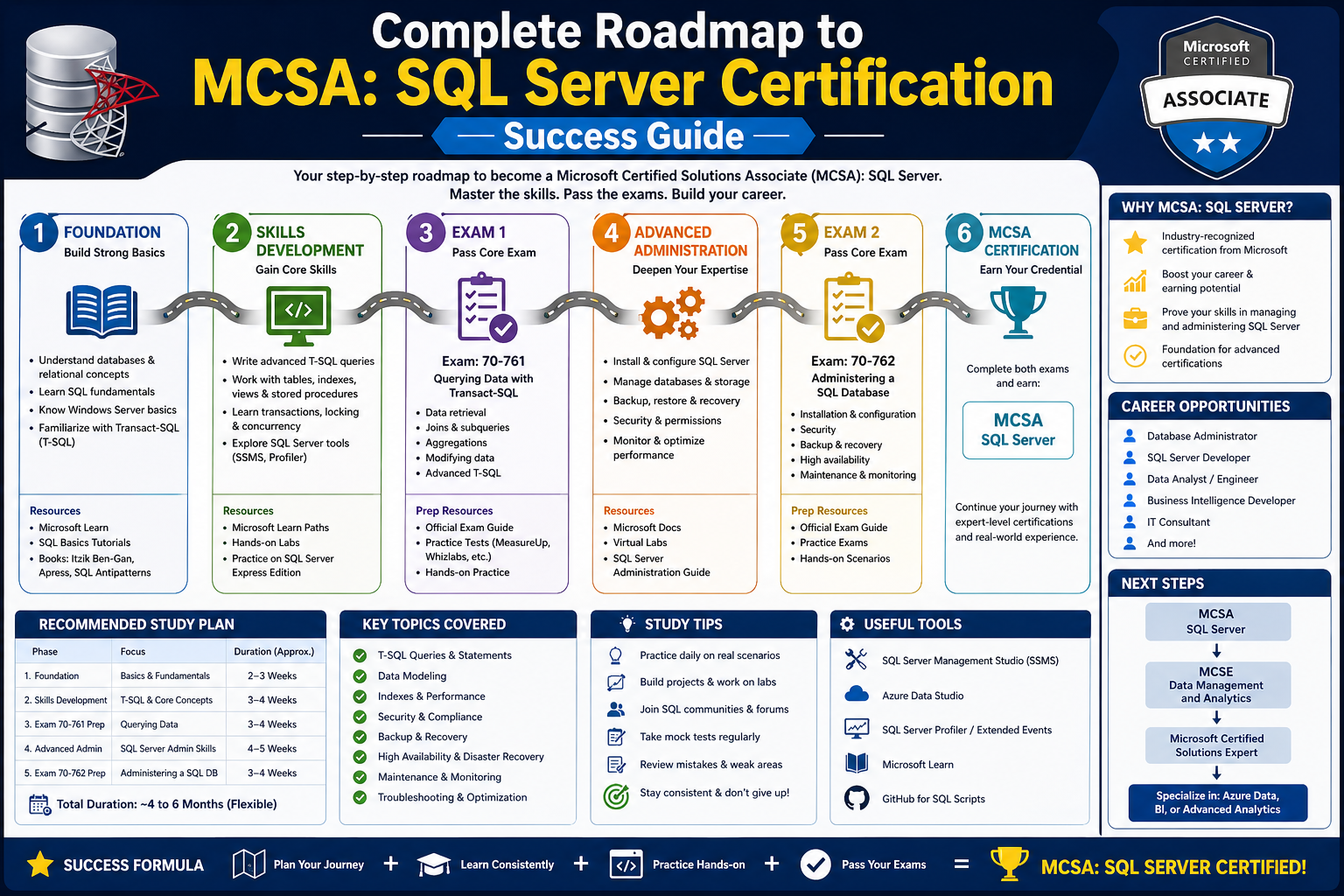
The Microsoft Certified Solutions Associate SQL Server 2016 Database Development certification represents a structured pathway designed for individuals who want to build strong expertise in database development using Microsoft SQL Server technologies. This certification focuses on equipping learners with the ability to work confidently with relational databases, design efficient data structures, and write queries that support business operations in real-world environments. It is positioned at an intermediate level, meaning it is not an entry point for complete beginners but rather a step for those who already understand basic database concepts and want to deepen their technical capability.
At its core, this certification emphasizes practical database development skills rather than theoretical understanding alone. It is structured to reflect the needs of modern organizations that rely heavily on structured data systems to store, manage, and retrieve information. SQL Server 2016 plays a significant role in this ecosystem, offering tools and features that support both traditional on-premises database systems and newer cloud-integrated environments. As a result, learners who follow this certification path are not only preparing for technical examinations but also building competencies that are directly applicable in professional settings.
The certification pathway is divided into two main examinations that together validate a candidate’s ability to work as a database developer. Each exam focuses on a different aspect of SQL Server functionality, ensuring that learners gain a balanced understanding of both querying and database development principles. The structure encourages a progressive learning journey, where foundational knowledge is applied and expanded through increasingly complex scenarios.
One of the defining characteristics of this certification path is its alignment with real-world database tasks. Rather than focusing on abstract theory, the learning objectives are built around scenarios that professionals encounter in business environments. These include writing queries to retrieve data, optimizing database structures for performance, and ensuring that data integrity is maintained across systems. This practical orientation makes the certification particularly valuable for individuals aiming to enter or advance within database-related roles.
The certification also reflects the evolving nature of data management. With organizations handling larger volumes of information than ever before, database professionals are expected to understand not only how to store data but also how to structure it efficiently for analysis and reporting. SQL Server 2016 introduces features that support advanced data handling, and the certification ensures that learners become familiar with these capabilities in a structured manner.
Another important aspect of this path is its focus on development rather than administration alone. While database administration deals with maintaining and securing database systems, database development focuses more on designing and building the actual structures within which data is stored. This includes tables, relationships, queries, and procedures that allow applications to interact with data effectively. Understanding this distinction is essential for learners who want to position themselves correctly within the broader database profession.
The certification path also encourages logical thinking and problem-solving. Database development is not simply about writing queries that work; it is about writing queries that are efficient, scalable, and maintainable. Learners are expected to think critically about how data flows through systems and how different components of a database interact with each other. This analytical mindset is one of the key outcomes of the certification journey.
Role of SQL Server Database Professionals in Modern IT Environments
In modern IT environments, SQL Server database professionals play a crucial role in ensuring that data systems function smoothly and efficiently. Almost every application used by businesses today depends on structured data storage, and SQL Server is one of the most widely used platforms for this purpose. Professionals who specialize in SQL Server database development are responsible for designing, building, and maintaining the systems that allow organizations to store and retrieve information reliably.
These professionals work closely with application developers, system architects, and business analysts to ensure that data is organized in a way that supports organizational goals. For example, when a business introduces a new application, database developers are responsible for creating the underlying data structures that will support that application’s functionality. This includes defining tables, establishing relationships between data entities, and ensuring that the system can handle expected workloads.
One of the most important responsibilities of database professionals is ensuring data accuracy and consistency. In any organization, data is considered a critical asset, and even small inconsistencies can lead to significant operational issues. SQL Server database developers implement rules and constraints within databases to ensure that data remains valid and reliable. This includes defining primary keys, foreign keys, and other integrity mechanisms that prevent incorrect or duplicate data entries.
Another key responsibility involves optimizing database performance. As organizations grow, the volume of data they handle increases significantly. Without proper optimization, databases can become slow and inefficient, affecting the performance of applications that rely on them. Database professionals analyze query performance, redesign database structures when necessary, and implement indexing strategies to improve speed and efficiency.
SQL Server database developers also contribute to data security. In many organizations, sensitive information such as financial records, customer data, and internal business information is stored in databases. Professionals in this field are responsible for implementing security measures that protect this data from unauthorized access. This includes managing user permissions, encrypting sensitive data, and ensuring compliance with organizational policies.
In addition to technical responsibilities, database professionals often play a role in decision-making processes related to data architecture. As organizations adopt more complex systems, decisions about how data should be structured and integrated become increasingly important. Database developers provide insights into how different design choices can impact performance, scalability, and maintainability.
The role also extends into supporting business intelligence and reporting systems. Many organizations rely on data analysis to make informed decisions, and SQL Server databases often serve as the foundation for these analytical systems. Database professionals ensure that data is structured in a way that supports efficient reporting and analysis, enabling businesses to extract meaningful insights from their data.
Overall, SQL Server database professionals serve as a bridge between raw data and meaningful information. Their work ensures that data is not only stored securely but also made accessible and useful for a wide range of business purposes.
Core Foundations of SQL Server 2016 and Database Development
SQL Server 2016 is built on a relational database model, which organizes data into structured tables consisting of rows and columns. Understanding this structure is fundamental for anyone pursuing database development certification. Each table represents a specific entity, and relationships between tables allow data to be connected in meaningful ways. This structure enables efficient storage and retrieval of large amounts of information.
Database development within SQL Server involves creating and managing these structures in a way that supports both current and future data requirements. Developers must understand how to design tables that minimize redundancy while maintaining data integrity. This involves applying normalization principles, which help organize data into logical structures and reduce duplication.
Another key foundation of SQL Server 2016 is its support for advanced data types and storage mechanisms. These allow developers to handle a wide variety of data formats, from simple text and numbers to more complex data structures. Understanding how to choose appropriate data types is essential for building efficient databases.
SQL Server also includes powerful indexing capabilities that improve data retrieval performance. Indexes allow the database system to locate specific data quickly without scanning entire tables. However, improper use of indexes can lead to performance issues, so database developers must understand how and when to apply them effectively.
Transaction management is another critical foundation. In database systems, transactions ensure that operations are completed reliably and consistently. If an error occurs during a transaction, the system can roll back changes to maintain data integrity. This is especially important in environments where multiple users interact with the database simultaneously.
SQL Server 2016 also supports stored procedures, which are pre-defined sets of SQL statements that can be executed as a single unit. These improve performance and allow developers to encapsulate complex logic within the database itself. Understanding how to create and manage stored procedures is an important part of database development.
Views are another important concept within SQL Server. A view is a virtual representation of data that is derived from one or more tables. Views allow developers to simplify complex queries and present data in a more accessible format. They also provide a layer of abstraction that can improve security and maintainability.
Security features are deeply integrated into SQL Server 2016. These include authentication mechanisms, role-based access control, and data encryption. Database developers must understand how to implement these features to ensure that sensitive information is protected.
Collectively, these foundational elements form the backbone of SQL Server database development. Mastering them is essential for anyone pursuing certification in this area.
Working Knowledge of Transact-SQL and Data Querying Concepts
Transact-SQL, commonly known as T-SQL, is the primary language used for interacting with SQL Server databases. It extends standard SQL by adding procedural programming capabilities, allowing developers to perform more complex operations within the database environment. A strong understanding of T-SQL is essential for anyone pursuing database development certification.
At a basic level, T-SQL is used to retrieve data from databases using queries. These queries can be simple, such as selecting data from a single table, or complex, involving multiple tables and conditions. Understanding how to construct efficient queries is a fundamental skill for database developers.
Beyond simple data retrieval, T-SQL allows developers to filter, sort, and aggregate data. These operations enable users to extract meaningful insights from large datasets. For example, grouping data and calculating totals or averages is a common requirement in business environments.
T-SQL also supports conditional logic through constructs such as IF statements and CASE expressions. These allow developers to implement decision-making processes within queries. This capability is particularly useful when dealing with dynamic data requirements.
Another important aspect of T-SQL is its ability to manipulate data. This includes inserting new records, updating existing data, and deleting records when necessary. These operations must be performed carefully to maintain data integrity.
Error handling is also an important feature of T-SQL. Developers can implement mechanisms to detect and respond to errors during query execution. This ensures that database operations remain reliable even when unexpected issues occur.
T-SQL also supports procedural programming elements such as loops and variables. These features allow developers to create more flexible and reusable code within the database environment. While not as extensive as full programming languages, these capabilities significantly enhance the functionality of SQL Server.
Understanding execution plans is another important aspect of working with T-SQL. Execution plans show how the database engine processes queries, allowing developers to identify inefficiencies and optimize performance. This analytical aspect of query development is essential for building scalable systems.
Overall, proficiency in T-SQL is a core requirement for database development professionals. It serves as the primary tool for interacting with data and forms the foundation of most database operations within SQL Server environments.
Structure of the Certification and Its Examination Approach
The certification structure for SQL Server 2016 Database Development is designed to evaluate both theoretical understanding and practical application. It consists of two separate examinations, each focusing on different aspects of database development. This dual-exam structure ensures that candidates demonstrate a well-rounded skill set.
The first examination focuses primarily on querying data using T-SQL. This includes constructing queries, filtering results, and working with multiple data sources. The emphasis is on understanding how to retrieve and manipulate data effectively within SQL Server environments.
The second examination focuses more on database development tasks. This includes designing database structures, implementing stored procedures, and managing database objects. Candidates are expected to demonstrate their ability to build and maintain functional database systems.
Each examination is time-limited, requiring candidates to manage their time effectively while answering a variety of question types. These questions are designed to test both knowledge and practical reasoning. Instead of relying solely on memorization, candidates must apply their understanding to solve scenario-based problems.
The exam structure also includes questions that simulate real-world database tasks. These scenarios require candidates to analyze requirements and determine the best solution based on SQL Server capabilities. This approach ensures that certified individuals are prepared for actual job responsibilities.
Performance evaluation is based on a standardized scoring system. Candidates must achieve a minimum score to pass each exam, ensuring that only those with sufficient understanding are certified. This maintains the credibility and value of the certification.
The examination approach emphasizes accuracy, efficiency, and problem-solving ability. Candidates are expected to demonstrate not only that they know how to perform tasks but also that they understand why certain approaches are more effective than others.
This structured evaluation process ensures that the certification remains aligned with professional standards in database development and reflects the skills required in real-world environments.
Microsoft Certification Hierarchy and Learning Progression
Microsoft certifications are organized in a structured hierarchy that reflects increasing levels of expertise and specialization. This hierarchy is designed to guide learners through a progressive learning journey, starting from foundational knowledge and advancing toward expert-level skills.
At the foundational level, learners are introduced to basic IT concepts and technical principles. This stage focuses on building an understanding of core technologies and preparing individuals for more specialized learning paths.
The next level represents the associate stage, where learners develop practical skills in specific technology areas. This includes database development, system administration, and application development. At this stage, individuals begin to apply their knowledge in more focused and technical contexts.
Beyond the associate level is the expert stage, which represents advanced knowledge and specialization. At this level, professionals are expected to demonstrate a deep understanding of complex systems and advanced technical concepts. This stage often involves integrating multiple technologies and solving complex business problems.
The certification path is designed to be cumulative, meaning that each level builds on the knowledge gained in previous stages. This ensures that learners develop a strong and structured understanding of IT systems over time.
Within this hierarchy, SQL Server 2016 Database Development falls within the associate level. It serves as an important step for individuals who want to specialize in database technologies and potentially move toward more advanced certifications in data management and analytics.
This structured progression allows learners to plan their career development effectively. By following the certification hierarchy, individuals can gradually build their expertise and move toward higher levels of professional recognition in the IT industry.
Skills and Experience Expectations Before Pursuing Certification
Before pursuing SQL Server 2016 Database Development certification, individuals are generally expected to have a foundational understanding of databases and query languages. This includes familiarity with relational database concepts such as tables, relationships, and data types.
Experience with writing basic queries is also important. Candidates should be comfortable retrieving and manipulating data using standard SQL commands. This foundational skill is essential for understanding more advanced T-SQL concepts covered in the certification.
In addition to technical knowledge, logical thinking and problem-solving skills are highly beneficial. Database development often involves analyzing requirements and designing solutions that efficiently manage data. This requires the ability to think critically about how different components of a database interact.
Familiarity with basic programming concepts can also be helpful, although it is not always required. Understanding variables, conditions, and loops can make it easier to grasp procedural aspects of T-SQL.
Practical experience working with databases in any capacity can provide a significant advantage. This may include academic projects, workplace experience, or personal experimentation with database systems.
Time management and study discipline are also important factors. The certification requires a thorough understanding of multiple topics, and consistent preparation is necessary to cover all required areas.
Overall, candidates who approach the certification with a combination of theoretical knowledge and practical exposure are better positioned to succeed.
How SQL Server Fits into On-Premises and Cloud Ecosystems
SQL Server 2016 is designed to operate in both traditional on-premises environments and modern cloud-based ecosystems. This flexibility makes it a widely used database platform across different types of organizations.
In on-premises environments, SQL Server is installed and managed within an organization’s internal infrastructure. This setup provides full control over database systems, allowing organizations to manage performance, security, and maintenance according to their specific requirements.
In cloud-based environments, SQL Server can be deployed using cloud infrastructure services. This approach offers scalability and flexibility, allowing organizations to adjust resources based on demand. It also reduces the need for physical infrastructure management.
Many organizations adopt hybrid approaches that combine both on-premises and cloud systems. In such environments, data may be distributed across multiple platforms, requiring database professionals to understand how to manage and integrate data across different systems.
SQL Server 2016 includes features that support these hybrid environments, enabling seamless data movement and integration. This allows organizations to take advantage of both traditional and modern data management approaches.
Database developers must understand how SQL Server operates in these different environments to design systems that are both efficient and adaptable. This includes considering factors such as latency, scalability, and security when designing database solutions.
The ability to work across on-premises and cloud systems is increasingly important in modern IT environments, making SQL Server 2016 a relevant and versatile platform for database development professionals.
Building Strong Database Design Thinking for SQL Server Development
A successful SQL Server database developer is not defined only by the ability to write queries, but by the ability to design systems that are logical, scalable, and maintainable over time. Database design thinking involves understanding how data should be structured before it is ever stored in a table. This means analyzing real-world requirements and translating them into a structured model that supports efficient storage and retrieval.
At the center of database design is the concept of organizing data into entities that reflect real-world objects or processes. Each entity must be carefully defined so that it holds only relevant attributes, avoiding unnecessary duplication. Poor design choices at this stage can lead to long-term issues such as data inconsistency, slow performance, and difficulty in maintaining the system.
A well-structured database design ensures that relationships between data entities are clearly defined. These relationships allow data to be connected in meaningful ways, enabling complex queries without compromising efficiency. Developers must understand how to identify one-to-one, one-to-many, and many-to-many relationships and represent them correctly within SQL Server.
Another important aspect of database design is ensuring flexibility for future growth. Business requirements change over time, and databases must be able to adapt without requiring complete redesigns. This requires careful planning of table structures, keys, and relationships so that modifications can be made with minimal disruption.
Good design thinking also involves balancing simplicity with functionality. Overly complex structures can make a database difficult to maintain, while overly simplified designs may not support required business logic. The goal is to achieve a structure that is both efficient and practical for long-term use.
Understanding Normalization and Data Integrity Principles
Normalization is one of the most important principles in database development, as it ensures that data is organized in a way that reduces redundancy and improves consistency. It involves dividing large tables into smaller, more focused tables and defining relationships between them.
The purpose of normalization is to eliminate unnecessary duplication of data. When data is stored in multiple places, it increases the risk of inconsistencies if updates are not applied uniformly. By structuring data properly, developers ensure that each piece of information is stored only once and referenced where needed.
Data integrity is closely related to normalization. It refers to the accuracy and reliability of data throughout its lifecycle. Maintaining data integrity means ensuring that relationships between data remain valid and that no incorrect or incomplete information is stored in the system.
There are different levels of normalization, each addressing specific types of redundancy and dependency issues. As a database is normalized, it becomes more structured and efficient, but it also requires careful consideration to avoid over-complication. In some cases, developers may choose to denormalize certain parts of a database to improve performance, especially in read-heavy environments.
Understanding when and how to apply normalization principles is a key skill for SQL Server database developers. It requires both theoretical knowledge and practical judgment, as each database system has unique requirements depending on its purpose and scale.
Advanced Query Construction and Data Retrieval Techniques
As database systems grow in complexity, the ability to construct advanced queries becomes increasingly important. SQL Server developers must be able to retrieve data from multiple sources while maintaining accuracy and performance.
Advanced queries often involve combining data from multiple tables using relationships defined during the design phase. This requires a deep understanding of how data is distributed across the system and how different entities interact with each other.
Filtering large datasets efficiently is another critical skill. Instead of retrieving unnecessary data, developers must write queries that target only the required information. This improves performance and reduces system load.
Aggregation is also an important part of advanced querying. It allows developers to summarize data in meaningful ways, such as calculating totals, averages, or counts. These operations are essential for reporting and decision-making processes within organizations.
Complex queries may also include nested structures, where one query depends on the result of another. Understanding how to structure these queries correctly ensures that data is processed efficiently and accurately.
In addition, developers must be able to interpret query results and verify their correctness. This involves testing different conditions and ensuring that outputs align with expected business logic.
Indexing Strategies for Performance Optimization
Indexing plays a crucial role in improving the performance of SQL Server databases. Without proper indexing, queries may need to scan entire tables to retrieve data, which can significantly slow down system performance.
An index acts as a structured reference that allows the database engine to locate data more efficiently. By organizing data in a specific way, indexes reduce the amount of time required to retrieve results.
However, indexing is not simply about adding as many indexes as possible. Poor indexing strategies can actually degrade performance, especially during data modification operations such as inserts, updates, and deletes. This is because indexes must also be updated whenever data changes.
Developers must carefully analyze query patterns to determine where indexes are most beneficial. Frequently accessed columns and columns used in filtering conditions are common candidates for indexing.
There are different types of indices, each serving specific purposes. Understanding when to use clustered and non-clustered indexes is essential for optimizing database performance. Each type affects how data is physically stored and accessed.
Effective indexing requires continuous monitoring and adjustment. As data grows and usage patterns change, indexing strategies must be revisited to ensure optimal performance.
Stored Procedures and Modular Database Programming
Stored procedures are an essential feature of SQL Server that allow developers to encapsulate reusable logic within the database. They consist of precompiled SQL statements that can be executed as a single unit, improving both performance and maintainability.
One of the key advantages of stored procedures is that they reduce the need to send repetitive queries from external applications. Instead, complex operations can be executed directly within the database, reducing network traffic and improving efficiency.
Stored procedures also enhance security by restricting direct access to underlying tables. Users can be granted permission to execute procedures without having direct access to sensitive data structures.
Another important benefit is modularity. By breaking down complex logic into reusable components, developers can simplify maintenance and improve code organization. Changes can be made in a single location without affecting multiple applications.
Stored procedures can also include conditional logic, loops, and error handling mechanisms. This allows developers to implement sophisticated business rules directly within the database layer.
Proper design of stored procedures is essential for maintaining performance and clarity. Poorly designed procedures can become difficult to manage and may negatively impact system efficiency.
Transaction Management and Concurrency Control
In environments where multiple users interact with a database simultaneously, transaction management becomes critical. A transaction represents a sequence of operations that must be completed as a single unit.
The primary goal of transaction management is to ensure data consistency. If any part of a transaction fails, the entire operation must be rolled back to prevent partial updates that could corrupt data integrity.
Concurrency control ensures that multiple transactions can occur at the same time without interfering with each other. Without proper control mechanisms, simultaneous operations could lead to issues such as data overwriting or inconsistent reads.
SQL Server uses locking mechanisms to manage concurrency. These locks determine how and when data can be accessed by different users. Understanding how locking works is important for preventing performance bottlenecks and conflicts.
Developers must also be aware of isolation levels, which define how transactions interact with each other. Different isolation levels offer different balances between consistency and performance.
Effective transaction management ensures that database operations remain reliable even under heavy workloads. It is a fundamental aspect of building robust database systems.
Database Security Implementation in SQL Server Environments
Security is a critical component of database development, especially in systems that handle sensitive or confidential information. SQL Server provides multiple layers of security that developers must understand and implement correctly.
Authentication mechanisms ensure that only authorized users can access the database system. Once authenticated, users are assigned specific roles that determine their level of access.
Role-based access control allows administrators to define permissions based on user responsibilities. This ensures that individuals only have access to the data and operations necessary for their role.
Data encryption is another important security feature. It protects sensitive information by converting it into unreadable formats that can only be decrypted with the correct keys.
Developers must also consider security at the application level. This includes preventing unauthorized query execution and protecting against common vulnerabilities such as injection attacks.
Auditing and monitoring are also important aspects of database security. By tracking database activity, organizations can detect suspicious behavior and respond to potential threats.
A strong security implementation ensures that data remains protected while still being accessible to authorized users.
Performance Tuning and Query Optimization Techniques
Performance tuning is the process of improving database efficiency by identifying and resolving performance bottlenecks. This is a continuous process that requires ongoing monitoring and analysis.
One of the primary areas of focus in performance tuning is query optimization. Poorly written queries can significantly slow down database performance, especially when dealing with large datasets.
Understanding how the SQL Server query engine processes requests is essential for optimization. Execution plans provide insights into how queries are executed and help identify inefficiencies.
Another important factor is resource utilization. High CPU usage, memory pressure, and disk I/O can all indicate performance issues that need to be addressed.
Developers must also consider database structure when optimizing performance. Poorly designed schemas often lead to inefficient queries, regardless of how well they are written.
Caching mechanisms can also improve performance by storing frequently accessed data in memory. This reduces the need for repeated database access and speeds up response times.
Performance tuning requires a combination of technical knowledge and analytical thinking. It involves continuously evaluating system behavior and making adjustments to improve efficiency.
Real-World Development Scenarios and Problem Solving
SQL Server database development is deeply rooted in real-world scenarios where developers must solve practical business problems. These scenarios often involve complex requirements that cannot be addressed with simple queries or basic structures.
One common scenario involves integrating data from multiple sources. This requires careful planning to ensure that data remains consistent and accurately represents business operations.
Another scenario involves handling large volumes of data efficiently. As datasets grow, developers must implement strategies that ensure performance remains stable under heavy load.
Data migration is also a common challenge in database development. Moving data from one system to another requires careful mapping and validation to ensure that no information is lost or corrupted.
Developers may also be required to support reporting systems that rely on real-time or near-real-time data. This requires efficient query design and optimized database structures.
Troubleshooting is another important aspect of real-world development. When issues arise, developers must be able to quickly identify the cause and implement effective solutions.
These scenarios require a combination of technical skills, logical reasoning, and practical experience to resolve effectively.
Developing Efficient Data Models for Scalable Database Systems
A strong SQL Server database developer must be able to design data models that remain efficient even as systems grow in size and complexity. Data modeling is the process of defining how information is structured, stored, and accessed within a database environment. It acts as the blueprint that determines how well a system performs under real-world conditions.
Efficient data models begin with a clear understanding of how information flows within an organization. Each piece of data must serve a defined purpose, and its relationship with other data elements must be carefully considered. Poor modeling decisions often lead to redundancy, slow performance, and difficulties in maintaining the system over time.
One of the key challenges in data modeling is anticipating future requirements. Databases are rarely static; they evolve as business needs change. A well-designed model must therefore be flexible enough to accommodate new data types, additional relationships, and increased workloads without requiring major structural changes.
Another important aspect is ensuring consistency in how data is represented. When similar information is stored in multiple formats or locations, it creates confusion and increases the risk of errors. A consistent data model ensures that all components of the system follow the same structural rules, making the database easier to manage and scale.
Developers must also consider how different parts of the data model interact with each other. Even small design decisions can have a significant impact on performance and usability. For example, the way relationships are defined between entities can influence how efficiently queries are executed and how easily data can be retrieved.
Managing Complex Relationships in Relational Database Structures
Relational databases are built on the concept of relationships between data entities, and managing these relationships effectively is a critical skill for SQL Server developers. These relationships define how data in one table connects to data in another, allowing complex information to be represented in a structured and meaningful way.
One-to-one relationships are used when a single record in one table corresponds to a single record in another table. These relationships are less common but are useful in scenarios where data must be separated for security or organizational reasons.
One-to-many relationships are the most frequently used in database design. They occur when a single record in one table is associated with multiple records in another table. This structure is essential for representing hierarchical or grouped data efficiently.
Many-to-many relationships require an intermediate structure to properly manage connections between tables. Without careful design, these relationships can become complex and difficult to maintain. Proper implementation ensures that data remains organized and accessible.
Maintaining relationship integrity is essential for ensuring that data remains accurate and consistent. If relationships are not properly enforced, it can lead to orphaned records or inconsistent data states, which negatively impact system reliability.
Understanding how relationships affect query performance is also important. Poorly designed relationships can result in complex queries that take longer to execute, while well-structured relationships enable faster and more efficient data retrieval.
Implementing Advanced Error Handling and Stability Mechanisms
Error handling is a critical component of database development, as it ensures that systems remain stable even when unexpected issues occur. In SQL Server environments, errors can arise from various sources, including invalid data input, connectivity issues, or system limitations.
Advanced error handling techniques allow developers to anticipate potential problems and respond to them in a controlled manner. Instead of allowing a system failure, errors can be captured and managed gracefully, ensuring that database operations continue safely.
One important aspect of error handling is ensuring that partial operations do not corrupt data integrity. If an error occurs during a multi-step operation, the system must be able to reverse any changes that were already made. This prevents inconsistent data states and maintains system reliability.
Stability mechanisms also involve monitoring system behavior during execution. By tracking how queries and operations perform under different conditions, developers can identify patterns that may lead to failures or performance degradation.
Another important consideration is handling unexpected user input. Databases must be designed to validate and process data correctly, even when input does not match expected formats. This reduces the risk of system crashes or incorrect data storage.
Developers must also ensure that error messages are meaningful and useful for troubleshooting. Clear error reporting helps identify issues quickly and reduces downtime in production environments.
Enhancing Data Retrieval Efficiency in Large-Scale Systems
As databases grow, retrieving data efficiently becomes increasingly important. Large-scale systems often contain millions of records, and without proper optimization, even simple queries can become slow and resource-intensive.
One approach to improving retrieval efficiency is minimizing unnecessary data access. Queries should be designed to retrieve only the information required for a specific task, rather than accessing entire datasets. This reduces processing time and improves overall system performance.
Another important factor is query structure. Well-structured queries allow the database engine to process requests more efficiently. This includes organizing conditions logically and avoiding unnecessary complexity in query design.
Partitioning data is another technique used to improve performance in large systems. By dividing large tables into smaller, more manageable segments, databases can retrieve data more quickly and efficiently.
Caching frequently accessed data can also significantly improve retrieval speed. When commonly used information is stored in memory, the system can bypass repeated database access, reducing load and improving response times.
Developers must also consider how indexing interacts with data retrieval. Properly designed indexes can dramatically improve query performance, while poorly designed ones can slow down operations. Understanding this balance is essential for maintaining system efficiency.
Maintaining Database Scalability in Evolving Environments
Scalability is a key requirement for modern database systems, as organizations must be able to handle increasing amounts of data and user activity. A scalable database can grow without requiring major redesign or performance degradation.
One aspect of scalability involves structuring data in a way that supports expansion. This includes designing tables and relationships that can accommodate additional records and new data types without disruption.
Another important factor is system resource management. As data volume increases, databases must efficiently use available memory, processing power, and storage. Poor resource management can lead to bottlenecks and reduced performance.
Horizontal and vertical scaling strategies are often considered when designing scalable systems. Horizontal scaling involves distributing data across multiple systems, while vertical scaling involves increasing the capacity of a single system. Understanding these approaches helps developers design more flexible solutions.
Scalability also depends on efficient query design. Queries that perform well on small datasets may not perform efficiently as data grows. Developers must anticipate how queries will behave under increased load and adjust their designs accordingly.
Monitoring system performance over time is essential for maintaining scalability. As usage patterns change, adjustments may be required to ensure that the database continues to perform effectively.
Conclusion
The MCSA SQL Server 2016 Database Development certification pathway represents a structured and practical approach to building strong database development skills in modern IT environments. It equips learners with the ability to design efficient data models, write and optimize complex T-SQL queries, and manage relational database systems with accuracy and confidence. Through its focus on both theoretical understanding and real-world application, it prepares individuals to handle the demands of professional database development roles.
Across the learning journey, emphasis is placed on core principles such as normalization, data integrity, performance tuning, and secure database design. These concepts ensure that developers are not only capable of building functional databases but also able to create systems that are scalable, secure, and efficient under increasing workloads. The certification also strengthens problem-solving abilities by encouraging analytical thinking and structured approaches to handling data challenges.
As organizations continue to rely heavily on data-driven decision-making, the need for skilled database professionals remains strong. Mastering SQL Server 2016 development concepts provides a solid foundation for advancing into more specialized roles and higher-level certifications in data management and analytics. Ultimately, this certification path supports long-term professional growth by bridging foundational knowledge with practical, industry-relevant expertise in database development.