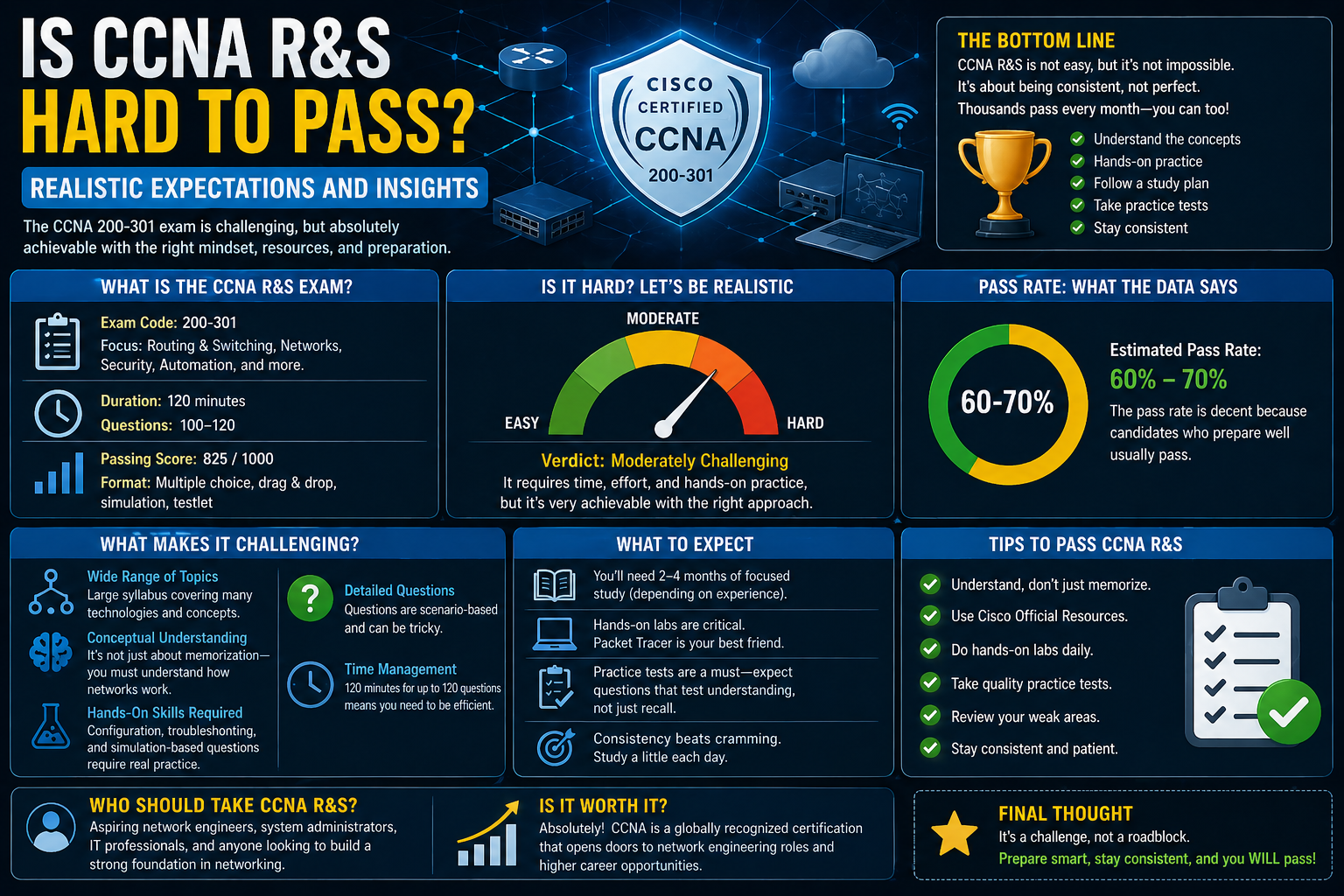
The CCNA Routing and Switching certification is often described as an entry point into networking, yet its reputation in practice is far more complex than that label suggests. Many people assume that “entry-level” means simple, but in the world of networking, entry-level only refers to the starting point of a professional journey, not the ease of the content itself. The CCNA R&S covers a wide range of foundational networking topics that form the backbone of modern IT infrastructure, including routing principles, switching behavior, IP addressing, and network troubleshooting. These concepts are not difficult because they are advanced, but because they are completely new to many learners who approach them without prior exposure.
One of the most important aspects that shapes the perceived difficulty of CCNA R&S is the shift from everyday technology usage to understanding how networks actually function behind the scenes. Most people interact with the internet daily without thinking about how data moves across routers, how switches make forwarding decisions, or how protocols communicate. The CCNA exam demands that this invisible layer becomes visible and understandable. That transition alone can feel overwhelming because it requires the learner to rebuild their mental model of something they have used for years.
Another important factor is that the CCNA is not just about memorization. It is designed to test conceptual understanding and practical application. Candidates are expected to interpret network behavior, analyze configurations, and predict outcomes of changes within a network. This means that simply reading about a topic is not enough. Understanding must be deep enough to apply knowledge in unfamiliar scenarios. For many learners, this is the first time they encounter an exam that tests reasoning over repetition, which naturally increases the perceived difficulty.
The structure of the CCNA content also contributes to its reputation. Topics are interconnected rather than isolated. For example, understanding routing protocols requires a solid grasp of IP addressing and subnetting, while troubleshooting requires knowledge of both switching and routing behavior. This interconnected nature means that gaps in one area can affect performance in another. As a result, learners often feel like they are constantly building on unstable ground until all foundational concepts are properly understood.
Why the CCNA Feels Harder Than an Entry-Level Certification
Although CCNA R&S is technically classified as entry-level, many candidates find it significantly more challenging than expected. One major reason for this perception is the depth of understanding required even for basic topics. Unlike certifications that focus on surface-level familiarity, CCNA expects learners to understand why something works, not just what it does. This subtle difference is what often surprises new candidates.
Another reason is the abstract nature of networking concepts. Unlike physical hardware tasks that can be seen and touched, networking involves invisible processes such as packet flow, protocol negotiation, and logical segmentation. These concepts require imagination and visualization. A learner must mentally construct how data travels through a network, how decisions are made at each layer, and how different devices interact. This level of abstraction is unfamiliar to many beginners, making the learning process more mentally demanding.
The terminology used in networking also adds to the challenge. Words like convergence, encapsulation, adjacency, and redundancy are not difficult individually, but they represent complex processes that must be understood in context. Early learners often struggle because they try to memorize definitions instead of understanding how these terms relate to real network behavior. Without context, the terminology feels overwhelming and disconnected.
Time pressure also plays a significant role in how difficult the CCNA feels. Many candidates approach the certification while balancing jobs, studies, or personal responsibilities. This limits the time available for consistent study and hands-on practice. Networking concepts require repetition and experimentation to fully understand, so limited time naturally increases difficulty. Even highly motivated learners can struggle when they cannot maintain consistent exposure to the material.
The breadth of topics is another contributing factor. CCNA covers multiple domains, including routing protocols, switching technologies, IP services, and network fundamentals. Each domain contains its own set of rules, behaviors, and configurations. For a beginner, switching between these domains can feel like learning multiple subjects at once. This creates the impression that the exam is harder than expected, even though each topic individually is manageable with proper study.
The Hidden Pressure Factors That Impact Candidates
While the technical content of CCNA R&S is important, many candidates underestimate the psychological and environmental pressures that significantly affect performance. These external factors often play a larger role in perceived difficulty than the actual exam content itself. One of the most common pressures comes from comparison with peers. When candidates see others progressing faster or passing earlier, it creates a sense of urgency and self-doubt. This emotional pressure can interfere with focus and reduce learning efficiency.
Work-life balance is another major factor. Many individuals pursuing CCNA are already employed in IT or studying full-time in other disciplines. This means study time must be carved out of already busy schedules. The stress of managing multiple responsibilities often leads to fragmented study sessions, which can reduce retention and increase frustration. When learners feel like they are constantly behind schedule, the certification begins to feel more difficult than it actually is.
Another subtle pressure comes from expectations. Because CCNA is widely recognized in the industry, candidates often feel that passing it will instantly validate their skills. This expectation can create anxiety, especially when progress feels slow. Instead of focusing on learning, candidates may focus on outcomes, which can make the learning process feel more difficult and stressful.
Financial and career-related pressure can also influence perception. For some, CCNA represents a gateway to better job opportunities or career transitions. This adds weight to every study session and practice attempt. When so much importance is attached to a single exam, even small setbacks can feel significant, increasing the emotional difficulty of the journey.
Finally, lack of structured guidance can contribute to confusion and frustration. Without a clear roadmap, learners may jump between topics without mastering foundational concepts. This creates gaps in understanding that become more noticeable as they progress. The resulting confusion often leads candidates to believe the material is harder than it actually is, when in reality the issue lies in the learning approach rather than the content itself.
Building the Right Foundation Before You Begin Studying
One of the most overlooked aspects of preparing for CCNA R&S is the importance of foundational knowledge. Many candidates begin studying advanced topics too early without fully understanding the basics of how networks operate. This creates confusion later, especially when dealing with routing protocols and switching logic. A strong foundation in basic networking concepts can significantly reduce the perceived difficulty of the certification.
Understanding how data flows through a network is one of the first essential steps. Before diving into protocols or configurations, it is important to grasp how devices communicate at a basic level. This includes understanding how IP addresses identify devices, how data is broken into packets, and how those packets move through different network devices. Without this understanding, advanced topics feel disconnected and difficult to follow.
Another critical foundation is familiarity with network devices and their roles. Routers, switches, and firewalls each perform specific functions, and understanding these roles helps learners make sense of how networks are structured. When these roles are clear, it becomes easier to understand why certain configurations are required and how different components interact.
Basic binary and subnetting knowledge also plays a key role in CCNA success. While these topics may seem mathematical at first, they are essential for understanding how IP networks are designed and segmented. Many learners struggle initially because they underestimate the importance of subnetting, but once mastered, it becomes a powerful tool for understanding routing behavior and network design.
Equally important is developing comfort with command-line interaction. Networking is not just theoretical; it involves configuring and verifying devices using structured commands. Early exposure to command-line environments helps reduce hesitation and builds confidence. When learners are comfortable navigating configurations, they can focus more on understanding concepts rather than struggling with syntax or interface unfamiliarity.
How Learning Networking Requires a Shift in Thinking
Studying for CCNA R&S requires more than just absorbing information; it requires a fundamental shift in how learners think about technology. Many people are accustomed to using technology as end users, where systems are designed to work seamlessly without requiring a deeper understanding. Networking, however, demands that learners move from passive usage to active analysis.
One of the most important mental shifts is learning to think in layers. Networks operate using structured layers where each layer has a specific responsibility. Instead of viewing communication as a single process, learners must understand how each layer contributes to the overall system. This layered thinking helps break down complex processes into manageable parts, making it easier to analyze network behavior.
Another important shift is moving from memorization to reasoning. In traditional learning environments, memorizing facts may be enough to pass exams. In networking, however, memorization alone is insufficient. Candidates must understand why certain behaviors occur under specific conditions. This requires logical thinking and the ability to connect multiple concepts.
Troubleshooting is another area that requires a new mindset. Instead of expecting systems to work perfectly, learners must become comfortable with identifying problems and analyzing causes. This involves observing behavior, forming hypotheses, and testing solutions. Developing this mindset takes time, but it is essential for mastering CCNA concepts.
Finally, learners must adapt to a systems-oriented way of thinking. Networks are not isolated components but interconnected systems that influence each other. A change in one part of the network can have cascading effects elsewhere. Understanding these relationships is key to developing true networking competence.
The Role of Consistency Over Long Study Sessions
One of the most misunderstood aspects of preparing for CCNA R&S is the belief that long study sessions are more effective than consistent short sessions. In reality, consistency plays a far more important role in retaining complex networking concepts. The human brain processes technical information more effectively when it is revisited regularly over time rather than consumed in large, infrequent blocks.
Short but consistent study sessions allow learners to reinforce concepts repeatedly. Each session builds on the previous one, strengthening understanding gradually. This approach helps prevent cognitive overload, which often occurs when too much information is consumed at once. Networking topics such as routing protocols and subnetting require time to fully absorb, and spaced repetition supports long-term retention.
Consistency also helps maintain engagement. When study sessions are too long, fatigue can reduce focus and retention. Shorter sessions allow learners to remain mentally sharp and more attentive to detail. This is especially important when dealing with complex configurations or troubleshooting scenarios, where small details can significantly affect understanding.
Another advantage of consistency is the ability to track progress more effectively. Regular exposure to material allows learners to identify weak areas early and address them before they become major obstacles. This continuous feedback loop is essential for mastering CCNA topics, which build upon each other progressively.
Finally, consistency helps build confidence. As learners revisit concepts repeatedly, they begin to recognize patterns and relationships between topics. This familiarity reduces anxiety and makes the overall learning experience feel more manageable, even when dealing with challenging material.
Why Real-World Practice Changes Everything
Understanding CCNA R&S concepts theoretically is important, but real mastery comes from applying those concepts in practical environments. Hands-on practice transforms abstract ideas into tangible experiences, making complex topics significantly easier to understand. When learners configure networks, observe behavior, and troubleshoot issues directly, they develop a deeper level of comprehension that cannot be achieved through reading alone.
Practical experience also helps bridge the gap between theory and reality. Many networking concepts behave differently in controlled environments compared to theoretical explanations. By experimenting with configurations and observing results, learners gain insight into how systems actually behave under different conditions. This helps solidify understanding and improves problem-solving skills.
Another benefit of real-world practice is the development of intuition. Over time, repeated exposure to network behavior allows learners to anticipate outcomes and recognize patterns quickly. This intuition is invaluable during troubleshooting and exam scenarios, where time and accuracy are critical.
Practical labs also encourage active learning. Instead of passively consuming information, learners are required to make decisions, test configurations, and evaluate results. This active engagement strengthens memory retention and improves overall understanding of the material.
Ultimately, real-world practice transforms CCNA R&S from a theoretical challenge into a practical skill set. It is this transition from knowledge to application that defines true readiness for the certification and builds long-term networking competence.
How the CCNA R&S Exam Structure Shapes the Learning Experience
The structure of the CCNA Routing and Switching certification plays a major role in how candidates experience the difficulty of the exam. Unlike assessments that focus on isolated knowledge areas, CCNA is designed to evaluate understanding across multiple interconnected domains. This structure forces learners to think beyond individual topics and instead consider how different parts of a network interact as a unified system.
The exam does not simply test whether a candidate remembers facts. It evaluates whether they can apply knowledge under varying conditions. Questions are often designed to reflect real-world scenarios where multiple factors influence outcomes at the same time. This means that even when a candidate understands a concept individually, they may still struggle if they cannot integrate it with other concepts.
Another defining feature of the exam structure is its focus on interpretation. Candidates are often required to analyze network configurations, identify potential issues, and predict behavior based on given information. This requires careful reading and attention to detail, as small differences in configuration can lead to completely different outcomes. The ability to interpret technical information accurately becomes just as important as knowing the material itself.
The breadth of topics included in the exam also influences how it feels. Instead of focusing deeply on one area, the CCNA requires familiarity across a wide range of networking concepts. This creates a learning experience where candidates must constantly switch mental focus between different topics. Over time, this can feel mentally demanding, especially for those who prefer structured, linear learning paths.
Breaking Down the Core Networking Domains in a Practical Way
Understanding the major domains of CCNA R&S is essential for developing a clear learning direction. Each domain represents a different aspect of networking, and together they form the foundation of the certification. While each area can be studied individually, true understanding comes from seeing how they connect in practice.
Routing is one of the most important domains, focusing on how data travels between different networks. This includes understanding routing tables, path selection, and protocol behavior. Routing concepts often feel abstract at first because they involve logical decision-making processes rather than physical actions. However, once learners understand how routers evaluate and select paths, the entire concept becomes much clearer.
Switching is another core domain that deals with how devices communicate within the same network. This includes how switches learn MAC addresses, how they forward frames, and how they manage network loops. Switching is often easier to visualize than routing because it involves direct communication between devices. However, deeper topics such as spanning tree behavior can introduce complexity that requires careful study.
IP services form another important area, covering essential network functions such as addressing, DHCP, DNS, and NAT. These services are critical for enabling communication in modern networks. Without them, even a correctly configured network would fail to function properly. Understanding how these services interact with routing and switching is essential for building a complete mental model of networking.
Network fundamentals provide the base layer of knowledge, including IP addressing, subnetting, and basic network design principles. These topics support everything else in the certification. While they may seem simple compared to advanced topics, they are essential for interpreting more complex scenarios later in the exam.
Developing Effective Study Flow Without Overloading the Mind
One of the most common challenges candidates face during CCNA preparation is managing the flow of information. Networking is a subject that builds continuously, meaning each new topic depends on understanding previous material. Without a structured study flow, learners can quickly become overwhelmed.
An effective study approach begins with gradual progression. Instead of jumping between unrelated topics, learners benefit from following a logical sequence where each concept builds on the previous one. This helps reinforce understanding and reduces confusion when encountering more advanced material later.
Another important aspect of study flow is repetition. Networking concepts are not easily mastered in a single exposure. They require repeated interaction over time. Revisiting topics at regular intervals allows the brain to strengthen connections between concepts, making them easier to recall and apply.
Balancing theory and practice is also essential. Studying concepts without applying them can lead to shallow understanding, while practicing without theoretical knowledge can lead to confusion. A healthy balance between reading, observing, and experimenting helps reinforce learning in multiple ways.
Spacing out study sessions also improves retention. Instead of attempting to absorb large amounts of information in a single sitting, spreading study sessions over time allows the brain to process and store information more effectively. This approach reduces fatigue and improves long-term understanding.
The Importance of Building a Strong Lab-Oriented Mindset
One of the most powerful ways to understand networking is through hands-on experimentation. A lab-oriented mindset encourages learners to explore concepts actively rather than passively reading about them. This approach transforms abstract ideas into real, observable behavior.
In a lab environment, learners can configure networks, test scenarios, and observe outcomes in real time. This direct interaction with network behavior helps bridge the gap between theory and practice. It also allows learners to make mistakes safely, which is an essential part of the learning process.
Experimentation helps reinforce cause-and-effect relationships. For example, changing a routing configuration and observing how traffic behaves provides immediate feedback. This type of learning is far more effective than simply memorizing configuration commands.
A lab-oriented mindset also encourages curiosity. Instead of following instructions mechanically, learners begin to ask questions about why certain behaviors occur. This curiosity leads to a deeper understanding and helps build problem-solving skills that are essential for both the exam and real-world networking.
Over time, regular lab practice builds confidence. Tasks that once seemed complex become familiar, and learners begin to recognize patterns in network behavior. This familiarity reduces hesitation and improves performance in both practical and theoretical scenarios.
Common Mistakes That Increase Perceived Difficulty
Many candidates unintentionally make mistakes during their CCNA preparation that increase the perceived difficulty of the exam. These mistakes are often not related to intelligence or ability but rather to approach and study habits.
One common mistake is focusing too heavily on memorization. While memorizing commands or definitions may seem helpful initially, it does not build the deep understanding required for CCNA. Without understanding context, memorized information becomes difficult to apply in real scenarios.
Another mistake is skipping foundational concepts. Some learners rush into advanced topics without fully understanding basic networking principles. This creates gaps in knowledge that become more noticeable as topics become more complex. These gaps often lead to confusion and frustration later in the learning process.
Inconsistent study habits also contribute to difficulty. Long breaks between study sessions can lead to forgetting previously learned material. This forces learners to repeatedly relearn concepts instead of building on them, which slows progress and increases frustration.
Relying too heavily on passive learning is another common issue. Watching or reading without actively engaging with the material limits retention. Without practice or application, concepts remain abstract and difficult to recall under pressure.
Finally, many learners underestimate the importance of reviewing mistakes. Mistakes made during practice are valuable learning opportunities. Ignoring them prevents improvement and allows misunderstandings to persist.
How Troubleshooting Skills Define True Understanding
Troubleshooting is one of the most important skills in networking, and it plays a significant role in CCNA R&S. It goes beyond simply knowing how systems work; it requires the ability to identify why they are not working correctly.
Effective troubleshooting begins with observation. Understanding what is happening in a network is the first step toward identifying problems. This involves analyzing behavior, reviewing configurations, and recognizing patterns that indicate issues.
Once observations are made, the next step is forming hypotheses. This means considering possible causes of the problem based on available information. This stage requires logical thinking and the ability to connect different concepts.
Testing is the final stage of troubleshooting. Once a hypothesis is formed, changes or tests are performed to confirm or eliminate possible causes. This process continues until the root cause is identified and resolved.
Developing troubleshooting skills requires practice and patience. It is not something that can be learned through theory alone. Real understanding comes from repeatedly analyzing network behavior and solving problems in practical environments.
Strengthening Memory Through Active Reinforcement Techniques
Memory plays a critical role in CCNA preparation, but effective memory is not built through repetition alone. It requires active reinforcement techniques that engage the brain in meaningful ways.
One effective method is self-explanation. When learners explain concepts in their own words, they reinforce understanding and identify gaps in knowledge. This process helps convert passive information into active knowledge.
Another technique is spaced repetition, where concepts are reviewed at increasing intervals over time. This helps strengthen long-term memory and reduces forgetting. Repeated exposure to information in different contexts also improves retention.
Associating concepts with real-world scenarios can also improve memory. When learners connect abstract ideas to practical examples, they are more likely to remember them. This makes it easier to recall information during problem-solving.
Active recall is another powerful technique. Instead of reviewing notes passively, learners attempt to retrieve information from memory. This strengthens neural connections and improves recall ability under pressure.
Combining these techniques creates a more effective learning process that supports both understanding and long-term retention of networking concepts.
Building Confidence Through Progressive Skill Development
Confidence in CCNA R&S does not come from simply passing practice tests or memorizing information. It develops gradually through progressive skill development. As learners gain experience with networking concepts, their confidence naturally increases.
Early in the learning process, many concepts may feel unfamiliar and complex. However, with repeated exposure and practice, these concepts become more understandable. This gradual improvement builds confidence over time.
Each small success contributes to overall confidence. Successfully configuring a network, solving a troubleshooting issue, or understanding a complex topic reinforces the belief that progress is being made. These small achievements accumulate and create momentum.
Confidence is also strengthened by familiarity. As learners become more comfortable with networking tools, commands, and concepts, they begin to approach problems with less hesitation. This familiarity reduces stress and improves performance.
Ultimately, confidence in CCNA R&S is not a fixed trait but a developing skill. It grows alongside knowledge and experience, making the learning journey progressively more manageable.
Transitioning From Student Thinking to Engineer Thinking
One of the most important shifts in CCNA R&S preparation is moving from a student mindset to an engineer mindset. A student mindset focuses on memorizing content to pass an exam, while an engineer mindset focuses on understanding systems well enough to predict and solve real problems. This shift is subtle but deeply influential in how effectively someone learns networking.
In a student’s mindset, the goal is often to recognize correct answers. In contrast, an engineer’s mindset focuses on understanding why an answer is correct and how the system behaves under different conditions. This requires curiosity and a willingness to explore beyond surface-level explanations. Instead of asking what a command does, the focus becomes understanding how that command changes network behavior.
This transition also changes how mistakes are viewed. In a student’s mindset, mistakes feel like failures. In an engineer’s mindset, mistakes are valuable signals that reveal gaps in understanding. This difference allows learners to approach difficult topics with less frustration and more analytical thinking.
Developing this mindset requires consistent exposure to real networking scenarios. Over time, learners begin to think in terms of systems rather than isolated concepts. This mental shift is essential for mastering CCNA-level material and building long-term networking competence.
Building Deep Fluency in Routing Behavior
Routing is one of the most conceptually important areas in CCNA R&S, and developing fluency in routing behavior is essential for success. Fluency in this context does not mean memorizing routing protocols but understanding how routers make decisions when forwarding traffic.
A key part of this fluency is understanding how routing tables are built and maintained. Routers continuously evaluate available paths and select the best route based on defined metrics. These decisions are not random; they follow predictable rules that can be learned and analyzed.
Another important aspect is understanding how dynamic routing protocols exchange information. Protocols communicate changes in network topology and adjust routing tables accordingly. This process of convergence is central to network stability and performance.
Learners often struggle when multiple routing protocols interact within the same environment. In such cases, understanding administrative distance and metric comparison becomes crucial. These factors determine which route is preferred when multiple options exist.
Developing fluency requires repeated exposure to routine scenarios. By observing how routes change under different conditions, learners begin to recognize patterns. Over time, routing behavior becomes intuitive rather than memorized, which significantly improves both exam performance and real-world understanding.
Switching Logic and Network Segmentation Mastery
Switching forms the foundation of local network communication, and mastering switching logic is essential for understanding how devices interact within a network. At its core, switching is about learning how data is forwarded efficiently between devices on the same network segment.
Switches operate by building MAC address tables that map devices to specific ports. This learning process allows switches to forward traffic intelligently rather than broadcasting it unnecessarily. Understanding how and when these tables are updated is key to mastering switching behavior.
Network segmentation is another important concept within switching. VLANs allow networks to be divided into smaller logical groups, improving performance and security. Understanding how VLANs separate traffic while still allowing controlled communication is essential for designing efficient networks.
Trunking introduces another layer of complexity by allowing multiple VLANs to share a single physical link. This requires careful configuration and understanding of tagging mechanisms. Without proper understanding, VLAN-related issues can become difficult to troubleshoot.
Spanning Tree Protocol adds another dimension by preventing loops in redundant network topologies. While its behavior can initially seem complex, it follows logical rules designed to maintain network stability. Once understood, it becomes a powerful tool for managing network redundancy effectively.
Developing Analytical Troubleshooting Habits in Complex Networks
Troubleshooting in CCNA R&S requires more than identifying errors; it requires a structured analysis of network behavior. Developing strong troubleshooting habits is one of the most valuable skills for both the exam and real-world networking.
The first step in effective troubleshooting is isolating the problem. Instead of attempting to fix everything at once, it is important to narrow down where the issue is occurring. This requires understanding how different layers of the network interact.
Once the problem area is identified, the next step is to analyze possible causes. This involves reviewing configurations, checking connectivity, and observing how traffic flows through the network. Logical reasoning plays a key role in narrowing down possibilities.
Testing hypotheses is a critical part of troubleshooting. Each potential cause must be verified or eliminated through controlled changes or observations. This structured approach prevents random guessing and leads to more efficient problem resolution.
Over time, troubleshooting becomes more intuitive. Patterns begin to emerge, and similar issues can be identified more quickly. This ability to recognize recurring problems is a sign of developing true networking expertise.
Designing an Effective Home or Virtual Lab Environment
A well-designed lab environment is essential for mastering CCNA R&S concepts. It provides a safe space to experiment, make mistakes, and observe network behavior without real-world consequences. The quality of a lab often determines the depth of understanding a learner can achieve.
An effective lab does not need to be complex. Even a simple setup with a few virtual devices can provide enough flexibility to explore routing, switching, and IP services. What matters most is consistency and regular usage.
A good lab environment should allow learners to replicate exam scenarios. This includes configuring networks, testing connectivity, and analyzing behavior under different conditions. The ability to recreate real networking situations is crucial for developing practical skills.
Experimentation is a key part of lab learning. Instead of following instructions blindly, learners should modify configurations and observe the results. This process builds intuition and strengthens understanding of how networks respond to changes.
Over time, a well-used lab becomes a personal learning environment where theory and practice merge. This combination is one of the most effective ways to build long-term networking competence.
Strengthening Exam Readiness Through Scenario-Based Thinking
Scenario-based thinking is a critical skill for CCNA R&S preparation. Instead of focusing on isolated facts, learners must learn to analyze complete network situations and understand how multiple factors interact.
In scenario-based learning, questions are not straightforward. They often present partial information and require interpretation. This reflects real-world networking, where problems are rarely clearly defined.
To succeed in this type of thinking, learners must develop the ability to break down complex scenarios into smaller parts. Each part must be analyzed individually before combining insights to form a complete understanding.
This approach requires strong conceptual clarity. Without understanding how different networking components interact, it becomes difficult to interpret scenarios correctly. This is why foundational knowledge plays such an important role in CCNA success.
Practicing scenario-based thinking also improves decision-making speed. As learners become more familiar with network behavior, they can quickly identify relevant information and eliminate distractions. This skill is particularly useful in time-limited exam environments.
Handling Time Pressure and Cognitive Load During Preparation
Time pressure is one of the most challenging aspects of CCNA preparation. Many learners struggle not because of the content itself, but because of the mental load associated with studying complex topics under limited time.
Cognitive load increases when too many new concepts are introduced at once. To manage this effectively, it is important to break learning into smaller, manageable segments. This allows the brain to process information more efficiently.
Regular breaks during study sessions also help reduce mental fatigue. Continuous study without rest can reduce retention and make complex topics harder to understand. Short pauses help reset focus and improve concentration.
Prioritization is another important strategy. Not all topics require equal attention at all times. Focusing on weaker areas while maintaining strength in others creates a more balanced preparation approach.
Managing time effectively also involves setting realistic expectations. Progress in networking is gradual, and understanding develops over time. Recognizing this helps reduce unnecessary pressure and improves overall learning efficiency.
Developing Long-Term Retention Beyond the Exam
While passing the CCNA R&S exam is an important goal, long-term retention of knowledge is equally valuable. Networking concepts are most useful when they can be applied beyond the exam environment.
Long-term retention requires continuous reinforcement. Concepts that are not revisited regularly tend to fade over time. Periodic review helps maintain familiarity and strengthens memory connections.
Application is also key to retention. Using networking knowledge in practical environments reinforces understanding and helps solidify concepts. Real-world exposure ensures that knowledge remains relevant and usable.
Teaching concepts to others is another effective method of reinforcement. Explaining ideas in simple terms requires deep understanding and helps identify gaps in knowledge. This process strengthens both comprehension and memory.
Retention improves when learning is connected to meaningful experiences. When concepts are associated with practical outcomes, they become easier to remember and apply in future situations.
How CCNA Knowledge Translates Into Real Networking Work
The knowledge gained during CCNA R&S preparation has direct relevance in real networking environments. The certification covers foundational principles that are widely used in professional IT roles.
Routing and switching concepts form the backbone of most enterprise networks. Understanding how data moves through networks helps professionals design, maintain, and troubleshoot systems effectively.
IP services such as DHCP and DNS are essential for network functionality. Knowledge of these services allows professionals to ensure proper configuration and resolve connectivity issues efficiently.
Troubleshooting skills developed during CCNA preparation are particularly valuable in real-world scenarios. The ability to analyze problems systematically and identify root causes is a critical professional skill.
Beyond technical knowledge, CCNA also builds analytical thinking and problem-solving abilities. These skills are transferable across many areas of IT and contribute to long-term career development.
Evolving Beyond CCNA-Level Understanding
CCNA R&S represents the beginning of a deeper journey into networking rather than the endpoint. As learners progress, they begin to encounter more complex network environments that build on CCNA foundations.
Advanced networking concepts require stronger analytical skills and a deeper understanding of system interactions. The foundational knowledge gained during CCNA becomes the basis for more specialized learning.
As experience grows, learners begin to understand networks not just as collections of devices but as dynamic systems that must be designed, optimized, and maintained continuously. This broader perspective is essential for advanced networking roles.
Continuous learning becomes a natural part of professional development. Networking is a constantly evolving field, and staying current requires ongoing exploration and practice.
The transition beyond CCNA is less about leaving foundational knowledge behind and more about expanding it into more complex and specialized areas of networking understanding.
Conclusion
The CCNA Routing and Switching certification is often labeled as “entry-level,” but that label can be misleading for many learners. While it is the starting point of a networking career path, it is not designed to be simple or superficial. Instead, it introduces the core principles that support almost every modern network in use today. The difficulty of CCNA R&S does not come from advanced mathematics or overly complex theory, but from the depth of understanding and the mental shift it demands from learners.
One of the most important insights about CCNA R&S is that its challenge is rarely just technical. For most candidates, the content itself is manageable when broken down properly. The real difficulty often comes from external pressures such as limited study time, work or academic responsibilities, and the mental strain of learning a completely new way of thinking. Networking requires learners to move away from everyday user experience and into a structured, logical understanding of how systems communicate. That transition can feel overwhelming at first, but it becomes more natural with consistent practice.
Another key factor that defines the CCNA experience is the requirement for applied understanding rather than memorization. Many learners initially approach the certification expecting to memorize commands, definitions, and configurations. However, the exam is designed to test whether those concepts can be applied in realistic scenarios. This means learners must develop the ability to analyze network behavior, interpret configurations, and predict outcomes. Once this shift in mindset occurs, the material becomes significantly more approachable.
Hands-on practice plays a critical role in overcoming these challenges. Reading and watching alone are not enough to fully understand networking concepts. Real learning happens when theory is applied in practice, when configurations are tested, and when mistakes are made and corrected. This process transforms abstract ideas into practical understanding and builds long-term confidence. Over time, repeated exposure to real or simulated network environments allows learners to recognize patterns and develop intuition, which is essential for both exam success and real-world performance.
The journey toward CCNA certification also teaches valuable personal skills beyond technical knowledge. Discipline, consistency, problem-solving, and patience become essential parts of the learning process. Short, consistent study sessions are often more effective than long, irregular ones. Progress may feel slow at times, but steady repetition and reinforcement lead to deep understanding. Many candidates discover that the greatest improvement comes not from intensity, but from consistency.
Ultimately, CCNA R&S is difficult not because it is out of reach, but because it requires a new way of thinking. It challenges learners to move beyond surface-level knowledge and develop a deeper understanding of how networks function as interconnected systems. Those who embrace this shift often find that the certification becomes less about difficulty and more about transformation. It marks the beginning of thinking like a network engineer, where curiosity, analysis, and practical experience come together to build real expertise.