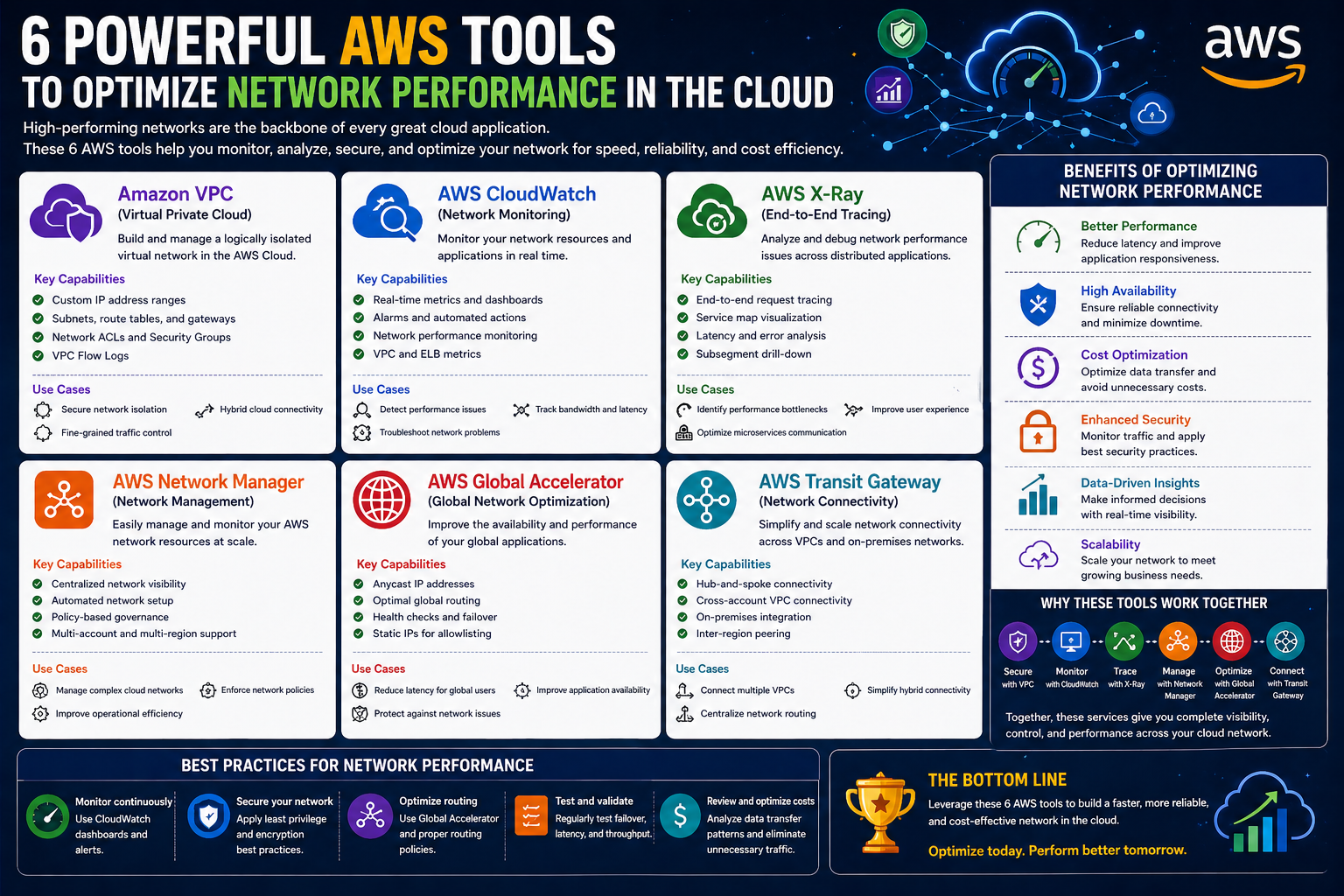
Modern cloud networks operate in environments where performance, reliability, and scalability are constantly under pressure. As organizations shift more workloads into the cloud, the need to manage traffic flow, reduce latency, and maintain consistent connectivity becomes increasingly important. Amazon Web Services provides a wide range of tools designed to support these goals by giving engineers visibility, control, and automation capabilities across their network infrastructure.
Network optimization in AWS is not limited to a single feature or service. Instead, it is achieved through a combination of monitoring tools, infrastructure automation systems, connectivity services, and traffic management solutions. Each of these components plays a different role in ensuring that cloud-based applications remain responsive and stable under varying conditions.
Understanding how these tools function and how they interact with one another helps in designing more efficient cloud architectures. In many cases, organizations rely on multiple services at the same time, each addressing a specific layer of network performance. Some tools focus on observing network behavior, while others are responsible for building or controlling the underlying network structure.
Among the most widely used AWS tools for improving network performance are Amazon CloudWatch, AWS CloudFormation, and AWS Direct Connect. These services address different aspects of optimization, from real-time monitoring and automated deployment to high-speed private connectivity between data centers and cloud environments. Each one contributes to improving efficiency, reducing downtime risks, and maintaining consistent performance across distributed systems.
Amazon CloudWatch for Network Visibility and Performance Insight
Amazon CloudWatch plays a central role in network optimization by offering deep visibility into system behavior across AWS environments. It collects and processes operational data from multiple sources, including compute instances, networking components, and application services. This continuous stream of information allows teams to understand how their infrastructure is performing at any given moment.
One of the most important aspects of CloudWatch is its ability to monitor metrics in real time. Network administrators can observe traffic patterns, latency changes, and throughput variations as they occur. This live visibility helps identify performance bottlenecks before they escalate into larger issues. Instead of reacting to failures after they happen, teams can respond proactively based on early warning signals.
CloudWatch also supports detailed logging capabilities, which provide a deeper layer of analysis beyond basic metrics. Logs can capture packet-level events, system responses, and service interactions. By analyzing these logs, engineers can trace the flow of network traffic and identify irregular patterns that may indicate misconfigurations or performance degradation.
Another important feature is alarm configuration. CloudWatch allows users to define thresholds for specific network metrics. When these thresholds are crossed, alerts are triggered automatically. This mechanism ensures that performance issues are detected quickly, even in large and complex environments where manual monitoring would be impractical. These alerts can be routed to operational dashboards or notification systems, enabling rapid response.
CloudWatch also integrates with enhanced networking features used in compute environments. In virtual machine-based architectures, improved network interfaces can significantly increase throughput and reduce latency. CloudWatch collects performance data from these interfaces, making it easier to evaluate how efficiently network resources are being utilized. This insight is especially valuable in workloads that require high-speed data transfer or low-latency communication between services.
A significant advantage of CloudWatch is its ability to monitor hybrid network connections. Many organizations operate in hybrid environments where on-premises systems are connected to cloud resources. In such setups, maintaining consistent performance across both environments is essential. CloudWatch provides visibility into these cross-environment connections, allowing teams to measure packet loss, round-trip time, and connection stability.
Global internet performance monitoring is another dimension of CloudWatch that contributes to optimization. It provides a broad view of how internet conditions affect application performance across different geographic regions. This is particularly useful for distributed applications that serve users across multiple locations. By understanding how external network conditions impact performance, adjustments can be made to improve user experience.
CloudWatch also supports anomaly detection capabilities. Instead of relying solely on predefined thresholds, it can analyze historical patterns and identify deviations from normal behavior. This is useful in detecting subtle performance issues that might not trigger traditional alarms. These anomalies can reveal emerging network congestion, inefficient routing, or unexpected traffic spikes.
In large-scale environments, CloudWatch acts as a foundational tool for operational awareness. It does not directly modify network configurations, but it provides the intelligence needed to make informed optimization decisions. By continuously gathering and analyzing data, it ensures that network performance is always visible and measurable, forming the basis for further improvements across the infrastructure.
AWS CloudFormation for Automated Network Infrastructure Design
AWS CloudFormation provides a structured way to design and deploy network infrastructure using automated templates. Instead of manually configuring each component through a management interface, infrastructure can be defined as code and deployed consistently across different environments. This approach significantly improves reliability and reduces the risk of human error during setup.
At the core of CloudFormation is the concept of infrastructure templates. These templates define resources such as virtual networks, subnets, routing configurations, and connectivity rules. Once written, a template can be reused multiple times to create identical environments. This repeatability is particularly valuable in large organizations where consistency across development, testing, and production environments is required.
One of the key benefits of using CloudFormation is standardization. When network configurations are manually created, small differences can occur between environments, leading to inconsistencies that are difficult to troubleshoot. CloudFormation eliminates this issue by ensuring that every deployment follows the same predefined structure. This consistency improves network stability and simplifies maintenance.
CloudFormation also supports version control for infrastructure design. Since templates are text-based definitions, they can be stored, updated, and tracked over time. This allows teams to review changes, roll back modifications if needed, and maintain a clear history of infrastructure evolution. In dynamic environments where network requirements frequently change, this level of control is essential.
Another important aspect of CloudFormation is automation. Once a template is defined, it can be deployed without manual intervention. This reduces the time required to build or modify network environments. For example, new virtual networks can be created in minutes rather than hours, allowing teams to respond quickly to changing business requirements.
CloudFormation also helps enforce best practices in network design. Defining rules and dependencies within templates, it ensures that resources are created in the correct order and configured properly. This reduces the likelihood of misconfigured networks that could lead to performance issues or security vulnerabilities.
Scalability is another strength of CloudFormation. As network demands grow, additional resources can be added through template updates. These changes can be applied consistently across multiple regions or accounts, ensuring that expansion does not compromise structural integrity. This is particularly important in global applications where infrastructure must remain synchronized across different geographic locations.
Error handling is also improved through CloudFormation’s rollback capabilities. If a deployment fails due to configuration issues, the system can automatically revert to the previous stable state. This prevents partial or broken network setups from affecting performance. It also provides a safety mechanism during large-scale infrastructure changes.
CloudFormation integrates with other AWS services to create fully automated workflows. Network configurations can be linked with compute resources, security settings, and monitoring systems. This integration allows entire environments to be deployed as a single coordinated unit. As a result, network optimization becomes part of a broader infrastructure strategy rather than an isolated task.
In complex environments, CloudFormation acts as the foundation for predictable and repeatable network architecture. It ensures that every network component is deployed with precision and consistency. By reducing manual intervention and introducing automation into infrastructure design, it supports more efficient and reliable network performance across cloud environments.
AWS Direct Connect for High-Performance Private Network Connectivity
AWS Direct Connect is designed to provide a dedicated network connection between on-premises environments and AWS cloud infrastructure. Unlike standard internet-based connections, it operates over private communication channels, which significantly improves stability and reduces variability in network performance.
One of the primary advantages of Direct Connect is its ability to deliver consistent bandwidth. Public internet connections often experience fluctuations due to congestion and external traffic conditions. In contrast, Direct Connect provides a dedicated path that is not shared with other users, resulting in more predictable performance. This stability is essential for applications that require steady data transfer rates.
Latency reduction is another important benefit of Direct Connect. Because traffic does not traverse the public internet, it follows a more direct route between source and destination. This reduces the number of intermediate hops and minimizes delays. Applications that depend on real-time communication, such as financial systems or large-scale data processing platforms, benefit significantly from this reduced latency.
Direct Connect also enhances security by isolating network traffic from the public internet. Data transmitted through this connection does not pass through external networks, reducing exposure to potential interception or attack. This makes it a preferred choice for organizations that handle sensitive information or require strict compliance with data protection standards.
Scalability is an important consideration in Direct Connect implementations. The service supports multiple connection speeds, allowing organizations to choose bandwidth levels based on their requirements. As demand increases, connections can be upgraded to accommodate higher data volumes without redesigning the entire network architecture.
Another advantage of Direct Connect is its integration with hybrid cloud environments. Many organizations maintain a combination of on-premises systems and cloud-based resources. Direct Connect provides a stable bridge between these environments, ensuring that data flows efficiently across both sides. This is particularly useful for workloads that rely on frequent synchronization between local infrastructure and cloud services.
Consistency in network performance is one of the most critical outcomes of using Direct Connect. Unlike internet-based connections, which may vary in quality depending on external conditions, Direct Connect maintains a stable performance profile. This predictability allows applications to be designed with more precise performance expectations.
Direct Connect also supports integration with other AWS networking components. It can be combined with virtual private networks and routing systems to create flexible hybrid architectures. This allows organizations to design complex network topologies that maintain both performance and redundancy.
In large-scale deployments, Direct Connect plays a key role in ensuring that cloud-based systems remain closely integrated with existing enterprise infrastructure. It reduces dependency on public internet pathways and provides a more controlled networking environment. This control is essential for maintaining optimal performance across distributed systems.
By providing dedicated, high-speed, and stable connectivity, AWS Direct Connect serves as a critical foundation for optimizing network performance in hybrid cloud architectures.
AWS Global Accelerator for Intelligent Traffic Routing and Latency Reduction
Network optimization in modern cloud environments often depends on how efficiently traffic can be routed between users and backend services. AWS Global Accelerator is designed to improve this process by directing traffic through the AWS global network rather than relying on the public internet. This shift in routing strategy significantly enhances performance consistency and reduces variability caused by external network conditions.
At its core, Global Accelerator assigns static IP addresses that act as fixed entry points for applications. These IP addresses remain constant regardless of backend changes, which simplifies connectivity management for distributed systems. Instead of relying on domain name resolution that may vary depending on location or DNS caching behavior, traffic is directed through a stable entry layer.
Once traffic enters the AWS network through Global Accelerator, it is automatically routed to the optimal endpoint based on real-time network conditions. This routing decision is influenced by factors such as latency, regional availability, and overall network health. The system continuously evaluates multiple AWS regions and selects the most efficient path for each user request.
This approach reduces the reliance on traditional internet routing, which often involves unpredictable paths across multiple service providers. By contrast, Global Accelerator leverages AWS’s private backbone network, which is engineered for high-speed and low-latency communication between regions. This controlled environment ensures that data travels through optimized routes rather than congested public infrastructure.
One of the key performance benefits of Global Accelerator is latency reduction. In traditional architectures, user requests may traverse multiple geographic hops before reaching the target service. With Global Accelerator, traffic is directed to the nearest AWS edge location and then routed internally across the AWS network. This significantly shortens the physical and logical distance between users and applications.
Another important aspect is failover automation. Global Accelerator continuously monitors the health of application endpoints. If a primary endpoint becomes unavailable or experiences degraded performance, traffic is automatically redirected to a healthy endpoint in another region. This process occurs without requiring manual intervention, which enhances system resilience and reduces downtime risks.
The architecture also supports multi-region deployment strategies. Applications can be distributed across multiple AWS regions, and Global Accelerator acts as a unified entry layer that balances traffic across them. This allows organizations to design globally distributed systems that still behave like a single cohesive application from the user’s perspective.
Global Accelerator also improves performance consistency for dynamic workloads. In environments where traffic patterns fluctuate rapidly, traditional routing systems may struggle to maintain stability. By continuously evaluating network conditions and adjusting routing decisions in real time, Global Accelerator ensures that performance remains stable even under changing load conditions.
Security benefits are also embedded into the system. Since traffic is routed through AWS’s private network infrastructure, exposure to external routing vulnerabilities is reduced. This minimizes the risk associated with unpredictable internet pathways and provides a more controlled environment for data transmission.
In addition to performance optimization, Global Accelerator simplifies traffic management for distributed applications. Instead of managing multiple regional endpoints directly, applications can be accessed through a single global entry point. This abstraction reduces complexity in network configuration and allows infrastructure teams to focus more on performance tuning rather than routing logistics.
Amazon VPC Traffic Mirroring for Deep Network Visibility and Analysis
Amazon VPC Traffic Mirroring provides a method for capturing and analyzing network traffic flowing through virtual network interfaces. Unlike high-level monitoring tools that focus on aggregated metrics, Traffic Mirroring enables inspection of actual packet-level data. This allows for a much deeper understanding of network behavior and performance characteristics.
The mechanism works by duplicating traffic from a selected network interface and sending it to a designated analysis destination. This destination can be a monitoring system, security appliance, or diagnostic tool capable of processing raw network packets. By replicating traffic in this way, the original flow of data remains unaffected while still enabling detailed inspection.
One of the most important use cases for Traffic Mirroring is performance troubleshooting. When applications experience latency or connectivity issues, it is often difficult to determine the exact cause using metrics alone. Packet-level analysis provides visibility into retransmissions, connection resets, and protocol-level inefficiencies that may be contributing to performance degradation.
Traffic Mirroring also plays a significant role in security analysis. By capturing network packets, security teams can inspect communication patterns for anomalies such as unauthorized access attempts, unusual data transfers, or suspicious protocol behavior. This level of inspection is essential in environments where maintaining strict security compliance is a priority.
Another advantage of Traffic Mirroring is its flexibility in filtering data. Users can define specific conditions that determine which traffic is captured. For example, traffic can be filtered based on protocol type, source address, or port range. This allows targeted analysis of specific application flows without overwhelming the analysis system with unnecessary data.
In distributed architectures, Traffic Mirroring can be used to observe communication between microservices. Modern cloud applications often consist of multiple interconnected services that communicate over virtual networks. By mirroring traffic between these services, engineers can gain insight into service dependencies and identify inefficiencies in inter-service communication.
Performance optimization also benefits from this level of visibility. For example, if a particular service is experiencing delays, Traffic Mirroring can reveal whether the issue originates from network congestion, inefficient routing, or application-level behavior. This enables more accurate diagnosis and targeted optimization efforts.
Traffic Mirroring integrates with virtual network interfaces, making it highly adaptable to different deployment models. Since it operates at the network interface level, it can capture traffic regardless of the application running on top of it. This ensures that analysis remains consistent across different workloads and environments.
The ability to replicate live traffic without disrupting production systems is another key advantage. Unlike active debugging techniques that may interfere with normal operations, Traffic Mirroring operates passively. This means that production traffic continues unaffected while a duplicate stream is analyzed separately.
In large-scale environments, this tool becomes particularly valuable for understanding complex traffic flows. As applications scale across multiple instances and regions, visibility into individual packet paths becomes increasingly important. Traffic Mirroring provides the granular detail needed to maintain performance and stability in such environments.
AWS Transit Gateway for Centralized Network Architecture and Scalable Connectivity
AWS Transit Gateway introduces a centralized approach to managing network connectivity across multiple virtual private clouds and on-premises systems. Instead of creating individual connections between each network segment, Transit Gateway acts as a central hub through which all traffic flows. This hub-and-spoke model simplifies network architecture and improves scalability.
In traditional network designs, connecting multiple environments requires establishing direct links between each pair of networks. As the number of networks increases, the number of required connections grows rapidly, leading to complex and difficult-to-manage configurations. Transit Gateway eliminates this issue by allowing each network to connect only once to a central gateway.
This centralized structure significantly reduces routing complexity. Instead of maintaining multiple routing tables across different network segments, Transit Gateway provides a unified routing framework. This simplifies traffic management and reduces the likelihood of configuration errors that could affect network performance.
Scalability is one of the strongest advantages of this architecture. As new virtual networks are added, they can be connected to the Transit Gateway without requiring changes to existing connections. This allows infrastructure to expand dynamically without disrupting existing communication paths.
Transit Gateway also supports hybrid connectivity, enabling integration between cloud environments and on-premises data centers. By connecting external networks through a single gateway, organizations can maintain consistent routing behavior across both cloud and local infrastructure. This ensures seamless communication between distributed systems.
Traffic segmentation is another important capability. Transit Gateway allows routing policies to be defined in a way that controls how traffic flows between different networks. This enables isolation between environments such as development, testing, and production, while still maintaining centralized control.
Performance optimization is achieved through efficient routing decisions within the gateway. Instead of traffic traversing multiple peer-to-peer connections, it follows a more direct and centralized path. This reduces unnecessary network hops and improves overall communication efficiency.
The architecture also improves operational visibility. Since all network traffic passes through a central point, it becomes easier to analyze flow patterns and identify congestion points. This centralized visibility simplifies network troubleshooting and helps in identifying performance bottlenecks more quickly.
Security is enhanced through controlled routing policies. Transit Gateway allows administrators to define which networks can communicate with each other. This reduces the risk of unintended exposure between different environments and ensures that traffic flows are governed by explicit rules.
In large enterprise environments, Transit Gateway plays a critical role in maintaining order within complex network topologies. As the number of connected systems increases, maintaining direct connections between each pair becomes impractical. The hub-and-spoke model ensures that connectivity remains manageable regardless of scale.
Combined Network Optimization Behavior Across AWS Connectivity and Traffic Services
When AWS Global Accelerator, VPC Traffic Mirroring, and Transit Gateway are used together, they form a layered approach to network optimization that addresses different aspects of performance, visibility, and scalability. Each service operates at a different level of the network stack, contributing to a more complete optimization strategy.
Global Accelerator primarily focuses on entry-point optimization and global routing efficiency. It ensures that user traffic is directed through the fastest available path into the AWS network. This reduces latency and improves responsiveness for globally distributed applications.
Transit Gateway operates at the internal network level, managing how traffic flows between different virtual networks and on-premises systems. It simplifies routing complexity and ensures that internal communication remains efficient even as infrastructure scales.
Traffic Mirroring complements both by providing deep visibility into packet-level behavior. While the other tools optimize routing and connectivity, Traffic Mirroring ensures that engineers can observe what is actually happening within the network. This visibility is essential for diagnosing issues that are not apparent from high-level metrics alone.
Together, these tools create a layered optimization model. External traffic is optimized by Global Accelerator, internal routing is streamlined by Transit Gateway, and detailed analysis is enabled by Traffic Mirroring. This combination allows organizations to manage both performance and observability across their entire network infrastructure.
In complex cloud environments, this layered approach becomes increasingly important. As systems grow in size and complexity, relying on a single optimization method is no longer sufficient. Instead, multiple tools must work together to address different dimensions of network performance.
By separating concerns across different services, AWS enables more precise control over network behavior. Each tool addresses a specific challenge, whether it is routing efficiency, infrastructure scalability, or traffic visibility. This separation allows for more targeted optimization strategies without introducing unnecessary complexity into any single component.
The interaction between these services forms a structured framework for maintaining high-performance cloud networks. Traffic is efficiently routed, infrastructure is centrally managed, and network behavior is continuously observable.
Designing High-Performance Multi-Region Network Architectures with AWS Tools
Modern cloud systems rarely operate within a single geographic boundary. Applications are expected to serve users across continents while maintaining consistent performance and availability. Designing such systems requires careful coordination of networking layers so that traffic flows efficiently between regions without introducing unnecessary delays or bottlenecks.
In multi-region architectures, the primary challenge is maintaining a balance between proximity and redundancy. Placing resources closer to users reduces latency, but distributing them across regions introduces complexity in synchronization and routing. AWS networking tools help manage this balance by providing structured ways to control how traffic moves across global infrastructure.
A key aspect of multi-region design is traffic distribution logic. Instead of relying on static routing rules, modern architectures depend on dynamic routing decisions that adapt to real-time conditions. This ensures that when one region experiences high load or degradation, traffic can be redirected seamlessly to another region without disrupting application behavior.
Another important consideration is data consistency across regions. While networking tools do not directly handle data replication, they influence how quickly and reliably systems communicate. Efficient network paths reduce synchronization delays, which is critical for applications that depend on near-real-time data consistency.
Latency variation between regions is also a significant factor. Even small differences in response times can accumulate into noticeable performance degradation for end users. Optimized routing paths help reduce this variation by ensuring that traffic always follows the most efficient available path across AWS infrastructure.
In complex deployments, multiple AWS networking capabilities work together to support this structure. Global traffic routing decisions, internal VPC communication design, and centralized connectivity models all contribute to maintaining predictable performance across distributed systems.
Improving Observability Pipelines for Network Performance at Scale
Large-scale cloud environments generate vast amounts of network-related data. Every request, connection, and service interaction produces signals that can be used to understand system behavior. The challenge lies in collecting, organizing, and interpreting this data in a way that supports meaningful optimization decisions.
Observability pipelines in AWS environments are designed to process these signals efficiently. Instead of treating network data as isolated events, they are aggregated into structured metrics that represent system-wide behavior. This allows engineers to move from reactive troubleshooting to proactive optimization.
At scale, one of the most important aspects of observability is filtering relevance from noise. Not all network events are equally important, and excessive data can obscure meaningful insights. Structured monitoring systems focus on key indicators such as latency trends, packet consistency, and connection stability rather than raw traffic volume alone.
Another dimension of observability is temporal analysis. Network performance is not static, and fluctuations often occur based on time of day, user distribution, or workload patterns. By analyzing trends over time, it becomes possible to distinguish between normal variation and actual performance anomalies.
Correlation between different network layers is also essential. A delay observed at the application level may originate from network congestion, routing inefficiencies, or endpoint limitations. Observability systems help connect these layers by aligning metrics from different sources into a unified view.
As environments grow, observability must remain scalable. This requires systems that can handle increasing data volumes without degrading performance. Efficient aggregation and sampling techniques ensure that insights remain accessible even as infrastructure expands.
Ultimately, observability is not just about monitoring but about enabling informed decision-making. By transforming raw network data into structured insights, it becomes possible to continuously refine performance and maintain stability across complex environments.
Hybrid Connectivity Optimization Strategies for Enterprise Environments
Many organizations operate in hybrid environments where cloud resources are integrated with on-premises infrastructure. This introduces unique networking challenges, as data must flow seamlessly between fundamentally different environments with varying performance characteristics.
One of the primary goals in hybrid networking is consistency. Applications should behave predictably regardless of whether resources are located in the cloud or within a local data center. Achieving this requires stable connectivity paths that minimize variation in latency and throughput.
Another important factor is bandwidth management. Hybrid architectures often involve large volumes of data transfer between environments. Without proper optimization, this can lead to congestion or uneven performance. Dedicated connectivity channels help ensure that critical data flows remain stable even under heavy load.
Routing efficiency is also critical in hybrid systems. Traffic must be directed through optimal paths that avoid unnecessary traversal across external networks. Poor routing design can introduce delays and increase operational complexity, especially when multiple systems are interconnected.
Security considerations are deeply integrated into hybrid connectivity design. Data moving between environments must be protected from external exposure while maintaining efficient transfer speeds. Controlled network pathways reduce the risk of interception and ensure that communication remains within trusted boundaries.
Scalability is another challenge in hybrid environments. As organizations expand their cloud usage, the volume of cross-environment traffic increases. Network architectures must be able to scale without requiring complete redesigns. Flexible connectivity models allow new systems to be integrated without disrupting existing communication flows.
In well-optimized hybrid systems, cloud and on-premises environments operate as a unified network rather than separate entities. This requires careful coordination of routing, connectivity, and performance tuning across both domains.
Traffic Engineering Techniques for Reducing Latency and Congestion
Traffic engineering in cloud networks focuses on controlling how data flows through infrastructure to achieve optimal performance. Instead of allowing traffic to take default paths, engineered routing strategies guide data through optimized channels based on real-time conditions.
One of the key objectives of traffic engineering is latency reduction. Even minor improvements in routing efficiency can significantly enhance user experience, especially for applications that rely on frequent interactions or real-time responses. By selecting faster network paths, overall responsiveness can be improved.
Congestion management is another critical aspect. Network congestion occurs when too much data flows through a limited set of routes, causing delays and packet loss. Intelligent traffic distribution helps prevent congestion by spreading the load across multiple paths or regions.
Adaptive routing plays a central role in modern traffic engineering. Rather than relying on fixed routes, systems continuously evaluate network conditions and adjust traffic flow accordingly. This ensures that performance remains stable even when conditions change unexpectedly.
Another important consideration is geographic distribution. Users located far from application servers naturally experience higher latency. By directing traffic to the nearest available processing point, perceived performance can be significantly improved.
Load balancing strategies also contribute to traffic optimization. By distributing requests evenly across multiple endpoints, no single resource becomes overwhelmed. This helps maintain consistent performance even during peak usage periods.
Traffic engineering is not limited to external user requests. Internal service communication also benefits from optimized routing. Microservices and distributed components rely on efficient internal traffic flow to maintain responsiveness and stability.
In advanced architectures, traffic engineering becomes a continuous process rather than a one-time configuration. Systems constantly evaluate performance data and adjust routing decisions dynamically to maintain optimal conditions.
Network Security and Traffic Inspection Optimization in Cloud Environments
Network optimization is closely linked with security, as both depend on understanding and controlling traffic flow. In cloud environments, securing network communication requires visibility into how data moves between services and endpoints.
One approach to enhancing security is analyzing network traffic at a granular level. By inspecting packet-level data, it becomes possible to detect unusual patterns that may indicate unauthorized access or malicious activity. This level of inspection provides insights that are not visible through aggregated metrics alone.
Traffic inspection also supports compliance requirements in regulated environments. Many industries require detailed monitoring of data flows to ensure that sensitive information is handled correctly. Packet-level analysis provides the necessary transparency for meeting these standards.
Another important aspect is the segmentation of network traffic. By isolating different types of communication, organizations can reduce the risk of lateral movement within their infrastructure. This ensures that even if one segment is compromised, others remain protected.
Security optimization also involves minimizing exposure points. Reducing unnecessary network paths limits opportunities for interception or exploitation. Streamlined routing not only improves performance but also reduces the attack surface.
An additional layer of protection comes from continuous monitoring of traffic behavior. Instead of relying solely on static security rules, dynamic analysis helps identify emerging threats based on behavior changes over time.
In large-scale environments, security and performance are tightly interconnected. Excessive inspection can introduce latency, while insufficient monitoring can increase risk exposure. Effective optimization requires balancing both aspects to maintain secure yet efficient communication.
Scalable Infrastructure Automation for Network Growth
As cloud environments expand, manual network management becomes increasingly inefficient. Infrastructure automation provides a way to manage complexity by defining network behavior in structured, repeatable formats that can be deployed consistently across environments.
Automation ensures that network configurations remain uniform, even as systems scale across multiple regions or accounts. This consistency is essential for maintaining predictable performance and avoiding configuration drift over time.
Scalability in automated environments is achieved through modular design. Instead of building entire networks from scratch each time, reusable components define specific parts of the infrastructure. These components can then be combined to create larger systems without losing structural integrity.
Change management is also improved through automation. Modifications to network architecture can be tested and applied systematically, reducing the risk of introducing errors into production environments. This controlled approach allows for safer evolution of infrastructure over time.
Another advantage of automation is speed. Network environments that once required manual setup can now be deployed rapidly, allowing organizations to respond quickly to changing requirements. This agility is particularly valuable in dynamic business environments.
Automation also supports consistency across multiple regions. As global infrastructure expands, maintaining uniform network behavior becomes increasingly difficult without structured deployment methods. Automated systems ensure that every region follows the same architectural principles.
In highly scalable environments, automation becomes a foundational requirement rather than an optional enhancement. It enables network systems to grow organically while maintaining stability and performance.
Performance Tuning Through Regional Distribution and Edge Optimization
Regional distribution plays a central role in network performance optimization. By positioning resources closer to users, latency can be significantly reduced, and responsiveness improved. However, distributing workloads across multiple regions introduces the need for careful coordination.
Edge optimization further enhances performance by processing traffic closer to its origin. Instead of routing all requests to centralized locations, edge systems handle certain operations locally, reducing the distance data must travel.
This approach improves not only speed but also efficiency. By reducing long-distance communication, network load is distributed more evenly across the infrastructure. This helps prevent congestion in central regions and improves overall system balance.
Regional performance differences must also be considered. Not all regions experience identical network conditions, and optimization strategies must account for these variations. Adaptive routing helps mitigate these differences by selecting the most efficient region for each request.
Edge optimization is particularly beneficial for applications with global user bases. Users located far from central infrastructure still receive responsive performance because processing occurs closer to their location.
In combination with regional distribution strategies, edge optimization creates a layered performance model where traffic is handled at multiple levels depending on its origin and destination.
Operational Resilience and Failover Engineering in AWS Networks
Network resilience is a critical component of cloud architecture. Systems must be able to withstand failures without significant disruption to service availability. This requires careful design of failover mechanisms that can respond automatically to changing conditions.
Failover engineering ensures that when one component becomes unavailable, traffic is redirected to an alternative path or endpoint. This process must occur quickly and seamlessly to avoid noticeable service interruptions.
Redundancy plays a key role in resilience. By maintaining multiple pathways for data transmission, systems can continue operating even if one route fails. This redundancy is essential in distributed environments where reliability is a priority.
Monitoring systems support resilience by continuously evaluating network health. When performance degradation is detected, corrective actions can be triggered automatically. This reduces the need for manual intervention during critical events.
Another aspect of resilience is regional isolation. By distributing workloads across multiple geographic regions, failures in one region do not necessarily affect others. This improves overall system stability and reduces the impact of localized disruptions.
Operational resilience also involves planning for gradual degradation rather than sudden failure. Systems are designed to maintain partial functionality even under stress, ensuring that essential services remain available.
In complex network environments, resilience is not a single feature but a combination of routing strategies, redundancy models, and automated response mechanisms working together to maintain continuity under varying conditions. Effective resilience depends on how intelligently traffic is directed, how efficiently backup systems are activated, and how quickly the network can adapt to failures without human intervention. Modern architectures achieve this by distributing workloads across multiple paths, continuously monitoring system health, and automatically shifting traffic when anomalies are detected. This layered approach ensures that disruptions in one part of the network do not cascade into full system outages, preserving performance stability and service availability.
Conclusion
Network optimization in AWS is not the result of a single tool or isolated technique, but rather the combined effect of multiple services working together across different layers of cloud infrastructure. Each tool plays a specific role in shaping how data moves, how systems respond, and how performance is maintained under varying conditions.
At the foundation, monitoring and visibility tools provide the awareness needed to understand what is happening inside the network. Without this insight, optimization would be based on assumptions rather than real performance data. Continuous observation of traffic behavior, latency trends, and system health makes it possible to identify inefficiencies before they escalate into larger disruptions.
Alongside visibility, infrastructure automation ensures that network environments remain consistent and scalable. As cloud systems grow, manual configuration becomes increasingly unreliable and difficult to manage. Automated design approaches help maintain uniformity across environments, reduce human error, and allow infrastructure to evolve in a controlled and predictable manner.
Connectivity services further strengthen performance by improving how data travels between users, applications, and regions. By reducing dependency on unpredictable external routing paths and enabling more direct communication channels, these tools help ensure that network traffic follows efficient and stable routes. This leads to more consistent application behavior, even in globally distributed environments.
Traffic control and inspection capabilities add another important layer by enabling a deeper understanding and management of network flows. They make it possible to analyze communication patterns at a granular level, identify inefficiencies, and ensure that security requirements are met without compromising performance. This balance between speed and control is essential in modern cloud systems.
When combined, these capabilities form a structured approach to network optimization that addresses performance, reliability, scalability, and security simultaneously. Instead of treating these goals separately, AWS networking tools allow them to be managed as interconnected components of a unified system.
Ultimately, effective network optimization is an ongoing process rather than a one-time configuration. As workloads change, user demand shifts, and applications evolve, network behavior must continuously adapt. AWS provides the foundation for this adaptability by offering tools that support real-time monitoring, automated scaling, intelligent routing, and deep traffic analysis.
In a cloud environment where performance expectations are constantly increasing, the ability to maintain efficient, resilient, and scalable network infrastructure becomes a critical factor in overall system success.