The rapid expansion of digital systems has fundamentally changed how organizations think about storing and managing data. In earlier computing environments, storage was tightly bound to physical infrastructure, often requiring dedicated servers, on-premises data centers, and extensive manual maintenance. As data volumes increased, this model became increasingly difficult to scale. Organizations found themselves spending more time maintaining storage systems than actually using the data they collected.
The emergence of cloud computing introduced a new approach where storage is no longer dependent on physical ownership of hardware. Instead, it is delivered as a flexible service that can scale up or down depending on demand. This shift enabled businesses to focus more on application development, analytics, and innovation rather than infrastructure maintenance.
Within this environment, different types of storage models were developed to handle different kinds of workloads. Not all data behaves the same way. Some data is static and needs to be accessed globally, while other data is dynamic and tightly connected to running applications. These differences led to specialized storage services designed to handle specific requirements efficiently.
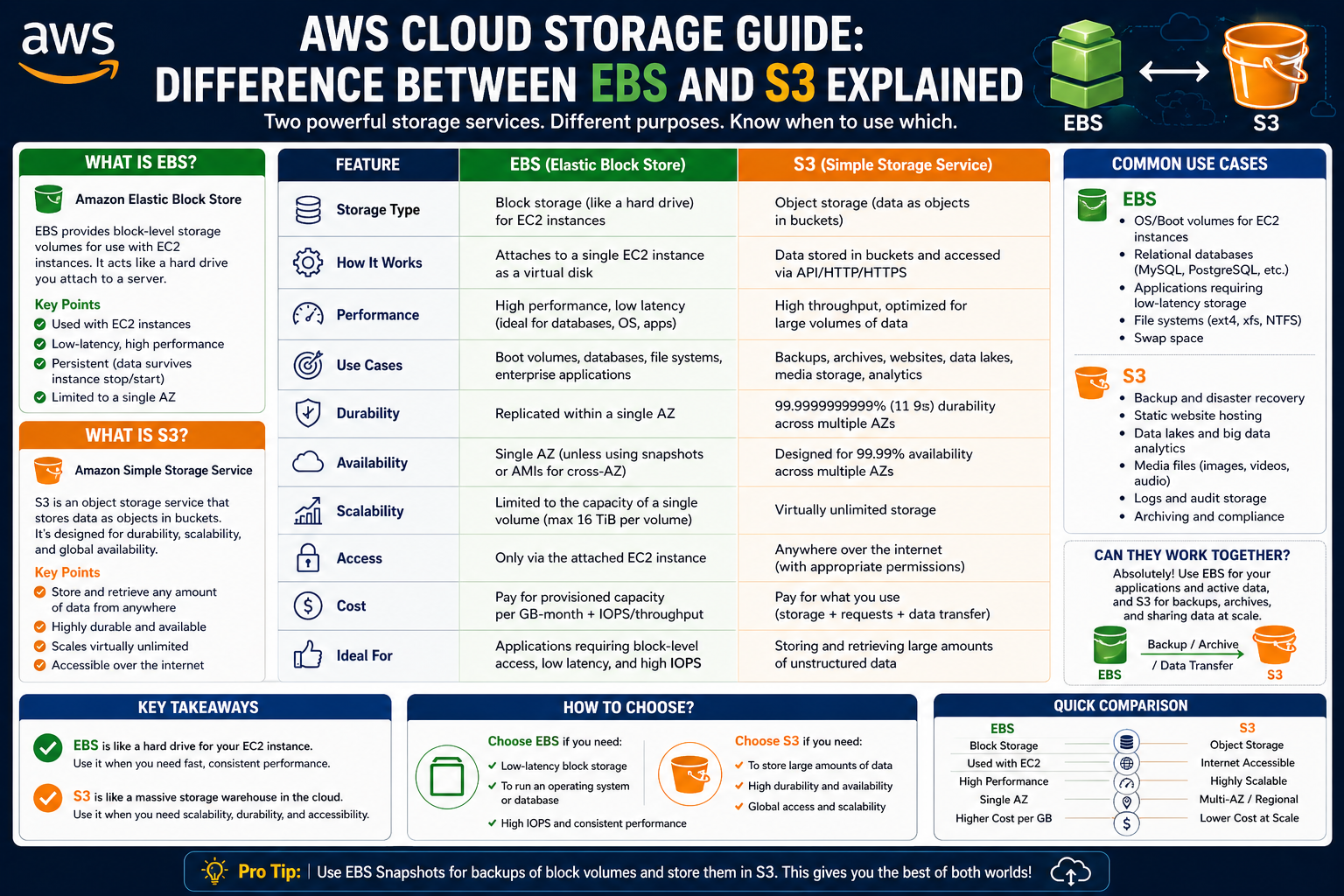
Two of the most widely used storage approaches in cloud environments are object-based storage and block-based storage. These two models form the foundation for understanding how services like Amazon S3 and Amazon EBS operate. Although both are designed to store data, they do so in fundamentally different ways, which directly affects how they are used in real-world applications.
Object storage is designed for massive scalability and distributed access, making it ideal for storing unstructured data such as images, documents, backups, and media files. Block storage, on the other hand, is designed for performance and low-latency access, making it suitable for applications that require direct, fast interaction with data at the system level.
Understanding these differences is essential before exploring individual services because the choice between them is not based on which one is better overall, but rather which one is better suited for a specific workload.
Understanding the Architecture of Object-Based Storage in S3
Object-based storage represents a fundamentally different way of organizing data compared to traditional file systems. Instead of storing data in hierarchical directories or structured blocks, object storage treats each piece of data as a self-contained unit called an object. Each object contains the data itself, metadata describing the data, and a unique identifier that allows it to be retrieved.
This structure allows object storage systems to scale horizontally without the limitations typically associated with file systems. Since each object is independent, there is no need to maintain complex directory relationships or sequential storage paths. This independence makes object storage highly efficient for distributed systems where data is accessed from multiple locations simultaneously.
In this model, data is accessed using a unique key rather than a file path. This key-based retrieval system allows for extremely fast lookup operations, even when managing billions of objects. The system does not need to scan directories or traverse file trees; it simply uses the identifier to locate the object directly.
Another important characteristic of object storage is its ability to distribute data across multiple physical locations automatically. This distribution enhances durability and availability, ensuring that data remains accessible even if individual hardware components fail. Redundancy is built into the system at a structural level rather than being manually configured.
Object storage also handles metadata in a flexible way. Each object can include custom metadata that describes its contents, usage, or origin. This makes it easier to categorize and manage large datasets without requiring rigid folder structures.
Because of this architecture, object storage is particularly effective for workloads involving large-scale data distribution, such as content delivery, backup storage, and archival systems. It is not designed for frequent in-place modification of data but rather for storing and retrieving complete objects efficiently.
Data Organization and Accessibility Patterns in S3 Environments
The way data is organized in object storage systems has a significant impact on how it is accessed and used. Unlike traditional file systems, where data is stored in nested directories, object storage uses a flat structure. This means that all objects exist at the same logical level, regardless of how they are grouped conceptually.
To simulate hierarchy, object storage systems use prefixes in object names. These prefixes create the illusion of folders, but in reality, the system does not treat them as physical directories. This design allows for greater flexibility and scalability because there are no restrictions imposed by directory depth or structure.
Data retrieval in such systems is optimized for high throughput rather than low-latency transactional access. This makes object storage particularly well-suited for scenarios where large volumes of data need to be accessed concurrently by multiple users or applications.
Another important aspect of object-based systems is their strong consistency model in modern implementations. When data is written or updated, it becomes immediately available for retrieval, ensuring that applications always interact with the most recent version of the data.
Object storage systems are also designed with global accessibility in mind. Data can be accessed from any location over the internet, provided appropriate permissions are configured. This makes it ideal for distributed applications where users and services operate across different geographic regions.
Because of its distributed nature, object storage does not rely on a single physical location. Instead, data is automatically replicated across multiple storage nodes. This ensures high durability and reduces the risk of data loss due to hardware failure or localized disruptions.
These accessibility characteristics make object storage particularly effective for serving static content. Files such as images, videos, documents, and web assets can be stored once and accessed repeatedly without requiring changes to the underlying structure.
Internal Structure and Behavior of Block-Based Storage Systems
Block-based storage operates at a lower level compared to object storage. Instead of managing complete objects, it divides data into fixed-sized blocks that are stored independently. Each block is assigned an address, and the system reconstructs data by retrieving and assembling these blocks when needed.
This approach closely resembles how traditional hard drives function, which makes block storage familiar to operating systems and applications that require direct disk access. When a block storage volume is attached to a computing instance, it behaves like a physical hard drive connected to that system.
One of the key characteristics of block storage is its ability to support file systems. Because it operates at a lower level, it allows users to format the storage volume, create directories, and manage files in a traditional hierarchical structure. This makes it suitable for workloads that depend on operating system-level interactions.
Block storage is typically associated with individual computing instances. It is not designed for widespread shared access across multiple systems simultaneously. Instead, it is attached to a specific environment where it provides dedicated storage resources.
This tight coupling between storage and compute resources allows block storage to deliver low-latency performance. Since the data is located close to the computing instance, read and write operations can be executed quickly without the need for network-based retrieval across distributed systems.
Another important aspect of block storage is its persistence model. Even if the computing instance it is attached to is stopped or restarted, the data remains intact on the storage volume. This makes it suitable for applications that require long-term data retention tied to a specific system.
Block storage also supports snapshot functionality, allowing the state of a volume to be captured at a specific point in time. These snapshots can be used for backup, recovery, or replication purposes, enabling administrators to preserve system states without interrupting operations.
Because of these characteristics, block storage is commonly used for applications that require structured data access, such as databases, application installations, and development environments.
Performance Characteristics and Latency Behavior in Storage Systems
Performance plays a crucial role in determining which storage model is appropriate for a given workload. Object storage and block storage differ significantly in how they handle latency and throughput.
Object storage is designed to handle large-scale data retrieval efficiently, but it is not optimized for ultra-low latency operations. Since data is accessed over a distributed network and retrieved using object keys, there is a small amount of overhead involved in each request. However, this trade-off enables massive scalability and durability.
Block storage, by contrast, is optimized for speed. Because it is directly attached to computing instances, it provides faster access to data by reducing the distance between storage and processing units. This proximity allows applications to perform read and write operations with minimal delay.
Latency differences become particularly important in scenarios where real-time processing is required. Applications such as databases, transactional systems, and development environments benefit from the predictable and fast response times offered by block storage.
Object storage, however, excels in environments where throughput is more important than latency. When handling large files or streaming data to multiple users, the ability to distribute requests efficiently becomes more valuable than individual request speed.
Another aspect of performance is concurrency. Object storage is designed to handle a high number of simultaneous requests from different locations. This makes it suitable for global applications where users access data from various regions at the same time.
Block storage typically focuses on performance within a single environment. While it can deliver high-speed access, it is not designed for widespread concurrent access across multiple systems.
These performance differences highlight why each storage type is optimized for specific workloads rather than being interchangeable.
Data Accessibility and System Integration Differences
The way storage systems integrate with computing environments significantly affects how developers and administrators interact with data. Object storage and block storage follow entirely different integration models.
Object storage is accessed through network-based requests. Applications interact with stored data by sending requests that include object identifiers. This makes integration straightforward for distributed systems, as it does not require direct mounting or physical attachment.
Block storage, however, integrates at the system level. When attached to a computing instance, it appears as a local drive. This allows operating systems to interact with it just like any other disk, enabling the use of file systems and traditional storage operations.
This difference in integration also affects portability. Object storage is inherently portable because data is not tied to a specific system. It can be accessed from anywhere with the correct permissions. Block storage, on the other hand, is typically bound to the system it is attached to, although it can be detached and reattached as needed.
Another important distinction is how applications interact with data. Object storage requires applications to be designed around API-based access patterns, while block storage allows applications to use standard file system operations without modification.
These integration differences influence how developers design systems and choose storage solutions based on application architecture requirements.
Mapping Real-World Workloads to AWS Storage Services
When evaluating cloud storage options in practical environments, the discussion moves beyond theoretical differences and focuses on how each service behaves under real operational demands. In modern cloud architectures, workloads vary significantly in structure, access frequency, performance sensitivity, and scalability requirements. This diversity is what makes the distinction between object-based and block-based storage so important.
Object storage tends to align naturally with workloads that are designed for distributed access patterns. These workloads often involve large volumes of unstructured data that do not require frequent modification at the block level. Instead, they are written once and accessed many times across different systems. This includes content-heavy applications, media distribution systems, and large-scale archival storage.
Block storage, by contrast, aligns with workloads that require consistent, low-latency interaction with data at the system level. These workloads are typically tied to compute instances and require direct disk-like access. Applications such as relational databases, application servers, and development environments depend heavily on this model because they require predictable performance and structured file system behavior.
In real-world scenarios, organizations rarely rely on a single storage type. Instead, they design hybrid architectures where object storage handles large-scale static or semi-static data, while block storage supports active processing systems. This separation allows each storage type to operate within its optimal performance domain.
Understanding workload mapping is essential because selecting the wrong storage model can lead to inefficiencies, higher costs, or performance bottlenecks. For example, using block storage for globally distributed content delivery would introduce unnecessary complexity, while using object storage for high-frequency transactional database operations would introduce latency challenges.
The decision is therefore less about capability and more about alignment with workload behavior. Each storage system is optimized for a specific category of operational demand, and modern cloud architectures leverage this specialization to achieve efficiency at scale.
Durability and Data Reliability in Distributed Storage Systems
Data durability is a critical factor in any storage system, especially in environments where data loss can have significant operational or financial consequences. In cloud environments, durability refers to the ability of a storage system to preserve data over time without corruption or loss.
Object storage systems are designed with extremely high durability in mind. They achieve this through extensive replication mechanisms that distribute data across multiple physical devices and sometimes across multiple geographic locations. This ensures that even if several components fail, the data remains intact and accessible.
The durability model in object storage is built on redundancy at multiple levels. Data is not stored as a single copy but is instead replicated in a way that allows the system to recover automatically from hardware failures. This design minimizes the need for manual intervention and reduces the risk of data loss due to localized failures.
Block storage also provides durability, but its approach is different. While it includes mechanisms for data persistence and snapshot creation, it is typically tied to a specific compute environment. The durability of block storage depends on the underlying infrastructure and replication policies configured for the volume.
Snapshots play an important role in block storage durability. They allow the state of a storage volume to be preserved at a specific moment in time, enabling recovery in case of system failure or accidental data modification. These snapshots can be used to restore environments or replicate systems across different instances.
The difference in durability approaches reflects the intended use cases of each storage type. Object storage prioritizes long-term resilience across distributed systems, while block storage focuses on maintaining data integrity within operational computing environments.
Scalability Models and Growth Handling in Cloud Storage
Scalability is one of the defining advantages of cloud-based storage systems. As data generation continues to increase exponentially across industries, storage systems must be capable of handling growth without requiring manual reconfiguration or physical infrastructure expansion.
Object storage is inherently designed for unlimited scalability. Its architecture allows data to grow continuously without being constrained by hierarchical structures or fixed storage limits. Since data is stored as independent objects, the system can distribute storage across a virtually unlimited number of nodes.
This horizontal scaling model ensures that performance remains stable even as data volume increases. There is no need to restructure storage or migrate data when capacity thresholds are reached. The system automatically adapts to growth by distributing objects across available resources.
Block storage scales differently. While it can be expanded by increasing volume size or attaching additional storage units, it is typically bound to the performance characteristics of individual compute instances. This makes it more suitable for controlled environments where storage growth is predictable and tied to application needs.
Scalability in block storage is often managed at the application level. Developers and system administrators must plan storage capacity based on expected workload growth. While modern cloud systems provide flexible resizing options, block storage still requires more structured planning compared to object storage.
The difference in scalability models highlights the distinction between distributed and instance-bound storage systems. Object storage is designed for unpredictable, large-scale growth, while block storage is optimized for controlled, performance-focused environments.
Cost Structures and Economic Considerations in Storage Selection
Cost efficiency plays a significant role in determining which storage solution is appropriate for a given workload. Cloud storage systems are designed with different pricing models that reflect their operational characteristics and usage patterns.
Object storage typically follows a usage-based pricing model where costs are determined by the amount of data stored, the frequency of access, and the volume of data transferred. This makes it particularly cost-effective for large datasets that do not require constant modification or high-frequency access.
Because object storage is optimized for long-term retention and scalability, it often becomes more economical as data volumes increase. The absence of infrastructure management costs also contributes to its cost efficiency, especially for archival and backup workloads.
Block storage, on the other hand, tends to be more expensive on a per-unit basis because it provides higher performance and dedicated resources. Its pricing structure reflects the need for low-latency access and consistent performance, which requires reserved capacity within the underlying infrastructure.
Cost considerations in block storage are closely tied to usage intensity. Since it is often used for active workloads such as databases and application servers, its cost is justified by performance requirements rather than storage volume alone.
Another important factor is data transfer and access frequency. Object storage may incur additional costs for frequent data retrieval, while block storage costs are generally associated with provisioned capacity rather than access patterns.
Organizations often optimize costs by distributing workloads between storage types based on their economic and performance profiles. Frequently accessed, performance-sensitive data is placed in block storage, while infrequently accessed or large-scale data is stored in object storage.
Security Models and Access Control Mechanisms
Security is a fundamental aspect of cloud storage systems, particularly when dealing with sensitive or regulated data. Both object storage and block storage implement security mechanisms, but they do so in different ways based on their architecture.
Object storage security is primarily managed through identity-based access control policies. These policies define who can access specific objects and under what conditions. Since object storage is accessed over networks, security is enforced at the request level, ensuring that only authorized users or applications can retrieve or modify data.
Encryption plays a significant role in object storage security. Data can be encrypted both at rest and in transit, ensuring that it remains protected even if intercepted or accessed without authorization. Access permissions are typically granular, allowing control over individual objects or groups of objects.
Block storage security is more closely tied to the computing environment. Since it is attached to specific instances, access is often controlled through system-level permissions. Only authorized instances can access the storage volume, reducing exposure to external access attempts.
Encryption is also commonly used in block storage, ensuring that data remains protected even if the underlying storage media is compromised. Because block storage operates at a lower system level, security controls often integrate directly with operating system mechanisms.
The difference in security models reflects the operational nature of each storage type. Object storage is designed for distributed access with strict identity controls, while block storage is designed for controlled environments where access is limited to specific systems.
Data Lifecycle Management and Retention Strategies
Data lifecycle management refers to the policies and processes that govern how data is stored, accessed, transitioned, and eventually removed. In cloud storage environments, lifecycle management is essential for optimizing both performance and cost.
Object storage systems often include automated lifecycle policies that allow data to transition between different storage tiers based on usage patterns. Frequently accessed data may remain in high-performance tiers, while older or less frequently accessed data can be moved to lower-cost storage options.
This tiered approach enables organizations to balance performance and cost efficiency without manual intervention. It also supports long-term data retention strategies, where data is preserved for compliance or historical purposes without incurring high storage costs.
Block storage lifecycle management is typically more manual and closely tied to system usage. Since block storage is often used for active workloads, data retention policies are usually managed at the application level rather than the storage system level.
Snapshots play an important role in lifecycle management for block storage. They allow historical states of data to be preserved and restored when needed. These snapshots can be retained for backup purposes or used to create new environments based on previous system states.
Lifecycle management in both storage types reflects their underlying design philosophy. Object storage emphasizes automated long-term data management, while block storage focuses on operational control and system-level consistency.
Integration with Compute Systems and Application Environments
Storage systems in cloud environments do not operate in isolation. They are deeply integrated with compute resources, and this integration plays a critical role in determining how applications are designed and deployed.
Object storage integrates with applications through network-based access. Applications interact with data by sending requests over the internet or internal networks. This decoupled model allows storage and compute resources to operate independently, enabling high flexibility in distributed architectures.
This type of integration is particularly useful for web-based applications, content delivery systems, and data analytics platforms where multiple services need access to shared datasets.
Block storage integrates directly with compute instances, appearing as local storage devices within the operating system. This tight coupling allows applications to interact with data as if it were stored on a physical disk.
This model is particularly important for applications that require persistent state or direct file system access. It allows software to operate without modification, using traditional file operations and system calls.
The integration differences between these storage types influence how systems are designed at a fundamental level. Object storage supports loosely coupled architectures, while block storage supports tightly integrated systems.
Backup Strategies and Disaster Recovery Planning
Backup and disaster recovery are essential components of any data management strategy. Cloud storage systems provide different mechanisms for ensuring data resilience and recovery depending on their design.
Object storage is often used as a primary solution for backups due to its durability and scalability. Data can be stored redundantly across multiple locations, ensuring that it remains available even in the event of hardware failures or regional disruptions.
Its ability to store large volumes of data efficiently makes it ideal for long-term backup retention. Organizations can maintain historical data copies without requiring significant infrastructure investment.
Block storage supports backup strategies through snapshot mechanisms. These snapshots capture the state of a storage volume at a specific point in time, allowing systems to be restored in case of failure or corruption.
Disaster recovery planning often involves combining both storage types. Object storage is used for off-site backups and archival data, while block storage supports rapid recovery of active systems.
This combination ensures both long-term resilience and short-term operational recovery, creating a balanced approach to data protection.
Data Distribution and Global Access Patterns
Modern applications often operate across multiple geographic regions, requiring storage systems that can support global access patterns. Object storage is particularly well-suited for this requirement due to its distributed architecture.
Data stored in object systems can be accessed from any location, making it ideal for global applications. This allows organizations to serve content efficiently to users regardless of their geographic location.
Block storage, however, is typically limited to specific compute environments. While it can be replicated across regions, it is not inherently designed for global distribution.
This difference affects how applications are architected for global scale. Object storage supports centralized data access for distributed users, while block storage supports localized system performance.
Development and Testing Environment Usage Patterns
Development environments often require flexible and repeatable infrastructure configurations. Block storage is commonly used in these scenarios because it allows entire environments to be replicated through snapshots and attached to new compute instances.
This makes it possible to create consistent development setups across teams. Each environment can include operating systems, applications, and configurations stored within block volumes.
Object storage plays a supporting role in development environments by storing shared assets, build artifacts, and static resources. Its ability to provide centralized access to data makes it useful for collaborative workflows.
The combination of both storage types allows development teams to maintain consistency while also enabling scalability and collaboration across distributed teams.
Data Analytics and Large-Scale Processing Workflows
Data analytics workloads often involve processing large volumes of unstructured data. Object storage is particularly effective in these environments due to its scalability and ability to store massive datasets.
Analytics systems can access data directly from object storage without requiring complex restructuring. This makes it suitable for data lakes and large-scale processing pipelines.
Block storage is used in analytics environments when intermediate processing requires high-speed access to temporary data structures. It supports performance-intensive operations that require low-latency access.
Together, both storage types enable efficient analytics workflows by separating raw data storage from processing-intensive operations.
Architectural Patterns Combining Object and Block Storage
Modern cloud systems rarely rely on a single storage model in isolation. Instead, they combine object and block storage to form layered architectures where each component handles a specific responsibility. This separation of concerns allows applications to scale efficiently while maintaining performance where it matters most.
In many enterprise environments, block storage is positioned close to compute resources to support active processing. It acts as the operational layer where applications run, databases execute queries, and system-level tasks are performed. Object storage is positioned as the durable persistence layer where data is stored for long-term access, sharing, or analysis.
This layered design creates a natural flow of data. Applications generate and process information using block storage, then periodically persist results or raw datasets into object storage. This approach reduces pressure on high-performance storage while ensuring long-term durability of critical data.
Another common pattern involves using object storage as a central repository for distributed systems. Multiple compute instances access shared datasets stored in object storage, while each instance uses its own block storage for temporary processing. This separation avoids contention and improves scalability across distributed workloads.
In analytics-heavy environments, object storage often serves as the foundation of data lakes, while block storage supports intermediate processing nodes. This allows massive datasets to remain centralized while computation is distributed across multiple processing units.
The combination of both storage types enables systems to balance performance, cost, and scalability without compromising on any single factor. It reflects the principle that no single storage model is sufficient for all workloads.
Performance Optimization Techniques for Each Storage Model
Optimizing performance in cloud storage systems requires an understanding of how each storage type handles data access. Object storage performance is primarily influenced by request patterns, data distribution, and network efficiency. Block storage performance depends on proximity to compute resources, I/O configuration, and volume type.
In object storage environments, performance improves when data access patterns are designed to minimize repeated retrieval of small objects. Instead, applications benefit from batching requests or retrieving larger datasets in fewer operations. This reduces overhead and improves throughput.
Another optimization technique involves structuring object naming conventions in a way that distributes access evenly across the storage system. Uneven access patterns can create bottlenecks in certain partitions, while well-distributed naming schemes help balance load.
Block storage performance optimization focuses on maximizing input and output operations per second while minimizing latency. This often involves selecting appropriate volume types based on workload requirements and ensuring that compute instances are properly matched to storage performance characteristics.
Caching also plays a significant role in both storage models. In block storage environments, operating system-level caching reduces repeated disk access. In object storage environments, application-level caching reduces redundant network requests.
Performance tuning requires continuous observation of workload behavior. Applications evolve, and storage configurations must be adjusted to match changing demands. What begins as a low-intensity workload may eventually require significant optimization as usage grows.
Data Consistency and Transaction Behavior in Distributed Storage
Data consistency refers to how quickly changes to stored data become visible across systems. In distributed storage environments, consistency models determine how reliable and immediate data updates are.
Object storage systems typically operate with strong consistency in modern implementations. Once data is written, it becomes immediately available for retrieval. This behavior simplifies application design because developers do not need to account for delayed visibility of updates.
Block storage inherits consistency from the underlying compute environment. Since it behaves like a traditional disk, changes are immediately reflected within the system that owns the storage volume. This makes it suitable for transactional workloads where immediate consistency is required.
However, challenges arise when data is replicated or accessed across multiple systems. In such cases, synchronization mechanisms are required to ensure that all systems view consistent data states.
Distributed consistency becomes especially important in systems that rely on object storage as a shared data layer. Applications must be designed to handle scenarios where data updates occur across multiple regions or services simultaneously.
Transaction behavior in block storage is typically managed at the application or database level. Since block storage does not inherently manage transactions, responsibility for consistency lies with the software running on top of it.
This distinction highlights a fundamental architectural difference: object storage handles consistency at the system level, while block storage delegates it to the application layer.
Network Architecture, Access Paths, and Connectivity Design
The way storage systems interact with network infrastructure significantly affects their performance and usability. Object storage relies heavily on network-based access paths. Every interaction with data involves sending requests over a network, which introduces dependency on connectivity and latency.
This network-based model allows object storage to operate independently of compute resources. Data can be accessed from anywhere, making it ideal for distributed applications and multi-region systems.
Block storage, by contrast, uses tightly coupled network connections that simulate direct hardware attachment. Although it is still accessed through network infrastructure in cloud environments, it behaves as if it were locally attached storage.
This difference in access paths influences how systems are designed. Object storage requires robust network optimization strategies, while block storage requires stable, high-performance connectivity between compute and storage layers.
Network latency plays a more visible role in object storage performance because each request depends on remote communication. In block storage, latency is minimized because storage is closely integrated with compute instances.
Connectivity design also impacts security and access control. Object storage often uses public or private endpoints with strict authentication layers, while block storage operates within isolated network boundaries tied to specific compute environments.
Migration Strategies Between Storage Systems
Data migration between storage systems is a common requirement in cloud environments, especially when workloads evolve or architectural decisions change. Moving data between object and block storage requires careful planning due to their structural differences.
Migrating from block storage to object storage typically involves exporting data from compute-attached volumes and transferring it into object-based systems. This process is often used for backup, archival, or analytics purposes.
During this transition, data must be reformatted to fit object storage structures. Instead of file system hierarchies, data is converted into objects with metadata and unique identifiers.
Migrating from object storage to block storage is less common but occurs in scenarios where data needs to be used within active computing environments. In such cases, data is retrieved from object storage and written onto block storage volumes attached to compute instances.
This process enables applications to transition from static storage models to active processing environments.
Migration strategies must account for data integrity, transfer speed, and consistency. Large datasets require optimized transfer mechanisms to avoid performance bottlenecks during migration.
Incremental migration approaches are often used to reduce system downtime and ensure continuous availability during transitions.
Operational Monitoring, Governance, and Reliability Engineering
Operational monitoring plays a critical role in maintaining the health and efficiency of storage systems. Both object and block storage require continuous observation to ensure performance and reliability.
In object storage systems, monitoring focuses on access patterns, request latency, and data transfer volumes. These metrics help identify unusual usage patterns or performance degradation.
Block storage monitoring is more closely tied to compute performance. Metrics such as input/output operations, latency, and throughput are used to evaluate system efficiency.
Governance frameworks define how data is stored, accessed, and retained across storage systems. These frameworks ensure compliance with organizational policies and regulatory requirements.
Reliability engineering involves designing systems that can withstand failures without data loss or service interruption. Object storage achieves reliability through distributed redundancy, while block storage relies on snapshots and replication strategies.
Together, monitoring, governance, and reliability practices ensure that storage systems remain stable, secure, and efficient over time.
Common Design Mistakes and Their Impact on System Behavior
Improper storage design can lead to significant performance and operational issues. One common mistake is using block storage for workloads that require global access. This leads to unnecessary complexity and performance limitations.
Another frequent issue is using object storage for high-frequency transactional workloads. Since object storage is not optimized for low-latency operations, this can result in degraded performance.
Over-reliance on a single storage type is also a common design flaw. Systems that do not separate workloads appropriately often struggle to scale efficiently or manage costs effectively.
Poor data organization in object storage can lead to inefficient access patterns, while improper configuration of block storage volumes can result in underutilized performance capacity.
Understanding these pitfalls is essential for designing efficient cloud architectures that align storage behavior with application requirements.
Decision Framework for Selecting Between Object and Block Storage
Selecting between object and block storage requires evaluating multiple factors, including workload type, performance requirements, scalability needs, and access patterns.
Object storage is typically chosen for workloads involving large volumes of unstructured data, distributed access, and long-term retention. It excels in scenarios where scalability and durability are more important than low-latency access.
Block storage is selected for workloads that require direct system-level interaction, consistent performance, and integration with compute instances. It is ideal for databases, application environments, and processing-intensive systems.
A structured decision framework considers how data is accessed, how frequently it changes, and how it integrates with compute resources. It also evaluates cost implications and operational complexity.
In many cases, the optimal solution involves combining both storage types within a single architecture. This hybrid approach allows each system to operate within its strengths while compensating for its limitations through complementary design.
Conclusion
The comparison between object storage and block storage highlights one of the most important design decisions in modern cloud computing: how data should be structured, accessed, and managed based on its role within an application. While both storage types ultimately serve the same fundamental purpose of retaining data, they differ significantly in architecture, performance behavior, scalability, and operational use cases.
Object storage represents a highly distributed and scalable approach to data management. It is designed to handle massive volumes of unstructured data with simplicity and resilience. Organizing data as independent objects with unique identifiers, it removes the limitations of traditional file systems and enables global accessibility. This makes it especially effective for workloads such as media storage, backups, content distribution, and large-scale analytics, where durability and scalability are more important than low-latency processing.
Block storage, on the other hand, operates closer to traditional computing models. It provides low-latency, high-performance storage that integrates directly with compute instances. Its ability to function like a physical disk makes it ideal for operating systems, databases, and applications that require structured file systems and consistent performance. This tight coupling between storage and compute ensures fast data access and predictable behavior in performance-sensitive environments.
The key takeaway is that neither storage type is inherently superior. Instead, each is optimized for specific operational needs. Object storage excels in distributed, data-heavy environments where accessibility and durability are critical. Block storage excels in performance-driven environments where speed and system-level integration are essential.
In real-world cloud architectures, the most effective solutions often combine both models. Object storage serves as the long-term repository for large datasets, while block storage powers active applications and processing workloads. This layered approach allows organizations to balance cost, performance, and scalability without compromising system efficiency.
As data continues to grow at unprecedented rates, the importance of selecting the right storage strategy becomes even more critical. Understanding how object storage and block storage differ allows developers, engineers, and organizations to design systems that are not only efficient but also adaptable to future demands.
Ultimately, the decision is not about choosing one over the other in isolation, but about understanding how each fits into a broader ecosystem of cloud infrastructure. When used together strategically, they form a powerful foundation capable of supporting everything from small applications to global-scale systems.