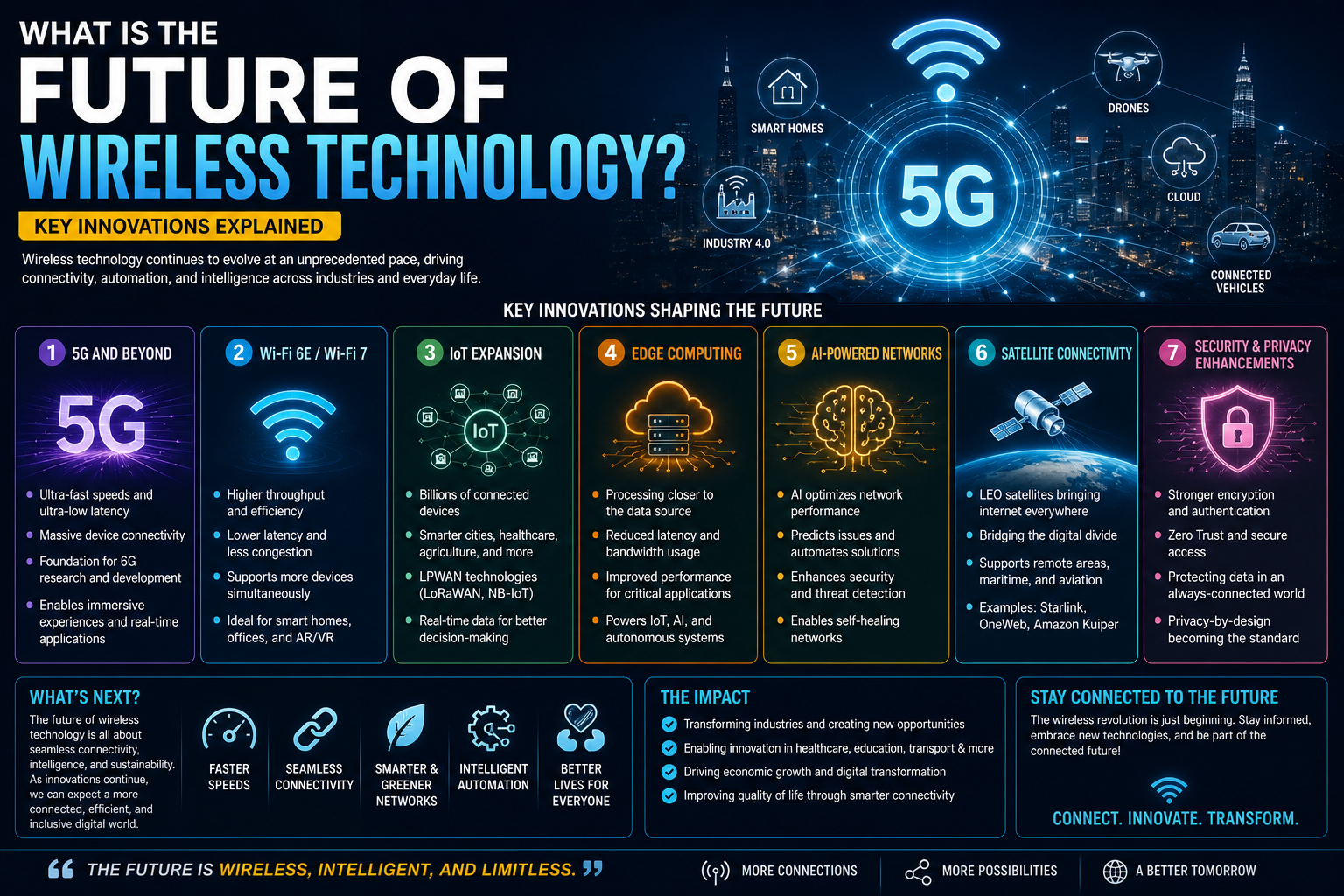
For decades, wired networking has been considered the backbone of reliable communication. Ethernet cables, fiber optics, and structured cabling systems have long provided the stability and speed that businesses depend on. In controlled environments like data centers, wired infrastructure still dominates because it offers predictable latency, high bandwidth, and minimal interference.
However, the world outside those controlled environments is changing rapidly. The demand for mobility, flexibility, and constant connectivity is pushing society toward wireless-first thinking. Devices are no longer fixed to desks or physical locations. Smartphones, tablets, smart home devices, wearable technology, industrial sensors, and autonomous systems all depend on uninterrupted wireless access.
This shift is not just about convenience. It is about necessity. Modern digital ecosystems are built on the expectation that users and machines remain connected at all times, regardless of location. As a result, wireless networks are no longer treated as secondary or backup systems—they are becoming primary infrastructure.
The transition is gradual but undeniable. Even organizations that once insisted on wired-only environments now rely heavily on Wi-Fi for employees, guests, and IoT systems. The growing dependence on cloud computing further accelerates this shift, since access to remote services requires constant, flexible connectivity rather than fixed physical links.
Expanding Capacity: The Race for Higher Bandwidth Wireless Networks
One of the biggest historical limitations of wireless communication has been bandwidth. Wired connections, especially fiber optics, can carry massive amounts of data with extremely low loss. Wireless networks, by contrast, have traditionally struggled with congestion, interference, and limited spectrum availability.
But this gap is narrowing quickly.
Modern wireless technologies, such as advanced 4G LTE and 5G networks, have dramatically increased data capacity. These systems use more efficient encoding methods, higher frequency bands, and smarter signal management to transmit far more data than earlier generations.
A key breakthrough has been the use of higher frequency spectrum, including millimeter-wave bands. These frequencies allow for extremely fast data transfer rates, though they come with shorter range limitations. To compensate, networks deploy dense clusters of small cells rather than relying on a few large towers. This creates a more distributed and efficient system capable of handling high user density.
Another major advancement is carrier aggregation, which allows devices to combine multiple frequency bands into a single, faster connection. This effectively increases available bandwidth without requiring entirely new infrastructure.
In real-world usage, these improvements are already visible. Large public events, stadiums, and urban centers now rely on advanced wireless infrastructure to handle massive traffic loads. While earlier generations of mobile networks would struggle under such pressure, newer systems are designed specifically for high-density environments.
The long-term trajectory points toward even more capable systems, where wireless networks may eventually rival or surpass wired infrastructure in raw throughput.
Ultra-Low Latency and Real-Time Connectivity Demands
Bandwidth is only one part of the wireless evolution. Latency—the time it takes for data to travel from one point to another—is equally important, especially for real-time applications.
In traditional wired systems, latency is already quite low. However, emerging technologies are pushing wireless latency into ranges that make real-time wireless control practical for advanced applications.
This is critical for technologies like autonomous vehicles, remote robotics, augmented reality, virtual reality, and industrial automation. These systems require near-instantaneous feedback. Even a small delay can cause safety issues or performance degradation.
To address this, modern wireless networks are being designed with edge computing integration. Instead of sending all data to distant servers, edge computing processes information closer to the user. This reduces travel distance and significantly improves response time.
For example, in autonomous driving scenarios, a vehicle cannot wait for a distant cloud server to process sensor data. Decisions must be made locally or at a nearby edge node in milliseconds. Wireless networks are evolving to support this decentralized processing model.
Network slicing is another innovation that helps reduce latency. It allows operators to create virtual network segments optimized for specific applications. A low-latency slice can be reserved for critical applications, while another slice handles general internet traffic.
These advancements are transforming wireless networks from simple communication tools into intelligent, responsive systems capable of supporting mission-critical operations.
The Rise of Always-Connected Devices and the Internet of Everything
Wireless connectivity is no longer limited to phones and laptops. The number of connected devices is exploding, driven by the growth of the Internet of Things (IoT).
Smart home systems, industrial sensors, medical devices, transportation systems, and environmental monitoring tools are all becoming interconnected. This shift is moving society toward what is often described as the Internet of Everything.
In this environment, connectivity is not occasional—it is continuous. Devices are expected to communicate constantly, sharing data in real time to improve efficiency, safety, and automation.
For example, smart cities use wireless networks to manage traffic lights, monitor air quality, track energy consumption, and optimize public services. Industrial environments use wireless sensors to monitor machinery health and predict maintenance needs before failures occur.
Healthcare is also transforming. Wearable devices can now track heart rate, oxygen levels, and other vital signs continuously, transmitting data to healthcare providers in real time. This enables remote patient monitoring and faster response to emergencies.
As the number of connected devices grows into the billions, wireless networks must evolve to support massive device density. Future systems are being designed not just for human users, but for machine-to-machine communication at scale.
This introduces new challenges, including efficient spectrum usage, interference management, and secure device authentication. However, it also opens the door to a fully interconnected environment where physical and digital systems operate seamlessly together.
Spectrum Innovation and the Future of Wireless Infrastructure
Wireless communication depends entirely on access to radio frequency spectrum, a limited natural resource. As demand increases, efficient spectrum management becomes one of the most important challenges in the industry.
Historically, spectrum was allocated in relatively large blocks to individual carriers or services. However, this approach is becoming less efficient as network demands grow more complex.
Modern wireless systems are increasingly using dynamic spectrum sharing. This allows multiple services to use the same frequency bands more efficiently by coordinating usage in real time. Instead of static allocation, the spectrum becomes a flexible resource that adapts to demand.
Cognitive radio technology is also emerging as a potential game-changer. These systems can detect unused frequencies and automatically adjust transmission patterns to optimize performance without causing interference.
Another important trend is the use of higher frequency bands, including millimeter-wave and even terahertz research for future systems. These bands offer enormous capacity but require dense infrastructure and advanced signal processing techniques.
To support these changes, wireless infrastructure is becoming more distributed. Instead of relying on a few large towers, networks are moving toward dense deployments of small cells, antennas, and edge nodes integrated into urban environments.
Buildings, streetlights, transportation systems, and public infrastructure may all play a role in hosting wireless equipment. This creates a layered network environment where connectivity is woven into the physical world itself.
The Growing Role of Artificial Intelligence in Wireless Networks
As wireless networks become more complex, manual management becomes increasingly difficult. This is where artificial intelligence begins to play a crucial role.
AI-driven network management systems can analyze massive amounts of data in real time, detecting congestion, predicting failures, and optimizing traffic flow automatically. Instead of relying solely on human engineers, networks can become self-adjusting and self-healing.
For example, if a particular area experiences high traffic demand, AI systems can dynamically allocate additional resources or reroute traffic to reduce congestion. Similarly, if a network node begins to fail, the system can shift load away before users are affected.
Machine learning models can also improve signal quality by analyzing environmental conditions, user behavior, and historical performance data. Over time, networks become more efficient without requiring constant manual tuning.
Security is another area where AI is increasingly important. Wireless networks are frequent targets for cyber threats, and AI-based systems can detect unusual behavior patterns that may indicate attacks or unauthorized access attempts.
As wireless networks continue to expand in scale and complexity, AI will likely become an essential component of their operation, transforming them into intelligent, adaptive systems rather than static infrastructure.
Emerging Wireless Use Cases Reshaping Everyday Life
Beyond infrastructure improvements, wireless connectivity is enabling entirely new categories of applications that were previously impossible.
Augmented reality and virtual reality systems are becoming more practical as latency decreases and bandwidth increases. These technologies require constant data streaming to create immersive experiences without lag or interruption.
Remote work and virtual collaboration tools are also evolving. High-quality video conferencing, real-time document collaboration, and shared virtual environments depend heavily on stable wireless connections.
In transportation, vehicle-to-everything (V2X) communication is emerging, allowing cars to communicate with each other and with infrastructure such as traffic lights and road sensors. This improves safety and lays the foundation for autonomous transportation systems.
In agriculture, wireless sensors are being used to monitor soil conditions, weather patterns, and crop health. This enables precision farming, where resources like water and fertilizer are used more efficiently.
Even entertainment is evolving. Cloud gaming services rely entirely on low-latency wireless connections to stream high-performance games without requiring powerful local hardware.
Each of these use cases increases demand on wireless networks, pushing the technology further and accelerating innovation across the entire ecosystem.
The Evolution From 4G to 5G and Beyond
The transition from 4G to 5G represents one of the most significant leaps in wireless communication history. While 4G LTE made mobile broadband practical for everyday use—enabling streaming, social media, and mobile apps—5G is designed to extend connectivity far beyond human-centered communication.
5G is not simply about faster download speeds. It introduces a fundamental redesign of how wireless networks operate. It focuses on three major pillars: enhanced mobile broadband, ultra-reliable low-latency communication, and massive machine-type communication. Each of these pillars supports different types of modern and future digital demands.
Enhanced mobile broadband improves speed and capacity, allowing users to download large files, stream high-definition content, and use data-heavy applications more efficiently. Ultra-reliable low-latency communication focuses on applications that require near-instant response, such as autonomous systems and remote control technologies. Massive machine-type communication enables billions of connected devices to operate simultaneously with minimal human intervention.
The real transformation lies in how 5G supports diverse use cases simultaneously. Unlike earlier generations of wireless technology that were optimized mainly for voice or data, 5G is designed as a flexible platform that adapts to different needs through network slicing and virtualization.
Even more important is the architectural shift behind the scenes. 5G networks rely heavily on software-defined networking and cloud-native infrastructure. This allows network behavior to be controlled dynamically through software rather than fixed hardware configurations.
As a result, wireless networks are becoming more programmable, scalable, and adaptable than ever before.
The Path Toward 6G and the Next Generation of Connectivity
While 5G is still being deployed globally, research into 6G is already underway. The next generation of wireless communication is expected to emerge in the 2030s, and it aims to push the boundaries of what connectivity can achieve.
6G is expected to focus heavily on extreme performance improvements in speed, latency, and intelligence. Some projections suggest that 6G could achieve data rates that are hundreds of times faster than 5G, along with latency levels approaching near-zero perceptible delay.
However, 6G is not just about speed. It is also about integrating communication with sensing, computation, and artificial intelligence in a unified system. This concept is often referred to as “network intelligence,” where the network itself becomes aware of its environment and can make autonomous decisions.
One of the most discussed features of 6G is the integration of terahertz frequency bands. These extremely high-frequency signals have the potential to carry enormous amounts of data, but they also present major engineering challenges due to limited range and high sensitivity to environmental conditions.
To overcome these limitations, future networks will likely rely on dense infrastructure, including intelligent surfaces, distributed antennas, and advanced signal relays. These systems will work together to maintain stable connections even in complex environments.
Another key direction for 6G is the merging of digital and physical worlds. Technologies like holographic communication, real-time digital twins, and immersive mixed reality experiences will require extremely high data throughput and ultra-low latency.
In this future, wireless networks will no longer just transmit information—they will actively shape digital experiences in real time.
The Expansion of Mesh Networking at a Global Scale
Mesh networking has long been used in localized environments such as enterprise campuses, industrial sites, and emergency response systems. However, its role is expanding rapidly as wireless connectivity becomes more central to everyday life.
A mesh network is a system where each node not only receives data but also forwards it to other nodes. This creates a decentralized architecture that improves coverage, reliability, and resilience.
Unlike traditional networks that rely on centralized towers or access points, mesh networks distribute connectivity responsibilities across many interconnected nodes. This reduces dependency on any single point of failure and allows networks to self-heal when disruptions occur.
At a global scale, mesh networking has the potential to redefine how cities and regions manage connectivity. Instead of relying solely on large telecom infrastructure, future cities may deploy hybrid systems where public infrastructure, private networks, and consumer devices all contribute to connectivity.
For example, streetlights, traffic systems, public vehicles, and even household devices could act as nodes in a broader urban mesh network. This would create a highly dense and resilient communication fabric that adapts dynamically to demand.
One of the most important advantages of mesh networks is scalability. As more nodes are added, the network becomes stronger rather than more fragile. This is fundamentally different from traditional hierarchical networks, where additional load often creates bottlenecks.
However, large-scale mesh deployment also introduces challenges. Routing complexity increases significantly as the number of nodes grows. Efficient algorithms are required to ensure data is transmitted through optimal paths without unnecessary delays.
Security is another concern. With so many interconnected devices, maintaining trust and preventing unauthorized access becomes more complex. Future mesh networks will likely rely on advanced encryption, identity management, and AI-driven monitoring systems to maintain integrity.
Despite these challenges, mesh networking represents one of the most promising directions for achieving truly ubiquitous wireless connectivity.
Smart Cities and Wireless-Driven Urban Infrastructure
As wireless connectivity expands, entire cities are being redesigned around the concept of digital integration. Smart cities rely heavily on wireless communication to connect infrastructure, services, and citizens in real time.
In a smart city environment, traffic systems are no longer static. They adjust dynamically based on real-time traffic flow data collected from sensors and vehicles. Street lighting can adjust brightness depending on pedestrian activity or environmental conditions. Waste management systems can optimize collection routes based on fill levels in containers.
Wireless connectivity is the foundation that enables all of these systems to communicate and coordinate. Without reliable and high-speed networks, smart city functionality would not be possible.
Public safety is another area transformed by wireless integration. Emergency response systems can receive real-time data from multiple sources, including surveillance systems, environmental sensors, and citizen reports. This allows for faster and more informed decision-making during critical situations.
Energy management also benefits significantly. Smart grids use wireless communication to balance electricity supply and demand more efficiently. Homes and businesses can adjust energy usage dynamically based on pricing and availability, reducing waste and improving sustainability.
Transportation systems in smart cities are becoming increasingly autonomous and interconnected. Public transit vehicles communicate with infrastructure to optimize routes, reduce delays, and improve passenger experience.
The long-term vision of smart cities is not just automation, but coordination. Every component of the urban environment becomes part of a larger, interconnected system that continuously adapts to changing conditions.
The Convergence of Wireless and Edge Computing
One of the most important developments shaping the future of wireless connectivity is the integration of edge computing. Instead of relying entirely on centralized cloud data centers, edge computing brings processing power closer to the user.
This shift is essential because modern applications generate massive amounts of data that must be processed quickly. Sending all of this data to distant servers would introduce delays and inefficiencies.
In wireless networks, edge computing is often deployed at base stations, local data centers, or even within devices themselves. This allows critical processing tasks to be handled locally, reducing latency and improving performance.
For example, in augmented reality applications, visual data must be processed in real time to overlay digital information onto the physical world. Any delay would disrupt the user experience. Edge computing ensures that this processing happens close enough to the user to maintain smooth interaction.
Similarly, in industrial environments, machines equipped with sensors generate continuous data streams that must be analyzed instantly. Edge computing allows predictive maintenance systems to detect issues before failures occur.
The combination of wireless connectivity and edge computing creates a distributed intelligence system. Instead of centralizing all computation, intelligence is spread across the network.
This architecture improves scalability, reduces bandwidth consumption, and enhances reliability.
Network Virtualization and Software-Defined Wireless Systems
Traditional wireless networks were built using fixed hardware configurations. Any major change required physical upgrades or manual reconfiguration of equipment. This approach is increasingly inefficient in a world where demand changes rapidly.
Network virtualization is transforming this model by separating network functions from physical hardware. This allows networks to be managed through software, enabling dynamic reconfiguration based on real-time needs.
Software-defined networking (SDN) plays a central role in this transformation. It allows network operators to control traffic flow, allocate resources, and manage connectivity policies through centralized software systems.
In wireless environments, this means that networks can adapt instantly to changing conditions. For example, if a particular area experiences a surge in traffic, additional resources can be allocated automatically without physical intervention.
Virtualization also enables network slicing, where a single physical network can be divided into multiple virtual networks, each optimized for a specific purpose. One slice might prioritize low latency for autonomous vehicles, while another focuses on high bandwidth for media streaming.
This flexibility makes wireless networks far more efficient and responsive than traditional systems.
It also opens the door for new business models, where connectivity can be tailored and sold based on specific performance requirements rather than generic service plans.
Security Challenges in an Always-Connected Wireless World
As wireless connectivity expands, security becomes increasingly critical. A highly connected world creates more opportunities for cyber threats, unauthorized access, and data breaches.
Unlike wired networks, wireless systems broadcast signals through the open air, making them inherently more vulnerable to interception. This requires strong encryption, authentication mechanisms, and continuous monitoring.
The growing number of connected devices also increases the attack surface. Each device represents a potential entry point for malicious actors. In large-scale IoT environments, securing every device becomes a significant challenge.
Another concern is network spoofing, where attackers create fake access points or signals to deceive users and devices. Advanced authentication systems are needed to ensure that devices connect only to legitimate networks.
Artificial intelligence is playing a growing role in cybersecurity. AI systems can detect unusual patterns of behavior, identify potential threats, and respond automatically to mitigate risks.
Quantum computing also introduces future challenges for wireless security. While still emerging, quantum computing could potentially break traditional encryption methods, requiring the development of quantum-resistant security protocols.
In response, researchers are exploring new cryptographic techniques and adaptive security systems that can evolve alongside emerging threats.
Security in wireless networks is not a static problem—it is a continuously evolving challenge that must adapt to technological progress.
The Growing Importance of Energy Efficiency in Wireless Systems
As wireless networks expand globally, energy consumption becomes a major concern. Billions of connected devices, dense infrastructure deployments, and continuous data transmission all contribute to increasing energy demands.
To address this, next-generation wireless systems are being designed with energy efficiency as a core priority. This includes optimizing signal transmission, reducing unnecessary data traffic, and using energy-efficient hardware components.
One approach is adaptive power management, where network components adjust their energy usage based on demand. During periods of low activity, systems can reduce power consumption without affecting performance.
Another strategy involves intelligent sleep modes for devices and network nodes. Instead of operating continuously at full capacity, systems can enter low-power states when not actively transmitting data.
Edge computing also contributes to energy efficiency by reducing the need for long-distance data transmission. Processing data locally requires less energy than sending large volumes of information to centralized servers.
Sustainable wireless infrastructure is becoming increasingly important as global connectivity demands continue to rise. Future networks will likely be judged not only by performance but also by their environmental impact.
Satellite Internet and Closing the Global Connectivity Gap
One of the most significant developments shaping the future of wireless connectivity is the rapid expansion of satellite-based internet systems. For decades, large parts of the world have remained underserved by traditional wired and cellular infrastructure due to geography, cost, and logistical challenges. Rural regions, remote islands, deserts, and mountainous areas often lack reliable broadband access, creating a persistent digital divide.
Satellite internet is changing this landscape by removing the need for extensive ground-based infrastructure. Instead of relying on fiber cables or cellular towers, modern satellite systems use large constellations of low Earth orbit (LEO) satellites to deliver internet connectivity directly to user terminals on the ground.
Unlike older satellite systems that suffered from high latency due to their distance from Earth, LEO satellites operate much closer to the planet’s surface. This significantly reduces communication delays and makes real-time applications more practical. As satellite constellations grow in size, coverage becomes more continuous and reliable, eventually forming a near-global network that can reach virtually any location.
This shift is particularly important for regions where building traditional infrastructure is economically unfeasible. Remote communities, maritime industries, aviation systems, and disaster recovery operations all benefit from satellite-based wireless connectivity.
In emergencies, satellite networks can be deployed rapidly to restore communication when ground infrastructure is damaged. This makes them a critical component of resilient global communication systems.
As satellite technology continues to mature, it is increasingly being integrated with terrestrial wireless systems, creating a hybrid connectivity model that blends space-based and ground-based networks into a unified ecosystem.
The Convergence of Terrestrial and Non-Terrestrial Networks
The future of wireless connectivity is not defined by a single type of infrastructure but by the convergence of multiple systems working together. Terrestrial networks, satellite systems, airborne platforms such as drones, and high-altitude balloons are all becoming interconnected components of a larger communication architecture.
This convergence creates what is often referred to as a multi-layered network environment. In this model, different layers of connectivity operate together to ensure continuous coverage, optimized performance, and adaptive resource allocation.
For example, in densely populated urban areas, terrestrial 5G or future 6G networks handle the majority of traffic due to their high capacity and low latency. In rural or remote regions, satellite networks fill coverage gaps. In between, airborne systems can provide temporary or supplemental connectivity during peak demand or infrastructure outages.
This layered approach significantly improves network resilience. If one layer becomes congested or unavailable, another can compensate dynamically. It also allows service providers to optimize performance based on geographic and environmental conditions.
One of the most important aspects of this convergence is seamless handover between different network types. A user or device moving from an urban environment to a rural area should not experience service interruption when switching from terrestrial to satellite connectivity.
Achieving this level of integration requires advanced orchestration systems capable of managing multiple network types simultaneously. These systems rely heavily on automation and artificial intelligence to ensure smooth transitions and optimal routing decisions.
As this convergence continues to evolve, the distinction between different types of networks will become less visible to end users. Connectivity will be experienced as a continuous utility, regardless of the underlying infrastructure.
The Expansion of the Machine-to-Machine Economy
A major transformation driven by wireless connectivity is the rise of machine-to-machine communication at a massive scale. In this emerging environment, devices no longer depend solely on human interaction to function. Instead, they communicate directly with each other to coordinate actions, exchange data, and make decisions autonomously.
This machine-driven ecosystem forms the foundation of what is often called the machine economy. In this system, devices, sensors, vehicles, and industrial systems operate as independent economic actors that exchange value in the form of data and services.
For example, in a smart logistics network, shipping containers can automatically report their location, temperature, and condition. Delivery vehicles can coordinate routes based on real-time traffic data. Warehouses can adjust inventory levels dynamically based on incoming shipments and demand patterns.
In agriculture, sensors embedded in soil can communicate moisture levels and nutrient conditions directly to irrigation systems, which then adjust water distribution automatically. This reduces waste and increases efficiency without requiring human intervention.
As the number of connected machines grows into the tens of billions, wireless networks must evolve to support extremely high device density. Unlike human users, machines generate continuous streams of small data packets rather than occasional large transfers. This requires networks optimized for efficiency, scalability, and reliability.
The machine economy also introduces new challenges related to security, identity management, and interoperability. Each device must be uniquely identifiable and capable of secure communication within a highly dynamic environment.
Over time, this machine-to-machine ecosystem will become a foundational layer of the global economy, enabling automation on a scale that was previously unimaginable.
AI-Native Wireless Networks and Autonomous Infrastructure
Artificial intelligence is becoming deeply embedded in the design and operation of future wireless networks. Rather than acting as an external optimization tool, AI is evolving into a native component of network architecture.
AI-native wireless networks are capable of self-configuration, self-optimization, and self-repair. These systems continuously analyze network conditions, predict demand patterns, and adjust parameters in real time to maintain optimal performance.
One of the key advantages of AI-driven networks is their ability to manage complexity at scale. As networks grow larger and more dynamic, manual configuration becomes increasingly impractical. AI systems can process vast amounts of data far beyond human capacity and make decisions in milliseconds.
For example, AI can dynamically allocate bandwidth to areas experiencing high demand, reroute traffic around congested nodes, or adjust signal strength based on environmental conditions. It can also predict potential failures in network infrastructure and initiate preventive measures before disruptions occur.
Security is another area where AI plays a critical role. Machine learning models can detect anomalies in network behavior that may indicate cyberattacks, unauthorized access, or system malfunctions. These systems can respond automatically to neutralize threats in real time.
In the future, wireless networks may evolve into fully autonomous systems that require minimal human intervention. Network engineers will shift from manual configuration roles to supervisory and strategic oversight functions, focusing on policy, design, and long-term optimization.
This transformation represents a fundamental shift in how communication infrastructure is managed and maintained.
Private Wireless Networks and Industrial Transformation
Beyond public mobile networks, private wireless systems are becoming increasingly important in industrial environments. These networks are designed for specific organizations, offering dedicated connectivity tailored to operational needs.
Factories, warehouses, ports, and energy facilities are adopting private wireless networks to support automation, robotics, and real-time monitoring systems. These environments require highly reliable, low-latency communication that public networks may not always guarantee.
Private wireless networks provide greater control over performance, security, and data management. Organizations can customize network behavior based on specific applications, ensuring that critical systems always receive priority connectivity.
In manufacturing, wireless connectivity enables smart production lines where machines communicate continuously to optimize workflows. Robots can coordinate tasks dynamically, adjusting production in real time based on demand and resource availability.
In energy sectors, wireless sensors monitor infrastructure such as pipelines, turbines, and electrical grids. This enables predictive maintenance, reducing downtime and improving safety.
Logistics and transportation industries also benefit from private wireless systems. Autonomous vehicles, automated cranes, and inventory tracking systems rely on constant communication to operate efficiently.
As industrial environments become more digitized, private wireless networks will play a central role in enabling the next generation of smart infrastructure.
Wireless Connectivity in Healthcare and Biomedical Systems
Healthcare is undergoing a major transformation driven by wireless communication technologies. The ability to transmit medical data in real time is reshaping diagnostics, treatment, and patient monitoring.
Wearable devices and implanted sensors now allow continuous tracking of vital signs such as heart rate, blood pressure, glucose levels, and oxygen saturation. This data can be transmitted wirelessly to healthcare providers, enabling early detection of potential health issues.
Remote patient monitoring has become particularly valuable for managing chronic conditions. Patients no longer need to remain in hospitals for extended periods, as their health can be tracked continuously from home.
Wireless connectivity also supports telemedicine services, allowing patients to consult with doctors remotely through high-quality video communication systems. This improves access to healthcare in underserved regions and reduces the burden on medical facilities.
In surgical environments, wireless robotics and imaging systems enable minimally invasive procedures with high precision. Surgeons can operate advanced robotic tools with real-time feedback, improving outcomes and reducing recovery times.
In the future, healthcare systems may become fully integrated wireless ecosystems where patient data flows seamlessly between devices, hospitals, and AI-driven diagnostic systems.
This level of connectivity has the potential to significantly improve healthcare efficiency, accessibility, and personalization.
Immersive Digital Experiences and the Expansion of Extended Reality
Wireless connectivity is also driving the growth of immersive technologies such as augmented reality, virtual reality, and mixed reality. These technologies rely heavily on high bandwidth and ultra-low latency to deliver seamless experiences.
Extended reality applications are expanding beyond entertainment into education, training, engineering, and remote collaboration. Users can interact with digital environments that overlay or replicate the physical world in real time.
For example, engineers can use augmented reality to visualize complex machinery during maintenance. Students can explore interactive virtual classrooms that simulate real-world environments. Remote teams can collaborate in shared virtual spaces as if they were physically present together.
The effectiveness of these systems depends heavily on wireless network performance. Any delay or interruption can break immersion and reduce usability. As a result, future wireless networks are being designed specifically to support immersive data transmission.
Edge computing plays a key role in enabling these experiences by processing visual and sensory data close to the user. This reduces latency and ensures smooth interaction.
As immersive technologies continue to evolve, they will become deeply integrated into everyday communication, work, and entertainment systems.
Societal Transformation Driven by Ubiquitous Connectivity
The widespread adoption of advanced wireless connectivity is reshaping society in profound ways. Communication is becoming continuous, instantaneous, and location-independent.
Work patterns are evolving as remote and hybrid environments become standard. Education systems are increasingly digital, allowing learning to take place anywhere. Entertainment is shifting toward interactive and on-demand experiences.
At the same time, access to connectivity is becoming a fundamental requirement for participation in modern economic and social systems. This raises important questions about digital inclusion and equitable access.
As wireless networks expand globally, the expectation is that connectivity will become as essential as traditional utilities such as electricity and water. However, ensuring fair distribution of this resource remains a complex challenge.
Economic structures are also being transformed. Industries are becoming more automated, data-driven, and interconnected. New business models are emerging based on real-time data exchange and machine collaboration.
Wireless connectivity is no longer just a technological feature. It is becoming a foundational layer of modern civilization, influencing how people live, work, and interact with the world around them.
Conclusion
Wireless connectivity has moved far beyond its early role as a convenience for mobile communication. It has become a foundational layer of modern life, quietly shaping how societies function, how economies grow, and how individuals interact with technology every day. Looking at its trajectory from early radio signals to today’s dense 5G ecosystems—and toward future 6G, satellite integration, and AI-driven networks—it becomes clear that wireless communication is not simply evolving. It is fundamentally redefining what “connection” means in the digital age.
At its core, the future of wireless connectivity is about removing friction. Every generation of wireless technology has reduced the barriers between people, devices, and information. What once required physical presence, wired infrastructure, or localized systems is now accessible instantly and globally. This trend is accelerating, not slowing down. The expectation of always-on connectivity is no longer a luxury; it is becoming the default condition of modern systems.
One of the most important shifts driving this transformation is the move from human-centered communication to machine-centered communication. In earlier eras, networks were designed primarily for voice calls, text messages, and human-driven internet use. Today, however, the majority of network traffic is increasingly generated by machines—sensors, automated systems, vehicles, and cloud-connected devices. This machine-to-machine communication creates an entirely new scale of demand, where billions of devices must interact simultaneously with minimal delay and maximum reliability.
As a result, wireless networks are evolving into highly intelligent, adaptive ecosystems. They are no longer static systems built solely on hardware infrastructure. Instead, they are becoming software-defined, AI-managed platforms capable of self-optimization and dynamic resource allocation. This shift allows networks to respond in real time to changing conditions, whether that means rerouting traffic during congestion, adjusting power consumption for efficiency, or detecting and neutralizing security threats automatically.
Another defining element of the future is convergence. Wireless connectivity is no longer confined to a single type of infrastructure or technology. Instead, multiple systems—terrestrial cellular networks, Wi-Fi, satellite constellations, edge computing nodes, and even airborne platforms—are merging into a unified communication fabric. This layered architecture ensures that connectivity is no longer dependent on one point of failure or one type of deployment. It creates resilience, adaptability, and near-global coverage.
This convergence also plays a critical role in bridging the digital divide. For many regions around the world, traditional wired infrastructure remains difficult or economically unfeasible to deploy. Wireless systems, especially satellite-based networks and expanding cellular coverage, offer a pathway to universal connectivity. While challenges still exist in affordability, accessibility, and regulatory frameworks, the direction of progress is toward broader inclusion rather than exclusivity.
In parallel, wireless connectivity is becoming deeply embedded in physical environments. Smart cities, intelligent transportation systems, automated industries, and connected healthcare systems all depend on continuous data exchange. Streets, buildings, vehicles, and infrastructure are no longer passive components of the environment—they are active participants in digital networks. This blending of physical and digital systems creates a world where information flows continuously between objects, systems, and people.
However, this level of integration also introduces complexity. Security, privacy, and reliability become more critical than ever before. A highly connected world expands the number of potential vulnerabilities, requiring advanced protection strategies. Encryption, authentication, AI-driven monitoring, and quantum-resistant security methods are all becoming essential components of next-generation wireless systems. Trust becomes just as important as speed or coverage in determining the success of a network.
Energy efficiency is another crucial consideration shaping the future. As the number of connected devices grows into the tens of billions, the energy required to maintain continuous connectivity becomes significant. Future wireless systems must balance performance with sustainability. This includes smarter power management, more efficient signal processing, and network designs that reduce unnecessary data transmission. Sustainability is no longer an optional feature—it is a core design requirement.
At the same time, wireless technology is unlocking entirely new categories of human experience. Immersive environments powered by augmented reality, virtual reality, and mixed reality depend on ultra-fast, low-latency networks. These technologies are changing how people learn, work, collaborate, and entertain themselves. They create digital experiences that blend seamlessly with physical reality, making connectivity feel less like a tool and more like an extension of perception itself.
In healthcare, wireless systems are enabling continuous patient monitoring, remote diagnostics, and real-time medical interventions. In transportation, they are laying the groundwork for autonomous mobility and coordinated traffic systems. In the industry, they are driving automation, predictive maintenance, and smart manufacturing. In every domain, wireless connectivity is not just improving efficiency—it is enabling capabilities that were previously impossible.
Perhaps the most important long-term shift is cultural and societal. Connectivity is becoming as fundamental as electricity or clean water. It influences education, employment, communication, governance, and even social identity. The expectation of being connected at all times is reshaping human behavior and redefining what it means to participate in modern society.