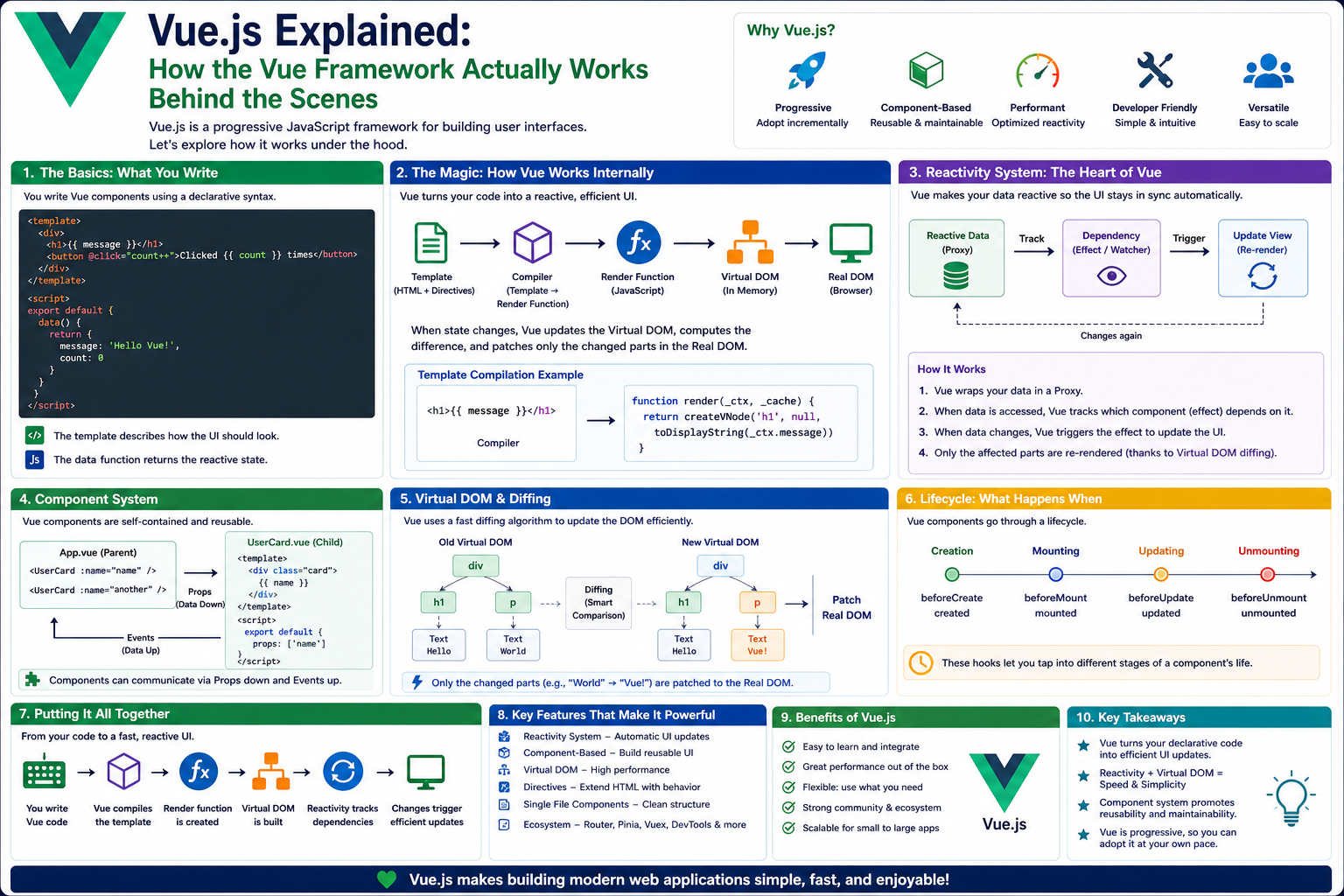
Vue.js has become one of the most widely adopted JavaScript frameworks in modern web development due to its simplicity, adaptability, and efficiency in building interactive applications. It is designed to help developers create user interfaces and single-page applications in a structured yet flexible way. Unlike traditional approaches that require extensive manual manipulation of web pages, Vue.js introduces a system where changes in data automatically reflect in the user interface. This makes application development faster, more organized, and easier to maintain.
At its core, Vue.js is not just a tool for building web pages but a complete ecosystem that supports scalable application development. It provides developers with a structured way to organize code while still allowing freedom in how applications are built. This balance between structure and flexibility is one of the key reasons it has become so popular in both small projects and large-scale enterprise systems.
The design philosophy of Vue.js is centered around gradual adoption. This means developers do not need to commit to the entire framework at once. Instead, they can start by using Vue in a small part of an existing project and gradually expand its usage as needed. This makes it especially useful in environments where rewriting an entire application is not practical or desirable.
The Meaning of a Progressive JavaScript Framework
The term “progressive” in Vue.js refers to its ability to scale with the needs of a project. Unlike rigid frameworks that require full architectural adoption, Vue is designed to be incrementally adoptable. This means developers can begin with basic functionality and progressively introduce more advanced features as their application grows.
In practical terms, this progressive nature allows Vue.js to be used in a wide variety of scenarios. For example, it can power a small interactive widget on a webpage or serve as the foundation for a complex single-page application. This flexibility ensures that developers are not forced into a one-size-fits-all structure.
Another important aspect of this progressive approach is that Vue.js does not assume anything about the rest of the technology stack. It can work alongside other libraries or frameworks without conflict. This makes it an excellent choice for projects that are already in development and need enhancement rather than replacement.
The progressive model also reduces the learning curve for new developers. Instead of requiring mastery of all concepts before building something useful, Vue allows gradual learning. Developers can start with basic data binding and component usage before moving on to more advanced topics like state management and routing.
Core Architecture and Design Philosophy of Vue.js
Vue.js is built around a few key architectural principles that define how it works internally. The most important of these principles are reactivity, component-based structure, and declarative rendering. Together, these concepts form the foundation of how Vue applications behave.
Reactivity is the system that allows Vue to automatically update the user interface when data changes. Instead of manually modifying the document structure, developers define relationships between data and the interface. Vue then takes care of updating only the necessary parts of the page when changes occur.
The component-based structure divides applications into smaller, reusable units. Each component contains its own logic, structure, and styling. This separation makes applications easier to manage and scale, especially when multiple developers are working on the same project.
Declarative rendering allows developers to describe what the interface should look like based on the current state of the data. Instead of writing step-by-step instructions for updating the interface, developers define the desired outcome, and Vue handles the process of keeping everything in sync.
These architectural principles work together to create a system that is both efficient and predictable. By abstracting away direct manipulation of the document structure, Vue reduces complexity and minimizes the risk of errors.
Understanding Single-Page Applications in Vue.js
Single-page applications represent a major shift in how modern web applications are built and experienced. Instead of loading a new page from the server every time a user interacts with the application, a single-page application loads once and dynamically updates content as needed.
Vue.js is particularly well-suited for building this type of application. When a Vue application loads, it initializes the necessary components and establishes a reactive system that manages updates internally. After the initial load, navigation and content changes happen without requiring full page reloads.
This approach significantly improves user experience. Pages feel faster because only the necessary parts of the interface are updated. There is no visible page refresh, which creates a smoother and more app-like interaction.
The efficiency of single-page applications also comes from reduced server communication. Instead of requesting entire pages from the server, the application only requests data when necessary. This reduces bandwidth usage and improves performance, especially on slower connections.
Vue.js manages this process through internal routing and state management systems. These systems determine what should be displayed based on user interaction and application state, ensuring that the correct components are rendered at the right time.
The Reactivity System and How It Powers Vue.js
One of the most important features of Vue.js is its reactivity system. This system is responsible for tracking changes in data and automatically updating the user interface when those changes occur. It eliminates the need for manual updates and ensures that the interface always reflects the current state of the application.
When a component is created in Vue.js, the framework converts its data into reactive properties. These properties are monitored so that any change can be detected instantly. When a change is detected, Vue determines which parts of the interface depend on that data and updates only those sections.
This targeted updating process is highly efficient. Instead of re-rendering the entire page, Vue focuses only on the affected components. This reduces unnecessary processing and improves overall performance.
The reactivity system also simplifies development. Developers do not need to write additional logic to keep the interface in sync with the data. Once the relationship between data and interface is defined, Vue handles the rest automatically.
This system is particularly powerful in applications where data changes frequently, such as dashboards, messaging platforms, or real-time analytics tools. In these environments, maintaining synchronization manually would be complex and error-prone, but Vue’s reactivity system handles it seamlessly.
Component-Based Architecture and Reusability
Vue.js organizes applications into components, which are independent building blocks that encapsulate structure, behavior, and styling. Each component is designed to handle a specific part of the user interface, making applications easier to manage and understand.
This modular approach allows developers to break down complex interfaces into smaller, more manageable pieces. Instead of working with a single large codebase, developers work with multiple components that can be developed and tested independently.
Components also promote reusability. Once a component is created, it can be used in multiple parts of an application or even in different projects. This reduces duplication of effort and ensures consistency across the application.
Another advantage of component-based architecture is improved collaboration. In team environments, different developers can work on separate components without interfering with each other’s work. This parallel development process increases efficiency and reduces development time.
Each component in Vue.js is self-contained, meaning it includes its own logic, structure, and styling. This encapsulation prevents unintended interactions between different parts of the application and makes debugging easier.
Template System and Declarative Interface Design
Vue.js uses a template-based system to define how the user interface should appear. These templates are built using standard HTML enhanced with special directives that add dynamic behavior.
This approach allows developers to describe the structure of the interface in a way that is both readable and expressive. Instead of manually manipulating elements, developers define what the interface should look like based on the current state of the data.
Templates support conditional rendering, loops, and data binding. These features allow developers to create dynamic interfaces that respond to changes in real time.
The template system is closely tied to Vue’s reactivity engine. When data changes, the template is automatically re-evaluated, and only the necessary parts of the interface are updated. This ensures consistency between the data and the displayed content.
By combining HTML-like syntax with dynamic behavior, Vue templates strike a balance between familiarity and functionality. Developers who already understand HTML can quickly adapt to Vue’s template system without needing to learn an entirely new language.
Data Flow, State Management, and Application Structure
In Vue.js applications, data flow plays a crucial role in maintaining consistency across components. Data can be passed between components using structured mechanisms that ensure predictable behavior.
Parent components can pass data to child components, allowing information to flow downward through the component hierarchy. This ensures that child components remain synchronized with the overall application state.
For more complex applications, centralized state management is often used. This involves storing shared data in a central location so that multiple components can access and modify it consistently. This approach helps prevent inconsistencies and makes it easier to track changes in application state.
Vue’s approach to data flow emphasizes clarity and predictability. Instead of allowing uncontrolled data modifications, it encourages structured patterns that make the application easier to understand and debug.
Flexibility and Integration with Existing Systems
One of the strongest advantages of Vue.js is its ability to integrate seamlessly with existing projects. It does not require a complete rewrite of an application. Instead, it can be introduced gradually into specific parts of a system.
This makes Vue particularly valuable in real-world development environments where legacy systems are common. Developers can enhance existing applications with Vue components without disrupting current functionality.
Vue also works well with other libraries and tools commonly used in web development. This compatibility ensures that developers are not locked into a specific ecosystem and can choose tools based on project requirements.
Performance Optimization and Efficient Rendering
Performance is a key consideration in Vue.js design. The framework is built to minimize unnecessary updates and ensure that applications remain fast and responsive.
Instead of re-rendering entire pages when changes occur, Vue calculates the smallest possible set of updates needed. This reduces computational overhead and improves rendering efficiency.
The virtual representation of the document structure plays an important role in this optimization. By comparing changes in a virtual model before applying them to the actual interface, Vue ensures that only necessary updates are executed.
This approach is especially beneficial in applications with frequent data changes, as it prevents performance degradation over time.
Developer Experience and Ease of Use
Vue.js places a strong emphasis on developer experience. The framework is designed to be intuitive, allowing developers to focus on building features rather than managing complex configurations.
Its structure encourages clarity and organization, making it easier to understand how different parts of an application work together. This reduces cognitive load and helps developers maintain productivity.
The gradual learning curve also contributes to a positive developer experience. Beginners can start with simple concepts and gradually move to more advanced features as their understanding grows.
Vue’s design philosophy prioritizes simplicity without sacrificing power. This balance ensures that developers can build both small and large applications efficiently without unnecessary complexity.
Deep Dive into Vue Reactivity System Internals
One of the most powerful aspects of Vue.js lies in its reactivity system, which forms the backbone of how applications respond to changes in data. At a deeper level, this system is not simply about updating the user interface when data changes; it is about creating a structured relationship between data sources and the parts of the application that depend on them. This relationship is established during the initialization of a component, where Vue analyzes the data properties and converts them into reactive entities.
These reactive entities are designed to observe usage patterns within the application. When a property is accessed during rendering, Vue records that interaction as a dependency. This means that the framework builds a map of relationships between data and interface elements without requiring developers to define those relationships manually. As a result, the system becomes self-aware of which parts of the interface depend on which pieces of data.
This internal structure allows Vue to efficiently manage updates. Instead of re-evaluating the entire application when a single value changes, Vue focuses only on the components that are directly connected to that value. This targeted approach significantly reduces computational overhead and ensures that performance remains stable even in large-scale applications.
The reactivity system is also designed to be transparent from the developer’s perspective. Developers do not need to interact with the underlying mechanisms directly. Instead, they work with plain data structures, while Vue handles observation and update propagation internally.
Dependency Tracking and Change Detection Mechanism
Closely connected to reactivity is the dependency tracking system, which plays a crucial role in ensuring that updates are both accurate and efficient. When a component renders for the first time, Vue identifies every piece of data used in that rendering process. These data points are then registered as dependencies for that specific component.
Once dependencies are established, Vue continuously monitors them for changes. When a value is modified, the system determines which components rely on that value and marks them for update. This ensures that only relevant parts of the application are refreshed.
The change detection mechanism is designed to be highly optimized. Instead of continuously scanning all data properties, Vue uses a structured observation model that reacts only when changes occur. This event-driven approach reduces unnecessary processing and contributes to overall performance efficiency.
Another important aspect of this system is its ability to batch updates. When multiple changes occur within a short time frame, Vue groups them together and processes them in a single update cycle. This prevents redundant rendering and improves responsiveness.
Virtual DOM and Efficient Rendering Strategy
Vue.js uses a virtual representation of the document structure to manage updates efficiently. This virtual model acts as an intermediary layer between the application’s state and the actual user interface. Instead of directly manipulating the real document structure every time a change occurs, Vue first updates the virtual representation.
Once the virtual structure is updated, Vue compares it with the previous version to identify differences. This process is known as reconciliation. After identifying the differences, Vue applies only the necessary changes to the actual interface.
This strategy significantly reduces the number of direct manipulations performed on the document structure, which is often one of the most performance-intensive operations in web development. By minimizing these operations, Vue ensures smoother and faster updates.
The virtual model also allows Vue to maintain consistency across complex interfaces. Even when multiple components are updated simultaneously, the system ensures that changes are applied in the correct order without conflicts.
Component Lifecycle Stages Explained in Depth
Every component in Vue.js goes through a series of lifecycle stages from creation to destruction. These stages define how and when certain operations are executed within a component.
The lifecycle begins with initialization, where the component is created and its data properties are set up. During this stage, Vue prepares the component for rendering but does not yet attach it to the interface.
The next stage involves mounting, where the component is inserted into the user interface. At this point, rendering occurs, and the component becomes visible to the user.
After mounting, the component enters an active state where it responds to changes in data and user interaction. During this phase, updates are continuously managed through the reactivity system.
Eventually, components may need to be removed from the interface. During the destruction stage, Vue cleans up resources associated with the component, ensuring that memory is freed and no unnecessary processes continue running.
Understanding these lifecycle stages is important because they provide structured points where developers can introduce logic such as data fetching, event handling, or cleanup operations.
Communication Between Components and Data Flow Patterns
In complex applications, multiple components often need to interact with each other. Vue.js provides structured patterns for managing this communication while maintaining clarity and predictability.
The most common method of communication is through a parent-child relationship. Parent components pass data to child components through structured properties, ensuring that information flows in a controlled direction. This prevents unpredictable changes and maintains consistency across the application.
Child components can communicate back to parent components through events. When a specific action occurs within a child component, it can trigger an event that the parent listens for and responds to accordingly.
In larger applications, more advanced communication patterns may be used to avoid excessive nesting and data passing. These patterns help maintain scalability by reducing dependency complexity between components.
The overall goal of these communication methods is to ensure that data flow remains predictable, traceable, and easy to manage even as applications grow in size.
Directives and Template Compilation Process
Vue.js templates are enhanced with special directives that extend the functionality of standard HTML. These directives allow developers to introduce dynamic behavior directly within the markup.
During the compilation process, Vue transforms templates into optimized render functions. This transformation allows the framework to interpret the structure of the interface more efficiently during runtime.
Directives are evaluated during this compilation phase and translated into instructions that control how the interface behaves. This includes conditional rendering, list iteration, and data binding.
The compilation process ensures that templates are not interpreted repeatedly during runtime. Instead, they are converted into optimized structures that Vue can execute efficiently.
This approach improves performance and ensures that dynamic behavior is handled in a structured and predictable way.
Computed Properties and Watchers Behavior
Vue.js provides specialized mechanisms for handling derived data and monitoring changes in application state. Computed properties are used to calculate values based on existing data, while watchers are used to observe changes and execute custom logic.
Computed properties are cached based on their dependencies. This means that they are only recalculated when their underlying data changes. This caching mechanism improves efficiency by avoiding unnecessary recalculations.
Watchers, on the other hand, provide a way to execute logic when specific data changes. Unlike computed properties, watchers are not designed to return values but to perform actions in response to changes.
Together, these features provide developers with fine-grained control over how data is processed and reacted to within the application.
Event Handling and User Interaction Model
User interaction is a central part of any web application, and Vue.js provides a structured system for handling events. Events represent user actions such as clicks, input changes, or form submissions.
Vue allows developers to attach event handlers directly within templates, creating a clear relationship between user actions and application logic. When an event occurs, the associated method is executed, allowing the application to respond immediately.
This event-driven model ensures that user interactions are handled in a predictable and organized way. It also integrates seamlessly with the reactivity system, allowing changes triggered by events to automatically update the interface.
Routing System in Single Page Architecture
In single-page applications, navigation between different views does not require full page reloads. Instead, Vue.js uses a routing system that manages transitions between different components.
This system maps specific paths to components, allowing the application to display different views based on the current route. When a user navigates within the application, the router determines which component should be displayed and updates the interface accordingly.
This approach maintains the speed and efficiency of single-page applications while providing a structured navigation experience similar to traditional multi-page websites.
State Management and Centralized Data Handling
As applications grow, managing data across multiple components becomes more complex. Vue.js addresses this challenge through centralized state management, which allows shared data to be stored in a single location.
This centralized structure ensures that all components have consistent access to shared data. Instead of passing data through multiple layers of components, the application can directly access and modify the central state.
This approach improves maintainability and reduces the risk of inconsistencies. It also makes it easier to track changes in application state, as all modifications are handled in a single structured system.
Asynchronous Updates and Rendering Queue
Vue.js handles updates asynchronously to improve performance and avoid unnecessary re-rendering. When multiple changes occur, they are placed into a queue rather than being processed immediately.
This queue is then processed in batches during the next update cycle. This ensures that multiple changes are handled efficiently and reduces redundant rendering operations.
Asynchronous processing also improves responsiveness by preventing the application from becoming blocked during intensive update operations.
Performance Optimization Techniques in Vue Applications
Performance optimization in Vue.js is achieved through a combination of internal mechanisms and developer practices. The framework itself minimizes unnecessary updates through its reactivity and virtual rendering systems.
Developers can further optimize performance by structuring components efficiently, avoiding unnecessary data complexity, and leveraging caching mechanisms such as computed properties.
Efficient use of components and state management also plays a significant role in maintaining performance as applications scale.
Project Structure and Scalability Practices
Organizing a Vue.js project effectively is essential for long-term maintainability. Applications are typically structured into modular components, each responsible for a specific part of the interface.
This modular structure allows developers to scale applications without creating unnecessary complexity. As new features are added, they can be integrated into existing structures without disrupting the overall architecture.
Clear separation of concerns between components, logic, and styling ensures that projects remain manageable even as they grow.
Tooling Ecosystem and Build Process Overview
Vue.js is supported by a robust ecosystem of development tools that streamline the build and deployment process. These tools handle tasks such as code compilation, optimization, and bundling.
During the build process, application code is transformed into optimized assets that can be efficiently delivered to users. This includes minimizing file sizes and improving load times.
The tooling ecosystem also supports development workflows, enabling features such as hot updates and real-time feedback during development.
Advanced Vue.js Architecture and Real-World Application Design
As Vue.js applications grow beyond small projects, their architecture becomes increasingly important. At this stage, developers must think not only about how individual components work but also about how the entire system is structured, maintained, and scaled over time. Vue.js supports this transition by offering a flexible architecture that can evolve from simple setups into highly organized, enterprise-level systems.
In real-world applications, Vue is often used to manage complex user interfaces that require consistent performance and predictable behavior. These applications may include dashboards, content management systems, e-commerce platforms, or interactive tools. Regardless of the use case, the underlying architectural principles remain focused on modularity, reusability, and maintainability.
A key strength of Vue.js in large-scale systems is its ability to separate concerns clearly. The interface layer is divided into components, business logic is managed through structured patterns, and data flow is handled in a controlled manner. This separation ensures that changes in one part of the system do not unintentionally affect other parts.
Another important aspect of advanced architecture in Vue applications is scalability. As applications expand, new features must be added without disrupting existing functionality. Vue supports this by allowing components to be developed independently and integrated gradually into the system.
Scaling Component Systems in Large Applications
Component-based architecture becomes even more critical in large applications where multiple teams may be working simultaneously. Each component acts as an independent unit that encapsulates its own structure, behavior, and styling. This encapsulation ensures that components remain isolated and reusable across different parts of the application.
In advanced systems, components are often organized into hierarchical structures. Smaller components are combined to form larger, more complex interfaces. This hierarchical design allows developers to break down even the most complex user interfaces into manageable pieces.
As applications scale, maintaining consistency across components becomes essential. Design patterns and naming conventions are often introduced to ensure that components follow a predictable structure. This improves collaboration among developers and reduces confusion when navigating large codebases.
Component reuse also becomes a major efficiency factor. Instead of rewriting similar functionality multiple times, developers can reuse existing components and extend them where necessary. This reduces development time and ensures consistency in user experience.
Advanced State Management Patterns and Data Flow Control
In large Vue.js applications, managing data across multiple components becomes increasingly complex. While basic parent-child communication is sufficient for small projects, larger systems require more structured approaches to state management.
Centralized state management provides a single source of truth for shared data. This ensures that all components access consistent information, regardless of where they are located in the application hierarchy. When data changes in one part of the system, those changes are automatically reflected wherever the data is used.
This centralized approach eliminates many of the problems associated with scattered or duplicated data. It also simplifies debugging, as developers can trace changes through a single controlled system rather than multiple independent sources.
In addition to centralized storage, advanced state management introduces structured mutation patterns. These patterns ensure that data changes occur in predictable ways. Instead of allowing direct modification from anywhere in the application, changes follow defined rules that maintain consistency.
As applications grow, state management systems may also introduce modular organization. This means that different parts of the state are grouped into logical sections, making it easier to manage large datasets and complex interactions.
Complex Data Flow Strategies in Enterprise Systems
Data flow in large Vue applications is not always linear. Instead, it often involves multiple layers of interaction between components, services, and state systems. Managing this complexity requires careful planning and structured design patterns.
One common approach is to separate data flow into distinct layers. The presentation layer handles user interface components, the logic layer processes application behavior, and the data layer manages storage and retrieval. This separation ensures that each layer has a clear responsibility.
In more advanced systems, data flow may also include asynchronous operations such as API calls. These operations introduce additional complexity because data is not immediately available. Vue handles this through structured patterns that allow components to react to data once it becomes available.
Error handling is also an important part of complex data flow systems. When data fails to load or becomes inconsistent, the application must handle these situations gracefully without breaking the user experience. Structured error management ensures that applications remain stable even under unexpected conditions.
Advanced Reactivity Patterns in Large Applications
While the basic reactivity system in Vue.js is straightforward, advanced applications often require more complex reactivity patterns. These patterns are designed to handle large datasets, deeply nested structures, and high-frequency updates.
One important concept in advanced reactivity is fine-grained observation. Instead of tracking entire objects, Vue can track individual properties within those objects. This allows for more precise updates and reduces unnecessary processing.
Another advanced pattern involves computed relationships between multiple data sources. In complex systems, data is often derived from several different inputs. Vue allows developers to define these relationships in a way that ensures consistent updates when any of the underlying data changes.
Reactivity also plays a key role in performance optimization. By minimizing unnecessary updates and focusing only on changed dependencies, Vue ensures that even large applications remain responsive.
Performance Optimization in Large-Scale Vue Applications
As applications grow, performance becomes a critical concern. Vue.js provides several built-in mechanisms to ensure that applications remain efficient even under heavy load.
One of the most important optimization techniques is lazy loading. Instead of loading all components at once, the application loads only the components that are needed at a given time. This reduces initial load time and improves user experience.
Another important technique is code splitting. This involves dividing the application into smaller bundles that can be loaded independently. By splitting code into logical sections, Vue reduces the amount of data that needs to be loaded at once.
Caching also plays a significant role in performance optimization. Frequently used data can be stored temporarily to avoid repeated calculations or network requests. This reduces processing time and improves responsiveness.
Vue’s virtual rendering system also contributes to performance efficiency. By minimizing direct changes to the document structure, the framework ensures that updates are applied in the most efficient way possible.
Advanced Routing Techniques and Navigation Structures
In complex single-page applications, routing becomes more than just navigation between pages. It becomes a structured system for managing application views, permissions, and dynamic content.
Advanced routing systems allow for nested routes, where multiple layers of views are displayed within a single interface. This is particularly useful in applications with dashboards or multi-section layouts.
Dynamic routing is another important feature. It allows routes to be generated based on data, enabling flexible navigation structures that adapt to user input or application state.
Route guards add an additional layer of control by allowing developers to restrict access to certain parts of the application. This is often used in authentication systems where users must meet specific conditions before accessing certain views.
Asynchronous Data Handling and API Integration
Modern Vue applications frequently rely on external data sources. This introduces asynchronous behavior, where data is not immediately available and must be fetched from external systems.
Vue handles asynchronous operations through structured patterns that allow components to respond to data once it is received. This ensures that the interface remains responsive even when waiting for external resources.
API integration is a common use case for asynchronous behavior. Applications may request data from servers, process it, and display it dynamically within the interface.
Handling asynchronous data requires careful management of loading states and error conditions. Vue applications often include mechanisms to indicate when data is being loaded or when an error has occurred.
Component Communication in Complex Hierarchies
As applications become more complex, component communication patterns must evolve. Direct parent-child communication may no longer be sufficient when components are deeply nested or widely distributed.
In such cases, alternative communication strategies are used. These include event-based communication systems, shared state management, and centralized data stores.
Event-based communication allows components to emit signals that other components can respond to. This decouples components and reduces dependencies between them.
Shared state systems provide a centralized location for data that needs to be accessed by multiple components. This ensures consistency and reduces duplication.
Modularity and Code Organization in Large Projects
Maintaining a clear structure in large Vue applications is essential for long-term maintainability. Modularity ensures that each part of the application has a well-defined responsibility.
Code is typically organized into directories based on functionality. Components, services, utilities, and state management systems are separated into distinct sections.
This organization makes it easier for developers to navigate the codebase and locate specific functionality. It also improves collaboration by reducing conflicts between different parts of the system.
Modularity also supports scalability. As new features are added, they can be integrated into the existing structure without disrupting other parts of the application.
Error Handling and Application Stability
In complex applications, errors are inevitable. Vue.js provides structured mechanisms for handling errors and maintaining application stability.
Error handling can occur at multiple levels, including component-level error detection and global error management systems. This ensures that unexpected issues do not break the entire application.
Graceful degradation is an important principle in error handling. Instead of allowing the application to fail completely, Vue applications are designed to recover or display fallback content when errors occur.
Logging and monitoring systems are often integrated to track errors and identify patterns that may indicate underlying issues.
Security Considerations in Vue.js Applications
Security is an important aspect of any web application. Vue.js applications must be designed with proper safeguards to prevent vulnerabilities such as unauthorized access or data manipulation.
One key principle is input validation. All user input must be validated before being processed or stored. This prevents malicious data from affecting application behavior.
Another important consideration is data sanitization. Any data displayed in the user interface must be properly sanitized to prevent injection attacks.
Authentication and authorization systems are often integrated into Vue applications to control access to sensitive features and data.
Real-World Application Patterns and Design Strategies
In real-world scenarios, Vue.js applications often follow established design patterns to ensure maintainability and scalability. These patterns provide structured approaches to solving common development challenges.
One common pattern involves separating presentation logic from business logic. This ensures that user interface components remain focused on display, while application logic is handled separately.
Another pattern involves modular service layers that handle data retrieval, processing, and transformation. This separation ensures that components remain lightweight and focused on user interaction.
Long-Term Maintenance and Application Evolution
As applications evolve over time, maintaining structure and consistency becomes increasingly important. Vue.js supports long-term maintenance through its modular architecture and clear separation of concerns.
Applications built with Vue can be incrementally updated without requiring complete rewrites. This makes it easier to introduce new features or refactor existing systems.
Documentation and consistent coding practices also play an important role in long-term maintenance. Well-structured applications are easier to understand, extend, and debug over time.
Developer Workflow and Project Lifecycle in Vue Applications
The development lifecycle of a Vue application typically includes planning, development, testing, and deployment stages. Each stage requires careful coordination to ensure application quality.
During development, components are created and integrated into the system. Testing ensures that components function correctly and interact properly with other parts of the application.
Deployment involves packaging the application into optimized assets that can be delivered to users efficiently. Continuous improvement ensures that the application remains up to date with evolving requirements.
Conclusion
Vue.js stands out in the modern web development landscape as a framework that successfully balances simplicity with powerful functionality. Its design is built around the idea that developers should be able to create responsive, dynamic applications without being overwhelmed by unnecessary complexity. This philosophy is reflected in every aspect of how Vue works—from its reactive data system to its component-based architecture and flexible integration capabilities.
One of the most important takeaways from understanding Vue.js is how naturally it fits into different stages of development. Whether a developer is enhancing a small feature on an existing website or building a full-scale single-page application, Vue can adapt to the situation without requiring major structural changes. This adaptability is what makes it “progressive” in nature. Instead of forcing a complete commitment from the start, Vue allows gradual adoption, which is especially valuable in real-world environments where systems often evolve over time rather than being built from scratch.
The internal mechanics of Vue.js, particularly its reactivity system, demonstrate how modern frameworks have evolved to simplify complex tasks. By automatically tracking dependencies between data and the user interface, Vue removes the need for manual updates and reduces the likelihood of errors. This not only improves development efficiency but also ensures that applications remain consistent and responsive even as they scale in complexity.
Another defining strength of Vue.js is its component-based architecture. Breaking down applications into modular, reusable components allows developers to manage complexity more effectively. Each component functions as a self-contained unit, which improves readability, maintainability, and collaboration among development teams. As applications grow, this modular structure becomes essential for keeping code organized and scalable.
Vue’s approach to single-page applications further enhances the user experience by minimizing page reloads and enabling seamless navigation. This creates a smoother, faster interaction model that aligns with modern user expectations. Combined with efficient rendering strategies and optimized update cycles, Vue ensures that performance remains strong even in demanding applications.
Beyond technical capabilities, Vue.js also emphasizes developer experience. Its intuitive syntax, clear structure, and gentle learning curve make it accessible to beginners while still powerful enough for advanced developers. This balance is one of the key reasons for its widespread adoption across different industries and project types.
In addition, Vue’s flexibility in integrating with existing systems makes it a practical choice for real-world development. Many projects do not start from scratch, and Vue’s ability to enhance existing applications without requiring full rewrites provides a significant advantage. This makes it suitable for both legacy systems and modern greenfield projects.
As applications continue to grow in complexity, the importance of structured architecture, efficient state management, and optimized performance becomes increasingly clear. Vue.js addresses these needs through a combination of built-in features and flexible design principles. Its ecosystem supports everything from simple UI components to complex enterprise-level systems, making it a versatile tool in any developer’s toolkit.
Ultimately, Vue.js is more than just a framework—it is a development approach that prioritizes clarity, efficiency, and adaptability. It empowers developers to build applications that are not only functional but also maintainable and scalable over time. By reducing unnecessary complexity and focusing on practical solutions, Vue.js continues to play a significant role in shaping modern web development practices.