In today’s interconnected digital world, almost every service we rely on—banking systems, cloud applications, communication platforms, and business infrastructure—depends on the consistent performance of underlying IT systems. Two of the most important metrics used to evaluate this performance are uptime and availability. Although they are often used interchangeably in casual conversation, they represent different perspectives on system reliability, and misunderstanding them can lead to incorrect expectations and costly operational decisions.
Uptime generally refers to the amount of time a system is operational and functioning without interruption. It is a straightforward measurement of whether a system is running or not during a defined time period. Availability, on the other hand, reflects a broader concept. It measures the probability that a system will be operational and ready to perform its intended function when required. This subtle distinction becomes extremely important in enterprise environments where systems are expected to perform reliably under varying conditions, often across multiple regions and user bases.
A key reason these metrics matter so much is that they directly influence user experience and business continuity. Even a few minutes of unexpected downtime can disrupt transactions, interrupt services, and reduce trust in digital platforms. As businesses increasingly rely on cloud infrastructure and distributed systems, maintaining consistent availability becomes more complex and more critical.
Why Reliability Metrics Matter in IT Infrastructure
Reliability metrics such as uptime and availability are not just technical indicators—they are business-critical measurements that influence financial performance, customer satisfaction, and operational resilience. Organizations often use these metrics to define expectations with service providers and internal IT teams, making them foundational to service delivery agreements and infrastructure design.
From a business perspective, system reliability is directly tied to revenue generation. For example, an e-commerce platform that experiences downtime during peak shopping hours may lose thousands of transactions within minutes. Similarly, financial institutions depend on continuous system availability to process transactions, manage accounts, and maintain market operations. In these contexts, even brief interruptions can have significant consequences.
Reliability metrics also play a central role in risk management. By analyzing historical uptime data, organizations can estimate system stability and identify potential weak points in their infrastructure. However, relying solely on past performance can be misleading, because future availability is influenced by numerous unpredictable factors such as hardware failure, network congestion, cyber incidents, or human error.
Another important aspect is customer expectation. Users today expect digital services to be available at all times, regardless of geographic location or time zone. This expectation has raised the standard for acceptable uptime levels and pushed organizations toward more resilient architectures, including redundancy, failover systems, and distributed cloud environments.
The Concept Behind Five Nines Availability
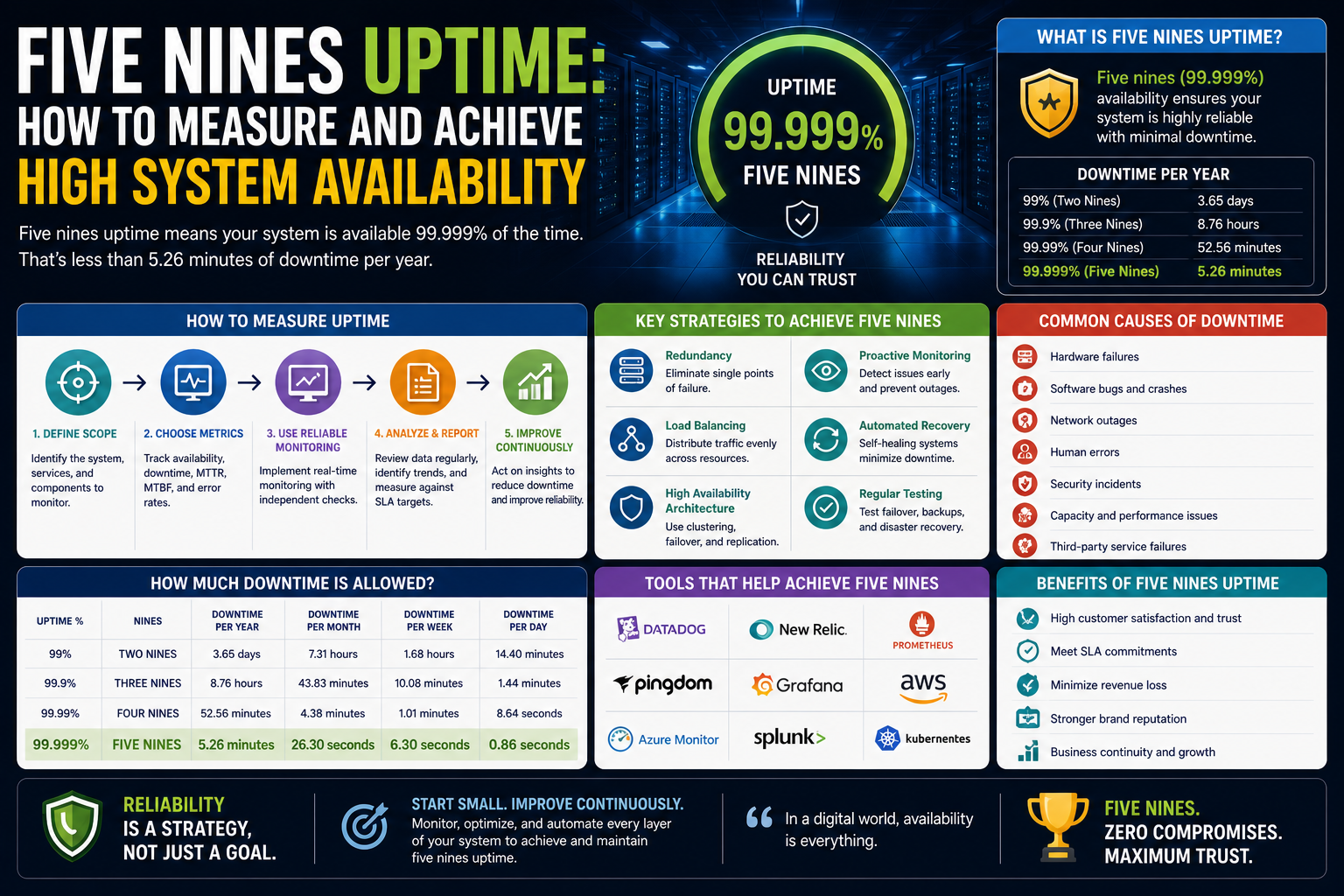
One of the most widely recognized standards for high system reliability is known as “Five Nines.” This refers to a system availability level of 99.999%, which represents an extremely high standard of uptime performance. The idea behind Five Nines is to quantify near-continuous system availability over a defined period, typically one year.
To understand the significance of this level, it is important to break down what 99.999% availability actually means in practical terms. Over the course of a full year, a system achieving Five Nines availability would experience only a few minutes of total downtime. This level of performance is considered exceptional and is often associated with mission-critical systems where interruptions are unacceptable or highly disruptive.
The concept of “The Nines” is used more broadly to describe different tiers of system reliability. For example, 99.9% availability represents three nines, while 99.99% represents four nines. Each additional nine significantly reduces allowable downtime and increases the complexity and cost required to achieve it. Moving from three nines to five nines is not a linear improvement—it requires exponential investment in infrastructure, redundancy, and monitoring systems.
The importance of Five Nines lies not only in its precision but also in its role as a benchmark for designing high-availability systems. It sets a clear expectation for engineers and service providers when building architectures that must minimize downtime. However, achieving this level of reliability is not simply about having better hardware; it involves careful system design, operational discipline, and continuous monitoring.
Understanding the Mathematics of Downtime
To fully appreciate what Five Nines represents, it is helpful to examine how downtime is calculated. System availability is typically expressed as a percentage of total operational time within a given period. The remaining percentage represents downtime, which includes both planned and unplanned interruptions.
For example, a system with 99.9% availability may seem highly reliable at first glance. However, when translated into actual time, it allows for several hours of downtime per year. As the number of nines increases, the allowable downtime decreases dramatically.
At 99% availability, a system may experience several days of downtime annually. At 99.9%, this drops to a few hours. At 99.99%, downtime is reduced to under an hour. Finally, at 99.999%, downtime is measured in mere minutes over an entire year.
This dramatic reduction highlights why each additional nine is so significant. It also illustrates why organizations must carefully evaluate how much availability they truly require. While Five Nines is often seen as an ideal standard, not all systems require or justify such a high level of reliability.
It is also important to recognize that downtime is not always caused by system failure alone. Maintenance activities, software updates, hardware replacements, and network reconfigurations all contribute to periods when systems may be temporarily unavailable. These planned interruptions are often included in availability calculations, depending on how service agreements are structured.
The Misinterpretation of Uptime Guarantees
One of the most common misconceptions in system reliability is the assumption that uptime guarantees represent absolute assurance of future performance. In reality, uptime statistics are based on historical data and probability models rather than guaranteed outcomes.
When a service provider advertises a specific uptime percentage, it typically reflects past performance under controlled conditions. While this information is useful for assessing reliability trends, it does not guarantee identical performance in the future. Unexpected events such as infrastructure failures, cyber incidents, or large-scale outages can still occur, regardless of historical uptime records.
This misunderstanding often leads to unrealistic expectations. Businesses may assume that a high uptime percentage eliminates risk entirely, when in fact it only reduces the likelihood of downtime. No system is completely immune to failure, especially in complex, distributed environments.
Another common misunderstanding involves the scope of uptime guarantees. Many service agreements define availability based on specific components or services rather than entire systems. For instance, a storage service may be considered operational even if connectivity issues prevent users from accessing it due to network failures elsewhere. This can create a gap between technical uptime metrics and actual user experience.
The Watermelon Effect in Performance Measurement
A particularly important concept in reliability measurement is what is often referred to as the “watermelon effect.” This occurs when performance metrics appear satisfactory on the surface but do not reflect the actual user experience. In other words, systems may appear “green” in monitoring dashboards, indicating that they are meeting predefined thresholds, while users experience poor performance or service disruptions that feel “red” in reality.
The watermelon effect highlights the limitations of relying solely on numerical indicators without considering real-world impact. A system might technically meet its uptime requirements while still delivering slow response times, intermittent errors, or degraded functionality. In such cases, the system is considered operational according to metrics but ineffective from a user perspective.
This disconnect often arises when performance indicators are designed without sufficient alignment to user expectations. For example, measuring only whether a service is reachable does not account for how quickly it responds or how reliably it performs under load. As a result, organizations may believe their systems are highly reliable while users experience frustration and inconsistency.
Addressing the watermelon effect requires a more holistic approach to monitoring and evaluation. Instead of focusing solely on binary uptime metrics, organizations must also consider performance quality, responsiveness, and user satisfaction indicators. This broader perspective ensures that reliability measurements reflect actual service effectiveness rather than just technical availability.
How Availability Differs Across System Designs
System availability is heavily influenced by architectural design choices. Different infrastructure models produce different levels of resilience and downtime tolerance. For example, traditional single-server systems are inherently more vulnerable to downtime because they rely on a single point of failure. If that server goes offline, the entire system becomes unavailable.
In contrast, modern distributed systems are designed with redundancy and failover mechanisms that allow workloads to shift automatically between multiple nodes. This approach reduces dependency on any single component and significantly improves overall availability. When one part of the system fails, another can take over its responsibilities, often without noticeable disruption to users.
Cloud-based architectures further enhance availability by distributing resources across multiple geographic regions. This ensures that even if one region experiences an outage, services can continue operating from another location. These designs are fundamental to achieving high availability levels, including those approaching Five Nines.
However, increased redundancy also introduces additional complexity. Managing multiple systems, synchronizing data, and ensuring consistent performance across environments requires careful planning and robust operational processes. Without proper coordination, redundancy can create inconsistencies rather than improving reliability.
The Role of Maintenance in System Availability
Maintenance plays a crucial role in determining system availability. All systems require periodic updates, repairs, and optimizations to maintain performance and security. However, these necessary activities often introduce temporary downtime, which must be accounted for when calculating availability metrics.
There are two main types of maintenance: preventive and corrective. Preventive maintenance involves planned activities such as software updates, hardware upgrades, and system optimizations designed to prevent future failures. Corrective maintenance occurs in response to unexpected issues or system failures that require immediate attention.
Both types of maintenance contribute to overall downtime, but they are often managed differently in terms of scheduling and impact. Preventive maintenance is usually planned during low-traffic periods to minimize disruption, while corrective maintenance is typically unplanned and may occur at any time.
Efficient maintenance strategies are essential for achieving high availability targets. By minimizing downtime during maintenance windows and improving response times during incidents, organizations can significantly enhance system reliability without necessarily increasing infrastructure costs.
Business Implications of High Availability Targets
Setting availability targets is not just a technical decision—it is a strategic business choice. Higher availability levels require more complex infrastructure, greater redundancy, and increased operational investment. As a result, organizations must carefully balance the cost of achieving high availability against the potential impact of downtime.
For some systems, such as internal tools or non-critical applications, lower availability levels may be acceptable. In these cases, occasional downtime may have minimal impact on operations or revenue. However, for customer-facing platforms, financial systems, or mission-critical services, even short periods of downtime can have significant consequences.
This trade-off is central to infrastructure planning. Organizations must determine the level of risk they are willing to accept and design systems accordingly. Over-investing in availability for low-impact systems can waste resources, while under-investing in critical systems can lead to substantial losses.
High availability is therefore not a universal requirement but a tailored objective based on business priorities, user expectations, and operational dependencies.
Service Level Agreements and the Real Meaning of Availability Commitments
When organizations purchase or design digital services, they often rely on formal agreements that define expected levels of performance. These agreements typically include uptime or availability commitments that outline how reliable a service should be over a specific time period. While these commitments appear straightforward on paper, their interpretation and real-world application are far more complex.
A common misconception is that availability commitments guarantee uninterrupted service. In reality, they define acceptable thresholds of downtime rather than absolute continuity. This means that a service described as highly available may still experience interruptions, as long as those interruptions remain within agreed limits. The distinction between expectation and contractual definition is critical for understanding how modern digital services are governed.
These agreements are structured to balance responsibility between service providers and customers. Providers commit to maintaining systems within defined reliability thresholds, while customers accept that occasional disruptions may still occur. However, the exact interpretation of these thresholds can vary depending on how availability is measured, what components are included, and how exclusions are defined.
One of the most important aspects of these agreements is the scope of coverage. Availability may apply to specific components, such as servers, storage systems, or network infrastructure, rather than the entire service ecosystem. This means that even if one component remains operational, users may still experience service degradation if dependent components fail.
Understanding these boundaries is essential for evaluating the real value of availability commitments. Without clarity on scope, organizations may assume a higher level of protection than actually exists, leading to operational gaps during unexpected incidents.
Service Metrics and the Hierarchy of Reliability Indicators
Modern system reliability is not measured using a single metric. Instead, it is evaluated through a hierarchy of indicators that collectively describe system behavior under different conditions. These indicators often include availability, performance, latency, error rates, and system responsiveness.
At the highest level, availability measures whether a system is operational. However, this binary perspective does not capture how well the system is functioning. A system may be technically available but still perform poorly due to slow response times or partial feature failures. This is why availability alone is insufficient as a measure of user experience.
To address this limitation, organizations often define additional performance indicators that provide more granular insight into system behavior. These indicators help distinguish between systems that are fully functional and those that are technically operational but degraded.
Latency is one such indicator that measures how quickly a system responds to user requests. Even if a system is available, high latency can significantly reduce usability. Similarly, error rates measure the frequency of failed operations, which can indicate underlying instability even when systems appear operational.
Together, these metrics form a more complete picture of system reliability. They allow organizations to move beyond simple uptime measurements and evaluate actual service quality from a user perspective.
The Relationship Between SLIs, SLOs, and System Expectations
To manage complex systems effectively, organizations often define structured reliability frameworks that separate measurement, objectives, and agreements. Within this structure, service level indicators represent measurable performance data, while service level objectives define target thresholds for those indicators.
Service level indicators are the raw measurements collected from systems. These may include uptime percentages, response times, request success rates, and resource utilization levels. They provide a factual representation of system behavior without interpretation.
Service level objectives, on the other hand, define the desired performance targets for these indicators. They represent internal goals that guide engineering decisions and operational priorities. For example, a system may have an objective that requires maintaining a specific response time under normal operating conditions.
The relationship between indicators and objectives is central to modern reliability engineering. Rather than relying solely on external agreements, organizations use internal objectives to proactively manage system behavior. This allows them to detect early signs of degradation and take corrective action before formal thresholds are breached.
This structured approach also helps align engineering efforts with user expectations. By defining clear performance targets, teams can prioritize improvements that directly impact user experience rather than focusing only on abstract uptime metrics.
Redundancy Strategies and System Resilience Design
One of the most effective ways to improve system availability is through redundancy. Redundancy involves duplicating critical system components so that if one fails, another can immediately take its place. This principle is fundamental to high availability architecture and is widely used in modern infrastructure design.
There are multiple forms of redundancy, each addressing different types of system risk. Hardware redundancy involves duplicating physical components such as servers, storage devices, and network interfaces. Software redundancy focuses on replicating application instances across multiple environments to ensure continuous execution.
Network redundancy ensures that communication paths remain available even if one route fails. This is typically achieved through multiple network providers or alternative routing configurations that allow traffic to be dynamically redirected.
While redundancy significantly improves reliability, it also introduces complexity. Maintaining consistency across duplicated systems requires careful synchronization, especially when dealing with real-time data or transactional systems. Without proper coordination, redundancy can lead to inconsistencies, data conflicts, or unexpected behavior during failover events.
Designing effective redundancy strategies requires balancing cost, complexity, and reliability. Over-redundancy can increase operational overhead without proportional benefits, while under-redundancy can leave systems vulnerable to failure.
Load Distribution and Dynamic Traffic Management
Another key factor in achieving high availability is how system load is distributed across infrastructure. In modern digital environments, workloads are rarely static. Traffic levels fluctuate based on user activity, time of day, geographic distribution, and external events. Managing this variability is essential for maintaining stable performance.
Load distribution systems are designed to allocate incoming requests across multiple computing resources. This ensures that no single system becomes overwhelmed while others remain underutilized. By distributing workloads evenly, organizations can maintain consistent performance even during periods of high demand.
Dynamic load management takes this concept further by continuously adjusting resource allocation based on real-time conditions. When one system becomes overloaded or fails, traffic is automatically redirected to healthier nodes. This process often occurs without user awareness, creating the perception of uninterrupted service.
However, effective load management requires careful monitoring of system health. If traffic is distributed without considering underlying performance conditions, it can inadvertently overload weaker systems, leading to cascading failures. This highlights the importance of combining load balancing with health checks and performance monitoring.
In advanced architectures, load distribution is also influenced by geographic proximity. Users are often routed to the nearest available system to reduce latency and improve responsiveness. This approach not only enhances performance but also contributes to resilience by distributing traffic across multiple regions.
Failure Modes and System Degradation Patterns
Understanding how systems fail is just as important as designing them for reliability. Systems rarely fail in a single, predictable way. Instead, they exhibit different failure modes depending on the nature of the issue and the structure of the infrastructure.
A complete system failure occurs when all components become unavailable simultaneously. This is relatively rare in well-designed systems but can happen due to major infrastructure outages or catastrophic events.
Partial failure is more common and occurs when specific components become unavailable while others continue functioning. This type of failure can be particularly challenging because the system may appear operational while delivering incomplete or degraded functionality.
Degraded performance failure occurs when systems remain operational but experience reduced efficiency. This may include slower response times, increased error rates, or inconsistent behavior under load. From a user perspective, this type of failure can be as disruptive as complete downtime.
Cascading failure is another critical pattern where the failure of one component triggers failures in others. This can occur in tightly coupled systems where dependencies are not properly isolated. Once a cascading failure begins, it can spread rapidly across the entire infrastructure.
Recognizing these failure patterns allows engineers to design systems that are more resilient. By isolating dependencies and implementing graceful degradation strategies, systems can continue operating even when certain components fail.
The Role of Monitoring in System Reliability
Continuous monitoring is essential for maintaining high availability systems. Without real-time visibility into system behavior, organizations cannot detect or respond to issues effectively. Monitoring provides the data needed to understand system health, identify anomalies, and trigger automated responses.
Modern monitoring systems track a wide range of metrics, including resource utilization, response times, error rates, and system availability. These metrics are collected continuously and analyzed to detect deviations from normal behavior.
However, monitoring alone is not sufficient. The value of monitoring depends on how quickly and effectively the data is interpreted and acted upon. Delayed response to system anomalies can result in prolonged downtime or widespread service disruption.
To address this challenge, many systems incorporate automated alerting mechanisms that notify engineers when specific thresholds are breached. These alerts enable rapid response and reduce the time between issue detection and resolution.
Advanced monitoring systems also incorporate predictive analysis, which uses historical data to identify patterns that may indicate future failures. This allows organizations to address potential issues before they impact users.
Despite its importance, monitoring must be carefully designed to avoid information overload. Excessive alerts or poorly configured thresholds can lead to alert fatigue, where critical signals are missed due to high volumes of non-critical notifications.
Incident Response and Operational Coordination
When system failures occur, the speed and effectiveness of response actions play a critical role in minimizing downtime. Incident response refers to the structured process used to detect, analyze, and resolve system disruptions.
Effective incident response relies on clear roles and responsibilities. Each member of the response team must understand their function during an incident, including who is responsible for diagnosis, communication, and remediation. Without this clarity, response efforts can become disorganized and slow.
Communication is a key component of incident management. During outages, timely and accurate information must be shared across technical teams, business units, and stakeholders. Poor communication can amplify the impact of an incident by creating confusion or misaligned expectations.
Automation plays an increasingly important role in incident response. Automated systems can detect anomalies, initiate failover procedures, and even resolve certain types of issues without human intervention. This reduces response time and minimizes the impact of human error.
However, automation must be carefully designed to avoid unintended consequences. Incorrect automation triggers can exacerbate issues rather than resolve them, leading to larger system disruptions.
Incident response is not only about technical resolution but also about coordination. The ability to align multiple teams and systems during a crisis is a key factor in maintaining high availability in complex environments.
Geographic Distribution and Global System Availability
As digital services expand globally, geographic distribution has become a critical factor in achieving high availability. Systems that rely on a single physical location are inherently vulnerable to regional disruptions such as power outages, natural disasters, or network failures.
Geographically distributed systems replicate data and services across multiple regions to ensure continuity during localized failures. If one region becomes unavailable, traffic can be redirected to another region with minimal disruption.
This approach significantly improves resilience but introduces challenges related to data consistency and synchronization. Ensuring that data remains accurate and up to date across multiple regions requires sophisticated replication strategies.
Latency is another important consideration in geographically distributed systems. While distributing services globally improves availability, it can also increase response times if users are far from active system nodes. Balancing performance and availability requires careful architectural design.
Despite these challenges, geographic distribution remains one of the most effective strategies for achieving high availability at scale.
Designing Systems for Extreme Reliability in Modern Infrastructure
Building systems that approach extreme reliability levels requires far more than simply adding redundancy or increasing hardware capacity. It demands a deliberate architectural philosophy that treats failure as a constant possibility rather than an exception. In high-availability engineering, systems are designed under the assumption that components will fail, networks will degrade, and unexpected disruptions will occur. The goal is not to prevent failure entirely, but to ensure that failure does not result in service interruption.
This approach shifts the focus from isolated system components to the behavior of the entire ecosystem. A highly reliable system is not defined by a single server or application, but by how effectively multiple components interact under both normal and abnormal conditions. This includes how workloads are distributed, how failures are isolated, and how quickly recovery mechanisms activate when disruptions occur.
One of the most important principles in this design philosophy is fault tolerance. Fault tolerance refers to a system’s ability to continue functioning even when one or more components fail. This is achieved through duplication, isolation, and intelligent failover mechanisms. Instead of treating failure as a catastrophic event, fault-tolerant systems treat it as a routine condition that must be handled gracefully.
Another key principle is graceful degradation. Rather than shutting down entirely when stressed or partially failing, a well-designed system reduces functionality in a controlled manner. This ensures that essential services remain available even when certain features or components are compromised. For example, a system might disable non-critical features while maintaining core functionality during periods of high load or partial outage.
These principles form the foundation of extreme reliability engineering, where the objective is to maintain continuity of service under almost any condition. However, achieving this level of resilience requires careful trade-offs between complexity, cost, and operational overhead.
The Economics of High Availability Systems
While high availability is often discussed in technical terms, it is fundamentally an economic decision. Achieving near-continuous uptime requires significant investment in infrastructure, engineering resources, and operational processes. As availability targets increase, the cost of achieving each additional increment of reliability grows exponentially.
For example, moving from standard availability levels to three nines may require basic redundancy and monitoring. However, achieving four or five nines often requires distributed systems, multi-region deployments, automated failover mechanisms, and continuous operational monitoring. Each of these enhancements adds complexity and cost.
This economic reality forces organizations to evaluate the value of uptime in relation to business impact. Not all systems require extreme availability. Internal tools, development environments, or low-impact services may function adequately with lower uptime thresholds. In contrast, financial systems, healthcare platforms, and global communication networks often justify the cost of extreme reliability due to the critical nature of their operations.
The challenge lies in identifying the appropriate level of investment for each system. Over-engineering non-critical systems wastes resources, while under-engineering critical systems introduces unacceptable risk. This balance is at the core of infrastructure strategy and long-term system planning.
Another important economic consideration is the cost of downtime itself. Downtime does not only represent lost functionality; it often translates directly into financial loss, reputational damage, and reduced customer trust. In some industries, even a few minutes of downtime can result in substantial monetary losses.
This cost perspective helps justify investments in redundancy, monitoring, and automated recovery systems. By reducing the probability and duration of outages, organizations effectively protect revenue streams and maintain operational stability.
Human Factors in System Availability
Although system reliability is often framed as a technical challenge, human factors play a critical role in determining overall availability. Many system failures are not caused by hardware or software defects alone, but by human decisions, configuration errors, or operational missteps.
One of the most common human-related issues is configuration error. Misconfigured systems can lead to unexpected behavior, service disruptions, or cascading failures across dependent systems. These errors are particularly dangerous in complex environments where small changes can have large unintended consequences.
Operational procedures also significantly impact system reliability. Inconsistent or poorly documented processes can lead to confusion during critical incidents, slowing down response times and increasing the severity of outages. Clear, well-defined procedures help ensure that teams can respond quickly and consistently under pressure.
Training and experience are equally important. Teams responsible for managing high-availability systems must be familiar with system architecture, failure modes, and recovery procedures. Without sufficient expertise, even well-designed systems can fail due to delayed or incorrect responses during incidents.
Communication is another critical human factor. During system outages, clear communication between technical teams, management, and stakeholders is essential. Miscommunication can lead to duplicated efforts, delayed responses, or incorrect assumptions about system status.
To mitigate human-related risks, organizations often implement structured workflows, automated safeguards, and standardized operational practices. These measures reduce the likelihood of human error and improve overall system stability.
Automation and Self-Healing Infrastructure
As systems become more complex, manual intervention becomes increasingly insufficient for maintaining high availability. Automation has therefore become a cornerstone of modern reliability engineering. Automated systems can detect issues, initiate responses, and even resolve certain types of failures without human involvement.
Self-healing infrastructure refers to systems that can automatically recover from specific types of failures. For example, if a server becomes unresponsive, an automated system may replace it with a healthy instance without requiring manual intervention. This reduces downtime and improves overall resilience.
Automation is also used in monitoring and alerting systems. Instead of relying on humans to detect issues, automated tools continuously analyze system behavior and trigger alerts when anomalies are detected. This allows for faster response times and reduces the risk of unnoticed failures.
In more advanced systems, automation extends to predictive maintenance. By analyzing historical performance data, systems can identify patterns that indicate potential future failures. This allows maintenance to be performed proactively rather than reactively, reducing the likelihood of unexpected outages.
However, automation is not without risks. Poorly designed automation can amplify failures instead of preventing them. For example, an automated system that incorrectly identifies a healthy component as faulty may trigger unnecessary failover events, potentially destabilizing the system further.
For this reason, automation must be carefully tested, monitored, and designed with fail-safes to prevent unintended consequences. Human oversight remains an essential component of automated environments, especially in critical systems.
Complexity as a Threat to Reliability
One of the most overlooked challenges in achieving high availability is system complexity. As systems grow in size and functionality, they become more difficult to understand, manage, and maintain. Increased complexity introduces more potential points of failure and makes it harder to predict system behavior under stress.
Complex systems often involve multiple interdependent components, each with its own configuration, dependencies, and failure modes. When these components interact, unexpected behaviors can emerge that are difficult to diagnose and resolve.
This phenomenon is sometimes referred to as emergent failure, where issues arise not from individual components but from their interactions. These failures can be particularly challenging because they are not easily reproducible or predictable.
Reducing complexity is therefore a key strategy for improving reliability. Simplified architectures are easier to monitor, easier to maintain, and less prone to unexpected interactions. While simplification may sometimes limit functionality or flexibility, it often leads to more stable and resilient systems.
Modular design is one approach to managing complexity. By breaking systems into independent components with clearly defined interfaces, organizations can reduce interdependencies and isolate failures more effectively. This allows individual components to be updated, replaced, or repaired without affecting the entire system.
Observability and Deep System Insight
Maintaining high availability requires more than just monitoring basic system metrics. It requires deep observability, which refers to the ability to understand the internal state of a system based on its outputs. Observability provides insight into why systems behave the way they do, not just whether they are functioning correctly.
Observability typically involves three key types of data: logs, metrics, and traces. Logs provide detailed records of system events, metrics offer quantitative measurements of performance, and traces track the flow of requests through complex systems.
Together, these data sources allow engineers to reconstruct system behavior and identify the root causes of issues. This is particularly important in distributed systems where failures may span multiple components and services.
High observability enables faster diagnosis and resolution of issues, reducing downtime and improving system resilience. Without it, teams may struggle to understand the source of problems, leading to longer outages and increased operational risk.
However, observability must be balanced with performance and storage considerations. Collecting excessive data can introduce overhead and make it harder to identify meaningful signals within large volumes of information.
Evolution of High Availability Architectures
High availability systems have evolved significantly over time. Early systems relied on single machines or simple backup servers, which provided limited protection against failure. As technology advanced, organizations began adopting clustered systems that distributed workloads across multiple machines.
The introduction of virtualization and cloud computing further transformed availability strategies. Virtual machines allowed workloads to be moved dynamically between physical hosts, while cloud platforms introduced scalable infrastructure that could adjust resources in real time based on demand.
Modern architectures are now heavily distributed, often spanning multiple geographic regions and incorporating microservices-based designs. In these systems, applications are broken down into smaller services that can operate independently. This allows individual components to fail without affecting the entire system.
Containerization has also contributed to improved availability by standardizing deployment environments and simplifying application portability. Containers allow applications to run consistently across different environments, reducing configuration-related failures.
Despite these advancements, achieving extreme reliability remains a complex challenge. Each new architectural improvement introduces additional layers of abstraction and dependency, which must be carefully managed to avoid introducing new failure risks.
The Future Direction of System Availability Engineering
As digital systems continue to expand in scale and complexity, the future of availability engineering is likely to focus on increased automation, intelligence, and adaptability. Systems will become more capable of self-diagnosis and self-repair, reducing the need for manual intervention.
Artificial intelligence and machine learning are expected to play a growing role in predictive reliability. By analyzing large volumes of system data, intelligent systems can identify patterns that indicate potential failures before they occur, allowing proactive intervention.
Edge computing is also likely to influence availability strategies by distributing processing closer to end users. This reduces latency and improves resilience by minimizing dependency on centralized infrastructure.
Despite these advancements, the fundamental challenge of reliability remains unchanged: systems must continue to function despite uncertainty and failure. The methods used to achieve this will evolve, but the underlying principles of redundancy, observability, automation, and simplicity will continue to guide system design.
Conclusion
High availability is not just a technical benchmark—it is a practical framework for ensuring that digital systems remain dependable in an environment where failure is inevitable. As organizations continue to rely on complex infrastructure to deliver services, the ability to maintain consistent performance becomes a defining factor in operational success. Concepts such as uptime, availability, and the Five Nines are often used to measure reliability, but their real value lies in how they influence system design, business strategy, and user experience.
One of the most important lessons from high availability engineering is that reliability cannot be treated as a single metric or a fixed guarantee. Uptime percentages may appear precise, but they represent historical performance rather than future certainty. Systems operate in dynamic environments where hardware failures, software bugs, network disruptions, and human errors can occur at any time. Because of this, availability must be understood as a probability shaped by architecture, process, and operational discipline rather than a static promise.
The concept of Five Nines highlights the extreme end of reliability expectations. Achieving 99.999% availability requires more than strong infrastructure—it demands careful coordination between redundancy, monitoring, automation, and incident response. Even then, such levels of uptime are not absolute guarantees of uninterrupted service but rather indicators of how resilient a system is under normal and abnormal conditions. Importantly, the cost of achieving each additional “nine” increases significantly, forcing organizations to evaluate whether the investment aligns with the criticality of the service being delivered.
Another key takeaway is that availability alone does not define user experience. Systems may technically remain online while still delivering degraded performance, slow response times, or inconsistent functionality. This gap between technical uptime and actual usability is where many organizations face challenges. Metrics must therefore evolve beyond simple availability percentages to include latency, error rates, and real user impact. Without this broader perspective, systems risk falling into the “watermelon effect,” where performance appears healthy on the outside but fails to meet user expectations in practice.
Human factors also play a crucial role in system reliability. Even the most advanced architectures can be undermined by misconfigurations, unclear procedures, or delayed responses during incidents. Effective communication, structured incident management, and continuous training are essential components of maintaining high availability. Similarly, automation has become a powerful tool for reducing response times and minimizing human error, but it must be carefully designed to avoid unintended consequences.
Ultimately, high availability is about resilience rather than perfection. It acknowledges that failure is unavoidable but emphasizes the importance of limiting its impact. Through redundancy, observability, load distribution, and intelligent system design, organizations can build infrastructure that continues to function even under stress. As technology continues to evolve, the principles of availability will remain central to ensuring that digital systems are reliable, efficient, and capable of supporting the growing demands of modern users and businesses.