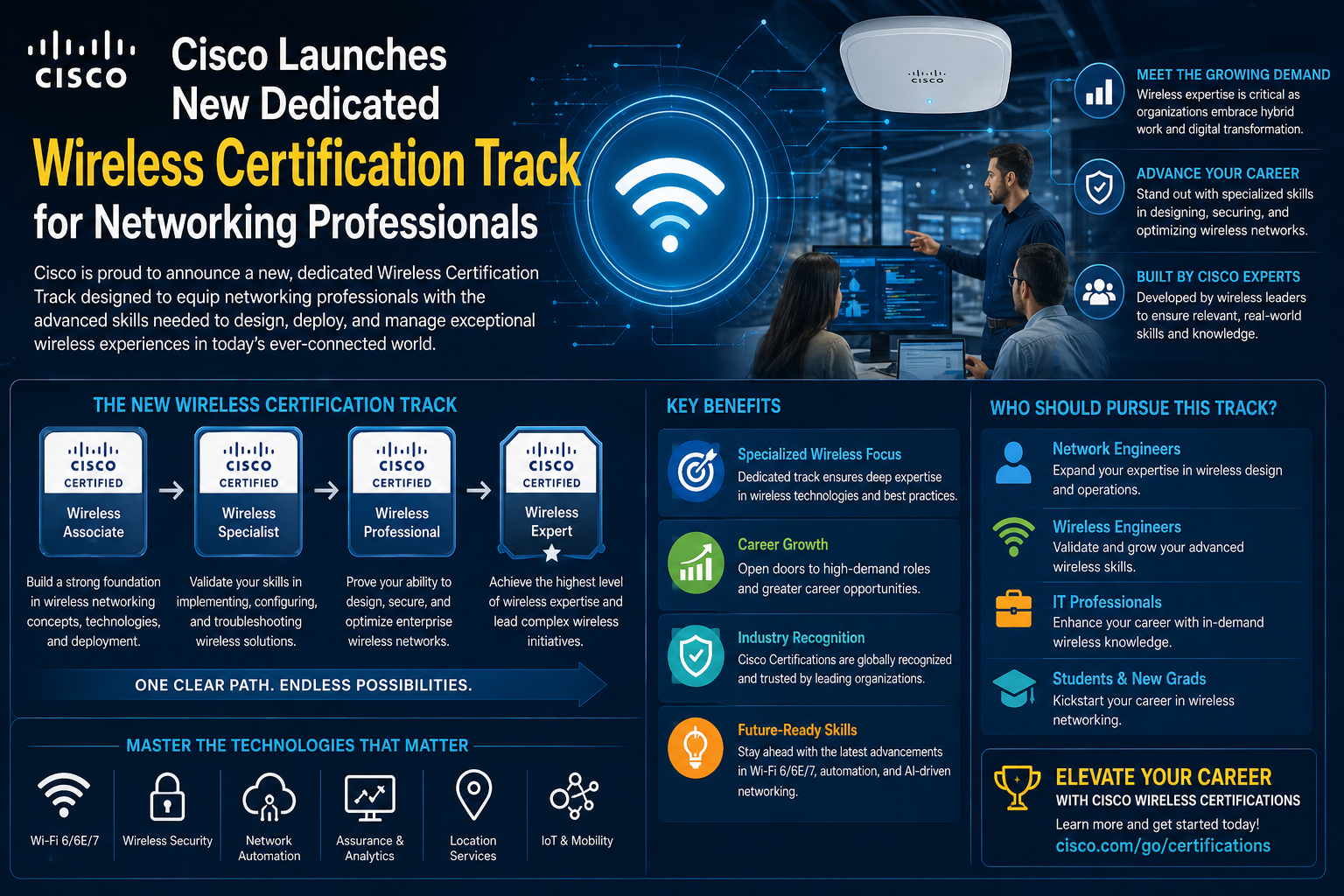
Cisco’s decision to introduce a dedicated wireless certification track marks a significant shift in how networking skills are structured and validated. For a long time, wireless networking existed as a subset within broader enterprise certifications, treated as one component among many in routing, switching, and infrastructure design. That structure made sense when wireless was still considered an extension of wired networks rather than a primary foundation.
Over time, however, the role of wireless connectivity has changed dramatically. Modern organizations no longer rely on Wi-Fi as a convenience layer; it is now a critical operational backbone. Employees connect through wireless devices as their primary access point to corporate systems, cloud applications, and collaboration platforms. Entire industries, from healthcare to logistics, depend on uninterrupted wireless connectivity for real-time operations.
Cisco’s introduction of CCNP Wireless and CCIE Wireless reflects this shift in reality. By separating wireless into its own certification path, Cisco is acknowledging that wireless networking has matured into a specialized discipline requiring deeper expertise, more focused training, and more precise validation of skills.
This move also signals a broader trend in IT certification design: specialization is becoming more important than generalization. Instead of bundling multiple domains into a single track, vendors are increasingly breaking them out into focused pathways that better reflect how modern networks are actually built and managed.
The Evolution of Wireless Networking in Enterprise Environments
To understand why this change matters, it helps to look at how wireless networking has evolved in enterprise environments. In the early days of Wi-Fi, wireless access was primarily used for convenience. It allowed laptops and mobile devices to connect without physical cables, but it was rarely considered mission-critical.
Wired networks were still the dominant force, providing stable, high-speed, and secure connectivity for most business operations. Wireless networks were often secondary, used in conference rooms, guest networks, or for employees who needed mobility within office spaces.
As mobile computing became more widespread, this balance began to shift. Laptops replaced desktops in many organizations, and smartphones became essential business tools. Employees started expecting seamless connectivity wherever they were, whether in the office, at home, or on the move.
The introduction of cloud computing accelerated this transformation. Applications were no longer hosted locally on enterprise servers but delivered over the internet. This meant that reliable wireless access became just as important as traditional wired infrastructure.
Today, wireless networks support not only user devices but also IoT systems, sensors, security cameras, industrial equipment, and automated systems. In many environments, wired connectivity is no longer the primary method of access. Instead, Wi-Fi has become the default layer through which most interactions occur.
Why Cisco Is Separating Wireless From Enterprise Certifications
Cisco’s certification structure has historically grouped wireless networking within the broader CCNP Enterprise track. This approach worked when wireless was a smaller part of enterprise networking. However, as the complexity and importance of Wi-Fi systems have increased, this structure has become less effective.
One of the main reasons for separating wireless into its own certification track is specialization. Wireless networking involves a distinct set of challenges that differ significantly from wired networking. These include radio frequency behavior, interference management, signal optimization, roaming behavior, and client density issues.
Unlike wired networks, where physical connections provide predictable performance, wireless networks operate in dynamic environments influenced by physical barriers, electromagnetic interference, and device variability. Engineers working in this field must understand not only networking protocols but also how radio waves behave in different environments.
Another reason for the separation is technological advancement. Modern wireless systems are far more complex than earlier generations. With the introduction of Wi-Fi 6 and Wi-Fi 7, networks now support higher data rates, lower latency, and significantly more connected devices. These advancements require deeper technical understanding and more advanced configuration skills.
Cisco’s decision also reflects changes in how organizations deploy wireless infrastructure. Many enterprises now use cloud-managed wireless platforms, hybrid architectures, and centralized controller-based systems. These environments demand expertise that goes beyond general enterprise networking knowledge.
By creating a dedicated certification track, Cisco is ensuring that professionals can specialize in wireless technologies without needing to navigate unrelated topics such as advanced routing or data center design.
CCNP Wireless and the Shift Toward Specialized Core Knowledge
The introduction of CCNP Wireless brings a structured approach to intermediate-level wireless expertise. At the center of this certification is a core exam focused entirely on wireless technologies, design principles, and operational management.
This represents a shift in how Cisco defines professional-level competency. Instead of expecting candidates to demonstrate broad enterprise knowledge with wireless as a component, the new structure places wireless at the center of the learning experience.
A major focus of this certification is wireless design. This includes understanding how to plan coverage areas, optimize access point placement, and ensure consistent signal strength across different environments. Engineers must consider building layouts, materials, user density, and interference sources when designing wireless networks.
Another key area is controller-based networking. Modern enterprise Wi-Fi systems rely heavily on centralized controllers that manage access points, policies, and security configurations. Professionals must understand how these systems operate, how they distribute configurations, and how they handle roaming and load balancing.
Troubleshooting is also a critical component. Wireless environments are inherently dynamic, and issues can arise from a wide range of sources. These include device compatibility problems, signal degradation, misconfigurations, and environmental interference. Engineers must be able to diagnose and resolve these issues efficiently to maintain network reliability.
Security plays an equally important role. Wireless networks are more exposed than wired networks, making them more vulnerable to unauthorized access and attacks. Understanding authentication methods, encryption protocols, and secure access design is essential for maintaining enterprise security standards.
The Increasing Role of Automation in Wireless Networking
One of the most notable aspects of the new certification structure is the emphasis on automation. Traditionally, wireless networking was configured and managed manually through controllers and graphical interfaces. While this approach is still widely used, it is becoming less efficient in large-scale environments.
Modern enterprise networks often include hundreds or thousands of access points spread across multiple locations. Managing these systems manually is time-consuming and prone to errors. As a result, automation has become a critical skill for network engineers.
Automation tools allow engineers to deploy configurations consistently, monitor network performance, and make large-scale changes with minimal manual intervention. Scripting languages and infrastructure automation frameworks are increasingly being used to streamline wireless operations.
This shift reflects a broader transformation in the IT industry. Networking is no longer purely about manual configuration; it is about programmable infrastructure. Engineers are expected to understand how to integrate networking systems with automation tools and workflows.
In wireless environments, automation can be used for tasks such as updating firmware across multiple access points, adjusting configurations based on network conditions, and collecting performance data for analysis. These capabilities improve efficiency and reduce the likelihood of human error.
By including automation in the CCNP Wireless track, Cisco is preparing professionals for a future where wireless networks are managed as dynamic, programmable systems rather than static configurations.
CCIE Wireless and the Expert-Level Expectations
At the expert level, the CCIE Wireless certification represents a deep specialization in wireless networking. This certification is designed for professionals who are responsible for large-scale, complex wireless environments where performance, reliability, and scalability are critical.
Expert-level wireless engineers must be capable of designing and optimizing networks that support thousands of users and devices simultaneously. This requires a strong understanding of high-density environments, advanced RF planning, and performance optimization techniques.
In modern enterprise environments, Wi-Fi 6 and Wi-Fi 7 introduce new capabilities that must be carefully managed. These technologies offer improved efficiency, reduced latency, and better handling of multiple devices, but they also require precise configuration to achieve optimal performance.
CCIE Wireless-level expertise involves not only understanding these technologies but also knowing how to apply them in real-world environments. This includes tuning network parameters, managing interference in dense deployments, and ensuring consistent performance across different locations.
Troubleshooting at this level is significantly more complex. Issues may not be immediately visible and can involve interactions between multiple systems, including cloud services, authentication servers, and network controllers. Expert engineers must be able to isolate and resolve these issues systematically.
Another key area is hybrid network management. Many organizations now operate wireless systems that integrate on-premises infrastructure with cloud-managed platforms. Engineers must understand how these systems interact and how to maintain consistency across different management layers.
Wireless Networking in the Context of Modern Digital Infrastructure
Wireless networking is no longer an isolated component of IT infrastructure. It is deeply integrated into the broader digital ecosystem that supports modern organizations.
In many cases, wireless networks serve as the primary access layer for cloud applications, collaboration tools, and enterprise systems. Employees rely on Wi-Fi for video conferencing, file sharing, remote access, and real-time communication.
The growth of IoT has further expanded the role of wireless connectivity. Devices such as sensors, smart building systems, and industrial equipment depend on stable wireless connections to function effectively. These systems often generate continuous data streams that must be transmitted reliably and securely.
As organizations adopt more digital tools, the demand for high-performance wireless networks continues to increase. This places greater responsibility on network engineers to ensure that wireless systems are not only functional but also optimized for performance and scalability.
Wireless networks must also support evolving workplace models. Hybrid work environments require seamless connectivity across office spaces, homes, and remote locations. This introduces additional complexity in managing consistent user experiences across different network conditions.
The Strategic Importance of Wireless Specialization for IT Careers
The introduction of a dedicated wireless certification track also has important implications for IT career development. Specialization in wireless networking can open opportunities in roles that focus specifically on network design, deployment, optimization, and troubleshooting.
As organizations continue to expand their reliance on wireless infrastructure, demand for skilled wireless engineers is expected to grow. These professionals will play a key role in ensuring that networks remain reliable, secure, and scalable.
Wireless specialization also aligns with broader industry trends toward niche expertise. Instead of generalist roles, many organizations are seeking professionals with deep knowledge in specific domains such as cloud networking, cybersecurity, and wireless systems.
This shift reflects the increasing complexity of IT environments. As systems become more interconnected and technology stacks more layered, specialized expertise becomes essential for maintaining performance and stability.
Wireless engineers who develop advanced skills in areas such as RF design, automation, and cloud-managed networking will be well-positioned to support the next generation of enterprise infrastructure.
Changing Expectations for Network Engineering Professionals
The evolution of wireless certification also reflects changing expectations for network engineers as a whole. The role of a network engineer is no longer limited to configuring routers and switches. It now includes managing cloud-integrated systems, automating network processes, and optimizing user experiences across diverse environments.
Wireless networking plays a central role in this transformation. Engineers must now think beyond traditional network boundaries and consider how users interact with applications over wireless connections.
Performance is no longer measured solely in terms of bandwidth or latency. It also includes user experience, device compatibility, and application responsiveness. These factors are heavily influenced by wireless network design and implementation.
As a result, wireless expertise is becoming a core competency rather than a secondary skill. Engineers who understand how to design and manage wireless systems will be better equipped to handle the demands of modern IT environments.
Deepening the Role of Wireless in Modern Network Architecture
As wireless networking becomes more central to enterprise operations, its role within overall network architecture has shifted from an access convenience layer to a foundational design element. This change is not just about increased usage but about how deeply wireless systems are now integrated into every layer of digital infrastructure.
In earlier network models, wireless was typically treated as an extension of the wired LAN. Devices connected through access points, but the real backbone of the network remained Ethernet-based switching and routing infrastructure. Today, that separation is no longer accurate in many environments.
Modern enterprise architectures are increasingly built around a “wireless-first” assumption. This means that network design begins with the expectation that most devices will connect via Wi-Fi rather than wired connections. As a result, wireless design considerations now influence decisions about IP addressing, segmentation, security policies, application delivery, and even cloud connectivity.
This shift forces network engineers to rethink traditional design hierarchies. Instead of treating wireless as a layer that sits on top of a wired foundation, it is now viewed as an equal or sometimes dominant access method. This has significant implications for scalability, performance planning, and infrastructure deployment strategies.
Wireless-centric design also requires closer coordination between different domains of networking. Routing, switching, security, and cloud services must all be aligned with wireless behavior. This level of integration increases complexity but also improves flexibility when properly implemented.
Evolution of Wi-Fi Standards and Their Engineering Impact
One of the key drivers behind Cisco’s decision to create a dedicated wireless certification track is the rapid evolution of Wi-Fi standards. Each new generation of Wi-Fi introduces not only faster speeds but also fundamental changes in how wireless networks operate.
Wi-Fi 6 brought significant improvements in efficiency, particularly in high-density environments. Technologies such as OFDMA and MU-MIMO allowed multiple devices to communicate simultaneously without excessive congestion. This made wireless networks more predictable and stable in environments such as offices, stadiums, and campuses.
Wi-Fi 6E extended capabilities into the 6 GHz spectrum, offering more channels and reducing interference from legacy devices. This expansion significantly improved performance in environments where spectrum congestion had previously been a major limitation.
Wi-Fi 7 takes this evolution even further, focusing on ultra-low latency, higher throughput, and improved reliability for real-time applications. It introduces advanced channel utilization techniques and supports even more complex multi-link operations.
For engineers, each of these transitions introduces new design considerations. It is no longer enough to simply deploy access points and ensure coverage. Engineers must understand how different Wi-Fi generations interact with client devices, how spectrum is allocated, and how performance varies under load.
This complexity is one of the reasons wireless networking now requires its own dedicated certification path. The depth of knowledge required to properly design and optimize modern Wi-Fi systems has expanded far beyond what can be covered as a subtopic within general enterprise networking.
Controller-Based and Cloud-Managed Wireless Systems
Another major transformation in wireless networking is the shift from standalone access point management to centralized control systems. Traditionally, wireless networks were configured individually on each access point, with limited coordination between devices.
Controller-based architectures changed this model by introducing centralized management systems that handle configuration, security policies, roaming behavior, and performance optimization. Access points now act as lightweight endpoints that rely on controllers for decision-making and coordination.
This approach significantly improves scalability and consistency. Instead of configuring hundreds or thousands of devices individually, engineers can define policies at a central level and apply them across the entire network.
Cloud-managed wireless systems represent the next stage in this evolution. In these environments, wireless controllers are hosted in cloud platforms rather than on-premises infrastructure. This allows for remote management, automated updates, and global visibility across distributed networks.
Cloud-based systems also enable more advanced analytics. Engineers can monitor network performance in real time, identify congestion points, and adjust configurations dynamically based on usage patterns. This level of visibility was not possible in traditional wireless deployments.
However, cloud-managed wireless introduces new challenges. Network performance becomes dependent not only on local infrastructure but also on internet connectivity and cloud service reliability. Engineers must understand how to design systems that remain resilient even when external dependencies fluctuate.
The CCNP Wireless and CCIE Wireless tracks reflect this shift by emphasizing both controller-based and cloud-managed architectures. Engineers are expected to understand how these systems interact and how to optimize performance across hybrid environments.
RF Engineering and Environmental Considerations
One of the most specialized areas within wireless networking is radio frequency (RF) engineering. Unlike wired networks, where signals travel through controlled physical media, wireless signals propagate through open environments and are subject to interference, reflection, absorption, and attenuation.
RF behavior is influenced by a wide range of environmental factors. Building materials such as concrete, metal, and glass can significantly impact signal strength. Even furniture placement and human movement can affect wireless performance in dense environments.
Engineers must consider these variables when designing wireless networks. This includes conducting site surveys, analyzing signal propagation patterns, and adjusting access point placement to ensure consistent coverage.
Channel planning is another critical aspect of RF engineering. Wireless networks operate across multiple frequency bands, and improper channel allocation can lead to interference and performance degradation. Engineers must carefully plan channel distribution to minimize overlap and maximize efficiency.
Power settings also play a key role in RF optimization. If access points transmit at too high a power level, they can create interference between neighboring devices. If power levels are too low, coverage gaps may occur. Balancing these factors requires a detailed understanding of RF behavior in specific environments.
Modern wireless certifications place increasing emphasis on RF engineering because it is one of the most complex and impactful aspects of wireless network performance. Poor RF design can lead to persistent connectivity issues that are difficult to diagnose and resolve.
High-Density Wireless Environments and Scalability Challenges
As wireless usage continues to grow, many organizations now operate in high-density environments where hundreds or even thousands of devices connect simultaneously. These environments present unique challenges that go beyond traditional network design considerations.
In high-density scenarios, the primary issue is not just coverage but capacity. Access points must handle large numbers of concurrent connections while maintaining consistent performance for all users.
This requires careful planning of airtime utilization, channel efficiency, and client distribution. Without proper design, networks can become congested, leading to increased latency and reduced throughput.
Device diversity also adds complexity. Modern networks support a wide range of devices, from smartphones and laptops to IoT sensors and industrial equipment. Each device type may have different connectivity requirements and performance characteristics.
Roaming behavior becomes especially important in dense environments. As users move through physical spaces, their devices must seamlessly transition between access points without experiencing drops in connectivity. This requires precise configuration of roaming thresholds and handoff mechanisms.
Engineers working in high-density environments must also consider load balancing. Distributing clients evenly across access points helps prevent congestion and ensures more stable performance. This often involves dynamic adjustment of client associations based on real-time network conditions.
These challenges highlight why wireless networking has become a specialized discipline. Managing high-density environments requires a combination of RF knowledge, protocol understanding, and performance optimization skills.
Security Architecture in Wireless Networks
Wireless networks introduce unique security challenges compared to wired environments. Because signals are transmitted through open air, they are inherently more exposed to interception and unauthorized access attempts.
As a result, wireless security relies heavily on encryption, authentication, and access control mechanisms. Modern wireless networks use advanced encryption standards to protect data in transit and ensure that only authorized devices can connect.
Authentication systems play a critical role in controlling access. Enterprises often use centralized identity systems to verify user credentials before granting network access. This allows organizations to enforce consistent security policies across all wireless connections.
Segmentation is another important aspect of wireless security. Networks are often divided into multiple segments based on user roles, device types, or security levels. This helps limit the impact of potential security breaches and improves overall network resilience.
Guest networks are commonly implemented to provide controlled access for external users. These networks are isolated from internal systems to prevent unauthorized access to sensitive resources.
Wireless intrusion detection and prevention systems are also used to monitor for suspicious activity. These systems can identify rogue access points, unauthorized connections, and abnormal traffic patterns.
Security considerations extend beyond configuration to include ongoing monitoring and maintenance. Wireless environments are dynamic, and security policies must be continuously updated to address emerging threats and vulnerabilities.
IoT Expansion and Wireless Network Load
The rapid growth of Internet of Things (IoT) devices has significantly increased the demands placed on wireless networks. Unlike traditional computing devices, IoT systems often operate continuously and generate constant streams of data.
These devices include sensors, cameras, smart building systems, industrial controllers, and environmental monitoring tools. Each device contributes to overall network traffic and must be managed effectively to avoid congestion.
IoT deployments often require specialized wireless design considerations. Many IoT devices have low bandwidth requirements but require high reliability and long battery life. This affects how networks are configured and optimized.
Device density also becomes a critical factor. In industrial or smart city environments, thousands of IoT devices may operate within a relatively small geographic area. Managing this level of density requires careful planning of network capacity and segmentation.
Wireless engineers must also consider how IoT devices interact with traditional user devices. Mixed environments can create unpredictable traffic patterns and require adaptive network management strategies.
As IoT adoption continues to grow, wireless networks will need to support increasingly diverse and demanding workloads. This further reinforces the importance of specialized wireless expertise.
Troubleshooting Complexity in Modern Wireless Systems
Troubleshooting wireless networks is significantly more complex than troubleshooting wired networks due to the variability of environmental conditions and device behavior.
Issues may originate from a wide range of sources, including signal interference, device incompatibility, misconfigurations, or external environmental factors. Identifying the root cause requires a systematic approach and deep understanding of wireless behavior.
Unlike wired networks, where connectivity issues can often be traced to physical faults or configuration errors, wireless issues may appear intermittently and vary based on location, time, or device type.
Engineers must analyze multiple data points, including signal strength, noise levels, client distribution, and roaming patterns. This data helps identify underlying issues that may not be immediately visible.
Modern wireless systems provide advanced diagnostic tools that allow engineers to monitor network performance in real time. These tools are essential for identifying congestion, detecting interference, and optimizing network behavior.
However, effective troubleshooting still requires strong foundational knowledge. Automated tools can provide insights, but interpreting those insights and applying corrective actions depends on engineering expertise.
As wireless environments become more complex, troubleshooting skills are becoming a core competency for network professionals specializing in this field.
Enterprise Integration and Hybrid Connectivity Models
Modern wireless networks do not operate in isolation. They are deeply integrated with cloud services, data centers, and enterprise applications. This integration creates hybrid connectivity models that combine on-premises infrastructure with cloud-based systems.
In these environments, wireless networks serve as the primary access layer for a wide range of services. Users connect to cloud-hosted applications, virtual desktops, and distributed systems through Wi-Fi connections.
This requires seamless integration between wireless infrastructure and other network components. Authentication systems, routing policies, and security frameworks must all work together to ensure consistent user experiences.
Hybrid models also introduce new challenges in terms of performance optimization. Network traffic may travel across multiple layers of infrastructure before reaching its destination, making latency and reliability critical considerations.
Wireless engineers must understand how their systems interact with broader enterprise architecture. This includes understanding cloud connectivity, data flow patterns, and application delivery mechanisms.
As organizations continue to adopt hybrid and multi-cloud strategies, wireless networking will remain a key component of overall infrastructure design, requiring deeper specialization and more advanced engineering approaches.
Wireless Networking as a Core Enterprise Platform
Wireless networking has moved far beyond its original role as a convenience layer for mobile users. In modern enterprises, it now functions as a core platform that supports daily operations, business applications, and critical infrastructure systems. This shift has fundamentally changed how organizations design, manage, and scale their networks.
In many environments, wireless is no longer secondary to wired connectivity. Instead, it often carries the majority of user traffic. Employees rely on Wi-Fi for access to cloud services, collaboration tools, enterprise applications, and virtual workspaces. This reliance has made wireless performance a direct factor in business productivity.
The growing importance of wireless connectivity has also changed expectations. Users now expect seamless roaming, consistent performance, and uninterrupted access regardless of their location within an office or campus. These expectations place pressure on network engineers to design systems that can adapt dynamically to changing conditions.
Wireless networks must now support a wide range of use cases simultaneously. Video conferencing, large file transfers, real-time communication, and IoT data streams all share the same infrastructure. Balancing these demands requires careful planning and advanced traffic management strategies.
As a result, wireless networking is increasingly treated as a foundational enterprise service rather than an optional extension. This change is one of the key reasons behind Cisco’s decision to establish a dedicated certification track focused entirely on wireless technologies.
The Growing Complexity of Wireless Design Environments
Designing wireless networks today is significantly more complex than it was in earlier generations of Wi-Fi. This complexity stems from a combination of higher user density, diverse device ecosystems, and more demanding application requirements.
Modern enterprise environments often include open office layouts, multi-floor buildings, warehouses, outdoor campuses, and hybrid workspaces. Each of these environments presents unique challenges for wireless coverage and performance.
In open office environments, high device density can create congestion if access points are not properly distributed. In multi-floor buildings, signal propagation between floors can introduce interference that must be carefully managed. Warehouses and industrial spaces often require long-range coverage and support for specialized equipment such as handheld scanners and automated systems.
Outdoor environments introduce additional challenges such as weather conditions, physical obstructions, and wider coverage areas. Each scenario requires a tailored design approach that considers both RF behavior and user requirements.
Engineers must also account for building materials when designing wireless systems. Concrete, metal structures, glass partitions, and even water sources can significantly affect signal strength and coverage patterns. These environmental factors make predictive modeling and site surveys essential parts of wireless design.
Modern wireless certification paths place strong emphasis on these design principles because they are critical to ensuring reliable network performance in real-world environments.
Client Behavior and Device Diversity in Wireless Networks
One of the most important but often overlooked aspects of wireless networking is client behavior. Unlike wired devices, which have consistent network interfaces and stable connections, wireless clients behave dynamically based on signal strength, mobility, and device capabilities.
Modern enterprise networks support a wide variety of devices, including laptops, smartphones, tablets, IoT sensors, wearable devices, and industrial equipment. Each of these device types interacts with wireless networks differently.
For example, mobile devices frequently roam between access points as users move through physical spaces. This requires seamless handoff mechanisms to ensure uninterrupted connectivity. If roaming is not properly configured, users may experience delays, dropped connections, or reduced performance.
IoT devices, on the other hand, often prioritize stability over mobility. These devices may remain connected to a single access point for extended periods and require consistent low-power communication.
Different device manufacturers also implement wireless standards differently. This can lead to variations in performance, compatibility, and roaming behavior. Engineers must account for these differences when designing and optimizing wireless networks.
Client diversity also impacts network capacity planning. Some devices generate minimal traffic, while others consume significant bandwidth through video streaming or data-intensive applications. Balancing these workloads is essential for maintaining consistent performance across the network.
Understanding client behavior is therefore a key skill for wireless engineers, especially in complex enterprise environments where device diversity is high.
Spectrum Management and Interference Challenges
Wireless networks operate within shared frequency bands, which makes spectrum management a critical aspect of network performance. Unlike wired networks, where bandwidth is dedicated and isolated, wireless networks must share limited spectrum resources among all connected devices.
This shared environment introduces the possibility of interference, which can significantly degrade performance if not properly managed. Interference can come from a variety of sources, including neighboring access points, non-Wi-Fi devices, and environmental factors.
Common sources of interference include microwave ovens, Bluetooth devices, cordless phones, and even physical obstructions that reflect or absorb wireless signals. In dense enterprise environments, overlapping wireless networks can also contribute to channel congestion.
To manage these challenges, engineers must carefully plan channel allocation and frequency usage. This involves distributing access points across available channels in a way that minimizes overlap and maximizes efficiency.
Modern wireless systems often include automated channel selection features that dynamically adjust frequency usage based on real-time conditions. However, these systems still require proper configuration and oversight to ensure optimal performance.
Spectrum analysis tools are commonly used to identify sources of interference and evaluate channel utilization. These tools provide visibility into the wireless environment and help engineers make informed design decisions.
Effective spectrum management is one of the most technically demanding aspects of wireless networking, requiring both theoretical knowledge and practical experience.
Roaming Optimization and Seamless Mobility
In enterprise wireless environments, users are constantly moving between different physical locations. This movement requires devices to switch between access points without experiencing connectivity interruptions. This process is known as roaming.
Roaming behavior is influenced by several factors, including signal strength, access point density, and client device capabilities. If roaming is not properly optimized, users may experience delays, dropped connections, or degraded application performance.
Modern wireless networks use various techniques to improve roaming efficiency. These include adjusting signal thresholds, optimizing access point placement, and configuring fast transition protocols.
Seamless roaming is particularly important for applications that require real-time connectivity, such as voice over Wi-Fi, video conferencing, and collaboration tools. Even small delays during handoffs can result in noticeable disruptions to these applications.
Engineers must also consider roaming behavior in high-density environments where multiple access points overlap. In these scenarios, devices may struggle to determine the best access point to connect to, leading to suboptimal performance.
Advanced roaming optimization requires a deep understanding of both network infrastructure and client behavior. It is a key area of focus in professional wireless certification tracks due to its direct impact on user experience.
Wireless Performance Monitoring and Analytics
Modern wireless networks generate large amounts of performance data that can be used to monitor system health and optimize operations. This data includes metrics such as signal strength, client distribution, throughput, latency, and error rates.
Performance monitoring tools allow engineers to visualize network behavior in real time and identify potential issues before they affect users. These tools are essential for maintaining large-scale wireless deployments.
Analytics platforms can also identify long-term trends in network usage. This includes peak usage times, high-traffic areas, and device behavior patterns. By analyzing this data, engineers can make informed decisions about capacity planning and network expansion.
In cloud-managed wireless environments, analytics capabilities are often built directly into the management platform. This allows for centralized visibility across multiple sites and locations.
Predictive analytics is also becoming increasingly important. By analyzing historical data, systems can anticipate potential performance issues and recommend proactive adjustments.
Despite the availability of automated tools, human interpretation remains essential. Engineers must understand how to interpret data correctly and apply appropriate solutions based on network conditions.
Automation and Programmability in Wireless Operations
The role of automation in wireless networking continues to expand as networks grow in size and complexity. Manual configuration of wireless systems is no longer practical in large-scale environments with hundreds or thousands of access points.
Automation allows engineers to standardize configurations, reduce human error, and improve deployment efficiency. It also enables faster response times when changes need to be applied across the network.
Programmability plays a key role in this transformation. Wireless systems are increasingly being designed with programmable interfaces that allow external tools and scripts to interact with network components.
This enables integration with broader IT automation frameworks, allowing wireless networks to be managed as part of a larger infrastructure ecosystem.
Automation is particularly valuable in tasks such as firmware updates, configuration changes, and performance monitoring. These processes can be executed consistently across large deployments without requiring manual intervention at each device.
As wireless networks become more dynamic, automation will continue to play a central role in maintaining stability and scalability.
Hybrid Workforce Models and Wireless Dependency
The rise of hybrid work models has significantly increased reliance on wireless connectivity. Employees now work from offices, homes, co-working spaces, and remote locations, all of which require reliable network access.
This shift has placed additional pressure on wireless infrastructure to deliver consistent performance across different environments. Users expect seamless access to corporate resources regardless of their location.
Enterprise wireless networks must therefore support secure remote access, VPN integration, and cloud connectivity. These requirements add complexity to network design and management.
Home office environments introduce additional variability, as network conditions are no longer controlled by centralized IT teams. Engineers must consider how enterprise systems interact with external networks that vary widely in quality and reliability.
This distributed model of connectivity makes wireless networking even more critical to overall business operations. It also reinforces the need for specialized expertise in designing and managing wireless systems.
Security Challenges in Expanding Wireless Ecosystems
As wireless networks expand in scale and complexity, security challenges also increase. Wireless environments are inherently more exposed than wired networks due to their broadcast nature.
Unauthorized access attempts, rogue access points, and misconfigured devices can all pose security risks. Engineers must implement strong authentication mechanisms and encryption protocols to protect network integrity.
Network segmentation plays a key role in limiting exposure. By dividing networks into isolated segments, organizations can reduce the impact of potential security breaches.
Continuous monitoring is also essential. Wireless networks must be actively monitored for suspicious activity, unusual traffic patterns, and unauthorized connections.
Security policies must evolve alongside network expansion. As new devices and technologies are introduced, security frameworks must be updated to address emerging threats.
Wireless security is no longer a standalone concern but an integrated part of overall enterprise security architecture.
The Future Direction of Wireless Engineering Specialization
Wireless networking is evolving into a highly specialized discipline that requires deep technical knowledge across multiple domains. These include RF engineering, network design, cloud integration, automation, security, and performance optimization.
As networks become more complex, the need for specialized expertise will continue to grow. Engineers will increasingly focus on specific areas of wireless technology rather than general networking tasks.
This trend reflects a broader shift in the IT industry toward specialization. As systems become more advanced, professionals are expected to develop deeper knowledge in specific domains rather than broad generalist skills.
Wireless engineering is one of the clearest examples of this shift. The introduction of dedicated certification tracks reflects the increasing importance and complexity of wireless systems in modern enterprise environments.
The continued evolution of Wi-Fi standards, cloud-managed systems, and automated infrastructure will further drive demand for specialized wireless expertise in the years ahead.
Conclusion
The introduction of a dedicated wireless certification track by Cisco reflects a clear turning point in how modern networking is understood and practiced. Wireless technology is no longer a supporting feature within enterprise environments; it has become one of the primary foundations of connectivity. From office campuses to industrial sites, from cloud-driven applications to IoT ecosystems, wireless networks now carry the majority of critical traffic that keeps organizations running.
This shift explains why separating wireless into its own structured certification path is so significant. It acknowledges that the skills required to design, manage, and optimize Wi-Fi systems have grown far beyond what can be covered within a general enterprise networking framework. Technologies such as Wi-Fi 6 and Wi-Fi 7, along with cloud-managed systems and automation tools, have added layers of complexity that demand deeper specialization.
At the same time, the expectations placed on wireless networks have never been higher. Users expect seamless connectivity, consistent performance, and reliable roaming across increasingly dense and diverse environments. Businesses depend on wireless systems not just for convenience, but for core operations, communication, and productivity. This makes the role of wireless engineers more critical than ever.
The emergence of CCNP Wireless and CCIE Wireless highlights a broader trend in the IT industry: specialization is becoming essential. As networks evolve, professionals are expected to develop focused expertise that aligns with real-world infrastructure demands. Wireless engineering is now a discipline that combines RF design, security, automation, cloud integration, and performance optimization into a single, highly technical field.
Ultimately, this development signals the continued evolution of networking itself. Wireless is no longer an accessory to enterprise infrastructure—it is a central pillar. The engineers who master it will play a key role in shaping how modern digital systems operate, scale, and adapt in the years ahead.