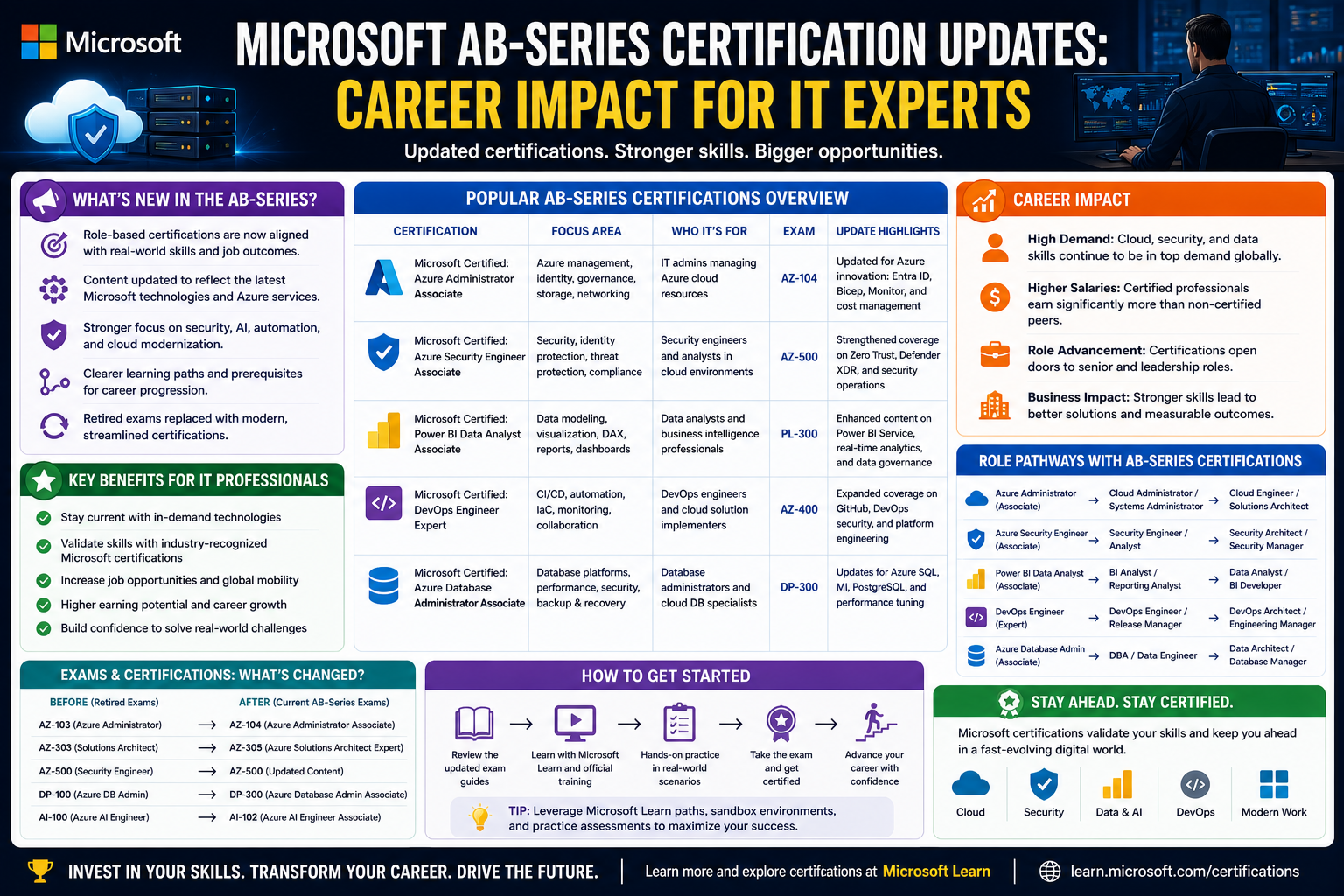
Microsoft’s certification ecosystem has undergone a noticeable transformation in recent years, and the introduction of the AB-Series represents one of the most significant changes in its approach to professional validation. Rather than focusing primarily on individual products or isolated technical tools, the new direction emphasizes the ability to design, manage, and optimize complete artificial intelligence systems within enterprise environments.
This shift reflects a broader change in how organizations operate. Businesses are no longer just adopting AI as an add-on feature or a productivity enhancement tool. Instead, AI is becoming deeply embedded into core workflows, decision-making systems, customer engagement platforms, and internal operations. As a result, professionals are expected to understand not just how a tool works, but how multiple AI systems interact, evolve, and support large-scale business goals.
The AB-Series certifications are designed to align with this reality. They prioritize system thinking, orchestration of AI agents, governance frameworks, and the ability to connect technical capabilities with measurable business outcomes. This marks a clear departure from earlier certification models that were often centered on specific platforms or standalone services.
At the heart of this transformation is the idea that modern IT professionals must think like architects of intelligent systems rather than operators of individual technologies. The AB-Series reflects this expectation by blending technical AI knowledge with strategic business alignment.
Why Microsoft Is Restructuring Its Certification Pathways
The decision to retire several older certifications and introduce the AB-Series is not accidental. It is driven by the rapid acceleration of AI adoption across industries and the increasing complexity of digital ecosystems.
Traditional certifications often focused on discrete skills such as database management, infrastructure configuration, or application deployment. While these skills remain important, they no longer represent the full scope of responsibilities required in modern enterprise environments. Today’s organizations are deploying interconnected AI systems that span cloud platforms, business applications, automation engines, and user-facing copilots.
Microsoft’s restructuring reflects the need for professionals who can operate within this interconnected landscape. Instead of validating knowledge of a single product, the AB-Series emphasizes the ability to design solutions that combine multiple AI services into unified, intelligent workflows.
Another key factor behind this shift is the rise of agentic AI systems. These systems are capable of making decisions, executing tasks, and collaborating with other AI agents with minimal human intervention. Managing such systems requires a new set of competencies, including ethical oversight, governance modeling, risk evaluation, and performance optimization.
By introducing certifications focused on these capabilities, Microsoft is aligning its training ecosystem with the next generation of enterprise technology rather than maintaining a focus on legacy tool-based expertise.
Understanding Agentic AI and Multi-Agent Systems
To fully understand the AB-Series certifications, it is important to grasp the concept of agentic AI. Unlike traditional AI models that respond to individual prompts or perform isolated tasks, agentic AI systems operate with a degree of autonomy. They can plan, execute, and adapt their actions based on evolving conditions and objectives.
In enterprise environments, these AI agents are often designed to work together. This creates what is known as a multi-agent system, where different AI components collaborate to complete complex workflows. One agent may handle data analysis, another may manage customer interactions, and a third may optimize operational decisions in real time.
The value of such systems lies in their ability to function as coordinated digital ecosystems rather than isolated tools. However, this also introduces new challenges. Coordination between agents must be carefully designed to avoid conflicts, inefficiencies, or unintended outcomes. Security, compliance, and governance also become significantly more complex when multiple autonomous systems are operating simultaneously.
The AB-Series certifications are structured around this emerging reality. They aim to equip professionals with the ability to design, deploy, and manage these interconnected AI environments while ensuring they remain secure, efficient, and aligned with business goals.
Microsoft 365 Certified: Copilot and Agent Administration Fundamentals
The entry point into the AB-Series ecosystem is the Microsoft 365 Certified: Copilot and Agent Administration Fundamentals certification. This credential is designed for professionals who are responsible for managing AI-powered productivity tools and ensuring their proper configuration within organizational environments.
At this level, the focus is not on designing complex AI systems but on understanding how AI agents function within existing platforms. This includes managing access controls, configuring Copilot features, monitoring usage patterns, and ensuring that AI tools operate within defined governance boundaries.
One of the key aspects of this certification is the emphasis on operational oversight. Professionals are expected to understand how AI agents interact with user data, how permissions affect system behavior, and how to maintain compliance with organizational policies.
Although this certification is considered foundational, it plays a critical role in establishing the groundwork for more advanced roles. Without a clear understanding of how AI agents are administered and controlled, it becomes difficult to progress into system design or strategic implementation.
This certification also introduces candidates to the basic principles of AI governance. This includes understanding data boundaries, ethical considerations, and monitoring frameworks that ensure responsible AI usage within enterprise environments.
Microsoft Certified: AI Business Professional and Workflow Integration
The next level in the AB-Series is the Microsoft Certified: AI Business Professional certification. This credential is designed for individuals who operate at the intersection of business strategy and AI implementation.
Rather than focusing on technical configuration, this certification emphasizes the application of AI within real-world business workflows. Professionals at this level are expected to identify opportunities where AI can improve efficiency, reduce costs, or enhance decision-making processes.
A significant part of this role involves communication between business stakeholders and technical teams. AI Business Professionals must translate organizational goals into actionable AI use cases and ensure that technical implementations align with those objectives.
This certification also introduces the concept of workflow optimization through AI integration. Instead of treating AI as a standalone tool, candidates learn how to embed AI capabilities into existing business processes. This might include automating customer support workflows, enhancing data analysis pipelines, or improving internal reporting systems.
Another important aspect of this certification is the focus on collaboration. AI Business Professionals often work alongside developers, architects, and data specialists to ensure that AI solutions are both technically feasible and strategically valuable.
This role represents a crucial bridge between business needs and technical execution, making it a key component of the AB-Series ecosystem.
Microsoft Certified: AI Transformation Leader and Enterprise Strategy
At a more advanced level, the Microsoft Certified: AI Transformation Leader certification focuses on organizational change and strategic leadership. This certification is intended for professionals who are responsible for guiding entire organizations through AI adoption and transformation initiatives.
Unlike the previous certifications, which focus on specific tools or workflows, this credential emphasizes long-term strategic planning. Candidates are expected to understand how AI impacts business models, operational structures, workforce dynamics, and competitive positioning.
A central theme of this certification is governance at scale. As organizations deploy multiple AI systems across different departments, maintaining consistency, compliance, and ethical alignment becomes increasingly complex. AI Transformation Leaders are responsible for establishing frameworks that ensure AI usage remains aligned with organizational values and regulatory requirements.
This certification also explores the concept of measurable business impact. Rather than evaluating AI based on technical performance alone, leaders must assess how AI contributes to revenue growth, operational efficiency, customer satisfaction, and innovation outcomes.
Change management is another critical component. Introducing AI systems into an organization often requires shifts in roles, processes, and cultural expectations. AI Transformation Leaders must be able to guide these transitions effectively while minimizing disruption and resistance.
This certification positions professionals as strategic decision-makers who shape the direction of AI adoption at the enterprise level.
Microsoft Certified: Agentic AI Business Solutions Architect and System Design
The most advanced certification within the AB-Series is the Microsoft Certified: Agentic AI Business Solutions Architect credential. This certification represents the highest level of system design expertise within the framework.
Professionals at this level are responsible for designing end-to-end AI ecosystems that integrate multiple agents, platforms, and business processes. This includes defining how AI components interact, how data flows between systems, and how decisions are executed across different layers of the organization.
A key focus of this certification is multi-agent orchestration. Candidates must understand how to coordinate multiple AI agents so that they operate collaboratively rather than independently. This requires careful design of communication protocols, task distribution mechanisms, and conflict resolution strategies.
Security and governance are also central to this role. Architecting AI systems involves ensuring that sensitive data is protected, access is properly controlled, and compliance requirements are consistently met across all components of the system.
Another important dimension is performance optimization. AI systems must be designed not only to function correctly but also to operate efficiently at scale. This includes managing computational resources, optimizing response times, and ensuring reliability under varying workloads.
This certification represents the culmination of the AB-Series pathway, bringing together technical expertise, strategic thinking, and system-level design capabilities.
Evolution from Product-Based to System-Based Certification Philosophy
The introduction of the AB-Series marks a fundamental philosophical shift in how Microsoft defines professional competency. Earlier certification models were largely built around individual products, services, or narrowly defined technical domains. Professionals would typically specialize in a single technology area such as infrastructure administration, database management, security configuration, or application deployment.
While this approach was effective during a period when enterprise systems were more isolated and modular, it has become less suitable for today’s interconnected digital environments. Modern organizations rely on complex ecosystems where cloud platforms, AI services, automation tools, and business applications operate as unified systems rather than standalone components.
The AB-Series reflects a transition from product-centric learning to system-centric thinking. Instead of validating whether a professional understands a specific tool, the new model evaluates whether they can design and manage integrated AI ecosystems that function across multiple platforms and business domains.
This shift is particularly important in the context of artificial intelligence. AI is no longer an isolated feature embedded in applications. It is becoming a foundational layer that influences decision-making, process automation, and strategic planning across entire organizations. As such, professionals must be able to think in terms of systems, interactions, dependencies, and outcomes rather than isolated technical tasks.
The AB-Series certification philosophy emphasizes adaptability, integration, and orchestration. These qualities are essential for managing environments where AI agents, cloud infrastructure, and business applications continuously interact and evolve.
Skills Framework Behind AB-Series Certifications
The AB-Series is structured around a multi-dimensional skills framework that goes beyond traditional technical competency models. Instead of focusing solely on technical execution, it integrates three core skill domains: technical AI capability, business alignment, and governance oversight.
Technical AI capability involves understanding how AI systems function at a structural level. This includes knowledge of machine learning workflows, generative AI models, agent-based systems, and automation frameworks. Professionals are expected to understand how AI components are configured, deployed, and optimized within enterprise environments.
Business alignment focuses on the ability to connect AI systems to organizational goals. This requires understanding business processes, operational efficiency metrics, customer experience design, and strategic planning. Professionals must be able to translate business needs into AI-driven solutions that deliver measurable value.
Governance oversight ensures that AI systems operate responsibly, securely, and in compliance with organizational and regulatory standards. This includes data protection, ethical AI usage, monitoring frameworks, and risk management strategies.
These three domains are deeply interconnected. A technically sound AI system that lacks business alignment may fail to deliver value. Similarly, a well-aligned business solution without governance oversight may introduce risks or compliance issues. The AB-Series framework ensures that professionals develop a balanced understanding across all three dimensions.
This integrated skills model represents a departure from traditional certification structures, where technical and business skills were often treated as separate learning tracks. In the AB-Series ecosystem, they are treated as interdependent components of a unified professional capability.
Deep Dive into Agentic AI Workflows in Enterprise Environments
Agentic AI workflows represent one of the most transformative concepts within the AB-Series framework. These workflows are built around autonomous or semi-autonomous AI agents that can perform tasks, make decisions, and collaborate with other agents to achieve complex objectives.
In enterprise environments, agentic workflows are designed to handle processes that traditionally required human coordination across multiple systems. For example, an AI agent might analyze customer data, another might generate insights, and a third might trigger automated actions based on predefined business rules.
What makes these workflows particularly powerful is their ability to operate continuously and adapt dynamically to changing conditions. Unlike static automation scripts, agentic systems can respond to new inputs, re-prioritize tasks, and adjust their behavior based on contextual understanding.
Within the AB-Series framework, professionals are trained to design these workflows in a structured and controlled manner. This involves defining agent roles, establishing communication protocols, and ensuring that each agent operates within clearly defined boundaries.
A key challenge in agentic workflows is maintaining coordination. When multiple AI agents operate simultaneously, there is a risk of overlapping actions, conflicting decisions, or inefficient resource usage. Designing effective workflows requires careful planning of task delegation, dependency management, and feedback loops.
Another important aspect is observability. Organizations must be able to monitor how agents are performing, what decisions they are making, and how those decisions impact business outcomes. Without proper observability, agentic systems can become difficult to manage or troubleshoot.
The AB-Series emphasizes the importance of designing agentic workflows that are not only functional but also transparent, controllable, and auditable.
Multi-Agent Orchestration and Design Thinking
Multi-agent orchestration is one of the most advanced concepts within the AB-Series ecosystem. It refers to the coordination of multiple AI agents working together to achieve shared objectives across complex environments.
Unlike traditional automation systems, where processes are linear and predefined, multi-agent systems operate in a distributed and dynamic manner. Each agent may have its own responsibilities, decision-making capabilities, and data access permissions.
Designing such systems requires a shift in thinking from procedural logic to system orchestration. Professionals must consider how agents communicate, how tasks are distributed, and how outcomes are aggregated into meaningful results.
One of the core challenges in multi-agent orchestration is ensuring consistency. When multiple agents are working on related tasks, their outputs must align with overall system objectives. This requires the establishment of shared context models and coordination protocols.
Another challenge is conflict resolution. In some cases, different agents may generate competing recommendations or attempt to execute conflicting actions. The system must include mechanisms for prioritization and decision arbitration.
Design thinking plays a critical role in addressing these challenges. Instead of focusing solely on technical implementation, professionals must consider user experience, business impact, and operational efficiency. This includes mapping workflows visually, identifying potential failure points, and designing systems that are resilient under varying conditions.
The AB-Series encourages a holistic approach to system design, where technical architecture and business logic are developed in parallel rather than in isolation.
Integration of Azure AI, Copilot Studio, Power Platform, and Dynamics 365
A defining characteristic of the AB-Series ecosystem is its integration across multiple Microsoft platforms. Rather than treating Azure AI, Copilot Studio, Power Platform, and Dynamics 365 as separate technologies, the certification framework emphasizes their combined use in building enterprise AI systems.
Azure AI serves as the foundational layer for machine learning models, cognitive services, and generative AI capabilities. It provides the computational and analytical backbone for AI-driven applications.
Copilot Studio enables the creation and customization of AI copilots that interact with users and systems. These copilots act as intelligent interfaces that can execute tasks, provide insights, and interact with enterprise data in natural language.
Power Platform introduces low-code and no-code capabilities for building automated workflows and business applications. It plays a key role in connecting AI agents with business processes, enabling rapid deployment of intelligent automation.
Dynamics 365 provides the business application layer, covering areas such as customer relationship management, enterprise resource planning, and operational management. AI integration within this platform allows organizations to enhance decision-making and automate complex business functions.
The AB-Series certifications emphasize the importance of understanding how these platforms interact. Professionals are expected to design solutions that leverage multiple services simultaneously, creating unified AI ecosystems rather than isolated implementations.
This integrated approach reflects the reality of modern enterprise environments, where business value is created through the combination of multiple technologies working together seamlessly.
Security, Ethics, and Governance in AI Systems
As AI systems become more autonomous and interconnected, security and governance become increasingly critical. The AB-Series places strong emphasis on ensuring that professionals understand how to manage these risks effectively.
Security in AI systems involves protecting data, controlling access, and ensuring that AI agents operate within authorized boundaries. This includes implementing identity management systems, encryption protocols, and monitoring tools that detect anomalous behavior.
Ethical considerations are equally important. AI systems must be designed to operate fairly, transparently, and without introducing unintended bias or harm. This requires careful selection of training data, continuous monitoring of outcomes, and the ability to intervene when necessary.
Governance frameworks provide the structural foundation for managing AI systems at scale. These frameworks define how AI systems are deployed, monitored, and evaluated across the organization. They also establish accountability structures that determine who is responsible for different aspects of AI operation.
Within the AB-Series, governance is not treated as an afterthought but as a core design principle. Professionals are expected to integrate governance mechanisms directly into AI system architecture rather than applying them as external controls.
This approach ensures that AI systems remain manageable, compliant, and aligned with organizational values throughout their lifecycle.
Mapping AB-Series Certifications to Job Roles and Career Paths
The AB-Series introduces a structured alignment between certification levels and real-world job roles. Each certification corresponds to a specific set of responsibilities within an AI-driven enterprise environment.
At the foundational level, professionals typically operate in administrative or support roles where they manage AI tools and ensure their proper configuration. These roles focus on operational stability and system oversight.
At the intermediate level, individuals often work as business analysts, solution consultants, or workflow designers. Their primary responsibility is to identify opportunities for AI integration and translate business requirements into functional solutions.
At the advanced level, professionals transition into leadership roles where they guide AI adoption strategies, manage transformation initiatives, and oversee organizational change. These roles require a combination of technical understanding and strategic vision.
At the highest level, AI architects design and manage entire AI ecosystems. They are responsible for ensuring that multiple systems work together efficiently, securely, and in alignment with business objectives.
This structured mapping allows organizations to build clear career progression paths while ensuring that skill development aligns with real-world responsibilities.
Transition Strategy from Legacy Certification Models
The introduction of the AB-Series also raises important considerations for professionals transitioning from older certification frameworks. Many existing certifications focused on specific technologies that are now being restructured or retired as part of Microsoft’s broader shift toward AI-centric systems.
For professionals with legacy certifications, the transition involves more than simply updating credentials. It requires a shift in mindset from product-specific expertise to system-level thinking. This includes developing a deeper understanding of AI integration, orchestration, and governance.
One of the key challenges in this transition is bridging knowledge gaps between traditional IT roles and AI-focused responsibilities. While foundational technical skills remain relevant, they must now be applied within more complex and dynamic environments.
Organizations are increasingly encouraging professionals to adopt a layered learning approach, where foundational knowledge is gradually expanded into more advanced AI system design capabilities. This ensures a smoother transition and reduces the risk of skill obsolescence.
The AB-Series provides a structured pathway for this evolution, enabling professionals to progressively build expertise in AI-driven enterprise environments.
Industry Adoption Patterns and Organizational Impact
Across industries, the adoption of AI systems is reshaping how organizations operate. In sectors such as finance, healthcare, manufacturing, and retail, AI is being used to optimize decision-making, automate processes, and enhance customer experiences.
In financial services, AI systems are used for risk analysis, fraud detection, and automated advisory services. These systems rely heavily on multi-agent coordination to analyze large volumes of data and generate actionable insights.
In healthcare, AI supports diagnostic processes, patient management, and operational efficiency. Agentic systems can assist in monitoring patient conditions and recommending treatment options based on real-time data.
In manufacturing, AI is used to optimize supply chains, predict maintenance needs, and improve production efficiency. Multi-agent systems coordinate across different stages of the production process to ensure smooth operations.
In retail and customer service environments, AI enhances personalization, automates support interactions, and improves inventory management. Copilot systems and AI agents work together to deliver seamless customer experiences.
These industry applications highlight the growing importance of professionals who can design and manage integrated AI systems, reinforcing the relevance of the AB-Series framework in modern enterprise environments.
The Strategic Role of AI in Modern Enterprise Architecture
The introduction of the AB-Series certifications reflects more than a change in credential structure; it signals a broader transformation in how organizations design and operate their digital environments. Artificial intelligence is no longer being positioned as a supporting technology but as a foundational layer in enterprise architecture.
In traditional IT environments, systems were typically built in layers that separated infrastructure, applications, and business logic. Each layer had distinct responsibilities and was often managed by specialized teams. However, the rise of AI—especially agentic and generative systems—has begun to blur these boundaries.
Modern enterprise architecture increasingly revolves around intelligent systems that can perceive data, interpret context, make decisions, and execute actions. These capabilities are distributed across multiple interconnected components rather than centralized in a single application or service.
The AB-Series certifications align with this architectural shift by emphasizing system-wide thinking. Professionals are expected to understand how AI agents interact with cloud infrastructure, business applications, and user interfaces simultaneously. This requires a departure from siloed thinking toward a holistic understanding of enterprise ecosystems.
A key aspect of this transformation is the move toward adaptive architecture. Instead of static systems that require manual updates and reconfiguration, organizations are deploying AI-driven environments that can adjust dynamically based on workload, user behavior, and business priorities.
This adaptive nature introduces both opportunities and challenges. While it increases efficiency and scalability, it also requires new approaches to monitoring, governance, and control. The AB-Series prepares professionals to operate within these evolving architectural models by focusing on orchestration, observability, and governance as core competencies.
Enterprise AI Governance and Responsible System Design
As AI systems become more deeply embedded in organizational operations, governance has emerged as one of the most critical areas of focus. Unlike traditional software systems, AI introduces a level of unpredictability due to its ability to learn, adapt, and generate outcomes dynamically.
Governance in this context refers to the frameworks, policies, and mechanisms that ensure AI systems behave in a predictable, ethical, and compliant manner. This includes controlling data access, monitoring decision-making processes, and ensuring transparency in automated actions.
One of the central challenges in AI governance is maintaining accountability. When multiple AI agents are operating autonomously, it can become difficult to determine how specific decisions were made or which component was responsible for a particular outcome. To address this, organizations must implement traceability mechanisms that record system actions and decision pathways.
Another important aspect is fairness and bias mitigation. AI systems are only as reliable as the data they are trained on. If training data contains biases, those biases can be amplified through automated decision-making processes. Governance frameworks must therefore include continuous evaluation of model behavior and data integrity.
Security is also tightly linked to governance. AI systems often interact with sensitive organizational data, making them potential targets for exploitation if not properly secured. This includes protecting against unauthorized access, adversarial manipulation, and data leakage.
The AB-Series emphasizes governance as an integral part of system design rather than a post-deployment consideration. Professionals are trained to embed governance controls directly into AI architectures, ensuring that oversight is built into the system from the ground up.
The Rise of AI Orchestration Layers in Enterprise Systems
One of the most significant developments in modern AI architecture is the emergence of orchestration layers. These layers act as coordination hubs that manage interactions between multiple AI agents, services, and applications.
In traditional software systems, orchestration was primarily used to manage workflows or automate sequences of tasks. In AI-driven environments, orchestration takes on a much more complex role. It must coordinate intelligent agents that are capable of independent decision-making while ensuring that their actions align with broader system objectives.
AI orchestration layers are responsible for managing task distribution, resolving conflicts between agents, and optimizing system performance. They also play a critical role in ensuring that AI systems remain responsive and adaptable under changing conditions.
Within the AB-Series framework, orchestration is a central concept, particularly at advanced certification levels. Professionals are expected to design systems where multiple AI agents can collaborate effectively without requiring constant human intervention.
This requires a deep understanding of dependency management. Each agent in a system may rely on outputs from other agents or external data sources. Orchestration layers must ensure that these dependencies are properly coordinated to avoid bottlenecks or inconsistencies.
Another key function of orchestration is resource optimization. AI systems often require significant computational power, especially when dealing with large-scale data processing or generative tasks. Orchestration layers help allocate resources efficiently to maintain system performance and cost-effectiveness.
The increasing importance of orchestration reflects the broader shift toward distributed intelligence in enterprise environments, where no single system operates in isolation.
Human-AI Collaboration and Workforce Transformation
The integration of AI into enterprise systems is not only changing technology landscapes but also transforming the nature of work itself. As AI agents take on more operational responsibilities, human roles are evolving toward supervision, strategy, and design.
Rather than replacing human workers, AI systems are increasingly functioning as collaborative partners. These systems assist in decision-making, automate repetitive tasks, and provide insights that enhance human judgment.
This shift requires a new model of human-AI collaboration. Professionals must learn how to interact with AI systems effectively, interpret their outputs, and guide their behavior when necessary. This is particularly important in environments where AI systems operate autonomously.
The AB-Series certifications reflect this transformation by emphasizing skills related to AI interaction, workflow design, and system oversight. Professionals are trained to work alongside AI agents rather than simply configuring or maintaining them.
One of the key challenges in this new environment is trust. For human-AI collaboration to be effective, users must trust that AI systems are reliable, transparent, and aligned with organizational goals. Building this trust requires consistent system behavior, clear communication of AI decisions, and robust governance mechanisms.
Another important aspect is skill augmentation. AI systems can enhance human capabilities by providing real-time insights, automating routine tasks, and enabling faster decision-making. This allows professionals to focus on higher-value activities such as strategy development and innovation.
Workforce transformation also involves reskilling and upskilling initiatives. As traditional roles evolve, organizations must invest in training programs that help employees adapt to new AI-driven workflows.
The AB-Series provides a structured framework for this transformation by defining clear skill progression paths aligned with emerging job roles in AI-centric environments.
Ethical Implications of Autonomous AI Systems
As AI systems become more autonomous, ethical considerations become increasingly important. Autonomous systems are capable of making decisions that directly impact business operations, customer experiences, and even societal outcomes.
One of the primary ethical concerns is transparency. AI systems often operate as complex models that are difficult to interpret. This can make it challenging to understand why certain decisions were made. Ensuring transparency requires the development of explainable AI techniques and clear documentation of system behavior.
Another concern is accountability. When AI systems operate autonomously, it becomes necessary to define who is responsible for their actions. This includes determining whether responsibility lies with developers, operators, or organizational leaders.
Privacy is also a critical issue. AI systems often rely on large volumes of data to function effectively. This data may include sensitive personal or organizational information. Ensuring that this data is handled responsibly is essential for maintaining trust and compliance.
There is also the risk of unintended consequences. Autonomous systems may behave in ways that were not anticipated during design or testing. This makes continuous monitoring and evaluation essential components of ethical AI deployment.
The AB-Series integrates ethical considerations into its certification framework by requiring professionals to understand not only how to build AI systems but also how to evaluate their broader impact.
Scalability Challenges in Multi-Agent AI Environments
Scalability is one of the most significant technical challenges in modern AI system design. As organizations deploy more AI agents across different functions, ensuring that these systems can scale effectively becomes increasingly complex.
Scalability involves both technical and operational dimensions. On the technical side, systems must be able to handle increased workloads without degradation in performance. This includes managing computational resources, optimizing data processing pipelines, and ensuring efficient communication between agents.
On the operational side, scalability involves maintaining consistency and control as systems grow in size and complexity. As more agents are introduced, the potential for conflicts, redundancies, and inefficiencies increases.
One of the key strategies for addressing scalability challenges is modular system design. By breaking down AI systems into independent components, organizations can scale individual parts of the system without affecting the entire architecture.
Another important strategy is distributed processing. Instead of relying on centralized systems, AI workloads are distributed across multiple nodes or environments. This improves performance and resilience while reducing bottlenecks.
The AB-Series emphasizes these principles by training professionals to design systems that are inherently scalable. This includes understanding how to structure agent interactions, manage workloads, and optimize system performance under varying conditions.
The Role of Data in AI-Driven Decision Systems
Data is the foundation of all AI systems, and its importance becomes even more pronounced in agentic environments. AI agents rely on data to make decisions, learn from outcomes, and adapt to changing conditions.
In enterprise environments, data is often distributed across multiple systems, platforms, and departments. This creates challenges related to consistency, accessibility, and quality.
One of the key responsibilities of AI system designers is ensuring that data flows efficiently between different components of the architecture. This includes establishing data pipelines, defining data formats, and implementing validation mechanisms.
Data governance also plays a critical role in ensuring that information is accurate, secure, and compliant with regulatory requirements. Poor data quality can lead to incorrect AI decisions, which may have significant business consequences.
Another important aspect is real-time data processing. Many AI systems operate in dynamic environments where decisions must be made quickly. This requires systems that can process and analyze data in real time rather than relying solely on batch processing methods.
The AB-Series integrates data management principles into its framework by emphasizing the relationship between data architecture and AI system performance.
Future Directions of Microsoft’s AI Certification Ecosystem
The AB-Series is likely to represent only the beginning of a broader transformation in Microsoft’s certification ecosystem. As AI technologies continue to evolve, certification models will need to adapt to new capabilities, tools, and architectural paradigms.
One likely direction is increased specialization within AI domains. As systems become more complex, professionals may need to develop deeper expertise in specific areas such as agent coordination, AI security, or industry-specific AI applications.
Another potential development is the integration of real-time assessment models. Instead of relying solely on traditional exam-based certification, future systems may incorporate continuous evaluation based on practical system design and performance.
There is also likely to be greater emphasis on cross-disciplinary skills. As AI becomes more integrated into business, professionals will need to combine technical knowledge with strategic, ethical, and operational expertise.
The evolution of certification frameworks will continue to reflect the changing nature of enterprise technology, where AI is no longer an optional enhancement but a core component of organizational infrastructure.
Conclusion
The introduction of Microsoft’s AB-Series certifications marks a defining moment in the evolution of IT professional development. Rather than simply updating an existing certification structure, Microsoft has fundamentally reimagined how technical expertise is defined, validated, and applied in modern enterprise environments. This shift reflects the growing reality that artificial intelligence is no longer an emerging technology at the edges of business systems—it is now becoming the central engine driving operations, decision-making, and innovation across industries.
At the core of this transformation is a clear departure from product-centric learning toward system-centric and outcome-driven thinking. Traditional certifications often measured a professional’s ability to configure, manage, or troubleshoot specific tools or platforms. While those skills remain relevant, they are no longer sufficient in a world where AI systems are deeply interconnected, adaptive, and capable of autonomous behavior. The AB-Series recognizes this shift by focusing on how professionals design and manage entire AI ecosystems rather than isolated components.
This change has significant implications for IT professionals at all levels. Entry-level roles are no longer limited to basic configuration or administrative tasks. Instead, even foundational certifications now introduce concepts such as AI governance, agent oversight, and system monitoring. As professionals progress through the certification pathway, they are gradually introduced to more complex responsibilities involving workflow orchestration, business integration, and enterprise-wide transformation strategies.
One of the most important outcomes of this new certification structure is the emphasis on agentic AI systems. These systems represent a new generation of artificial intelligence capable of acting with a degree of autonomy, coordinating tasks, and collaborating with other AI agents to achieve defined objectives. Unlike traditional automation tools, which follow static rules, agentic systems operate dynamically and adapt to changing conditions. This introduces both powerful opportunities and new challenges, particularly in areas such as governance, security, and ethical oversight.
The AB-Series prepares professionals to navigate this complexity by teaching them how to design systems that are not only functional but also controlled, transparent, and aligned with organizational objectives. This includes understanding how to structure multi-agent workflows, manage dependencies between AI components, and ensure that system outputs remain consistent and reliable. These skills are becoming essential as organizations move toward increasingly autonomous digital environments.
Another key theme of the AB-Series is the integration of AI into business strategy. Certifications such as the AI Business Professional and AI Transformation Leader highlight the importance of bridging the gap between technical implementation and organizational goals. This reflects a growing recognition that successful AI adoption is not just a technical challenge but also a strategic and cultural one. Businesses must be able to identify meaningful use cases, align AI initiatives with long-term objectives, and manage the organizational change that comes with automation and intelligent systems.
The highest level of the certification pathway, the Agentic AI Business Solutions Architect, represents the culmination of this integrated approach. Professionals at this level are expected to design complete AI ecosystems that span multiple platforms, services, and business functions. They must understand how to orchestrate complex systems involving generative AI, automation platforms, enterprise applications, and data infrastructures. More importantly, they must ensure that these systems operate securely, ethically, and efficiently at scale.
This evolution also signals a broader shift in the IT profession itself. The role of the IT professional is expanding beyond system administration and technical support into areas such as strategic planning, enterprise architecture, and organizational leadership. As AI becomes more embedded in business operations, professionals are increasingly expected to act as designers of intelligent systems rather than maintainers of static infrastructure.
For organizations, the implications are equally significant. The AB-Series reflects a future in which digital transformation is driven not by isolated technology upgrades but by holistic system redesign. Enterprises will need professionals who can think across disciplines, combining technical expertise with business insight and governance awareness. This will be essential for building scalable, secure, and effective AI-driven environments.
At the same time, the retirement of older certifications signals the end of an era in which IT skills were primarily defined by specific products or platforms. While legacy certifications still hold value in certain contexts, they are gradually being replaced by models that emphasize adaptability, integration, and system thinking. This transition may require professionals to rethink their learning paths and embrace continuous skill development as a core part of their careers.
Looking forward, the AB-Series is likely to influence not only certification structures but also how organizations approach workforce development, hiring, and project design. As AI systems continue to evolve, the demand for professionals who can operate at the intersection of technology, business, and governance will only increase. Those who develop these skills early will be well-positioned to take on leadership roles in shaping the future of enterprise AI.
Ultimately, the AB-Series represents more than a new certification track. It represents a shift in how the IT industry understands intelligence, systems, and professional capability. It acknowledges that the future of technology is not about isolated tools, but about interconnected ecosystems of intelligent agents working together to solve complex problems.