The Project Management Professional (PMP) certification is one of the most recognized credentials in the project management field. Because of its global reputation, the organization behind it, the Project Management Institute (PMI), places strong emphasis on maintaining integrity in its certification process. One of the ways it does this is through audits of selected applications. When candidates hear the word “audit,” it often triggers concern or confusion, but the PMP audit process is more structured verification than an investigation or penalty-based review.
At its core, the PMP audit is designed to confirm that the information provided in an application is accurate and supported by proper documentation. It is not meant to question a candidate’s honesty by default, nor does it assume wrongdoing. Instead, it functions as a quality control step to ensure that certification standards remain consistent across all applicants worldwide.
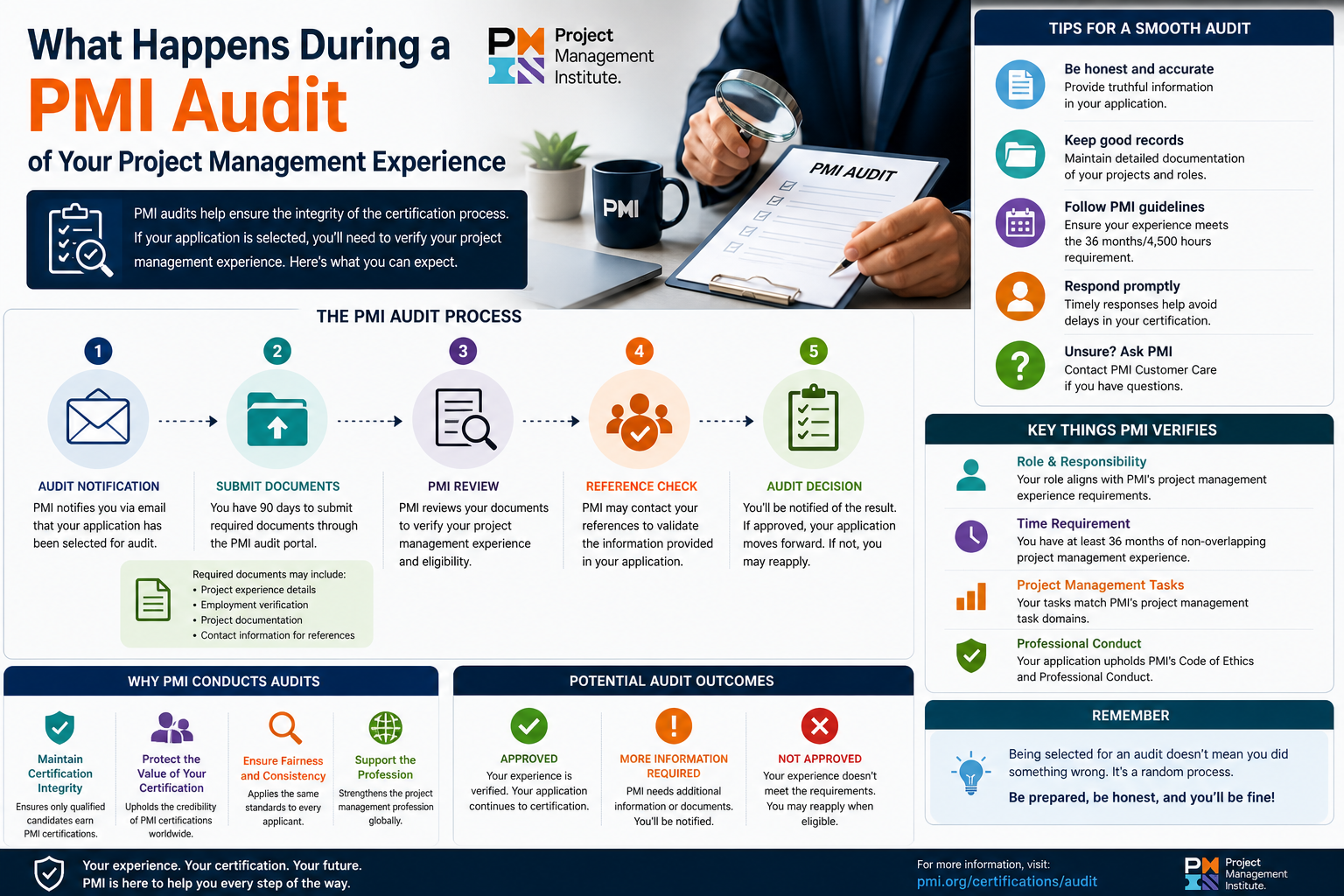
The audit process is relatively straightforward. Once an application is selected, the candidate is required to submit supporting documentation for their education, project management experience, and training hours. These documents are then reviewed to verify alignment with what was reported in the application. If everything is in order, the audit is cleared, and the candidate can proceed toward scheduling the exam.
While the process may feel formal, it is generally procedural and predictable. Many candidates complete it without major complications, especially when their application information is accurate and well-documented.
Why PMI Conducts Audits in the First Place
To understand the PMP audit properly, it is important to look at why it exists. PMI operates globally, and its certifications are used across industries, companies, and countries. Because of this scale, maintaining consistency and credibility is essential. Without verification steps, the value of the certification could be questioned.
The audit process helps ensure that every certified professional meets the same baseline requirements. Project management experience, in particular, can be subjective when self-reported. Different organizations describe roles differently, and responsibilities can vary widely from one workplace to another. The audit helps confirm that the experience submitted meets PMI’s standardized definitions.
Another reason audits exist is to protect the integrity of the certification itself. PMP certification is often used as a benchmark for hiring, promotions, and professional credibility. If inaccurate applications were accepted without review, it could reduce trust in the certification overall.
It is also important to understand that audits are not triggered by suspicion. They are part of a structured selection system, meaning even highly qualified and experienced professionals can be chosen. The process is designed to be impartial rather than targeted.
How Audit Selection Actually Works
A common misconception is that PMP audits are triggered by errors, inconsistencies, or red flags in an application. In reality, selection is generally random. Applicants from different regions, industries, and experience levels may be chosen without any specific pattern.
This randomness is intentional. If audits were only triggered by questionable applications, it could encourage attempts to “game” the system. A random selection model ensures fairness and keeps the certification process consistent for all candidates.
Because of this approach, being selected for audit is not an indication that something is wrong with the application. Many candidates who are fully qualified and accurately documented still go through the audit process. It is simply part of the broader quality assurance system.
Once selected, candidates are notified through their PMI account. From that moment, they are required to begin submitting the requested documentation within a specified timeframe.
What Happens Immediately After Being Selected
The moment a candidate is selected for audit, the application status changes and instructions become available. The candidate is then required to gather and submit supporting documents that verify the claims made in the application.
This typically includes signed experience verification forms, proof of education, and documentation of project management training hours. Each section of the application must be supported with evidence that confirms its accuracy.
One of the most important things at this stage is timing. PMI usually provides a clear deadline for submission. Candidates are expected to respond within that window. Delays or failure to respond can lead to application denial, not because of the content itself, but due to non-compliance with the process.
Despite the structured nature of this step, it is not meant to be overwhelming. Most candidates already possess the required documentation, especially if they have maintained professional records throughout their careers.
Types of Documents Required for PMP Audit
The PMP audit process focuses on three main areas: education, project management experience, and formal training in project management.
Education verification usually involves submitting copies of diplomas, degrees, or equivalent academic qualifications. These documents confirm that the candidate meets the educational requirements necessary for eligibility.
Experience verification is more detailed. Candidates must provide signed confirmation of their project management experience. This often includes documentation from supervisors, managers, or organizational representatives who can validate the work performed. The focus is not only on job titles but on actual project involvement and responsibilities.
Training verification is used to confirm that the candidate has completed the required number of formal project management education hours. This may include certificates or completion records from structured training programs.
Each of these categories must align with what was originally submitted in the application. Consistency is key, and discrepancies can slow down or complicate the review process.
Verifying Project Management Experience
One of the most important parts of the PMP audit is the verification of project management experience. This section often requires the most attention because project work can vary significantly between roles and organizations.
PMI is looking for evidence that the candidate has actively participated in leading or directing projects, rather than simply being involved in general operational work. This distinction is important because the PMP certification is designed for professionals who have hands-on project leadership experience.
Experience verification forms typically require signatures from supervisors or managers who can confirm the accuracy of the reported work. In some cases, HR departments may also be involved in providing confirmation.
Candidates are expected to ensure that the descriptions provided in their application match the information that can be reasonably verified. Clear, consistent documentation makes this process smoother and reduces the likelihood of delays.
Education Verification and Its Role in the Audit
Education verification is usually more straightforward than experience verification. Candidates are asked to provide proof of their academic qualifications, such as diplomas or degree certificates.
The purpose of this step is to confirm that the candidate meets the minimum educational requirement set by PMI. This requirement may vary depending on whether the candidate holds a secondary or post-secondary degree, but the audit ensures that the stated qualification is genuine.
In most cases, this step does not require additional explanation or interpretation. As long as the documentation is clear and matches the application details, it is typically processed without complications.
Digital copies are commonly accepted, which makes it easier for candidates to submit the required proof quickly. However, clarity and readability of documents remain important.
Common Mistakes Candidates Make During Audit
Although the PMP audit process is not designed to be difficult, some candidates face challenges due to avoidable mistakes. One common issue is delay in submission. Since PMI provides a limited timeframe, waiting too long to gather documents can create unnecessary stress.
Another frequent mistake is incomplete documentation. Candidates sometimes submit partial forms or fail to obtain proper signatures from supervisors. This can slow down the verification process and may require additional communication.
Inconsistency between application details and supporting documents is another issue. If the project descriptions in the application do not match what is being verified, auditors may request clarification. While this does not automatically lead to rejection, it can extend the review time.
Some candidates also underestimate the importance of preparation before applying. Keeping accurate records of project work, training, and education throughout one’s career can make the audit process significantly easier.
How Auditors Review Submitted Information
The audit review process is systematic. Auditors check whether the submitted documentation aligns with the application details. They focus on consistency, authenticity, and completeness.
They are not evaluating a candidate’s performance or judging the quality of their work. Instead, the goal is to confirm that the reported experience and qualifications are genuine and verifiable.
If the documentation matches the application and is properly completed, the audit is typically cleared without further questions. If there are discrepancies or missing information, candidates may be asked to provide clarification or additional proof.
The review process is structured to be fair and standardized, ensuring that all candidates are evaluated using the same criteria.
Timelines and Expectations During the Audit Process
The PMP audit process is generally time-sensitive but not lengthy. Once documentation is submitted, the review period typically takes about a week, although this can vary depending on volume and completeness of the submission.
During this time, candidates are expected to remain responsive in case additional information is requested. However, most audits are completed without multiple rounds of communication.
It is important for candidates to understand that the audit does not pause the overall certification journey. Instead, it is a checkpoint that must be completed before proceeding to the exam scheduling stage.
Maintaining organization and responding promptly are key factors in ensuring a smooth experience.
Emotional Response and Reality of Being Audited
Many candidates initially feel anxious when they learn they have been selected for audit. The formal nature of the process and the use of the word “audit” can create unnecessary stress. However, in practical terms, the process is administrative rather than adversarial.
Being selected does not reflect negatively on a candidate’s application. It does not imply suspicion or wrongdoing. Instead, it reflects the structured quality assurance approach used by PMI to maintain certification standards.
Once candidates begin gathering and submitting their documents, the process often becomes more manageable than expected. Most discover that they already have the necessary information available and only need to organize it properly.
Preparing Before You Even Submit an Application
One of the most effective ways to handle a potential audit smoothly is preparation before submitting the PMP application. Keeping detailed records of project involvement, maintaining signed documentation from supervisors, and organizing educational certificates can significantly reduce stress later.
Candidates who treat documentation as part of their professional routine are often better prepared for audits, even if they are selected unexpectedly. This proactive approach ensures that when verification is required, everything is already in place.
Careful preparation also helps ensure accuracy in the application itself. When information is well-documented, it is easier to present consistent and verifiable details, which naturally aligns with audit expectations.
Preparing Documentation Strategy for a Smooth Audit Response
Once a PMP audit notification arrives, the most important shift in mindset is moving from uncertainty to structured action. The audit process is heavily document-driven, which means success depends less on interpretation and more on organization. A strong documentation strategy can significantly reduce delays and prevent unnecessary back-and-forth during verification.
The first step in building this strategy is identifying every requirement clearly. PMI typically requests evidence in three categories, but within those categories, details matter. It is not enough to simply provide proof of employment or education. The documents must align precisely with what was declared in the application, including dates, roles, responsibilities, and training hours.
Many candidates find it helpful to treat the audit as a file compilation exercise rather than a review of eligibility. This mindset removes emotional pressure and replaces it with task-oriented focus. Each document becomes a piece of evidence that supports a previously submitted claim.
Consistency is the core principle. Even small mismatches in job titles or project timelines can create confusion during review. Therefore, candidates are encouraged to cross-check their application line by line against their supporting documents before submission.
Understanding How Project Experience Is Interpreted
Project management experience is not assessed based on job titles alone. One of the most important aspects of the PMP audit is understanding how PMI interprets project involvement. Many professionals assume that having “project manager” in their job title is sufficient, but the reality is more nuanced.
PMI focuses on the nature of the work performed rather than the designation. This means that even individuals without formal project manager titles may qualify if they have led or directed project activities. Conversely, individuals with project manager titles may still need to demonstrate that their responsibilities align with PMI’s definition of project leadership.
During the audit, experience descriptions are examined to confirm that they reflect structured project work. This includes planning, execution, monitoring, controlling, and closing of projects. The emphasis is on actual involvement in project lifecycle activities.
Candidates who clearly articulate their roles in their application often experience smoother audits because their documentation naturally aligns with PMI’s expectations. Vague descriptions, on the other hand, can create additional scrutiny.
Handling Supervisor and Manager Verification
One of the most sensitive parts of the PMP audit process involves obtaining verification from supervisors or managers. This step can become complicated depending on employment history, organizational structure, or personal circumstances.
In many cases, candidates are still in contact with their current or former managers, which makes the process straightforward. A simple request for confirmation and signature is usually sufficient. However, challenges arise when managers have changed roles, left the organization, or are no longer reachable.
When direct contact is available, clarity is essential. Candidates should explain that the request is part of a formal certification audit and that verification is required to confirm documented experience. Most professionals in management roles understand the importance of such requests and cooperate accordingly.
In situations where supervisors are no longer accessible, candidates may need to rely on HR departments or alternative documentation. Some organizations maintain detailed employment records that can serve as supporting evidence.
The key principle is not who signs the document, but whether the experience can be reliably verified through credible sources.
When Old Projects and Teams Are No Longer Accessible
A common concern during the PMP audit process is the inability to reach former colleagues or project stakeholders. Over time, professionals change jobs, teams dissolve, and organizational structures evolve. This can make direct verification difficult.
However, lack of access does not automatically create a problem. PMI understands that professional environments change, and not all historical project participants remain reachable. In such cases, candidates are encouraged to focus on available evidence.
Alternative documentation may include employment verification letters, archived project reports, internal records, or any formal documentation that confirms involvement in project work. Even email confirmations from organizational representatives can sometimes help support claims.
In some cases, candidates may also rely on LinkedIn or professional networks to reconnect with former colleagues. While this is not a formal requirement, it can be a practical solution when other options are limited.
The important factor is demonstrating credibility through available records, even if direct supervisor signatures are not possible.
The Role of HR Departments in Audit Verification
Human Resources departments often play an important role in supporting PMP audit documentation. Many organizations maintain structured employment records that can validate job roles, durations, and responsibilities.
HR verification is especially useful when direct managerial confirmation is unavailable. Since HR departments are responsible for maintaining official employee records, their documentation is generally considered reliable.
In some organizations, HR may issue standardized experience letters that confirm employment history and job functions. These letters can serve as strong supporting evidence during the audit process.
However, not all organizations are equally responsive or familiar with certification audits. In such cases, candidates may need to provide guidance on what is required or submit alternative documentation.
The effectiveness of HR support often depends on how well the organization maintains its internal recordkeeping systems.
International Candidates and Cross-Border Documentation Challenges
The PMP certification is globally recognized, which means candidates come from diverse regions and professional environments. This global nature introduces variations in documentation standards, language, and organizational practices.
International candidates may face challenges such as non-standard employment letters, different academic documentation formats, or language translation requirements. These differences can sometimes complicate the audit process, especially when documents do not follow a uniform structure.
In such cases, clarity becomes even more important than format. Documents must clearly communicate the necessary information, even if formatting differs from region to region.
Translation may be required when documents are not in English. The goal is to ensure that auditors can accurately understand the content without ambiguity.
Despite these variations, the audit process remains consistent in its expectations. The focus is always on verifying authenticity and alignment with application details.
What Happens When Documentation Is Incomplete
Incomplete documentation is one of the most common issues encountered during PMP audits. This can include missing signatures, unclear employment verification, or insufficient proof of training hours.
When documentation is incomplete, PMI may request additional information. This does not automatically result in rejection, but it does extend the review timeline. Candidates are usually given an opportunity to correct or supplement missing elements.
The key to avoiding this situation is thorough preparation before submission. Each document should be reviewed carefully to ensure it meets all requirements. Even small omissions, such as missing dates or unclear job descriptions, can create unnecessary delays.
In many cases, candidates discover that most issues arise not from lack of qualification, but from incomplete presentation of valid information.
Misunderstandings About Audit Outcomes
There are several misconceptions surrounding PMP audit outcomes. One of the most common is the belief that being audited is a negative reflection on an application. In reality, audit selection is not based on suspicion or performance evaluation.
Another misconception is that audits are used to disqualify candidates. While it is true that applications can be rejected if documentation is not provided or verified, this is a procedural outcome rather than a subjective judgment.
Some candidates also believe that audits are rare or unusual. In fact, audits are a standard part of the certification process and occur regularly across all applicant groups.
Understanding these misconceptions helps reduce unnecessary anxiety and allows candidates to approach the process with a more balanced perspective.
Communication During the Audit Process
Clear and timely communication plays an important role in the audit process. Once selected, candidates may need to interact with PMI through formal channels to submit documents or respond to requests.
Communication during this stage should be precise and organized. Since the process is documentation-driven, clarity is more important than explanation. Each submission should directly address the requirement without unnecessary elaboration.
In cases where clarification is needed, responses should focus on factual information. The goal is to ensure that auditors can easily verify the information without ambiguity.
Delays in communication can affect the overall timeline, so timely responses are essential.
Understanding Audit Clearance and What It Means
When an audit is successfully completed, the candidate’s application is marked as verified. This clearance confirms that the submitted information aligns with PMI’s requirements and that the candidate is eligible to proceed in the certification process.
Audit clearance is not a separate certification achievement, but rather a confirmation step. It allows candidates to move forward to the next phase, which typically involves scheduling and taking the exam.
For many candidates, receiving audit clearance brings relief because it confirms that their documentation has been successfully validated. It also reinforces the importance of maintaining accurate professional records.
The clearance process is generally straightforward when documentation is complete and consistent.
When Audit Issues Require Additional Review
In some cases, audit reviews may take longer due to inconsistencies or missing details. When this happens, PMI may request additional clarification or supporting documents.
This does not necessarily indicate a problem with the application. It simply means that further verification is needed to ensure accuracy.
Candidates are typically given instructions on what additional information is required. Responding promptly and accurately is essential in these situations.
Extended review periods can be frustrating, but they are usually resolved once the required information is provided.
Reapplication After Audit Failure
If a candidate does not successfully complete the audit process, there are consequences related to reapplication timelines. In such cases, candidates may be required to wait before submitting a new application.
This waiting period is designed to ensure that applicants take sufficient time to prepare accurate and complete documentation before reapplying.
Although this outcome can be disappointing, it is relatively uncommon when candidates provide accurate information and complete documentation from the beginning.
The reapplication process also serves as an opportunity to strengthen recordkeeping practices and improve documentation clarity for future attempts.
Building Long-Term Documentation Habits for Project Professionals
Beyond the audit itself, the PMP verification process highlights an important professional habit: maintaining organized documentation throughout one’s career. Project management roles often involve complex responsibilities, multiple stakeholders, and evolving project scopes.
Keeping detailed records of project involvement, responsibilities, and outcomes can significantly simplify future certification or professional verification processes.
This habit also supports career development beyond certification. Well-documented experience makes it easier to demonstrate expertise during job applications, promotions, and performance evaluations.
Over time, structured documentation becomes a professional asset that reduces uncertainty in formal verification processes.
Common Myths About PMP Audits
There are several myths that circulate about PMP audits, often causing unnecessary concern among candidates. One common myth is that audits are based on random suspicion of inaccurate applications. While selection is random, it is not based on assumptions about individual candidates.
Another myth is that only inexperienced or borderline applicants are audited. In reality, experienced professionals are also selected regularly.
Some believe that audits are designed to discourage candidates from pursuing certification. However, the audit process exists to maintain consistency, not to limit participation.
Understanding these myths helps create a more realistic view of the process and reduces unnecessary anxiety during application preparation.
Advanced Situations During a PMP Audit and How They Are Handled
Once a candidate moves beyond the initial stages of the PMP audit process, the situation can become more nuanced. While most audits are straightforward and resolve with standard documentation, there are cases where complexity arises due to unique employment histories, organizational changes, or gaps in records. Understanding these advanced scenarios helps clarify what happens when the process is not perfectly linear.
One such situation involves discrepancies between application data and supporting documents. Even small differences in dates, job titles, or project descriptions can prompt additional review. These inconsistencies are not automatically treated as issues of integrity. Instead, they are treated as areas requiring clarification. PMI’s goal is alignment, not confrontation.
Another advanced scenario occurs when companies have undergone restructuring, mergers, or closures. In these cases, verifying project experience may require alternative documentation. Candidates may need to rely on archived records, legacy HR systems, or third-party confirmations that the organization existed during the stated employment period.
There are also cases where project work was performed in informal or decentralized environments, such as consulting roles or freelance engagements. These situations require more detailed explanation of responsibilities and deliverables, as traditional managerial verification may not always exist in the same form.
In all these scenarios, the core principle remains consistent: provide verifiable, logical, and structured evidence that aligns with the application.
How PMI Evaluates Consistency Across Documentation
Consistency is one of the most important factors in the PMP audit review process. PMI does not rely on a single document or signature; instead, it evaluates the alignment between multiple sources of information.
For example, if a candidate states they led a project for a specific duration, that timeframe must be supported by employment records or supervisor confirmation. If project descriptions include certain responsibilities, those responsibilities must be logically consistent with the job role being verified.
Auditors are trained to look for coherence rather than perfection. Minor differences in wording are acceptable as long as the core meaning remains the same. However, conflicting timelines or contradictory roles may trigger additional review.
Consistency also extends to training records. The number of hours, course content, and completion dates must match what was declared in the application. Even if training is completed through multiple providers, the cumulative documentation must form a clear and unified record.
This emphasis on consistency reflects the structured nature of project management itself, where alignment between scope, timeline, and deliverables is essential.
Handling Gaps in Employment or Project History
Employment gaps are not uncommon in professional careers, and they do not automatically disqualify a PMP application or audit outcome. However, they can require additional explanation if they overlap with reported project experience.
During the audit, gaps may be reviewed to ensure that project work was not misattributed to periods of non-employment. If a candidate reports experience during a time frame where formal employment is not documented, PMI may request clarification.
The best approach is transparency supported by documentation. If project work was completed during freelance periods, consulting engagements, or volunteer roles, these should be clearly described with supporting evidence where possible.
Gaps that are unrelated to project experience generally do not cause issues, as long as the reported project work is accurately represented within documented employment periods.
The Role of Digital Records in Modern PMP Audits
As organizations increasingly move toward digital systems, the PMP audit process has also adapted to accept electronic documentation. Digital records can simplify verification by providing clearer, more accessible proof of experience and education.
Scanned certificates, digitally signed employment letters, and online training completion records are commonly used in modern audits. These formats reduce the need for physical documentation and make submission faster and more efficient.
However, digital convenience does not replace the need for accuracy. Documents must still be official, complete, and traceable to a legitimate source. Altered or informal records may not be accepted if they cannot be verified.
In many cases, digital records actually improve audit outcomes by reducing ambiguity. Clear formatting, readable timestamps, and official branding help auditors quickly validate information.
Dealing With Non-Cooperative Employers or Former Managers
One of the more challenging situations during a PMP audit occurs when an employer or former manager is unwilling or unable to provide verification. This can happen for various reasons, including organizational policies, communication breakdowns, or changes in personnel.
When this occurs, candidates are not automatically disqualified. Instead, alternative forms of verification become important. HR records, official employment letters, and project documentation can serve as substitutes in many cases.
In some organizations, internal policies restrict employees from signing external verification forms. In such cases, candidates may need to request standardized employment confirmation documents instead of individual signatures.
If an organization no longer exists, candidates may rely on archived records, tax documentation, or other formal evidence of employment. The key is to demonstrate that the experience is genuine and traceable.
PMI evaluates these situations on a case-by-case basis, focusing on overall credibility rather than strict documentation format.
Understanding Audit Timelines in Complex Cases
While standard PMP audits are often completed within a relatively short timeframe, complex cases can extend the review period. This is not unusual when additional verification is required or when documentation needs clarification.
Extended timelines are typically the result of incomplete submissions, inconsistent records, or difficulty in verifying external sources. In such cases, PMI may request additional documentation or clarification from the candidate.
It is important to understand that longer timelines do not necessarily indicate a problem. They often reflect the time required to properly validate complex professional histories.
Candidates are usually advised to respond promptly to any additional requests to avoid further delays. Responsiveness plays a significant role in keeping the process moving smoothly.
Ethical Considerations in PMP Audit Documentation
The PMP audit process is closely tied to professional ethics. The integrity of the certification depends on truthful and accurate representation of experience and education.
Ethical considerations include ensuring that project responsibilities are not exaggerated, timelines are not adjusted to meet eligibility requirements, and training hours are not misrepresented.
Even small inaccuracies can create ethical concerns if they misrepresent actual experience. PMI places strong emphasis on honesty because project management is a discipline built on accountability and trust.
Candidates are expected to present their experience as it truly occurred, without embellishment. The audit process reinforces this principle by requiring documentation that supports all claims.
Ethical compliance is not only important for audit success but also for long-term professional credibility.
How Organizational Culture Affects Audit Preparation
Different organizations have different levels of documentation maturity, which can influence how easily candidates can prepare for a PMP audit. In highly structured organizations, project documentation is often standardized, making verification straightforward.
In contrast, smaller organizations or less formal environments may not maintain detailed project records. This can make audit preparation more challenging, requiring candidates to reconstruct information from multiple sources.
Organizational culture also affects how supervisors respond to verification requests. In some environments, managers are familiar with certification processes and respond quickly. In others, additional explanation may be required.
Understanding the documentation culture of one’s workplace can help candidates anticipate potential challenges before they arise.
Strengthening Application Accuracy Before Submission
One of the most effective ways to reduce audit complications is to improve application accuracy before submission. This involves carefully reviewing every section of the application to ensure clarity and consistency.
Project descriptions should clearly outline responsibilities, methodologies, and outcomes without unnecessary ambiguity. Dates should be accurate and aligned with employment records. Training information should be complete and verifiable.
Many candidates benefit from reviewing their application multiple times before submission, focusing specifically on alignment between experience and documentation.
This proactive approach significantly reduces the likelihood of audit delays and improves overall confidence in the application.
Psychological Pressure and How Candidates Experience the Audit
Although the PMP audit is procedural, it often creates psychological pressure for candidates. The formal tone of communication and the structured documentation requirements can feel intimidating, especially for first-time applicants.
Much of this pressure comes from uncertainty rather than actual difficulty. Once candidates begin organizing their documents, the process often becomes more manageable.
A common emotional response is concern about being judged or questioned. However, the audit process is not designed as an evaluation of competence or trustworthiness. It is strictly a verification step.
Understanding this distinction helps reduce unnecessary stress and allows candidates to focus on completing requirements methodically.
Role of Communication Clarity in Reducing Audit Stress
Clear communication plays a critical role in reducing complications during the audit process. When candidates understand exactly what is required, they are less likely to experience confusion or delays.
Ambiguity in documentation requests can often be resolved by carefully reviewing instructions and ensuring that each requirement is addressed directly.
When communicating with PMI or submitting documents, clarity should always take priority over explanation. The goal is to make verification as simple as possible for auditors.
Structured communication reduces the likelihood of follow-up requests and helps streamline the overall process.
Long-Term Impact of Passing a PMP Audit
Successfully completing a PMP audit has long-term implications beyond certification eligibility. It reinforces the importance of accurate documentation and professional integrity throughout a candidate’s career.
Professionals who go through the audit process often develop stronger habits around recordkeeping and project documentation. These habits become valuable in future roles, especially in leadership positions where accountability and reporting are essential.
Audit completion also strengthens confidence in the certification itself. Knowing that credentials have been independently verified adds credibility in professional environments.
Over time, this verification process becomes part of the broader professional identity of a certified project manager.
What Happens When Audit Information Is Questioned
In rare cases, auditors may question specific parts of submitted documentation. This does not immediately indicate rejection but rather a need for clarification.
When this happens, candidates are typically asked to provide additional context or supporting evidence. The focus is on resolving ambiguity rather than penalizing the applicant.
Responses should remain factual and consistent with original application details. Over-explanation or unnecessary elaboration is usually not required.
The goal is to ensure that all information can be clearly understood and verified without contradiction.
Professional Growth Through Documentation Discipline
One of the often-overlooked benefits of the PMP audit process is the development of documentation discipline. Maintaining clear records of project work encourages professionals to become more structured in how they manage information.
This discipline extends beyond certification and becomes useful in day-to-day project management activities. Clear documentation improves communication, reduces misunderstandings, and enhances accountability within teams.
Over time, professionals who maintain strong documentation habits tend to perform better in roles that require reporting, stakeholder communication, and project tracking.
The audit process indirectly reinforces these skills by requiring candidates to demonstrate them during verification.
Conclusion
The PMP audit process often feels more intimidating in theory than it is in practice. The word “audit” naturally carries a sense of pressure in most professional settings, but in the context of PMI and PMP certification, it functions more as a structured verification checkpoint than a punitive review. Its purpose is not to challenge a candidate’s credibility without reason, but to ensure that the information submitted in an application is accurate, consistent, and properly supported by documentation.
When viewed objectively, the audit is part of the broader framework that maintains the global credibility of the PMP certification. Because project management roles vary widely across industries, countries, and organizational structures, a standardized verification process helps ensure fairness and consistency. Without it, the certification could lose its reliability as a benchmark for professional competence. The audit process, therefore, protects both the value of the certification and the integrity of the professionals who earn it.
For candidates, the most important takeaway is that being selected for audit is not an indication of wrongdoing or suspicion. It is a random selection process applied across applicants, regardless of experience level or background. Many highly qualified professionals are audited simply as part of this system. Understanding this removes much of the anxiety associated with the process and allows candidates to approach it with a more balanced mindset.
Another key insight is that success in the audit process depends far more on preparation and organization than on complexity. Most of the required documents—such as educational certificates, training records, and employment verification—already exist in some form for working professionals. The challenge lies not in obtaining them, but in ensuring they are complete, clear, and consistent with the application. When candidates maintain structured records throughout their careers, the audit becomes a straightforward administrative step rather than a stressful experience.
Honesty also plays a central role in the process. The audit is built on verification, which means all submitted information must align with real-world experience. Any exaggeration, misrepresentation, or inconsistency can create complications, not because the system is harsh, but because it is designed to validate accuracy. Professionals who present their experience truthfully rarely encounter significant issues during review. In fact, transparency often leads to faster and smoother clearance.
Equally important is the understanding that audits are not designed to evaluate performance or judge professional worth. They are not a reflection of competence or capability. Instead, they serve as a documentation check to confirm eligibility. This distinction helps reduce unnecessary stress and reframes the process as administrative rather than evaluative.
There is also a broader professional lesson embedded in the PMP audit experience. It highlights the importance of maintaining detailed and organized records of project work throughout one’s career. Many candidates only begin gathering documentation when an audit occurs, which can lead to last-minute challenges. However, professionals who consistently document their projects, responsibilities, and achievements are naturally better prepared—not only for certification audits but also for career advancement, performance evaluations, and future opportunities.
In complex situations, such as missing supervisors, organizational changes, or incomplete historical records, the audit process still remains manageable. PMI allows flexibility in verification methods as long as the core requirement—credible evidence of experience—is met. This adaptability reflects an understanding of real-world professional environments, where perfect documentation is not always possible.
Ultimately, the PMP audit should be seen as a reminder of the importance of integrity and structure in professional development. It reinforces the idea that credibility is built not only through experience but also through the ability to clearly and accurately demonstrate that experience when required.
For most candidates, once the initial uncertainty fades, the process becomes surprisingly manageable. What begins as a moment of concern often ends as a straightforward administrative task that confirms readiness for certification. By approaching the audit with preparation, honesty, and organization, candidates can move through it confidently and continue toward their PMP certification without unnecessary disruption.
In the broader scope of a project management career, the audit is a small but meaningful checkpoint—one that emphasizes accountability, reinforces professional discipline, and ultimately strengthens the value of the credential itself.