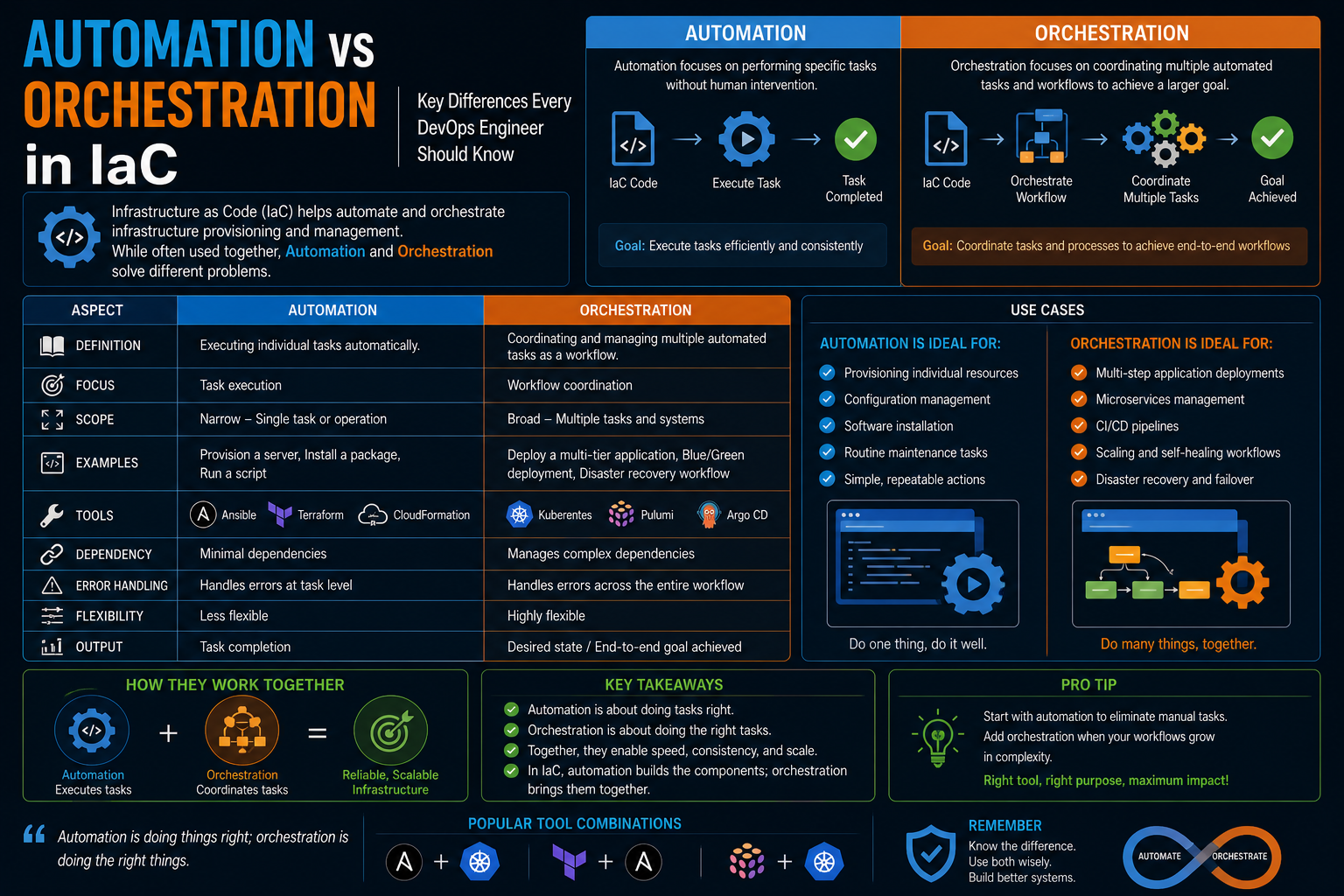
Infrastructure as Code (IaC) represents a major shift in how modern IT environments are designed, deployed, and maintained. Instead of relying on manual processes to configure servers, networks, and storage systems, IaC allows infrastructure to be defined using machine-readable configuration files. These files describe the desired state of the environment in a structured format that can be executed repeatedly and consistently.
This approach brings infrastructure management closer to software development practices. Just as developers write application code to build software, system administrators and DevOps engineers write infrastructure definitions to build and manage environments. The result is a more predictable, scalable, and controlled way of handling IT resources.
In traditional setups, infrastructure changes often required direct interaction with physical or virtual machines. This manual approach was slow, error-prone, and difficult to track. Even small inconsistencies between environments—such as development, testing, and production—could lead to unexpected behavior and system failures. IaC addresses these challenges by making infrastructure reproducible through code.
By treating infrastructure as software, organizations gain access to version control systems, testing frameworks, and automated deployment pipelines. These capabilities significantly improve operational efficiency and reduce the likelihood of human error during configuration changes.
Evolution from Manual Infrastructure to Code-Based Management
Before IaC became widely adopted, infrastructure management was largely manual. System administrators would log into servers, install software, configure settings, and adjust network parameters by hand. While this approach worked for small environments, it quickly became unmanageable as systems grew in size and complexity.
As businesses expanded their digital presence, they began to rely on multiple servers, distributed systems, and cloud environments. Managing each component manually became not only inefficient but also risky. A single misconfiguration could cause downtime or security vulnerabilities across the entire system.
This led to the introduction of automation scripts. Early automation tools helped reduce repetitive tasks by allowing administrators to write scripts that executed predefined commands. However, these scripts were often limited in scope and lacked consistency across environments.
Infrastructure as Code emerged as a more structured and scalable solution. Instead of executing isolated scripts, IaC defines the entire infrastructure in a declarative or procedural format. This allows systems to be recreated from scratch in a predictable way, ensuring consistency across all environments.
Over time, IaC has become a foundational practice in cloud computing and DevOps environments. It enables organizations to move faster, reduce operational risk, and maintain better control over complex infrastructures.
Core Principles Behind Infrastructure as Code
At its core, Infrastructure as Code is built on several key principles that guide its design and implementation.
One of the most important principles is declarative configuration. In this approach, users define what the infrastructure should look like rather than how to build it step by step. The system then determines how to achieve that desired state automatically. This reduces complexity and simplifies infrastructure management.
Another key principle is idempotency. This means that running the same configuration multiple times produces the same result. Whether executed once or repeatedly, the infrastructure remains consistent. This is essential for maintaining stability in dynamic environments.
Version control is also a fundamental aspect of IaC. By storing infrastructure definitions in version control systems, teams can track changes over time, review modifications, and roll back to previous configurations if necessary. This introduces accountability and transparency into infrastructure management.
Reusability is another guiding principle. Infrastructure components can be modularized and reused across different environments. This reduces duplication and ensures consistency in deployment practices.
Finally, automation readiness is built into IaC. Since infrastructure is defined in code, it can be integrated into automated workflows, enabling continuous deployment and scaling without manual intervention.
Why IaC Matters in Large-Scale Environments
In small systems, manual infrastructure management may still be manageable. However, in large-scale environments that involve hundreds or thousands of servers, manual approaches quickly become unsustainable.
IaC becomes especially important in cloud-based systems where resources can be created and destroyed dynamically. In such environments, infrastructure is no longer static. Instead, it must adapt continuously to changing workloads, user demands, and application requirements.
Without IaC, maintaining consistency across these dynamic systems would be extremely difficult. Teams would struggle to ensure that every environment matches the same configuration standards. This often leads to configuration drift, where systems gradually diverge from their intended state.
IaC solves this by providing a single source of truth for infrastructure definitions. Every environment can be rebuilt or adjusted based on the same codebase, ensuring uniformity across all deployments.
In addition, IaC improves collaboration between development and operations teams. Developers can define infrastructure requirements alongside application code, while operations teams can manage deployment and scaling processes more efficiently. This alignment is a key component of modern DevOps practices.
Understanding Configuration Drift and Operational Inconsistencies
One of the major challenges in traditional infrastructure management is configuration drift. This occurs when systems that are supposed to be identical gradually become different over time due to manual changes, patches, or updates.
For example, one server may receive a security update while another does not. Over time, these small differences accumulate, leading to inconsistencies across environments. This can cause unpredictable application behavior, security vulnerabilities, and troubleshooting difficulties.
Operational inconsistencies also arise when different teams manage infrastructure in different ways. Without a standardized approach, each administrator may apply their own configurations, resulting in fragmented systems.
Infrastructure as Code helps eliminate these issues by enforcing a consistent configuration model. Since infrastructure is defined in code, any changes must be made through the same controlled process. This ensures that all environments remain aligned with the intended state.
When drift does occur, IaC tools can detect and correct it by comparing the actual state of the infrastructure with the desired state defined in the code. This ability to self-correct is a key advantage of code-based infrastructure management.
Automation in IaC: Foundational Concept
Automation is one of the foundational elements of Infrastructure as Code. It refers to the ability to execute infrastructure tasks without manual intervention. These tasks include provisioning servers, configuring networks, deploying applications, and managing system resources.
In the context of IaC, automation is achieved through scripts and configuration files that define infrastructure components. Once these definitions are executed, the system automatically creates and configures the required resources.
Automation reduces the need for repetitive manual tasks, allowing IT teams to focus on higher-level planning and optimization. It also improves speed and accuracy by eliminating human error from routine operations.
In modern IT environments, automation is not limited to initial provisioning. It also extends to ongoing maintenance tasks such as updates, scaling, and monitoring adjustments. This ensures that infrastructure remains aligned with application requirements at all times.
Automation in IaC is particularly powerful because it is repeatable. The same code can be used to deploy identical environments in different regions, cloud providers, or stages of development. This consistency is essential for reliable software delivery.
How Automation Executes Infrastructure Changes
When automation is applied in an Infrastructure as Code environment, it follows a structured process. First, the desired state of the infrastructure is defined in a configuration file. This file describes resources such as virtual machines, storage systems, and network settings.
Once the configuration is executed, the automation engine interprets the code and translates it into infrastructure actions. These actions may include creating new resources, modifying existing ones, or removing outdated components.
The system continuously compares the current state of the infrastructure with the desired state defined in the code. If differences are detected, it automatically applies the necessary changes to align the system with the configuration.
This process ensures that infrastructure remains consistent over time. Even if manual changes are made outside of the defined configuration, the automation system can detect and correct them during the next execution cycle.
This mechanism allows organizations to maintain control over complex environments without requiring constant manual oversight.
Key Characteristics of IaC Automation
Automation in Infrastructure as Code is defined by several important characteristics that distinguish it from traditional scripting methods.
One key characteristic is repeatability. Infrastructure definitions can be executed multiple times with the same outcome, ensuring consistent results across environments.
Another characteristic is scalability. Automation allows infrastructure to be scaled up or down based on demand without manual intervention. This is particularly important in cloud environments where workloads fluctuate frequently.
Consistency is also a defining feature. Since infrastructure is defined in code, every deployment follows the same structure and configuration rules.
Speed is another advantage. Automated processes significantly reduce the time required to deploy and configure infrastructure compared to manual methods.
Finally, traceability plays an important role. Because infrastructure changes are defined in code and often stored in version control systems, it becomes easier to track modifications and understand how systems evolve over time.
Popular Automation Approaches and Tools Overview
Several tools and platforms support Infrastructure as Code automation, each offering different approaches and capabilities.
Configuration management tools such as Ansible, Chef, and Puppet focus on defining system configurations and ensuring that servers remain in a desired state. These tools are widely used for managing software installations, system settings, and application dependencies.
Cloud provisioning tools like Terraform, AWS CloudFormation, and Azure Resource Manager focus on building and managing infrastructure resources in cloud environments. They allow users to define entire environments using declarative templates.
These tools differ in syntax, structure, and execution models, but they all share the same goal of enabling infrastructure automation through code.
Some tools use imperative approaches, where users define step-by-step instructions for building infrastructure. Others use declarative approaches, where users define the desired end state and allow the system to determine how to achieve it.
The choice of tool often depends on organizational needs, cloud strategy, and infrastructure complexity.
Benefits of Automation for Infrastructure Delivery
Automation provides significant advantages in infrastructure delivery, especially in large-scale environments.
One of the primary benefits is improved efficiency. Tasks that once required manual intervention can now be completed automatically in a fraction of the time.
Automation also enhances reliability by reducing the likelihood of human error. Since configurations are defined in code, there is less room for inconsistency or misconfiguration.
Another benefit is improved scalability. Infrastructure can be expanded or reduced dynamically based on workload requirements, allowing organizations to respond quickly to changing demands.
Automation also supports better resource utilization. Systems can be optimized to allocate resources efficiently, reducing waste and improving performance.
Additionally, automation improves collaboration between teams. Developers and operations teams can work from the same infrastructure definitions, reducing communication gaps and improving deployment consistency.
Limitations and Challenges of Automation in Isolation
While automation provides many benefits, it also has limitations when used in isolation.
One major challenge is complexity. As infrastructure grows, automation scripts and configurations can become difficult to manage without proper structure and organization.
Another limitation is lack of coordination. Automation focuses on individual tasks rather than the broader system. Without additional coordination mechanisms, managing large distributed environments can become challenging.
There is also the risk of over-reliance on automation tools. If not properly designed, automated systems can propagate errors quickly across environments.
Security considerations are also important. Automated systems must be carefully configured to avoid exposing sensitive resources or mismanaging access controls.
Finally, automation alone does not address higher-level infrastructure coordination needs. While it handles individual tasks efficiently, managing entire ecosystems requires additional layers of orchestration and control logic.
Understanding Orchestration in Infrastructure as Code
Orchestration in Infrastructure as Code (IaC) builds upon automation but focuses on a broader and more coordinated perspective. While automation handles individual tasks such as provisioning a server or installing software, orchestration is responsible for organizing and managing how multiple automated tasks work together as part of a complete system.
In modern IT environments, applications rarely run on a single machine. Instead, they depend on multiple interconnected services such as databases, load balancers, application servers, storage systems, and networking components. Orchestration ensures that all these components are deployed, configured, and managed in a way that allows them to function as a unified system.
Unlike automation, which focuses on executing predefined tasks, orchestration focuses on sequencing, coordination, dependency management, and lifecycle control. It determines not just what should be done, but also when and in what order different tasks should be executed.
This makes orchestration essential in distributed systems, cloud-native environments, and microservices architectures where complexity is high and components are tightly interdependent.
The Role of Orchestration in Managing Complex Systems
As IT environments grow, managing individual components becomes less important than managing the relationships between them. Orchestration addresses this need by providing a higher-level control layer that ensures infrastructure components work together seamlessly.
For example, deploying a modern web application might require multiple steps: creating virtual machines, setting up networking, deploying containers, configuring databases, and establishing security rules. If each of these tasks were executed independently without coordination, the system could easily fail or become unstable.
Orchestration solves this problem by defining workflows that govern how these tasks interact. It ensures that dependencies are respected—for instance, a database must be available before an application connects to it, and network configurations must be in place before services are exposed externally.
In this way, orchestration acts as a conductor, guiding multiple automated processes to achieve a desired overall outcome.
Relationship Between Automation and Orchestration
Automation and orchestration are often used together, but they serve different purposes. Automation focuses on executing specific tasks efficiently, while orchestration focuses on coordinating those tasks within a larger system.
To understand the relationship, it helps to think of automation as building blocks and orchestration as the blueprint that determines how those blocks are assembled.
Automation might be used to create a virtual machine, install software, or configure a network interface. Orchestration, on the other hand, determines the sequence in which these actions should occur and how they depend on each other.
Without automation, orchestration would have nothing to execute. Without orchestration, automation would lack structure and coordination in complex environments.
Together, they form a complete system for managing infrastructure as code, enabling both precision and scalability.
Workflow Management in Orchestrated Environments
One of the most important aspects of orchestration is workflow management. A workflow defines a series of steps that must be executed in a specific order to achieve a desired outcome.
In Infrastructure as Code, workflows often involve multiple stages such as provisioning, configuration, deployment, testing, and scaling. Orchestration tools manage these workflows automatically, ensuring that each step is completed successfully before moving on to the next.
This is particularly important in environments where failure at one stage can impact the entire system. For example, if a database setup fails, the orchestration system can prevent application deployment from proceeding, avoiding potential runtime errors.
Workflows can also include conditional logic. This means that different actions can be executed based on the state of the system. For example, if a resource already exists, the orchestration system may skip creation and move directly to configuration.
This dynamic behavior makes orchestration highly adaptable to changing infrastructure conditions.
Dependency Management in Orchestration
Modern IT systems are built on interdependent components. Applications rely on databases, services depend on APIs, and networks must be properly configured to allow communication between systems.
Orchestration plays a critical role in managing these dependencies. It ensures that resources are created and configured in the correct order so that each component is available when needed.
For example, a web application cannot function properly if its database is not yet initialized. Similarly, a load balancer cannot distribute traffic if backend servers are not ready.
Orchestration systems maintain a dependency graph that maps relationships between components. This graph helps determine execution order and ensures that no component is deployed prematurely.
By managing dependencies automatically, orchestration reduces the risk of system failures and improves deployment reliability.
Container Orchestration and Modern Application Architectures
One of the most important use cases of orchestration in IaC is container management. As applications have shifted toward microservices architectures, containers have become a standard way to package and deploy software.
Containers allow applications to run consistently across different environments by bundling code, dependencies, and runtime configurations into a single unit. However, managing large numbers of containers manually is not practical.
This is where container orchestration systems come into play. These systems automate the deployment, scaling, networking, and management of containerized applications.
They ensure that containers are distributed efficiently across available resources, restarted if they fail, and scaled based on demand.
Container orchestration also handles service discovery, load balancing, and network communication between containers. This allows microservices to interact seamlessly even when deployed across multiple nodes or regions.
Kubernetes as a Leading Orchestration Platform
Among orchestration platforms, Kubernetes has become one of the most widely adopted solutions. It is designed specifically to manage containerized applications in distributed environments.
Kubernetes provides a control plane that manages clusters of machines, known as nodes. These nodes run containerized workloads, which are organized into logical units called pods.
The system continuously monitors the state of the cluster and ensures that the actual state matches the desired state defined in configuration files. If a container fails or a node becomes unavailable, Kubernetes automatically takes corrective action.
This self-healing capability is a key feature of orchestration. It ensures that applications remain available even in the presence of failures.
Kubernetes also supports scaling, allowing applications to handle varying levels of traffic by automatically adjusting the number of running containers.
In addition, it provides networking, storage integration, and security controls, making it a comprehensive orchestration solution for modern applications.
Docker Swarm and Simplified Orchestration Models
While Kubernetes is highly powerful, it can also be complex. For smaller environments or simpler use cases, Docker Swarm offers a more lightweight orchestration solution.
Docker Swarm is built directly into the Docker ecosystem, making it easier to set up and manage. It allows multiple Docker hosts to be combined into a single virtual cluster.
Within this cluster, containers can be deployed and managed across different nodes. Swarm handles scheduling, load balancing, and basic scaling operations.
Although it lacks some of the advanced features of Kubernetes, Docker Swarm provides a simpler entry point into orchestration. It is often used in environments where ease of use is more important than advanced functionality.
Orchestration in Multi-Service Environments
Modern applications are rarely monolithic. Instead, they are composed of multiple services that communicate with each other through APIs or messaging systems.
In such environments, orchestration plays a crucial role in ensuring that all services are deployed and managed correctly.
For example, an e-commerce platform may include services for user authentication, product catalog management, payment processing, and order tracking. Each of these services must be deployed in a coordinated manner to ensure system stability.
Orchestration ensures that services are started in the correct sequence, configured with the appropriate dependencies, and scaled based on demand.
It also manages communication between services, ensuring that data flows smoothly across the system.
Health Monitoring and Self-Healing Systems
One of the most powerful features of orchestration is its ability to monitor system health and perform self-healing actions.
In a distributed environment, failures are inevitable. Servers may crash, network connections may fail, or services may become unresponsive. Orchestration systems continuously monitor the health of all components and take corrective action when issues are detected.
For example, if a container stops responding, the orchestration system may restart it automatically. If a node becomes unavailable, workloads can be redistributed to healthy nodes.
This self-healing capability ensures high availability and reduces downtime without requiring manual intervention.
Health monitoring also includes performance tracking. Orchestration systems can detect resource exhaustion, such as high CPU or memory usage, and trigger scaling actions to maintain performance.
Scaling and Resource Optimization Through Orchestration
Scaling is another critical function of orchestration systems. As demand for applications increases or decreases, infrastructure must adapt accordingly.
Orchestration enables both vertical and horizontal scaling. Vertical scaling involves increasing resources for existing components, while horizontal scaling involves adding more instances of services.
This dynamic scaling ensures that applications can handle traffic spikes without performance degradation while also avoiding unnecessary resource consumption during low-demand periods.
Resource optimization is closely tied to scaling. Orchestration systems allocate resources efficiently based on workload requirements, ensuring that infrastructure is used effectively.
This helps organizations reduce operational costs while maintaining performance and reliability.
Security Considerations in Orchestrated Environments
Security is a major concern in orchestration environments due to the complexity and scale of distributed systems.
Orchestration systems must manage access control, network segmentation, and secure communication between services.
For example, sensitive services such as databases must be isolated from public access, while still being accessible to authorized application components.
Orchestration platforms often include built-in security features such as role-based access control, encryption, and secret management systems.
However, misconfiguration can still lead to vulnerabilities. For instance, exposing internal services to external networks or failing to properly restrict access permissions can create security risks.
Therefore, security must be carefully integrated into orchestration strategies to ensure system integrity.
Challenges in Managing Orchestrated Infrastructure
Despite its advantages, orchestration introduces its own set of challenges.
One major challenge is complexity. Orchestration systems manage multiple layers of infrastructure, which can be difficult to configure and maintain.
Another challenge is debugging. When multiple services interact across distributed systems, identifying the root cause of failures can be difficult.
There is also a learning curve associated with orchestration tools. Platforms like Kubernetes require specialized knowledge to operate effectively.
Additionally, orchestration systems require careful resource planning. Poorly configured systems can lead to inefficiencies or performance bottlenecks.
Finally, maintaining consistency across environments remains a challenge, especially in multi-cloud or hybrid deployments.
Integrating Automation and Orchestration in Modern Infrastructure as Code
In modern Infrastructure as Code (IaC) environments, automation and orchestration are not separate ideas competing for attention. Instead, they function as two complementary layers of the same system. Automation handles the execution of individual tasks, while orchestration manages how those tasks interact across a complete infrastructure lifecycle.
When combined effectively, they form a powerful framework for building, deploying, and maintaining complex IT environments. This integration is especially important in cloud-native systems, where infrastructure is dynamic, distributed, and constantly evolving.
Automation ensures that tasks such as provisioning servers, installing software, or configuring networks are executed consistently and without manual intervention. Orchestration ensures that these tasks occur in the correct order, under the right conditions, and with proper coordination between services.
Together, they transform infrastructure from a static environment into a responsive, self-managed system capable of adapting to changing demands.
The Role of Orchestration as a Coordination Layer
To understand how automation and orchestration integrate, it is helpful to think of orchestration as a coordination layer built on top of automation.
Automation is responsible for performing actions. Orchestration is responsible for deciding when and how those actions should occur.
For example, consider deploying a web application. Automation tools might handle creating virtual machines, installing dependencies, and configuring application settings. However, orchestration ensures that these steps occur in the correct sequence.
A database must be available before the application connects to it. Networking must be configured before services are exposed. Load balancers must be set up after backend services are running. Orchestration manages these relationships and dependencies.
Without orchestration, automation would simply execute tasks without awareness of the larger system. This could lead to failures, inconsistencies, or incomplete deployments.
With orchestration, automation becomes part of a structured workflow that ensures reliability and coherence across the entire infrastructure.
Continuous Integration and Continuous Deployment in IaC Systems
One of the most important real-world applications of integrated automation and orchestration is found in Continuous Integration and Continuous Deployment (CI/CD) pipelines.
CI/CD pipelines are designed to automate the process of building, testing, and deploying applications. In these pipelines, automation handles individual steps such as compiling code, running tests, or deploying containers.
Orchestration manages the overall pipeline flow, ensuring that each stage is executed in the correct order and only when previous stages have completed successfully.
For example, code changes might first trigger automated testing. If tests pass, orchestration moves the process forward to build and packaging stages. Finally, deployment automation is executed to release the application into production environments.
This structured approach reduces human intervention, accelerates release cycles, and improves software reliability.
Orchestration also allows CI/CD pipelines to adapt dynamically. If a test fails, the pipeline can stop automatically. If additional approval is required, orchestration can pause execution until conditions are met.
This combination of automation and orchestration makes CI/CD pipelines both efficient and controlled.
Multi-Cloud and Hybrid Infrastructure Management
Modern organizations rarely rely on a single cloud provider. Instead, they often operate across multiple cloud platforms or maintain hybrid environments that combine on-premises infrastructure with cloud services.
Managing such environments manually is extremely complex. Each platform has its own configuration models, APIs, and deployment mechanisms.
Automation helps by standardizing tasks within each environment. However, orchestration is required to coordinate operations across different platforms.
For example, an application may have its frontend hosted in one cloud provider, its database in another, and backup systems in a private data center. Orchestration ensures that all these components work together as a unified system.
It manages cross-platform dependencies, synchronizes deployment processes, and ensures consistent configuration across environments.
This abstraction layer allows organizations to treat multi-cloud infrastructure as a single logical system rather than a collection of isolated platforms.
It also improves flexibility by enabling workloads to move between environments based on cost, performance, or availability requirements.
Infrastructure Scaling and Dynamic Resource Management
One of the most powerful capabilities enabled by combining automation and orchestration is dynamic scaling.
In traditional environments, scaling infrastructure required manual planning and execution. Administrators had to estimate resource needs and provision systems accordingly.
In modern IaC environments, scaling is automated and orchestrated in real time.
Automation handles the actual creation or removal of resources such as virtual machines or containers. Orchestration determines when scaling actions should occur based on system metrics such as CPU usage, memory consumption, or network traffic.
For example, if an application experiences a sudden spike in traffic, orchestration detects increased demand and triggers automation processes to add more instances of the application.
Once demand decreases, orchestration scales the system back down to conserve resources.
This dynamic behavior ensures that infrastructure is always aligned with workload requirements, improving both performance and cost efficiency.
Scaling is no longer a manual process but an intelligent, automated response to real-time conditions.
Self-Healing Infrastructure and Fault Recovery
Another major benefit of integrating automation and orchestration is the ability to build self-healing systems.
In complex distributed environments, failures are inevitable. Servers may crash, services may become unresponsive, or network issues may occur.
Automation alone can restart services or replace failed components. However, orchestration ensures that the system as a whole remains stable and functional.
Orchestration continuously monitors system health and detects failures across different layers of infrastructure. When an issue is identified, it triggers automated recovery actions.
For example, if a container fails, it can be automatically restarted. If a node becomes unavailable, workloads can be redistributed to healthy nodes. If a service becomes unresponsive, traffic can be rerouted to alternative instances.
This self-healing capability reduces downtime and improves system reliability without requiring manual intervention.
It also ensures that applications remain available even during unexpected failures, which is critical for business-critical systems.
Multi-Tier Application Deployment Using IaC
Most modern applications are built using multi-tier architectures that separate concerns into different layers, such as presentation, application logic, and data storage.
Deploying these architectures manually can be complex and error-prone due to the number of interdependent components involved.
Automation helps by defining deployment steps for each layer. Orchestration ensures that these layers are deployed in the correct sequence.
For example, the database layer must be initialized before the application layer can connect to it. Similarly, the application layer must be running before the presentation layer is exposed to users.
Orchestration manages these dependencies and ensures smooth deployment across all tiers.
It also allows updates to be applied safely. If a change is made to one layer, orchestration can coordinate updates across dependent layers without disrupting system functionality.
This structured approach reduces deployment risks and ensures consistency across environments.
Infrastructure Lifecycle Management
Infrastructure is not static. It goes through a lifecycle that includes provisioning, configuration, scaling, updating, and decommissioning.
Automation plays a key role in each stage of this lifecycle by executing tasks such as creating resources or applying updates.
Orchestration ensures that lifecycle stages occur in the correct order and under the right conditions.
For example, when a new environment is created, orchestration ensures that networking is configured before application deployment begins. When an environment is no longer needed, orchestration ensures that resources are safely decommissioned in the correct sequence.
Lifecycle management also includes updates and patching. Orchestration can coordinate rolling updates across multiple systems to minimize downtime.
This ensures that infrastructure remains up-to-date and secure throughout its operational life.
Security Integration in Automated and Orchestrated Systems
Security is a critical component of modern infrastructure management. As systems become more automated and distributed, maintaining security becomes increasingly complex.
Automation helps enforce security configurations consistently across systems. Orchestration ensures that security policies are applied in a coordinated and controlled manner.
For example, access control rules can be automatically applied when new resources are created. Network segmentation can be enforced across distributed services. Encryption settings can be applied consistently across environments.
Orchestration also ensures that security changes do not disrupt system functionality. For instance, when updating firewall rules, orchestration can coordinate changes to avoid service interruptions.
In addition, orchestration systems often manage secrets such as passwords, tokens, and encryption keys. These are securely distributed to services only when needed and are protected from unauthorized access.
By integrating security into both automation and orchestration layers, organizations can maintain strong security postures without sacrificing agility.
Monitoring, Observability, and Feedback Loops
Effective infrastructure management requires continuous monitoring and feedback. Automation and orchestration systems rely heavily on real-time data to make decisions.
Monitoring tools collect metrics such as system performance, resource utilization, and application health. Orchestration systems use this data to determine when actions such as scaling or recovery should be triggered.
This creates a feedback loop where infrastructure continuously adjusts itself based on observed conditions.
For example, if monitoring systems detect high latency, orchestration may trigger additional resource allocation. If error rates increase, traffic may be rerouted or services restarted.
This feedback-driven approach ensures that infrastructure remains responsive and adaptive.
Observability also plays an important role in troubleshooting. By providing visibility into system behavior, it becomes easier to identify and resolve issues in complex environments.
Challenges in Integrating Automation and Orchestration
While integration provides many benefits, it also introduces challenges.
One major challenge is system complexity. Combining automation and orchestration creates multiple layers of abstraction, which can be difficult to design and manage.
Another challenge is debugging distributed systems. When multiple automated processes interact across orchestrated workflows, identifying the root cause of failures can be difficult.
There is also a need for careful design. Poorly structured automation scripts or orchestration workflows can lead to inefficiencies or unintended behavior.
Resource management is another challenge. Without proper planning, automated scaling and orchestration decisions can lead to over-provisioning or under-utilization of infrastructure.
Security configuration complexity also increases as systems become more dynamic and distributed.
Finally, organizations must invest in skill development to effectively manage integrated IaC systems. Understanding both automation and orchestration is essential for maintaining stable environments.
The Future of Infrastructure as Code with Automation and Orchestration
As infrastructure continues to evolve, the integration of automation and orchestration will become even more important.
Future systems are likely to become more autonomous, with increased reliance on intelligent decision-making based on real-time data.
Automation will continue to handle execution-level tasks, while orchestration will evolve into a more intelligent control layer capable of optimizing entire infrastructure ecosystems.
Artificial intelligence and machine learning may further enhance orchestration by enabling predictive scaling, automated anomaly detection, and adaptive resource management.
Infrastructure will increasingly behave like a self-regulating system, capable of adjusting itself without human intervention.
In this evolving landscape, the distinction between automation and orchestration will remain important, but their integration will become deeper and more seamless.
Conclusion
Infrastructure as Code (IaC) has fundamentally changed how modern IT systems are built, deployed, and maintained. What once relied heavily on manual configuration, repetitive tasks, and human intervention has now shifted toward structured, repeatable, and code-driven processes. This transformation is not just about efficiency—it represents a deeper change in how infrastructure is conceptualized and managed across organizations of all sizes.
At the heart of IaC lie two closely connected but distinct concepts: automation and orchestration. While they are often mentioned together, they serve different roles within the infrastructure ecosystem. Automation focuses on executing specific tasks reliably and consistently, such as provisioning servers, configuring networks, installing applications, or updating system components. It eliminates the need for repetitive manual work and reduces the likelihood of human error, making infrastructure management faster and more predictable.
Orchestration, on the other hand, operates at a higher level. It is responsible for coordinating multiple automated tasks into cohesive workflows. Instead of focusing on individual actions, orchestration focuses on relationships, dependencies, sequencing, and overall system behavior. It ensures that complex infrastructure environments operate as unified systems rather than disconnected components. This coordination becomes especially critical in distributed systems, cloud-native architectures, and microservices-based applications where multiple services must interact seamlessly.
When automation and orchestration are combined, they create a powerful foundation for modern infrastructure management. Automation provides the execution engine, while orchestration provides the intelligence and structure that guide execution. Together, they enable organizations to build systems that are not only efficient but also resilient, scalable, and adaptable to change.
One of the most significant outcomes of this integration is consistency. In traditional infrastructure environments, even small manual changes could lead to configuration drift, where systems gradually diverge from their intended state. This often results in performance issues, security vulnerabilities, and operational inconsistencies. With IaC, both automation and orchestration work together to ensure that infrastructure remains aligned with its defined state, regardless of scale or complexity.
Another key benefit is scalability. Modern applications must respond dynamically to changing workloads, user demands, and business requirements. Automation allows infrastructure resources to be created or modified quickly, while orchestration ensures that scaling decisions are made intelligently based on system conditions. This dynamic behavior enables systems to grow or shrink in real time without disrupting service availability or performance.
Reliability is also greatly improved through the integration of automation and orchestration. In distributed environments, failures are inevitable. Servers may crash, services may become unresponsive, or network issues may occur. Automation can handle recovery actions such as restarting services or recreating failed components. Orchestration ensures that these recovery actions happen in a coordinated manner that preserves system stability. This leads to self-healing infrastructure that can recover from failures automatically with minimal downtime.
Beyond operational benefits, IaC also enhances collaboration between development and operations teams. By defining infrastructure in code, both teams can work from a shared source of truth. Developers can align application requirements with infrastructure definitions, while operations teams can manage deployment workflows and system stability more effectively. This alignment supports modern DevOps practices, where collaboration, automation, and continuous delivery are central principles.
However, despite its advantages, the integration of automation and orchestration is not without challenges. The complexity of modern systems can make it difficult to design, implement, and maintain effective workflows. As infrastructure becomes more distributed, managing dependencies, debugging issues, and ensuring security requires careful planning and expertise. Organizations must also invest in skill development to ensure teams can effectively work with tools and frameworks that support IaC practices.
Security considerations also become more critical in automated and orchestrated environments. As systems grow more dynamic, ensuring proper access control, secure communication, and consistent policy enforcement becomes increasingly important. Misconfigurations in automated workflows or orchestration logic can lead to vulnerabilities if not carefully managed.
Despite these challenges, the direction of infrastructure management is clear. The combination of automation and orchestration is becoming the standard for modern IT environments. As cloud computing, containerization, and distributed systems continue to evolve, the need for structured, scalable, and intelligent infrastructure management will only increase.
Ultimately, Infrastructure as Code is not just a technical approach—it represents a shift in mindset. It encourages treating infrastructure as a living system defined by code, governed by logic, and managed through automation and orchestration working together. This shift enables organizations to move faster, operate more reliably, and adapt more effectively in an increasingly complex digital landscape.