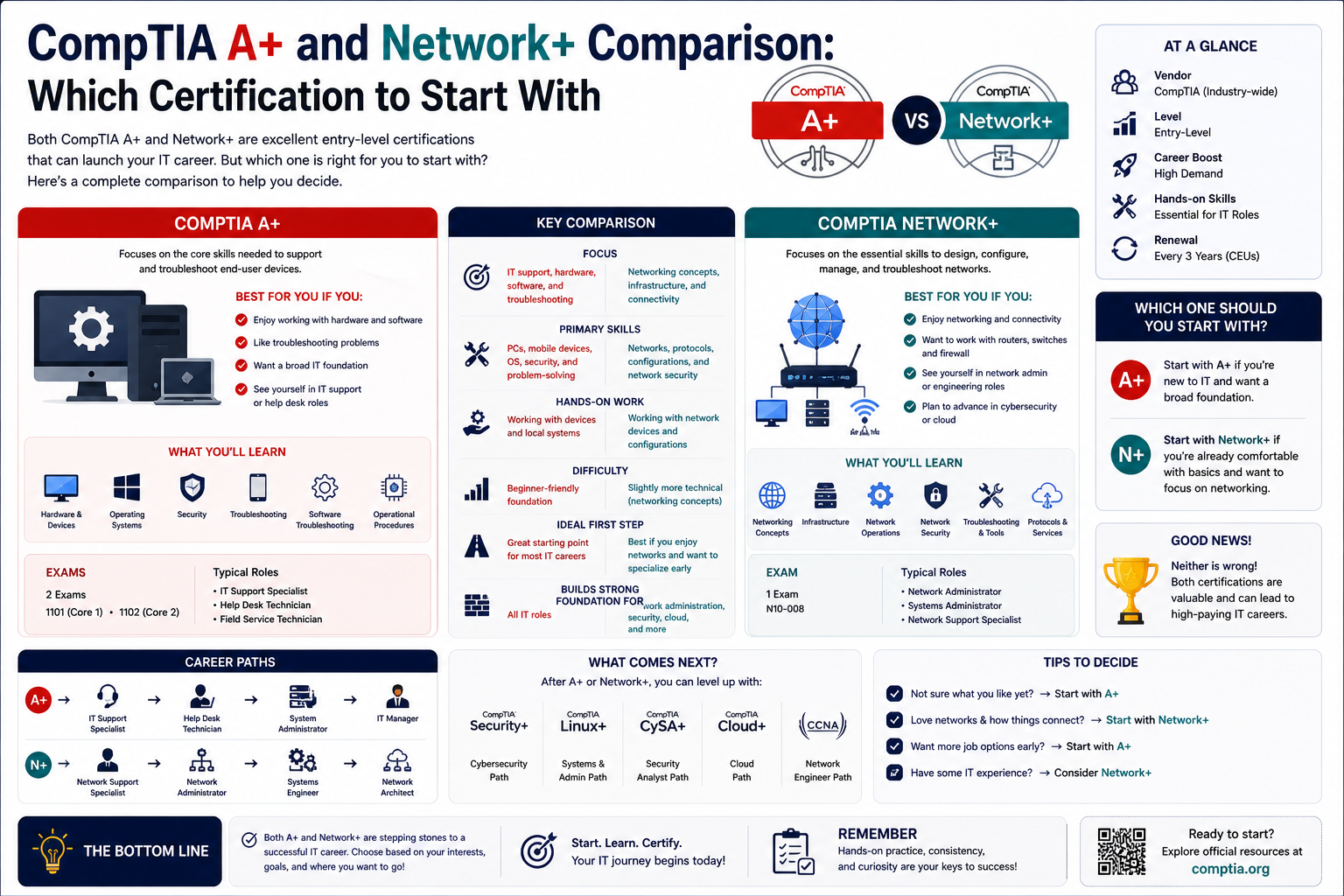
Starting a career in information technology can feel like stepping into a vast landscape where almost every direction seems important. There are cybersecurity roles, networking roles, cloud engineering paths, support positions, and many more specialized areas. For beginners, this variety often creates confusion rather than clarity. That is exactly where foundational certifications such as CompTIA A+ and Network+ come into the picture.
These certifications are not just academic milestones. They represent structured pathways into the IT industry, designed to help learners build real-world technical confidence. Employers often view them as signals that a candidate understands core principles rather than just theoretical ideas. However, what makes the A+ and Network+ debate so interesting is that both certifications serve different purposes, even though they belong to the same vendor-neutral ecosystem.
The key challenge for beginners is not deciding whether certifications are useful—it is deciding which one provides the most appropriate starting point for their personal background, comfort level, and career direction.
The Real Purpose Behind CompTIA A+
CompTIA A+ is often described as the “entry point into IT,” but that description only tells part of the story. At its core, A+ is designed to establish baseline technical literacy. It focuses on the kind of knowledge that anyone entering an IT support role would need to function effectively in real-world environments.
Rather than diving into complex architecture or advanced networking theories, A+ begins with the fundamentals of how computers work. This includes understanding hardware components, operating systems, troubleshooting methods, and basic security principles. The goal is not to turn learners into experts in any single domain but to make them comfortable interacting with technology at a practical level.
One of the most important aspects of A+ is that it mirrors the reality of entry-level IT work. In many organizations, the first IT role a person holds involves helping users solve everyday technical problems. These problems might include a laptop not booting, software not installing correctly, Wi-Fi connectivity issues, or printer malfunctions. A+ training prepares individuals to think through these scenarios logically.
The certification also introduces learners to mobile devices, virtualization basics, cloud concepts, and operational procedures. While these topics may seem simple at first glance, they form the backbone of modern IT environments. Without understanding these foundational elements, more advanced topics can feel overwhelming later.
Breaking Down the Scope of A+ Knowledge Areas
To fully understand where A+ fits into an IT journey, it helps to look at its knowledge structure in a broader sense.
At a high level, A+ builds familiarity with physical computer systems. This includes identifying components such as processors, memory modules, storage drives, and power supplies. It also teaches how these components interact with each other, which is essential for troubleshooting hardware issues.
Beyond hardware, A+ introduces operating systems from multiple ecosystems. Instead of focusing on a single platform, it encourages versatility. Learners become exposed to different operating system environments and begin to understand installation processes, configuration steps, and maintenance tasks.
Another significant part of A+ is troubleshooting methodology. This is arguably one of the most valuable skills for beginners. Rather than memorizing solutions, learners are taught a structured approach to diagnosing problems. This mindset becomes extremely important in real IT roles, where issues are rarely straightforward.
Security fundamentals are also included, although at a basic level. This covers concepts such as user authentication, malware awareness, and safe computing practices. Even though these topics are introductory, they prepare learners for more specialized security training later on.
Finally, A+ introduces basic networking concepts. However, these are limited to general connectivity issues rather than deep networking design or configuration.
What Network+ Represents in the IT Learning Path
While A+ focuses on general IT support knowledge, Network+ shifts the focus specifically toward networking systems. This certification is built for learners who want to understand how devices communicate across local and global networks.
Networking is one of the most essential components of modern technology. Every online service, application, and digital communication depends on network infrastructure. Network+ helps learners understand what is happening behind the scenes when data travels from one device to another.
Unlike A+, which spreads its focus across multiple IT domains, Network+ is more specialized. It assumes that learners already have some comfort with basic computing concepts and are ready to explore more structured technical systems.
Network+ covers topics such as network architecture, protocols, IP addressing, routing, switching concepts, and wireless technologies. It also explores network security and troubleshooting, but from a connectivity perspective rather than a device-level perspective.
This shift in focus is important because networking requires a different way of thinking. Instead of focusing on individual machines, learners begin to think in terms of systems, pathways, and communication flows.
The Conceptual Jump Between A+ and Network+
One of the biggest reasons the A+ versus Network+ decision feels difficult is because the two certifications are not just different in content—they are different in thinking style.
A+ is grounded in tangible, physical computing. It encourages learners to interact with hardware, operating systems, and user-level troubleshooting. The problems are often direct and visible. For example, a computer either turns on or it does not. A software application either installs or fails.
Network+ introduces a more abstract layer of understanding. Instead of seeing physical components, learners begin working with invisible systems. Networks rely on protocols, configurations, and communication rules that are not always visible to the user. This requires a shift from “what is broken?” to “how is data moving?”
For beginners without prior IT exposure, this shift can feel significant. It is not necessarily harder in a technical sense, but it demands a different mindset. This is one reason why many learners are advised to consider their comfort level before choosing a starting point.
The Importance of Prior Experience in Choosing a Starting Point
One of the most practical factors in deciding between A+ and Network+ is prior experience with technology.
Learners who have limited exposure to computer systems often benefit from starting with A+. This is because A+ builds confidence gradually. It does not assume deep technical familiarity and instead introduces concepts step by step.
On the other hand, learners who already understand how computers operate at a basic level may find A+ repetitive or too introductory. In such cases, Network+ can feel more engaging because it introduces new conceptual challenges.
This distinction is important because motivation plays a key role in learning technical subjects. If a learner feels that the material is too simple, they may lose interest. If the material feels too advanced, they may become discouraged. Choosing the right starting point helps maintain balance.
How A+ Builds Practical Workplace Readiness
One of the strongest arguments in favor of starting with A+ is its direct alignment with entry-level IT job responsibilities.
Many first jobs in IT involve technical support roles. These positions require interacting with users, diagnosing problems, and resolving technical issues quickly. A+ prepares learners for exactly this environment by teaching structured troubleshooting and communication skills.
Beyond technical knowledge, A+ also introduces operational habits. These include documenting issues, following escalation procedures, and understanding workplace IT policies. These skills are often overlooked but are extremely important in real job settings.
A+ also helps learners become comfortable with multitasking in technical environments. In real IT support roles, professionals often deal with multiple issues at once. Having a foundational understanding of systems makes this process more manageable.
How Network+ Builds System-Level Thinking
Network+ shifts focus from individual systems to interconnected systems. This change is important because modern IT environments are highly network-dependent.
In Network+, learners begin to understand how devices communicate across networks using structured protocols. They learn why connectivity issues occur, how data packets travel, and what causes network congestion or failure.
This certification also introduces learners to enterprise-level concepts such as network topology and infrastructure design. Even though these topics are still introductory, they represent a step toward more advanced networking careers.
Network+ also emphasizes security in a network context. Instead of focusing on individual device protection, it looks at securing entire communication systems. This includes understanding threats, vulnerabilities, and protective mechanisms at a network level.
The Natural Progression Between the Two Certifications
Although the debate often presents A+ and Network+ as competing options, they are actually designed to complement each other.
A+ builds foundational IT literacy. Network+ builds foundational networking literacy. Together, they form a broader understanding of how modern IT environments function.
For many learners, the most effective path is sequential. Starting with A+ provides the grounding needed to understand device-level concepts. Once that foundation is established, Network+ becomes easier to grasp because learners already understand the systems that connect to networks.
However, this sequence is not mandatory. Some learners bypass A+ entirely if they already possess strong technical familiarity. Others prefer to start with Network+ if their career goals are network-focused from the beginning.
The key is not the sequence itself, but the alignment between the learner’s current knowledge level and the certification content.
Understanding the Learning Curve Difference
Another important factor in this decision is the learning curve associated with each certification.
A+ generally has a gentler learning curve because it introduces concepts gradually and builds from everyday technology experiences. Most learners can relate to the material because it involves devices they already use.
Network+, however, often introduces abstract concepts earlier in the learning process. Terms like IP addressing, subnetting, and routing require more conceptual understanding. These topics can feel unfamiliar at first, especially for learners without prior exposure to networking.
This does not mean Network+ is more difficult overall—it simply requires a different type of thinking. Some learners find this transition exciting, while others prefer to build more foundational knowledge first.
The Role of Career Direction in the Decision
While technical readiness is important, career direction plays an equally significant role in choosing between A+ and Network+.
Learners aiming for IT support roles often benefit from starting with A+. These roles require strong troubleshooting skills and a broad understanding of systems.
On the other hand, learners interested in networking, infrastructure, or systems administration may feel more aligned with Network+ content. In these cases, starting with networking concepts can provide earlier exposure to relevant career skills.
However, even in specialized career paths, foundational knowledge remains valuable. Many advanced roles still require an understanding of basic IT support principles, which A+ provides.
Why There Is No Universal “Correct” Starting Point
One of the most important truths in this debate is that there is no single correct answer. The choice between A+ and Network+ depends heavily on individual learning background, career goals, and personal comfort with technical concepts.
Some learners thrive when they begin with structured, broad foundational knowledge. Others prefer diving into specialized topics early to stay motivated and engaged. Both approaches can lead to successful IT careers.
What matters most is consistency and progression. Whether starting with A+ or Network+, learners eventually benefit from understanding both foundational IT support and networking principles.
How to Evaluate Your Current IT Skill Level Before Choosing
One of the most practical ways to decide between CompTIA A+ and Network+ is to take an honest look at your current level of technical comfort. This is not about formal education or job experience alone, but about how naturally you interact with technology in everyday situations.
For example, some learners are already comfortable installing software, managing operating system settings, troubleshooting basic hardware issues, or understanding how different devices connect to a home network. Others may still feel uncertain about basic concepts such as file management, system settings, or how internet connectivity actually works.
This difference matters because A+ assumes very little prior knowledge and builds from the ground up. It is designed for individuals who may be entering IT for the first time or who have only casual exposure to computers. Network+ assumes a baseline familiarity with computing environments and shifts attention toward how systems communicate with each other.
A helpful way to evaluate readiness is to consider problem-solving comfort. If a computer issue arises, do you feel confident experimenting with settings and troubleshooting, or do you prefer step-by-step guidance? The more independent your technical curiosity is, the more likely you may find Network+ approachable earlier in your journey.
However, if you feel more comfortable learning structured basics first, A+ becomes a natural starting point that reduces confusion later on.
The Role of Learning Style in Certification Success
Beyond technical skill level, learning style plays a major role in determining which certification feels more manageable. Not all learners absorb information in the same way, and IT education is no exception.
Some individuals learn best through hands-on interaction. They prefer working directly with systems, testing configurations, and seeing immediate results. A+ aligns well with this style because it focuses heavily on physical hardware, operating systems, and practical troubleshooting scenarios.
Other learners prefer conceptual understanding before application. They want to understand the “why” behind systems before engaging with the “how.” Network+ often appeals to this group because it explains how data flows through networks, how protocols interact, and how communication systems are structured.
There are also learners who prefer structured progression with clearly defined steps. These individuals tend to perform better when foundational knowledge is built first before moving into more abstract topics. In this case, starting with A+ provides a smoother learning curve before transitioning into Network+.
Understanding your learning style does not determine success or failure. Instead, it influences how efficiently you progress and how confident you feel while learning. Choosing a certification that aligns with your natural learning preference can significantly reduce frustration and improve retention.
Career Paths That Align Naturally With A+
CompTIA A+ is strongly associated with entry-level IT support roles. These positions form the backbone of IT departments in organizations of all sizes. The work typically involves assisting users, resolving technical issues, and maintaining basic system functionality.
One common career path connected to A+ is IT support technician roles. In these positions, professionals handle day-to-day technical problems such as software errors, hardware malfunctions, and user account issues. The focus is on practical problem resolution rather than system design.
Another related path is helpdesk support. This role is often the first point of contact for users experiencing technical difficulties. It requires patience, communication skills, and the ability to diagnose problems efficiently. A+ training directly prepares individuals for this environment by combining technical fundamentals with troubleshooting methodology.
Field technician roles also align well with A+. These professionals often travel to different locations to fix hardware or network-related issues. Understanding computer components, device setup, and system diagnostics is essential in such roles.
Additionally, A+ can serve as a stepping stone into more specialized areas such as system administration. While it does not provide deep specialization, it creates the foundational knowledge needed to grow into more advanced positions.
Career Paths That Align Naturally With Network+
Network+ aligns more closely with roles that focus on connectivity, infrastructure, and communication systems. These roles often exist within larger IT environments where networking plays a central role in operations.
One of the most direct career paths is network support technician roles. These professionals are responsible for maintaining and troubleshooting network systems, ensuring that devices can communicate effectively across internal and external networks.
Another path is junior network administrator positions. In these roles, individuals help manage network configurations, monitor performance, and assist with infrastructure maintenance. While still entry-level, these positions require a stronger understanding of networking concepts than general IT support roles.
Network+ also aligns with roles in systems administration, especially in environments where networking knowledge is essential. System administrators often need to understand how servers, devices, and services interact across networks to ensure stable performance.
In some cases, Network+ can also serve as a foundation for cybersecurity careers. Many security concepts are built on networking principles, such as understanding traffic flow, identifying vulnerabilities, and securing communication channels.
The key difference is that Network+ prepares learners for roles where systems are viewed as interconnected structures rather than isolated devices.
What Employers Actually Expect from Entry-Level Candidates
Employers hiring for entry-level IT positions are not looking for deep specialization. Instead, they prioritize reliability, problem-solving ability, and foundational technical understanding.
For A+ level roles, employers expect candidates to understand basic troubleshooting processes, be familiar with operating systems, and have enough hardware knowledge to diagnose common issues. Communication skills are also highly valued because many support roles involve interacting with non-technical users.
For Network+ level roles, expectations shift slightly toward understanding connectivity issues, network configuration basics, and awareness of how data moves across systems. Employers often assume candidates can interpret network-related problems and assist in maintaining system uptime.
In both cases, certifications are viewed as validation of structured learning rather than proof of mastery. Employers recognize that entry-level candidates are still developing their skills, but they want assurance that candidates understand core principles.
This is why both A+ and Network+ hold value in hiring decisions. However, the relevance of each depends on the specific role. A+ is more widely applicable across general IT support, while Network+ becomes more relevant in infrastructure-focused environments.
Common Misunderstandings About Both Certifications
One common misconception is that A+ is “too basic” or unnecessary. While it is true that it covers foundational material, this does not reduce its importance. Many IT professionals underestimate how often they rely on basic troubleshooting and system knowledge in real-world environments.
Another misunderstanding is that Network+ is significantly more advanced. While it introduces more abstract concepts, it is still an entry-level certification. It is designed to be accessible to learners who already understand basic IT systems.
Some learners also believe that skipping A+ will automatically accelerate their career progression. While this may be true in certain cases, it can also lead to gaps in foundational understanding that become more noticeable later in advanced roles.
Similarly, some assume that Network+ is only useful for network engineers. In reality, many IT roles benefit from networking knowledge, including system administrators, cybersecurity analysts, and cloud professionals.
These misunderstandings often lead to confusion when choosing a starting point. In reality, both certifications are designed to complement each other rather than compete.
How Each Certification Shapes Problem-Solving Skills
A+ and Network+ both develop problem-solving abilities, but they approach it from different angles.
A+ teaches structured troubleshooting at the device level. Learners are trained to isolate issues within a system, identify hardware or software causes, and apply step-by-step solutions. This builds a methodical thinking process that is essential in IT support environments.
Network+ develops problem-solving at a systems level. Instead of focusing on individual devices, learners analyze how multiple systems interact. Troubleshooting involves understanding network paths, identifying bottlenecks, and diagnosing communication failures.
The shift in thinking between the two certifications is significant. A+ builds diagnostic precision, while Network+ builds system-wide analytical thinking. Together, they create a more complete problem-solving skill set.
Even in advanced IT roles, professionals often combine both approaches. They may need to troubleshoot a device issue while also considering network-level factors that could be contributing to the problem.
Transitioning from A+ to Network+ Without Gaps
For learners who choose to start with A+, transitioning to Network+ is often a natural progression. However, the transition is most effective when it is approached intentionally rather than rushed.
After completing A+, learners already understand basic computing concepts, operating systems, and troubleshooting methods. This provides a strong foundation for introducing networking concepts.
The main adjustment involves shifting from device-level thinking to system-level thinking. Instead of focusing on individual components, learners begin to understand how devices communicate across networks.
One of the most important benefits of starting with A+ is that it reduces cognitive overload when learning Network+ concepts. Since learners already understand how computers function internally, they can focus more easily on how computers interact externally.
However, the transition still requires time and repetition. Networking introduces abstract ideas that are not always visible in physical systems. Concepts such as routing, addressing, and network protocols require consistent practice to fully understand.
When Skipping A+ Makes Sense
Although A+ is a common starting point, there are situations where skipping it can be reasonable. This typically applies to learners who already have strong familiarity with computers and basic troubleshooting skills.
For example, individuals who have worked in technical environments, built their own systems, or regularly troubleshoot technology issues may already possess much of the knowledge covered in A+.
In such cases, starting with Network+ can provide a more challenging and engaging learning experience. It allows learners to progress directly into networking concepts without spending time on material they already understand.
However, skipping A+ requires honest self-assessment. If there are gaps in foundational knowledge, those gaps may become more noticeable when learning Network+ concepts. Networking builds on basic computing understanding, so missing fundamentals can create confusion.
The decision to skip A+ should be based on confidence and practical experience rather than assumption.
When Starting With Network+ Can Be a Challenge
While Network+ is accessible as an entry-level certification, it can still present challenges for complete beginners. The primary difficulty lies in its abstract nature.
Unlike A+, where learners can physically interact with components, Network+ often involves invisible systems. Understanding how data moves across networks requires visualization and conceptual thinking.
Topics such as IP addressing and subnetting can also feel unfamiliar at first. These concepts require practice and repetition before they become intuitive.
Additionally, Network+ assumes some familiarity with basic operating systems and device behavior. Without this foundation, learners may struggle to understand how network issues relate to individual devices.
This does not mean Network+ is unsuitable for beginners, but it does mean that learners may need additional time to build context before fully grasping its concepts.
Building Confidence in Technical Thinking
One of the most important outcomes of both certifications is the development of technical confidence. This confidence is not about knowing everything, but about knowing how to approach problems logically.
A+ builds confidence by allowing learners to solve tangible problems. Fixing a hardware issue or resolving a software error provides immediate feedback and reinforces learning.
Network+ builds confidence by helping learners understand systems that initially seem complex. As learners begin to recognize patterns in network behavior, abstract concepts become more manageable.
Confidence in IT is built through repetition, exposure, and gradual complexity. Both certifications contribute to this process in different ways, making them complementary rather than competing options.
The Hidden Skills Both Certifications Develop
Beyond technical knowledge, both A+ and Network+ develop a range of hidden skills that are essential in IT careers.
These include critical thinking, structured problem analysis, and attention to detail. Learners also develop communication skills, especially in support-related scenarios where technical issues must be explained clearly to non-technical users.
Time management is another subtle skill gained through certification study. Preparing for structured exams requires discipline and consistent effort over time.
Adaptability is also developed, as learners must adjust to new technologies, concepts, and troubleshooting methods. In the IT industry, adaptability is often just as important as technical knowledge.
Both certifications ultimately train learners to think like IT professionals, even before they enter formal roles in the industry.
How Real-World IT Environments Blur the Line Between A+ and Network+
In real IT environments, the boundaries between device-level support and network-level troubleshooting are not as clear as certification outlines might suggest. While A+ focuses on individual systems and Network+ focuses on connectivity and infrastructure, workplace problems rarely stay confined to one category.
For example, when a user reports that “the internet is not working,” the issue could involve hardware failure, incorrect operating system settings, Wi-Fi misconfiguration, DNS problems, router faults, or even service provider outages. A technician trained in A+ thinking might begin by checking the device itself—network adapter status, drivers, and local settings. A network-trained professional might immediately consider routing issues, IP conflicts, or gateway failures.
In reality, both perspectives are needed simultaneously. Modern IT environments require hybrid thinking, where professionals move fluidly between device-level and network-level diagnostics. This overlap is one reason why both certifications remain relevant even as technology evolves.
The blending becomes even more noticeable in enterprise environments where systems are deeply interconnected. A single misconfigured switch or firewall rule can affect hundreds of devices, while a single faulty workstation can sometimes appear like a network-wide issue. Understanding both layers helps professionals isolate problems more efficiently.
This overlap also highlights why choosing between A+ and Network+ is not about excluding one path, but about selecting the most logical entry point into a broader skill ecosystem.
Thinking Like a Support Technician vs Thinking Like a Network Specialist
The mental approach required for A+ and Network+ differs significantly, even when solving similar problems. A support technician mindset focuses on individual users, devices, and immediate issues. The goal is to restore functionality as quickly as possible with minimal disruption.
This mindset values step-by-step troubleshooting, direct observation, and hands-on intervention. It is highly practical and grounded in visible system behavior. For example, checking whether a computer powers on, verifying cables, or reinstalling software are typical actions.
A network specialist mindset, however, shifts attention away from individual devices and toward system interactions. Instead of asking why one computer is not working, the question becomes how multiple devices are communicating and where breakdowns occur in that communication flow.
This perspective requires abstraction. Network professionals often analyze diagrams, configurations, and data flows rather than physical components. They think in terms of paths, nodes, protocols, and layers.
Both mindsets are valuable, and most IT professionals eventually develop a combination of both. However, beginners often find one mindset more natural than the other, which influences their choice of starting certification.
The Influence of Modern Cloud and Remote Work on Certification Choice
The rise of cloud computing and remote work has significantly changed how IT systems operate. Devices are no longer confined to local environments, and networks now extend across global infrastructures.
This shift has made networking knowledge more important than ever, but it has also increased the importance of foundational IT support skills. Remote workers frequently encounter device-level issues that require basic troubleshooting knowledge, such as connectivity problems, software compatibility issues, or system configuration errors.
Cloud environments add another layer of complexity. Even though users may interact with cloud services through simple interfaces, the underlying infrastructure still depends on networking principles, security rules, and system configurations.
A+ becomes important in this environment because it helps professionals understand endpoint devices, which remain the primary interaction point for most users. Network+ becomes important because it explains how those endpoints communicate with cloud services and remote systems.
Rather than replacing one another, these certifications have become more interconnected due to modern IT architecture. This makes the decision about where to start more about personal readiness than industry relevance.
How Different IT Job Descriptions Map to A+ and Network+ Skills
Job descriptions in IT often blend responsibilities from both certifications, even when they are labeled as entry-level roles. However, certain patterns still emerge when analyzing the skill requirements.
Roles centered around user support typically emphasize troubleshooting, device setup, software installation, and customer interaction. These responsibilities align closely with A+ knowledge areas.
Positions focused on infrastructure or connectivity tend to emphasize network monitoring, configuration, and system performance analysis. These align more closely with Network+ competencies.
However, many job postings include both sets of requirements. For example, a desktop support role may require basic networking knowledge, while a junior network role may require familiarity with operating systems and hardware troubleshooting.
This overlap reflects the reality that IT environments are integrated systems rather than isolated domains. Employers expect entry-level professionals to be flexible enough to handle cross-domain issues.
Understanding this overlap helps learners realize that the choice between A+ and Network+ is not about restricting future opportunities, but about choosing the most comfortable entry point into a shared skill landscape.
Common Learning Mistakes Beginners Make When Choosing Their First Certification
One of the most common mistakes beginners make is choosing a certification based on perceived difficulty rather than actual readiness. Some learners assume that starting with the “harder” certification will accelerate their career, while others avoid challenges that would actually help them grow faster.
Another frequent mistake is underestimating foundational gaps. Learners may believe they understand basic computing concepts, but struggle when faced with structured troubleshooting or networking logic. These gaps become more visible when studying advanced topics.
A different mistake involves rushing the learning process. Some individuals attempt to complete certifications quickly without fully absorbing the underlying concepts. This often leads to surface-level understanding that does not translate well into real-world problem solving.
There is also a tendency to rely heavily on external opinions rather than personal assessment. While guidance is useful, every learner has a unique background that influences how they absorb technical material.
Avoiding these mistakes requires honest self-evaluation and patience with the learning process. Both certifications are designed to be foundational, not rushed milestones.
Building a Personal Roadmap Without Following a Fixed Sequence
Not every IT career follows a linear path. While many learners start with A+ and progress to Network+, others take alternative routes based on interest, experience, or job requirements.
A flexible roadmap allows learners to adjust their path based on evolving understanding. For example, someone may begin with A+ but develop a strong interest in networking during their studies, leading them to transition earlier than planned. Others may start with Network+ and later return to A+ concepts to fill foundational gaps.
The most effective roadmaps are those that adapt to learning progress rather than rigid timelines. IT is a field that rewards continuous learning, and early flexibility often leads to stronger long-term development.
In some cases, learners may even explore both certifications in parallel, although this approach requires careful time management. The key is not the order itself, but the consistency of learning and the ability to connect concepts across domains.
How Troubleshooting Scenarios Differ Between Device-Level and Network-Level Thinking
Troubleshooting in IT can be approached from multiple angles depending on whether the issue is perceived as device-related or network-related.
Device-level troubleshooting focuses on individual system behavior. This includes checking hardware components, verifying software functionality, and ensuring operating systems are configured correctly. The process is often linear and localized.
Network-level troubleshooting involves examining communication between systems. Instead of focusing on one device, the attention shifts to how multiple devices interact, how data flows, and where communication breaks down.
For example, a slow internet connection could be caused by a failing network card, incorrect IP configuration, DNS issues, or congestion in the network infrastructure. Determining the root cause requires switching between both perspectives.
A+ trains learners to identify and resolve issues within a single system. Network+ trains learners to analyze system interactions. In real-world scenarios, both approaches are often used together to reach accurate conclusions.
The Role of Practical Labs and Hands-On Practice in Each Path
Hands-on experience plays a critical role in both A+ and Network+ learning, but the type of practice differs between the two.
A+ practical learning often involves direct interaction with hardware and operating systems. Learners may practice installing components, configuring settings, or simulating troubleshooting scenarios on individual devices.
Network+ practical learning focuses more on simulated environments that replicate network behavior. This includes understanding how devices connect, how data flows through systems, and how configurations affect communication.
The difference lies in tangibility. A+ practice is often physical or device-centered, while Network+ practice is conceptual and system-centered. Both require repetition to build confidence, but they engage different cognitive skills.
Practical exposure helps bridge the gap between theory and real-world application. Without hands-on experience, both certifications remain abstract, which limits their effectiveness in professional environments.
How Long It Typically Takes to Become Comfortable With Each Certification
The time required to become comfortable with A+ or Network+ concepts varies widely depending on prior experience and study consistency.
A+ generally requires more time for complete beginners because it introduces foundational concepts across multiple domains. Learners must become familiar with hardware, operating systems, troubleshooting methods, and basic networking concepts simultaneously.
Network+ may take less time for those who already understand basic IT systems, but it can also take longer for those unfamiliar with networking terminology and abstract concepts.
Comfort is not defined by exam readiness alone but by the ability to apply concepts in real-world scenarios. Some learners may pass exams quickly but still struggle with practical application, while others may take longer but develop deeper understanding.
Consistency in learning is often more important than speed. Gradual exposure to concepts allows for better retention and long-term skill development.
When Both Certifications Become Equally Valuable in Career Growth
As IT careers progress, the distinction between A+ and Network+ becomes less about choice and more about integration. Many mid-level roles require a combination of both foundational device knowledge and networking understanding.
System administrators, for example, must understand both hardware and network behavior to maintain stable environments. Cybersecurity professionals rely on both device-level and network-level insights to identify threats and vulnerabilities.
Even cloud-based roles require an understanding of how devices connect to remote systems and how network configurations impact performance and security.
At this stage, both certifications serve as building blocks rather than separate paths. The value lies in how well the knowledge from both areas is integrated into broader IT thinking.
Shifting From Certification Thinking to Career Thinking
At some point in the learning journey, the focus naturally shifts from choosing certifications to building a career. This transition changes how A+ and Network+ are viewed.
Instead of asking which certification is better or which should come first, learners begin to ask how each contributes to long-term career goals. The certifications become tools rather than goals themselves.
Career thinking emphasizes skill application, adaptability, and continuous learning. It focuses less on structured paths and more on evolving expertise.
In this mindset, A+ and Network+ are not endpoints but starting points that introduce essential IT thinking patterns. These patterns continue to develop as professionals gain experience in real-world environments, where technical challenges rarely fit into neat categories or predefined solutions.
Conclusion
The decision between starting with CompTIA A+ or Network+ is less about finding a universally correct answer and more about understanding where you currently stand in your IT learning journey. Both certifications serve distinct but closely connected purposes, and both are designed to build the foundational thinking required for a successful career in technology.
CompTIA A+ is often the most natural entry point for individuals who are new to IT or still developing confidence with computers and operating systems. It builds essential skills in hardware, software, troubleshooting, and basic IT support practices. These are the kinds of skills that form the backbone of many entry-level IT roles, especially in helpdesk and technical support environments. A+ helps learners develop a structured way of thinking about problems at the device level, which is a critical skill in real-world IT scenarios.
On the other hand, Network+ is more focused on how systems communicate and interact. It introduces learners to networking concepts such as connectivity, protocols, infrastructure, and data flow. This certification is especially valuable for those who already have a basic understanding of computers and want to move toward roles that involve system administration, networking, or infrastructure support. Network+ encourages a broader, systems-level perspective that becomes increasingly important as technology environments grow more complex.
While the debate often positions A+ and Network+ as competing choices, in practice they complement each other. Many IT professionals benefit from understanding both device-level and network-level concepts, as real-world technical problems rarely exist in isolation. A computer issue may be influenced by network configurations, just as a network issue may originate from a device-level fault.
Ultimately, the right starting point depends on your experience, confidence, and career goals. Beginners with limited exposure to IT typically gain more stability by starting with A+, while those with existing technical familiarity may find Network+ more engaging and relevant. However, neither path limits future growth, as both lead toward deeper IT knowledge and more advanced certifications.
What matters most is not the order in which you take these certifications, but the consistency of your learning and your ability to connect concepts across different areas of IT. Whether you begin with A+ or Network+, both paths lead toward the same goal: building the foundational skills needed to understand, support, and eventually master modern technology systems.