Modern organizations no longer operate within the predictable boundaries of traditional office networks. Instead, they function in highly distributed environments where data, applications, and users are spread across multiple cloud platforms, remote locations, and personal devices. This shift has fundamentally changed how security must be designed, deployed, and managed.
In earlier computing eras, cybersecurity was largely built around a perimeter model. Companies focused on defending a clearly defined internal network, with firewalls acting as the primary gatekeepers. Anything outside the network was considered untrusted, while everything inside was assumed to be relatively safe. However, this model has become increasingly ineffective in today’s environment.
Cloud adoption has eliminated the idea of a fixed network perimeter. Employees now access corporate systems from home networks, mobile devices, and public Wi-Fi. Applications run across multiple cloud providers, and data is continuously transferred between systems outside the direct control of any single organization. This creates a vastly expanded attack surface, where threats can originate from almost anywhere.
At the same time, cyberattacks have become more sophisticated. Attackers are no longer relying solely on simple malware or brute-force techniques. Instead, they use advanced persistent threats, ransomware campaigns, identity theft, and social engineering tactics that are designed to bypass traditional defenses. As a result, organizations require security systems that are intelligent, adaptive, and capable of operating in real time.
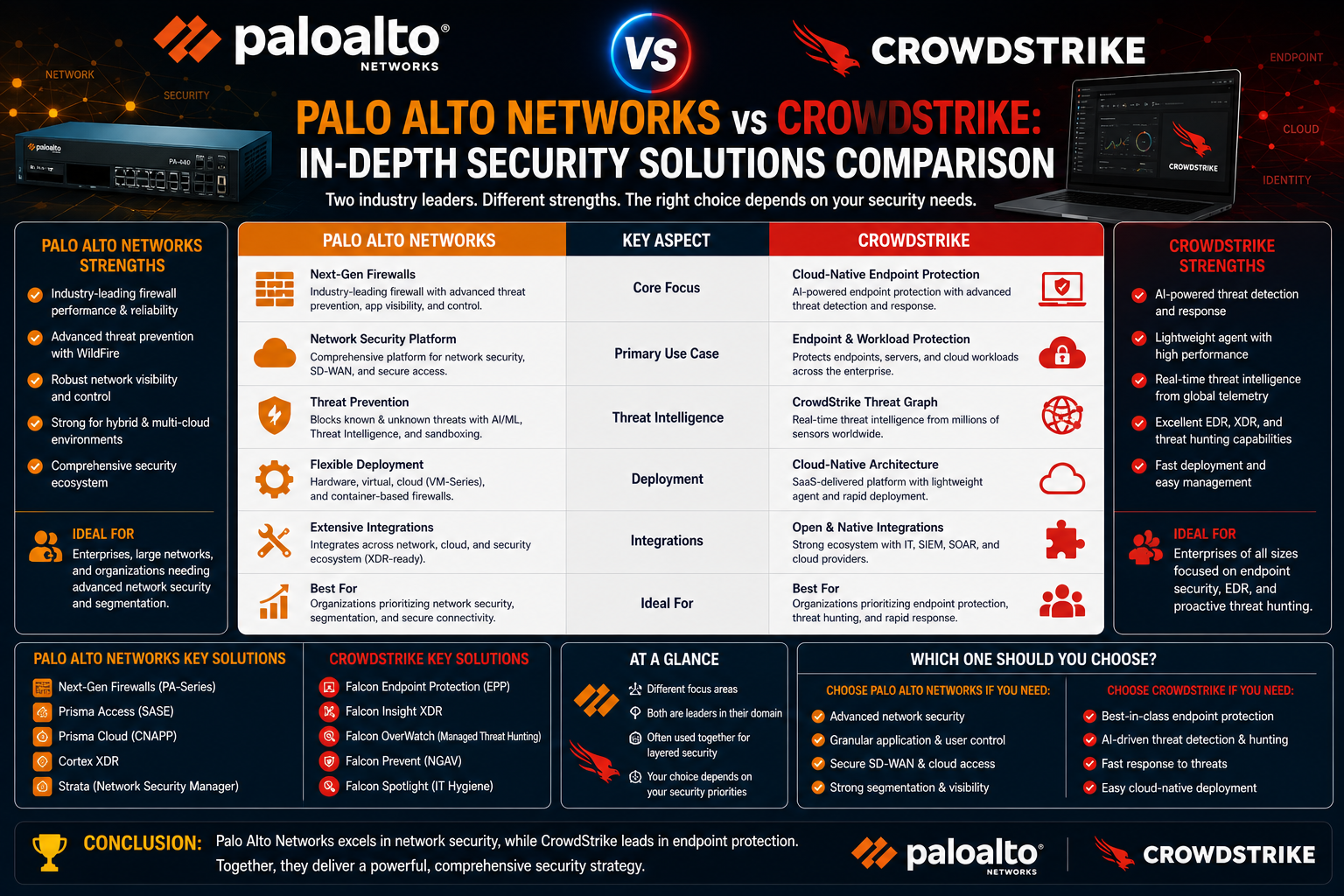
This is the environment in which modern cybersecurity platforms like Palo Alto Networks and CrowdStrike have risen to prominence. Both companies offer advanced security ecosystems designed to protect enterprises across endpoints, networks, cloud environments, and identity layers. While they share similar goals, their approaches reflect different philosophies and technical architectures.
Understanding how these companies approach security requires a closer look at how cybersecurity itself has evolved over time.
From Perimeter-Based Security to Cloud-Native Defense Models
Cybersecurity has undergone several major transformations over the past few decades. Initially, security was primarily hardware-based and focused on physical network boundaries. Organizations used firewalls, intrusion detection systems, and antivirus software to defend against known threats.
As internet connectivity expanded, attackers began exploiting vulnerabilities in exposed systems. This led to the development of more advanced tools such as intrusion prevention systems and behavior-based threat detection. However, these systems were still largely reactive in nature, responding to known signatures or predefined rules.
The rise of virtualization and cloud computing marked a turning point. Workloads were no longer confined to physical servers within a data center. Instead, they were distributed across dynamic environments that could scale up or down instantly. This made it difficult for traditional security tools to maintain visibility and control.
Cloud computing also introduced new risks. Misconfigured storage systems, unsecured APIs, and identity-based attacks became common entry points for attackers. The focus of cybersecurity shifted from protecting a perimeter to protecting identities, workloads, and data across distributed environments.
In this new paradigm, security platforms needed to evolve in three key ways:
First, they had to become cloud-aware, capable of monitoring and protecting workloads regardless of where they were hosted.
Second, they needed to adopt real-time analytics, allowing them to detect threats as they emerged rather than after damage had already been done.
Third, they had to unify security across multiple domains, including endpoints, networks, applications, and identity systems.
Both Palo Alto Networks and CrowdStrike emerged as leaders during this transition, but they approached the problem from different starting points. Palo Alto Networks originated from network security and expanded into cloud and endpoint protection, while CrowdStrike began as a cloud-native endpoint security company and later expanded into broader security operations.
The Core Philosophy Behind Palo Alto Networks
Palo Alto Networks is built on the principle of platform unification. Its approach centers on the idea that security should not be fragmented across multiple disconnected tools. Instead, organizations should operate within a unified security ecosystem that integrates network security, cloud security, and security operations.
At the heart of this philosophy is the belief that visibility is essential for effective protection. Without full visibility into network traffic, cloud workloads, and user activity, organizations cannot accurately detect or respond to threats. As a result, Palo Alto Networks has developed a broad portfolio of integrated products designed to provide end-to-end visibility.
One of the key strengths of this approach is its emphasis on deep network intelligence. The company’s technology is built to analyze traffic at a granular level, identifying suspicious behavior even when attackers attempt to disguise their activity. This makes it particularly effective in environments where network security remains a critical concern.
Another important aspect of its philosophy is consolidation. Many enterprises struggle with security sprawl, where multiple tools from different vendors create complexity and operational inefficiency. Palo Alto Networks addresses this by offering a unified platform that brings together firewall protection, cloud security, and security operations under a single architectural framework.
However, this level of integration also introduces complexity. Because the platform is highly configurable and feature-rich, it often requires skilled security teams to fully deploy and manage it effectively. This makes it more suitable for larger enterprises with dedicated cybersecurity teams rather than small organizations with limited resources.
Despite this complexity, the platform is widely respected for its depth and reliability. Its architecture is designed to handle large-scale enterprise environments where security requirements are extensive and continuously evolving.
The Core Philosophy Behind CrowdStrike
In contrast, CrowdStrike was designed from the ground up as a cloud-native security platform. Its philosophy is centered on simplicity, speed, and scalability. Rather than building complex on-premise systems, CrowdStrike focuses on delivering security through lightweight agents and cloud-based analytics.
The foundational idea behind CrowdStrike is that modern security must be fast, automated, and easy to deploy. Organizations should not need to manage heavy infrastructure or complex configurations to achieve strong protection. Instead, security should be delivered as a service that operates seamlessly in the background.
This philosophy is reflected in its architecture, which relies heavily on cloud processing and centralized intelligence. By shifting analysis to the cloud, CrowdStrike reduces the burden on local systems while enabling rapid detection of threats across global environments.
Another defining aspect of CrowdStrike’s approach is its focus on endpoint protection. While it has expanded into cloud security and identity protection, its core strength remains in monitoring and defending endpoints. This makes it particularly effective for organizations that prioritize endpoint visibility and rapid threat response.
CrowdStrike also emphasizes artificial intelligence and behavioral analytics. Rather than relying on traditional signature-based detection, it uses machine learning models to identify unusual activity patterns. This allows it to detect previously unknown threats and respond in real time.
The simplicity of deployment is one of its most attractive features. Organizations can quickly roll out protection across thousands of devices without requiring extensive configuration or infrastructure changes. This makes it especially appealing to companies with limited security personnel or those seeking rapid implementation.
However, this simplicity comes with trade-offs. While CrowdStrike excels in endpoint and identity protection, it is less focused on deep network security compared to platforms like Palo Alto Networks. As a result, organizations with complex network environments may need additional tools to achieve full coverage.
Deployment Models and Architectural Differences
The architectural differences between Palo Alto Networks and CrowdStrike play a significant role in how organizations choose between them.
Palo Alto Networks typically operates as a multi-layered platform that integrates hardware, software, and cloud services. Its solutions often involve the deployment of firewalls, cloud security tools, and centralized management systems. This creates a highly structured environment where security policies can be tightly controlled across the entire infrastructure.
This model is particularly effective for organizations with hybrid environments that include both on-premise data centers and cloud workloads. It allows for consistent enforcement of security policies across different environments while maintaining deep visibility into network traffic.
CrowdStrike, on the other hand, uses a fully cloud-native model. Its deployment is centered around lightweight agents installed on endpoints, which communicate with cloud-based analytics systems. This eliminates the need for traditional on-premise infrastructure and reduces operational overhead.
The cloud-native design also enables rapid scaling. As organizations grow or add new devices, they can easily extend protection without significant infrastructure changes. This makes CrowdStrike highly adaptable in dynamic environments where scalability is a priority.
However, this architecture also means that CrowdStrike is more dependent on internet connectivity and cloud infrastructure. While this is generally not an issue for modern organizations, it does create a reliance on external systems for real-time protection and analysis.
Security Domains: Where Each Platform Focuses
Cybersecurity today spans multiple domains, including endpoints, networks, cloud environments, and identity systems. Both Palo Alto Networks and CrowdStrike address these domains, but with different levels of emphasis.
Palo Alto Networks places strong emphasis on network security and cloud infrastructure protection. Its solutions are designed to monitor traffic flows, secure cloud workloads, and enforce policies across distributed systems. This makes it well-suited for organizations that require deep visibility into network activity.
CrowdStrike focuses primarily on endpoints and identity protection. It is designed to detect threats at the device level and prevent unauthorized access through behavioral analysis. This makes it highly effective in environments where endpoint security is the primary concern.
Both platforms have expanded into cloud security, but their roots still influence their strengths. Palo Alto Networks maintains a broader architectural scope, while CrowdStrike emphasizes speed and simplicity in endpoint-focused environments.
The Role of Artificial Intelligence and Automation in Modern Security
Artificial intelligence has become a central component of modern cybersecurity platforms. Both Palo Alto Networks and CrowdStrike use AI-driven systems to enhance threat detection and response capabilities.
AI allows these platforms to analyze vast amounts of data in real time, identifying patterns that would be impossible for human analysts to detect manually. This includes detecting unusual login behavior, identifying malware signatures, and recognizing potential data exfiltration attempts.
Automation further enhances these capabilities by enabling systems to respond to threats without human intervention. For example, when a suspicious activity is detected, automated systems can isolate affected devices, block network traffic, or trigger alerts for further investigation.
In the case of Palo Alto Networks, AI is deeply integrated into its security operations platform, enabling coordinated responses across network, cloud, and endpoint environments. CrowdStrike, meanwhile, uses AI primarily for endpoint detection and rapid response, focusing on speed and precision.
Together, these technologies represent a shift toward proactive security models that aim to prevent attacks before they cause damage, rather than simply reacting after the fact.
Expanding Security Beyond the Perimeter: How Modern Platforms Operate in Practice
As organizations continue shifting toward distributed cloud environments, the practical application of cybersecurity tools has become just as important as their theoretical capabilities. In real-world enterprise settings, security is no longer a static layer placed at the edge of a network. Instead, it is a continuously operating system that must adapt to changing workloads, user behaviors, and threat patterns.
Both Palo Alto Networks and CrowdStrike are designed to function in this dynamic environment, but they operationalize security in very different ways. Palo Alto Networks builds layered, infrastructure-wide protection that spans networks, cloud environments, and security operations centers. CrowdStrike, on the other hand, focuses on endpoint-centric intelligence delivered through a cloud-native architecture that emphasizes speed and automation.
Understanding how these platforms behave in real enterprise conditions requires examining how they handle visibility, detection, response, and integration across multiple security domains.
Network-Centric Intelligence and the Palo Alto Networks Approach
One of the defining characteristics of Palo Alto Networks is its deep focus on network-level visibility. Unlike endpoint-only solutions, its architecture is designed to inspect traffic flows at multiple layers, enabling organizations to see not just what is happening on individual devices but how data moves across the entire infrastructure.
This network-centric model is particularly valuable in environments where complex application traffic, hybrid cloud deployments, and inter-service communication create potential blind spots. By analyzing traffic at a granular level, the platform can identify anomalies that might indicate malicious activity, such as lateral movement within a network or unauthorized data transfers between systems.
A key strength of this approach is its ability to enforce consistent security policies across different environments. Whether traffic originates from a corporate data center, a public cloud environment, or a remote endpoint, the same policy framework can be applied. This consistency helps reduce security gaps that often arise when multiple disconnected tools are used.
The platform’s firewall technology plays a central role in this process. Instead of relying solely on port and protocol-based filtering, modern next-generation firewalls can inspect application-level traffic, enabling more precise control over what is allowed or blocked. This level of inspection allows organizations to differentiate between legitimate application usage and potentially harmful behavior disguised within normal traffic patterns.
Beyond traditional firewall capabilities, Palo Alto Networks extends its visibility into cloud environments through integrated cloud security services. These services monitor workloads, detect misconfigurations, and ensure compliance with security policies across infrastructure-as-a-service and platform-as-a-service environments.
This unified visibility is one of the reasons why large enterprises often choose Palo Alto Networks when they require deep control over complex hybrid environments.
Endpoint-Centric Security and the CrowdStrike Model
In contrast to network-heavy architectures, CrowdStrike operates on an endpoint-first philosophy. Its architecture is designed to treat every device as a potential entry point for threats, making endpoint monitoring the foundation of its security model.
Instead of relying on network traffic inspection, CrowdStrike collects telemetry directly from endpoints. This includes process activity, file execution patterns, login behavior, and system interactions. By analyzing this data in real time, it can detect suspicious activity even if it does not generate unusual network traffic.
This approach is particularly effective in modern environments where attackers often bypass network defenses entirely by targeting endpoints directly. For example, phishing attacks, credential theft, and malware infections typically begin at the device level rather than through network penetration.
CrowdStrike’s cloud-native architecture allows this endpoint data to be processed at scale. Each device runs a lightweight agent that continuously streams data to the cloud, where machine learning models analyze it for anomalies. This eliminates the need for heavy on-premise infrastructure and allows organizations to scale security across thousands or even millions of devices.
One of the key advantages of this model is speed. Because analysis occurs in the cloud, threat detection and response can happen in near real time. This is particularly important in fast-moving attacks where delays of even a few seconds can result in significant damage.
The simplicity of deployment also makes CrowdStrike highly accessible. Organizations can onboard new endpoints quickly without complex configuration, making it suitable for distributed workforces and rapidly growing companies.
However, this endpoint-centric focus means that CrowdStrike relies heavily on device-level visibility. While it provides strong protection at the endpoint layer, organizations with highly complex network environments may need additional tools to achieve full-spectrum visibility.
Cloud Security Expansion and the Evolution of Platform Boundaries
As the cloud adoption has increased, both Palo Alto Networks and CrowdStrike have expanded their capabilities beyond their original domains. This expansion reflects a broader industry trend where security platforms must cover multiple layers of the technology stack.
Palo Alto Networks has extended its reach into cloud security through its integrated platform approach. Its cloud security tools are designed to provide visibility into workloads, configurations, and data flows across cloud environments. This allows organizations to identify vulnerabilities such as misconfigured storage systems, overly permissive access controls, and exposed services.
By integrating cloud security with network and endpoint protection, Palo Alto Networks aims to create a unified security fabric that spans the entire infrastructure. This approach reduces fragmentation and allows security teams to manage multiple domains from a single operational framework.
CrowdStrike has also expanded into cloud security, but its approach remains closely tied to its endpoint heritage. Its cloud security capabilities are built around workload protection, identity monitoring, and behavioral analysis. Instead of focusing on network configuration, it emphasizes detecting threats that originate from compromised credentials or malicious activity within cloud workloads.
This difference highlights a key distinction between the two platforms. Palo Alto Networks emphasizes infrastructure-wide control, while CrowdStrike focuses on behavioral intelligence across distributed endpoints and workloads.
Security Operations and Incident Response Workflows
Security operations centers (SOCs) play a critical role in modern cybersecurity strategies. These teams are responsible for monitoring alerts, investigating threats, and coordinating responses to incidents across the organization.
Both Palo Alto Networks and CrowdStrike provide tools designed to support SOC operations, but their workflows differ significantly.
Palo Alto Networks integrates security operations into its broader platform, combining network, cloud, and endpoint data into a unified dashboard. This allows analysts to correlate events across multiple layers of the infrastructure. For example, a suspicious login detected on an endpoint can be linked to unusual network traffic or cloud activity, providing a more complete picture of potential threats.
This level of correlation is particularly valuable in complex environments where attacks often span multiple systems. However, it also requires skilled analysts who can interpret large volumes of data and manage complex workflows.
CrowdStrike takes a more streamlined approach to security operations. Its platform is designed to simplify investigation workflows by automatically correlating endpoint data and highlighting high-confidence threats. This reduces the burden on security teams and allows them to focus on remediation rather than manual analysis.
The platform’s automation capabilities also play a key role in incident response. When a threat is detected, CrowdStrike can automatically isolate affected devices, terminate malicious processes, and initiate remediation actions. This reduces response times and helps contain threats before they spread.
In contrast, Palo Alto Networks provides more granular control over response actions, allowing organizations to define complex policies that govern how different types of incidents are handled across various environments.
Threat Intelligence and Behavioral Analytics
Threat intelligence is a critical component of modern cybersecurity platforms. It involves collecting and analyzing data about known and emerging threats to improve detection and response capabilities.
Palo Alto Networks leverages a combination of global threat intelligence feeds, machine learning models, and behavioral analysis to identify suspicious activity. Its approach focuses on correlating data across multiple security layers, enabling it to detect sophisticated attacks that span networks, cloud environments, and endpoints.
This multi-layered intelligence model allows it to identify complex attack patterns such as lateral movement, privilege escalation, and command-and-control communication.
CrowdStrike, meanwhile, has built its reputation around advanced threat intelligence capabilities. Its platform collects vast amounts of endpoint telemetry from across its global customer base, enabling it to identify emerging threats quickly.
One of its key strengths lies in behavioral detection. Instead of relying solely on known signatures, it analyzes how processes behave over time. This allows it to detect previously unknown malware and zero-day attacks.
CrowdStrike also maintains a dedicated threat hunting team that actively investigates adversary behavior. This proactive approach helps identify attack techniques before they become widespread, giving organizations early warning of emerging threats.
Integration and Ecosystem Considerations
Modern enterprises rarely rely on a single security tool. Instead, they operate complex ecosystems of interconnected platforms that must work together seamlessly.
Palo Alto Networks emphasizes integration across its own product suite, creating a tightly connected ecosystem that spans network security, cloud security, and security operations. This integrated design allows data to flow freely between different components, improving visibility and coordination.
It also supports integration with third-party tools, enabling organizations to extend its capabilities within existing security architectures.
CrowdStrike similarly offers integration capabilities, but its ecosystem is more focused on endpoint and cloud security data. It is often used alongside other network security tools to provide a more complete security posture.
This difference in ecosystem design reflects their underlying philosophies. Palo Alto Networks aims to provide a unified platform that covers multiple security domains, while CrowdStrike focuses on delivering best-in-class endpoint intelligence that integrates into broader environments.
Operational Complexity vs. Simplicity in Real Environments
One of the most important practical considerations when evaluating these platforms is operational complexity.
Palo Alto Networks provides a highly configurable and deeply integrated system. This allows organizations to fine-tune security policies and build complex architectures tailored to their specific needs. However, this flexibility comes with increased operational overhead.
Security teams must manage multiple components, configure detailed policies, and ensure proper integration across environments. This often requires experienced personnel and structured processes.
CrowdStrike, by contrast, prioritizes simplicity. Its cloud-native architecture and unified agent model reduce the need for complex configuration. Security teams can deploy and manage protection with relatively minimal effort.
This simplicity makes it particularly attractive for organizations with smaller security teams or those that prioritize rapid deployment over granular control.
However, simplicity can also mean less customization. Organizations with highly specialized security requirements may find CrowdStrike less flexible in certain areas compared to more comprehensive platforms.
Real-World Security Scenarios and Platform Behavior
In practical terms, the differences between these platforms become most apparent during real-world security incidents.
In a large enterprise environment with complex network infrastructure, Palo Alto Networks can provide deep visibility into traffic flows, allowing security teams to trace attacks across multiple systems. This is particularly useful in detecting sophisticated, multi-stage attacks.
In contrast, CrowdStrike excels in scenarios where threats originate at the endpoint level. For example, if a user unknowingly executes malicious software, CrowdStrike can quickly detect abnormal behavior and isolate the affected device before the threat spreads.
In cloud-heavy environments, both platforms provide value, but in different ways. Palo Alto Networks offers broad visibility across infrastructure, while CrowdStrike focuses on detecting compromised identities and workloads.
These differences highlight that neither platform is universally superior. Instead, their effectiveness depends heavily on the specific environment in which they are deployed.
How Organizations Actually Decide Between Security Platforms in Practice
When enterprises evaluate cybersecurity platforms in real-world scenarios, the decision is rarely based on features alone. Instead, it emerges from a complex mix of operational needs, risk tolerance, internal expertise, regulatory requirements, and long-term IT strategy.
Both Palo Alto Networks and CrowdStrike operate in overlapping but fundamentally different layers of the cybersecurity ecosystem. One emphasizes broad infrastructure control across networks, cloud, and security operations, while the other prioritizes endpoint intelligence, behavioral analytics, and cloud-native simplicity.
Because of this, choosing between them is less about identifying a “better” platform and more about aligning a platform with organizational reality. A global enterprise running hybrid data centers will evaluate security differently from a fast-scaling digital startup operating entirely in the cloud. Similarly, a highly regulated industry such as finance or healthcare will prioritize governance, auditability, and control in ways that differ significantly from a technology company focused on agility.
This section explores how those real-world constraints shape decision-making, and how each platform aligns with different types of organizational needs.
Enterprise Architecture Maturity and Its Influence on Security Choices
One of the most important factors influencing platform selection is the maturity of an organization’s IT architecture. Mature enterprises often operate complex hybrid environments that include legacy systems, private data centers, and multiple cloud providers. In such environments, security must be deeply integrated into infrastructure at multiple layers.
Organizations with this level of complexity often benefit from platforms that provide broad visibility across networks, workloads, and applications. A platform like Palo Alto Networks tends to align well with these requirements because it is designed to operate across multiple domains simultaneously. Its architecture supports detailed policy enforcement, network inspection, and cloud workload monitoring in a unified framework.
In these environments, the ability to enforce consistent security policies across diverse systems is critical. Large enterprises cannot afford fragmented security controls that behave differently depending on where workloads are hosted. They need centralized governance and consistent enforcement mechanisms that scale across geographies and infrastructure types.
On the other hand, organizations with more modern, cloud-native architectures often operate with significantly less infrastructure complexity. These organizations typically rely heavily on SaaS applications, containerized workloads, and serverless computing. In such environments, traditional network boundaries are less relevant, and security is more focused on identity, endpoint behavior, and workload activity.
CrowdStrike aligns naturally with this type of architecture because its design assumes that endpoints and identities are the primary security boundary. Its cloud-native model allows organizations to deploy protection quickly across distributed systems without requiring deep infrastructure changes.
As a result, architecture maturity plays a central role in determining which platform fits better within an organization’s long-term strategy.
Risk Posture: Balancing Control, Visibility, and Speed
Every organization has a unique risk posture that determines how aggressively it prioritizes security versus operational efficiency. Some organizations operate in high-risk environments where security failures can result in significant financial loss, regulatory penalties, or even threats to human safety. Others prioritize speed, innovation, and user experience, accepting a higher degree of risk in exchange for agility.
Palo Alto Networks is often favored by organizations with a conservative risk posture. Its platform provides extensive control over network traffic, cloud configurations, and security policies. This level of control allows security teams to define highly specific rules governing how systems behave under different conditions.
This is particularly important in regulated industries where compliance requirements demand strict auditing, logging, and policy enforcement. The ability to trace activity across multiple layers of infrastructure provides strong assurance that security policies are being followed consistently.
However, this level of control also introduces operational complexity. Managing detailed policies across large environments requires skilled personnel and structured governance processes. Organizations must be prepared to invest in security operations capabilities to fully leverage the platform.
CrowdStrike, by contrast, aligns more closely with organizations that prioritize speed and operational efficiency. Its security model is designed to reduce friction, enabling rapid deployment and automated response to threats. This makes it particularly well-suited for organizations that need to scale quickly or operate with lean security teams.
Its automated detection and response capabilities reduce the need for manual intervention, allowing security teams to focus on higher-level decision-making rather than day-to-day operational tasks. This can significantly improve response times in fast-moving threat environments.
However, organizations that rely heavily on automation must also be comfortable with less granular control over security decisions. While CrowdStrike provides strong protection, it abstracts many underlying details in favor of simplicity.
Operational Staffing and Security Team Capabilities
Another critical factor in platform selection is the capability and size of the internal security team. Cybersecurity platforms are not standalone solutions; they require human expertise to configure, monitor, and optimize effectively.
Palo Alto Networks typically requires more specialized expertise due to the breadth and depth of its platform. Security teams must understand network architecture, firewall configuration, cloud security principles, and security operations workflows. This makes it more suitable for organizations with mature security operations centers and experienced personnel.
In such environments, the platform’s complexity becomes an advantage rather than a burden. Skilled analysts can leverage its advanced capabilities to create highly customized security architectures that align closely with organizational needs.
CrowdStrike, on the other hand, is designed to reduce operational overhead. Its cloud-native interface and automated workflows make it accessible to smaller teams that may not have deep expertise across all security domains. This democratization of security capabilities allows organizations to achieve strong protection without requiring large teams of specialists.
This difference has significant implications for hiring, training, and long-term operational costs. Organizations must consider not only the cost of the platform itself but also the cost of maintaining the expertise required to operate it effectively.
Incident Response Models and Real-World Attack Scenarios
Incident response is one of the most critical functions of any cybersecurity platform. When an attack occurs, the speed and effectiveness of the response can determine the extent of damage.
Palo Alto Networks approaches incident response as a multi-layered process that integrates data from networks, cloud environments, and endpoints. This allows security teams to reconstruct attack chains across the entire infrastructure. For example, an attack that begins with a compromised endpoint can be traced through lateral movement across the network and into cloud workloads.
This level of visibility is extremely valuable in complex attack scenarios where multiple systems are involved. It enables organizations to understand not just what happened, but how it happened and where additional vulnerabilities may exist.
However, this comprehensive visibility requires careful coordination and skilled analysis. Incident response teams must interpret large volumes of data and correlate events across multiple systems.
CrowdStrike takes a more streamlined approach to incident response. Its platform automatically correlates endpoint data and identifies high-confidence threats. When an incident is detected, it can automatically isolate affected devices and initiate remediation actions.
This automation significantly reduces response times and limits the spread of attacks. In many cases, threats can be contained before they escalate into larger incidents.
However, while this approach is highly efficient, it may provide less contextual depth compared to broader network-based analysis. Organizations that require detailed forensic investigation across multiple systems may still need additional tools to complement endpoint-focused insights.
Cloud Security Evolution and Platform Convergence
As cloud environments continue to evolve, the boundaries between different types of security platforms are becoming increasingly blurred. Both Palo Alto Networks and CrowdStrike have expanded their offerings to address this convergence, but their approaches reflect their origins.
Palo Alto Networks has extended its platform into cloud security by integrating workload protection, configuration management, and identity-based controls. This allows it to maintain its core philosophy of unified security across infrastructure layers.
Its approach emphasizes visibility and control across cloud environments, ensuring that security policies remain consistent regardless of where workloads are deployed.
CrowdStrike has expanded into cloud security by focusing on workload protection and identity-based threat detection. Rather than emphasizing network configuration, it focuses on detecting abnormal behavior within cloud environments.
This reflects a broader industry shift toward identity-centric security models, where access control and behavioral monitoring become more important than traditional network boundaries.
As cloud adoption increases, these approaches are gradually converging, with both platforms expanding into overlapping domains while maintaining distinct architectural philosophies.
Regulatory Compliance and Governance Requirements
For many organizations, especially in regulated industries, compliance requirements play a central role in platform selection. Regulations often require strict controls over data access, logging, monitoring, and incident response.
Palo Alto Networks is often favored in these environments due to its ability to provide detailed visibility and granular policy enforcement. Its platform supports comprehensive logging and reporting capabilities, making it easier for organizations to demonstrate compliance with regulatory standards.
The ability to enforce consistent policies across hybrid environments is particularly important in industries such as finance, healthcare, and government, where regulatory oversight is strict, and violations can result in significant penalties.
CrowdStrike also supports compliance requirements, but its focus is more on endpoint and identity protection. While it provides strong visibility into device activity and threat detection, organizations may need to integrate it with additional tools to achieve full compliance coverage across the network and cloud infrastructure.
This difference reflects the broader architectural distinction between the two platforms: one emphasizes infrastructure-wide governance, while the other emphasizes endpoint intelligence and rapid response.
Cost Structures and Long-Term Investment Considerations
Cost is another important factor in platform selection, although it is often evaluated in terms of total cost of ownership rather than initial licensing fees alone.
Palo Alto Networks typically involves higher upfront complexity and operational investment. Organizations must account for deployment, configuration, training, and ongoing management costs. However, this investment can result in highly customized security architectures that provide long-term value in complex environments.
CrowdStrike generally offers a more streamlined cost structure due to its cloud-native model. Reduced infrastructure requirements and simplified deployment can lower operational costs, particularly for organizations with limited IT resources.
However, cost comparisons must also consider the scope of protection. Organizations that require broader infrastructure coverage may need to supplement endpoint-focused solutions with additional tools, potentially increasing overall costs.
The Future of Cybersecurity Platforms and Industry Direction
The cybersecurity industry is currently undergoing a major transformation driven by cloud adoption, artificial intelligence, and increasing automation. Traditional boundaries between security domains are dissolving, and platforms are evolving toward more integrated, intelligent systems.
Both Palo Alto Networks and CrowdStrike are adapting to these changes, but their strategies reflect different visions of the future.
Palo Alto Networks continues to emphasize platform unification, aiming to bring network, cloud, and security operations into a single integrated ecosystem. Its future direction appears focused on expanding this unified architecture while increasing automation and AI-driven analytics.
CrowdStrike continues to emphasize cloud-native simplicity and endpoint intelligence. Its future evolution is likely to focus on expanding behavioral analytics, improving identity protection, and increasing automation across cloud environments.
Despite their differences, both platforms are converging toward a shared goal: reducing the time between threat detection and response while increasing visibility across increasingly complex digital environments.
Strategic Alignment as the Final Determining Factor
Ultimately, the choice between these platforms is not determined by technical superiority alone. Instead, it is shaped by strategic alignment with organizational goals, infrastructure complexity, and operational capabilities.
Some organizations require deep infrastructure control, extensive customization, and multi-layered visibility. Others prioritize speed, simplicity, and automated protection across distributed environments.
In practice, many enterprises also adopt hybrid approaches, combining elements of both platforms to achieve balanced coverage across different layers of their infrastructure.
What remains consistent is that cybersecurity is no longer a static discipline. It is an evolving ecosystem that requires continuous adaptation, integration, and strategic decision-making across multiple domains of technology and risk management.
Conclusion
The comparison between Palo Alto Networks and CrowdStrike reflects a broader shift in how modern cybersecurity is designed, deployed, and managed in today’s cloud-driven world. Rather than being simple competitors offering interchangeable solutions, both platforms represent different philosophies for solving the same core problem: protecting organizations against increasingly sophisticated and fast-moving digital threats.
Palo Alto Networks is built around the idea of unified, infrastructure-wide security. Its strength lies in providing deep visibility across networks, cloud environments, and security operations. This makes it particularly valuable for large enterprises with complex hybrid infrastructures, where controlling traffic flows, enforcing consistent policies, and maintaining centralized governance are critical. Its platform approach is broad, detailed, and highly configurable, giving organizations the ability to fine-tune security at multiple layers. However, this depth also introduces complexity, requiring skilled teams and structured operational maturity to fully realize its potential.
On the other hand, CrowdStrike represents a cloud-native, endpoint-centric philosophy that prioritizes simplicity, speed, and automation. Its design assumes that endpoints and identities are the primary battlegrounds of modern cyberattacks. By focusing on lightweight deployment and real-time behavioral analytics, CrowdStrike enables organizations to detect and respond to threats quickly, often with minimal manual intervention. This makes it especially effective for organizations that operate in highly dynamic cloud environments or those with smaller security teams that need rapid, scalable protection without heavy infrastructure overhead.
The contrast between these two approaches highlights an important reality in cybersecurity today: there is no universal “best” solution. Instead, effectiveness depends heavily on context. Organizations with deeply integrated hybrid infrastructures and strict compliance requirements often benefit from the broad visibility and control offered by Palo Alto Networks. Meanwhile, organizations that prioritize agility, cloud-native operations, and rapid deployment often find CrowdStrike’s streamlined model more aligned with their needs.
Another key takeaway is that modern cybersecurity is no longer confined to a single layer of defense. Threats now move fluidly across endpoints, identities, networks, and cloud workloads. As a result, security platforms must either expand their scope or integrate effectively with complementary technologies. Both Palo Alto Networks and CrowdStrike have evolved in this direction, extending their capabilities beyond their original focus areas to address the full spectrum of enterprise risk.
Ultimately, the decision between these platforms is not just a technical choice—it is a strategic one. It requires organizations to evaluate their architecture, risk tolerance, operational maturity, and long-term digital transformation goals. In many cases, the most effective approach may not be choosing one over the other, but rather understanding how each can contribute to a layered, defense-in-depth strategy.
As cyber threats continue to evolve and cloud environments become even more distributed, the importance of adaptable, intelligent, and well-integrated security platforms will only grow. Whether through the comprehensive ecosystem of Palo Alto Networks or the agile, cloud-native design of CrowdStrike, organizations must ensure that their security strategy evolves in step with the complexity of the environments they are trying to protect.