For many years, IT certifications were built around a straightforward idea: prove that you understand a specific technology. If you wanted to validate your skills in networking, databases, operating systems, or cloud platforms, you would study a fixed set of exam objectives tied closely to a particular product or version. Success meant memorizing technical details, understanding configurations, and demonstrating that you could work within the boundaries of a defined system.
This model worked reasonably well in an era when technology environments were more predictable and slower to evolve. Organizations often used stable, long-term infrastructure stacks, and professionals could build careers around mastering a specific product line. Certifications mirrored this structure by focusing heavily on tools rather than job functions.
However, as IT environments became more complex, distributed, and cloud-driven, this approach started showing limitations. Professionals found that passing exams did not always translate into being fully prepared for real job responsibilities. A certification might confirm knowledge of a technology, but it did not necessarily confirm the ability to design solutions, manage systems in production environments, or respond to dynamic business needs.
This growing gap between certification content and workplace reality set the stage for a significant transformation in how IT vendors approached professional validation. Microsoft became one of the first major companies to formally address this shift at scale.
The Pre-2019 Certification Model and Its Limitations
Before the introduction of role-based certifications, Microsoft certifications were organized around product families and specific technical tracks. These certifications were widely recognized and respected, but they were also deeply tied to individual technologies and versions.
For example, professionals might pursue certifications centered on Windows Server, SQL Server, Office technologies, or early versions of Azure. Each certification had a structured set of exams, and each exam focused on detailed technical knowledge of a product’s features, configuration options, and administrative tasks.
This approach had several strengths. It created a clear learning path, allowed professionals to specialize deeply in a technology, and provided employers with a simple way to evaluate technical knowledge. However, it also created several structural weaknesses that became more apparent as the industry evolved.
One of the most important issues was fragmentation. Professionals often had to pursue multiple certifications to build a complete skill profile. For instance, someone working in infrastructure might need certifications in networking, server administration, virtualization, and cloud services separately. Each certification stood on its own, with limited integration between them.
Another limitation was the focus on static knowledge. Exams were often designed around specific product versions, meaning that knowledge could become outdated quickly. When technology platforms evolved or shifted to new versions, certifications had to be updated, retired, or replaced entirely.
More importantly, the certification structure did not always reflect how real-world job roles functioned. In practice, IT professionals rarely work on isolated technologies. Instead, they operate in roles that require a combination of skills across systems, services, security, automation, and architecture. The older certification model did not fully capture this interconnected nature of modern IT work.
This gap between certification design and real job requirements became increasingly visible as cloud computing began reshaping enterprise IT environments.
The Rise of Cloud Computing and New Skill Expectations
The rapid adoption of cloud platforms fundamentally changed how organizations build and manage technology systems. Instead of relying solely on on-premises infrastructure, companies began using cloud services for computing, storage, networking, application hosting, security, and analytics.
This shift introduced new expectations for IT professionals. Traditional roles such as system administrators and network engineers expanded into broader responsibilities that included cloud architecture, identity management, security governance, and automation.
Cloud environments also introduced a new level of abstraction. Many tasks that were previously manual became automated or service-driven. Instead of configuring hardware directly, professionals now worked with scalable services that required conceptual understanding rather than device-level configuration.
As a result, employers began looking for professionals who could perform across multiple domains rather than specialize narrowly in a single technology. Skills such as designing scalable systems, managing distributed environments, securing cloud resources, and integrating services became more important than memorizing product-specific commands or configurations.
This evolution created a mismatch between traditional certifications and emerging job requirements. While certifications still validated technical knowledge, they did not always reflect the broader skill sets needed in cloud-driven roles.
Microsoft observed this shift closely as Azure adoption grew globally. The company recognized that a new approach to certification design would be necessary to align learning with real-world job expectations.
Microsoft’s Recognition of the Skills Gap
By 2019, Microsoft had accumulated significant experience with cloud services through Azure and enterprise solutions. As organizations adopted Azure at scale, Microsoft gained insight into how professionals actually used cloud technologies in production environments.
One key observation was that professionals were increasingly evaluated based on their job roles rather than individual technical certifications. Employers were less interested in whether someone had passed an exam on a specific product version and more focused on whether they could perform tasks associated with a role such as cloud administrator, developer, or solutions architect.
This insight led to a fundamental question: should certifications continue to focus on technologies, or should they focus on the responsibilities and capabilities required in real job roles?
Microsoft’s answer to this question resulted in a major redesign of its certification framework. Instead of organizing certifications around products, Microsoft began structuring them around job roles. This meant shifting from a technology-centered model to a skills-centered model.
The goal was not only to update certification content but to realign the entire learning structure with modern career paths. Rather than asking what someone knows about a specific product, the new model asked what someone can do in a specific job function.
This shift represented a significant philosophical change in how certification value was defined.
The Introduction of Role-Based Certifications in 2019
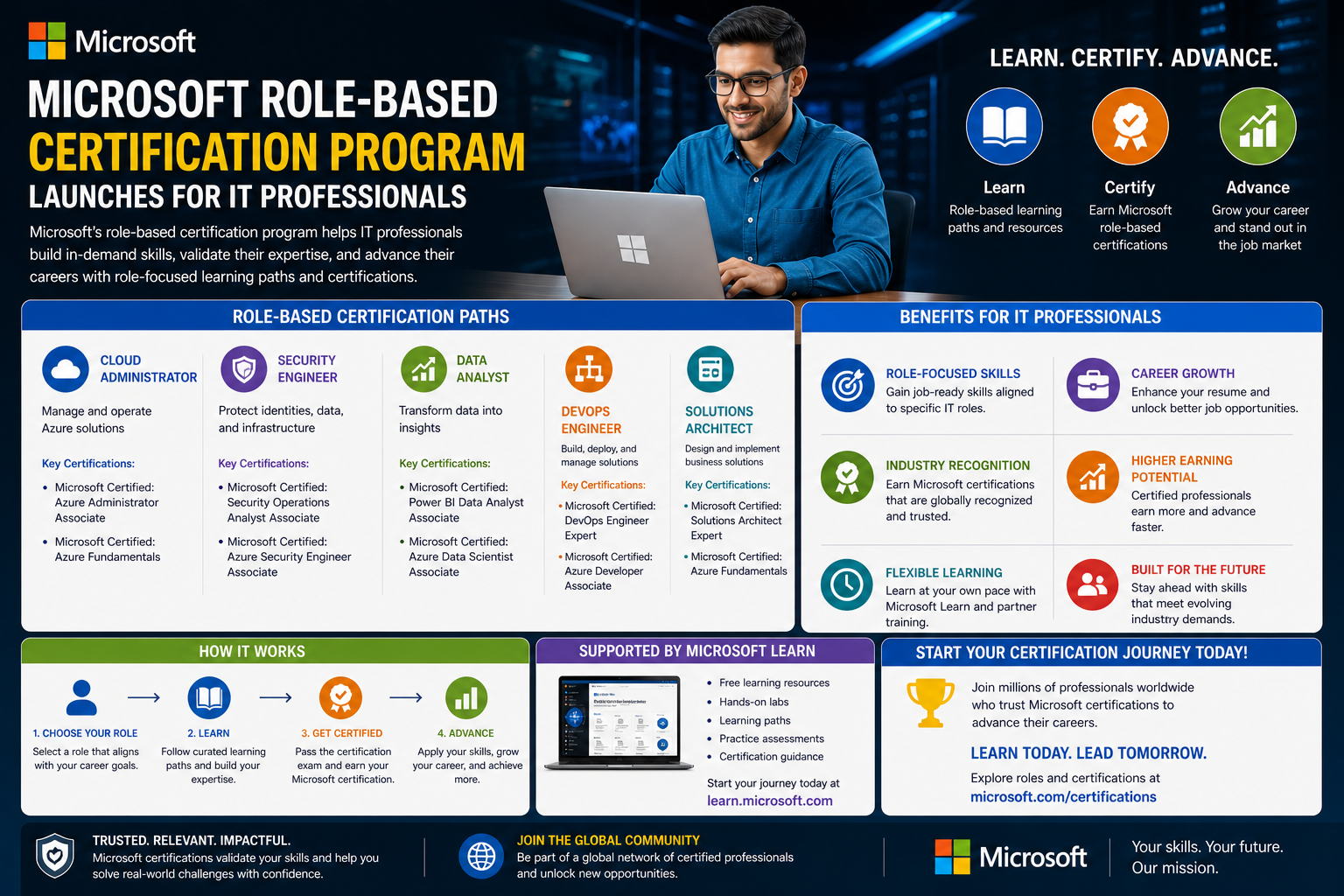
In 2019, Microsoft officially introduced role-based certifications, marking a turning point in its certification strategy. The first set of certifications focused on three primary Azure roles: administrator, developer, and solutions architect.
Each of these roles represented a distinct set of responsibilities commonly found in cloud environments. Instead of focusing on isolated technologies, each certification was designed around real-world job functions and tasks.
The Azure Administrator role focused on managing cloud infrastructure, including computing resources, storage, networking, and identity management. The Azure Developer role focused on building and deploying applications in cloud environments. The Azure Solutions Architect role focused on designing scalable and secure cloud solutions that meet organizational requirements.
What made this shift significant was not just the introduction of new exams, but the restructuring of how knowledge was defined. Each certification now represented a combination of skills, tools, and practical scenarios aligned with job responsibilities.
This approach allowed professionals to build certifications that more closely mirrored actual career paths. Instead of collecting isolated technical credentials, individuals could now pursue certifications that reflected their intended professional role.
The introduction of role-based certifications also signaled a broader shift in how Microsoft viewed career development. Rather than positioning certifications as purely technical validations, they became part of a structured career progression framework.
From Product Knowledge to Skill-Based Learning
One of the most important aspects of this transformation was the shift from product knowledge to skill-based learning. In the older certification model, success was largely based on understanding how a specific product worked. Candidates were expected to know configuration settings, command structures, and system behaviors in detail.
In the new model, emphasis shifted toward applying knowledge in practical scenarios. Instead of simply knowing how a feature works, candidates needed to understand how to use it in a real job context.
This change reflected a broader understanding of how professionals learn and perform in real environments. In practice, IT roles require problem-solving, decision-making, and the ability to integrate multiple technologies rather than relying on isolated product knowledge.
Skill-based learning also encouraged a more dynamic approach to certification design. Instead of focusing on static versions of technology, certifications could evolve more quickly to reflect changes in industry practices and cloud services.
This made certifications more adaptable and relevant to modern IT environments, where technologies evolve rapidly and job responsibilities shift frequently.
Industry Response and the Broader Certification Evolution
Microsoft’s move toward role-based certifications did not occur in isolation. It reflected a broader trend across the IT industry toward aligning learning pathways with job roles and real-world responsibilities.
As organizations increasingly adopted cloud computing, automation, and DevOps practices, the need for role-specific skill validation became more apparent. Employers wanted certifications that demonstrated readiness for specific functions rather than general technical familiarity.
This shift also influenced how training programs and professional development strategies were designed. Instead of focusing on product manuals or isolated technical topics, learning pathways began to emphasize integrated skill sets.
The industry’s response to Microsoft’s changes was largely positive, particularly among professionals working in cloud environments. Many saw the new model as more aligned with how modern IT work actually functions.
However, the transition also introduced challenges. Professionals who had invested heavily in older certification paths needed to adjust to new structures. Organizations also had to reinterpret how they evaluated certifications in hiring and workforce planning.
Despite these challenges, the shift marked a clear direction toward more practical, role-focused professional validation systems.
Early Azure Role Certifications and Their Structure
The initial role-based certifications introduced by Microsoft centered on Azure because of its growing importance in enterprise environments. These certifications were designed to reflect common job roles within cloud operations and development teams.
Each certification included a combination of conceptual knowledge and applied skills. Instead of focusing solely on theoretical understanding, candidates were expected to demonstrate how they would perform tasks in real-world environments.
For example, the Azure Administrator certification emphasized managing resources, implementing identity solutions, configuring virtual networks, and maintaining cloud infrastructure. These responsibilities reflected the daily tasks of professionals working in operational cloud roles.
The Azure Developer certification focused on building applications, integrating services, and deploying solutions in cloud environments. This aligned with the responsibilities of software engineers working within cloud-native development frameworks.
The Azure Solutions Architect certification emphasized designing cloud architectures, ensuring scalability, and aligning technical solutions with business requirements. This role required a broader understanding of both technical and organizational considerations.
These certifications collectively represented a shift toward defining learning paths based on job function rather than technology specialization.
Reframing Career Development in IT
The introduction of role-based certifications also changed how career development in IT was perceived. Instead of viewing certifications as isolated achievements, professionals began to see them as part of a structured career progression system.
This shift encouraged a more intentional approach to skill development. Rather than collecting certifications without a clear direction, individuals could now align their learning with specific career goals and job roles.
It also helped bridge the gap between education and employment by making certification paths more closely aligned with job descriptions. This alignment made it easier for employers to understand what certified professionals were capable of doing in practical environments.
At the same time, it reinforced the idea that professional development is an ongoing process rather than a one-time achievement. As roles evolve and technologies change, certifications also need to evolve to remain relevant.
This dynamic approach reflects the reality of modern IT careers, where continuous learning is essential for long-term success.
The Transition Away from Traditional Certification Structures
As Microsoft introduced role-based certifications, it also began phasing out older certification structures that were based on legacy systems. This transition reflected the company’s commitment to aligning its certification strategy with modern industry needs.
Older certifications focused heavily on specific technologies such as server operating systems, database platforms, and legacy infrastructure tools. While these certifications were valuable in their time, they increasingly reflected outdated models of IT operations.
The transition to role-based certifications marked a deliberate move away from this technology-centric approach. Instead, Microsoft aimed to create a more flexible and future-oriented certification system that could adapt to evolving job roles.
This transition required professionals to reconsider their certification strategies and adapt to new learning pathways. It also encouraged organizations to rethink how they evaluated technical expertise within their teams.
The shift ultimately represented a broader transformation in how technical skills are defined, validated, and applied in professional environments.
Expanding the Role-Based Certification Ecosystem Beyond Azure
As Microsoft introduced role-based certifications in 2019, the initial focus on Azure marked only the beginning of a much larger restructuring. While Azure roles formed the foundation, the broader certification ecosystem soon expanded to cover productivity platforms, security operations, modern desktop management, and enterprise identity systems.
This expansion was important because it demonstrated that role-based learning was not limited to cloud infrastructure alone. Instead, it reflected a company-wide shift in how professional skills were defined across Microsoft technologies.
In the older certification model, each product line existed in a relatively separate track. Office technologies had their own certifications, server technologies had another set, and development platforms followed a different structure entirely. The new model began dissolving these silos.
Instead of treating each product as an isolated domain, Microsoft started grouping technologies based on how they were used within job roles. This allowed certifications to reflect real-world responsibilities more accurately.
For example, professionals working in enterprise environments often deal with identity management, security configuration, device compliance, and cloud service integration simultaneously. Rather than requiring separate certifications for each product area, the role-based system began integrating these responsibilities into unified learning paths.
This shift reflected a more holistic understanding of IT operations, where job roles are defined by outcomes rather than tools.
The Retirement of Legacy Certifications and Structural Realignment
As role-based certifications gained prominence, Microsoft began retiring a large number of legacy certifications that were built around older models. This transition was not simply an update of exam content; it represented a structural realignment of the entire certification framework.
Legacy certifications such as MCSA, MCSE, and MCSD had been widely recognized for many years. They provided clear progression paths and were deeply embedded in IT career structures. However, they were also tightly bound to specific technologies and product versions.
Over time, this created a challenge. As Microsoft shifted toward cloud-first development and service-based architecture, maintaining version-specific certifications became increasingly difficult. Each new product iteration required updates or new exam tracks, leading to fragmentation and complexity.
The decision to retire these certifications marked a significant transition away from version-based validation. Instead of certifying knowledge tied to a specific product release, Microsoft began emphasizing skills that remained relevant across evolving technologies.
This change also reflected the reality that modern IT environments are no longer static. Organizations frequently adopt hybrid systems that combine cloud services, legacy infrastructure, and third-party platforms. Certifications needed to reflect this complexity rather than simplify it into isolated product knowledge.
The retirement of legacy certifications signaled the end of an era in which IT validation was primarily product-centric.
Mapping Old Certifications to New Role-Based Paths
One of the major challenges during this transition was helping professionals understand how their existing certifications related to the new role-based structure. Many individuals had already invested significant time and effort into legacy certifications and needed clarity on how their skills would transfer.
Microsoft attempted to address this by introducing partial mapping between older exams and new role-based certifications. However, this mapping was not always direct or one-to-one. In some cases, multiple legacy exams contributed to a single role-based certification. In other cases, no clear equivalent existed at all.
This complexity arose because the underlying philosophy of certification had changed. Legacy certifications were built around technology coverage, while role-based certifications were built around job function coverage. These two models do not always align neatly.
For example, an older certification focused on infrastructure deployment might overlap partially with an Azure Administrator certification, but it would not fully capture the broader responsibilities associated with cloud operations, identity management, and security integration.
Similarly, development-focused certifications from the legacy system might align with modern Azure Developer roles, but they often lacked coverage of cloud-native application design principles that are now central to modern development practices.
This mismatch meant that professionals often needed to supplement their existing knowledge when transitioning into the new certification system. It also highlighted the broader shift from technology-specific expertise to role-based competency.
Transition Exams and Bridging Knowledge Gaps
To ease the transition from legacy certifications to role-based certifications, Microsoft introduced transition exams. These exams were designed to bridge the gap between older knowledge frameworks and new skill-based expectations.
Unlike traditional exams, transition exams focused on updated content that was not fully covered in legacy certification paths. Instead of retesting everything, they emphasized new concepts, updated services, and modern architectural approaches.
This approach reflected an understanding that many professionals already possessed foundational knowledge. The goal was not to require them to start over but to update their skills in line with current industry practices.
Transition exams also reinforced the idea that certification is a continuous process rather than a one-time achievement. As technologies evolve, professionals must adapt their knowledge to remain relevant in changing environments.
However, transition exams also introduced complexity. Professionals needed to carefully evaluate whether they should complete legacy certification paths, switch to transition exams, or pursue entirely new role-based certifications.
This decision often depended on where they were in their learning journey and how closely their existing knowledge aligned with modern job roles.
The Evolution of Azure Certification Tracks
Azure played a central role in the early development of role-based certifications, and its certification structure continued to evolve rapidly after 2019. Over time, Azure certifications expanded beyond the initial three roles to include specialized areas such as security engineering, data engineering, AI solutions, and DevOps practices.
This expansion reflected the growing complexity of cloud environments. As organizations scaled their use of Azure, new specialized roles emerged that required deeper expertise in specific domains.
For instance, security became a critical focus area as cloud adoption increased. Organizations needed professionals who could design secure architectures, manage identity systems, and respond to threats in real time. This led to the creation of security-focused certification paths that extended beyond general administration roles.
Similarly, data-driven decision-making became more important in modern enterprises. This created demand for professionals who could manage large-scale data systems, implement analytics pipelines, and support machine learning workflows. Azure certifications evolved to reflect these needs through dedicated data and AI-focused roles.
DevOps practices also influenced certification design. As organizations adopted continuous integration and continuous deployment models, certifications began emphasizing automation, infrastructure as code, and cross-functional collaboration between development and operations teams.
This continuous expansion demonstrated that role-based certifications were not static. Instead, they evolved alongside industry practices and emerging technologies.
Identity and Security as Core Certification Domains
One of the most significant shifts in the role-based certification model was the increased emphasis on identity and security as core competencies rather than specialized add-ons.
In earlier certification models, security was often treated as a separate domain. Professionals could pursue security-focused certifications independently of infrastructure or development certifications. While this approach worked in simpler environments, it did not fully reflect the integrated nature of modern cloud systems.
In cloud environments, identity and security are foundational components of almost every system. Access control, authentication, encryption, compliance, and monitoring are embedded into every layer of infrastructure and application design.
As a result, Microsoft began integrating security concepts into multiple role-based certifications rather than isolating them into a single track. This meant that administrators, developers, and architects all needed to understand security principles relevant to their roles.
This integration reflected a broader industry trend in which security is no longer treated as a separate function but as a shared responsibility across all IT roles.
Identity management also became increasingly important due to the rise of hybrid and multi-cloud environments. Organizations needed unified identity systems that could manage access across multiple platforms and services. This led to certifications that emphasized identity integration, access governance, and secure authentication mechanisms.
Productivity and Enterprise Collaboration Certifications
Beyond Azure, Microsoft also restructured certifications related to productivity platforms and enterprise collaboration tools. These certifications were aligned with roles focused on identity management, endpoint administration, messaging systems, and organizational security.
Instead of treating productivity tools as standalone applications, the role-based model positioned them within broader enterprise management contexts. This meant that certifications covered not just how to use tools, but how to manage them at scale within organizations.
For example, identity-focused certifications emphasized managing user access, configuring authentication policies, and integrating cloud services with organizational directories. Messaging-focused roles addressed communication systems, compliance management, and information governance.
Device management also became a key area of focus. With the growth of remote work and mobile device usage, organizations needed professionals who could manage endpoints across diverse environments. This included enforcing security policies, managing updates, and ensuring compliance across devices.
These changes reflected the increasing complexity of modern workplace environments, where IT professionals are responsible for managing both infrastructure and user-facing systems.
The Shift in Exam Design Philosophy
One of the most important behind-the-scenes changes in the role-based certification system was the redesign of exam philosophy. Instead of focusing primarily on memorization of technical details, exams began emphasizing scenario-based problem solving.
This shift aligned certification assessments more closely with real job tasks. Instead of asking candidates to recall isolated facts, exams began presenting situations that required analysis, decision-making, and application of knowledge across multiple domains.
This approach better reflected how IT professionals actually work. In real environments, problems rarely present themselves as isolated technical questions. Instead, they involve interconnected systems, constraints, and business requirements.
By designing exams around scenarios rather than static questions, Microsoft aimed to evaluate whether candidates could apply their knowledge in realistic contexts.
This also required a change in how study preparation was approached. Rather than focusing solely on product documentation, candidates needed to understand how systems interact and how different services integrate within larger architectures.
Industry Impact of Role-Based Certification Adoption
The introduction of role-based certifications had a broader impact on the IT industry beyond Microsoft’s ecosystem. Other vendors and training organizations began reevaluating how they structured their own certification programs.
The idea of aligning certifications with job roles rather than products became increasingly influential. This shift reflected a broader recognition that modern IT careers are defined by responsibilities rather than tools.
Employers also began adjusting how they interpreted certifications in hiring decisions. Instead of viewing certifications as standalone indicators of technical knowledge, they increasingly saw them as part of a broader skill profile.
This change encouraged more holistic evaluation of candidates, combining certifications with practical experience, problem-solving ability, and domain knowledge.
At the same time, it also raised expectations for certification holders. Because role-based certifications are designed around job functions, employers often expect certified professionals to be more immediately productive in relevant roles.
The Ongoing Expansion of Role-Based Learning Paths
As the certification ecosystem continued to evolve, Microsoft expanded role-based learning paths into increasingly specialized domains. This included areas such as artificial intelligence, advanced analytics, automation, and hybrid infrastructure management.
Each new certification path reflected emerging industry trends and evolving job roles. Rather than remaining static, the certification system became a continuously evolving structure that adapts to technological change.
This dynamic approach allowed Microsoft to respond more quickly to industry shifts. As new technologies emerged, they could be integrated into role-based frameworks without requiring complete restructuring of the certification system.
This flexibility also allowed professionals to continuously update their skills in alignment with industry demands.
Challenges in Adopting a Role-Based Certification Model
Despite its advantages, the role-based certification model also introduced challenges for both professionals and organizations.
One challenge was the increased complexity of certification choices. With multiple role-based paths available, professionals needed to carefully consider which certification aligned best with their career goals.
Another challenge was the evolving nature of certification content. Because role-based certifications are updated regularly, professionals must continuously adapt to changes in exam objectives and skill requirements.
Organizations also faced challenges in aligning internal job roles with certification paths. While the role-based model provides a general framework, real-world job roles often vary significantly between organizations.
This means that certifications must be interpreted in context rather than applied rigidly.
Despite these challenges, the role-based model represents a significant step toward aligning certification systems with modern IT realities.
The Expansion of Role-Based Certifications Across the Microsoft Ecosystem
As Microsoft continued refining its certification strategy after the initial 2019 rollout, the role-based model gradually extended far beyond Azure and cloud infrastructure. What began as a restructuring of cloud certifications evolved into a company-wide redesign of how professional skills were defined across nearly all Microsoft technologies.
This expansion reflected a deeper realization: modern IT roles are not isolated to a single product or service. Instead, they span multiple interconnected systems, including cloud platforms, productivity suites, security frameworks, data services, and development environments. A single professional might work across several of these areas within a typical workweek.
To accommodate this reality, Microsoft expanded role-based certifications into domains such as Microsoft 365, security operations, enterprise administration, data engineering, and AI development. Each of these domains was restructured to reflect real-world job responsibilities rather than isolated technical knowledge.
For example, Microsoft 365 certifications moved beyond simple application usage or administration. Instead, they began focusing on roles such as enterprise administrators, security administrators, and collaboration specialists. These roles required a blend of identity management, device configuration, compliance enforcement, and cloud service integration.
This shift reflected a growing expectation that IT professionals should not only understand tools but also understand how those tools interact within organizational ecosystems. The focus moved from “how does this product work” to “how does this system function within a business environment.”
The Growing Importance of Security-Focused Roles
One of the most significant expansions within the role-based certification framework occurred in the area of cybersecurity. As organizations increasingly moved their infrastructure to cloud environments, the attack surface expanded dramatically. This created an urgent need for professionals who could manage security across distributed systems.
In response, Microsoft introduced security-focused certification paths that aligned with real-world security roles such as security administrators, security engineers, and security operations analysts.
These roles reflected the complexity of modern cybersecurity environments. Security was no longer confined to firewalls or perimeter defenses. Instead, it included identity protection, threat detection, endpoint security, data governance, and compliance management.
Role-based certifications in this domain emphasized practical skills such as monitoring security alerts, responding to incidents, configuring identity protection policies, and implementing zero-trust architectures.
This approach marked a shift away from theoretical security knowledge toward operational security capabilities. Professionals were expected to understand not only how security technologies function but also how to apply them in dynamic and evolving threat environments.
Another important change was the integration of security responsibilities across multiple roles. Rather than isolating security into a single certification track, Microsoft embedded security concepts into administrative, development, and architecture roles. This reflected the modern principle that security is a shared responsibility across all IT functions.
Data and Artificial Intelligence as Emerging Career Domains
As digital transformation accelerated, organizations began generating and analyzing vast amounts of data. This led to an increased demand for professionals who could manage data pipelines, build analytics solutions, and support machine learning systems.
Microsoft responded by introducing role-based certifications focused on data engineering, data analysis, data science, and AI engineering.
These certifications reflected a shift in how data-related roles were defined. Instead of focusing solely on database management or reporting tools, the new model emphasized end-to-end data workflows. Professionals were expected to understand data ingestion, transformation, storage, analysis, and visualization.
Data engineers, for example, were responsible for building scalable data systems that could handle large volumes of structured and unstructured data. Data analysts focused on interpreting data to generate business insights. AI engineers worked on integrating machine learning models into applications and services.
This structured approach helped clarify the distinctions between different data-related roles, which had previously been overlapping and sometimes unclear in traditional certification frameworks.
It also reflected the growing importance of data-driven decision-making in modern organizations. Certifications were no longer just about technical administration but about enabling business intelligence and innovation.
The Role of DevOps and Automation in Certification Design
Another major evolution within the role-based certification model was the incorporation of DevOps principles. As organizations adopted agile development methodologies and continuous delivery pipelines, the need for automation and collaboration between development and operations teams became increasingly important.
Microsoft integrated these concepts into certifications focused on DevOps engineering roles. These certifications emphasized skills such as infrastructure as code, continuous integration and deployment, automated testing, and monitoring.
The inclusion of DevOps principles marked a shift away from traditional siloed IT roles. In earlier models, developers and system administrators often operated independently. In modern environments, these roles are deeply interconnected, requiring shared responsibility for application performance, reliability, and deployment.
Role-based certifications reflected this reality by encouraging cross-functional skill development. Professionals were expected to understand not only their primary area of expertise but also how their work influenced other parts of the system lifecycle.
Automation also became a key theme across multiple certification paths. Instead of manually configuring systems, professionals were encouraged to use automation tools and scripts to manage infrastructure and applications at scale.
This shift aligned with industry trends toward efficiency, scalability, and reliability in software delivery.
The Evolution of Exam Structure and Skill Assessment
As certification content evolved, so did the structure of the exams themselves. Microsoft moved away from traditional exam formats that relied heavily on memorization and technical recall. Instead, exams began incorporating scenario-based questions designed to evaluate practical problem-solving abilities.
These scenarios often reflected real-world workplace situations. Candidates might be asked to evaluate system requirements, identify appropriate solutions, or troubleshoot complex multi-system issues.
This approach was designed to assess not just what a candidate knows, but how they apply that knowledge in context. It reflected a more realistic view of IT work, where professionals rarely deal with isolated problems.
Instead, they must consider multiple factors such as security, scalability, performance, cost, and compliance when making technical decisions.
The shift toward scenario-based assessment also encouraged deeper understanding of system interactions. Rather than focusing on individual features, candidates needed to understand how different services and technologies work together.
This made certification preparation more aligned with actual job responsibilities, but it also required a more comprehensive approach to learning.
Continuous Updates and the Living Certification Model
One of the defining characteristics of role-based certifications is their continuous evolution. Unlike legacy certifications, which often remained static until a major product version change, role-based certifications are regularly updated to reflect changes in technology and industry practices.
This creates what can be described as a “living certification model.” Instead of being fixed snapshots of knowledge, certifications evolve alongside the technologies they represent.
This approach ensures that certifications remain relevant in rapidly changing environments, particularly in cloud computing and software development.
However, it also introduces a challenge for professionals. Because certification content can change over time, individuals must stay continuously updated to maintain relevance.
This reinforces the idea that certification is not a one-time achievement but an ongoing process of professional development.
It also reflects the broader reality of modern IT careers, where continuous learning is essential due to constant technological evolution.
Industry Expectations and the Value of Role-Based Certifications
As role-based certifications became more widely adopted, they began influencing how employers evaluated technical talent. Instead of focusing solely on whether a candidate held a specific certification, employers started considering how well a certification aligned with job responsibilities.
This shift improved the relevance of certifications in hiring decisions. Because role-based certifications are structured around job functions, they provide clearer signals about what a candidate is capable of doing in a real-world environment.
For example, a candidate with an Azure Administrator certification is expected to understand cloud infrastructure management, identity configuration, and resource governance. This makes it easier for employers to map certification outcomes to job requirements.
However, certifications alone are not sufficient indicators of performance. Employers increasingly view them as part of a broader evaluation that includes experience, problem-solving ability, and practical knowledge.
Role-based certifications therefore function as structured indicators of capability rather than absolute measures of competence.
This nuanced understanding has helped improve the relationship between certifications and career development.
The Global Shift Toward Skills-Based Professional Validation
Microsoft’s adoption of role-based certifications contributed to a broader global shift toward skills-based validation in the IT industry. Other technology providers and training ecosystems began exploring similar models that emphasized job roles and practical competencies rather than product-specific knowledge.
This shift reflects a fundamental change in how professional expertise is defined. In modern IT environments, the ability to perform tasks, solve problems, and adapt to changing systems is often more valuable than memorizing static technical information.
Skills-based validation also aligns more closely with the needs of employers, who are increasingly focused on outcomes rather than credentials alone.
As a result, certification systems across the industry are gradually moving toward more flexible, role-oriented structures.
The Ongoing Evolution of Career Paths in IT
The introduction of role-based certifications has also influenced how career paths in IT are structured. Instead of linear progression based on product expertise, career development is now more closely aligned with functional roles.
Professionals can move between roles such as administrator, developer, architect, or security engineer based on their skills and interests rather than being confined to a single technology track.
This flexibility reflects the increasingly interdisciplinary nature of IT work. Many roles now require knowledge across multiple domains, including infrastructure, development, security, and data management.
As a result, career progression is becoming more dynamic and personalized. Professionals are encouraged to build skill combinations that align with their career goals rather than following rigid certification ladders.
This shift supports more diverse career trajectories and encourages continuous learning and adaptation.
The Long-Term Impact of Role-Based Certification Models
The transition to role-based certifications represents one of the most significant changes in IT professional development in recent years. It reflects a broader transformation in how technical skills are defined, validated, and applied in real-world environments.
By focusing on job roles rather than individual technologies, Microsoft has created a certification model that better aligns with modern IT realities. This model recognizes that professionals must integrate multiple skills, adapt to evolving systems, and operate within complex environments.
At the same time, it reinforces the importance of continuous learning and professional development. As technology continues to evolve, certifications must also evolve to remain relevant and valuable.
The role-based model represents an ongoing shift toward more practical, adaptable, and career-focused approaches to professional validation in the IT industry.
Conclusion
The introduction of role-based certifications by Microsoft in 2019 marked a major turning point in the evolution of IT professional validation. It shifted the focus away from memorizing isolated product features and toward developing practical, job-ready skills aligned with real workplace responsibilities. This change reflected a growing recognition that modern IT environments are no longer defined by single technologies, but by interconnected systems that require professionals to operate across multiple domains.
By organizing certifications around job roles such as administrator, developer, architect, and security specialist, Microsoft created a framework that better matches how IT work is actually performed. Instead of evaluating knowledge in isolation, the new model emphasizes the ability to apply skills in real-world scenarios, solve complex problems, and support business outcomes.
This transformation also highlighted the limitations of older certification systems, which were often tied to specific product versions and struggled to keep pace with rapidly evolving technologies. As cloud computing, automation, and digital transformation reshaped the industry, a more flexible and adaptive certification model became necessary.
Role-based certifications address this need by continuously evolving alongside technology trends. They integrate concepts such as security, data management, DevOps practices, and cloud architecture into cohesive learning paths that reflect modern job expectations. This approach not only improves the relevance of certifications but also strengthens their value in professional development and hiring decisions.
At the same time, this shift reinforces the idea that certification alone is not a final destination but part of an ongoing learning journey. IT professionals are now expected to continuously update their skills as technologies and job roles evolve.
Ultimately, the move toward role-based certifications represents a broader industry transformation—one that prioritizes capability over memorization and practical expertise over static knowledge. It sets a foundation for a more dynamic, skills-driven future in IT careers, where professionals are better equipped to meet the demands of an increasingly complex digital world.