The role of a cloud systems administrator has evolved significantly as organizations increasingly depend on scalable and distributed infrastructure. In modern cloud environments, administrators are no longer limited to maintaining physical servers or performing routine maintenance tasks. Instead, they are responsible for ensuring that complex, dynamic systems remain reliable, efficient, and secure across multiple regions and services.
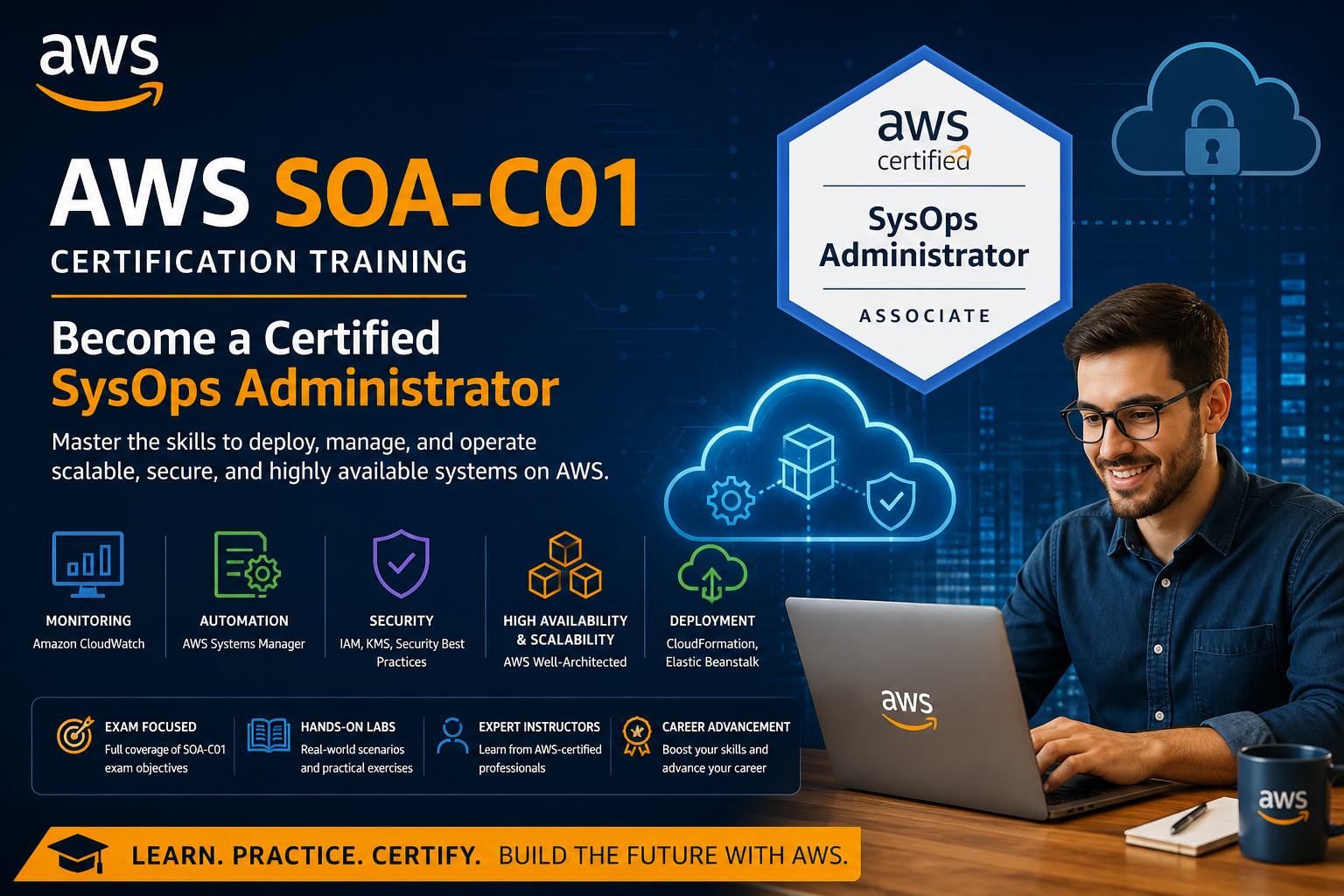
Within this context, the AWS SysOps Administrator Associate certification represents a structured way to validate operational expertise in managing cloud resources. The focus is not just on theoretical knowledge but on practical skills required to deploy, monitor, and optimize workloads in real-world environments.
A SysOps administrator working in AWS is expected to understand how different services interact, how workloads scale under demand, and how system health is maintained through monitoring and automation. This requires familiarity with compute services, storage systems, networking components, and observability tools that together form the backbone of cloud operations.
Modern cloud operations emphasize automation, elasticity, and resilience. Instead of manually configuring systems, administrators design environments that can adjust automatically to changing workloads. This shift demands a strong conceptual understanding of architecture as well as hands-on awareness of operational tools.
Understanding Core AWS Compute Concepts
At the heart of most cloud environments lies compute infrastructure, which provides the processing power needed to run applications. In AWS, compute services are primarily built around virtual servers that can be created, configured, and scaled on demand.
These virtual servers allow organizations to avoid the limitations of physical infrastructure. Instead of purchasing and maintaining hardware, resources can be provisioned within minutes and released when no longer needed. This flexibility introduces both opportunities and challenges for system administrators.
One of the most important concepts in this area is the lifecycle of compute instances. Administrators must understand how instances are launched, configured, monitored, and eventually terminated. Each stage of this lifecycle plays a role in maintaining system efficiency and cost control.
Another key concept is instance sizing. Choosing the correct computational capacity involves balancing performance requirements with cost considerations. Oversized systems waste resources, while undersized systems risk performance degradation under load.
Storage and networking configurations also influence compute behavior. A virtual machine is not an isolated entity; it depends on storage volumes, network interfaces, and security configurations that define how it interacts with the rest of the system.
Understanding these relationships is essential for designing systems that remain stable under varying conditions. Compute resources must be treated as part of a larger ecosystem rather than standalone components.
Planning and Managing Virtual Server Environments
When designing cloud-based systems, administrators must carefully plan how virtual servers will be used. This includes deciding how many instances are required, where they should be deployed, and how they will interact with other services.
One of the key considerations is availability. Applications must remain accessible even when underlying components fail. To achieve this, systems are often distributed across multiple availability zones, ensuring that a single point of failure does not disrupt service.
Another important aspect is workload distribution. Instead of relying on a single server, traffic is typically distributed across multiple instances. This approach improves both performance and resilience.
Administrators must also consider lifecycle management policies. Instances may need to be replaced regularly to apply updates, improve performance, or reduce costs. Automating these processes reduces operational overhead and minimizes human error.
Security is another essential component. Each virtual server must be configured with appropriate permissions, access controls, and network restrictions. Misconfigurations in this area can lead to vulnerabilities or unauthorized access.
Operational efficiency is often improved through standardized configurations. By using predefined templates and automated deployment methods, administrators ensure consistency across environments. This reduces troubleshooting complexity and improves scalability.
Understanding Elasticity and Dynamic Workloads
One of the defining characteristics of cloud computing is elasticity—the ability of systems to automatically adjust resources based on demand. This concept is fundamental to modern infrastructure design.
In traditional environments, capacity planning often required estimating peak usage and provisioning hardware accordingly. This approach frequently led to inefficiencies, as systems remained underutilized during off-peak periods.
Cloud environments solve this problem by allowing resources to scale dynamically. When demand increases, additional compute capacity can be added automatically. When demand decreases, resources can be reduced to optimize costs.
This dynamic behavior requires careful configuration. Systems must be designed to recognize workload patterns and respond appropriately. Metrics such as CPU utilization, memory usage, and request rates are commonly used to trigger scaling decisions.
The concept of elasticity also extends beyond compute resources. Storage systems, databases, and networking components can also adjust dynamically based on demand.
Designing for dynamic workloads requires an understanding of both technical and operational factors. Administrators must ensure that scaling actions do not disrupt application performance or introduce instability.
Scaling Strategies and Automated Resource Adjustment
Scaling strategies can be broadly categorized into vertical and horizontal approaches. Vertical scaling involves increasing the capacity of an existing resource, while horizontal scaling involves adding more instances to distribute workload.
In cloud environments, horizontal scaling is often preferred due to its flexibility and resilience. Adding multiple instances allows systems to handle increased traffic more efficiently and reduces dependency on individual components.
Automated scaling mechanisms play a critical role in managing these adjustments. These systems continuously monitor performance metrics and make scaling decisions based on predefined rules.
For example, if CPU usage exceeds a certain threshold over a sustained period, additional instances may be launched automatically. Conversely, when demand decreases, unnecessary instances can be removed.
This automation reduces the need for manual intervention and ensures that systems remain responsive under varying conditions. However, it also requires careful tuning to avoid overreaction to short-term fluctuations.
Scaling policies must be aligned with application behavior. Some workloads respond quickly to changes in demand, while others require more gradual adjustments. Understanding these patterns is essential for effective system design.
Monitoring Systems and Observability in Cloud Environments
Monitoring is a fundamental aspect of cloud operations. Without visibility into system behavior, administrators cannot effectively manage performance, reliability, or security.
Modern monitoring systems collect data from various sources, including compute instances, storage systems, and network components. This data is then analyzed to identify trends, detect anomalies, and trigger alerts when necessary.
Metrics such as CPU utilization, disk activity, network traffic, and request latency provide insight into system health. These indicators help administrators understand how systems are performing under different conditions.
Logs also play a critical role in observability. They provide detailed records of system events, allowing administrators to trace issues and diagnose problems. Log data can be filtered and analyzed to identify patterns or detect irregular behavior.
Alerting mechanisms ensure that administrators are notified when specific conditions are met. This allows for proactive response to potential issues before they impact users.
Effective monitoring requires a balance between data collection and usability. Collecting too much data can lead to information overload, while collecting too little can result in blind spots.
Using Log-Based Metrics for System Insights
Log-based metrics provide a powerful way to extract meaningful information from raw system logs. Instead of manually reviewing large volumes of log data, administrators can define patterns that automatically generate metrics.
These metrics can be used to track specific events, such as error occurrences, request counts, or security-related activities. By converting logs into measurable data points, systems become easier to analyze and monitor.
For example, a log filter might identify failed authentication attempts and convert them into a numerical metric. This metric can then be monitored over time to detect unusual spikes or patterns.
Log-based metrics are particularly useful for troubleshooting. When issues arise, administrators can quickly isolate relevant log entries and identify root causes.
They also support long-term analysis by providing historical data that can be used to understand system behavior trends.
Designing for Reliability and Fault Tolerance
Reliability is one of the most important goals in cloud system design. A reliable system continues to function correctly even when components fail or experience disruptions.
Fault tolerance is closely related to reliability. It refers to the ability of a system to continue operating despite failures in individual components.
Achieving these goals requires careful architectural planning. Systems must be designed with redundancy, meaning that critical components are duplicated across multiple locations or instances.
For example, distributing resources across multiple availability zones ensures that a failure in one location does not affect overall system availability.
Health checks are also commonly used to detect failing components. When an instance becomes unresponsive or unhealthy, it can be automatically replaced or removed from service.
Data redundancy is another important consideration. Storing multiple copies of data ensures that information is not lost in the event of hardware failure.
Designing for reliability involves anticipating potential failure scenarios and implementing mechanisms to mitigate their impact.
Networking Foundations in Cloud Systems
Networking forms the backbone of all cloud-based communication. Every application relies on network configurations to connect services, transfer data, and interact with users.
In cloud environments, networking is highly configurable. Administrators can define virtual networks, subnets, routing rules, and access controls to control traffic flow.
Subnets are used to divide networks into smaller segments, often separating public-facing systems from internal resources. This improves both security and organization.
Internet connectivity is managed through gateway components that allow controlled access between private networks and external systems.
Security groups and access control rules determine which traffic is allowed or denied. These rules are essential for protecting systems from unauthorized access.
Understanding networking concepts is critical for designing secure and efficient architectures. Misconfigured networks can lead to performance issues or security vulnerabilities.
Foundations of Observing System Health at Scale
As systems grow in complexity, maintaining visibility becomes increasingly challenging. Large-scale environments may contain hundreds or thousands of components generating continuous streams of data.
To manage this complexity, observability systems aggregate data into centralized platforms. This allows administrators to view system health from a unified perspective.
Dashboards provide visual representations of key metrics, making it easier to identify trends and anomalies. These visual tools help simplify decision-making and improve response times.
Time-based analysis is also important. By comparing historical data with current performance, administrators can detect deviations that may indicate emerging issues.
Effective observability requires integration between monitoring, logging, and alerting systems. Together, these components provide a comprehensive view of system behavior across all layers of the infrastructure.
Designing Cost-Aware Cloud Infrastructure and EC2 Pricing Models
In large-scale cloud environments, one of the most important responsibilities of a systems administrator is understanding how infrastructure decisions impact cost. Unlike traditional environments where costs are relatively fixed once hardware is purchased, cloud systems introduce a dynamic pricing model where usage directly influences expenses. This flexibility is powerful, but it also requires careful planning and continuous oversight.
Compute services are typically billed based on consumption, meaning that every running instance, storage volume, and data transfer contributes to the overall cost. As a result, administrators must develop a mindset that balances performance requirements with financial efficiency.
One of the key concepts in cost optimization is selecting the appropriate pricing model for compute resources. Different workloads may benefit from different pricing approaches depending on predictability, duration, and scalability requirements.
On-demand usage is often used for short-term or unpredictable workloads where flexibility is more important than cost savings. This approach allows systems to be provisioned instantly without long-term commitments, but it usually comes at a higher price per unit of usage.
In contrast, long-term workloads that run consistently can benefit from more stable pricing structures. These models reward predictable usage patterns with reduced costs, making them suitable for production systems that require continuous availability.
Administrators must also consider how resource sizing impacts cost efficiency. Overprovisioning leads to wasted capacity, while underprovisioning can result in performance issues and potential downtime. Finding the right balance requires monitoring real usage patterns and adjusting configurations accordingly.
Cost optimization is not a one-time task but an ongoing process. As workloads evolve, infrastructure must be continuously evaluated to ensure that resources are being used effectively.
Observability and Real-Time System Monitoring at Scale
As cloud environments grow in complexity, visibility into system behavior becomes essential for maintaining reliability and performance. Observability is the practice of understanding system health through the analysis of metrics, logs, and events.
Monitoring systems continuously collect data from various components, including compute instances, storage services, and network layers. This data provides insight into how systems are performing under different conditions.
Metrics are numerical representations of system behavior over time. They help administrators track performance indicators such as resource utilization, request latency, and error rates. By analyzing these metrics, patterns can be identified that reveal both normal and abnormal behavior.
Logs provide a more detailed view of system activity. They capture individual events, including system errors, configuration changes, and user actions. When analyzed collectively, logs help reconstruct sequences of events that led to specific outcomes.
Event data adds another layer of insight by capturing state changes within the system. These events can trigger automated responses or alert administrators to important changes in system behavior.
Effective observability requires the integration of all three data types. Metrics provide trends, logs provide detail, and events provide context. Together, they create a comprehensive understanding of system health.
Understanding Cloud Monitoring Signals and Operational Awareness
Monitoring systems rely on signals that indicate the current state of infrastructure. These signals are essential for detecting performance issues, identifying bottlenecks, and ensuring system stability.
One of the most commonly used signals is resource utilization. High CPU usage, memory consumption, or disk activity can indicate that a system is under stress. However, these signals must be interpreted carefully, as high usage is not always a problem if the system is performing as expected.
Latency is another critical signal. It measures the time it takes for a system to respond to requests. Increasing latency often indicates performance degradation or resource contention.
Error rates provide insight into system reliability. A sudden increase in errors may indicate application bugs, configuration issues, or external disruptions.
Throughput measures the volume of requests processed over time. Changes in throughput can help identify traffic patterns and workload shifts.
Administrators must interpret these signals collectively rather than in isolation. A single metric rarely tells the full story, but a combination of signals can reveal deeper insights into system behavior.
Log Management and Structured Event Analysis
Logs play a central role in understanding system activity. They provide a chronological record of events that occur within applications and infrastructure components.
In large environments, logs can quickly accumulate into massive datasets. Managing this data efficiently requires structured approaches to collection, storage, and analysis.
Log filtering allows administrators to extract meaningful information from raw data. Instead of manually searching through logs, filters can identify specific patterns or events of interest.
Structured logging improves readability and analysis by organizing log data into consistent formats. This makes it easier to query and correlate events across different systems.
Log retention policies are also important. Storing logs indefinitely can become expensive and inefficient, so administrators must decide how long different types of logs should be retained.
Log analysis is often used for troubleshooting. When an issue occurs, logs can be reviewed to trace the sequence of events leading up to the problem. This helps identify root causes and prevent recurrence.
Building Scalable and Resilient Compute Architectures
Scalability is a core principle of cloud system design. It refers to the ability of a system to handle increasing workloads without performance degradation. Resilience complements scalability by ensuring that systems continue to function even when components fail.
A scalable architecture is designed to grow or shrink based on demand. This flexibility allows systems to handle both peak traffic and low-usage periods efficiently.
Horizontal distribution of workloads is a key strategy for achieving scalability. Instead of relying on a single powerful system, workloads are distributed across multiple smaller instances. This approach improves both performance and fault tolerance.
Resilience is achieved through redundancy and failover mechanisms. By duplicating critical components, systems can continue operating even if one part fails.
Health monitoring systems play an important role in maintaining resilience. When a component becomes unhealthy, it can be automatically replaced or isolated to prevent further impact.
Designing scalable and resilient systems requires anticipating failure scenarios and ensuring that no single point of failure can disrupt overall operations.
Automation in Cloud Operations and Infrastructure Management
Automation is a defining characteristic of modern cloud environments. It reduces manual effort, improves consistency, and enables rapid response to changing conditions.
Infrastructure automation allows systems to be deployed, configured, and managed programmatically. This eliminates the need for manual intervention and reduces the risk of human error.
Automated scaling mechanisms adjust resources based on demand. When traffic increases, additional resources are provisioned automatically. When demand decreases, unnecessary resources are removed.
Automation also plays a role in system recovery. If a component fails, automated processes can replace or restart it without requiring manual intervention.
Configuration management ensures that systems remain consistent over time. Automated tools enforce predefined configurations across all resources, reducing drift and inconsistency.
Operational automation improves efficiency by allowing administrators to focus on higher-level design and optimization tasks rather than repetitive maintenance activities.
Designing Monitoring Strategies for Distributed Systems
Distributed systems introduce additional complexity into monitoring strategies. Because components are spread across multiple locations and services, visibility must be aggregated into a unified view.
Centralized monitoring systems collect data from all components and present it in a consolidated format. This allows administrators to analyze system behavior holistically rather than in isolation.
Correlation of metrics across different services is essential for understanding dependencies. For example, a slowdown in one service may affect performance in another, even if the second service is functioning correctly.
Time synchronization is also important. Without consistent timing across systems, it becomes difficult to correlate events accurately.
Alerting strategies must be carefully designed to avoid excessive noise. Too many alerts can lead to alert fatigue, while too few can result in missed issues.
Effective monitoring strategies prioritize meaningful signals and ensure that alerts are actionable.
Network Architecture Foundations for Cloud Systems
Networking is a fundamental component of cloud infrastructure. It defines how systems communicate internally and externally.
Virtual networks allow administrators to create isolated environments within the cloud. These networks can be segmented into smaller sub-networks to improve organization and security.
Routing rules determine how traffic flows between different components. Proper routing ensures that data reaches its intended destination efficiently.
Network interfaces connect compute resources to virtual networks. These interfaces define how instances communicate with other systems and services.
Security configurations control access to network resources. By defining rules for inbound and outbound traffic, administrators can enforce strict security boundaries.
Understanding network architecture is essential for designing secure, efficient, and scalable systems.
Managing System Limits and Operational Boundaries
Every cloud system has operational limits that define how much resource can be consumed. These limits exist to ensure stability and prevent overuse of shared infrastructure.
Administrators must be aware of these constraints when designing systems. Exceeding limits can result in performance degradation or service disruptions.
Resource quotas define the maximum number of components that can be created within an environment. These quotas help prevent uncontrolled resource expansion.
Service limits apply to specific components, such as the number of instances, storage capacity, or network connections.
Monitoring usage against these limits is essential for maintaining operational stability. Proactive planning ensures that systems can scale without interruption.
Understanding Security Foundations in Operational Environments
Security is an integral part of cloud operations. Every component within a system must be protected against unauthorized access and potential threats.
Access control mechanisms define who can interact with resources and what actions they are allowed to perform. These controls are essential for maintaining system integrity.
Identity management systems ensure that users and services are properly authenticated before accessing resources.
Network security policies restrict traffic flow and protect systems from external threats.
Encryption is used to protect data both at rest and in transit. This ensures that sensitive information remains secure even if intercepted.
Security must be integrated into every layer of system design rather than treated as a separate concern.
Understanding System Health Through Performance Trends
System health is not determined by a single metric but by analyzing trends over time. Performance trends reveal how systems behave under different conditions and workloads.
Gradual increases in resource usage may indicate growth in demand, while sudden spikes may indicate anomalies or failures.
Long-term performance analysis helps administrators plan capacity and optimize resource allocation.
Comparing historical and current data allows for better forecasting and system tuning.
Performance trends also help identify inefficiencies that may not be immediately visible through real-time monitoring.
Understanding these trends is essential for maintaining stable and efficient cloud environments.
Advanced System Monitoring, Metrics Interpretation, and Operational Intelligence
As cloud environments continue to grow in scale and complexity, system monitoring evolves beyond simple uptime checks into a deeper discipline known as operational intelligence. This approach focuses on understanding not just whether systems are running, but how they behave under different conditions, how they interact, and how they respond to stress.
In modern cloud operations, monitoring is no longer reactive. Instead, it is designed to be predictive and analytical. Administrators use historical data, real-time metrics, and system logs to anticipate issues before they become critical failures. This shift transforms monitoring from a support function into a core architectural component.
One of the most important aspects of operational intelligence is the ability to interpret metrics correctly. Raw data alone does not provide meaningful insight unless it is contextualized. For example, a high CPU usage value may indicate a problem in one system but may be completely normal in another depending on workload design.
This is why baseline behavior is essential. Every system has a normal operating range, and deviations from this range often indicate underlying issues. Establishing these baselines requires continuous observation over time.
Another important concept is metric correlation. Instead of analyzing each metric independently, administrators examine relationships between multiple metrics. For example, an increase in latency combined with rising error rates and CPU spikes may indicate a bottleneck in processing capacity.
Operational intelligence also involves anomaly detection. Systems can be configured to identify unusual patterns automatically, such as sudden drops in traffic, unexpected spikes in resource consumption, or irregular access behavior.
These insights allow administrators to respond proactively rather than reactively, improving system stability and user experience.
Deep Dive into Cloud Logging Systems and Event Correlation
Logging systems form the backbone of troubleshooting and forensic analysis in cloud environments. They capture detailed records of system activity, providing a chronological sequence of events that can be used to reconstruct system behavior.
However, in large-scale systems, logs can become overwhelming due to their volume and complexity. This is why structured logging and log aggregation are essential practices.
Structured logs organize information into consistent formats, making it easier to filter and analyze specific events. Instead of relying on unstructured text, logs contain defined fields such as timestamps, severity levels, request identifiers, and service names.
Log aggregation systems collect data from multiple sources and centralize it for analysis. This allows administrators to view logs from different components in a unified interface, making it easier to identify cross-system issues.
Event correlation is another critical capability. Instead of analyzing logs in isolation, systems link related events across different services. For example, a failed request in one service may be connected to a timeout in another service.
By correlating these events, administrators can trace the full path of a request through the system and identify where failures occur.
Log retention strategies are also important in cloud environments. Not all log data needs to be stored indefinitely. Older logs may be archived or removed based on compliance requirements and storage costs.
Effective log management ensures that relevant data is available when needed without overwhelming storage systems.
Designing High-Performance Scalable Compute Architectures
Scalability is one of the most critical principles in cloud architecture design. It ensures that systems can handle increasing workloads without degradation in performance.
High-performance architectures are built around the idea of distributing workloads across multiple resources rather than relying on a single system. This approach reduces bottlenecks and improves fault tolerance.
One key aspect of scalable design is statelessness. Stateless systems do not retain session information locally, allowing requests to be processed by any available instance. This makes scaling simpler and more efficient.
Load distribution mechanisms play a crucial role in scalability. They ensure that incoming traffic is evenly distributed across available resources, preventing any single component from becoming overloaded.
Another important concept is decoupling. By separating system components, each part can scale independently based on demand. For example, a processing service can scale separately from a storage service.
Scalability also depends on efficient resource utilization. Systems must be designed to avoid unnecessary consumption of compute or storage resources.
Performance optimization often involves balancing speed, cost, and resource availability. Achieving this balance requires continuous monitoring and adjustment.
Reliability Engineering and Fault-Tolerant System Design
Reliability engineering focuses on ensuring that systems remain operational even in the presence of failures. This involves designing architectures that can withstand component breakdowns without affecting overall functionality.
Fault tolerance is achieved through redundancy. Critical components are duplicated so that if one fails, another can take over seamlessly.
Geographic distribution is another important strategy. By distributing resources across multiple locations, systems can remain operational even if an entire region experiences disruption.
Health checks are used to continuously monitor the status of system components. When a component becomes unhealthy, it can be automatically removed from service and replaced.
Retry mechanisms also improve reliability by allowing failed operations to be attempted again. This is particularly useful in distributed systems where temporary failures are common.
Data replication ensures that important information is not lost in case of hardware failure. Multiple copies of data are stored across different locations to provide redundancy.
Reliability engineering requires careful planning and continuous testing to ensure that systems behave as expected under failure conditions.
Advanced Networking Concepts in Cloud Environments
Networking in cloud systems is highly flexible and configurable, allowing administrators to design complex communication structures between services.
Virtual networks provide isolated environments where resources can communicate securely. These networks can be subdivided into smaller segments to organize traffic flow.
Routing configurations determine how data moves between different components. Proper routing ensures efficient communication and minimizes latency.
Network gateways provide controlled access between internal systems and external networks. They act as entry and exit points for traffic.
Security rules define which types of traffic are allowed or blocked. These rules are essential for protecting systems from unauthorized access.
Private networking allows internal communication without exposure to the public internet. This improves security and reduces attack surfaces.
Understanding these networking concepts is essential for designing secure and efficient cloud architectures.
Cloud Security Architecture and Access Control Models
Security is a foundational element of cloud system design. Every resource must be protected against unauthorized access and potential threats.
Access control systems define permissions for users and services. These permissions determine what actions can be performed on specific resources.
Authentication ensures that only verified identities can access systems. This is typically achieved through credentials, tokens, or identity providers.
Authorization determines what actions an authenticated user is allowed to perform. This ensures that users only have access to the resources they need.
Encryption protects data both at rest and in transit. This ensures that sensitive information cannot be intercepted or read by unauthorized parties.
Security policies are applied at multiple layers, including network, application, and infrastructure levels.
Security monitoring systems continuously analyze activity for signs of suspicious behavior. This includes unusual access patterns, repeated failed login attempts, or unexpected data transfers.
A strong security architecture is built on the principle of least privilege, ensuring that access is granted only when necessary.
Operational Automation and Infrastructure as a Managed System
Automation is a key enabler of modern cloud operations. It allows systems to be managed at scale without requiring constant manual intervention.
Infrastructure automation involves defining system configurations in a repeatable and programmable way. This ensures consistency across environments.
Automated deployment processes allow new systems to be created quickly and reliably. This reduces setup time and minimizes configuration errors.
Self-healing systems automatically detect and recover from failures. When a component fails, it can be replaced or restarted without human intervention.
Configuration drift is prevented through continuous enforcement of defined states. Systems are regularly checked and corrected if they deviate from expected configurations.
Automation also supports scaling operations. Systems can automatically adjust resources based on demand, ensuring optimal performance and cost efficiency.
Operational automation reduces manual workload and allows administrators to focus on higher-level system design and optimization.
Advanced Metrics Analysis and Performance Optimization Techniques
Performance optimization in cloud environments relies heavily on analyzing metrics and identifying inefficiencies.
Resource utilization metrics help determine how efficiently systems are using compute, memory, and storage resources.
Latency analysis identifies delays in system responses. Reducing latency improves user experience and system responsiveness.
Throughput metrics measure how much data or traffic a system can handle over time. Increasing throughput often involves optimizing processing efficiency.
Error analysis helps identify failure points within systems. High error rates may indicate bugs, misconfigurations, or resource constraints.
Performance tuning involves adjusting system parameters to improve efficiency. This may include scaling resources, optimizing configurations, or redesigning workflows.
Continuous monitoring ensures that performance improvements are maintained over time.
Designing Distributed Systems for Global Scale
Distributed systems are designed to operate across multiple locations and environments. This allows them to serve users globally with improved performance and reliability.
One of the key challenges in distributed systems is maintaining consistency. When data is stored in multiple locations, ensuring that all copies remain synchronized can be complex.
Latency is another important consideration. Data must travel across networks, and minimizing this delay is critical for performance.
Replication strategies are used to ensure data availability across regions. This improves resilience and reduces the risk of data loss.
Consistency models define how data synchronization is handled across distributed systems. Different models offer trade-offs between performance and accuracy.
Distributed systems must also handle partial failures, where some components fail while others remain operational.
Designing for global scale requires careful balancing of performance, consistency, and availability.
Operational Decision-Making and System Lifecycle Management
Cloud systems are continuously evolving, and administrators must make decisions that affect system performance, cost, and reliability.
Lifecycle management involves planning how systems are created, maintained, updated, and eventually decommissioned.
Regular updates are necessary to maintain security and performance. Systems must be patched and upgraded without disrupting operations.
Resource optimization involves reviewing system usage and adjusting configurations to eliminate waste.
Capacity planning ensures that systems can handle future growth without performance degradation.
Operational decisions are often based on data collected from monitoring systems, making observability a key component of decision-making.
Understanding system lifecycle management ensures that infrastructure remains efficient, secure, and scalable over time.
Continuous Operational Improvement and Real-World Cloud Stability Practices
In large cloud environments, system administration is not a static responsibility but an ongoing process of refinement. Even well-designed systems require continuous improvement as workloads change, services evolve, and user demand fluctuates. This is why operational maturity is often measured by how effectively an organization can adapt its infrastructure over time rather than simply how well it performs at a single moment.
One of the most important aspects of continuous improvement is feedback loops. These loops are created when monitoring systems collect data, administrators analyze it, and changes are applied back into the system. Over time, this cycle leads to more stable, efficient, and predictable infrastructure behavior.
For example, if monitoring data shows that a particular service experiences consistent CPU spikes during specific hours, administrators may adjust scaling policies or optimize application logic. These adjustments are then observed again through monitoring tools, and further refinements are made if necessary.
Another key practice is operational standardization. As environments grow, inconsistency becomes a major risk factor. Different configurations, naming conventions, or deployment methods can lead to confusion and increase the likelihood of misconfigurations. Standardizing operational practices helps reduce these risks and improves system maintainability.
Change management also plays a critical role in stability. In cloud environments, even small modifications can have wide-ranging effects due to interconnected services. Controlled change processes ensure that updates are tested, reviewed, and applied in a structured manner. This reduces the chance of unexpected disruptions.
Observability tools also contribute to continuous improvement by providing historical insights. Long-term data trends reveal how systems behave under different conditions, allowing administrators to identify inefficiencies that may not be visible in short-term monitoring.
For instance, gradual increases in response time over several weeks might indicate resource saturation or inefficient code paths. Without long-term analysis, such issues could remain unnoticed until they become critical.
Incident Response and System Recovery Strategies
Even in highly optimized cloud environments, failures are inevitable. Hardware can fail, network issues can occur, and software bugs can introduce unexpected behavior. Because of this, incident response is a core operational discipline.
Incident response focuses on detecting, analyzing, and resolving system issues as quickly as possible. The primary goal is to minimize downtime and reduce impact on users.
Detection is often automated through monitoring systems that trigger alerts when specific thresholds are exceeded. However, not all issues are immediately detectable through metrics alone, which is why log analysis and user reports also play an important role.
Once an incident is detected, the next step is classification. Issues are categorized based on severity, impact, and scope. This helps prioritize response efforts and allocate resources effectively.
Root cause analysis is a critical part of incident resolution. Instead of only addressing symptoms, administrators must identify the underlying cause of the problem. This ensures that the issue does not recur.
Recovery strategies may include restarting services, replacing failed components, or rolling back recent changes. In some cases, systems may automatically recover through built-in redundancy and failover mechanisms.
After an incident is resolved, a post-incident review is typically conducted. This review examines what happened, why it happened, and how similar issues can be prevented in the future.
These practices contribute to long-term system reliability and operational maturity.
Performance Efficiency and Resource Optimization Techniques
Cloud environments provide vast flexibility, but without careful management, this flexibility can lead to inefficiency. Performance efficiency focuses on ensuring that systems deliver optimal output while using minimal resources.
One approach to improving efficiency is right-sizing resources. This involves matching compute capacity to actual workload requirements. Over-provisioned systems waste resources, while under-provisioned systems may struggle to handle demand.
Another technique is workload optimization. This involves analyzing how applications use system resources and identifying opportunities for improvement. For example, inefficient queries or poorly optimized code can significantly increase resource consumption.
Caching is another important performance enhancement strategy. By storing frequently accessed data closer to the application, systems can reduce latency and improve response times.
Load balancing also contributes to efficiency by distributing traffic evenly across available resources. This prevents individual components from becoming overloaded while others remain underutilized.
Data lifecycle management helps optimize storage usage. Frequently accessed data is kept in high-performance storage, while infrequently used data is moved to more cost-effective storage tiers.
Together, these strategies ensure that systems remain both high-performing and cost-efficient.
Conclusion
Cloud systems administration has become a central discipline in modern IT environments, where reliability, scalability, and efficiency are essential for supporting digital services at any meaningful scale. The evolution from traditional infrastructure management to cloud-based operations has reshaped the responsibilities of administrators, requiring a broader understanding of computing, networking, automation, monitoring, and security.
At the core of effective cloud operations is the ability to design systems that can adapt dynamically to changing workloads. This includes understanding how compute resources behave under demand, how scaling mechanisms respond to traffic fluctuations, and how distributed architectures maintain stability even when individual components fail. These principles ensure that applications remain available and performant, even in unpredictable conditions.
Equally important is observability, which allows administrators to gain insight into system behavior through metrics, logs, and events. Without visibility, managing complex environments would be impossible. By analyzing patterns and trends, administrators can identify inefficiencies, detect anomalies early, and make informed decisions that improve long-term system health.
Automation further strengthens operational efficiency by reducing manual intervention and ensuring consistency across environments. Automated scaling, deployment, and recovery processes help minimize human error while improving responsiveness. This enables systems to operate more reliably and efficiently at scale.
Security and governance also remain foundational elements of cloud administration. Protecting resources, enforcing access controls, and maintaining compliance ensures that systems are not only functional but also secure and aligned with organizational requirements.
Ultimately, successful cloud operations depend on continuous improvement. Systems must be regularly evaluated, optimized, and refined as demands evolve. Administrators play a key role in maintaining this cycle, ensuring that infrastructure remains resilient, cost-effective, and capable of supporting future growth.
As cloud environments continue to expand, the importance of skilled systems administrators will only increase, making their expertise essential for sustaining modern digital ecosystems.