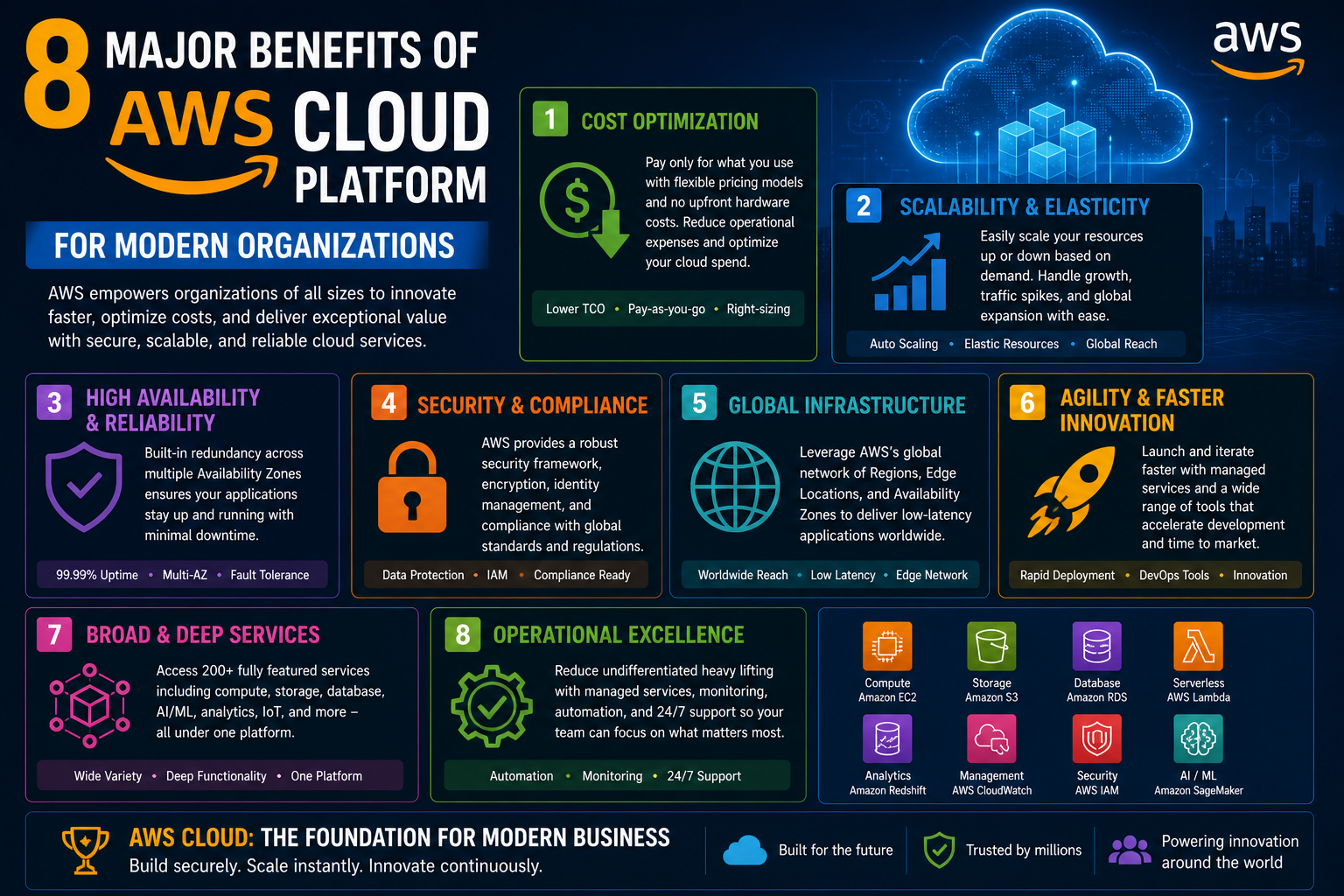
As organizations increasingly adopt digital transformation strategies, cloud computing has become a central part of how modern IT systems are designed, deployed, and managed. Among the various cloud platforms available today, Amazon Web Services (AWS) has emerged as one of the most widely used solutions due to its broad range of capabilities, flexibility, and global infrastructure.
What makes AWS particularly significant is not just its technical strength, but the way it enables businesses of all sizes to operate more efficiently without the traditional limitations of physical infrastructure. Instead of investing heavily in hardware, maintenance, and long deployment cycles, organizations can focus on building applications, improving services, and scaling operations dynamically.
The following sections explore the foundational benefits of AWS, focusing on ease of use, cost efficiency, and scalability—three pillars that make cloud adoption more accessible and practical for modern businesses.
Easy to Set Up and Use in Real-World Environments
One of the most important advantages of AWS is its accessibility. Many organizations assume that cloud platforms require advanced technical expertise to configure and manage. While AWS is certainly powerful and capable of supporting highly complex systems, it is also designed to be approachable for beginners and scalable for experts.
When a business first begins using AWS, the onboarding process is structured to reduce complexity. Users are guided through intuitive interfaces that allow them to create virtual environments, manage storage systems, and deploy applications without needing to build everything from scratch. This reduces the initial barrier to entry, especially for small teams or startups that may not have large IT departments.
The AWS Management Console plays a key role in simplifying cloud operations. It provides a visual dashboard where users can access services, monitor performance, and adjust configurations. Instead of relying solely on command-line tools or complex scripts, users can interact with systems through a centralized interface that organizes services logically.
At the same time, AWS does not limit advanced users. For developers and engineers who prefer automation, AWS provides command-line tools and programmatic interfaces that allow full control over infrastructure. This dual approach ensures that both beginners and experienced professionals can work efficiently within the same ecosystem.
Another major aspect of ease of use is documentation and learning resources. AWS services are supported by extensive technical documentation that explains how each component works, how to configure it, and how to troubleshoot common issues. This reduces the dependency on external support and allows teams to become self-sufficient over time.
Beyond documentation, AWS is structured around modular services. Instead of requiring users to understand an entire system at once, AWS breaks down functionality into manageable components. For example, storage, computing, networking, and databases are all provided as separate services. This modular approach makes it easier to learn step by step rather than overwhelming users with a single complex system.
In practical terms, this ease of use translates into faster deployment cycles. Businesses can launch applications in a shorter timeframe because they do not need to wait for physical infrastructure to be installed or configured. Development teams can focus on building features rather than managing servers, which significantly improves productivity from the beginning.
Cost Efficiency and Financial Flexibility for Businesses of All Sizes
Cost is one of the most influential factors when organizations decide whether to adopt cloud computing. Traditional IT infrastructure requires significant upfront investment in servers, networking equipment, storage systems, and physical space. On top of that, businesses must continuously spend money on maintenance, upgrades, and operational support.
AWS changes this model by introducing a usage-based pricing structure. Instead of paying large upfront costs, organizations only pay for the resources they actually consume. This approach makes cloud computing accessible even to small startups that may not have large capital budgets.
One of the key financial advantages of AWS is the elimination of unnecessary resource waste. In traditional environments, businesses often over-provision hardware to ensure they have enough capacity during peak usage periods. This means that during low-usage periods, expensive resources remain underutilized. AWS solves this problem by allowing resources to be scaled up or down based on real-time demand.
This flexibility ensures that organizations are not paying for idle capacity. If a system requires more computing power during peak hours and less during off-peak times, AWS automatically adjusts resource allocation accordingly. This dynamic adjustment helps optimize costs while maintaining performance.
Another important financial benefit is the reduction of maintenance expenses. In traditional IT environments, businesses must hire technical staff to manage servers, replace hardware, and handle system failures. These operational costs can accumulate significantly over time. With AWS, many of these responsibilities are handled by the platform itself, reducing the need for large infrastructure teams.
Additionally, AWS reduces the risk of financial loss due to hardware failure. Physical servers can fail unexpectedly, requiring expensive replacements and causing downtime. Since AWS operates on distributed cloud infrastructure, workloads are spread across multiple data centers, reducing dependency on a single physical system.
For businesses that are growing or experimenting with new ideas, AWS also provides financial flexibility by eliminating long-term commitments. Organizations are not locked into fixed contracts for infrastructure they may no longer need in the future. This allows companies to experiment, innovate, and pivot without being financially constrained by previous investments.
Another subtle but important cost advantage comes from improved efficiency. When teams are able to deploy applications faster and manage systems more effectively, they reduce the amount of labor required for infrastructure tasks. This allows technical teams to focus on innovation rather than maintenance, indirectly contributing to cost savings.
Over time, these financial advantages compound. As businesses scale, the ability to align costs directly with usage becomes increasingly valuable. Instead of scaling infrastructure ahead of demand, organizations can scale in real time, ensuring that financial resources are always used efficiently.
Scalability as a Built-In Advantage of Cloud Infrastructure
Scalability is one of the defining features of cloud computing, and AWS is designed to deliver it at a global scale. In traditional IT environments, scaling a system requires significant planning, procurement of hardware, and physical installation. This process can take weeks or even months, limiting how quickly a business can respond to changes in demand.
AWS eliminates this limitation by providing virtually unlimited scalability through its global infrastructure. Resources can be expanded or reduced dynamically based on real-time needs, allowing businesses to respond immediately to changes in user activity or market conditions.
This scalability is particularly important for applications that experience unpredictable traffic patterns. For example, an online service may have stable usage most of the time but experience sudden spikes during peak events or seasonal demand. In traditional systems, preparing for these spikes requires over-provisioning resources, which leads to inefficiency. With AWS, systems can automatically scale up during high demand and scale down when demand decreases.
This dynamic scaling is supported by AWS’s distributed architecture. Instead of relying on a single physical data center, AWS operates across multiple regions and availability zones. This distributed structure allows workloads to be balanced across different locations, improving both performance and reliability.
From a technical perspective, scalability in AWS is not limited to computing power alone. It extends across storage systems, databases, networking, and application services. This means that entire systems can scale together rather than scaling individual components separately, reducing complexity and improving coordination.
Another important aspect of scalability is consistency. As systems grow, maintaining performance becomes increasingly challenging. AWS addresses this by ensuring that additional resources are seamlessly integrated into existing environments. Applications do not need to be rewritten or reconfigured every time they scale, which simplifies long-term growth.
Scalability also plays a major role in global expansion. Businesses that operate in multiple regions can deploy applications closer to their users, reducing latency and improving performance. This geographic scalability allows organizations to deliver consistent user experiences regardless of location.
Furthermore, scalability supports innovation by removing infrastructure limitations. Developers can test new ideas, deploy experimental systems, and run large-scale simulations without worrying about hardware constraints. This encourages faster innovation cycles and reduces the risk associated with experimentation.
In many cases, scalability is not just about handling growth but also about managing efficiency. Systems that can scale down during low usage periods help optimize resource consumption, ensuring that performance and cost remain balanced at all times.
Security, Reliability, and Service Flexibility in AWS Cloud Environments
As cloud adoption becomes a standard part of modern business operations, concerns about security, system reliability, and flexibility naturally become more important. Organizations are no longer asking whether cloud computing is useful—they are asking whether it is safe, stable, and adaptable enough to support mission-critical workloads.
AWS addresses these concerns by building its infrastructure around enterprise-grade security controls, globally distributed systems for reliability, and a highly flexible service model that supports diverse technologies and workloads. These elements work together to create a cloud environment where businesses can operate confidently while maintaining control over their systems and data.
This part explores three major dimensions of AWS: security architecture, uptime and reliability, and service flexibility that supports a wide range of technical requirements.
Security as a Shared Responsibility Model in AWS
Security is one of the most important concerns in cloud computing. When organizations move their data and applications to the cloud, they often worry about losing control over sensitive information or exposing themselves to cyber threats. AWS addresses these concerns through a structured approach known as the shared responsibility model.
In this model, security responsibilities are divided between AWS and the customer. AWS is responsible for securing the underlying infrastructure, including physical data centers, hardware, networking, and core cloud services. Customers, on the other hand, are responsible for securing their own applications, configurations, and data.
This division of responsibility ensures that both layers of security are addressed. AWS invests heavily in protecting its global infrastructure, which includes advanced physical security controls, continuous monitoring systems, and strict access management policies. Data centers are designed with multiple layers of protection, including surveillance systems, restricted access zones, and environmental controls.
On the customer side, AWS provides a wide range of tools that allow organizations to configure and enforce their own security policies. These tools include identity and access management systems, encryption services, logging capabilities, and monitoring dashboards. This gives businesses full control over who can access their resources and how data is protected.
One of the key strengths of AWS security is its scalability. Whether a business is a small startup or a large enterprise, the same security framework can be applied. This ensures consistency across all levels of usage. Smaller organizations benefit from enterprise-grade security without needing to build their own infrastructure, while larger organizations can implement highly customized security policies.
Encryption plays a major role in AWS security architecture. Data can be encrypted both at rest and in transit, ensuring that sensitive information remains protected even if intercepted or accessed without authorization. AWS provides built-in encryption options that can be enabled without requiring complex configurations.
Another important component is identity and access control. AWS allows organizations to define granular permissions, ensuring that users only have access to the resources they need. This reduces the risk of unauthorized access and helps enforce the principle of least privilege.
Logging and monitoring also enhance security by providing visibility into system activity. Organizations can track user actions, system changes, and access patterns in real time. This makes it easier to detect unusual behavior and respond to potential security incidents quickly.
Compliance is another area where AWS provides strong support. Many industries have strict regulatory requirements related to data protection and privacy. AWS infrastructure is designed to meet a wide range of compliance standards, allowing organizations to operate within regulated environments more easily.
Security in AWS is not a static feature but an ongoing process. Continuous updates, threat detection systems, and automated security tools help ensure that the environment remains protected against emerging risks.
Reliability and High Availability Through Global Infrastructure
Reliability is another critical factor that influences cloud adoption. Businesses depend on continuous system availability to serve customers, process transactions, and maintain operations. Even short periods of downtime can lead to financial losses, reputational damage, and operational disruptions.
AWS is designed with reliability as a core principle. Its infrastructure is distributed across multiple geographic regions, each containing several isolated availability zones. These zones are physically separate data centers that are connected through high-speed networks. This structure ensures that if one zone experiences a failure, others can continue operating without interruption.
This redundancy is one of the key reasons AWS is able to deliver high levels of uptime. Instead of relying on a single point of failure, systems are distributed across multiple independent locations. This significantly reduces the risk of complete system outages.
Applications built on AWS can be designed to automatically failover between availability zones. This means that if one system becomes unavailable, traffic is redirected to another functioning system without user intervention. This process helps maintain continuity even during unexpected disruptions.
AWS also uses load balancing techniques to distribute traffic evenly across resources. This prevents any single system from becoming overloaded and ensures that performance remains stable even under heavy usage conditions.
Data durability is another important aspect of reliability. AWS storage systems are designed to replicate data across multiple locations automatically. This reduces the risk of data loss due to hardware failure or system errors. Even if one storage device fails, copies of the data remain available in other locations.
The platform also includes monitoring and diagnostic tools that help detect issues before they become critical. These tools continuously analyze system performance and can automatically trigger corrective actions when necessary.
Service-level agreements (SLAs) provided by AWS define expected uptime levels for different services. These guarantees reflect the platform’s commitment to reliability and provide organizations with measurable expectations for system availability.
Reliability in AWS is not just about preventing downtime—it is also about maintaining consistent performance. Even under varying workloads, AWS systems are designed to adjust resource allocation dynamically to ensure stable operation.
This combination of redundancy, monitoring, and automation creates a highly resilient environment where businesses can operate with confidence, knowing that their systems are protected against both expected and unexpected disruptions.
Flexibility Through Diverse Services and Technology Support
One of the most powerful advantages of AWS is its flexibility. Unlike traditional IT systems that often lock organizations into specific technologies or architectures, AWS supports a wide range of operating systems, programming languages, databases, and application frameworks.
This flexibility allows businesses to choose the tools and technologies that best fit their needs rather than adapting their workflows to match platform limitations.
AWS supports multiple computing environments, including virtual machines, container-based systems, and serverless architectures. This means organizations can select the most appropriate model based on workload requirements.
For example, applications that require full control over system configuration can use virtual machines, while lightweight applications that need automatic scaling can use serverless environments. This variety ensures that different types of workloads can coexist within the same ecosystem.
Storage flexibility is another key feature. AWS offers different types of storage systems optimized for performance, cost, or long-term archival. This allows organizations to choose storage solutions based on specific use cases rather than relying on a one-size-fits-all model.
Database flexibility is equally important. AWS supports relational databases, NoSQL systems, and specialized data storage engines. This allows organizations to design data architectures that match their application requirements instead of adapting applications to fit a limited database structure.
Networking flexibility enables organizations to design custom virtual networks, control traffic flow, and integrate cloud systems with on-premises infrastructure. This is particularly important for hybrid environments where businesses operate both cloud and traditional systems.
AWS also supports a wide range of third-party tools and integrations. This ensures that organizations can continue using existing workflows while gradually transitioning to cloud-based systems.
Another important aspect of flexibility is geographic deployment. AWS allows applications to be deployed in multiple regions around the world. This helps organizations reduce latency, improve performance for global users, and meet data residency requirements.
Flexibility also extends to scaling strategies. Businesses can choose manual scaling, automatic scaling, or predictive scaling depending on their operational needs. This allows systems to adapt to different types of workloads without requiring constant manual intervention.
From a development perspective, AWS enables rapid experimentation. Developers can quickly create test environments, deploy applications, and remove resources when no longer needed. This encourages innovation by reducing the cost and complexity of experimentation.
Flexibility in AWS is not just about technical options—it also impacts business strategy. Organizations can adapt more easily to market changes, shift priorities, and adopt new technologies without rebuilding their entire infrastructure.
Productivity, Innovation, Automation, and Long-Term Business Transformation with AWS
As organizations continue to adopt cloud computing at scale, the conversation shifts beyond basic infrastructure improvements toward long-term transformation. AWS is not only a platform for hosting applications; it is an ecosystem that reshapes how teams build software, manage operations, analyze data, and innovate over time.
The real value of AWS becomes more visible as organizations mature in their cloud usage. What begins as simple migration often evolves into deep operational changes that improve productivity, accelerate innovation, and enable entirely new business capabilities.
This section explores how AWS influences productivity, supports modern development practices, enables data-driven decision-making, and creates long-term transformation opportunities across industries.
Enhancing Business Productivity Through Reduced Operational Burden
One of the most immediate long-term benefits of AWS is the significant improvement in productivity across technical and non-technical teams. In traditional IT environments, a large portion of time and resources is spent managing infrastructure rather than building value-added features.
Tasks such as server maintenance, hardware upgrades, system monitoring, patching, and troubleshooting consume a considerable amount of operational effort. AWS reduces this burden by automating or fully managing many of these responsibilities.
With infrastructure managed as a service, teams are freed from repetitive administrative work and can focus more on application development, customer experience, and strategic initiatives. This shift in focus leads to higher output without necessarily increasing team size.
Another productivity advantage comes from faster provisioning of resources. In traditional environments, setting up new servers or environments may take days or weeks. With AWS, resources can be created within minutes, allowing development teams to move quickly from idea to execution.
This speed directly impacts project timelines. Features can be tested, deployed, and iterated on much more rapidly. As a result, organizations become more responsive to market demands and customer feedback.
Collaboration also improves in cloud environments. Teams across different locations can access shared infrastructure and tools without requiring complex network setups. This enables distributed teams to work more efficiently and reduces delays caused by infrastructure dependencies.
Automation further enhances productivity. Many routine tasks, such as backups, scaling, monitoring, and updates, can be automated using AWS tools. This reduces manual intervention and minimizes the risk of human error.
Over time, these productivity improvements accumulate. Organizations find that they can deliver more features, maintain higher system stability, and respond faster to changes without significantly increasing operational costs.
Enabling DevOps Practices and Continuous Delivery Models
AWS plays a major role in supporting modern software development practices, particularly DevOps and continuous delivery. These approaches focus on shortening development cycles, improving collaboration between development and operations teams, and increasing deployment frequency.
In traditional environments, software deployment is often slow and manual. Each release may require extensive coordination between multiple teams, leading to delays and increased risk of errors. AWS simplifies this process by providing tools and infrastructure that support automated deployment pipelines.
Development teams can integrate code changes, run automated tests, and deploy applications continuously. This reduces the time between writing code and delivering it to users. It also improves software quality by identifying issues earlier in the development process.
Infrastructure as code is another important concept supported by AWS. Instead of manually configuring systems, teams can define infrastructure using code-based templates. This makes environments reproducible, consistent, and easier to manage across different stages of development.
Automation in deployment pipelines reduces dependency on manual approvals and repetitive tasks. This allows teams to release updates more frequently while maintaining stability and control.
Monitoring and feedback loops are also integrated into the development process. Teams can observe system behavior in real time and quickly respond to performance issues or errors. This creates a continuous improvement cycle where applications are constantly refined based on real-world usage.
Over time, DevOps practices supported by AWS lead to more efficient development cycles, higher-quality software, and faster innovation.
Driving Innovation Through Experimentation and Rapid Prototyping
Innovation is often limited by the cost and complexity of infrastructure. In traditional environments, experimenting with new ideas requires significant investment in hardware, setup time, and operational planning. This creates barriers that slow down innovation.
AWS removes many of these barriers by providing on-demand access to computing resources. Developers can quickly create environments for testing new ideas without long-term commitments or large upfront costs.
This flexibility encourages experimentation. Teams can build prototypes, test assumptions, and validate concepts without worrying about infrastructure constraints. If an idea does not work, resources can simply be released without financial or operational impact.
The ability to rapidly prototype also improves decision-making. Instead of relying on theoretical planning, organizations can test real implementations and gather data before committing to large-scale development.
Innovation is further supported by the availability of advanced technologies within AWS. Machine learning tools, analytics systems, and serverless computing models allow teams to explore new types of applications without building underlying infrastructure from scratch.
This combination of accessibility and capability enables organizations to innovate faster and more effectively than in traditional IT environments.
Leveraging Data Analytics for Smarter Business Decisions
Modern businesses generate large volumes of data from applications, user interactions, transactions, and operational systems. The ability to analyze this data effectively is critical for making informed decisions.
AWS provides a range of services that allow organizations to collect, process, and analyze data at scale. This enables businesses to move from intuition-based decision-making to data-driven strategies.
Data storage systems in AWS can handle structured and unstructured data, making it easier to centralize information from multiple sources. Once data is stored, it can be processed using scalable computing resources that adjust based on workload demands.
Analytics tools allow organizations to identify patterns, trends, and anomalies in their data. This information can be used to improve customer experience, optimize operations, and identify new business opportunities.
Real-time data processing is another important capability. Instead of waiting for batch reports, organizations can analyze data as it is generated. This enables faster responses to changing conditions and improves operational agility.
Over time, data analytics becomes a core part of strategic planning. Businesses that effectively use data gain a competitive advantage by understanding customer behavior, optimizing resources, and predicting future trends.
Supporting Artificial Intelligence and Machine Learning Workloads
Artificial intelligence and machine learning have become increasingly important in modern business environments. These technologies require significant computational power, data processing capabilities, and scalable infrastructure.
AWS provides an environment where machine learning models can be developed, trained, and deployed efficiently. Instead of building specialized hardware systems, organizations can use cloud-based resources that scale according to workload requirements.
This makes advanced AI technologies more accessible to organizations that may not have large research teams or infrastructure budgets.
Machine learning models can be trained using large datasets without worrying about hardware limitations. Once trained, these models can be deployed into production environments where they process real-time data and generate insights or predictions.
AI-powered applications can be used in various domains, including customer service automation, recommendation systems, fraud detection, and predictive analytics.
The scalability of AWS ensures that AI workloads can grow alongside business needs. As data volumes increase, systems can automatically adjust resources to maintain performance.
This integration of AI and cloud computing enables organizations to adopt intelligent systems more easily and apply them across different parts of their operations.
Enabling Global Expansion and Digital Reach
One of the most strategic advantages of AWS is its global infrastructure. Businesses are no longer limited to operating within a single geographic region. Instead, they can deploy applications across multiple locations around the world.
This global reach allows organizations to serve users with lower latency and improved performance by hosting applications closer to their audience.
For businesses expanding into new markets, this capability is particularly valuable. Instead of building physical infrastructure in each region, organizations can deploy digital systems instantly through cloud regions.
Global deployment also improves resilience. If one region experiences issues, systems can continue operating in other regions, ensuring continuity of service.
This global accessibility supports international growth strategies and enables businesses to scale their operations beyond local boundaries without significant infrastructure investment.
Improving Operational Efficiency Through Automation
Operational efficiency is a key factor in long-term business success. AWS enables organizations to automate many aspects of their infrastructure management, reducing manual effort and improving consistency.
Automation can be applied to system monitoring, scaling, backups, deployments, and performance optimization. This reduces the need for constant human intervention and minimizes the risk of operational errors.
Automated scaling ensures that resources are adjusted based on demand without manual input. This improves both performance and cost efficiency.
Monitoring systems can detect anomalies and trigger automated responses, reducing downtime and improving system stability.
Over time, automation leads to more predictable operations and allows teams to focus on higher-value tasks rather than routine maintenance.
Long-Term Evolution of IT Strategy with Cloud Adoption
As organizations continue to use AWS over time, their IT strategies naturally evolve. What begins as infrastructure migration often transforms into a broader shift in how technology is managed and used within the business.
IT teams move from hardware-focused roles to strategic roles centered around architecture, optimization, and innovation. This shift changes the nature of IT departments from support functions to strategic enablers of business growth.
Systems become more modular, scalable, and integrated, allowing organizations to adapt quickly to changing market conditions.
The long-term use of AWS also encourages continuous improvement. As new services and capabilities are introduced, organizations can adopt them without major infrastructure changes, ensuring that their systems remain modern and competitive.
This ongoing evolution creates a dynamic environment where technology and business strategy evolve together rather than separately.
Expanding Organizational Agility Through Cloud-Driven Workflows
As organizations deepen their use of AWS, one of the most noticeable long-term changes is the increase in overall agility. Agility in this context refers to how quickly a business can respond to new requirements, market shifts, or internal operational needs without being slowed down by infrastructure limitations.
In traditional IT environments, even small changes often require significant planning. Hardware procurement, environment setup, and deployment scheduling can introduce delays that slow down innovation. AWS reduces these constraints by allowing resources to be created, modified, or removed almost instantly.
This flexibility changes how teams plan and execute projects. Instead of committing to long development cycles with fixed infrastructure assumptions, teams can iterate continuously. Systems can be adjusted in real time based on feedback, which creates a more adaptive development culture.
Agility also improves cross-functional collaboration. Development, operations, security, and business teams can all work within the same cloud environment, reducing friction between departments. This unified environment ensures that decisions can be implemented faster and with greater coordination.
Over time, this shift leads to a more responsive organization where technology supports business strategy rather than restricting it.
Strengthening Disaster Recovery and Business Continuity Planning
A critical but often underestimated benefit of AWS is its impact on disaster recovery and business continuity. In traditional setups, disaster recovery systems require duplicate infrastructure, which is expensive and difficult to maintain. Many organizations either underinvest in these systems or rely on outdated recovery strategies.
AWS changes this approach by making resilient architectures more accessible and cost-effective. Because infrastructure is distributed across multiple geographic regions and availability zones, businesses can design systems that continue operating even when individual components fail.
Data replication across multiple locations ensures that critical information is preserved even in the event of hardware failure or regional disruption. This reduces the risk of permanent data loss and improves system reliability during unexpected events.
Recovery processes can also be automated. Instead of relying on manual intervention during outages, systems can be configured to automatically switch to backup environments. This significantly reduces downtime and improves operational stability.
For businesses, this means stronger protection against natural disasters, technical failures, and cyber incidents. It also allows continuity planning to become more predictable and less resource-intensive.
As organizations grow, the importance of reliable disaster recovery increases. AWS enables scalable recovery strategies that can evolve alongside business requirements without requiring complete redesigns of infrastructure.
Optimizing Resource Utilization Across the Enterprise
One of the ongoing challenges in traditional IT systems is inefficient resource utilization. Servers are often underused during low-demand periods but still consume operational costs. At the same time, organizations may over-provision resources to handle peak demand, leading to wasted capacity.
AWS addresses this issue through dynamic resource allocation. Computing power, storage, and networking resources can be adjusted automatically based on real-time usage patterns. This ensures that resources are only used when needed.
This optimization leads to better cost efficiency, but it also improves system performance. Applications are able to scale smoothly during peak demand without manual intervention, preventing performance bottlenecks.
Resource optimization also extends to storage systems. Different types of storage can be used depending on access frequency and performance requirements. Frequently accessed data can be stored in high-performance systems, while archival data can be moved to lower-cost storage options.
Over time, this intelligent allocation of resources allows organizations to maintain high performance while minimizing waste. It also provides better visibility into infrastructure usage, helping decision-makers understand where resources are being consumed most effectively.
Supporting Hybrid and Multi-Cloud Strategies
Many organizations today operate in hybrid or multi-cloud environments, where cloud services are combined with on-premises systems or other cloud providers. AWS supports these architectures by providing integration tools and networking capabilities that allow systems to work together seamlessly.
Hybrid strategies are often used by organizations that cannot fully migrate to the cloud due to regulatory, operational, or legacy system constraints. AWS enables these organizations to extend their existing infrastructure into the cloud without replacing everything at once.
This gradual transition approach reduces risk and allows businesses to modernize at their own pace. Systems can be moved to the cloud incrementally, starting with less critical workloads before migrating core applications.
Multi-cloud strategies, on the other hand, allow organizations to distribute workloads across different cloud providers. AWS supports interoperability through APIs, networking tools, and standardized services that help maintain consistency across environments.
This flexibility reduces dependency on a single provider and allows organizations to optimize performance, cost, and compliance based on specific requirements.
Hybrid and multi-cloud support ensures that AWS can fit into complex enterprise environments without forcing architectural limitations.
Enhancing Customer Experience Through Performance Optimization
Customer experience has become a key differentiator for modern businesses. Users expect applications to be fast, reliable, and responsive regardless of their location or device.
AWS contributes to improved customer experience through global infrastructure and performance optimization tools. By deploying applications closer to end users, organizations can significantly reduce latency and improve response times.
Content delivery systems and distributed architectures ensure that data is served from the nearest available location. This reduces loading times and improves the overall user experience.
Scalability also plays an important role in maintaining performance during high traffic periods. Applications can automatically adjust to increased demand, ensuring that users do not experience slowdowns or service interruptions.
Monitoring tools provide real-time insights into application performance, allowing teams to identify and resolve issues quickly. This proactive approach helps maintain consistent service quality.
Over time, improved performance leads to higher user satisfaction, increased engagement, and stronger customer retention.
Reducing Time-to-Market for Digital Products and Services
Speed is a critical factor in competitive industries. The ability to launch new products or features quickly can determine market success. AWS significantly reduces time-to-market by simplifying infrastructure management and enabling rapid development cycles.
Instead of waiting for hardware provisioning or environment setup, development teams can immediately begin building and testing applications. This accelerates the entire product development lifecycle.
Automation further reduces delays by streamlining testing, integration, and deployment processes. Continuous integration pipelines ensure that updates can be delivered frequently without manual intervention.
This speed allows organizations to respond quickly to customer feedback and market changes. Features can be updated, improved, or removed based on real usage data rather than long planning cycles.
In highly competitive markets, this ability to iterate quickly provides a significant advantage.
Driving Sustainable IT Practices Through Efficient Computing
Sustainability is becoming an increasingly important consideration in IT strategy. AWS contributes to more sustainable computing by optimizing resource usage and reducing waste.
Because resources are allocated dynamically, systems avoid unnecessary energy consumption associated with idle hardware. This improves overall efficiency compared to traditional data centers that often run underutilized equipment.
AWS also operates large-scale infrastructure designed for energy efficiency. Shared resources and optimized workloads reduce the overall environmental impact of computing operations.
For organizations, this translates into more responsible IT practices that align with sustainability goals while maintaining performance and scalability.
Evolving Workforce Roles in Cloud-Centric Environments
As AWS becomes more integrated into organizational operations, the roles of IT professionals also evolve. Traditional infrastructure-focused roles gradually shift toward cloud architecture, automation, security management, and data analysis.
Instead of managing physical servers, IT teams focus on designing scalable systems, optimizing performance, and implementing automation strategies.
This shift requires new skill sets but also creates opportunities for more strategic and impactful work. Teams become more involved in business decision-making and innovation planning rather than routine maintenance tasks.
Over time, this transformation leads to a more skilled and versatile workforce capable of managing complex digital ecosystems.
Continuous Improvement as a Core Operational Principle
One of the most important long-term impacts of AWS adoption is the shift toward continuous improvement. Cloud environments naturally support iterative development, where systems are constantly refined based on performance data and user feedback.
This creates a cycle where applications are never truly static. Instead, they evolve continuously to meet changing requirements.
New services and features introduced by AWS can be integrated into existing systems without major disruptions. This allows organizations to stay up to date with technological advancements without rebuilding their infrastructure.
Continuous improvement becomes part of the organizational culture, influencing how systems are designed, deployed, and maintained over time.
Conclusion
The adoption of AWS represents far more than a shift from traditional IT infrastructure to cloud-based systems; it reflects a broader transformation in how modern organizations design, operate, and scale their digital capabilities. Across its core advantages—ease of use, cost efficiency, scalability, security, reliability, flexibility, productivity, and long-term innovation—AWS provides a unified foundation that supports both technical and business growth.
One of the most important outcomes of AWS adoption is the removal of traditional infrastructure barriers. Organizations are no longer constrained by physical hardware limitations, lengthy procurement cycles, or rigid scaling models. Instead, they gain access to a dynamic environment where resources can be provisioned on demand, adjusted in real time, and optimized continuously based on actual usage. This shift allows businesses to respond more effectively to changing market conditions and customer expectations.
Security and reliability further strengthen the value of AWS as a trusted platform for critical workloads. By distributing infrastructure across global regions and implementing robust security frameworks, AWS enables organizations to operate with confidence while maintaining control over their data and applications. This balance between centralized protection and customer-driven configuration ensures that security remains both strong and adaptable.
Equally important is the impact AWS has on innovation and productivity. By reducing the operational burden associated with infrastructure management, teams can focus more on development, experimentation, and strategic initiatives. This accelerates the delivery of new features and services while fostering a culture of continuous improvement. Organizations are able to innovate faster, test ideas more freely, and bring products to market with greater efficiency.
Over time, the benefits of AWS compound. What begins as simple cloud adoption evolves into a deeper transformation of business operations, workforce roles, and long-term strategy. Systems become more intelligent, processes become more automated, and decision-making becomes increasingly data-driven. This evolution positions organizations to remain competitive in a rapidly changing digital landscape.
Ultimately, AWS serves as more than a technology platform—it acts as an enabler of modern business agility, resilience, and growth. Organizations that effectively leverage its capabilities are better equipped to scale, adapt, and innovate in an environment where technology continues to evolve at an accelerating pace.