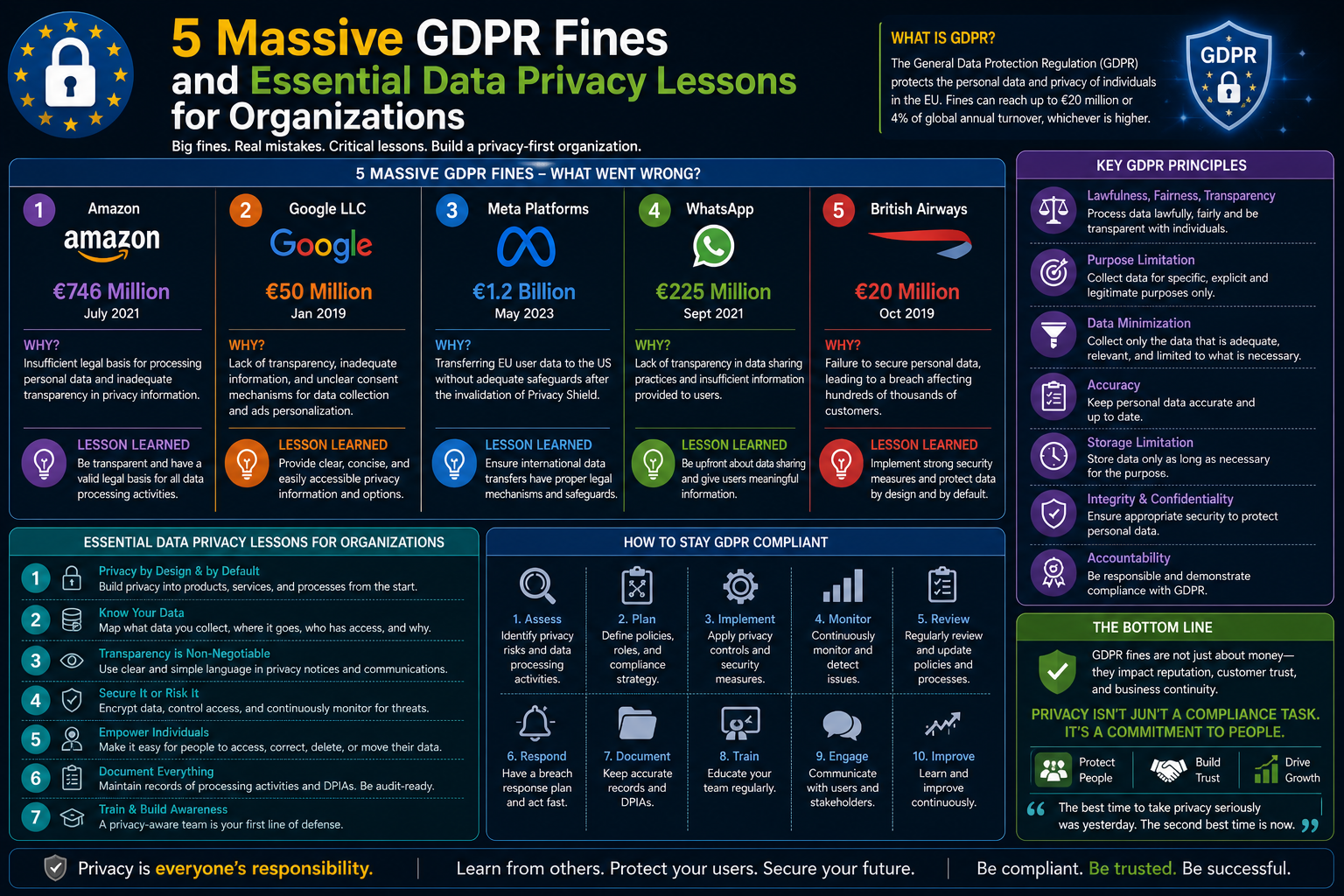
The General Data Protection Regulation, widely known as GDPR, is one of the most significant privacy and data protection laws ever introduced. It was designed by the European Union to give individuals greater control over their personal data while setting strict obligations for organizations that collect, process, or store that data. At its core, GDPR is built around the idea that personal information is not just a business resource but a protected right belonging to individuals.
Before GDPR came into effect on May 25, 2018, data protection rules in Europe were governed by the Data Protection Directive. While it established basic principles, it left much of the enforcement and interpretation to individual EU member states. This led to inconsistencies in how data protection laws were applied across Europe. Some countries enforced strict rules, while others were more lenient, creating gaps that multinational organizations could exploit.
GDPR was introduced to unify these rules under a single, enforceable legal framework. One of its most powerful features is the introduction of significant financial penalties for non-compliance. These fines were not designed merely as punishment but as a strong deterrent to ensure that organizations take data privacy seriously from the beginning of any system, product, or service design.
The scale of these penalties is intentionally high. Regulators wanted to ensure that compliance would not be optional or treated as a secondary concern. Instead, privacy became a central responsibility for any organization handling personal data of EU residents, regardless of where the company itself is located.
Over time, GDPR enforcement has matured significantly. In the early years after implementation, there was uncertainty about how aggressively regulators would apply fines. Today, that uncertainty has largely disappeared. Enforcement authorities across the European Union have demonstrated a willingness to impose substantial penalties, especially in cases involving large-scale data misuse, weak consent practices, or inadequate protection of sensitive information.
The Purpose Behind GDPR Enforcement
GDPR enforcement is not only about punishing organizations after violations occur. It is also about shaping corporate behavior in advance. The regulation encourages companies to build privacy protections into their systems from the earliest stages of development, a principle often referred to as “data protection by design and by default.”
This approach shifts responsibility from reactive correction to proactive prevention. Instead of fixing privacy issues after a breach or complaint, organizations are expected to anticipate risks and address them before harm occurs.
Another key objective of enforcement is accountability. Organizations are expected to be transparent about how they collect and use data. They must also be able to demonstrate compliance at any time. This means maintaining detailed documentation, conducting regular risk assessments, and ensuring that employees understand their responsibilities under GDPR.
Enforcement authorities also aim to protect individuals from harm caused by improper data handling. This includes identity theft, unauthorized profiling, discrimination, and loss of control over personal information. By imposing financial penalties, regulators aim to make non-compliance more costly than compliance itself.
How GDPR Fines Are Determined
GDPR does not apply a fixed penalty for every violation. Instead, it uses a structured but flexible system that allows regulators to assess each case individually. This ensures that penalties are proportionate to the severity of the infringement while still maintaining consistency across different cases.
When a potential violation is identified, data protection authorities begin a detailed investigation. During this process, they evaluate a wide range of factors that influence the final fine amount. These factors are designed to capture both the technical aspects of the violation and the broader context in which it occurred.
Nature and Severity of the Infringement
One of the most important considerations is the nature of the violation itself. Regulators examine what type of GDPR rule was broken and how serious the impact was on individuals.
For example, a minor administrative error may be treated differently from a large-scale data breach involving sensitive personal information. Authorities also consider how many individuals were affected and whether the violation was isolated or part of a repeated pattern.
The duration of the violation is also important. A short-term issue that was quickly resolved may result in a lower penalty compared to a long-term failure to comply with data protection obligations.
Intentional Actions Versus Negligence
Regulators distinguish between intentional misconduct and accidental or negligent behavior. If an organization deliberately ignores GDPR requirements or actively attempts to bypass them, the penalty is likely to be significantly higher.
On the other hand, if the violation occurred due to oversight, lack of awareness, or technical error, this may reduce the severity of the fine. However, negligence is still taken seriously, especially when it involves inadequate internal controls or poor governance structures.
In modern enforcement practice, ignorance of GDPR obligations is not considered a valid defense. Organizations are expected to understand and comply with the regulation regardless of size or industry.
Mitigation Efforts After a Violation
Another key factor is how the organization responds once a violation is discovered. Regulators carefully assess whether the company took immediate steps to reduce harm to affected individuals.
Mitigation efforts may include notifying users quickly, fixing security vulnerabilities, cooperating with authorities, and providing support to those impacted. A strong and transparent response can help reduce the severity of penalties, while delayed or inadequate action can increase them.
This encourages organizations to act responsibly even after mistakes occur, rather than attempting to conceal or minimize the issue.
Preventive Measures and Internal Controls
GDPR places strong emphasis on prevention. Regulators evaluate what systems and safeguards were in place before the violation occurred. This includes technical security measures, employee training programs, data governance policies, and risk assessment procedures.
Organizations that invest in strong privacy frameworks are generally viewed more favorably during enforcement actions. In contrast, companies with weak or outdated controls may face higher penalties, even if the violation itself was unintentional.
This reflects GDPR’s broader philosophy that compliance is not a one-time action but an ongoing responsibility.
History of Compliance and Previous Violations
An organization’s past behavior plays a significant role in determining fines. Companies with a history of repeated violations are more likely to face harsher penalties.
If a business has previously been warned or fined for similar issues but fails to improve, regulators may interpret this as a pattern of non-compliance. This can significantly increase the financial consequences of subsequent violations.
Conversely, organizations with a strong track record of compliance may receive more lenient treatment for isolated incidents.
Cooperation with Regulatory Authorities
During investigations, companies are expected to fully cooperate with data protection authorities. This includes providing requested documentation, answering questions honestly, and facilitating audits when required.
Cooperation can influence the final outcome of a case. Organizations that are transparent and responsive are more likely to receive reduced penalties compared to those that obstruct or delay investigations.
Regulators view cooperation as a sign of good faith and willingness to comply with the law.
Types of Data Involved in Violations
Not all personal data is treated equally under GDPR. Some categories of information are considered more sensitive and therefore require stronger protection.
For example, data related to health, ethnicity, political opinions, or religious beliefs is subject to stricter rules. Violations involving this type of information typically result in higher penalties because of the increased potential for harm.
Even standard personal data such as email addresses or location information can be sensitive depending on how it is used or combined with other data.
Reporting and Transparency Obligations
Organizations are required to report certain types of data breaches to regulators within a specific timeframe. In many cases, they must also inform affected individuals.
Failure to report a breach, or delaying notification without valid reason, can significantly increase penalties. Regulators view transparency as a fundamental aspect of accountability.
Timely reporting allows individuals to take protective action, such as changing passwords or monitoring financial activity.
Certifications and Compliance Frameworks
GDPR encourages organizations to adopt recognized codes of conduct and certification mechanisms that demonstrate compliance. While these are not mandatory, they can serve as evidence of good practice.
During enforcement actions, regulators may consider whether an organization followed such frameworks when assessing penalties. However, certification alone does not guarantee immunity from fines if a violation occurs.
Categories of GDPR Fines
GDPR defines two main levels of fines depending on the severity of the violation.
The lower tier applies to less serious infringements, such as administrative failures or incomplete documentation. These fines can reach up to 10 million euros or 2% of global annual turnover, whichever is higher.
The upper tier applies to more serious violations, including breaches of core data protection principles or unlawful data processing. These fines can reach up to 20 million euros or 4% of global annual turnover, whichever is higher.
This structure ensures that penalties scale with the size of the organization. Larger companies with higher revenues face proportionally larger fines, making enforcement effective even against global corporations.
Early Trends in GDPR Enforcement
In the first years after GDPR came into force, enforcement actions were relatively cautious. Regulators focused on education and awareness, giving organizations time to adjust to the new requirements.
However, as the regulation matured, enforcement became more aggressive. Authorities began targeting high-profile companies and issuing record-breaking fines to demonstrate the seriousness of compliance obligations.
This shift signaled that GDPR was not a symbolic regulation but a fully enforceable legal framework with real financial consequences.
Over time, enforcement patterns have shown increasing focus on large-scale data processing, advertising technologies, social media platforms, and cross-border data transfers. These areas present higher risks due to the volume and sensitivity of data involved.
International Data Transfers and Emerging Challenges
One of the most complex areas of GDPR enforcement involves transferring personal data outside the European Union. Organizations operating globally often need to move data across borders for processing, storage, or analytics.
GDPR requires that such transfers meet strict conditions to ensure that data remains protected even outside EU jurisdiction. This includes using approved contractual mechanisms and ensuring equivalent levels of protection in destination countries.
However, differences in legal systems and government access laws have created ongoing challenges. Regulators continue to scrutinize how organizations handle international data flows, making this one of the most active areas of enforcement development.
How GDPR Enforcement Became Real-World Corporate Accountability
Once GDPR became fully enforceable, it quickly moved from being a legal framework on paper to a powerful enforcement system with global consequences. Early discussions around GDPR often focused on theoretical compliance—policies, consent banners, and documentation requirements. However, as enforcement actions increased, it became clear that regulators were willing to examine how organizations actually handle personal data in practice, not just what they claim in their policies.
Over time, enforcement shifted toward high-impact cases involving multinational companies, complex data ecosystems, and large-scale processing systems. These cases revealed how privacy failures often arise not from a single mistake, but from systemic design choices, long-standing business models, and weak internal governance structures.
The most significant GDPR fines issued so far highlight recurring themes: unclear legal bases for data processing, insufficient user consent mechanisms, weak protection for minors, and risky international data transfers. Each case also demonstrates how regulators interpret GDPR principles in real-world contexts, where business needs and privacy obligations often collide.
Meta Platforms Ireland and Cross-Border Data Transfer Failures
One of the most significant GDPR enforcement actions involved Meta Platforms Ireland and its handling of user data transfers between the European Economic Area and the United States. This case centered on a long-standing legal tension surrounding cross-border data flows and government surveillance concerns.
The core issue was not simply the transfer of data itself, but whether adequate safeguards existed to protect EU users once their information left European jurisdiction. European privacy law requires that personal data exported outside the region must still receive a level of protection essentially equivalent to that guaranteed within the EU.
In this case, Meta relied on Standard Contractual Clauses as the legal mechanism for transferring data. These clauses are contractual commitments designed to ensure that organizations receiving data outside the EU maintain appropriate safeguards. However, regulatory authorities concluded that contractual assurances alone were insufficient when local laws in the destination country could allow government access to personal data in ways incompatible with EU rights.
The enforcement action highlighted a deeper structural issue: even if companies implement contractual safeguards, they must also assess whether foreign legal systems undermine those protections in practice. This placed a significant burden on global companies operating cloud-based or distributed data systems.
Regulators determined that Meta’s data transfer practices failed to adequately protect user rights, resulting in one of the largest fines ever issued under GDPR. The scale of the penalty reflected not only the volume of data involved but also the long duration of the compliance gap and the systemic nature of the issue.
This case fundamentally changed how many multinational organizations approach international data architecture. It made clear that compliance is not just about contractual documentation but about evaluating the entire legal and operational environment in which data flows occur.
Amazon and the Complexity of Advertising Consent
Another landmark GDPR enforcement action involved Amazon and its advertising data processing systems. This case focused heavily on the concept of consent, which is one of the central pillars of GDPR.
Consent under GDPR must be freely given, specific, informed, and unambiguous. It cannot be assumed, bundled into unrelated agreements, or hidden within complex legal language. Users must clearly understand what they are agreeing to and must have genuine control over whether their data is used.
The investigation into Amazon examined how personal data was processed for targeted advertising purposes. Regulators found that consent mechanisms were not sufficiently clear or transparent, particularly in relation to how user data was utilized for personalized advertising.
At the heart of the issue was the complexity of modern digital advertising ecosystems. Large technology platforms often process vast amounts of behavioral data to build detailed user profiles. This enables highly targeted advertising but also raises significant privacy concerns.
In Amazon’s case, regulators concluded that users had not been provided with adequate clarity or control over how their personal data was being used in advertising systems. The fine reflected concerns that consent was not properly obtained under GDPR standards.
This case highlighted an important challenge for digital businesses: consent is not a one-time checkbox but an ongoing obligation that must be clearly maintained throughout the entire lifecycle of data processing. It also demonstrated that even sophisticated organizations can face significant compliance risks if user-facing consent mechanisms are not designed with sufficient transparency.
Instagram and the Protection of Children’s Data
A separate enforcement action involving Meta Platforms Ireland focused specifically on Instagram and the handling of children’s personal data. This case highlighted one of the most sensitive areas of GDPR enforcement: the protection of minors in digital environments.
Children’s data receives heightened protection under GDPR because younger users may not fully understand the implications of data sharing or privacy settings. As a result, organizations are expected to implement stronger safeguards, default protections, and clearer consent mechanisms when processing data related to minors.
The investigation into Instagram revealed concerns about default account settings and the visibility of personal information belonging to younger users. In some cases, children’s contact details were made publicly accessible due to platform configuration choices.
Regulators also examined how the platform handled account creation and privacy settings for younger users. The central issue was whether adequate steps had been taken to ensure that children’s data remained protected by default rather than requiring users to manually adjust settings to achieve privacy.
The resulting penalty reflected the seriousness of exposing minors’ personal data in a social media environment where information can be widely shared and difficult to retract once made public.
This case reinforced the principle that privacy protection for children must be proactive rather than reactive. Organizations cannot rely on users—especially minors—to configure privacy settings correctly. Instead, systems must be designed with maximum privacy protection as the default state.
Facebook and the Legal Basis for Data Processing
Another major enforcement action against Meta Platforms Ireland involved Facebook and the legal basis used for processing personal data. This case focused on a fundamental GDPR requirement: organizations must have a valid legal reason for collecting and using personal data.
GDPR defines several legal bases for processing data, including consent, contractual necessity, legal obligation, and legitimate interest. Each of these bases has strict conditions, and organizations must clearly identify which one applies to each type of processing activity.
The investigation centered on Facebook’s shift in legal basis for certain data processing activities, particularly the transition from consent-based processing to contract-based processing. This change had significant implications for how users were informed and how much control they had over their data.
Regulators questioned whether users were adequately informed about this shift and whether the change complied with GDPR transparency requirements. The concern was that users may not have fully understood how their data would be used under the revised legal framework.
This case highlighted the importance of consistency and transparency in data governance. Organizations cannot freely switch legal bases for processing without ensuring that users are properly informed and that the new basis is genuinely applicable under GDPR rules.
The penalty reflected concerns about the scale of data processing involved and the systemic nature of the compliance issue. It also reinforced the principle that legal justification for data processing must be carefully documented and consistently applied.
TikTok and the Challenges of Protecting Younger Users
The enforcement action against TikTok Technology Limited focused heavily on the platform’s handling of children’s data and privacy settings. This case reflected growing regulatory attention on social media platforms and their responsibility to protect younger audiences.
One of the key issues examined was how user accounts were configured by default, particularly for younger users. Regulators assessed whether privacy settings were sufficiently protective at the point of account creation or whether users had to manually adjust settings to achieve privacy.
Another area of focus was age verification. Ensuring that users are correctly categorized by age is critical for applying appropriate privacy protections. Weak age verification systems can result in children being treated as adults in data processing systems, exposing them to inappropriate levels of data visibility.
The investigation also looked at transparency obligations, particularly whether users were clearly informed about how their data was being processed and who could access it. In digital platforms with large user bases, transparency becomes a critical factor in ensuring informed participation.
The resulting fine reflected concerns about the vulnerability of children in digital environments and the responsibility of platforms to implement strong default protections. It also emphasized that privacy design must account for user demographics, not just general compliance requirements.
This case reinforced a broader regulatory expectation that platforms with large youth audiences must adopt a “privacy-first by default” approach rather than relying on user-driven configuration.
Patterns Emerging from Major GDPR Enforcement Cases
Although each enforcement action has its own specific circumstances, several common patterns emerge when examining these major GDPR fines together.
One recurring theme is the importance of data governance at scale. Large organizations often rely on complex systems involving multiple subsidiaries, third-party vendors, and cross-border infrastructure. In such environments, maintaining consistent privacy standards becomes significantly more challenging.
Another pattern is the growing focus on user autonomy and control. Whether through consent mechanisms, default settings, or transparency requirements, GDPR enforcement consistently emphasizes that individuals must retain meaningful control over their personal data.
A third recurring issue is the tension between business models and privacy obligations. Many enforcement cases involve advertising technologies, behavioral tracking, or personalized services, all of which rely heavily on data processing. Regulators are increasingly scrutinizing whether these models can operate in compliance with strict privacy standards.
Finally, enforcement actions demonstrate that regulatory authorities are willing to intervene in foundational aspects of system design. This includes legal frameworks for data processing, technical architecture decisions, and default user settings. GDPR compliance is therefore not limited to legal documentation but extends deeply into product design and engineering decisions.
These cases collectively illustrate how GDPR has evolved into a comprehensive regulatory system influencing not just legal compliance teams but also product developers, data engineers, and corporate governance structures.
Expanding Scope of GDPR Enforcement Across Industries
As GDPR enforcement has matured, one of the most important developments has been its expansion beyond large social media platforms and global tech companies. Regulators have increasingly targeted organizations across a wide range of industries, including retail, healthcare, hospitality, recruitment, surveillance technology, and financial services. This broader enforcement approach demonstrates that GDPR is not limited to digital-native companies but applies to any organization that processes personal data.
What makes this expansion significant is that many of the fined organizations were not primarily technology companies. Instead, they were traditional businesses that adopted digital systems for efficiency, marketing, employee management, or customer engagement. These cases reveal that GDPR compliance failures often arise not from advanced technical complexity but from everyday operational practices that were not designed with privacy in mind.
Regulators have shown that even internal processes such as employee monitoring, customer profiling, or third-party data sharing can result in substantial penalties if they violate GDPR principles. This shift has forced organizations to rethink how personal data is embedded across all business functions.
Google and Transparency in Data Processing
One of the most widely discussed GDPR enforcement actions involved Google and the French data protection authority CNIL. The case centered on transparency and consent in the context of personalized advertising.
The investigation examined how users were informed about data processing activities when creating accounts and using services such as Android and Google’s advertising ecosystem. Regulators concluded that the information provided to users was not sufficiently clear, accessible, or comprehensive.
A key issue was that consent mechanisms were embedded across multiple layers of services, making it difficult for users to fully understand how their data was being used. Important information about advertising personalization and data collection was spread across different documents, requiring multiple steps to access.
The penalty reflected concerns that users were not able to provide truly informed consent. GDPR requires that consent must be specific and unambiguous, meaning individuals should clearly understand what they are agreeing to without needing to navigate complex systems.
This case highlighted an important principle: transparency is not just about publishing privacy policies but about ensuring that users can easily understand how their data is processed in real-world interactions. It also reinforced that large-scale digital ecosystems must prioritize simplicity in consent design rather than relying on legal complexity.
WhatsApp and Intra-Group Data Sharing
Another significant enforcement action involved WhatsApp, particularly in relation to data sharing practices within its parent corporate group.
The investigation focused on how personal data was shared between WhatsApp and other entities within the broader corporate structure. Regulators examined whether users were adequately informed about these data flows and whether the legal basis for processing was clearly established.
One of the main concerns was transparency. Users were not fully aware of the extent to which their data could be shared across different services within the corporate ecosystem. GDPR requires that individuals be informed not only about data collection but also about how their data may be shared with affiliated organizations.
Another issue was the legal justification for data processing. Regulators questioned whether the processing activities were properly aligned with GDPR requirements for consent or legitimate interest.
This case demonstrated that intra-group data sharing is not automatically exempt from GDPR scrutiny. Even when data remains within a corporate family, organizations must still clearly define and communicate how and why personal data is being transferred and used.
The enforcement action reinforced the principle that corporate structure does not reduce privacy obligations. Whether data is shared externally or internally, the same standards of transparency and legal justification apply.
H&M and Employee Surveillance in the Workplace
A landmark case involving H&M highlighted how GDPR applies not only to customers but also to employees. The investigation focused on extensive monitoring practices within a corporate workforce environment.
The company had collected detailed information about employees, including personal conversations, family circumstances, and health-related information. This data was used in managerial decision-making processes, particularly in relation to performance evaluations and employment decisions.
The core issue was proportionality. GDPR requires that data collection must be limited to what is necessary for a specific purpose. In this case, regulators concluded that the level of employee surveillance was excessive and not justified by legitimate business needs.
Another concern was the lack of proper legal basis for processing sensitive employee data. Employees are considered data subjects under GDPR, and their personal information is subject to the same protections as customer data.
This case demonstrated that workplace surveillance must be carefully balanced against employee privacy rights. Even in internal business contexts, organizations must ensure that data collection is limited, transparent, and legally justified.
It also highlighted the importance of internal governance structures. Many violations in workplace settings occur due to decentralized data collection practices, where managers or departments gather information without centralized oversight.
British Airways and Large-Scale Data Breaches
The enforcement action involving British Airways focused on a major data breach that exposed personal and financial information of hundreds of thousands of customers.
The breach was caused by weaknesses in the company’s website security infrastructure, which allowed attackers to intercept customer data during online transactions. The incident included sensitive information such as payment card details, personal contact information, and booking records.
Regulators examined whether the organization had implemented appropriate technical and organizational measures to protect personal data. Under GDPR, companies are required to adopt security measures appropriate to the risk level of their data processing activities.
A key finding was that the security vulnerabilities could have been identified and mitigated earlier with stronger monitoring and testing systems. This highlighted the importance of proactive cybersecurity practices rather than reactive responses after breaches occur.
The case demonstrated that GDPR enforcement extends deeply into cybersecurity practices. Organizations are expected to maintain continuous monitoring, vulnerability management, and secure system architecture.
It also reinforced that financial penalties for data breaches are not based solely on the breach itself but on the adequacy of preventive measures in place before the incident occurred.
Marriott and Third-Party Data Risk Exposure
Another major enforcement action involved Marriott International, which faced penalties following a large-scale data breach originating from a third-party system.
The breach involved unauthorized access to customer reservation systems, exposing sensitive personal data over an extended period before detection. Regulators focused on how the company managed security risks associated with acquired systems and external vendors.
A key issue was that the compromised system had originally belonged to another organization before being integrated into Marriott’s infrastructure. This raised questions about due diligence during mergers and acquisitions and the ongoing responsibility for inherited systems.
GDPR makes clear that organizations remain responsible for personal data even when it is processed by third parties. This means that vendor risk management is a critical component of compliance.
The case highlighted the importance of continuous security assessment across all systems, including those inherited through acquisitions or managed by external providers.
It also demonstrated that data protection responsibility cannot be outsourced. Even when third-party vendors are involved, the primary organization remains accountable for ensuring compliance.
Clearview AI and Facial Recognition Technology
The enforcement actions involving Clearview AI represent some of the most controversial GDPR cases, centered on biometric data and facial recognition technology.
The company built a large-scale database of facial images collected from publicly available sources across the internet. These images were then used to support facial recognition services offered to law enforcement and private organizations.
Regulators in Europe raised serious concerns about the legality of collecting and processing biometric data without explicit consent. Biometric data is classified as highly sensitive under GDPR, requiring strict legal justification for processing.
The investigation focused on whether individuals had any meaningful control over the use of their facial data. In most cases, individuals were unaware that their images had been collected or processed.
This case highlighted fundamental questions about privacy in the context of emerging technologies. It demonstrated that even publicly available data is not automatically exempt from privacy protections when processed at scale for identification purposes.
The enforcement actions taken against Clearview AI reflected growing regulatory concern about surveillance technologies and their impact on individual privacy rights.
How Regulators Evaluate Organizational Privacy Culture
Beyond individual violations, GDPR enforcement increasingly evaluates the overall privacy culture within an organization. Regulators assess whether privacy is embedded into decision-making processes or treated as a secondary compliance task.
A strong privacy culture typically includes clear accountability structures, regular training, documented policies, and active involvement from leadership. In contrast, weak privacy culture is often characterized by fragmented responsibilities and inconsistent application of policies.
One of the key indicators regulators examine is how quickly organizations identify and respond to privacy risks. Slow detection of issues often suggests inadequate monitoring systems or lack of internal awareness.
Another factor is whether privacy considerations are integrated into product development and business strategy. Organizations that treat privacy as an afterthought are more likely to face compliance failures.
Data Minimization and Retention Failures in Practice
A recurring issue across GDPR enforcement cases is the failure to properly implement data minimization and retention policies. GDPR requires that organizations only collect data that is necessary for a specific purpose and retain it only for as long as needed.
In practice, many organizations collect far more data than required, often as a default business practice. Over time, this leads to large volumes of stored data that may no longer serve a legitimate purpose.
Retention failures also increase security risks. The more data an organization holds, the greater the potential impact of a breach.
Regulators frequently identify cases where outdated or unnecessary data was retained without justification. These failures often contribute to higher penalties because they indicate systemic governance weaknesses.
Role of Technical Safeguards in Compliance
Technical safeguards play a central role in GDPR compliance. Measures such as encryption, access control, logging, and network security are essential for protecting personal data.
However, regulators assess not only whether these measures exist but whether they are appropriate for the level of risk involved. High-risk processing activities require stronger protections.
A common issue identified in enforcement cases is inconsistent implementation of security controls across systems. Some parts of an organization may be well protected, while others remain vulnerable.
This inconsistency often arises in large organizations with complex infrastructures, where different departments or teams manage separate systems without centralized oversight.
Vendor and Third-Party Liability in GDPR
GDPR places significant responsibility on organizations for the actions of their vendors and processors. When third-party service providers handle personal data, the primary organization remains accountable for ensuring compliance.
This includes conducting due diligence, establishing contractual safeguards, and monitoring vendor performance. Failure to properly manage third-party relationships can lead to regulatory penalties even if the breach originates externally.
This principle has become increasingly important in modern digital ecosystems, where cloud services and external platforms are widely used.
Cross-Border Enforcement Complexity
As data flows increasingly cross international boundaries, enforcement has become more complex. Regulators must consider not only local laws but also how data is processed globally.
Conflicts between jurisdictions, particularly regarding government access to data, continue to shape enforcement decisions. These issues are especially relevant for multinational companies operating cloud-based infrastructure.
Impact on Small and Medium Organizations
While high-profile fines often involve large corporations, GDPR applies equally to small and medium-sized organizations. However, the impact of enforcement differs significantly based on organizational size and resources.
Smaller organizations may face fewer large-scale investigations but can still experience significant penalties relative to their revenue. In some cases, compliance challenges arise due to limited legal and technical resources rather than intentional misconduct.
Emerging Enforcement Trends in AI and Biometrics
Recent enforcement trends show increasing attention toward artificial intelligence systems, biometric data processing, and behavioral tracking technologies. These areas raise new privacy challenges that are still being interpreted under GDPR principles.
Regulators are particularly focused on transparency, fairness, and the ability of individuals to understand and control automated decision-making systems.
As technology continues to evolve, enforcement practices are likely to expand further into areas involving algorithmic profiling and large-scale behavioral analytics.
Emerging Role of Artificial Intelligence in GDPR Enforcement
One of the newest challenges for GDPR enforcement is the rapid expansion of artificial intelligence systems across industries. AI-driven tools are now widely used for decision-making, prediction, customer segmentation, fraud detection, and personalization. While these technologies offer efficiency and innovation, they also introduce complex privacy risks that regulators are still learning to address.
A major concern is transparency. Many AI systems operate as “black boxes,” meaning their decision-making processes are not easily explainable even to the organizations that deploy them. Under GDPR, individuals have the right to understand how their data is being used, especially when it contributes to automated decisions that significantly affect them.
This becomes particularly important in areas such as hiring, credit scoring, insurance assessment, and targeted advertising. If an algorithm influences whether a person gets a job, loan approval, or service access, regulators expect clear explanations of how that decision was made.
Another challenge is data minimization. AI systems often rely on large datasets to improve accuracy, but GDPR requires that only necessary data be collected and processed. This creates tension between technical performance and legal compliance. Organizations must carefully balance model accuracy with privacy constraints, ensuring they do not collect excessive or unrelated personal data.
Bias and fairness are also emerging areas of concern. If AI systems are trained on biased or incomplete data, they can produce discriminatory outcomes. While GDPR does not explicitly regulate algorithmic bias in detail, its principles of fairness and lawful processing apply directly to such risks. Regulators are increasingly examining whether organizations test their systems for unintended discrimination before deployment.
Increasing Scrutiny of Behavioral Tracking and Profiling
Another growing focus of GDPR enforcement is behavioral tracking. Many digital platforms rely on tracking user activity across websites, apps, and devices to build detailed behavioral profiles. These profiles are then used for advertising, recommendation systems, and analytics.
The main issue is whether users are truly aware of the extent of tracking taking place. In many cases, tracking technologies operate in the background, collecting data through cookies, device identifiers, or similar mechanisms.
GDPR requires that users give informed consent for non-essential tracking. However, regulators have found that consent mechanisms are often unclear or overly complex, leading to questions about whether consent is genuinely valid.
Profiling also raises concerns about user autonomy. When organizations build detailed behavioral models, individuals may be influenced or categorized in ways they do not fully understand. This can affect not only advertising but also pricing, content visibility, and service access.
As enforcement evolves, regulators are paying closer attention to how profiling systems operate and whether users have meaningful control over how their behavior is tracked and analyzed.
Conclusion
GDPR enforcement has evolved into one of the most influential regulatory forces shaping how organizations handle personal data. What began as a framework aimed at improving privacy standards across the European Union has now developed into a global benchmark for data protection accountability. The fines issued in major cases demonstrate that compliance is no longer a theoretical obligation but a practical requirement with significant financial and reputational consequences.
Across all enforcement actions, a consistent message emerges: organizations must treat personal data as a core responsibility rather than a secondary operational concern. Failures often arise not from a single technical error but from deeper structural issues such as weak governance, unclear consent practices, excessive data collection, or insufficient security measures. These patterns show that privacy risks are embedded in everyday business decisions, from system design to marketing strategies and employee management.
Another key takeaway is the importance of transparency and user control. Whether dealing with customers, employees, or children, organizations are expected to ensure that individuals understand how their data is used and retain meaningful control over it. Regulators continue to emphasize that compliance must be proactive, not reactive.
As technology continues to advance, especially in areas like artificial intelligence and behavioral tracking, GDPR enforcement will likely become even more complex. Organizations that prioritize privacy by design, strong governance, and continuous risk management will be better positioned to adapt to this evolving regulatory landscape.