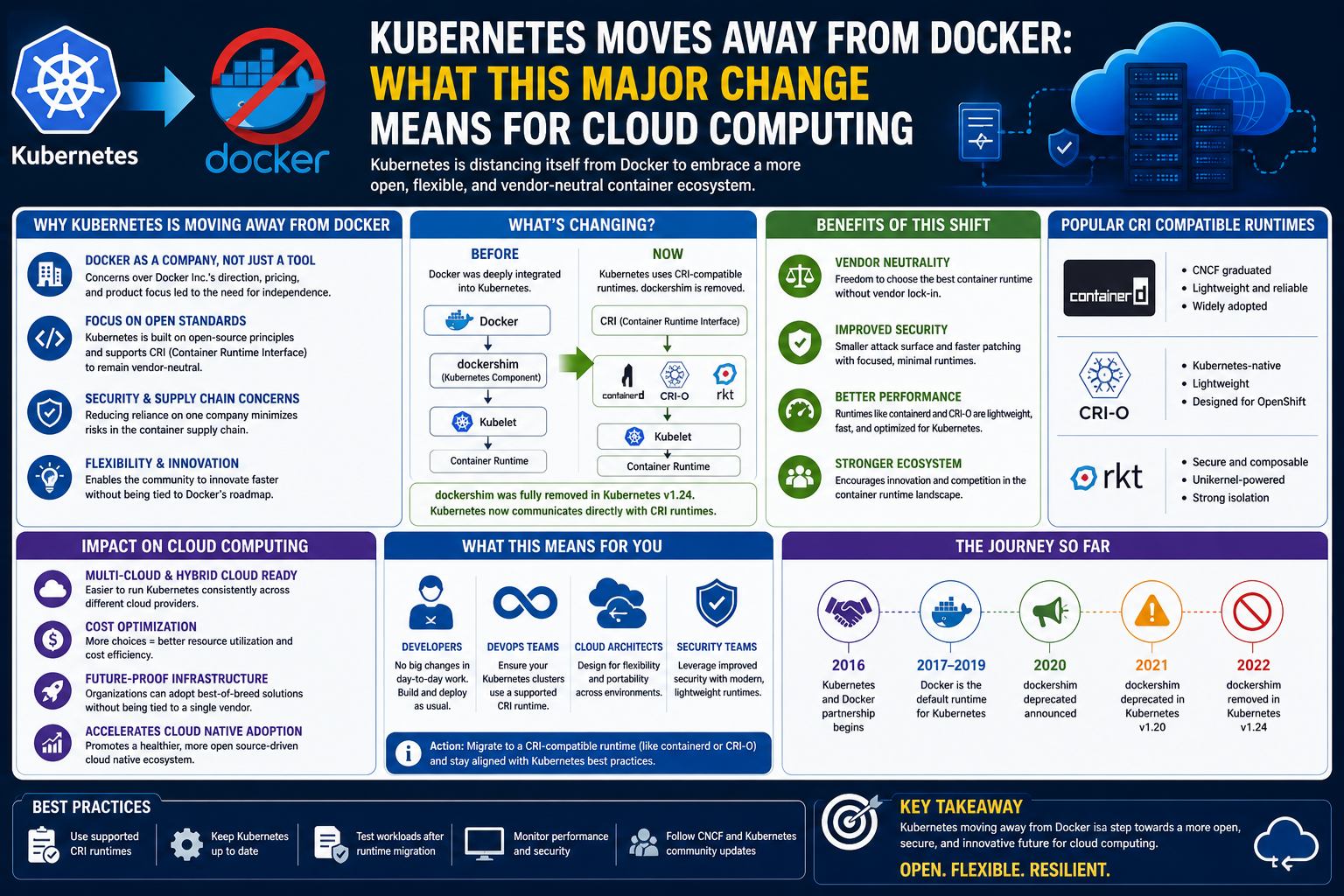
The conversation around Kubernetes and Docker has evolved significantly over the years, especially as containerization has become a core part of modern software development and deployment. To understand why the announcement about Kubernetes “dropping Docker support” caused such widespread confusion, it is important to first understand how deeply intertwined these technologies had become in everyday workflows.
Kubernetes was designed to orchestrate containers at scale, while Docker became one of the most widely adopted tools for building and running those containers. Over time, many people began to assume that Kubernetes “depended on Docker,” even though the relationship was more nuanced. This misunderstanding set the stage for the reaction that followed the 2020 announcement.
At the heart of the issue is not the disappearance of Docker containers themselves, but a shift in how Kubernetes interacts with container runtimes. This distinction is critical. Kubernetes is not removing support for containers created with Docker, nor is it breaking compatibility with images built using Docker tooling. Instead, the change is focused on a specific internal component that previously allowed Kubernetes to communicate with Docker.
This subtle but important difference is what turned a technical adjustment into a widely discussed industry moment. For many developers, Docker had become synonymous with containers themselves, making it easy to misinterpret what Kubernetes was actually changing.
To properly understand this shift, it is necessary to break down the architecture of Kubernetes, the role of container runtimes, and how Docker fits into that ecosystem.
The Role of Container Runtimes in Kubernetes Architecture
Kubernetes does not directly run containers on its own. Instead, it relies on a lower-level system known as a container runtime. A container runtime is responsible for the actual creation, execution, and management of containers on a machine. It handles tasks such as starting and stopping containers, managing container images, and isolating processes.
In the early days of Kubernetes, Docker was the most widely used container runtime. Because of this popularity, Kubernetes initially integrated directly with Docker to manage containers. This made adoption easier and allowed Kubernetes to grow quickly in popularity.
However, as the container ecosystem matured, new runtimes emerged that were more specialized and designed specifically for Kubernetes environments. Examples include container runtimes that focused solely on Kubernetes integration, offering lighter weight and more direct communication with the orchestration layer.
This evolution created a challenge: Kubernetes needed a standardized way to communicate with different container runtimes without tightly coupling itself to one specific implementation. Relying heavily on Docker made Kubernetes less flexible and more complex to maintain over time.
As a result, the Kubernetes ecosystem moved toward a more abstract model where container runtimes could be swapped without requiring major changes to Kubernetes itself. This abstraction became one of the key reasons behind the introduction of a standard interface.
Understanding the Container Runtime Interface (CRI)
To solve the problem of interacting with multiple container runtimes, Kubernetes introduced a standard known as the Container Runtime Interface. This interface defines a consistent way for Kubernetes to communicate with any compatible container runtime.
The purpose of this interface is to decouple Kubernetes from the underlying implementation details of how containers are actually managed. Instead of integrating directly with each runtime, Kubernetes can simply communicate through a standardized set of instructions.
This shift allowed Kubernetes to become more modular and flexible. Any runtime that adheres to the interface can be used without requiring Kubernetes to change its internal architecture.
Some container runtimes were designed with this interface in mind from the beginning and supported it natively. Others, like Docker, were not originally built to comply with this interface. This created an integration gap that needed to be addressed in order for Docker to continue functioning smoothly within Kubernetes.
To bridge this gap, Kubernetes introduced an intermediary layer that would translate between Docker’s runtime system and the standardized interface used by Kubernetes. This layer became a crucial part of the system for several years.
The Purpose and Function of Dockershim
Dockershim was introduced as a compatibility layer between Kubernetes and Docker. Since Docker did not natively support the Container Runtime Interface, Kubernetes needed a way to translate its instructions into a format Docker could understand.
Dockershim acted as this translator. When Kubernetes needed to start a container, stop a container, or manage images, it would send instructions through the CRI. Dockershim would then convert those instructions into Docker-specific commands that the Docker Engine could execute.
This setup allowed Kubernetes to continue supporting Docker without requiring Docker itself to adopt the new interface. For a long time, this worked effectively and helped Kubernetes maintain backward compatibility with the vast number of systems already using Docker.
However, while Dockershim solved a short-term compatibility problem, it introduced long-term complexity. It added an extra layer in the architecture that needed to be maintained, tested, and updated. As Kubernetes evolved, this additional layer became increasingly difficult to support efficiently.
Over time, the Kubernetes project began to reassess whether this translation layer was still necessary, especially as alternative runtimes became more widely adopted and more mature in their support for the standardized interface.
Why Kubernetes No Longer Needs Docker as a Middle Layer
The decision to phase out Dockershim was driven by architectural simplification rather than a rejection of Docker itself. Kubernetes developers observed that most of the functionality required from Docker was already available through other runtimes that directly supported the Container Runtime Interface.
In practical terms, Kubernetes was only using a subset of Docker’s capabilities when acting as a runtime. Much of Docker’s broader functionality, such as developer tooling and image building features, was not required by Kubernetes at runtime.
This meant that maintaining a special translation layer solely for Docker was becoming less efficient over time. It introduced additional maintenance overhead and complexity without providing unique benefits that could not be achieved through other means.
At the same time, container runtimes that were designed specifically for Kubernetes workloads had matured significantly. These runtimes were simpler, more direct in their integration, and did not require an intermediary layer to function.
As a result, Kubernetes made the architectural decision to remove Dockershim as part of its long-term strategy to streamline the system and reduce unnecessary dependencies.
Why the Announcement Created Widespread Confusion
When news broke that Kubernetes was “dropping Docker support,” many interpreted it as the end of Docker containers in Kubernetes environments. This interpretation spread quickly because Docker had become deeply embedded in developer workflows and industry terminology.
A major source of confusion came from the fact that “Docker” is often used as a blanket term for containers in general. In reality, Docker refers to a full platform that includes multiple components, such as image building tools, container runtime capabilities, and registry services.
The Kubernetes change was not targeting Docker images or the concept of containers themselves. Instead, it was focused on a specific runtime integration path used internally by Kubernetes.
Because this distinction is highly technical, it was easily lost in broader discussions. Many headlines simplified the message, which unintentionally amplified concerns about compatibility and disruption.
In practice, most developers using Docker to build container images would not see any immediate changes. Their images would continue to function in Kubernetes environments because those images adhere to industry standards that are independent of the runtime used to execute them.
The Importance of Open Standards in Container Compatibility
One of the key reasons Docker containers continue to work in Kubernetes, even without Dockershim, is the presence of open standards governing container formats. These standards ensure that container images are portable across different runtimes.
This means that a container image created using Docker tooling is not tied exclusively to the Docker runtime. Instead, it follows a specification that allows it to be executed by any compatible runtime.
This separation between image format and runtime implementation is fundamental to the flexibility of modern container ecosystems. It allows developers to build once and run anywhere, regardless of the underlying infrastructure.
As container technologies evolved, this standardization became increasingly important. It ensured that Kubernetes could transition away from Docker as a runtime dependency without breaking compatibility with existing container images.
This is why the removal of Dockershim does not equate to the removal of Docker-built containers. The images remain valid and usable because they conform to shared specifications that extend beyond any single tool or platform.
Early Signals of Change in the Kubernetes Ecosystem
Before the formal announcement, there were already signs that Kubernetes was moving toward a more modular runtime architecture. Alternative runtimes were gaining traction, and many of them were already being used in production environments without issues.
These runtimes offered more direct integration with Kubernetes and eliminated the need for additional translation layers. This made them attractive from both a performance and maintenance perspective.
At the same time, the Kubernetes project was evolving rapidly, with a strong focus on reducing unnecessary complexity in its core architecture. Removing redundant components became a natural part of this evolution.
Dockershim, while historically important, was increasingly viewed as a legacy component rather than a core dependency. Its continued maintenance was no longer aligned with the long-term direction of the project.
As these trends converged, the decision to deprecate Dockershim became a logical step in the broader effort to modernize Kubernetes architecture.
The Technical Relationship Between Docker and Kubernetes
To fully appreciate the change, it is useful to understand how Docker and Kubernetes interact at a technical level. Docker provides tools for building, packaging, and running containers. Kubernetes, on the other hand, focuses on orchestrating those containers across clusters of machines.
In earlier architectures, Kubernetes would rely on Docker to perform the actual container execution tasks. This meant Kubernetes was indirectly dependent on Docker’s internal systems to manage workloads.
Over time, this dependency became less necessary as Kubernetes introduced abstraction layers that allowed it to interact with container runtimes more generically.
Instead of calling Docker directly, Kubernetes began using standardized interfaces that could be implemented by multiple runtimes. This reduced its dependency on any single tool and made the system more adaptable to future changes.
Dockershim existed as a bridge during this transition period, ensuring compatibility while the ecosystem matured. However, once alternative runtimes became fully capable of handling Kubernetes workloads independently, the need for this bridge diminished.
The Broader Impact on Kubernetes Development Practices
While the average developer working with containers may not notice immediate changes, the removal of Dockershim represents a meaningful shift in how Kubernetes is maintained and developed.
By eliminating a long-standing compatibility layer, Kubernetes reduces the complexity of its internal codebase. This allows developers working on Kubernetes itself to focus more on core functionality and long-term improvements.
It also encourages the adoption of more standardized runtime implementations across the ecosystem. Over time, this leads to a more consistent and predictable environment for running containerized workloads.
For organizations managing large-scale Kubernetes deployments, this shift signals a gradual transition in infrastructure planning. While immediate action may not be required in many cases, understanding the direction of the ecosystem becomes important for future architectural decisions.
The change reflects a broader trend in cloud-native computing: moving away from tightly coupled systems and toward more modular, interoperable components that can evolve independently.
Shift in the Container Ecosystem and Why Alternatives Emerged
The evolution of container technology did not happen in isolation. It grew alongside the increasing demands of cloud computing, distributed systems, and large-scale application deployment. As organizations adopted containers for portability and consistency, the need for more efficient runtime systems became increasingly clear.
Docker played a foundational role in popularizing containers, but over time, the ecosystem expanded beyond a single implementation. Different use cases began to require different design priorities. Some environments prioritized simplicity, while others needed performance, minimal overhead, or tighter integration with orchestration systems like Kubernetes.
This diversification led to the emergence of alternative runtimes designed specifically for Kubernetes environments. These runtimes were not trying to replace containers themselves but to provide more streamlined ways of running them inside orchestrated clusters.
The key shift was architectural: instead of relying on a general-purpose container platform, Kubernetes environments began favoring specialized components that focused solely on running containers efficiently within a cluster context.
This gradual shift made it increasingly practical to move away from older integration layers and toward direct communication between Kubernetes and container runtimes that were purpose-built for orchestration.
What Replacing Dockershim Means in Practical Terms
Replacing Dockershim does not mean removing Docker from the ecosystem. Instead, it means removing a translation mechanism that allowed Kubernetes to communicate with Docker’s runtime engine.
In practical terms, this affects how container execution requests are processed inside a Kubernetes node. Previously, when Kubernetes needed to start or stop a container, it would pass the request through Dockershim, which would then translate it into Docker-specific instructions.
After Dockershim’s removal, Kubernetes communicates directly with a runtime that understands its interface natively. This eliminates one intermediate step in the process.
For most users, this change is invisible at the application level. Containers still run, images still deploy, and workloads behave the same way. The difference lies entirely in the internal mechanics of how those operations are executed.
However, for cluster administrators and platform engineers, this change alters the underlying architecture of node management. It requires understanding which runtime is active on each node and ensuring compatibility with operational tools that previously assumed Docker was always present.
This shift also influences troubleshooting workflows, monitoring approaches, and system inspection methods that relied on Docker-specific commands or behavior.
Understanding containerd as a Default Runtime Direction
One of the most widely adopted runtimes in Kubernetes environments is containerd. It originated as part of the Docker ecosystem but evolved into a standalone project designed specifically for container execution.
containerd focuses on the core responsibilities of running containers: managing images, executing workloads, and handling lifecycle operations. It does not include the broader developer tooling that Docker provides, such as build interfaces or high-level CLI features.
This separation of concerns makes containerd more aligned with Kubernetes requirements. Kubernetes does not need a full developer platform on every node; it only needs a reliable and efficient runtime capable of executing container workloads.
Because of this alignment, many Kubernetes distributions and managed environments have adopted containerd as the default runtime. This reduces complexity and eliminates the need for translation layers like Dockershim.
From an operational standpoint, containerd also tends to integrate more cleanly with Kubernetes’ internal architecture. It communicates directly through standardized interfaces, which reduces overhead and improves maintainability.
As adoption increases, containerd becomes a reference point for how modern Kubernetes environments are structured at the runtime level.
CRI-O and the Rise of Kubernetes-Native Runtimes
Another significant runtime in the Kubernetes ecosystem is CRI-O. Unlike containerd, which has broader origins, CRI-O was designed specifically with Kubernetes in mind from the beginning.
Its primary goal is to provide a minimal, stable, and Kubernetes-focused runtime that adheres strictly to the Container Runtime Interface. It avoids unnecessary features and focuses only on what is required to run containers in a cluster environment.
This minimal design reduces complexity and makes CRI-O particularly attractive for environments where predictability and tight integration are priorities.
CRI-O also emphasizes security and isolation by limiting its scope to essential runtime functions. This reduces the attack surface compared to more feature-rich platforms.
In Kubernetes environments where simplicity and strict adherence to standards are important, CRI-O offers a direct and efficient execution model without legacy compatibility layers.
The emergence of CRI-O and similar runtimes reflects a broader trend: Kubernetes is increasingly decoupled from legacy container platforms and moving toward purpose-built runtime systems.
How Kubernetes Nodes Actually Change Under the Hood
A Kubernetes node is essentially a machine responsible for running container workloads. Under the hood, each node relies on a container runtime to execute those workloads.
Before the removal of Dockershim, nodes using Docker required an additional layer that translated Kubernetes instructions into Docker commands. This added complexity to the node architecture.
After the removal, the structure becomes more direct. Kubernetes communicates with a runtime that understands its interface natively, eliminating the need for translation.
This change simplifies the internal architecture of nodes. It reduces the number of components involved in processing container lifecycle events and makes system behavior more predictable.
From a system perspective, this also reduces potential points of failure. Fewer layers mean fewer opportunities for miscommunication or incompatibility between components.
However, it also means that administrators must be more aware of which runtime is installed on each node. In mixed environments, different nodes may use different runtimes, which requires careful management.
Impact on Developers Building Container Images
For developers, the most important reassurance is that container images remain unaffected by the removal of Dockershim. Images built using Docker tools continue to function normally in Kubernetes environments.
This is because container images follow standardized specifications that are independent of the runtime used to execute them. As long as an image adheres to these standards, it can be run by any compatible runtime.
This separation between image creation and runtime execution is one of the most important design principles in modern container ecosystems.
Developers can continue using familiar tools to build and package applications without needing to adjust their workflows. The change occurs downstream in how those images are executed, not in how they are created.
However, developers working closely with cluster environments may notice changes in debugging or inspection workflows, particularly if they previously relied on runtime-specific tools tied to Docker.
CI/CD Pipelines and Build Systems Adjustments
Continuous integration and deployment systems often integrate deeply with container tooling. These pipelines typically build images, test them, and deploy them to Kubernetes clusters.
In most cases, these pipelines are unaffected by the removal of Dockershim because they operate at the image level rather than the runtime level.
However, environments that rely on Docker-specific commands during deployment or debugging may need adjustments. This is particularly true for pipelines that assume Docker is present on Kubernetes nodes.
Some older workflows may include steps that interact directly with Docker sockets or rely on Docker-specific behaviors. These workflows may require redesign to align with runtime-agnostic approaches.
Modern CI/CD systems increasingly separate build environments from runtime environments, which reduces dependency on node-level Docker installations.
This separation improves portability and ensures that pipelines remain consistent regardless of the runtime used in the target Kubernetes cluster.
Kubernetes Clusters Before vs After Dockershim Removal
Before the removal of Dockershim, Kubernetes clusters that used Docker had an additional compatibility layer embedded within each node. This layer ensured that Kubernetes could communicate with Docker even though it did not natively support the CRI interface.
After removal, clusters are expected to use runtimes that directly support the interface without requiring translation.
This structural change simplifies cluster architecture. Instead of maintaining compatibility layers, clusters rely on direct communication between components.
From an operational perspective, this results in fewer moving parts within each node and more consistent runtime behavior across environments.
However, it also means that older clusters or legacy configurations may require updates to align with the new runtime expectations.
In environments where Docker was deeply integrated into operational tooling, this transition requires careful planning to ensure continuity.
Debugging Differences Without Docker Runtime Access
One of the most noticeable changes for administrators is the shift in debugging workflows. Docker provided a familiar set of tools for inspecting containers, viewing logs, and interacting with running workloads.
When Docker is no longer the runtime layer within Kubernetes nodes, some of these direct inspection methods are no longer available in the same form.
Instead, administrators must rely on tools provided by the active runtime or by Kubernetes itself. These tools are designed to be runtime-agnostic, focusing on cluster-level visibility rather than node-level Docker interactions.
This shift encourages a more standardized approach to debugging but may require adjustment for those accustomed to Docker-based inspection commands.
Over time, operational practices evolve to rely more heavily on Kubernetes-native tools rather than node-specific runtime commands.
This leads to more consistent debugging experiences across different environments, even when underlying runtimes differ.
Logging, Monitoring, and Operational Changes
Logging and monitoring systems also experience subtle changes when moving away from Docker as a runtime dependency.
Previously, some logging mechanisms were tightly coupled with Docker’s internal logging drivers. These systems collected logs directly from Docker-managed containers.
With the removal of Dockershim, logging becomes more dependent on Kubernetes-level abstractions or runtime-specific logging implementations that adhere to standard interfaces.
This shift encourages a more unified logging strategy across different runtimes. Instead of relying on Docker-specific mechanisms, logging systems interact with containers through standardized interfaces.
Monitoring systems also benefit from this abstraction. Metrics collection becomes more consistent across environments because it is no longer tied to a single runtime implementation.
However, organizations that built custom tooling around Docker’s internal logging behavior may need to adapt their systems to align with runtime-agnostic approaches.
Security and Isolation Implications
From a security perspective, removing Dockershim reduces the number of components involved in container execution. Fewer layers can mean fewer potential vulnerabilities introduced through translation or compatibility logic.
Direct runtime integration reduces the attack surface by eliminating intermediary systems that could be exploited or misconfigured.
Runtimes like containerd and CRI-O are designed with a narrower scope, which allows them to focus more heavily on security and isolation principles.
This streamlined architecture also improves auditability, as there are fewer moving parts involved in container lifecycle management.
However, security outcomes still depend heavily on configuration practices, runtime selection, and cluster management policies. The removal of Dockershim is not a security upgrade by itself, but it contributes to a cleaner and more predictable runtime environment.
Enterprise Adoption Concerns and Migration Planning
Large-scale enterprise environments often rely on stable, predictable infrastructure. Any change in underlying systems requires careful evaluation to avoid disruption.
The transition away from Dockershim introduced concerns about compatibility, particularly in environments that had deeply integrated Docker into operational workflows.
Enterprises needed to assess whether their workloads depended on Docker-specific runtime behavior or whether they were already aligned with standard container practices.
In many cases, migration involved verifying that workloads could run on alternative runtimes without modification. This process also included updating monitoring tools, debugging workflows, and deployment pipelines.
Planning became an important part of the transition process, even though the actual impact on most workloads remained minimal.
Enterprises that adopted more modern, Kubernetes-aligned runtimes earlier generally experienced smoother transitions, while those relying heavily on Docker-specific integrations required more extensive adjustments.
Common Misconceptions That Persist
Despite widespread clarification, several misconceptions about the removal of Dockershim continue to circulate.
One common misunderstanding is that Docker containers no longer work in Kubernetes. In reality, container images remain fully compatible due to adherence to open standards.
Another misconception is that Docker itself has been removed from Kubernetes environments entirely. In truth, only the runtime integration layer is being phased out, not Docker as a tool or platform.
Some also assume that application performance is directly affected by this change. However, runtime efficiency differences are generally minimal from the perspective of application execution.
These misconceptions often arise from the complexity of container terminology and the overlap between different layers of the ecosystem.
Understanding the distinction between image creation, runtime execution, and orchestration is key to interpreting the actual impact of the change.
Workload Compatibility and Edge Cases
While most workloads continue to run without modification, certain edge cases require attention. These typically involve systems that rely on direct interaction with Docker runtime features.
Examples include workloads that depend on Docker socket access, specialized logging configurations tied to Docker internals, or tools that assume Docker is present on every node.
In these cases, migration may require adjusting assumptions about runtime availability and replacing Docker-specific dependencies with more general approaches.
Most standard application workloads, however, are unaffected because they operate at a higher level of abstraction and do not depend on runtime-specific behavior.
Edge cases highlight the importance of designing systems that rely on standardized interfaces rather than specific implementations.
Migration Planning for Cluster Administrators
As Kubernetes moved toward removing Dockershim, one of the most important responsibilities for platform engineers became planning the migration path away from Docker as a node runtime. While the change did not affect container images or application logic, it required careful attention to infrastructure configuration.
The first step in migration planning is identifying which nodes are still using Docker as the underlying runtime. In many environments, especially older or self-managed clusters, Docker had been installed by default during initial setup. These clusters often relied on implicit assumptions that Docker would always be available.
Once these nodes are identified, administrators must evaluate which alternative runtime will replace Docker. The most common choices include containerd and CRI-O, both of which integrate directly with Kubernetes through standardized interfaces.
Migration planning also involves reviewing cluster tooling. Any scripts, monitoring agents, or debugging utilities that depend on Docker-specific behavior need to be updated or replaced. This includes tools that inspect containers directly through Docker commands or rely on Docker socket access.
Another important aspect is ensuring compatibility across mixed environments. During transition periods, some nodes may still use Docker while others use alternative runtimes. This can introduce inconsistencies in behavior if not carefully managed.
Proper migration planning minimizes disruption by gradually shifting workloads rather than performing abrupt changes. This staged approach allows teams to validate system behavior at each step, ensuring stability throughout the transition.
The Role of Managed Kubernetes Services in the Transition
Managed Kubernetes services significantly influenced how the Dockershim transition was experienced across the industry. In many cases, these platforms handled the runtime transition on behalf of users, reducing the operational burden.
Cloud providers had already begun moving away from Docker as the default runtime before the deprecation announcement. This meant that many managed clusters were already using containerd or similar runtimes without requiring user intervention.
As a result, users of managed services often experienced little to no visible impact from the Dockershim removal. The complexity of runtime management was abstracted away behind the service layer.
This abstraction highlights one of the key advantages of managed Kubernetes environments: infrastructure-level changes can often be handled transparently without affecting application teams.
However, even in managed environments, understanding the underlying runtime is still important for debugging and performance optimization. While users may not directly manage the runtime, awareness of its behavior helps in interpreting system logs and performance metrics.
The transition also reinforced the importance of aligning workloads with cloud-native standards, ensuring that applications remain portable across different infrastructure providers.
Impact on Docker Desktop and Local Development Environments
While Kubernetes clusters moved away from Docker as a runtime dependency, local development environments followed a slightly different trajectory. Many developers rely on Docker Desktop to build and test containerized applications locally.
Docker Desktop continues to serve as a widely used tool for local container development, but its relationship with Kubernetes has evolved. Local Kubernetes clusters running inside development environments may now use alternative runtimes internally while still allowing Docker-based workflows for image creation.
This separation between local development and cluster runtime environments is intentional. Developers can continue using familiar Docker tooling while production systems adopt more streamlined runtimes.
However, differences between local and production environments can sometimes introduce subtle inconsistencies. For example, debugging behavior or container lifecycle timing may differ depending on the runtime used in each environment.
To mitigate this, many teams adopt development practices that emphasize runtime-agnostic testing. Instead of relying on Docker-specific behavior, they focus on ensuring that applications behave consistently across different environments.
This approach improves portability and reduces surprises when applications are deployed from local systems to production clusters.
Evolution of Container Lifecycle Management
The removal of Dockershim also reflects a broader evolution in how container lifecycles are managed within Kubernetes. Early architectures were heavily dependent on external tools to handle container creation and management.
Over time, Kubernetes evolved into a more self-contained system with clearly defined interfaces for interacting with container runtimes. This allowed lifecycle management to become more standardized and predictable.
In modern Kubernetes environments, the lifecycle of a container is managed through a series of well-defined stages, including creation, scheduling, execution, monitoring, and termination. These stages are handled through direct communication with the runtime rather than through intermediary translation layers.
This evolution improves system clarity and reduces ambiguity in how containers are managed. It also allows Kubernetes to enforce consistent behavior across different runtime implementations.
By removing legacy compatibility layers, Kubernetes strengthens its ability to manage workloads in a more uniform and reliable way.
Observability Changes in Post-Dockershim Environments
Observability plays a crucial role in managing distributed systems, and changes in container runtime architecture naturally affect how observability is implemented.
In environments that previously relied on Docker, observability tools often integrated directly with Docker’s internal mechanisms. This allowed detailed inspection of container processes, logs, and resource usage.
After the removal of Dockershim, observability systems shifted toward more standardized interfaces provided by Kubernetes and the underlying runtime.
This transition encourages a more consistent observability model across different environments. Instead of relying on runtime-specific behavior, monitoring systems now interact with containers through unified APIs.
While this improves consistency, it also requires updates to older monitoring setups that were tightly coupled with Docker internals. In some cases, these systems need to be reconfigured to work with runtime-agnostic data sources.
Over time, this shift leads to more portable observability solutions that function across multiple Kubernetes environments without modification.
Security Hardening Through Runtime Simplification
Security considerations played an important role in the decision to remove Dockershim. By reducing the number of components involved in container execution, Kubernetes reduces its overall attack surface.
Each additional layer in a system introduces potential points of vulnerability. Dockershim, as a translation layer, represented an additional component that needed to be maintained and secured.
Removing it simplifies the execution path from Kubernetes to the container runtime. This makes it easier to reason about system behavior and reduces the likelihood of unexpected interactions between components.
Runtimes like containerd and CRI-O are designed with minimal scope, focusing only on essential execution tasks. This reduces complexity and limits exposure to unnecessary functionality.
Security hardening in modern Kubernetes environments increasingly relies on minimizing system complexity and standardizing interfaces rather than adding additional protective layers.
This approach aligns with broader cloud-native security principles that emphasize simplicity and predictability.
The Changing Role of Docker in Cloud-Native Systems
Even as Docker is no longer central to Kubernetes runtime operations, it continues to play an important role in the broader development ecosystem.
Docker remains widely used for building container images, managing development environments, and providing tooling for developers. Its role has shifted from being a runtime dependency to being a development and packaging tool.
This separation of responsibilities reflects a maturation of the container ecosystem. Different tools now specialize in different parts of the workflow rather than trying to handle the entire lifecycle end-to-end.
Kubernetes focuses on orchestration and runtime management, while Docker continues to serve as a developer-facing tool for building and distributing containers.
This division of labor improves efficiency and allows each tool to evolve independently without being constrained by the needs of the other.
Debugging Workflows in Runtime-Agnostic Clusters
As Kubernetes environments move away from Docker dependencies, debugging workflows have also evolved. Previously, many administrators relied on Docker commands to inspect running containers or diagnose issues on nodes.
In modern environments, debugging is more tightly integrated with Kubernetes itself. Tools focus on cluster-level abstractions rather than node-specific runtime behavior.
This shift encourages a more consistent debugging experience across different environments. Whether a cluster uses containerd, CRI-O, or another runtime, the debugging interface remains largely the same.
However, administrators must adapt to new workflows that may not provide the same level of direct container inspection as Docker-based approaches.
Instead of interacting directly with containers through runtime-specific tools, debugging is often performed through Kubernetes-native commands and APIs.
This approach improves portability but requires a shift in mindset for teams accustomed to Docker-centric workflows.
Enterprise Governance and Infrastructure Standardization
In large organizations, governance plays a key role in managing infrastructure transitions. The removal of Dockershim required enterprises to evaluate their container runtime strategies and standardize their environments.
Many organizations used the opportunity to simplify their infrastructure by adopting a single runtime across all clusters. This reduces operational complexity and improves consistency in behavior.
Standardization also simplifies training, documentation, and incident response procedures. When all clusters behave similarly at the runtime level, teams can apply consistent operational practices.
Governance frameworks often include policies that define approved runtimes, configuration standards, and upgrade paths. These policies help ensure that infrastructure remains aligned with long-term architectural goals.
The transition away from Docker as a runtime dependency fits naturally into these broader efforts to simplify and standardize cloud infrastructure.
Long-Term Direction of Kubernetes Runtime Architecture
The removal of Dockershim is part of a broader trend toward modular, interface-driven architecture in Kubernetes. Instead of relying on specific implementations, Kubernetes increasingly defines clear interfaces that allow components to be swapped independently.
This design philosophy improves flexibility and future-proofs the system against changes in underlying technologies.
In the long term, Kubernetes is likely to continue refining its runtime abstraction model, allowing even more flexibility in how containers are executed across different environments.
This may include support for additional runtime types, improved performance optimizations, and tighter integration with emerging cloud-native technologies.
The goal is to ensure that Kubernetes remains adaptable without being tied to any single implementation or vendor-specific toolchain.
Influence on Multi-Cluster and Hybrid Deployments
Modern infrastructure often spans multiple environments, including on-premises data centers, public cloud providers, and hybrid configurations. In these scenarios, consistency across clusters becomes especially important.
The removal of Dockershim contributes to this consistency by encouraging the use of standardized runtimes across different environments.
When clusters use different runtimes, operational behavior can vary in subtle ways. Standardizing runtimes reduces these differences and simplifies multi-cluster management.
This is particularly important in hybrid deployments, where workloads may move between environments based on demand, cost, or availability.
A consistent runtime layer ensures that workloads behave predictably regardless of where they are executed.
The Broader Shift Toward Cloud-Native Abstraction
At a higher level, the removal of Dockershim reflects a broader shift in cloud computing toward abstraction and modularity. Systems are increasingly designed to hide implementation details behind well-defined interfaces.
This allows infrastructure components to evolve independently without disrupting higher-level systems.
Kubernetes embodies this philosophy by abstracting away the details of container execution and focusing on workload orchestration.
As a result, users interact with a consistent platform even as underlying components change over time.
This abstraction is one of the key reasons Kubernetes has become so widely adopted. It allows organizations to build portable, scalable systems without being locked into specific technologies.
Evolving Developer Expectations in Container Ecosystems
As container technology matures, developer expectations have also evolved. Early container adoption focused heavily on Docker as the primary interface for building and running applications.
Today, developers are more aware of the layered nature of container ecosystems. They understand that building, running, and orchestrating containers are separate concerns handled by different tools.
This shift in understanding allows for more flexibility in tool selection and reduces dependency on any single platform.
Developers increasingly focus on portability and standard compliance rather than runtime-specific features.
This mindset aligns with the direction Kubernetes has taken in removing tightly coupled components like Dockershim.
Conclusion
The removal of Dockershim from Kubernetes marked an important architectural shift rather than a disruption to container workflows. While the announcement initially created confusion due to the close association between Docker and container technology, the actual change was far more targeted and technical in nature. It focused on simplifying Kubernetes internals by removing an intermediary translation layer that was no longer necessary.
In practice, Docker-built images continue to run without issues because they conform to open container standards that ensure compatibility across multiple runtimes. This separation between image creation and container execution is what makes the modern ecosystem resilient and flexible. Developers can continue using familiar tools while the underlying infrastructure evolves independently.
For cluster administrators, the change introduced a need to reassess runtime configurations and gradually adopt alternatives such as containerd or CRI-O. However, this transition also brought benefits in the form of reduced complexity, improved performance consistency, and a more streamlined architecture.
More broadly, the shift reflects the ongoing evolution of cloud-native systems toward modularity and standardization. Kubernetes continues to move away from tightly coupled dependencies and toward a model where components interact through well-defined interfaces. This approach not only simplifies maintenance but also strengthens long-term scalability and adaptability.
Ultimately, the Dockershim deprecation highlights how mature technologies evolve: by shedding legacy layers while preserving compatibility where it matters most.