In today’s digital environment, data is generated at a pace that most organizations struggle to fully comprehend, let alone control. Every interaction a customer makes, every transaction a business processes, and every internal system log contributes to an expanding universe of structured and unstructured data. This includes everything from simple spreadsheets and databases to emails, images, videos, cloud storage files, and application telemetry.
As businesses grow, so does the complexity of their data landscape. A small startup might manage its information within a handful of systems, where engineers and administrators clearly understand where data comes from and how it is used. In such environments, informal governance practices are often enough to maintain order. However, as organizations scale into multiple departments, regions, and cloud environments, this clarity begins to fade.
Data starts to spread across platforms. Marketing may use one set of tools, finance another, and engineering yet another. At the same time, organizations may operate across hybrid environments that include on-premises infrastructure, multiple cloud providers, and SaaS applications. Each system introduces its own structure, permissions, and risks.
This fragmentation creates a major challenge: no single person or team can easily see the full picture of where data resides, how it moves, and who is responsible for it. Without this visibility, organizations risk losing control over sensitive information, failing compliance requirements, or exposing themselves to security incidents.
It is within this environment that modern data governance platforms have become essential. Among these, Microsoft Purview has emerged as a central solution designed to unify, map, and govern data across complex digital ecosystems.
Introducing Microsoft Purview as a Unified Governance Platform
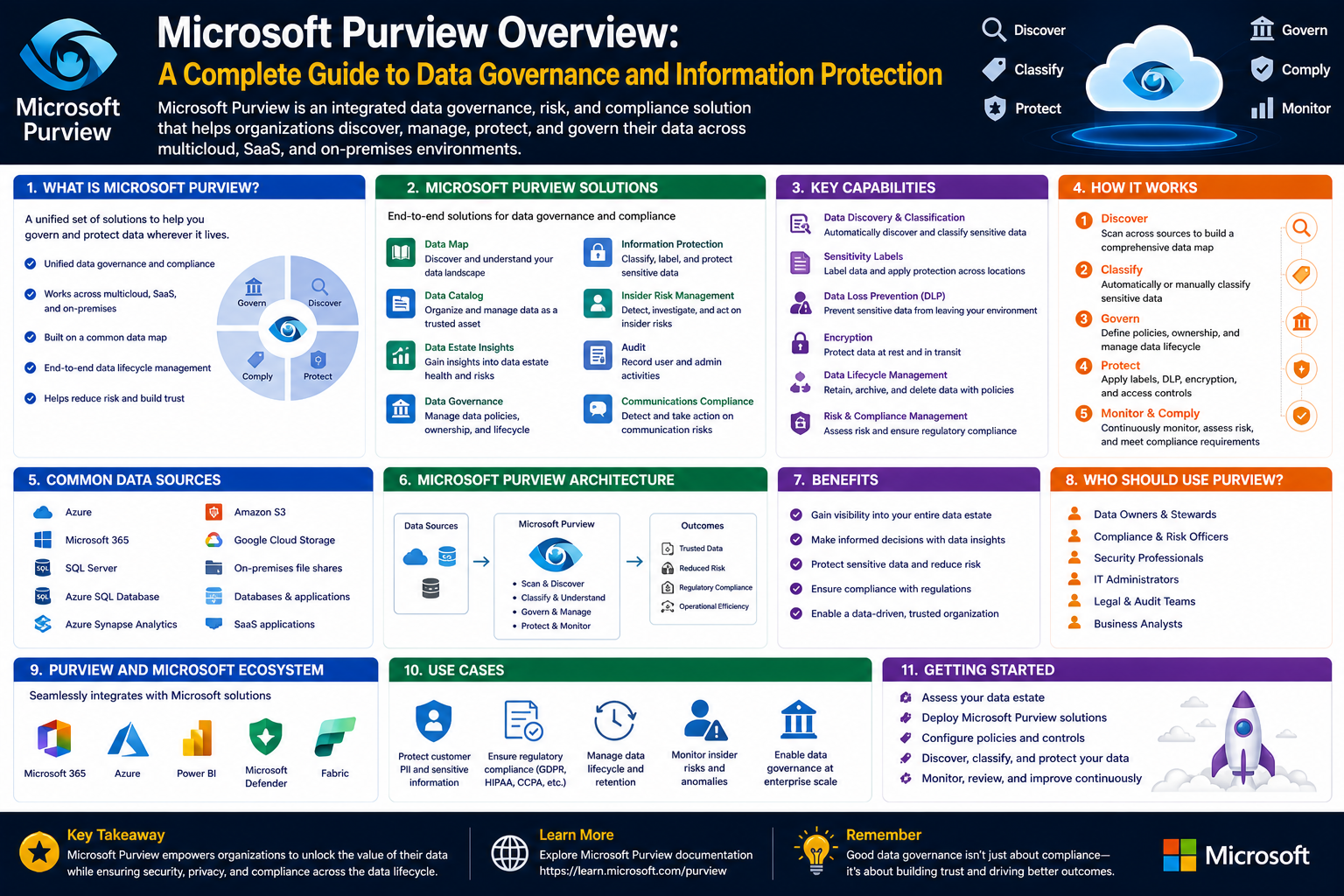
Microsoft Purview is a comprehensive data governance solution designed to help organizations gain visibility into their data estate, classify sensitive information, and apply consistent governance policies across multiple environments. Rather than treating data governance as a fragmented collection of tools and manual processes, Microsoft Purview brings these capabilities together into a unified system.
At its core, Microsoft Purview is built to solve a fundamental problem: organizations often do not know exactly what data they have, where it lives, or how it is being used. This lack of visibility becomes even more critical when dealing with sensitive information such as personal data, financial records, intellectual property, or regulated content.
Microsoft Purview addresses this by continuously scanning data sources, cataloging metadata, and building a map of data relationships. This allows organizations to understand not just individual datasets, but how those datasets are connected across systems and workflows.
The platform supports a wide range of data sources, including relational databases, cloud storage systems, analytics platforms, and SaaS applications. This broad compatibility is essential because modern enterprises rarely rely on a single data environment. Instead, they operate in hybrid ecosystems where information flows freely between systems.
What makes Microsoft Purview particularly powerful is that it does not just collect data—it interprets it. Through classification, lineage tracking, and policy enforcement, it transforms raw data into governed, understandable assets that can be managed at scale.
Why Data Governance Has Become a Critical Business Requirement
Data governance refers to the set of processes, policies, and technologies used to manage the availability, usability, integrity, and security of data. While this concept has existed for years, its importance has grown dramatically in the modern era due to several key factors.
First, regulatory pressure has increased significantly. Governments and industry bodies around the world have introduced strict rules regarding how personal and sensitive data must be handled. Regulations require organizations to know exactly what data they hold, where it is stored, and how it is protected. Failure to comply can result in severe financial penalties and reputational damage.
Second, cyber threats have become more sophisticated. Attackers are no longer targeting systems randomly; instead, they often seek out specific types of valuable data. Without proper governance, organizations may not even realize what sensitive information is exposed or where it resides.
Third, digital transformation has expanded the number of systems handling data. Cloud adoption, remote work, and SaaS platforms have created environments where data is constantly moving across boundaries. This makes traditional governance approaches, which relied heavily on manual tracking and isolated systems, increasingly ineffective.
Finally, organizations are now more data-driven than ever. Decisions are made based on analytics, machine learning, and real-time insights. If data is inaccurate, poorly classified, or inaccessible, business decisions suffer as a result.
In this context, data governance is no longer just an IT concern. It is a foundational business capability that impacts security, compliance, operational efficiency, and strategic decision-making.
The Core Problem: Lack of Visibility Across Data Ecosystems
One of the most significant challenges organizations face is simply understanding what data they possess. In many enterprises, data is distributed across dozens or even hundreds of systems. Each department may manage its own tools, storage systems, and databases without a unified view.
This leads to several common problems:
Data duplication occurs when multiple teams store similar information in different systems without awareness of existing datasets. This not only wastes storage resources but also creates inconsistencies in reporting.
Data silos emerge when information is isolated within departments or applications. These silos prevent collaboration and make it difficult to gain a holistic view of the organization.
Unclassified sensitive data becomes a serious risk when personal or confidential information is stored without proper labeling or protection. This increases the likelihood of accidental exposure.
Unknown data lineage makes it difficult to trace how data has moved or been transformed over time. Without this visibility, troubleshooting errors or ensuring compliance becomes extremely challenging.
Microsoft Purview directly addresses these issues by creating a centralized data map. This map acts as a living inventory of all connected data assets, continuously updated as systems change.
How Microsoft Purview Builds a Unified Data Map
A key capability of Microsoft Purview is its ability to create a comprehensive data map across an organization’s entire ecosystem. This is achieved through automated scanning and metadata extraction.
When Purview connects to a data source, it does not simply copy the data. Instead, it collects metadata—information about the data. This includes details such as table names, file structures, data types, relationships between datasets, and usage patterns.
Once collected, this metadata is organized into a structured map that represents the organization’s data landscape. This map allows users to visually explore how data is connected across systems.
For example, a customer record stored in a database may be linked to transactional data in an analytics platform and further connected to reporting dashboards. Microsoft Purview can trace these relationships, showing how a single piece of information flows through the organization.
This visibility is crucial for both operational and compliance purposes. It allows teams to understand dependencies, identify redundant data sources, and assess the impact of changes before they are made.
Data Classification and Sensitivity Labeling
Another essential function of Microsoft Purview is data classification. Not all data carries the same level of sensitivity, and treating all information equally can lead to inefficiencies and risks.
Purview enables organizations to automatically classify data based on predefined rules or patterns. For instance, it can identify personal identifiers such as national identification numbers, credit card details, or employee records.
Once classified, data can be assigned sensitivity labels. These labels define how the data should be handled, who can access it, and what protections should be applied. For example, highly sensitive data may require encryption, restricted access, or audit tracking.
This classification process is not static. As new data is created or modified, Purview continuously evaluates and updates classifications to ensure accuracy over time.
The ability to automate classification at scale is particularly important in large organizations where manual tagging would be impractical.
Understanding Data Lineage and Its Importance
Data lineage refers to the ability to track the lifecycle of data from its origin to its final destination. It shows how data is created, transformed, and used across systems.
In complex environments, data rarely remains in its original form. It is often extracted, transformed, aggregated, and analyzed before being used in reports or dashboards. Without lineage tracking, it becomes extremely difficult to understand how final outputs are derived.
Microsoft Purview provides detailed lineage visualization, allowing organizations to trace data flow step by step. This is valuable for several reasons.
It helps in debugging data issues by identifying where errors or inconsistencies originate. It supports compliance audits by demonstrating how data is processed and stored. It also improves trust in analytics by showing exactly how insights are generated.
By making data lineage visible, Purview helps organizations move from uncertainty to clarity in their data processes.
The Expanding Role of Data Governance Beyond IT Teams
One of the most important shifts in modern data governance is that it is no longer limited to technical teams. Traditionally, data management was primarily handled by database administrators, software engineers, and IT specialists. However, this model is no longer sufficient.
Today, data is used across virtually every department in an organization. Sales teams interact with customer data, HR manages employee information, finance handles sensitive financial records, and marketing analyzes user behavior.
Each of these departments contributes to data creation and usage, which means governance must extend beyond IT boundaries.
Microsoft Purview supports this broader model by providing tools that can be used across roles. It enables organizations to define governance policies centrally while applying them consistently across departments.
This ensures that sensitive data is handled appropriately regardless of who is interacting with it or where it resides.
The Importance of Visibility in Preventing Data Risks
Without visibility, organizations operate in a state of uncertainty. They may not know where sensitive data is stored, who has access to it, or how it is being used. This creates significant risk exposure.
Data breaches often occur not because of a single failure, but because of accumulated gaps in visibility and control. Sensitive data may be stored in unexpected locations, shared without proper safeguards, or left unprotected in outdated systems.
By providing a unified view of the data estate, Microsoft Purview reduces these blind spots. It allows organizations to proactively identify risks rather than reacting to incidents after they occur.
This shift from reactive to proactive governance is one of the most important transformations in modern data management.
Preparing for Scalable Data Governance in Large Enterprises
As organizations continue to grow, scalability becomes a key concern. What works for a small team does not necessarily work for a global enterprise operating across multiple continents and cloud environments.
Microsoft Purview is designed with scalability in mind. It can handle large volumes of data, integrate with diverse systems, and adapt to changing environments without requiring constant manual intervention.
This scalability ensures that governance practices remain consistent even as the organization evolves. It also allows businesses to expand their data operations without losing control or visibility.
In large enterprises, this capability is not just beneficial—it is essential for maintaining operational stability and compliance across complex infrastructures.
Building a Unified Governance Architecture Across Modern Data Systems
As organizations expand their digital operations, data no longer lives in a single, predictable environment. Instead, it becomes distributed across cloud platforms, on-premises systems, analytics engines, and third-party applications. This distribution creates a fundamental architectural challenge: how do you govern something that is everywhere at once?
Microsoft Purview approaches this problem by introducing a layered governance architecture designed to sit above existing systems rather than replace them. Instead of forcing organizations to migrate data into a single repository, it connects to existing environments and builds a governance layer across them.
This design is important because modern enterprises rely heavily on heterogeneous systems. A finance department might use a relational database for transactions, while a marketing team relies on cloud analytics tools, and engineering teams operate data pipelines in distributed environments. Replacing all of these systems would be unrealistic. Instead, Purview integrates with them.
At a high level, the architecture of Microsoft Purview revolves around three foundational capabilities: discovery, classification, and governance enforcement. These capabilities work together to create a continuous cycle of visibility and control.
Discovery identifies what data exists. Classification determines what type of data it is. Governance enforcement defines how that data should be handled. Together, they form a dynamic system that adapts as the data landscape evolves.
The Role of the Data Map in Structural Visibility
One of the most important architectural components in Microsoft Purview is the data map. While it was introduced in a general sense earlier, its internal structure and operational role deserve deeper attention.
The data map functions as a centralized metadata repository that continuously collects information from connected systems. It does not store the actual data itself but instead focuses on describing it. This includes schema definitions, data relationships, system origins, and usage patterns.
The key advantage of this approach is scalability. Because only metadata is stored, the system can manage extremely large environments without performance degradation. It also ensures that sensitive data remains in its original location, reducing security risks associated with duplication.
The data map is continuously updated through automated scanning processes. These scans identify new data sources, detect changes in existing structures, and refresh metadata records. This creates a living model of the organization’s entire data ecosystem.
Over time, the data map evolves into a highly detailed representation of how information flows across the enterprise. It becomes possible to trace how data originates in one system, transforms through multiple pipelines, and ultimately appears in reports, dashboards, or applications.
This structural visibility is essential for governance at scale because it eliminates guesswork. Instead of relying on documentation or manual tracking, organizations gain an always-updated view of their data environment.
Data Cataloging as a Foundation for Discovery and Accessibility
Beyond structural mapping, Microsoft Purview also introduces a data cataloging system that organizes and presents metadata in a user-friendly format. This catalog acts as an index of all data assets across the organization.
In large enterprises, one of the most common challenges is simply finding the right data. Teams often spend significant time searching for datasets, verifying their accuracy, or confirming ownership. This inefficiency slows down decision-making and increases the risk of using outdated or incorrect information.
The data catalog solves this by allowing users to search, browse, and explore data assets in a structured environment. Each asset in the catalog includes metadata such as description, classification, lineage, and ownership details.
This transforms data from a hidden resource into an accessible asset. Instead of being locked away in isolated systems, data becomes discoverable across the organization.
A key aspect of cataloging is context. Data is not just listed; it is described. Users can understand where it came from, how it has been used, and what it represents. This contextual layer is essential for building trust in data-driven decision-making.
In many organizations, poor data quality is not caused by the data itself but by a lack of understanding about its origin. The catalog helps bridge this gap by providing clarity and transparency.
Automated Classification Engines and Pattern Recognition
A critical component of data governance is the ability to identify sensitive information automatically. Manual classification is not feasible at enterprise scale, especially when data volumes grow continuously.
Microsoft Purview addresses this challenge through automated classification engines that analyze data patterns and content structures. These engines are designed to detect specific types of information such as personal identifiers, financial records, health-related data, and organizational secrets.
The classification process relies on pattern recognition and rule-based detection. For example, certain formats may indicate credit card numbers or national identification codes. Similarly, contextual analysis can help identify sensitive terms within unstructured text.
Once identified, data is assigned classification labels. These labels serve as metadata tags that define the sensitivity level of the information. Common categories include general business data, confidential information, and highly sensitive regulated data.
What makes this system powerful is its continuous operation. Classification is not a one-time event. As data is created, modified, or moved, it is continuously re-evaluated. This ensures that governance remains accurate even in dynamic environments.
In practice, this reduces the risk of sensitive data being overlooked or improperly handled. It also ensures consistency across departments, as classification rules are applied uniformly throughout the organization.
Data Lineage as a Transparency Mechanism for Complex Systems
Data lineage plays a central role in understanding how information flows through an organization. In complex environments, data rarely remains static. It is extracted from sources, transformed through pipelines, aggregated into datasets, and eventually consumed by applications or analytics platforms.
Without visibility into these transformations, organizations face significant challenges when trying to validate results or troubleshoot issues.
The lineage capabilities in Microsoft Purview provide a step-by-step visualization of this entire process. Each transformation stage is recorded, allowing users to trace data from its origin to its final output.
This is particularly important in environments where data is used for decision-making. If a report contains incorrect information, lineage helps identify where the error occurred. It may be in the original source, during transformation, or in the aggregation process.
Lineage also plays a key role in compliance. Regulatory frameworks often require organizations to demonstrate how data has been processed and where it has been stored. Without lineage tracking, this becomes extremely difficult to prove.
By providing end-to-end visibility, Microsoft Purview turns complex data pipelines into transparent systems that can be audited and verified.
Policy Frameworks and Governance Enforcement Layers
While visibility and classification are essential, governance is incomplete without enforcement. This is where policy frameworks become critical.
In Microsoft Purview, governance policies define how data should be accessed, shared, and protected. These policies are applied across connected systems, ensuring consistent enforcement regardless of where the data resides.
Policies can control access based on classification labels, user roles, or data sensitivity levels. For example, highly sensitive data may only be accessible to specific departments or require additional authentication layers.
The enforcement mechanism ensures that governance rules are not just theoretical guidelines but actively applied constraints within the data environment.
This is particularly important in large organizations where multiple teams interact with the same datasets. Without centralized policy enforcement, inconsistencies can arise, leading to potential security gaps.
By embedding governance rules into the data infrastructure itself, Microsoft Purview ensures that compliance is maintained automatically rather than manually enforced.
Integration Across Hybrid and Multi-Cloud Environments
Modern enterprises rarely operate within a single cloud provider or infrastructure model. Instead, they adopt hybrid strategies that combine on-premises systems with multiple cloud platforms.
This creates a fragmented data landscape that is difficult to govern using traditional tools.
Microsoft Purview is designed specifically to operate across these environments. It integrates with a wide range of data sources, regardless of where they are hosted.
This includes relational databases, cloud storage systems, analytics platforms, and SaaS applications. The key requirement is not relocation of data but connectivity.
Once connected, Purview applies the same governance principles across all systems. This ensures consistency in classification, lineage tracking, and policy enforcement.
This cross-environment capability is particularly valuable for organizations undergoing digital transformation. As systems migrate to the cloud or evolve over time, governance remains stable and uninterrupted.
Managing Sensitive Information Across Organizational Boundaries
One of the most complex aspects of data governance is managing sensitive information that moves across organizational boundaries. Data is rarely confined to a single department. It is often shared between teams, used in external communications, or transferred between systems.
This movement increases the risk of accidental exposure or misuse.
Microsoft Purview addresses this by maintaining continuous awareness of sensitive data locations and movements. When data is classified as sensitive, its handling rules follow it across systems.
This ensures that protections are not lost when data moves from one environment to another.
For example, if sensitive customer information is exported from a database into a reporting tool, the classification and associated governance rules remain attached to that data.
This persistence is critical for maintaining security in dynamic environments where data is constantly in motion.
The Relationship Between Metadata and Operational Intelligence
A key concept in Microsoft Purview’s architecture is the distinction between data and metadata. While data represents the actual content used by organizations, metadata describes the structure, context, and behavior of that data.
Metadata is what enables governance systems to function effectively at scale.
By analyzing metadata, Purview can understand how systems interact, how data flows between them, and how changes in one system affect others.
This enables a form of operational intelligence where governance is not static but responsive. The system can adapt to changes in real time, ensuring that governance policies remain aligned with the current state of the data environment.
This metadata-driven approach also reduces operational overhead. Instead of manually tracking systems, organizations rely on automated discovery and mapping processes.
Scaling Governance Without Increasing Complexity
One of the most significant challenges in enterprise environments is maintaining governance without introducing excessive complexity.
As systems grow, governance frameworks often become fragmented, with different teams applying inconsistent rules and practices.
Microsoft Purview addresses this by centralizing governance logic while distributing execution across connected systems. This ensures that governance remains unified even as infrastructure expands.
The result is a scalable model where complexity is managed through abstraction rather than manual coordination.
Organizations can grow their data ecosystems without losing control over governance processes, ensuring long-term stability and compliance.
From Visibility to Control: Turning Data Governance Into Action
In earlier discussions, the focus was on understanding how organizations gain visibility into their data landscape. Visibility is the foundation, but it is only the beginning. Knowing where data exists and how it moves is important, but it does not, by itself, prevent misuse, leaks, or compliance failures.
The real value emerges when visibility is combined with enforcement, automation, and policy-driven control. This is where Microsoft Purview becomes more than a discovery tool and evolves into a full-scale governance and risk management platform.
At enterprise level, governance is not a passive activity. It is continuous, operational, and deeply embedded into everyday workflows. Data is constantly created, shared, modified, and consumed. Without active governance, risks accumulate silently in the background until they become incidents.
Microsoft Purview addresses this by turning governance into an operational layer that sits across the entire data ecosystem. Instead of relying on manual audits or isolated security checks, it applies rules dynamically, ensuring that data is always handled according to defined policies.
This shift—from static governance to active enforcement—is what makes modern data governance fundamentally different from traditional approaches.
The Security Dimension of Data Governance
Data governance and data security are closely connected, but they are not identical. Security focuses on protecting systems from unauthorized access, while governance ensures that data is used correctly, consistently, and responsibly.
Microsoft Purview bridges these two domains by embedding security principles directly into governance structures. This allows organizations to manage not only who can access data, but also how that data can be used once access is granted.
One of the most important aspects of this approach is classification-based protection. Once data is labeled according to sensitivity, those labels become actionable. They are not just descriptive—they drive behavior.
For example, highly sensitive data may automatically trigger encryption requirements, restrict sharing capabilities, or enforce auditing. Less sensitive data may have fewer restrictions but still remain under governance oversight.
This dynamic enforcement ensures that security is not applied uniformly but contextually. Different types of data require different levels of protection, and Microsoft Purview allows these distinctions to be applied consistently at scale.
Protecting Sensitive Data Across Organizational Workflows
In modern enterprises, sensitive data rarely stays in one place. It moves across departments, applications, and external communication channels. This movement is where many security risks occur.
A common scenario involves sensitive customer or employee information being exported from internal systems into reports, spreadsheets, or communication tools. Without governance, this data can easily be shared beyond intended boundaries.
Microsoft Purview helps mitigate this risk by maintaining persistent awareness of sensitive data. Once data is classified, that classification follows it wherever it goes within supported systems.
This persistence ensures that protection is not lost during movement. If data is exported or transferred, governance rules remain attached, influencing how that data can be handled in its new context.
This approach is particularly important in hybrid and cloud-based environments where data flows frequently between systems. Without persistent governance, each transfer introduces a potential vulnerability.
By maintaining continuity of classification and policy enforcement, Microsoft Purview reduces the likelihood of accidental exposure or misuse.
Data Loss Prevention and Behavioral Governance
One of the most critical aspects of enterprise data governance is preventing accidental or intentional data loss. Data loss is not always the result of malicious activity. In many cases, it occurs due to human error, lack of awareness, or inconsistent handling practices.
Microsoft Purview addresses this through behavioral governance mechanisms that monitor how data is accessed and used.
Instead of only focusing on static rules, the system also considers user behavior patterns. For example, unusual access attempts, unexpected data exports, or attempts to share sensitive information externally can trigger governance responses.
These responses may include blocking actions, requiring additional verification, or generating alerts for administrators.
This behavioral layer adds a dynamic dimension to governance. It allows organizations to respond not only to predefined conditions but also to unexpected or suspicious activity patterns.
The result is a more adaptive security posture that evolves with usage behavior rather than relying solely on static configurations.
Compliance Management in Regulated Environments
For many organizations, data governance is not optional—it is a regulatory requirement. Industries such as finance, healthcare, education, and government operate under strict compliance frameworks that define how data must be handled.
Compliance requirements typically include data classification, access control, audit logging, retention policies, and reporting obligations.
Microsoft Purview provides a structured approach to meeting these requirements by aligning governance capabilities with regulatory needs.
One of its key strengths is centralized policy management. Instead of configuring compliance rules separately in different systems, organizations can define them once and apply them consistently across the entire data estate.
This reduces the risk of inconsistent implementation, which is a common cause of compliance failures.
Additionally, auditability is a core feature. Every interaction with governed data can be tracked, recorded, and reviewed. This provides organizations with the ability to demonstrate compliance during audits or investigations.
Audit trails are particularly important in regulated industries where proof of data handling is required. Without clear records, organizations may struggle to demonstrate adherence to legal obligations.
Microsoft Purview ensures that these records are generated automatically, reducing manual effort and increasing reliability.
Data Risk Visibility and Continuous Assessment
One of the most powerful aspects of modern governance platforms is their ability to continuously assess risk. Traditional governance approaches often rely on periodic reviews, which means risks may go unnoticed between assessments.
Microsoft Purview introduces continuous risk visibility by constantly analyzing the data environment.
This includes identifying sensitive data exposure, detecting unusual access patterns, and highlighting misconfigured assets.
Risk visibility is not limited to security alone. It also includes governance risks such as unmanaged data sources, missing classifications, or outdated metadata.
By maintaining a real-time view of risk across the entire data ecosystem, organizations can prioritize remediation efforts more effectively.
Instead of reacting to incidents after they occur, they can proactively address vulnerabilities before they escalate.
This shift from reactive to proactive governance significantly improves organizational resilience.
The Role of Data Lineage in Compliance and Accountability
Earlier discussions highlighted data lineage as a tool for understanding data flow. In the context of compliance, lineage plays an even more critical role.
Regulatory frameworks often require organizations to demonstrate how data is processed, transformed, and stored over time.
Data lineage provides this transparency by mapping the entire lifecycle of information.
For example, if a financial report is generated, lineage can show exactly where the source data originated, what transformations were applied, and how the final output was produced.
This level of detail is essential for accountability. It ensures that organizations can justify their data usage and verify the integrity of their processes.
In audit scenarios, lineage reduces uncertainty by providing a clear, visual representation of data movement.
It also supports internal governance by helping teams understand dependencies between systems. If a change is made in one part of the data pipeline, lineage can show what downstream systems might be affected.
This prevents unintended disruptions and improves operational stability.
Managing Data Across Cloud, Hybrid, and On-Premises Systems
Modern enterprise environments are rarely uniform. Instead, they are composed of multiple layers of infrastructure, including legacy systems, private data centers, and public cloud platforms.
This diversity creates governance challenges because each environment may have different rules, capabilities, and visibility limitations.
Microsoft Purview is designed to operate across these heterogeneous environments without requiring data migration.
Instead of moving data into a centralized repository, it connects to existing systems and applies governance layers across them.
This approach allows organizations to maintain their existing infrastructure while still achieving unified governance.
It also reduces operational disruption, as systems do not need to be rebuilt or replaced.
The ability to operate across hybrid environments is particularly important for large enterprises that are in transition between legacy and cloud-native architectures.
The Importance of Metadata-Driven Governance
A central concept in Microsoft Purview is metadata-driven governance. Rather than focusing solely on data content, the platform emphasizes metadata as the foundation of control.
Metadata includes information about data structure, classification, relationships, and usage patterns.
By analyzing metadata, governance systems can make informed decisions without directly interacting with the underlying data.
This approach has several advantages. It improves scalability, reduces performance overhead, and enhances security by minimizing direct exposure to sensitive information.
Metadata also enables automation. Since metadata can be continuously collected and analyzed, governance rules can be applied dynamically based on real-time conditions.
This creates a self-updating governance model that evolves with the organization’s data landscape.
Reducing Operational Complexity Through Centralized Governance
As organizations grow, governance often becomes fragmented. Different teams may apply different rules, use different tools, or interpret policies differently.
This fragmentation leads to inconsistency and increases operational risk.
Microsoft Purview addresses this by centralizing governance definitions while distributing enforcement.
Policies are defined in a unified system but applied across multiple environments. This ensures consistency without requiring centralized execution of every action.
This model reduces complexity while maintaining scalability. Teams can operate independently while still adhering to common governance standards.
It also improves collaboration, as all departments operate under a shared understanding of data rules and classifications.
Real-World Impact of Integrated Data Governance
In practical terms, the adoption of a unified governance platform changes how organizations operate.
Instead of treating data governance as a reactive or isolated function, it becomes embedded into everyday workflows.
Data becomes more discoverable, more secure, and more reliable. Teams spend less time searching for information and more time using it effectively.
Security risks are reduced because sensitive data is consistently identified and protected.
Compliance becomes easier to manage because policies are applied uniformly and audit trails are automatically maintained.
Operational efficiency improves because data lineage and cataloging reduce ambiguity and duplication.
Over time, this leads to a more mature data culture where information is treated as a governed asset rather than an uncontrolled resource.
The Shift Toward Governance-Driven Decision Making
One of the most significant long-term impacts of platforms like Microsoft Purview is the shift toward governance-driven decision making.
Instead of relying on fragmented or incomplete data, organizations can base decisions on verified, well-governed information.
This improves accuracy, reduces risk, and increases confidence in business outcomes.
Governance is no longer just a backend IT function. It becomes an integral part of how organizations operate, innovate, and compete in a data-driven world.
Conclusion
In today’s rapidly evolving digital landscape, data is no longer just a byproduct of business operations—it is one of the most valuable assets an organization owns. Every decision, transaction, customer interaction, and system process generates information that can either drive growth or create risk if not properly managed. As organizations scale, this data spreads across multiple systems, cloud environments, applications, and departments, making it increasingly difficult to control, understand, and secure.
This is where modern governance platforms become essential, and why Microsoft Purview plays a significant role in shaping how organizations think about data at scale.
Throughout the discussion, a clear pattern emerges: traditional approaches to data management are no longer sufficient. Earlier methods relied heavily on manual tracking, isolated tools, and department-specific practices. These approaches may have worked in smaller environments, but they break down quickly in complex, distributed ecosystems. As data becomes more fragmented, organizations lose visibility into what they have, where it is stored, and how it is being used. This lack of clarity introduces risks that are not always immediately visible but can have serious consequences over time.
Microsoft Purview addresses this challenge by introducing a unified approach to data governance. Instead of treating data as scattered and independent pieces, it brings structure and visibility through centralized metadata management, classification systems, lineage tracking, and policy enforcement. This allows organizations to move from reactive problem-solving to proactive governance.
One of the most important outcomes of this approach is visibility. Without visibility, governance is almost impossible. Organizations cannot protect what they cannot see. Microsoft Purview builds a comprehensive map of data assets across systems, giving teams a clear understanding of how information flows throughout the organization. This visibility alone transforms decision-making, as teams are no longer working with partial or outdated information about their data environment.
However, visibility is only the first step. True governance requires action. This is where classification and policy enforcement become critical. Microsoft Purview ensures that data is not only discovered but also understood in terms of sensitivity and purpose. By automatically identifying sensitive information and assigning appropriate classifications, the system enables consistent handling of data across all environments.
This consistency is especially important in large organizations where multiple departments interact with the same datasets. Without unified governance, each department may apply different rules or interpretations, leading to inconsistency and potential security gaps. Microsoft Purview helps eliminate this fragmentation by applying standardized governance rules across the entire data estate.
Another key theme is data lineage. Understanding where data comes from and how it transforms is essential for both operational efficiency and regulatory compliance. In complex systems, data often passes through multiple stages before reaching its final form. Without lineage tracking, it becomes extremely difficult to trace errors, validate results, or demonstrate compliance. Microsoft Purview provides this transparency by mapping data movement from origin to destination, making complex workflows easier to understand and manage.
Security is also deeply embedded in the governance model. In modern environments, data is constantly moving between systems, users, and applications. Each movement introduces potential risk. Microsoft Purview reduces this risk by ensuring that governance policies travel with the data. Sensitive information remains protected regardless of where it is accessed or how it is used. This persistent protection is crucial in preventing accidental exposure and maintaining regulatory compliance.
At the same time, governance is not limited to security alone. It also plays a major role in operational efficiency. When data is properly organized, classified, and cataloged, teams spend less time searching for information and more time using it. This improves productivity across departments and reduces duplication of effort. It also enhances trust in data, which is essential for analytics, reporting, and strategic decision-making.
Another important aspect of modern governance is scalability. As organizations grow, their data environments become more complex. New systems are introduced, cloud adoption increases, and data volumes continue to expand. A governance strategy that works at a small scale may quickly become unmanageable at enterprise level. Microsoft Purview is designed to scale with these changes, ensuring that governance remains consistent regardless of size or complexity.
This scalability is achieved through a metadata-driven architecture. Instead of relying on centralized data storage, Microsoft Purview focuses on metadata—information about data rather than the data itself. This approach allows it to manage vast environments efficiently without introducing unnecessary overhead or duplication. It also enables continuous updates, ensuring that governance models remain accurate as systems evolve.
Perhaps one of the most significant shifts enabled by Microsoft Purview is the cultural change it encourages within organizations. Data governance is no longer seen as a purely technical responsibility. Instead, it becomes a shared responsibility across departments. Finance, HR, marketing, operations, and engineering all play a role in how data is created, used, and protected. This shift fosters greater awareness and accountability across the organization.
Ultimately, the value of Microsoft Purview lies in its ability to bring order to complexity. Modern data environments are inherently complex, and that complexity is only increasing. Without a structured governance approach, organizations risk losing control over their most valuable asset. With a unified platform like Microsoft Purview, they gain the ability to see, understand, and manage their data in a coherent and scalable way.
As data continues to grow in volume and importance, governance will remain a foundational requirement for any organization that wants to operate securely, efficiently, and responsibly. Microsoft Purview represents a step toward that future, where data is not just collected and stored, but actively governed, understood, and trusted across every layer of the enterprise.