Cybersecurity has evolved into one of the most strategically important fields in modern technology. As organizations become more dependent on digital infrastructure, the responsibility of protecting systems, data, and identities has shifted into the hands of highly skilled professionals who must think beyond simple defense mechanisms. Among these roles, the cybersecurity architect stands out as one of the most critical and forward-looking positions.
A cybersecurity architect is not just someone who configures firewalls or monitors alerts. Instead, this role involves designing entire security ecosystems from the ground up. It requires the ability to anticipate threats, understand how attackers think, and build systems that remain resilient even when under constant pressure. The work is less about reacting to incidents and more about preventing them from becoming possible in the first place.
This profession sits at the intersection of engineering, risk management, governance, and strategic planning. A cybersecurity architect must understand both technical depth and organizational priorities. They must translate business needs into secure technical frameworks while ensuring compliance, scalability, and resilience.
What makes this role especially compelling is its complexity. Cyber threats are not static. They evolve rapidly, influenced by global events, technological innovation, and even human behavior. As a result, cybersecurity architects must continuously learn and adapt. Certifications play a major role in this journey, as they help professionals structure their knowledge, validate their skills, and stay aligned with industry expectations.
To become effective in this field, professionals often pursue a combination of foundational, intermediate, and advanced certifications. Each certification builds a layer of expertise, gradually shaping the individual into someone capable of designing enterprise-level security systems.
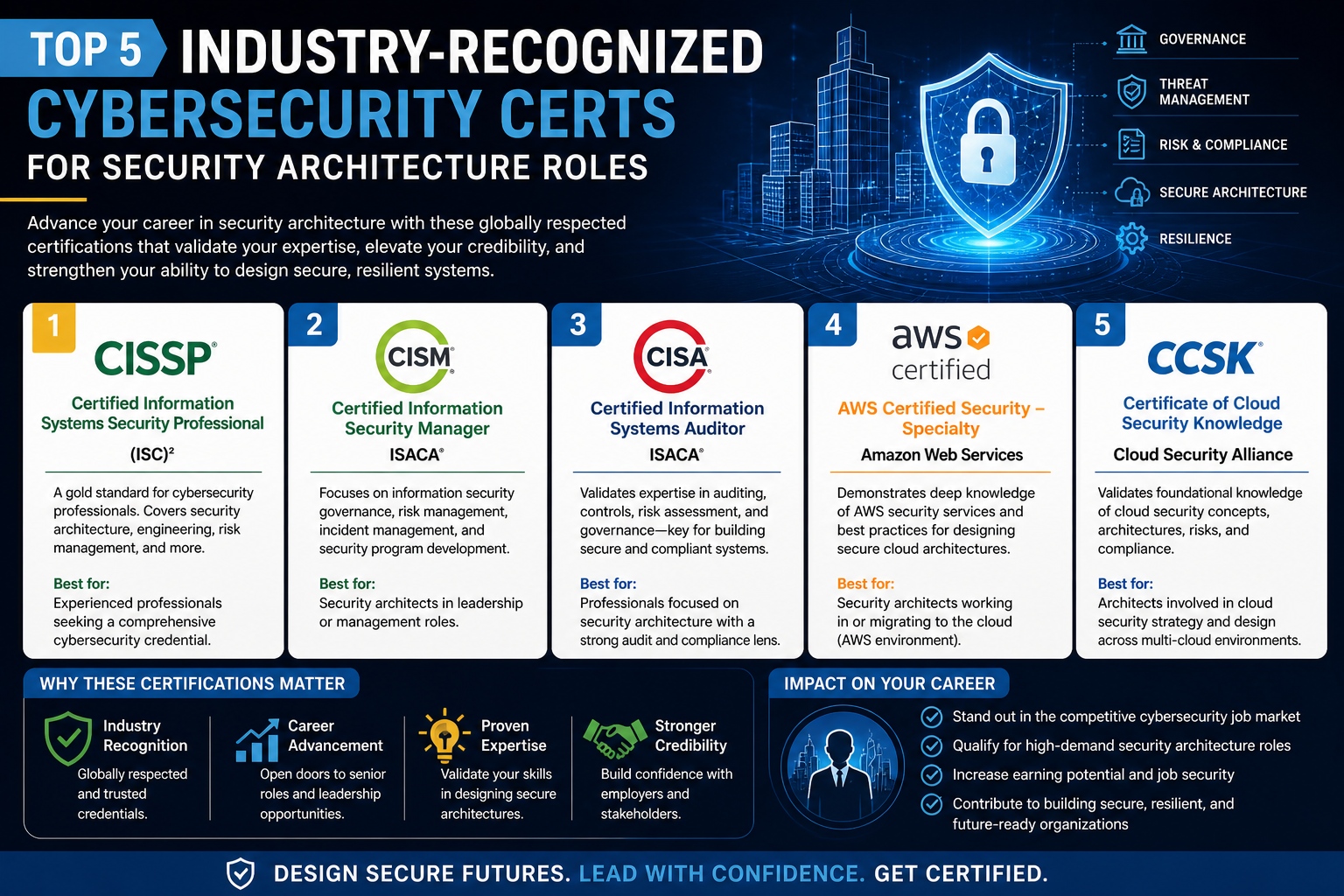
In this discussion, we will explore five important certifications that contribute to shaping a cybersecurity architect’s career. The focus here is not just on passing exams but on understanding how each certification develops specific thinking patterns, technical capabilities, and strategic insights required in real-world environments.
The Strategic Role of Certifications in Cybersecurity Architecture
Certifications in cybersecurity are more than credentials on a resume. They act as structured learning pathways that guide professionals through the complexity of security principles. Unlike informal learning, certifications ensure that key concepts are covered systematically, from basic security hygiene to advanced architectural design principles.
For cybersecurity architects, certifications serve several important purposes. First, they establish a shared language across the industry. Security professionals across different organizations often rely on similar frameworks, terminology, and methodologies. This consistency helps teams collaborate effectively, even in large and distributed environments.
Second, certifications help bridge the gap between theory and practice. Many cybersecurity concepts are abstract until they are applied to real systems. Certification programs often simulate real-world scenarios, helping professionals understand how security principles operate under practical constraints.
Third, they create a progression path. Cybersecurity architecture is not an entry-level skill. It is typically built over years of experience in networking, systems administration, penetration testing, risk analysis, and governance. Certifications provide stepping stones that help professionals move from foundational knowledge to advanced design thinking.
Finally, certifications help validate credibility. In a field where trust and responsibility are critical, organizations need assurance that their security architects understand both technical depth and strategic risk. Certifications provide that validation in a standardized form.
With this context in mind, we begin with one of the most influential certifications in modern cybersecurity architecture.
Microsoft Certified Cybersecurity Architect Expert and the Zero-Trust Mindset
Among modern cybersecurity certifications, one of the most architecturally significant is the Microsoft Certified Cybersecurity Architect Expert, associated with advanced security design principles and enterprise-level architecture thinking.
This certification represents a shift in cybersecurity philosophy. Instead of assuming that internal networks are safe and external threats are dangerous, it embraces a more realistic model: trust nothing by default. This approach is known as zero-trust architecture.
Zero-trust fundamentally changes how systems are designed. Every user, device, and application must continuously verify identity and authorization. Access is granted based on context, not assumption. This includes factors such as user identity, device health, location, behavior patterns, and risk scoring.
A cybersecurity architect working with these principles must understand how to design systems that enforce continuous verification without disrupting usability. This requires balancing security with operational efficiency, which is often one of the most challenging aspects of enterprise architecture.
The Microsoft-focused cybersecurity architecture mindset also emphasizes integration across multiple layers of infrastructure. Modern organizations use cloud services, hybrid environments, and distributed applications. Security cannot be applied in isolation. Instead, it must be embedded into identity systems, network configurations, application design, and data governance frameworks.
A key responsibility of an architect in this domain is designing identity-centric security models. Identity has become the new security perimeter. Instead of relying on physical or network boundaries, organizations now secure access based on verified identities and roles. This includes implementing multifactor authentication, conditional access policies, and privilege management systems.
Another major focus is governance, risk, and compliance alignment. Cybersecurity architects must ensure that security designs meet regulatory requirements while still enabling business agility. This involves mapping technical controls to compliance frameworks and ensuring that security policies are enforceable across complex environments.
Resilience is also a central theme. Security systems must not only prevent attacks but also recover from failures quickly. Architects must design systems that can withstand breaches, isolate compromised components, and restore operations with minimal disruption.
The Microsoft cybersecurity architecture approach also emphasizes visibility. Without proper monitoring and telemetry, security becomes reactive rather than proactive. Architects must ensure that systems generate meaningful logs, alerts, and insights that allow security teams to detect anomalies before they escalate.
In practice, this certification develops a mindset that goes beyond tools and technologies. It teaches professionals to think in terms of systems, interactions, and dependencies. A cybersecurity architect is not simply securing individual components but designing entire ecosystems where security is an inherent property rather than an added layer.
Building a Strong Foundation with Core Security Knowledge
Before advancing into complex architectural roles, cybersecurity professionals must first develop a strong understanding of foundational security principles. Without this base, advanced design concepts become difficult to apply effectively in real-world environments.
A foundational cybersecurity certification introduces core topics such as risk management, threat identification, network security basics, access control models, and cryptographic principles. These areas form the backbone of all cybersecurity architecture decisions.
Risk management is particularly important. Cybersecurity is not about eliminating all risk but about reducing it to an acceptable level. Architects must constantly evaluate trade-offs between security, cost, usability, and performance. Understanding how to assess risk helps professionals prioritize security controls effectively.
Threat identification introduces professionals to the mindset of attackers. Instead of viewing systems only from a defensive perspective, cybersecurity professionals learn how vulnerabilities are discovered and exploited. This helps architects design systems that anticipate and mitigate attack paths.
Network security fundamentals are also essential. Even in cloud-based environments, networking concepts such as segmentation, routing, and traffic filtering remain critical. Cybersecurity architects must understand how data flows between systems to effectively secure communication channels.
Access control models provide the foundation for identity-based security. Concepts such as least privilege, role-based access control, and permission inheritance are essential when designing secure systems. Architects must ensure that users only have access to the resources necessary for their roles, minimizing the potential impact of compromised accounts.
Cryptography introduces the mathematical foundation of security. Encryption, hashing, and digital signatures are essential tools used to protect data confidentiality, integrity, and authenticity. Cybersecurity architects must understand when and how to apply these mechanisms within system designs.
Together, these foundational areas create a common baseline of knowledge. Without this foundation, advanced architectural decisions may lack depth or fail to address critical security considerations.
Developing Practical Security Thinking Through Applied Knowledge
While theoretical knowledge is important, cybersecurity architecture is ultimately a practical discipline. Systems must function in real environments where constraints, limitations, and unpredictable behavior are constant factors.
Applied cybersecurity knowledge helps bridge the gap between theory and execution. It teaches professionals how to implement security controls in real systems and how to evaluate their effectiveness under real-world conditions.
One of the most important aspects of applied cybersecurity is monitoring and detection. Security architects must ensure that systems are capable of identifying suspicious behavior. This involves understanding how logs are generated, how alerts are triggered, and how security events are correlated across systems.
Another critical area is infrastructure security. Modern organizations rely on hybrid environments that combine on-premises systems with cloud services. Cybersecurity architects must design security models that work seamlessly across these environments. This includes ensuring consistent identity management, secure communication channels, and unified policy enforcement.
Incident response awareness is also essential. Even well-designed systems can be compromised. Architects must design environments that support rapid detection, containment, and recovery. This requires understanding how systems behave during breaches and how to minimize damage while restoring normal operations.
Security automation is becoming increasingly important as well. Manual processes are no longer sufficient in large-scale environments. Architects must design systems that can automatically respond to certain threats, such as isolating compromised devices or revoking suspicious access tokens.
Finally, applied knowledge emphasizes continuous improvement. Cybersecurity is not a one-time implementation but an ongoing process. Architects must regularly evaluate system performance, update security controls, and adapt to emerging threats.
This combination of foundational understanding and applied practice prepares professionals for more advanced responsibilities, including ethical hacking, penetration testing, and strategic security design, which will be explored in the next part of this series.
Strengthening Core Competence with CompTIA Security+ in Cybersecurity Architecture
As cybersecurity architecture becomes more complex and layered, professionals need a strong operational understanding of how security works at its most fundamental level. One of the most widely recognized starting points for building this understanding is the CompTIA Security+ certification. While it is often considered entry-level, its role in shaping future cybersecurity architects is far more significant than its classification might suggest.
Security+ serves as a structured introduction to the essential principles that underpin all modern cybersecurity systems. It does not focus on any single vendor or platform. Instead, it emphasizes universal security concepts that apply across networks, cloud environments, and hybrid infrastructures. This neutrality makes it especially valuable for professionals aiming to become cybersecurity architects, as they must often design systems that integrate multiple technologies and vendors.
At its core, Security+ introduces the idea that security is not a single control but a combination of layered defenses. This layered approach, often referred to as defense in depth, is fundamental to architectural thinking. A cybersecurity architect must ensure that even if one layer fails, others continue to provide protection. This concept influences decisions about network segmentation, identity controls, endpoint security, and data protection strategies.
Another critical area covered at this level is threat identification and risk awareness. Cybersecurity architects are constantly evaluating potential weaknesses in systems. Security+ introduces structured ways to categorize threats, understand attack types, and evaluate vulnerabilities. This helps professionals move beyond reactive thinking and start anticipating how systems might be targeted.
Identity and access management is another foundational pillar. Modern cybersecurity architecture revolves heavily around identity. Every request for access must be verified, validated, and authorized. Security+ introduces key principles such as authentication methods, authorization models, and identity lifecycle management. These ideas later evolve into more advanced architectural decisions involving zero-trust frameworks and privileged access management systems.
Network security fundamentals also play a major role. Even in cloud-first environments, understanding how data moves through networks remains essential. Security+ introduces concepts such as secure protocols, segmentation, firewalls, and secure communication channels. Cybersecurity architects rely on these principles when designing network boundaries and isolating critical systems from potential threats.
Security operations are another key focus. Architects must design systems that can be monitored effectively. Security+ introduces concepts such as logging, monitoring, and alerting. These elements are essential for building systems that provide visibility into potential threats. Without proper monitoring, even well-designed architectures can become blind to ongoing attacks.
What makes Security+ particularly valuable for future architects is that it builds a shared baseline of understanding. In large organizations, cybersecurity teams often include professionals with varying levels of experience. Security+ ensures that architects can communicate effectively with analysts, engineers, and incident responders by using consistent terminology and concepts.
This shared language becomes especially important when designing enterprise systems. A cybersecurity architect must collaborate with multiple teams, including infrastructure engineers, developers, compliance officers, and executives. Without a common understanding of security fundamentals, architectural decisions can easily become misaligned with operational realities.
Security+ also reinforces the importance of compliance and governance. Cybersecurity is not only a technical discipline but also a regulatory one. Architects must ensure that systems comply with industry standards and legal requirements. Security+ introduces basic compliance frameworks that later become critical when designing enterprise-grade security architectures.
Although Security+ does not provide deep specialization, its value lies in its breadth. It ensures that professionals entering advanced cybersecurity roles do not overlook essential security principles. It creates a stable foundation upon which more complex skills, such as penetration testing and architectural design, can be built.
Expanding Security Perspective Through Offensive Thinking
Once foundational knowledge is established, cybersecurity professionals must expand their perspective beyond defensive strategies. Understanding how attackers think and operate is essential for designing resilient systems. This is where offensive security concepts begin to play a crucial role in the development of cybersecurity architects.
Offensive security is not about promoting malicious activity. Instead, it involves studying attack techniques in controlled environments to better understand vulnerabilities. By learning how systems are exploited, architects gain insight into how to design systems that resist exploitation in the first place.
This mindset shift is critical. Defensive security focuses on protection, while offensive security focuses on exploration. Cybersecurity architects must balance both perspectives. They must not only defend systems but also think like adversaries who are actively trying to bypass defenses.
One of the most important aspects of offensive thinking is understanding attack surfaces. Every system has multiple entry points, including applications, APIs, network interfaces, and user interactions. Cybersecurity architects must identify these surfaces and design controls that reduce exposure.
Another key concept is privilege escalation. Attackers often attempt to gain higher levels of access after initially compromising a system. Understanding how privilege escalation works helps architects design systems that limit the damage caused by compromised accounts.
Social engineering is also a major component of offensive security thinking. Many attacks do not rely solely on technical vulnerabilities but instead exploit human behavior. Cybersecurity architects must therefore consider how users interact with systems and how those interactions can be manipulated. This leads to design decisions that include user education, authentication friction, and behavioral monitoring.
Offensive security also introduces the concept of persistence. Attackers often attempt to maintain access to systems even after initial detection. Understanding persistence techniques helps architects design systems that can detect and eliminate unauthorized long-term access.
By incorporating offensive thinking into architectural design, cybersecurity professionals become better equipped to anticipate real-world threats. This perspective ensures that systems are not only theoretically secure but also practically resilient against sophisticated adversaries.
Penetration Testing and Its Role in Architectural Design
Penetration testing is one of the most practical expressions of offensive security knowledge. It involves simulating real-world attacks on systems to identify vulnerabilities before malicious actors can exploit them. For cybersecurity architects, understanding penetration testing is not optional; it is essential for validating design decisions.
The CompTIA PenTest+ certification represents a structured approach to learning penetration testing methodologies. Unlike basic security certifications, PenTest+ focuses on the entire lifecycle of an attack simulation. This includes planning, reconnaissance, exploitation, reporting, and remediation.
At the architectural level, penetration testing provides valuable feedback. It reveals how systems behave under attack conditions and whether security controls function as intended. Cybersecurity architects use this information to refine system designs and eliminate weaknesses.
One of the key contributions of penetration testing to architecture is vulnerability discovery. Even well-designed systems can contain unexpected weaknesses. These may arise from configuration errors, software flaws, or integration issues between components. Penetration testing helps uncover these issues in controlled environments.
Another important aspect is attack path analysis. Penetration testers often map out how an attacker could move through a system after gaining initial access. This helps architects understand how different components are connected and where segmentation may be insufficient.
Penetration testing also highlights the importance of layered defenses. A single security control is rarely enough to stop a determined attacker. Instead, multiple overlapping controls must be in place. When penetration tests succeed in bypassing one layer, architects can evaluate whether additional layers are needed.
Reporting is another critical element. Penetration testing is not just about finding vulnerabilities but also about communicating them effectively. Architects rely on detailed reports to understand the severity, impact, and remediation strategies for identified issues. This feedback loop is essential for continuous improvement.
From an architectural perspective, penetration testing also reinforces the importance of secure design principles. Systems should be designed with the assumption that they will be tested, probed, and attacked. This mindset encourages architects to build systems that are inherently resilient rather than dependent on reactive security measures.
Ethical Hacking Mindset and Its Influence on System Design
Ethical hacking extends the principles of penetration testing into a broader mindset. It involves thinking like an attacker across all stages of system design and operation. For cybersecurity architects, this mindset is invaluable because it transforms how systems are evaluated and constructed.
An ethical hacker does not simply look for vulnerabilities; they explore systems in creative and often unconventional ways. This creativity is essential in cybersecurity architecture, where attackers are constantly evolving their techniques.
One important aspect of ethical hacking is curiosity. Cybersecurity architects must question how systems behave under unusual conditions. They must explore edge cases, unexpected inputs, and unconventional user behavior. This curiosity helps identify weaknesses that traditional testing might overlook.
Another key element is adaptability. Attackers constantly change their methods, and ethical hackers must do the same. Cybersecurity architects benefit from this mindset by designing systems that are flexible and resilient rather than rigid and predictable.
Ethical hacking also emphasizes persistence. Real-world attacks are rarely simple or linear. They often involve multiple attempts, failures, and adaptations. Understanding this persistence helps architects design systems that can detect repeated intrusion attempts and respond accordingly.
Reconnaissance is another critical area. Before attacking a system, ethical hackers gather as much information as possible. This includes identifying technologies, configurations, and potential weaknesses. Cybersecurity architects must understand this process to minimize the amount of exposed information in their systems.
Exploitation techniques also provide insight into how systems fail. By understanding how vulnerabilities are exploited, architects can design controls that prevent or mitigate those exploits.
Ultimately, the ethical hacking mindset helps cybersecurity architects think beyond static defenses. It encourages continuous evaluation, adaptation, and improvement of security systems.
Translating Offensive Knowledge into Architectural Resilience
The most important outcome of studying offensive security and penetration testing is the ability to translate that knowledge into resilient system design. Cybersecurity architecture is not about preventing all attacks but about minimizing impact and ensuring recovery.
One way this is achieved is through segmentation. By dividing systems into isolated zones, architects can limit the spread of attacks. Even if one component is compromised, others remain protected.
Another approach is redundancy. Critical systems must have backup mechanisms that ensure continuity even during failures or attacks. This includes redundant authentication systems, failover networks, and backup data stores.
Monitoring and detection also play a central role. Offensive knowledge helps architects understand what abnormal behavior looks like. This allows them to design systems that can detect suspicious activity early.
Response automation is another key element. When attacks are detected, systems must respond quickly. This may involve isolating affected components, revoking credentials, or redirecting traffic.
Finally, continuous testing ensures that systems remain resilient over time. Cybersecurity architects must assume that threats will evolve and that systems must be regularly evaluated to maintain security effectiveness.
By integrating offensive knowledge into architectural design, cybersecurity professionals create systems that are not only secure in theory but also resilient in practice.
Moving Toward Strategic Authority in Cybersecurity Architecture
As cybersecurity professionals progress beyond foundational and offensive skill sets, their responsibilities begin to shift in a significant way. The focus is no longer just on understanding systems or testing their weaknesses. Instead, it becomes about designing entire security ecosystems that support business goals, manage risk at scale, and operate reliably across complex environments.
At this stage, cybersecurity architecture is no longer a purely technical discipline. It becomes a strategic function within an organization. Architects are expected to influence decision-making at executive levels, translate business requirements into security frameworks, and ensure that every technological choice aligns with long-term risk management goals.
This transition is where advanced certifications such as the Certified Information Systems Security Professional and the Certified Ethical Hacker play a defining role. These certifications do not just add technical knowledge; they reshape how professionals think about security as a whole system that includes people, processes, governance, and technology.
The Role of CISSP in Shaping Security Architecture Thinking
The Certified Information Systems Security Professional certification represents one of the most comprehensive approaches to cybersecurity leadership and architecture. Unlike certifications that focus primarily on tools or technical execution, CISSP emphasizes broad security domains that cover the entire lifecycle of information security within an organization.
At its core, CISSP encourages professionals to think like security leaders rather than operators. This means understanding how security decisions affect business continuity, legal exposure, operational efficiency, and organizational trust.
One of the most important areas covered at this level is security and risk management. Cybersecurity architects must be able to evaluate risk not only in technical terms but also in business impact. This involves understanding how vulnerabilities translate into financial loss, reputational damage, and regulatory consequences.
Risk management at this level is not about eliminating risk entirely. Instead, it is about balancing risk against business objectives. Every security control has a cost, whether in performance, usability, or financial investment. Architects must determine where to invest in stronger protections and where to accept controlled levels of risk.
Another major domain is security architecture and engineering. At this stage, professionals move beyond implementing individual controls and begin designing entire security frameworks. This includes defining how systems authenticate users, how data is encrypted, how networks are segmented, and how security policies are enforced across distributed environments.
A key concept in this domain is the idea of secure design principles. These principles include concepts such as least privilege, defense in depth, fail-safe defaults, and complete mediation. Cybersecurity architects use these principles as guiding rules when designing systems that must remain secure under unpredictable conditions.
CISSP also emphasizes identity and access management at a strategic level. Rather than simply configuring authentication systems, architects must design identity frameworks that scale across organizations. This includes managing user lifecycles, defining role structures, and ensuring that access rights are continuously reviewed and adjusted.
Security assessment and testing is another critical domain. While penetration testing focuses on simulating attacks, CISSP-level thinking involves designing ongoing evaluation processes. This includes vulnerability management programs, audit frameworks, and continuous compliance monitoring systems.
Security operations also become a major focus. At the architectural level, operations are not just about responding to incidents but about designing systems that are inherently observable and manageable. This includes defining logging strategies, incident response workflows, and security monitoring architectures.
Software development security is another essential area. Modern cybersecurity architects must understand how applications are built and how security can be integrated into development pipelines. This includes secure coding practices, threat modeling, and DevSecOps principles.
Finally, CISSP introduces governance, compliance, and legal considerations. Cybersecurity architects must ensure that their designs align with regulatory frameworks and organizational policies. This requires understanding how laws, industry standards, and internal governance structures influence technical decisions.
What makes CISSP particularly valuable for cybersecurity architects is its emphasis on integration. Instead of viewing security domains in isolation, it encourages professionals to see how they interact. Identity affects network security. Governance affects architecture design. Operations affect incident response. Everything is interconnected.
This systems-level thinking is essential for professionals responsible for designing enterprise security architectures.
Cybersecurity Architecture as an Enterprise Function
At advanced levels, cybersecurity architecture becomes deeply embedded within enterprise architecture. It is no longer treated as a separate technical discipline but as a foundational layer that supports all digital operations within an organization.
Enterprise environments are inherently complex. They include legacy systems, cloud platforms, mobile applications, third-party integrations, and global user bases. Cybersecurity architects must design security models that operate effectively across all these environments without introducing unnecessary friction.
One of the key challenges at this level is maintaining consistency. Security policies must be applied uniformly across different systems while still allowing flexibility where needed. This requires careful abstraction of security controls so that they can be implemented across diverse technologies.
Another major challenge is scalability. Security designs must support growth without requiring constant redesign. As organizations expand, add new services, or adopt new technologies, the security architecture must adapt seamlessly.
Interoperability is also critical. Modern organizations rely on multiple vendors and platforms. Cybersecurity architects must ensure that security systems can integrate effectively across these environments. This includes identity federation, centralized logging, and unified policy enforcement.
A major focus in enterprise architecture is resilience. Systems must be designed to continue operating even under adverse conditions such as cyberattacks, system failures, or network disruptions. This involves redundancy, failover mechanisms, and disaster recovery planning.
Cybersecurity architects also play a key role in aligning security with business strategy. Security decisions cannot be made in isolation from business objectives. Architects must work closely with leadership teams to ensure that security investments support organizational goals such as digital transformation, customer trust, and regulatory compliance.
Governance, Risk, and Compliance at Architectural Scale
As cybersecurity architecture evolves into an enterprise-level function, governance, risk, and compliance become central to decision-making. These elements ensure that security is not only technically effective but also aligned with organizational accountability and legal requirements.
Governance refers to the framework of policies, standards, and decision-making structures that guide security implementation. Cybersecurity architects must ensure that systems adhere to these governance structures while still remaining flexible enough to support innovation.
Risk management at this level becomes more formalized. Instead of evaluating risks on a case-by-case basis, organizations adopt structured risk frameworks. Cybersecurity architects contribute to this process by identifying technical risks, assessing their impact, and recommending mitigation strategies.
Compliance introduces external constraints into architectural design. Organizations must comply with industry regulations, data protection laws, and contractual obligations. Cybersecurity architects must ensure that system designs can support audits, reporting, and evidence collection.
One of the key challenges in this area is balancing compliance with usability. Overly strict security controls can hinder productivity, while overly flexible systems can increase risk exposure. Architects must find a balance that satisfies both security and operational needs.
Another important aspect is documentation. Governance frameworks require clear documentation of security decisions, system designs, and risk assessments. Cybersecurity architects are responsible for ensuring that these records are accurate, up-to-date, and accessible for audits and reviews.
Certified Ethical Hacker and the Advanced Offensive Perspective
While earlier discussions of offensive security focused on penetration testing and tactical exploitation, the Certified Ethical Hacker certification represents a more structured and comprehensive understanding of adversarial behavior.
At this level, ethical hacking is not just about finding vulnerabilities but about understanding entire attack ecosystems. This includes how attackers plan campaigns, escalate privileges, maintain persistence, and evade detection over time.
One of the key contributions of this mindset to cybersecurity architecture is adversary modeling. Architects must think not only about individual attacks but about coordinated attack strategies. This helps in designing systems that can detect patterns of behavior rather than isolated events.
Another important area is reconnaissance awareness. Ethical hackers demonstrate how much information can be gathered from public sources, system responses, and network behavior. Cybersecurity architects use this understanding to minimize information exposure and reduce attack surfaces.
Exploitation techniques also provide deep insight into system weaknesses. By understanding how vulnerabilities are exploited, architects can design controls that block or disrupt exploitation attempts at multiple stages.
Persistence techniques are particularly important at this level. Attackers often attempt to maintain long-term access to systems. Cybersecurity architects must design detection mechanisms that identify unusual persistence behavior and remove unauthorized access quickly.
Evasion techniques are another critical area. Ethical hackers study how attackers bypass security tools such as intrusion detection systems, antivirus software, and monitoring platforms. This helps architects design systems that are resistant to bypass techniques.
Identity-Centric Security and Modern Architecture Design
One of the most significant shifts in modern cybersecurity architecture is the move toward identity-centric security models. Instead of relying on network boundaries, organizations now treat identity as the primary security control.
This shift changes how systems are designed. Every access request must be evaluated based on identity attributes, contextual factors, and risk signals. Cybersecurity architects must design systems that can continuously evaluate trust rather than relying on static permissions.
Identity lifecycle management becomes a core architectural concern. Users must be provisioned, modified, and deprovisioned in a controlled manner. Failure to manage identity lifecycles properly can lead to security gaps and unauthorized access.
Multi-factor authentication and adaptive authentication are also key components. Architects must ensure that authentication mechanisms are both secure and user-friendly. This often involves balancing friction with protection.
Privileged access management is another critical area. Administrative accounts represent high-value targets for attackers. Cybersecurity architects must design systems that tightly control and monitor privileged access.
Identity federation is also important in modern environments. Organizations often collaborate with external partners and services. Architects must design identity systems that allow secure cross-organization access without compromising internal security.
Designing for Continuous Security Evolution
Cybersecurity architecture is not a static discipline. It must evolve continuously in response to changing threats, technologies, and business requirements. This requires a mindset of continuous improvement.
One aspect of this evolution is threat intelligence integration. Architects must design systems that can incorporate external threat data into security decision-making processes.
Another aspect is automation. As systems grow in complexity, manual security management becomes unsustainable. Architects must design automated responses for common security scenarios.
Continuous monitoring is also essential. Systems must be capable of detecting anomalies in real time and providing actionable insights to security teams.
Regular reassessment of security architecture is necessary to ensure that systems remain aligned with current threats and organizational goals. This includes revisiting assumptions, updating controls, and refining processes.
Cybersecurity architects must also stay informed about emerging technologies such as artificial intelligence, edge computing, and quantum-resistant cryptography. These technologies will significantly influence future security architectures.
In advanced practice, cybersecurity architecture becomes a discipline of constant adaptation, where stability and flexibility must coexist within the same system design philosophy.
Security Architecture in Cloud-Native and Hybrid Environments
As organizations continue migrating toward cloud-native and hybrid infrastructures, cybersecurity architects face a new level of complexity that goes far beyond traditional on-premises design. Systems are no longer contained within clearly defined network boundaries. Instead, they span multiple cloud providers, containerized workloads, serverless functions, and distributed edge environments.
This shift fundamentally changes how security must be designed. Cybersecurity architects can no longer rely on perimeter-based defenses. Instead, they must assume that every component exists in a partially untrusted environment. Security must therefore travel with the data, workloads, and identities rather than being anchored to a fixed network location.
One of the key architectural challenges in cloud-native environments is visibility. Traditional monitoring tools were designed for static infrastructure, but modern systems are highly dynamic. Containers can spin up and disappear in seconds, workloads can scale automatically, and services can communicate across multiple layers of abstraction. Cybersecurity architects must design observability frameworks that can track behavior across these ephemeral environments without losing context.
Another important consideration is configuration management. In cloud environments, misconfigurations are one of the leading causes of security incidents. Architects must enforce strict configuration standards and ensure that infrastructure is defined as code wherever possible. This allows security policies to be consistently applied and audited across all environments.
Identity management becomes even more critical in cloud-native systems. Since workloads are distributed, identity is no longer limited to human users. Machines, applications, and services all require identities to interact securely. Cybersecurity architects must design identity frameworks that support machine-to-machine authentication, short-lived credentials, and automated identity rotation.
Data protection also takes on a new dimension. In distributed environments, data often moves between multiple systems and storage layers. Architects must ensure encryption is applied consistently both at rest and in transit. They must also consider data classification strategies that determine how sensitive information is handled across different environments.
Finally, resilience in cloud-native systems requires careful architectural planning. Systems must be designed to recover automatically from failures without manual intervention. This includes multi-region deployments, automated failover mechanisms, and self-healing infrastructure patterns. Cybersecurity architects must ensure that security controls do not hinder these resilience mechanisms but instead enhance them.
Human Factors and Security Architecture Decision-Making
While cybersecurity architecture is often viewed as a technical discipline, human behavior plays a far more significant role than many realize. Even the most advanced security systems can be undermined by poor usability, unclear processes, or insufficient user awareness.
Cybersecurity architects must therefore consider human factors when designing systems. Security controls must be effective, but they must also be usable. If security mechanisms are too complex or disruptive, users will find ways to bypass them, unintentionally creating vulnerabilities.
One key aspect is authentication design. Strong authentication methods such as multi-factor authentication improve security but can also introduce friction. Architects must carefully design authentication flows that balance security with user experience to ensure consistent adoption.
Another important consideration is error handling. Users will inevitably make mistakes. Security systems must be designed to prevent small mistakes from escalating into major incidents. This includes designing safe defaults, clear error messages, and guided recovery processes.
Training and awareness also influence architectural decisions. Cybersecurity architects must assume that users are part of the security system. This means designing workflows that encourage secure behavior and reduce opportunities for accidental misuse.
Organizational culture plays a role as well. Security is more effective in environments where users understand its importance and feel responsible for maintaining it. Architects must therefore align security designs with cultural and operational realities rather than relying solely on technical enforcement.
Ultimately, cybersecurity architecture is not just about protecting systems from external attackers but also about enabling secure behavior within human workflows. When systems are designed with human factors in mind, security becomes more sustainable and less dependent on constant enforcement.
Conclusion
Cybersecurity architecture has evolved into one of the most strategically important disciplines in modern IT, sitting at the intersection of technology design, risk management, and organizational decision-making. It is no longer enough for professionals to understand isolated security tools or react to threats after they occur. Instead, the role of a cybersecurity architect demands a holistic understanding of how systems are built, how they are attacked, and how they must continuously adapt to changing environments.
Across the progression of foundational knowledge, offensive security thinking, and enterprise-level architectural strategy, one clear pattern emerges: cybersecurity architecture is fundamentally about perspective. It requires the ability to see systems not only as they are intended to function, but also as they might be exploited, misconfigured, or misunderstood. This dual perspective is what transforms a technical professional into an architect capable of designing resilient, scalable, and secure environments.
Certifications such as foundational security credentials, penetration testing certifications, and advanced governance-focused programs all contribute to this journey in different ways. Each one builds a layer of thinking—starting from basic principles of risk and defense, moving through adversarial awareness, and ultimately reaching strategic security design aligned with business objectives. None of these certifications exist in isolation; instead, they form a structured pathway toward architectural maturity.
Equally important is the understanding that cybersecurity architecture is not a fixed destination. It is a continuously evolving practice shaped by new technologies, emerging threats, and shifting organizational priorities. Cloud adoption, identity-centric security models, automation, and artificial intelligence are all redefining how security systems are designed and maintained. Architects must therefore remain adaptable, continuously learning and refining their approach to stay aligned with real-world demands.
At its core, cybersecurity architecture is about trust—how it is established, how it is maintained, and how it is restored when broken. It is a discipline that requires both precision and creativity, technical depth and strategic vision. Those who pursue it must be prepared to think broadly, act decisively, and design systems that protect not just technology, but the people and organizations that depend on it.