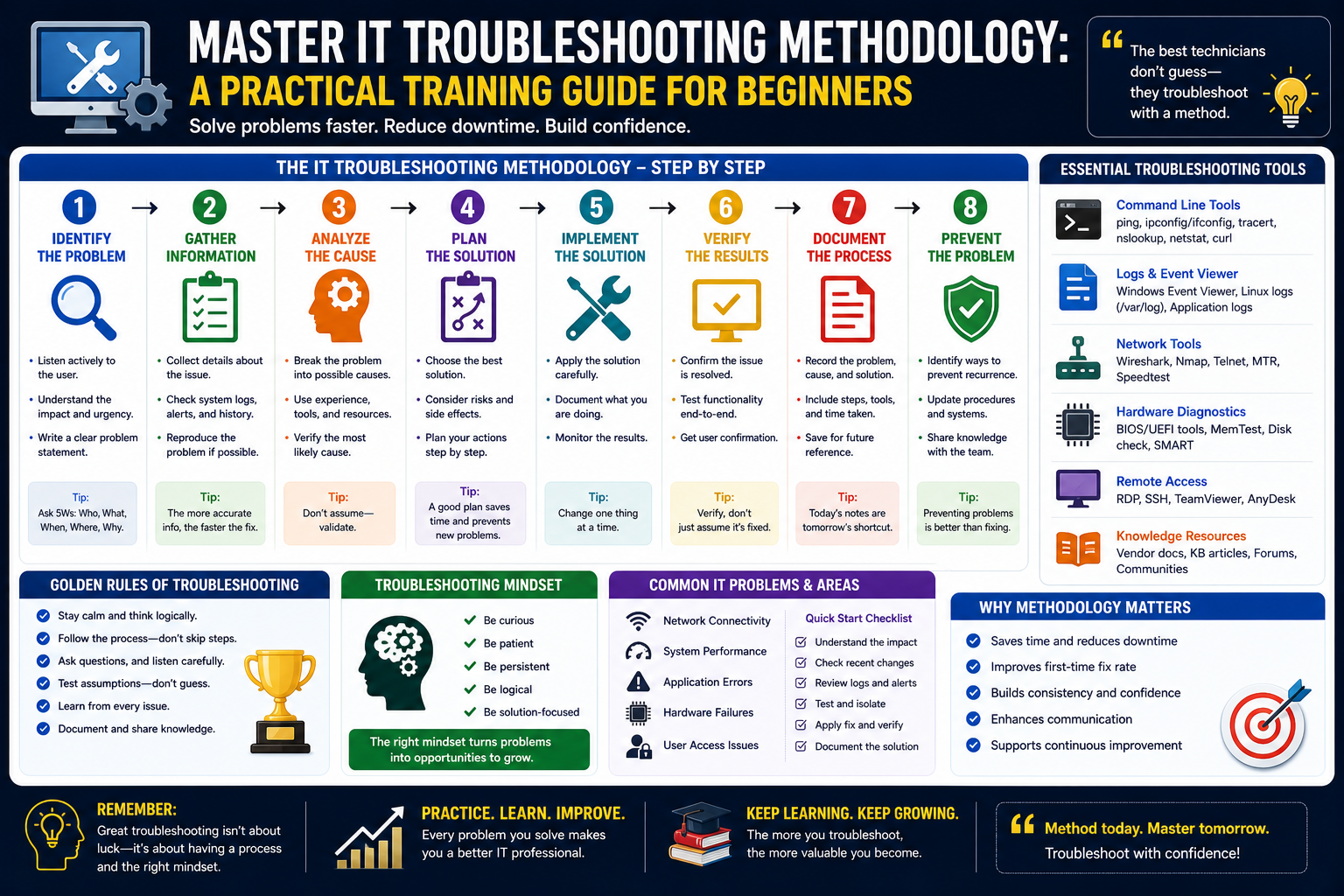
Network troubleshooting methodology is a structured approach used to identify, analyze, and resolve problems that occur within computer networks. In modern IT environments, networks are the backbone of communication, enabling everything from simple file sharing to complex cloud-based applications. When something goes wrong, it can disrupt business operations, slow productivity, and create security risks.
Because network issues can arise from many different sources—hardware faults, configuration errors, software conflicts, or external interference—a systematic approach is essential. Without structure, troubleshooting becomes guesswork, often leading to wasted time and incomplete solutions. A well-defined methodology ensures that problems are handled logically, consistently, and efficiently.
At its core, network troubleshooting is not just about fixing issues; it is about understanding why they occurred in the first place. This mindset allows IT professionals to prevent recurring problems and improve overall system reliability.
The Importance of a Structured Troubleshooting Approach
Networks are complex systems made up of interconnected devices, protocols, and services. Even a small misconfiguration can cause widespread disruption. A structured troubleshooting methodology provides a repeatable process that helps eliminate confusion and reduces the chances of overlooking critical details.
One of the biggest advantages of using a structured approach is consistency. When technicians follow the same steps every time, they are more likely to identify the root cause correctly. It also makes collaboration easier, as multiple team members can follow the same logical process when working on a problem.
Another important benefit is efficiency. Instead of randomly testing different solutions, a structured approach narrows down possibilities step by step. This reduces downtime and helps restore network functionality faster.
The Nature of Network Problems in Modern Environments
Network problems can appear in many forms, and understanding their nature is essential for effective troubleshooting. Some issues are obvious, such as a complete loss of connectivity, while others are subtle, like slow performance or intermittent failures.
Common causes of network problems include physical issues such as damaged cables, faulty switches, or disconnected devices. Configuration problems are also frequent, especially in environments where multiple systems rely on precise settings such as IP addressing, routing, and DNS resolution.
Software-related issues can arise from outdated drivers, incompatible updates, or misconfigured services. Additionally, external factors such as network congestion or security attacks can also disrupt normal operations.
Because these issues vary widely, a one-size-fits-all solution does not exist. Instead, a flexible but structured methodology is required to diagnose and resolve them effectively.
The First Step: Identifying the Problem Clearly
The first stage of any troubleshooting process is identifying the problem. This step is often more complex than it appears because the visible symptoms may not accurately reflect the underlying issue.
Identifying the problem begins with gathering information. This may involve observing system behavior, checking error messages, and understanding when the issue started. It is also important to determine whether the problem is isolated to a single user or affecting multiple systems.
User communication plays a key role at this stage. Users experiencing the issue can provide valuable insights into what they were doing when the problem occurred. Their input helps narrow down possible causes and gives direction to further investigation.
Another important aspect is determining whether anything has changed recently. Network issues often occur after updates, configuration changes, or hardware modifications. Identifying recent changes can significantly reduce the scope of investigation.
During this stage, the goal is not to fix the problem but to define it clearly. A well-defined problem statement makes all subsequent steps more effective.
Understanding Symptoms Versus Root Causes
One of the most common mistakes in troubleshooting is confusing symptoms with root causes. A symptom is the visible effect of a problem, while the root cause is the underlying reason it occurred.
For example, slow internet speed is a symptom. The root cause could be network congestion, bandwidth limitations, misconfigured routers, or even malware consuming network resources. Treating only the symptom without addressing the root cause often leads to temporary fixes rather than permanent solutions.
A structured troubleshooting methodology helps distinguish between these two by encouraging deeper investigation at each stage. Instead of reacting immediately to symptoms, technicians are guided to analyze and validate information before making changes.
The Role of Observation in Problem Identification
Observation is a critical skill in network troubleshooting. Many network issues can be identified simply by carefully observing system behavior. Indicators such as blinking interface lights, error logs, connectivity status, and performance metrics provide valuable clues.
Observation also involves recognizing patterns. For example, if a network problem occurs at specific times of day, it may indicate congestion or scheduled tasks interfering with performance. If only certain devices are affected, the issue may be related to configuration or hardware.
Effective observation requires patience and attention to detail. Rushing through this stage often leads to incomplete understanding and incorrect assumptions later in the process.
Establishing a Baseline for Comparison
A baseline is a reference point that represents normal network performance. It helps technicians identify deviations that may indicate problems. Without a baseline, it becomes difficult to determine whether performance is actually degraded or simply within normal variation.
Establishing a baseline involves monitoring network activity over time and recording typical values for metrics such as bandwidth usage, latency, and error rates. When a problem occurs, current data can be compared against this baseline to identify abnormalities.
This comparison is essential because not all network issues are immediately obvious. Some problems develop gradually, making them harder to detect without historical reference data.
Introducing the Concept of Logical Isolation
Logical isolation is the process of narrowing down the scope of a problem to identify its source. Instead of examining the entire network at once, technicians break it down into smaller segments.
For example, if users cannot access a server, the issue could be related to the user’s device, the local network, the router, the server, or external connectivity. By testing each segment individually, it becomes easier to locate the point of failure.
Logical isolation is a powerful technique because it reduces complexity. Large networks can be overwhelming, but breaking them into manageable sections allows for systematic analysis.
The Role of Documentation in Early Stages
Even in the initial stages of troubleshooting, documentation is important. Recording observations, symptoms, and user reports helps maintain clarity throughout the process.
Documentation ensures that no information is lost and allows others to understand what has already been investigated. It also helps avoid repeating tests unnecessarily, saving time and effort.
In addition, early documentation creates a foundation for later stages, especially when verifying solutions or analyzing recurring issues.
Building the Foundation for Theoretical Analysis
Once the problem has been clearly identified, the next stage involves preparing for deeper analysis. This includes organizing collected information and beginning to form possible explanations for the issue.
At this point, technicians do not yet attempt to solve the problem. Instead, they focus on understanding relationships between symptoms, recent changes, and system behavior. This structured thinking sets the stage for developing a theory of probable cause in the next phase of troubleshooting.
A strong foundation in problem identification ensures that the following steps are more accurate and effective. Without it, troubleshooting becomes reactive rather than strategic, increasing the likelihood of incorrect conclusions.
Developing Analytical Thinking in Network Troubleshooting
Effective troubleshooting requires more than technical knowledge; it requires analytical thinking. This means approaching problems logically, breaking them into smaller components, and evaluating each possibility based on evidence.
Analytical thinking helps prevent assumptions, which are one of the biggest causes of troubleshooting errors. Instead of guessing, technicians rely on data, observation, and structured reasoning.
Over time, this approach becomes a habit, allowing professionals to handle even complex network issues with confidence and clarity.
Transitioning Toward Deeper Investigation
With the problem clearly identified and initial data collected, the troubleshooting process naturally moves toward deeper investigation. This involves forming theories about what might be causing the issue and preparing to test those theories systematically.
This transition marks the shift from observation to analysis. It is a critical step in ensuring that troubleshooting remains structured rather than reactive.
The next phase builds directly on the foundation established in problem identification, ensuring that every subsequent action is based on evidence rather than assumptions.
Moving from Observation to Logical Reasoning in Troubleshooting
Once the network problem has been clearly identified and its symptoms documented, the troubleshooting process shifts into a more analytical phase. At this stage, the focus moves away from simply describing what is happening and toward understanding why it is happening. This transition is critical because effective troubleshooting is not based on random testing but on structured reasoning.
In real-world network environments, many issues appear similar on the surface but have completely different root causes. A device that cannot access the internet might be suffering from DNS failure, IP misconfiguration, gateway issues, or even physical connectivity problems. Without a structured reasoning process, it becomes easy to waste time testing unrelated solutions.
Logical reasoning in troubleshooting involves taking the collected observations and using them to build a structured explanation of what might be causing the issue. This explanation is not yet confirmed but serves as a working model that guides further investigation.
Establishing a Theory of Probable Cause
The next major step in the troubleshooting methodology is developing a theory of probable cause. This step is about forming educated guesses based on evidence, rather than random assumptions. It represents a bridge between identifying the problem and actively testing solutions.
A theory of probable cause is essentially a hypothesis. It is a structured explanation that attempts to connect the symptoms of the problem with a likely underlying issue. For example, if multiple users in a single office are experiencing connectivity issues, a possible theory might be that a network switch in that area has failed or is malfunctioning.
The key to building a strong theory is evidence-based thinking. Instead of guessing, technicians rely on what they have already observed. This may include error messages, network logs, user reports, and performance patterns. The more accurate the initial data collection was, the stronger and more reliable the theory will be.
It is important to understand that multiple theories may exist at the same time. In complex network environments, there is rarely a single obvious explanation. Therefore, technicians often develop several possible theories and prioritize them based on likelihood.
Prioritizing Theories Based on Probability
Not all theories carry equal weight. Some explanations are more likely than others based on available evidence. Prioritizing theories helps streamline the troubleshooting process by focusing efforts on the most probable causes first.
For example, if a network outage occurs immediately after a configuration update, it is more reasonable to suspect configuration errors than hardware failure. Similarly, if only wireless users are affected, the issue is more likely related to the wireless access point rather than the entire network infrastructure.
Prioritization helps reduce unnecessary testing and speeds up problem resolution. Instead of checking every possible cause, technicians focus on the most logical ones first and gradually eliminate them.
This approach also reduces disruption to the network. Some tests can temporarily affect services, so it is important to perform them in a controlled and efficient manner.
Using Evidence to Strengthen or Eliminate Theories
A strong troubleshooting process relies heavily on evidence. Every theory must be supported or rejected based on observable data. This ensures that decisions are not based on assumptions or incomplete information.
Evidence can come from multiple sources. Network monitoring tools provide performance metrics, logs reveal system behavior, and user feedback provides real-world impact details. Physical inspection of devices can also reveal hardware-related issues such as damaged cables or overheating components.
When evidence supports a theory, it becomes more likely to be the root cause. When evidence contradicts a theory, it is eliminated or revised. This process of validation and elimination continues until the most accurate explanation is identified.
The ability to interpret evidence correctly is a key skill in troubleshooting. Misinterpreting data can lead to incorrect conclusions, which may worsen the problem instead of solving it.
The Importance of Controlled Testing
After developing and prioritizing theories, the next step is testing them. Controlled testing involves carefully checking whether a theory is correct without causing unnecessary disruption to the network.
Testing should always be structured and methodical. Instead of making multiple changes at once, technicians test one theory at a time. This ensures that results can be clearly attributed to a specific action.
For example, if a theory suggests that a DNS issue is causing connectivity problems, the first test might involve pinging an IP address directly instead of a domain name. If the test succeeds, it supports the DNS-related theory.
Controlled testing is essential because it prevents confusion. If multiple changes are made simultaneously, it becomes difficult to determine which action actually resolved or affected the problem.
Tools Used in Theory Validation
A variety of tools are used to test and validate theories in network troubleshooting. These tools provide visibility into different layers of the network and help isolate issues more effectively.
Diagnostic tools such as ping and traceroute help test connectivity and routing paths. Network analyzers provide detailed insights into traffic flow and packet behavior. System logs offer information about errors, warnings, and system events that may be related to the issue.
Monitoring tools also play an important role. They allow technicians to observe network performance in real time and detect abnormalities. These tools help confirm whether a suspected issue is actually occurring or not.
Each tool provides a different perspective on the network. When used together, they create a comprehensive view that supports accurate decision-making.
Eliminating Incorrect Theories Systematically
One of the most important aspects of troubleshooting is elimination. Not every theory will be correct, and part of the process involves ruling out incorrect assumptions.
Systematic elimination is based on testing and evidence. If a theory is proven incorrect, it is removed from consideration. This narrows down the possibilities and brings the technician closer to the actual cause.
For example, if a theory suggests that a router is failing but testing shows that the router is functioning normally, that theory can be eliminated. The focus then shifts to other possible causes such as switches, configurations, or endpoint devices.
This step-by-step elimination process is what makes structured troubleshooting effective. It ensures that every possibility is considered logically and methodically.
Refining Theories Based on New Information
Troubleshooting is an iterative process. As new information becomes available, existing theories may need to be adjusted or refined.
For instance, initial observations might suggest a hardware failure, but further testing could reveal a software misconfiguration instead. In such cases, the original theory is modified to reflect the new evidence.
This flexibility is important because network environments are dynamic. New data can change the understanding of a problem, and technicians must be willing to adapt their thinking accordingly.
Refining theories ensures that troubleshooting remains accurate and responsive to real-world conditions.
Recognizing Patterns in Network Behavior
Pattern recognition plays a significant role in developing and testing theories. Many network issues follow predictable patterns that can provide valuable clues.
For example, recurring slowdowns at specific times may indicate scheduled backups or heavy traffic loads. Intermittent connectivity issues might suggest unstable hardware or wireless interference.
By recognizing patterns, technicians can quickly narrow down possible causes and focus their investigation more effectively. Pattern recognition is developed through experience and careful observation over time.
Transitioning Toward Root Cause Identification
Once theories have been tested and refined, the troubleshooting process begins to converge on the root cause. At this stage, most incorrect possibilities have been eliminated, and only the most likely explanation remains.
Identifying the root cause is a critical milestone in troubleshooting. It marks the point where understanding shifts from uncertainty to clarity. However, even at this stage, validation is necessary to ensure accuracy before any corrective action is taken.
The transition from theory development to root cause identification sets the stage for the next phase of troubleshooting, which involves implementing a solution based on confirmed findings.
Maintaining Objectivity During Analysis
One of the challenges in troubleshooting is maintaining objectivity. It is easy to become attached to a particular theory, especially if it seems likely early in the process. However, bias can lead to incorrect conclusions.
Objectivity requires continuously evaluating evidence without assumptions. If new data contradicts an existing theory, it must be reconsidered. This disciplined approach ensures that decisions are based on facts rather than expectations.
Maintaining objectivity is especially important in complex network environments where multiple issues may occur simultaneously.
The Role of Communication in Theory Development
Communication plays an important role in developing and testing theories. Collaboration between team members can provide additional perspectives and insights that may not be immediately obvious.
Users experiencing the issue can also provide valuable feedback. Their observations help validate or challenge existing theories and ensure that troubleshooting efforts remain aligned with real-world conditions.
Clear communication ensures that everyone involved understands the problem, the current theories, and the results of testing. This reduces misunderstandings and improves efficiency.
Preparing for Solution Planning
After theories have been tested and the root cause has been identified or strongly suspected, the troubleshooting process begins preparing for solution planning. This involves considering possible ways to resolve the issue effectively and safely.
At this stage, the focus shifts from identifying problems to designing solutions. However, before any action is taken, it is important to ensure that the chosen approach is practical, efficient, and minimizes risk to the network.
The structured development and testing of theories in this phase ensures that solution planning is based on solid evidence rather than assumptions.
Transitioning from Diagnosis to Action in Network Troubleshooting
After identifying and validating the root cause of a network problem, the troubleshooting process moves into a decisive phase: planning and implementing a solution. This stage represents the shift from analysis to action, where theories are no longer being tested but instead transformed into practical steps to restore normal network operation.
This transition is critical because even an accurately diagnosed issue can be mishandled if the solution is poorly planned or executed. In network environments, incorrect fixes can introduce new problems, disrupt services further, or even compromise system security. Therefore, careful planning is just as important as accurate diagnosis.
At this stage, the technician’s goal is not only to fix the immediate issue but also to ensure that the solution is stable, sustainable, and does not negatively affect other parts of the network.
Establishing a Plan of Action for Network Resolution
Once the root cause has been identified, the next step is to develop a clear and structured plan of action. This plan outlines exactly how the issue will be resolved and what steps are required to implement the fix safely.
A strong plan of action is based on evidence gathered during earlier troubleshooting stages. It considers the nature of the problem, the systems involved, and the potential impact of changes. For example, if the issue is caused by incorrect routing configuration, the plan must include precise adjustments to routing tables while ensuring that no other network segments are affected.
Planning also involves prioritization. If multiple issues are discovered during troubleshooting, they must be addressed in a logical order. Critical problems affecting large numbers of users are typically resolved first, while less urgent issues may be scheduled for later resolution.
A good plan also includes contingency considerations. This means preparing for potential failure scenarios and having backup strategies in place in case the initial solution does not work as expected.
Evaluating Risks Before Implementing Changes
Every network change carries some level of risk. Even simple modifications can have unintended consequences if not properly evaluated. Therefore, risk assessment is an essential part of the planning phase.
Risk evaluation involves considering what could go wrong during implementation. For example, restarting a network device might temporarily disconnect users. Updating firmware might introduce compatibility issues. Changing configuration settings might affect other connected systems.
By identifying these risks in advance, technicians can take steps to minimize disruption. This may include scheduling changes during low-traffic periods, creating backups of configurations, or preparing rollback procedures.
Understanding risk ensures that troubleshooting is not just about fixing a problem but doing so in a controlled and safe manner.
Coordinating with Teams and Stakeholders
In many environments, network troubleshooting is not a solo activity. Complex issues often require coordination between multiple teams, such as system administrators, network engineers, security specialists, and sometimes even end users.
Effective communication is essential during the planning stage. All stakeholders must understand what changes are being made, why they are necessary, and how they may be affected.
Coordination ensures that everyone involved is aligned and prepared for the upcoming changes. It also reduces the likelihood of conflicting actions that could interfere with the troubleshooting process.
For example, if a server configuration needs to be modified, application teams must be informed so they can prepare for possible downtime or test application behavior afterward.
Implementing the Solution in a Controlled Manner
Once the plan is finalized and approved, the solution is implemented. This step involves executing the planned changes carefully and systematically.
Implementation should always follow the documented plan without unnecessary deviations. This ensures consistency and allows the results to be accurately evaluated afterward.
In network environments, implementation might involve tasks such as adjusting configurations, replacing hardware components, restarting services, or applying software updates. Each action must be performed carefully to avoid introducing new issues.
It is also important to implement changes incrementally whenever possible. Instead of making multiple modifications at once, technicians often apply changes step by step. This makes it easier to identify which specific action resolves the issue.
Monitoring the Network During Implementation
During implementation, continuous monitoring is essential. This helps ensure that changes are producing the desired effect and not causing additional problems.
Monitoring involves observing network performance, checking system logs, and verifying connectivity in real time. If unexpected behavior is detected, the implementation may need to be paused or adjusted.
Real-time monitoring provides immediate feedback, allowing technicians to respond quickly if something goes wrong. It also helps confirm that the solution is progressing as expected.
In many cases, monitoring tools can automatically alert technicians to abnormal conditions, making it easier to maintain control during changes.
Verifying the Effectiveness of the Solution
After implementation, the next step is verification. This stage confirms whether the applied solution has successfully resolved the original problem.
Verification involves testing the network under the same conditions that previously caused the issue. If the problem no longer occurs, the solution is considered successful.
For example, if users previously experienced inability to access a server, verification would involve checking whether they can now connect without errors. If performance issues were reported, verification would include measuring response times and comparing them to baseline values.
Verification is essential because it ensures that the solution is not just theoretically correct but practically effective in real-world conditions.
Ensuring No New Issues Were Introduced
One of the risks in troubleshooting is that fixing one problem may unintentionally create another. This is why verification must go beyond simply confirming that the original issue is resolved.
Technicians must also check that no new problems have been introduced during the process. This includes testing related systems, monitoring performance, and ensuring that all network services continue to function normally.
For example, fixing a routing issue should not disrupt other network segments. Similarly, updating a device should not negatively impact connected services.
This broader validation ensures overall network stability rather than just isolated problem resolution.
Reverting Changes When Necessary
If verification shows that the solution did not work or caused additional issues, rollback procedures may be required. This involves reverting the system to its previous stable state.
Rollback is an important safety mechanism in troubleshooting. It ensures that changes can be undone if they do not produce the desired results.
Having backups and documented configurations makes rollback more efficient and reduces downtime. It also allows technicians to try alternative solutions without permanently affecting the system.
The ability to safely reverse changes is a key part of responsible network management.
Documenting the Entire Troubleshooting Process
Documentation is the final and one of the most important steps in the troubleshooting methodology. It involves recording everything that was done during the process, from initial problem identification to final resolution.
Proper documentation includes details such as observed symptoms, theories developed, tests performed, solutions applied, and final outcomes. It may also include configuration changes, system logs, and performance data.
This information is valuable for several reasons. It helps technicians understand what worked and what did not. It also provides a reference for future troubleshooting, especially if similar issues occur again.
In addition, documentation supports knowledge sharing within IT teams. It allows others to learn from previous experiences and apply similar solutions more efficiently in the future.
Building Knowledge from Troubleshooting Experiences
Each troubleshooting case contributes to overall professional experience. Over time, technicians develop a deeper understanding of network behavior, common issues, and effective solutions.
This accumulated knowledge improves future troubleshooting efficiency. Problems that once required extensive investigation can later be identified and resolved more quickly based on past experience.
Learning from each case also helps identify recurring patterns, which can be used to prevent future issues. This proactive approach is essential for maintaining stable and reliable network environments.
Preventing Future Network Problems
One of the most valuable outcomes of structured troubleshooting is prevention. By understanding why a problem occurred, steps can be taken to prevent it from happening again.
Prevention strategies may include improving configuration standards, upgrading hardware, implementing monitoring systems, or enhancing security measures. In some cases, additional training or process improvements may also be necessary.
Preventing issues is more efficient than repeatedly fixing them. It reduces downtime, improves performance, and enhances overall system reliability.
Strengthening Network Reliability Through Methodology
A structured troubleshooting methodology does more than solve individual problems; it strengthens the entire network environment. By consistently applying logical steps, organizations build more reliable and predictable systems.
This methodology ensures that problems are not only resolved but also understood in depth. It transforms troubleshooting from reactive problem-solving into proactive system improvement.
Over time, this leads to more stable networks, fewer disruptions, and improved performance across all systems.
Developing Professional Troubleshooting Discipline
Effective troubleshooting is not just about technical skills; it also requires discipline. Following a structured methodology ensures that every problem is handled consistently and professionally.
Discipline means resisting the urge to make random changes or shortcuts. Instead, each step is followed carefully, and decisions are based on evidence rather than assumptions.
This disciplined approach is what separates experienced technicians from beginners. It ensures reliability, accuracy, and long-term success in managing network systems.
Continuous Improvement in Troubleshooting Practices
Network environments are constantly evolving, and so are the challenges associated with them. As new technologies emerge, troubleshooting methods must also adapt.
Continuous improvement involves refining troubleshooting techniques based on experience, new tools, and changing network architectures. It also includes learning from past mistakes and updating procedures accordingly.
By continuously improving their approach, technicians ensure that they remain effective in handling both current and future network challenges.
Long-Term Value of Structured Troubleshooting Methodology
A structured troubleshooting methodology provides long-term value by creating a consistent framework for problem-solving. It reduces uncertainty, improves efficiency, and enhances the overall quality of network management.
Instead of relying on trial and error, technicians follow a logical sequence that leads to accurate and reliable results. This not only solves immediate issues but also strengthens the entire IT infrastructure over time.
Through careful identification, analysis, planning, implementation, and verification, network troubleshooting becomes a systematic and predictable process that supports stable and efficient digital environments.
Expanding the Practical Impact of Troubleshooting Methodology in Real Network Environments
In real-world IT environments, network troubleshooting methodology becomes far more than a theoretical framework—it turns into a daily operational discipline that directly affects system uptime, business continuity, and user satisfaction. Even in well-designed infrastructures, unexpected issues are inevitable due to constant changes in configurations, software updates, user behavior, and external dependencies. The real strength of a structured methodology lies in how consistently it can be applied under pressure, especially when systems are down and decisions must be made quickly but accurately.
One of the most practical advantages of a structured approach is its ability to reduce cognitive overload. When a network issue occurs, technicians are often faced with urgency, incomplete information, and user frustration. Without a methodology, it is easy to jump to conclusions or apply fixes based on assumptions. However, when the troubleshooting process is broken into defined stages—identifying the problem, forming theories, testing causes, implementing solutions, and verifying results—it creates a mental roadmap that keeps the process focused and organized even in stressful situations.
Another important aspect is scalability. In small networks, issues may be easier to isolate because there are fewer devices and simpler architectures. However, in enterprise environments with multiple sites, cloud integrations, virtualized systems, and layered security controls, troubleshooting becomes significantly more complex. A structured methodology ensures that regardless of network size or complexity, the same logical steps can be applied consistently. This makes it easier for teams to collaborate, transfer knowledge, and maintain operational standards across different departments or locations.
The methodology also plays a key role in reducing downtime. In network operations, time is critical. Every minute of disruption can impact productivity, revenue, and customer experience. By following a step-by-step process, technicians avoid unnecessary experimentation and focus directly on the most probable causes first. This targeted approach significantly shortens resolution time compared to unstructured troubleshooting, where multiple unrelated attempts may delay the actual fix.
A less obvious but equally important benefit is improved accuracy in long-term problem resolution. Many network issues are recurring in nature, especially when root causes are not fully understood or documented. Without a structured approach, technicians may apply temporary fixes that resolve symptoms but leave underlying issues unresolved. Over time, this leads to repeated outages and inconsistent system behavior. A proper methodology ensures that each issue is fully investigated, validated, and documented, reducing the likelihood of recurrence.
Another critical factor is knowledge transfer within IT teams. Network environments are rarely managed by a single individual; instead, they rely on collaboration between multiple technicians and administrators. Structured troubleshooting ensures that every step taken during an incident is recorded and understandable to others. This documentation becomes a valuable knowledge base that can be referenced in future incidents, reducing dependency on individual memory or experience. It also helps new team members quickly understand how specific issues were resolved in the past.
In addition, structured troubleshooting encourages continuous improvement in network design and management practices. When recurring issues are documented and analyzed, patterns begin to emerge. These patterns often reveal weaknesses in configuration standards, hardware limitations, or process gaps. By identifying these weaknesses, organizations can implement preventive measures such as redesigning network segments, upgrading infrastructure, or improving monitoring systems. This shifts the focus from reactive problem-solving to proactive system optimization.
The methodology also supports better decision-making under uncertainty. In many cases, network problems do not present clear or immediate answers. Symptoms may overlap, or multiple issues may occur simultaneously. A structured approach allows technicians to systematically eliminate possibilities rather than relying on intuition. This reduces the risk of incorrect fixes, which can sometimes worsen the situation or introduce new failures into the system.
Finally, structured troubleshooting reinforces professionalism and accountability within IT operations. Every step in the process is traceable, from initial identification to final resolution. This transparency ensures that actions can be reviewed, audited, and improved over time. It also builds confidence among stakeholders, as network issues are handled in a controlled and predictable manner rather than through improvisation.
Overall, the continued application of a structured troubleshooting methodology transforms network management into a disciplined, efficient, and highly reliable practice. It strengthens not only technical problem-solving skills but also organizational resilience, ensuring that networks remain stable, scalable, and capable of supporting modern digital demands.
Conclusion
Network troubleshooting methodology is more than a technical procedure; it is a disciplined way of thinking that shapes how IT professionals approach problems, make decisions, and maintain system reliability. In modern digital environments, where networks support everything from communication and business operations to cloud computing and security systems, the ability to resolve issues efficiently and accurately is essential. A structured troubleshooting approach ensures that this responsibility is handled with consistency, clarity, and precision.
One of the most important takeaways from the troubleshooting process is that effective problem-solving is rarely about immediate fixes. Instead, it is about understanding the complete lifecycle of an issue—from the first symptom to the final resolution. By following a structured sequence that includes identifying the problem, developing theories, testing probable causes, implementing solutions, verifying results, and documenting the process, technicians ensure that no critical step is overlooked. This reduces guesswork and replaces it with logical, evidence-based decision-making.
The value of this methodology becomes especially clear when dealing with complex network environments. Modern networks are no longer simple, isolated systems. They include interconnected devices, cloud services, virtual machines, wireless infrastructure, and security layers that all interact with one another. In such environments, a single issue can have multiple possible causes, and a single cause can produce multiple symptoms. Without structure, troubleshooting becomes overwhelming and inefficient. A systematic approach breaks this complexity into manageable stages, allowing technicians to isolate problems and focus on the most relevant information.
Another key strength of the methodology is its ability to improve accuracy. Many network failures are misdiagnosed when technicians rely on assumptions or jump to conclusions based on initial symptoms. This often leads to temporary fixes that fail to address the root cause. Over time, these incomplete solutions can create recurring problems that are harder to resolve. A structured approach eliminates this risk by requiring each theory to be tested and validated before moving forward. This ensures that solutions are not only effective but also sustainable.
Efficiency is another major benefit. In IT environments, time is a critical factor. Network downtime can affect productivity, communication, and business continuity. A structured troubleshooting process reduces wasted effort by guiding technicians through a logical sequence of steps. Instead of trying multiple random solutions, they focus on the most probable causes first, eliminating unnecessary actions. This targeted approach significantly reduces resolution time and helps restore services faster.
Equally important is the role of documentation in the troubleshooting lifecycle. Recording each step of the process ensures that knowledge is preserved and accessible for future reference. This is especially valuable in team environments where multiple technicians may work on similar issues. Documentation allows organizations to build a knowledge base of past incidents, solutions, and patterns. Over time, this improves overall efficiency and reduces the time required to resolve similar problems in the future. It also supports accountability by providing a clear record of actions taken during an incident.
The methodology also encourages continuous learning and improvement. Each troubleshooting experience contributes to a technician’s understanding of network behavior and system interactions. Patterns begin to emerge, making it easier to recognize common issues and respond more effectively. This experience-driven learning process strengthens technical expertise and enhances problem-solving skills over time. It also helps organizations refine their infrastructure, policies, and configurations based on real-world observations.
Another significant benefit is the improvement of collaboration within IT teams. Network troubleshooting is rarely a solo activity, especially in larger organizations. Multiple specialists may be involved in diagnosing, analyzing, and resolving issues. A structured methodology provides a common framework that ensures everyone follows the same logical process. This reduces confusion, improves communication, and allows teams to work more efficiently together. It also ensures that knowledge is shared consistently, reducing dependency on individual expertise.
Beyond technical advantages, structured troubleshooting also promotes a more disciplined mindset. It encourages patience, critical thinking, and attention to detail. Instead of reacting impulsively to problems, technicians learn to observe, analyze, and validate before acting. This disciplined approach reduces errors and improves the overall quality of decision-making. It also builds confidence, as technicians can rely on a proven process rather than uncertainty or guesswork.
In addition, the methodology supports long-term network stability. By identifying root causes rather than just symptoms, organizations can implement permanent fixes that prevent recurring issues. This proactive approach reduces downtime, improves system reliability, and enhances user satisfaction. Over time, it contributes to a more resilient and well-managed network infrastructure that can adapt to changing demands and technologies.
Ultimately, the structured network troubleshooting methodology represents a foundational skill in IT and networking. It is not limited to resolving isolated issues but extends to improving overall system design, operational efficiency, and organizational knowledge. Whether dealing with minor connectivity problems or large-scale network failures, the same principles apply: observe carefully, analyze logically, test systematically, and document thoroughly.
By consistently applying this approach, IT professionals ensure that network environments remain stable, efficient, and capable of supporting modern digital requirements. It transforms troubleshooting from a reactive task into a strategic process that strengthens both technical capability and organizational resilience over time.