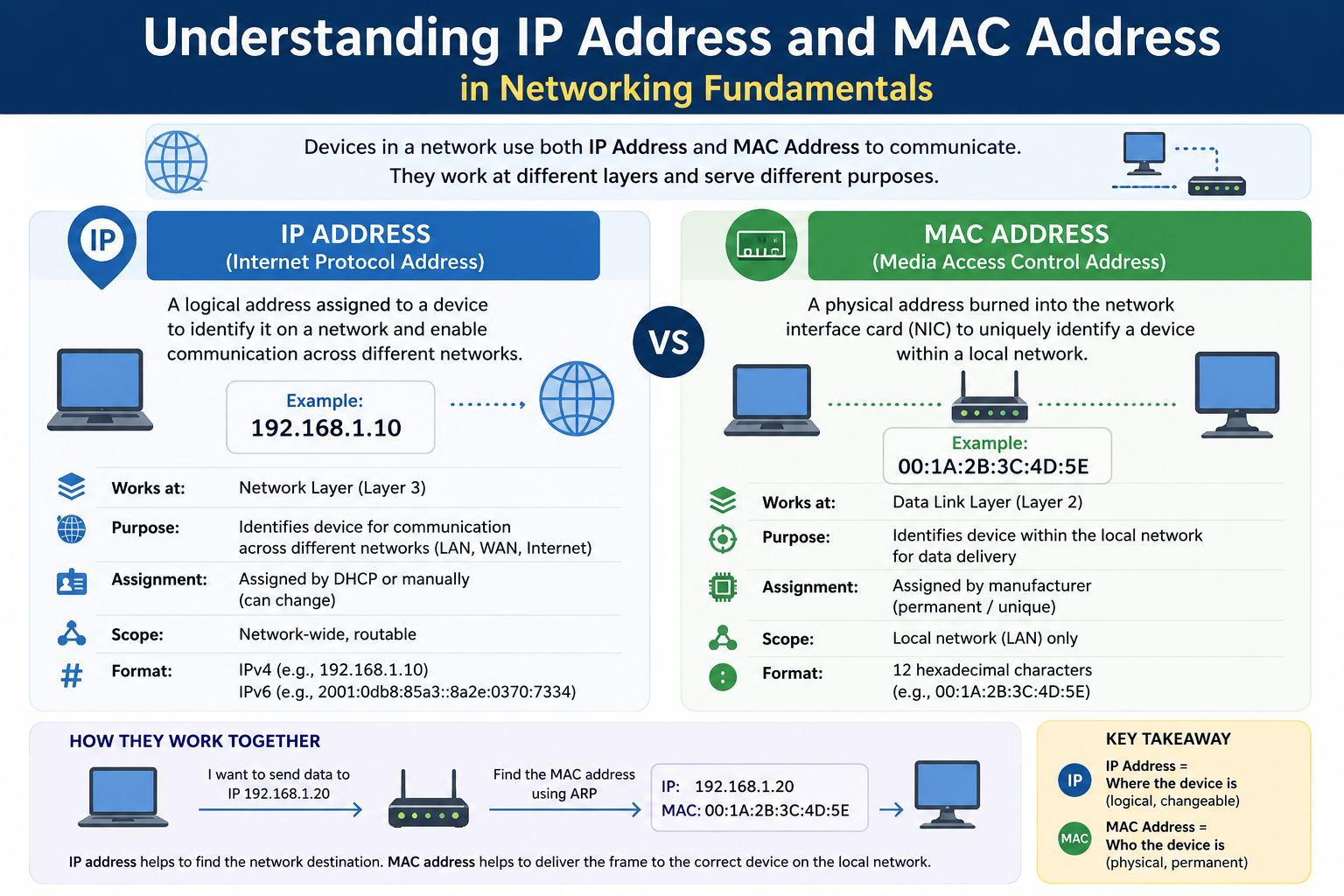
Every time a device connects to a network—whether it’s a smartphone, laptop, or gaming console—it relies on a system of addressing to communicate with other devices. These identifiers allow data to travel accurately across networks, ensuring that information reaches the correct destination. Among the most important of these identifiers are IP addresses and MAC addresses. While both serve the purpose of identifying devices, they operate at different levels and perform distinct roles.
At a basic level, a MAC address is tied directly to the hardware of a device. It is assigned by the manufacturer and remains constant throughout the device’s life. On the other hand, an IP address is more flexible and can change depending on the network the device connects to. This dual system of identification ensures both stability and adaptability in communication.
To understand why both are necessary, imagine a postal system. A MAC address is like the unique serial number of a mailbox, permanently attached and unchanging. An IP address, however, is like the street address assigned to that mailbox, which can vary if the mailbox is relocated. Together, they allow messages to be routed efficiently and accurately.
In modern networking, devices rarely communicate directly using MAC addresses alone. Instead, IP addresses are used for routing data across networks, while MAC addresses handle communication within a local network. This layered approach ensures scalability, allowing billions of devices to connect to the internet without confusion.
The interaction between these two types of addresses is seamless and usually invisible to users. When you browse the web or send a message, your device automatically uses both identifiers behind the scenes. This coordination is what makes networking reliable and efficient.
Understanding how these systems work together provides insight into the foundation of digital communication. It reveals how devices identify each other, how data finds its path, and how networks maintain order despite their complexity.
The Role and Structure of MAC Addresses
A MAC address, or Media Access Control address, is a fundamental component of network communication. It is embedded into a device’s network interface card during manufacturing, making it a permanent identifier. This address is typically represented as a sequence of 12 hexadecimal characters, often grouped in pairs separated by colons or hyphens.
Each MAC address is designed to be unique. The first half of the address identifies the manufacturer, while the second half is assigned to the specific device. This structure ensures that no two devices share the same MAC address, which is essential for accurate communication within a network.
MAC addresses operate at the data link layer of the networking model. This layer is responsible for direct communication between devices on the same network. When one device wants to send data to another nearby device, it uses the MAC address to ensure the data reaches the correct recipient.
One important characteristic of MAC addresses is that they do not change under normal circumstances. Unlike IP addresses, which can be reassigned, a MAC address remains constant. This stability makes it useful for network management tasks such as device identification, access control, and troubleshooting.
In a local network, devices rely on MAC addresses to exchange data directly. For example, when a computer sends information to a printer on the same network, it uses the printer’s MAC address to ensure the data is delivered correctly. This process happens quickly and efficiently, often without the user realizing it.
Although MAC addresses are primarily used within local networks, they play a crucial role in the overall communication process. Without them, devices would struggle to identify each other at a hardware level, leading to confusion and data loss.
The Purpose and Function of IP Addresses
IP addresses, or Internet Protocol addresses, serve as the logical identifiers for devices on a network. Unlike MAC addresses, which are fixed, IP addresses can change depending on the network environment. This flexibility allows devices to move between networks while still maintaining connectivity.
An IP address is typically represented as a series of numbers separated by periods. In IPv4, the most common format, the address consists of four numbers ranging from 0 to 255. Each address is divided into two parts: the network portion and the host portion. The network portion identifies the broader network, while the host portion identifies the specific device within that network.
IP addresses operate at the network layer, which is responsible for routing data across different networks. When you access a website or send data over the internet, your device uses IP addresses to determine where the data should go. Routers and other networking devices rely on these addresses to guide data along the correct path.
One of the key features of IP addressing is its dynamic nature. In many networks, IP addresses are assigned automatically using a system that ensures each device receives a unique address. This process allows networks to manage large numbers of devices efficiently.
There are also static IP addresses, which remain constant over time. These are typically used for servers or devices that need a consistent address. However, most everyday devices use dynamic IP addresses, which can change when the device reconnects to the network.
The flexibility of IP addressing makes it essential for modern networking. It allows devices to communicate across vast distances, connecting users around the world. Without IP addresses, the internet as we know it would not function.
How Subnet Masks Define Network Structure
Subnet masks are an essential part of IP addressing, helping to divide networks into smaller, manageable segments. They work alongside IP addresses to determine which portion of the address represents the network and which part represents the device.
A subnet mask is also written in a format similar to an IP address, consisting of four numbers separated by periods. These numbers act as a filter, indicating which bits of the IP address belong to the network portion. The remaining bits identify the host.
For example, a subnet mask of 255.255.255.0 indicates that the first three segments of the IP address represent the network. The final segment is used to identify individual devices. This structure allows multiple devices to exist within the same network while maintaining unique identifiers.
Subnetting improves network efficiency by reducing unnecessary traffic. By dividing a large network into smaller segments, devices only communicate with others within their subnet unless necessary. This reduces congestion and improves performance.
Another benefit of subnetting is enhanced security. By isolating different parts of a network, administrators can control access more effectively. This segmentation helps prevent unauthorized communication and limits the spread of potential threats.
Subnet masks also play a role in routing decisions. When a device sends data, it uses the subnet mask to determine whether the destination is within the same network. If it is, the data is sent directly. If not, the data is forwarded to a router for further processing.
Understanding subnet masks provides a deeper insight into how networks are organized and managed. It highlights the importance of structure in ensuring efficient and secure communication.
Interaction Between IP and MAC Addresses in a Network
The cooperation between IP and MAC addresses is what enables seamless communication within and across networks. While IP addresses handle routing over long distances, MAC addresses ensure accurate delivery within a local network.
When a device wants to send data to another device, it starts by identifying the destination using its IP address. However, to deliver the data within the local network, it needs the corresponding MAC address. This is where a process called address resolution comes into play.
The device checks a local table that stores known IP-to-MAC mappings. If the mapping exists, the data is sent directly. If not, the device sends a broadcast message to the network, asking which device owns the target IP address. The correct device responds with its MAC address, allowing communication to proceed.
This process ensures that data is delivered accurately without requiring manual configuration. It also allows networks to adapt dynamically as devices join or leave.
Routers play a crucial role in this interaction. They use IP addresses to determine the best path for data and rely on MAC addresses to deliver it within each segment of the journey. This layered approach ensures both efficiency and reliability.
The collaboration between these addressing systems is a key aspect of networking. It demonstrates how different components work together to achieve a common goal, enabling devices to communicate seamlessly.
Conclusion
IP addresses and MAC addresses form the backbone of modern networking, each serving a distinct yet complementary role. While MAC addresses provide a permanent, hardware-based identity for devices, IP addresses offer the flexibility needed for communication across diverse and ever-changing networks. Together, they create a system that balances stability with adaptability, ensuring that data can move efficiently from one point to another.
This relationship is further enhanced by subnet masks, which organize networks into manageable segments, improving both performance and security. The interaction between these elements allows devices to communicate seamlessly, whether they are located in the same room or across the globe.
By understanding how these components work together, it becomes easier to grasp the fundamentals of networking. This knowledge not only clarifies how everyday digital interactions occur but also lays the groundwork for exploring more advanced concepts in the field.