The AWS Cloud has become a foundational part of how modern businesses operate, scale, and innovate. Organizations today rely heavily on cloud computing to reduce infrastructure costs, improve performance, and increase flexibility. Instead of maintaining expensive physical servers, companies can now build entire systems in the cloud using on-demand services.
This shift has created a demand for professionals who understand how cloud environments work and how they can be applied effectively in real business scenarios. AWS, as one of the largest cloud providers globally, offers a wide range of tools that support computing, storage, networking, security, analytics, and application development. When these services are used correctly, they can significantly improve efficiency and reduce operational complexity.
However, the challenge for many companies is not access to technology—it is having people who can understand and explain how to use it properly. Businesses need individuals who can bridge the gap between technical cloud services and business goals. This is where foundational cloud knowledge becomes valuable. Professionals who understand how AWS works at a high level are often better equipped to contribute to strategic decisions, cost optimization, and system design discussions.
Cloud computing is no longer limited to engineers or developers. It has become a business-critical skill set that affects finance, operations, marketing, and leadership decisions. As a result, even entry-level cloud knowledge has become increasingly valuable across industries.
What the AWS Certified Cloud Practitioner Certification Represents
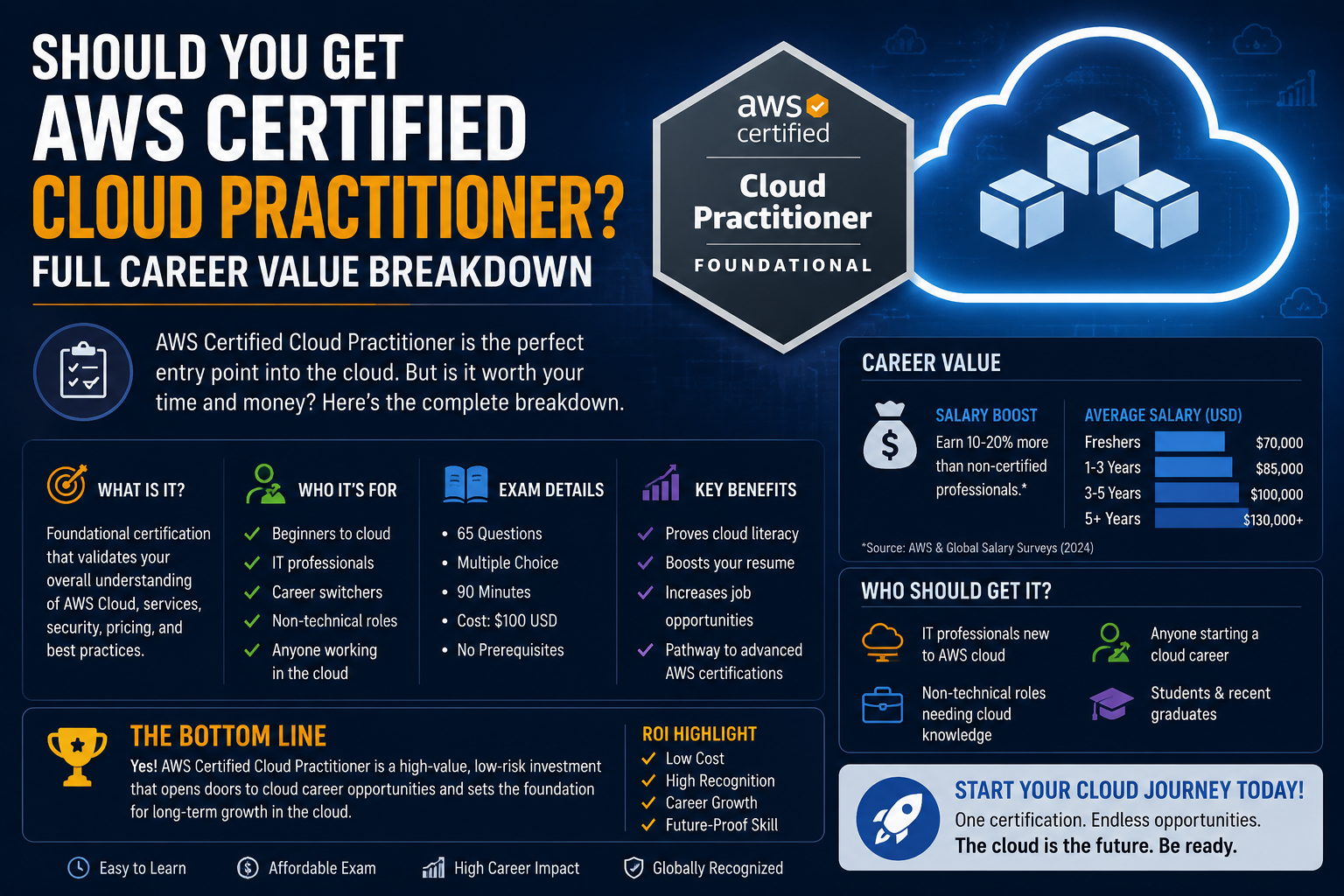
The AWS Certified Cloud Practitioner certification is designed as an entry-level credential that validates a broad understanding of cloud computing and AWS services. Rather than focusing on deep technical specialization, it emphasizes foundational knowledge that applies across roles and industries.
This certification is intended for individuals who want to understand the core principles of cloud computing, including how cloud services are delivered, how they are priced, and how they support business operations. It also introduces learners to AWS core services such as compute, storage, networking, and databases, without requiring hands-on expertise in configuring or deploying them at an advanced level.
One of the key ideas behind this certification is accessibility. It is designed for people from both technical and non-technical backgrounds. Whether someone is working in IT support, project management, sales, finance, or operations, the certification provides a structured way to understand cloud concepts that are increasingly relevant in all departments.
Another important aspect is the focus on communication. A certified individual should be able to explain cloud concepts clearly to stakeholders who may not have technical backgrounds. This includes understanding cost models, service categories, security responsibilities, and business use cases.
The certification also reflects awareness of AWS’s shared responsibility model, which defines how security and compliance responsibilities are divided between AWS and the customer. This concept is critical for understanding cloud security at a foundational level.
Overall, the certification represents awareness, literacy, and the ability to participate in cloud-related discussions within an organization, rather than deep technical implementation skills.
Key Knowledge Areas and What the Exam Covers
The AWS Certified Cloud Practitioner exam evaluates understanding across several broad domains. These domains are structured to reflect how cloud knowledge is applied in real-world scenarios rather than focusing on isolated technical details.
One major area is cloud concepts. This includes understanding what cloud computing is, why organizations adopt it, and how it differs from traditional IT infrastructure. It also covers the different cloud deployment models, such as public, private, and hybrid environments.
Another important area is security and compliance. This section focuses on foundational security principles, including identity and access management, encryption basics, and AWS compliance frameworks. It emphasizes how security responsibilities are shared between AWS and the customer, which is a crucial concept in cloud environments.
Cloud technology and services form another core domain. This includes recognition of key AWS services and their general purpose. For example, compute services handle processing power, storage services manage data, and networking services enable communication between systems. The goal is not to configure these services in detail but to understand their role within the cloud ecosystem.
The final domain focuses on billing and pricing. This is particularly important because cloud computing operates on a pay-as-you-go model. Understanding how costs are calculated, how pricing models work, and how organizations can optimize spending is essential for anyone involved in cloud decision-making.
Together, these domains ensure that certified individuals have a balanced understanding of both technical and business aspects of AWS Cloud.
Who Benefits Most from the Certification
The AWS Certified Cloud Practitioner is designed for a wide audience, but its value depends on the individual’s role and career stage.
For beginners in IT or cloud computing, it serves as a strong starting point. It introduces essential concepts that prepare learners for more advanced certifications and technical roles. It helps build confidence and provides a structured overview of the cloud landscape.
Non-technical professionals also benefit significantly. Individuals working in project management, finance, sales, or business analysis often interact with cloud-related decisions. Understanding AWS at a conceptual level allows them to contribute more effectively to discussions about cost, strategy, and system design.
For example, someone in a finance role may need to evaluate cloud spending reports or forecast infrastructure costs. A basic understanding of AWS pricing models helps them make more informed decisions. Similarly, a project manager overseeing a cloud migration project benefits from understanding how AWS services interact and what trade-offs may exist.
Even experienced IT professionals can find value in the certification, especially if they are transitioning into cloud-focused roles or need a broader understanding of AWS beyond their specialization. While it may not provide new technical depth for experienced engineers, it reinforces foundational knowledge and ensures alignment with industry standards.
Cloud administrators and support professionals often use this certification as a stepping stone toward more advanced AWS credentials. It helps them build a strong base before moving into specialized areas such as architecture, security, or DevOps.
Career Impact and Practical Value in the Industry
The value of the AWS Certified Cloud Practitioner in the job market is closely tied to how organizations are adopting cloud technologies. As cloud usage continues to grow, companies increasingly expect employees to have at least a basic understanding of cloud principles, even in non-technical roles.
From a hiring perspective, this certification signals that an individual is familiar with AWS terminology, services, and business applications. While it is not an advanced technical certification, it demonstrates initiative and awareness of one of the most widely used cloud platforms in the world.
In many cases, it can serve as a differentiator for entry-level candidates. Employers often prefer candidates who can demonstrate cloud literacy, especially when hiring for roles that involve coordination between technical and business teams.
The certification can also support career transitions. Professionals moving from traditional IT environments into cloud-based roles can use it as a foundation to build more advanced skills. It helps bridge the gap between legacy systems and modern cloud infrastructure.
However, it is important to understand its limitations. The certification alone is not sufficient for advanced engineering roles or highly technical positions. It is best viewed as a foundational credential rather than a specialized qualification.
Despite this, its value lies in accessibility and relevance. In an increasingly cloud-driven world, even basic AWS knowledge can open doors to new opportunities and improve collaboration across teams.
Conclusion
The AWS Certified Cloud Practitioner certification serves as an entry point into the world of cloud computing and AWS services. Its primary strength lies in its ability to make complex cloud concepts accessible to a broad audience, including both technical and non-technical professionals. Rather than focusing on deep technical implementation, it emphasizes understanding how cloud systems work, how they are used in business environments, and how organizations manage cost, security, and scalability.
In today’s technology-driven workplace, this type of foundational knowledge is increasingly valuable. Businesses are adopting cloud solutions at a rapid pace, and employees who understand these systems are better positioned to contribute to decision-making processes and cross-functional collaboration. While the certification does not replace advanced technical expertise, it provides a strong base for further learning and career development in cloud computing.
Its worth ultimately depends on the individual’s goals. For beginners, it offers structure and clarity. For non-technical professionals, it improves communication and decision-making. For IT professionals, it reinforces essential concepts and supports career growth. In all cases, it helps build confidence in working with one of the most important technologies shaping modern business infrastructure.