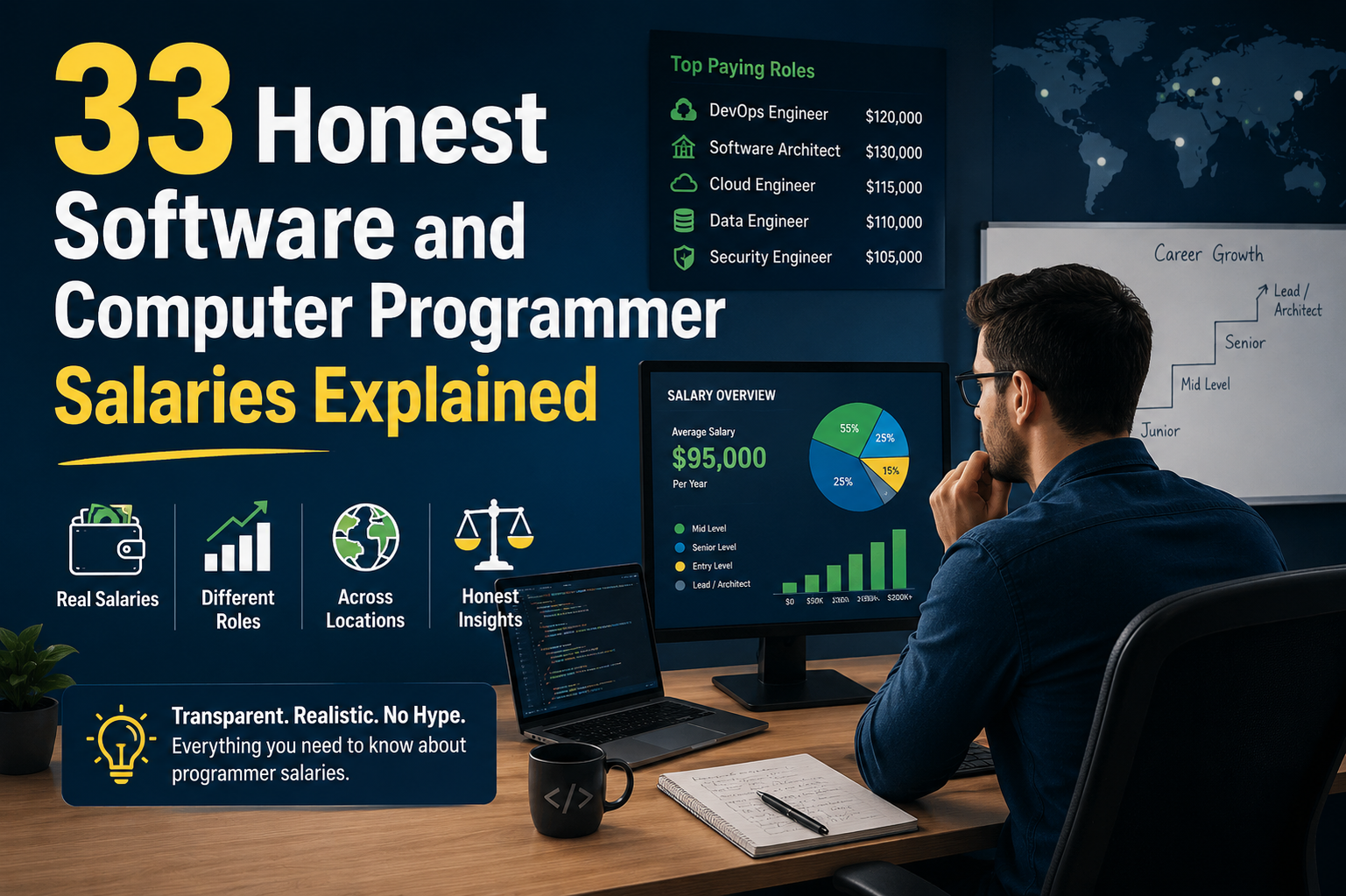
Computer programmers play a central role in the digital economy. Every modern business, from retail stores and hospitals to banks and entertainment companies, relies on software systems that are built and maintained by people who understand code. Behind mobile applications, websites, automation systems, payment platforms, and cloud services are programmers who turn ideas into working technology.
Over the last decade, the programming profession has changed dramatically. What was once considered a highly specialized technical field has now become one of the most influential and widely recognized career paths in the world. Businesses continue to digitize operations, consumers expect faster and smarter online experiences, and organizations depend on software for nearly every aspect of daily operations. As a result, skilled programmers are in demand across almost every industry.
One of the biggest questions people ask about this profession is simple: how much do computer programmers actually earn? The answer depends on several factors, including location, technical expertise, years of experience, industry, and the complexity of the projects involved. Salaries can vary widely even among programmers with similar job titles because responsibilities and technical expectations differ from company to company.
The term “computer programmer” itself covers a broad range of work. Some programmers focus on websites and mobile applications, while others develop software for financial institutions, healthcare systems, manufacturing equipment, gaming companies, or government organizations. Some spend their days writing backend systems that process millions of transactions, while others focus on user interfaces, cybersecurity, automation, or cloud infrastructure.
As technology continues to evolve, programmers are expected to adapt quickly. Modern development environments move fast, and businesses constantly seek professionals who can learn new tools, solve problems efficiently, and collaborate with technical and non-technical teams. This ability to evolve has become one of the strongest indicators of long-term salary growth.
Programming salaries also attract attention because they often rise faster than many traditional professions. Entry-level positions can offer competitive compensation compared to other industries, and experienced developers with specialized skills frequently earn six-figure salaries. However, the path toward higher pay is rarely automatic. The highest-paid programmers typically combine technical expertise with communication skills, business understanding, and experience solving large-scale problems.
Location remains one of the strongest influences on salary levels. Technology hubs such as San Jose, Seattle, New York, and Boston consistently report some of the highest salaries for programmers in the United States. These cities are home to major technology firms, startups, financial companies, and cloud computing organizations that compete aggressively for skilled developers.
In San Jose, programmers working for large technology companies may earn well over $100,000 annually, especially when bonuses and stock options are included. The region benefits from high demand for software engineers, artificial intelligence specialists, and cloud developers. However, the cost of living in the area is also extremely high, which means higher salaries are often balanced by expensive housing and daily expenses.
Seattle has become another major technology center. The city hosts major cloud computing companies, gaming studios, and enterprise software firms. Programmers in Seattle frequently work on distributed systems, machine learning platforms, and large-scale cloud applications. Salaries are often competitive because companies in the region are competing for talent with both local employers and remote opportunities.
New York offers a slightly different environment. While technology companies remain important employers, many programmers in New York work in finance, media, healthcare, and advertising industries. Financial technology firms especially tend to pay well because they rely heavily on reliable and high-performance software systems. Programmers who understand backend systems, security, and data processing are often rewarded with strong compensation packages.
Not every programmer works in a major coastal city. Mid-sized cities like Raleigh, Columbus, Kansas City, and Charlotte have become attractive markets for software professionals. These cities often offer lower living costs while still providing competitive salaries. Many employers in these regions are expanding digital operations and hiring developers to support remote teams, internal systems, and customer-facing applications.
For many professionals, the balance between salary and living expenses matters more than raw income numbers. A programmer earning $90,000 in a lower-cost city may enjoy a higher quality of life than someone earning $130,000 in a much more expensive metropolitan area. Housing, transportation, healthcare, and taxes all affect how far a salary actually goes.
Remote work has also transformed salary discussions. Before remote work became widespread, programmers often had to relocate to major technology hubs to access high-paying jobs. Today, many developers work from smaller cities or rural areas while earning salaries tied to companies headquartered in expensive markets. This shift has created new opportunities for programmers who want better work-life balance without sacrificing income.
Some employers now hire nationally or globally, allowing programmers to compete for roles beyond their local job markets. This increased competition benefits highly skilled developers who can demonstrate strong technical ability, project experience, and communication skills. At the same time, it also means companies have access to a larger talent pool, which can influence salary negotiations.
Another major factor influencing programmer salaries is specialization. General programming skills are valuable, but certain technical areas command significantly higher compensation. Cloud computing, cybersecurity, machine learning, data engineering, and distributed systems development are among the most lucrative specialties in the current market.
Programming languages also influence earnings. Developers experienced with widely used languages like Python, Java, and JavaScript continue to see strong demand because these languages power modern web applications, enterprise software, and automation systems. Python, in particular, has become popular in data science, artificial intelligence, and backend development.
Java remains essential for enterprise systems, banking platforms, and large-scale applications. Many organizations rely on Java-based infrastructure that requires experienced programmers to maintain and improve critical systems. Java developers with experience in cloud architecture and enterprise frameworks often receive strong compensation.
JavaScript dominates front-end web development and has expanded into backend development through modern frameworks and runtime environments. Full-stack developers who understand both frontend and backend systems are highly valued because they can contribute across multiple areas of a project.
C++ developers frequently work in performance-critical environments such as gaming, finance, embedded systems, and operating systems. These roles often require deeper technical expertise and understanding of memory management, which can lead to higher salaries.
Some niche or emerging languages can provide salary advantages as well. Developers experienced with Go, Rust, or Kotlin may find fewer competitors in the job market, especially in companies building modern infrastructure systems or mobile applications.
Ironically, older programming languages can also become profitable specialties. Industries like banking, insurance, and government continue to rely on legacy systems written in languages such as COBOL and Fortran. Because fewer programmers learn these technologies today, experienced professionals capable of maintaining older systems can command surprisingly high salaries.
Industry selection also has a major impact on programmer compensation. Financial services companies are known for paying high salaries because software reliability and speed directly affect business performance. Developers working in trading systems, payment processing, or banking infrastructure often handle mission-critical systems where errors can be extremely costly.
Healthcare technology has become another strong sector for programmers. Electronic health records, telemedicine platforms, diagnostic software, and patient management systems all require skilled development teams. Healthcare organizations also place heavy emphasis on privacy and security, creating demand for developers who understand compliance and secure system design.
Defense and aerospace industries frequently offer competitive compensation for programmers who work on secure systems, embedded software, or simulation platforms. These positions sometimes require security clearances or specialized technical backgrounds.
Technology startups can offer a different compensation structure. While base salaries may vary, startups often include equity or stock options as part of compensation packages. Some developers accept slightly lower salaries in exchange for potential long-term financial rewards if the company grows successfully.
Experience level naturally affects salary progression. Entry-level programmers typically focus on learning workflows, debugging code, and contributing to smaller features under supervision. At this stage, employers prioritize adaptability, problem-solving potential, and foundational programming knowledge.
After several years of experience, programmers often move into mid-level positions where they design larger systems, work independently, and contribute to technical decision-making. Mid-level developers are expected to understand architecture, testing, deployment practices, and performance optimization.
Senior programmers carry significantly more responsibility. They often mentor junior developers, guide architectural decisions, review code quality, and help coordinate technical strategy. Senior-level professionals are also expected to communicate effectively with stakeholders and balance technical considerations with business needs.
One major misconception about programming salaries is that technical skills alone determine income. While strong coding ability is essential, communication and collaboration skills often separate average earners from top professionals. Companies value developers who can explain complex problems clearly, work effectively in teams, and contribute to long-term project planning.
Programmers who understand business goals also tend to advance more quickly. Employers appreciate professionals who can connect technical work with customer needs, operational efficiency, or revenue growth. This broader understanding increases trust and often leads to leadership opportunities.
Another important factor in salary growth is visibility. Developers who consistently contribute to successful projects, improve processes, and solve difficult technical challenges are more likely to receive raises and promotions. Reliability matters just as much as technical brilliance in many organizations.
Certifications can support salary growth in some situations, especially for programmers working with cloud platforms, enterprise systems, or cybersecurity technologies. Certifications demonstrate commitment to learning and may help candidates stand out during hiring processes. However, most employers still place greater value on practical experience and real-world project work.
The rise of automation and artificial intelligence has also changed how programmers work. Rather than replacing developers entirely, these technologies often increase the need for programmers who can integrate AI tools, build scalable systems, and maintain complex software environments. Developers who learn how to work effectively alongside automation tools may find themselves even more valuable in the coming years.
Demand for programmers is unlikely to disappear anytime soon because software now powers nearly every industry. Retail companies rely on e-commerce platforms, manufacturers depend on automation systems, banks require secure transaction processing, and healthcare providers need digital records and telemedicine services. As businesses continue to digitize operations, skilled developers remain essential.
Career flexibility is another reason many people pursue programming. Developers can work in startups, global corporations, freelance environments, government agencies, or nonprofit organizations. Some focus on technical specialization, while others move into leadership, architecture, consulting, or product management roles.
Freelancing has become increasingly common among experienced programmers. Some developers choose contract work because it allows them to work on diverse projects, set their own schedules, or earn higher hourly rates. Freelance income can vary significantly depending on reputation, expertise, and project complexity.
Programmers who build strong portfolios often gain access to better opportunities. Employers increasingly look beyond formal education and focus on practical evidence of skill. Open-source contributions, personal projects, published applications, and collaborative work can all strengthen a programmer’s professional reputation.
The learning process in programming never truly ends. New frameworks, languages, tools, and security practices emerge constantly. Developers who stay curious and adaptable generally experience stronger long-term career growth than those who rely only on existing knowledge.
While salary figures often attract attention, long-term career satisfaction usually depends on more than compensation alone. Work culture, flexibility, project interest, leadership quality, and opportunities for growth all influence whether programmers enjoy their careers over time.
Many programmers also appreciate the creative side of software development. Programming combines logic with problem-solving and design thinking. Developers build systems that people rely on every day, whether they are creating mobile applications, improving healthcare software, or designing platforms that support millions of users.
The profession can also be demanding. Tight deadlines, production issues, changing requirements, and technical complexity can create stress. Developers often need patience and persistence because debugging and troubleshooting can consume significant time and energy.
Even so, programming remains one of the most dynamic and financially rewarding careers in the modern workforce. As industries continue adopting digital technologies, companies will keep searching for professionals who can design, maintain, and improve software systems.
For anyone considering a programming career, understanding salary trends is important, but it is equally important to recognize the bigger picture. High salaries often come from continuous learning, practical experience, adaptability, and the ability to contribute meaningful solutions to real-world problems.
Skills, Specializations, and Career Growth That Influence Programmer Salaries
The difference between an average programming salary and an exceptional one often comes down to the depth and relevance of a developer’s skills. In the technology industry, employers are not simply paying people to write code. They are paying for problem-solving ability, technical judgment, adaptability, reliability, and the capacity to build systems that support real business goals.
For this reason, programmers who continuously improve their technical and professional abilities usually experience stronger salary growth than those who rely only on basic coding knowledge. The software industry changes rapidly, and developers who evolve alongside new technologies often become far more valuable over time.
One of the first major decisions programmers make is choosing which technologies to learn deeply. While it is useful to understand multiple languages and frameworks, specialization often creates stronger earning potential because companies pay premium salaries for expertise that is difficult to replace.
Backend development remains one of the most consistently valuable specializations in programming. Backend developers build the systems responsible for processing data, managing authentication, handling business logic, and supporting application performance.
Large-scale backend systems can become incredibly complex. Developers working in these environments must think carefully about scalability, database optimization, security, and reliability. Applications supporting millions of users cannot afford constant downtime or performance bottlenecks.
Programmers who understand distributed systems architecture often earn strong salaries because they help organizations maintain stable and efficient digital platforms. These developers frequently work on APIs, cloud services, server infrastructure, and data processing systems.
Frontend development has evolved significantly as well. Modern user interfaces involve far more than simple website layouts. Frontend developers now create highly interactive applications that behave almost like desktop software inside web browsers.
User expectations continue rising, which means frontend developers must focus heavily on responsiveness, accessibility, performance optimization, and design consistency. Businesses understand that poor user experiences can reduce customer satisfaction and hurt revenue.
Developers skilled in frontend architecture, state management, and performance optimization are increasingly valuable because user experience directly affects product success. In many organizations, frontend teams collaborate closely with designers and product managers to create polished customer experiences.
Mobile development offers another strong specialization path. Smartphones have become central to modern life, and businesses continue investing heavily in mobile applications. Developers skilled in iOS or Android ecosystems often work on products that serve enormous user bases.
Mobile developers face unique challenges related to battery performance, device compatibility, user interface design, and application security. Because mobile users expect fast and reliable experiences, companies seek developers who can deliver polished products across multiple devices.
Cloud engineering has become one of the most important technical specialties in recent years. Businesses increasingly migrate systems away from traditional on-premise infrastructure toward cloud environments because cloud platforms provide scalability and operational flexibility.
Programmers working in cloud environments often manage deployment pipelines, containerization systems, monitoring tools, and automated infrastructure. These roles require both development and operational knowledge, making cloud engineers highly valuable.
Container technologies and orchestration platforms have become standard tools in modern development environments. Developers who understand how to deploy scalable applications efficiently are often rewarded with higher salaries because their work directly improves operational reliability.
Another rapidly growing specialization is cybersecurity-focused development. Security concerns now affect nearly every industry because organizations store enormous amounts of sensitive information digitally.
Developers who understand secure authentication systems, encryption practices, access control, and vulnerability prevention play critical roles in protecting business operations. Companies are increasingly willing to invest heavily in security expertise because cyberattacks can lead to severe financial and reputational damage.
Security-focused programmers often collaborate closely with infrastructure teams and compliance departments. In highly regulated industries, secure software development practices are not optional but legally required.
Artificial intelligence and machine learning have also transformed salary opportunities in programming. Businesses across industries are exploring predictive analytics, recommendation systems, automation tools, and intelligent software platforms.
Developers working in AI-related environments often need strong mathematical reasoning in addition to programming skills. Building machine learning systems involves data preprocessing, model training, algorithm evaluation, and scalable deployment.
Because AI expertise remains relatively specialized, companies frequently offer strong compensation to developers capable of building and maintaining intelligent systems. However, competition in this field is increasing as more professionals enter the market.
Data engineering represents another high-demand specialization. Modern organizations collect vast amounts of information from customers, operations, and digital services. Businesses need reliable systems capable of processing and organizing this data efficiently.
Data engineers build pipelines, storage systems, and processing infrastructure that support analytics and decision-making. These roles require understanding databases, distributed systems, scalability, and automation.
Programmers who combine software engineering skills with data expertise often become especially valuable because businesses increasingly rely on data-driven strategies.
Embedded systems development offers a completely different technical path. Embedded developers write software that interacts directly with hardware devices such as medical equipment, industrial machinery, automotive systems, and consumer electronics.
These environments often involve strict performance and reliability requirements. Embedded programmers must optimize code carefully because hardware resources may be limited. Mistakes in embedded systems can sometimes create safety risks, which increases the importance of reliability.
Because embedded systems work requires specialized technical understanding, experienced developers in this field often earn competitive salaries.
Game development remains a dream career for many programmers, though the industry can be highly competitive. Game developers work on rendering engines, networking systems, gameplay mechanics, artificial intelligence, and optimization.
Modern games are technically complex products requiring collaboration between artists, designers, writers, and engineers. Developers who understand graphics programming, physics systems, and performance optimization often become highly valued within gaming studios.
Financial technology continues generating strong salary opportunities for programmers. Banks, investment firms, payment processors, and trading platforms all depend on software systems capable of handling enormous transaction volumes securely and efficiently.
Fintech developers often work under strict reliability and security requirements because system failures can directly impact financial operations. This level of responsibility contributes to strong compensation in the sector.
Healthcare technology is another growing field for programmers. Hospitals, insurance providers, and telemedicine platforms rely heavily on software systems for patient management, diagnostics, scheduling, and communication.
Healthcare developers must often understand privacy regulations and secure data handling practices. The complexity of healthcare systems creates strong demand for developers who can maintain reliability while protecting sensitive information.
Beyond technical specialization, career advancement in programming often depends on the ability to work independently. Junior developers typically receive close guidance, while senior programmers are expected to make technical decisions confidently and solve problems without constant supervision.
Employers value developers who can manage ambiguity effectively. Real-world software projects rarely involve perfectly clear requirements. Developers often need to evaluate trade-offs, anticipate future problems, and make practical decisions under time pressure.
Technical interviews increasingly focus on system design and architectural thinking because companies want developers capable of understanding large-scale systems rather than only writing isolated pieces of code.
Code quality also strongly influences career growth. Experienced programmers understand that maintainable code matters just as much as functionality. Software systems often survive for years or decades, meaning poorly written code can create expensive long-term problems.
Developers who write clean, organized, and well-documented code help organizations reduce maintenance costs and improve team efficiency. These habits may not appear glamorous, but they often separate highly trusted professionals from average contributors.
Testing skills have become increasingly valuable as businesses demand more reliable software. Automated testing frameworks allow teams to detect problems early and maintain system stability.
Programmers familiar with unit testing, integration testing, performance testing, and quality assurance processes are often viewed as more dependable contributors. Reliable software delivery improves business confidence and customer satisfaction.
Version control systems are another essential part of modern programming work. Collaborative development environments rely heavily on tools that track code changes and support teamwork.
Developers who understand collaborative workflows, branching strategies, and deployment practices integrate more effectively into professional engineering teams.
Soft skills continue playing a major role in salary growth. Communication abilities become especially important as developers move into senior positions. Companies rely on experienced programmers to explain technical concepts, mentor junior developers, and coordinate cross-functional work.
A programmer who communicates clearly can often influence projects more effectively than someone with stronger technical knowledge but poor interpersonal skills. Leadership opportunities frequently emerge for developers who build trust and collaborate well.
Mentorship represents another valuable aspect of career development. Senior developers who help junior programmers grow often become influential team members. Companies appreciate professionals who improve overall team performance rather than focusing only on individual productivity.
Adaptability remains one of the most important long-term career traits. Technology changes constantly, and developers who resist learning new tools may eventually fall behind industry expectations.
However, adaptability does not mean blindly chasing every trend. Strong programmers balance experimentation with foundational knowledge. Core concepts such as algorithms, databases, networking, and software design remain valuable regardless of changing frameworks.
Many developers increase their salaries by changing employers strategically. Technology companies frequently compete for experienced talent, and external job changes sometimes produce larger salary increases than internal promotions.
Still, frequent job hopping can create drawbacks if developers fail to build deep experience or long-term project ownership. Employers often value candidates who demonstrate both growth and stability.
Open-source contributions can also influence career opportunities. Public technical work allows employers to evaluate coding style, collaboration ability, and problem-solving approaches.
Developers who maintain visible portfolios or contribute to widely used projects may attract stronger opportunities because their expertise becomes easier to verify.
Freelancing and consulting provide alternative paths toward higher earnings. Experienced programmers with specialized skills sometimes earn substantial income through independent contract work.
Consultants often help businesses solve difficult technical problems, modernize systems, or implement new infrastructure. While freelancing can offer flexibility and strong earning potential, it also requires business management skills and financial planning.
Many programmers increase their salaries by transitioning into broader technical roles. Software engineering, solutions architecture, cloud engineering, and technical leadership positions often offer higher compensation because they involve larger responsibilities.
Software engineers typically focus on system design, scalability, maintainability, and architecture in addition to writing code. These roles require a broader understanding of how applications function within larger ecosystems.
Solutions architects work closely with businesses to design technical systems that meet organizational goals. This position combines technical expertise with strategic planning and communication. Architects often guide infrastructure decisions, integration strategies, and scalability planning.
Technical leadership roles frequently involve mentoring teams, reviewing designs, coordinating projects, and helping organizations establish development standards. Leadership positions require balancing technical decisions with business priorities.
Project ownership also influences career growth. Developers who consistently take responsibility for important systems often become trusted contributors within organizations. This trust can lead to promotions, raises, and leadership opportunities.
Open-source contributions have become another valuable way to strengthen professional reputations. Developers who contribute to public projects demonstrate initiative, collaboration skills, and technical competence. Hiring managers often view active contributors favorably because their work is visible and verifiable.
Personal projects can also help programmers stand out in competitive job markets. Building applications independently allows developers to demonstrate creativity, persistence, and technical ability. Strong portfolios sometimes matter more than formal credentials.
Certifications may help programmers validate skills, especially in cloud computing, cybersecurity, and enterprise technologies. Employers sometimes use certifications as hiring filters or evidence of technical commitment.
The Future of Computer Programming Salaries and Opportunities in a Changing Industry
The computer programming profession continues to evolve at an extraordinary pace. Technologies that seemed cutting-edge only a few years ago can quickly become standard industry tools, while entirely new areas of development emerge almost overnight. As businesses adapt to automation, artificial intelligence, cloud computing, and digital transformation, programmers are entering a future filled with both opportunity and uncertainty.
Despite constant technological change, one thing remains clear: software continues to shape the modern world. Organizations depend on digital systems to communicate with customers, manage operations, analyze data, automate processes, and deliver services. Behind these systems are programmers responsible for building, maintaining, and improving the technology people use every day.
Because software has become essential to nearly every industry, demand for programmers remains strong. However, the types of skills companies prioritize are changing. Developers who understand modern infrastructure, scalability, cybersecurity, automation, and artificial intelligence are becoming increasingly valuable.
Artificial intelligence has become one of the most discussed topics in the technology industry. Many people wonder whether AI tools will reduce demand for programmers or dramatically change software development careers. In reality, AI is more likely to transform programming work than eliminate it entirely.
Modern AI tools can assist developers with repetitive tasks such as generating boilerplate code, identifying syntax errors, and suggesting optimizations. These tools may improve productivity and reduce the time required for routine development work. However, businesses still need skilled programmers who understand architecture, security, scalability, and system reliability.
Software development involves much more than writing lines of code. Developers must understand user needs, design maintainable systems, solve complex problems, and coordinate with teams across organizations. AI tools may speed up certain tasks, but human oversight and technical judgment remain critical.
Programmers who learn how to work effectively with AI systems may actually increase their value in the workforce. Companies will continue seeking developers who can integrate machine learning features, manage AI infrastructure, and ensure software behaves reliably in real-world conditions.
Machine learning engineering has already become one of the highest-paying specialties in the technology industry. Organizations across finance, healthcare, logistics, marketing, and retail are experimenting with predictive analytics and automation. Developers capable of building scalable AI systems often receive strong compensation packages.
Cloud computing continues reshaping the programming landscape as well. Businesses increasingly rely on cloud infrastructure because it allows them to scale applications quickly and reduce hardware management costs. This shift has created strong demand for programmers who understand distributed systems and cloud-native development.
Developers working with cloud technologies often manage deployment pipelines, monitoring systems, and infrastructure automation in addition to traditional coding tasks. The combination of software development and infrastructure expertise makes these professionals especially valuable.
Cybersecurity concerns are also influencing programmer salaries. As organizations collect more digital data, they face growing risks from cyberattacks, ransomware, and system vulnerabilities. Companies need developers who understand secure coding practices and can help protect sensitive information.
Security-focused programmers frequently work on authentication systems, encryption, access control, and vulnerability mitigation. These responsibilities carry significant importance because security failures can lead to financial losses and reputational damage.
Remote work has permanently changed the technology job market. Before widespread remote hiring, many developers relocated to major technology hubs to access better opportunities. Today, companies hire programmers from across the country and around the world.
This shift has created greater flexibility for workers. Programmers living in smaller cities can now apply for positions with companies based in expensive metropolitan areas. Many professionals enjoy improved work-life balance because they no longer need to live near corporate offices.
Remote work has also increased competition. Employers can recruit from larger talent pools, which means programmers must demonstrate strong communication skills and self-management abilities in addition to technical expertise.
Some companies still adjust salaries based on geographic location, while others offer standardized national compensation regardless of where employees live. These differing approaches continue shaping salary negotiations throughout the technology industry.
Freelancing and independent consulting are becoming more common among experienced programmers. Businesses often hire contractors for specialized projects, short-term migrations, or system upgrades rather than maintaining large permanent teams.
Independent developers who build strong reputations can earn substantial income through consulting work. However, freelancing also requires managing contracts, finding clients, estimating timelines, and handling financial responsibilities independently.
Another trend affecting programmer salaries is the rise of low-code and no-code development platforms. These tools allow non-technical users to create simple applications through visual interfaces instead of traditional programming.
Some observers initially feared that low-code platforms would reduce demand for programmers. In practice, these tools often handle only basic workflows and still require skilled developers for customization, scalability, integrations, and complex functionality.
Rather than replacing programmers entirely, low-code platforms may shift some developers toward higher-level technical responsibilities. Organizations still need professionals who understand architecture, security, APIs, databases, and performance optimization.
Software complexity continues increasing across industries. Modern applications must handle massive amounts of data, support global users, maintain high availability, and integrate with multiple external systems. These technical challenges require experienced developers capable of building reliable infrastructure.
The growth of connected devices has created additional opportunities for programmers. Smart appliances, wearable devices, industrial sensors, autonomous vehicles, and medical equipment all rely on embedded software systems.
Embedded systems programming requires understanding hardware limitations, real-time performance requirements, and low-level system interactions. Because these roles demand specialized expertise, salaries are often competitive.
Gaming remains another major sector for programmers. Game developers work on graphics engines, physics systems, networking infrastructure, and artificial intelligence for interactive experiences. While the gaming industry can be highly competitive, experienced developers with strong technical abilities are often well compensated.
Financial technology continues expanding rapidly. Digital payments, online banking, cryptocurrency systems, and investment platforms all depend on secure and scalable software. Programmers working in fintech environments frequently earn high salaries because reliability and performance are critical.
Healthcare technology has also become increasingly important. Hospitals, clinics, and healthcare providers rely on software for patient records, diagnostics, scheduling, billing, and telemedicine services. Developers who understand healthcare compliance and security standards are especially valuable.
Educational technology grew significantly as remote learning expanded worldwide. Developers building learning management systems, educational applications, and virtual classroom platforms continue supporting evolving educational needs.
Government organizations also rely heavily on programmers for infrastructure modernization, cybersecurity, data management, and public services. While government salaries may not always match private-sector compensation, these roles sometimes offer stability and long-term benefits.
One of the most important long-term trends in programming careers is specialization. As software ecosystems become more complex, employers increasingly seek developers with deep expertise in specific domains.
General programming knowledge remains useful, but specialization often leads to higher salaries. Developers who master cybersecurity, machine learning, cloud architecture, distributed systems, or high-performance computing frequently earn more because their skills are harder to replace.
At the same time, foundational knowledge remains essential. Technologies evolve constantly, but core concepts such as algorithms, databases, networking, system design, and debugging continue forming the backbone of software engineering.
Programmers who rely entirely on trendy tools without understanding underlying principles may struggle when technologies change. Long-term career stability often comes from combining strong fundamentals with adaptable technical skills.
Continuous learning has become a permanent requirement in programming careers. Developers who stop learning risk falling behind as frameworks, platforms, and business requirements evolve.
Many programmers dedicate time outside work to reading technical documentation, experimenting with tools, contributing to projects, or studying system design concepts. This habit of ongoing learning often separates highly paid professionals from those whose careers stagnate.
Communication skills are becoming increasingly valuable in technical environments. Modern software projects involve collaboration between engineers, designers, analysts, managers, and executives. Developers who explain technical ideas clearly often advance into leadership roles more quickly.
Leadership opportunities represent another path toward higher earnings. Technical leads, engineering managers, and architects frequently earn more than individual contributors because they coordinate teams, guide strategy, and influence organizational decisions.
However, not every programmer wants to become a manager. Some developers prefer remaining highly specialized technical experts. Many companies now provide advanced technical career tracks that allow experienced engineers to earn senior-level compensation without moving into traditional management positions.
Work-life balance has become an increasingly important topic in the technology industry. High salaries can come with demanding schedules, tight deadlines, and pressure to deliver results quickly. Burnout remains a serious issue in some programming environments.
Developers are increasingly evaluating employers based on flexibility, culture, and sustainability rather than compensation alone. Remote work options, manageable workloads, and professional growth opportunities now influence career decisions as much as salary figures.
Another challenge facing programmers is economic uncertainty. Technology hiring can fluctuate during economic downturns, and some companies periodically reduce staff during periods of slower growth. However, software remains deeply integrated into modern business operations, which helps maintain long-term demand for technical talent.
Adaptability continues to be one of the most important qualities for future programmers. Developers who can learn quickly, embrace change, and solve unfamiliar problems are likely to remain valuable regardless of how technology evolves.
Younger programmers entering the industry today face a very different environment than developers did twenty years ago. Access to learning resources has expanded dramatically, making programming knowledge more available than ever before.
At the same time, competition has increased because more people are pursuing software careers globally. Standing out now requires more than basic coding ability. Employers increasingly seek developers who demonstrate initiative, collaboration skills, and practical experience.
Portfolio development has become especially important for early-career programmers. Employers often evaluate personal projects, internships, collaborative work, and open-source contributions when hiring junior developers.
Mentorship also remains critical in the growth of programming careers. Experienced developers often accelerate the learning process for newer professionals by sharing best practices, architectural thinking, and troubleshooting strategies.
One of the most positive aspects of programming careers is their flexibility. Developers can move between industries, technologies, and work styles throughout their careers. Some transition into entrepreneurship, consulting, education, product management, or technical writing.
Programming also allows people to build products independently. A single developer can create applications, launch online services, or develop software businesses with relatively low startup costs compared to many other industries.
The globalization of software development continues influencing salaries as well. International collaboration has become common, and companies often maintain distributed teams across multiple countries. This creates both opportunities and competitive pressure within the workforce.
Despite changing technologies, the fundamental purpose of programming remains the same: solving problems through software. Businesses need reliable systems, users expect seamless experiences, and industries continue adopting digital tools to improve efficiency.
Programmers who combine technical ability with adaptability, communication, and strategic thinking are likely to remain highly valuable in the future economy. While specific tools and languages may change, the ability to design effective systems and solve meaningful problems will continue driving career success.
The future of programming salaries will likely depend on several interconnected factors: specialization, continuous learning, business impact, and the ability to adapt to evolving technologies. Developers who invest in modern skills while maintaining strong technical foundations are positioned to benefit from ongoing demand across industries.
Technology will continue changing rapidly, but software itself is not going away. As long as businesses rely on digital systems to operate, programmers will remain essential contributors to economic growth, innovation, and the development of modern society.
Conclusion
Computer programming has become one of the most influential and financially rewarding careers in the modern world. From mobile applications and cloud systems to healthcare platforms and financial technology, programmers help build the digital tools that businesses and consumers rely on every day. As technology continues expanding into nearly every industry, the demand for skilled developers is expected to remain strong for years to come.
One of the most important lessons about programming salaries is that earnings are influenced by far more than job titles alone. Factors such as technical specialization, years of experience, industry choice, communication skills, and the ability to adapt to changing technologies all play a major role in long-term career growth. Developers who continuously improve their knowledge and stay current with modern tools often position themselves for stronger salary opportunities and greater job security.
The profession also offers exceptional flexibility. Programmers can work in startups, global corporations, healthcare organizations, financial institutions, government agencies, or freelance environments. They can specialize in cloud computing, cybersecurity, artificial intelligence, backend systems, mobile development, or many other technical fields. This variety allows developers to shape careers that match both their interests and financial goals.
At the same time, programming requires persistence and continuous learning. Technology changes rapidly, and successful developers are usually the ones who remain curious, adaptable, and willing to grow throughout their careers. Strong technical ability combined with communication, collaboration, and problem-solving skills often creates the best opportunities for advancement.
As businesses continue investing in digital transformation, software systems will remain central to modern life. For programmers who are committed to developing their skills and taking on meaningful challenges, the future continues to offer strong earning potential, career stability, and opportunities to build technology that shapes the world around us.