Modern organizations rely heavily on technology to operate, compete, and grow. From digital communication tools to large-scale cloud infrastructures, technology now touches nearly every business function. At the center of this technological ecosystem stands one of the most influential leaders in the corporate world: the Chief Information Officer, commonly known as the CIO. Once viewed primarily as the senior manager responsible for maintaining internal IT systems, the CIO has evolved into a strategic executive who helps shape the long-term direction of the organization.
The responsibilities of a CIO extend far beyond keeping servers running or managing software deployments. Today’s CIO is deeply involved in decision-making that influences business strategy, innovation, and operational efficiency. Companies rely on CIOs to identify new technological opportunities, reduce risk, manage large IT budgets, and ensure that digital initiatives align with broader organizational goals. Because of this expanded role, the position has become one of the most respected and highly compensated leadership roles within the corporate structure.
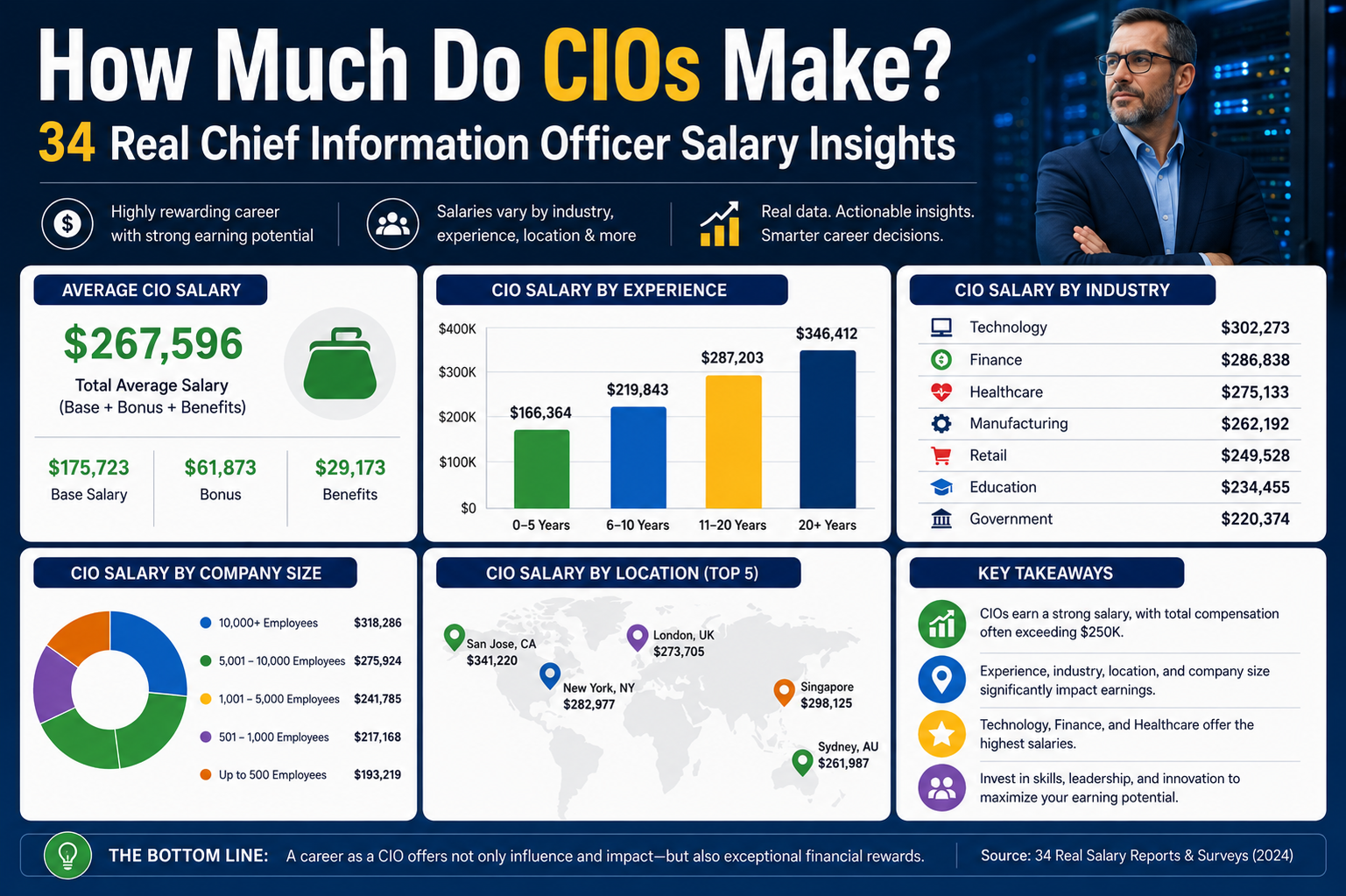
As organizations become increasingly digital, interest in CIO salaries has grown significantly. Many professionals working in technology leadership roles are curious about how much CIOs earn and what factors influence their compensation. Understanding the financial rewards associated with the role also sheds light on the scale of responsibility and expertise required to succeed at the highest level of IT leadership.
CIO compensation varies widely depending on several factors. Location, company size, industry type, and experience all contribute to differences in salary. Some CIOs working in major technology hubs earn significantly more than those in smaller cities. Likewise, a CIO responsible for global IT operations at a multinational corporation will typically earn more than one managing technology for a smaller regional organization. Despite these variations, one thing remains consistent: the CIO role commands substantial compensation because of its strategic importance.
At its core, the CIO position is about connecting technology to business outcomes. Organizations invest heavily in technology infrastructure, software platforms, cybersecurity defenses, and data systems. These investments must generate real value for the company, whether that value appears as improved efficiency, better customer experiences, or new revenue opportunities. The CIO ensures that these investments support measurable business results rather than existing as isolated technical projects.
The scope of the CIO’s responsibilities often begins with technology planning and governance. This includes overseeing the development of the company’s technology roadmap and determining which systems or platforms should be adopted. Decisions about cloud computing, enterprise software, network architecture, and cybersecurity frameworks all fall under the CIO’s domain. Because these decisions influence the entire organization, they require both technical expertise and business awareness.
A successful CIO understands how technology impacts every department. Sales teams rely on customer relationship systems to track prospects and close deals. Finance departments depend on enterprise software to manage budgets and financial reporting. Human resources teams use digital platforms to handle hiring, payroll, and employee engagement. The CIO must ensure that all of these systems function together smoothly and securely.
Another key responsibility of the CIO is managing IT teams. Large organizations may have hundreds or even thousands of technology professionals working across multiple departments. These teams may include network engineers, cybersecurity specialists, software developers, system administrators, data analysts, and support technicians. The CIO sets the vision for these teams, establishes priorities, and ensures that projects move forward efficiently.
Leadership skills are therefore just as important as technical knowledge in this role. A CIO must communicate effectively with executives, board members, and department leaders who may not have technical backgrounds. They must translate complex technological concepts into language that clearly explains the business impact. When proposing major technology investments, the CIO must demonstrate how those investments will improve productivity, security, or profitability.
Risk management is another major component of the CIO’s responsibilities. Modern businesses face numerous technology-related risks, including cyberattacks, data breaches, system outages, and compliance violations. A single security incident can damage a company’s reputation and cost millions of dollars. CIOs therefore work closely with security teams to ensure that systems are protected against threats and that the organization follows industry regulations and best practices.
Because the CIO role spans so many areas of responsibility, it requires a rare combination of skills. Technical expertise is essential, but it is not enough on its own. CIOs must also understand finance, strategy, operations, and leadership. They need to evaluate how technology decisions affect the company’s bottom line and competitive position.
The transformation of the CIO role reflects the broader shift toward digital business models. In the past, IT departments often operated in the background, providing support for other parts of the organization. Today, technology drives innovation and growth. Companies launch digital products, analyze massive amounts of data, automate complex processes, and interact with customers through online platforms. The CIO plays a central role in making all of this possible.
One of the most significant changes in the CIO’s role is their increased involvement in executive leadership discussions. In many organizations, CIOs now report directly to the chief executive officer or participate regularly in board-level meetings. Their input helps guide major decisions about acquisitions, expansion strategies, and long-term technology investments. This level of influence demonstrates how integral technology has become to overall business success.
As the importance of the role has grown, so has the complexity of the challenges CIOs face. They must manage rapid technological change while ensuring that existing systems remain reliable and secure. They must balance innovation with cost control. They must also lead digital transformation initiatives that fundamentally reshape how the organization operates.
Digital transformation has become one of the most common initiatives led by CIOs. These projects often involve replacing legacy systems with modern cloud platforms, implementing advanced analytics tools, or redesigning internal processes through automation. Successful transformation projects can dramatically improve efficiency and competitiveness, but they also require careful planning and strong leadership.
The CIO must coordinate efforts across many departments during such transformations. Technology teams implement new systems, but employees throughout the organization must adapt to new workflows and tools. The CIO must guide this transition while ensuring that business operations continue without disruption. This requires not only technical planning but also change management and communication.
The growing emphasis on data has also increased the strategic importance of the CIO. Businesses collect enormous amounts of information about customers, operations, and market trends. Turning this information into meaningful insights requires advanced data management systems and analytics platforms. CIOs often oversee the infrastructure that allows organizations to gather, store, analyze, and protect their data.
Data-driven decision-making has become a competitive advantage in many industries. Companies that effectively analyze data can identify new opportunities, improve customer experiences, and optimize operations. CIOs therefore play a key role in enabling these capabilities by building the technological foundations for data analysis and reporting.
In addition to managing technology internally, CIOs frequently collaborate with external partners and vendors. Large enterprises often rely on third-party service providers for cloud hosting, cybersecurity monitoring, software development, and infrastructure management. The CIO oversees these partnerships, negotiates contracts, and ensures that vendors meet performance and security standards.
The financial aspect of the role cannot be overlooked. CIOs often manage budgets worth millions of dollars each year. These budgets cover hardware purchases, software licensing, staffing, cybersecurity programs, and long-term technology investments. Careful financial management ensures that resources are allocated efficiently and that technology spending produces meaningful results.
The combination of technical leadership, strategic influence, and financial responsibility explains why CIO compensation is typically substantial. Organizations recognize that the CIO’s decisions directly affect productivity, competitiveness, and risk exposure. As a result, companies are willing to invest heavily in recruiting and retaining strong technology leaders.
However, the path to becoming a CIO is rarely straightforward. Most professionals reach this role after many years of experience in various technology and leadership positions. They often begin their careers in technical roles such as system administration, software development, or network engineering. Over time, they move into management positions where they gain experience leading teams and managing projects.
As their careers progress, future CIOs typically expand their expertise beyond technology alone. They learn about business strategy, budgeting, regulatory compliance, and organizational leadership. This broader perspective allows them to understand how technology decisions influence the entire organization.
The modern CIO must also remain adaptable. Technology evolves rapidly, and new trends continuously reshape the business landscape. Artificial intelligence, automation, advanced analytics, and cloud computing are just a few examples of technologies that have transformed the way companies operate. CIOs must stay informed about these developments and determine how they can be applied effectively within their organizations.
Ultimately, the CIO serves as the bridge between technological capability and business vision. Their role is not merely to manage systems but to ensure that technology becomes a powerful tool for innovation and growth. By aligning digital initiatives with organizational goals, CIOs help companies remain competitive in an increasingly digital world.
As interest in the CIO role continues to grow, professionals across the technology industry are paying closer attention to compensation trends. Understanding how salaries vary by location, industry, and responsibility can provide valuable insight into the broader demand for technology leadership. The next part of this article explores how CIO compensation differs across cities and what those variations reveal about the technology landscape across the United States.
CIO Salary Trends Across Major U.S. Cities
Compensation for chief information officers varies significantly across different regions of the United States. While the responsibilities of the role remain broadly similar regardless of location, economic conditions, industry concentration, and company size all influence how much CIOs earn in different cities. Understanding these regional salary differences helps illustrate the demand for technology leadership and the environments where CIOs tend to command the highest pay.
Across the country, CIO salaries typically fall well into the six-figure range. On average, chief information officers earn around $159,468 per year nationally. However, that figure only represents a midpoint. Many CIOs earn far more depending on their experience, the complexity of their responsibilities, and the type of organization they serve. In some markets, especially those dominated by large technology companies or global enterprises, compensation packages can climb dramatically higher.
Major technology hubs consistently rank among the highest-paying locations for CIOs. Cities known for strong innovation ecosystems attract companies that depend heavily on digital infrastructure and software development. These organizations require experienced technology leaders capable of managing complex IT environments and driving digital transformation.
San Francisco stands out as one of the highest-paying cities for chief information officers. In this region, CIO salaries can range from approximately $220,000 at the lower end to as high as $450,000 for top executives. The average salary in the area is around $310,000. These numbers reflect the concentration of large technology companies and startups that rely heavily on advanced digital systems. Organizations in this region compete fiercely for skilled technology executives, which drives compensation upward.
New York City also ranks among the top-paying locations for CIOs. Salaries there typically range from about $200,000 on the lower end to approximately $430,000 for highly experienced leaders overseeing major technology initiatives. The average salary in New York approaches $295,000. The city’s diverse economy includes finance, media, healthcare, and technology sectors, all of which require strong IT leadership.
Seattle represents another major technology hub with strong CIO compensation levels. Salaries in the region generally begin around $190,000 and can reach approximately $400,000 for senior executives leading complex technology organizations. On average, CIOs in Seattle earn about $280,000 per year. The presence of large cloud computing companies and major digital enterprises has created strong demand for experienced technology leadership.
Boston is also known for competitive CIO salaries, with typical compensation ranging from around $185,000 to approximately $390,000. The city’s average salary for CIOs sits near $270,000. Boston’s thriving biotechnology, healthcare, and financial services sectors rely heavily on technology infrastructure and data systems, increasing the value of skilled CIOs.
Chicago represents another major metropolitan market where CIOs earn strong compensation. Salaries typically range from about $160,000 to roughly $350,000, with an average around $225,000. The city’s large corporate presence across industries such as manufacturing, finance, and logistics contributes to the demand for experienced technology executives.
Los Angeles also offers substantial earning potential for CIOs. Compensation generally falls between approximately $170,000 and $370,000 depending on experience and organizational scope. The average CIO salary in the region is around $250,000. With industries ranging from entertainment and media to technology and aerospace, companies in Los Angeles rely heavily on digital systems and data management.
Washington, D.C. provides another strong market for CIO salaries. The region’s technology leaders typically earn between $175,000 and $380,000, with an average salary around $260,000. Government agencies, defense contractors, and consulting firms all require sophisticated IT leadership, making experienced CIOs highly valuable in the area.
Beyond these major technology centers, several mid-tier cities also provide impressive compensation opportunities. Austin, Texas has emerged as one of the fastest-growing technology hubs in the country. CIO salaries in Austin generally range from about $160,000 to $340,000, with an average around $235,000. The city’s rapidly expanding tech industry and business-friendly environment have attracted many companies seeking strong IT leadership.
Dallas also offers strong CIO salaries, typically ranging between $155,000 and $330,000. The average salary in the city is approximately $230,000. Dallas hosts numerous large corporations across industries such as telecommunications, finance, healthcare, and logistics, all of which depend heavily on technology infrastructure.
Denver represents another mid-tier city with competitive CIO compensation. Salaries generally range from $150,000 to $325,000, with an average around $220,000. The city’s growing technology sector and strong startup ecosystem contribute to steady demand for experienced technology leaders.
Atlanta also offers attractive opportunities for CIOs. Salaries typically range from about $145,000 to $310,000, with an average near $215,000. As a major business hub in the southeastern United States, Atlanta hosts large corporations in industries such as transportation, banking, and retail.
Charlotte, North Carolina provides similar earning potential, with CIO salaries typically ranging from $140,000 to $300,000 and an average around $210,000. The city’s role as a major banking center creates significant demand for secure and reliable IT systems, increasing the importance of experienced technology leadership.
Phoenix, Arizona offers salaries ranging from roughly $140,000 to $295,000, with an average around $205,000. The region’s expanding technology and manufacturing sectors contribute to strong demand for CIOs who can oversee complex digital infrastructures.
Miami represents another growing market where CIO salaries typically fall between $135,000 and $290,000, averaging around $200,000. The city’s growing role as a financial and technology hub has increased the demand for experienced IT executives capable of managing digital transformation initiatives.
Houston, Texas provides compensation levels similar to other large southern cities. CIO salaries typically range from about $145,000 to $310,000, with an average around $215,000. Houston’s energy sector relies heavily on advanced data systems, cybersecurity measures, and operational technology, making strong IT leadership essential.
San Diego offers CIO salaries ranging from approximately $150,000 to $320,000, with an average around $225,000. The city’s technology, biotechnology, and defense industries all depend on sophisticated digital infrastructure.
Portland, Oregon presents another market where CIOs earn competitive compensation. Salaries typically range from about $140,000 to $305,000, with an average around $210,000. Portland’s technology sector and manufacturing industries contribute to the demand for experienced CIOs.
Philadelphia provides similar earning potential, with salaries ranging from roughly $150,000 to $310,000 and an average near $220,000. As a major healthcare and financial services hub, the city requires strong technology leadership to support complex data systems and regulatory requirements.
Minneapolis offers CIO salaries typically ranging between $145,000 and $305,000, with an average around $215,000. The region hosts several large corporations that rely heavily on digital systems to support global operations.
Salt Lake City represents a smaller but rapidly growing technology market. CIO salaries there typically range from about $130,000 to $280,000, with an average around $195,000. The city’s expanding technology startup ecosystem has created increased demand for experienced IT leadership.
Detroit, Michigan also offers competitive CIO compensation, typically ranging from $135,000 to $290,000 with an average near $200,000. The automotive industry’s increasing reliance on digital technologies and connected systems has elevated the importance of technology leadership.
Columbus and Cincinnati both provide solid CIO salaries despite being smaller markets. In Columbus, salaries typically range from $130,000 to $275,000 with an average around $190,000. Cincinnati offers similar ranges, typically between $125,000 and $270,000, with an average near $185,000.
Indianapolis represents another mid-sized market where CIO salaries generally range from $125,000 to $260,000, averaging around $180,000. Despite being a smaller city compared to major technology hubs, Indianapolis hosts several large companies that require experienced IT leadership.
St. Louis and Kansas City offer comparable compensation levels. In both cities, CIO salaries typically range from about $120,000 to $260,000 depending on experience and company size. Average salaries fall around $175,000 to $180,000.
Nashville also provides strong CIO earning potential, typically ranging from $125,000 to $265,000 with an average near $185,000. The city’s healthcare and entertainment industries rely heavily on digital infrastructure and data management systems.
Pittsburgh offers salaries ranging from approximately $120,000 to $255,000, with an average around $175,000. The city’s growing technology and robotics sectors contribute to the demand for experienced CIOs.
Tampa and Orlando represent additional markets in Florida where CIOs earn competitive compensation. Salaries in both cities typically range between $120,000 and $270,000 depending on experience and company size.
Raleigh, North Carolina also stands out as a growing technology hub. CIO salaries in the region typically range from $130,000 to $275,000, averaging around $190,000. The presence of research institutions and technology companies contributes to the strong demand for IT leadership.
San Antonio provides salaries ranging from about $120,000 to $250,000 with an average near $170,000. Sacramento offers slightly higher averages around $200,000, with top salaries reaching approximately $290,000.
In smaller markets such as Omaha and Boise, CIO salaries remain impressive despite lower overall averages. In Omaha, salaries typically range from $115,000 to $240,000, while Boise salaries range from about $110,000 to $230,000.
These regional differences highlight several important trends in CIO compensation. Cities with strong technology sectors or concentrations of large corporations tend to offer the highest salaries. However, even smaller markets recognize the value of experienced technology leadership, ensuring that CIOs across the country earn substantial compensation.
Another important observation is the wide salary range within each city. In many locations, the difference between entry-level CIO salaries and top-tier executive compensation exceeds $100,000. These variations often depend on company size, industry complexity, and the scope of the CIO’s responsibilities.
While location remains an important factor, it is only one piece of the compensation puzzle. Other variables such as leadership experience, technical expertise, and strategic influence also play major roles in determining how much a CIO earns. The next section explores the additional factors that influence CIO salaries and how experienced technology leaders can increase their earning potential.
Factors That Influence CIO Compensation and Career Growth
While geographic location plays a major role in determining chief information officer salaries, it is far from the only factor influencing compensation. Several other elements contribute to how much CIOs earn, including the size of the organization, the level of influence the CIO holds within the executive team, their areas of specialization, and their professional track record. Understanding these factors provides insight into why some CIOs earn significantly more than others and what distinguishes the highest-paid technology executives from the rest.
One of the most influential factors affecting CIO compensation is the size and complexity of the company they serve. Large organizations often operate across multiple countries, manage extensive technology infrastructures, and employ thousands of workers who rely on digital systems to perform their daily tasks. Managing technology at this scale requires exceptional leadership and technical expertise.
CIOs working for multinational corporations or publicly traded companies often oversee massive budgets, global teams, and enterprise-level systems that must remain available around the clock. The complexity of these responsibilities increases the value of the CIO’s leadership, which in turn drives higher salaries. In such environments, CIO compensation packages can exceed $400,000 when bonuses, stock options, and long-term incentives are included.
In contrast, CIOs at smaller organizations may still earn strong salaries but typically operate with more limited resources. Their teams may be smaller, their technology environments less complex, and their budgets more constrained. While these roles still require strong leadership and technical knowledge, the scale of responsibility often results in somewhat lower compensation compared with enterprise-level CIO positions.
Another major factor influencing CIO salaries is the level of strategic influence the executive holds within the organization. In many companies, the CIO now plays a direct role in shaping business strategy. Rather than focusing exclusively on internal technology operations, they participate in high-level discussions about market expansion, mergers and acquisitions, and long-term digital initiatives.
CIOs who regularly present to the board of directors or work closely with the chief executive officer often command higher salaries because their insights affect critical business decisions. Their ability to align technology with corporate strategy makes them valuable advisors to senior leadership. Organizations reward this strategic impact through higher base salaries and performance incentives.
The industry in which a CIO works can also have a substantial impact on compensation. Some industries rely more heavily on complex technology systems than others. Financial services, healthcare, technology companies, and large e-commerce businesses often require extremely sophisticated digital infrastructures. These environments demand experienced CIOs capable of managing high levels of security, regulatory compliance, and data management.
For example, financial institutions must maintain secure transaction systems, protect sensitive customer data, and comply with strict regulatory standards. A CIO responsible for overseeing these systems must ensure reliability, security, and performance under constant scrutiny. Because the stakes are so high, companies in these industries tend to offer higher salaries to attract top-tier technology leaders.
Healthcare organizations present similar challenges. Hospitals and medical networks rely on electronic health record systems, diagnostic technologies, and secure patient data platforms. Ensuring that these systems operate safely and reliably requires specialized expertise. CIOs who lead technology strategy in healthcare environments often earn competitive compensation due to the complexity of these systems and the importance of maintaining strict compliance standards.
Technology companies themselves are another industry where CIO salaries often reach the upper end of the compensation scale. These organizations depend entirely on digital systems, cloud platforms, and software development environments. CIOs in technology-focused companies may oversee massive data centers, global cloud infrastructures, and highly specialized engineering teams.
Specialized expertise also plays a major role in determining CIO compensation. Technology leaders with deep knowledge in high-demand areas often command higher salaries because their skills address some of the most pressing challenges organizations face. Cloud computing is one example of such a specialization. As businesses migrate from traditional data centers to cloud-based environments, CIOs must guide the transition carefully to ensure reliability, security, and cost efficiency.
Artificial intelligence and advanced data analytics represent another rapidly growing area of expertise. Companies increasingly rely on machine learning models and predictive analytics to improve decision-making and automate processes. CIOs who understand how to implement these technologies effectively can create significant value for their organizations.
Cybersecurity leadership is perhaps one of the most critical specializations influencing CIO compensation today. Data breaches and cyberattacks have become major threats to organizations across every industry. CIOs responsible for implementing robust security strategies and maintaining regulatory compliance often earn higher salaries due to the importance of protecting company data and infrastructure.
Professional reputation and track record also significantly affect CIO compensation. Organizations seek leaders who have demonstrated their ability to deliver measurable results through technology initiatives. CIOs who successfully lead large digital transformation projects, modernize outdated systems, or significantly improve operational efficiency often build strong reputations within the industry.
These accomplishments become powerful negotiating tools when pursuing new opportunities. Companies looking for experienced leaders may offer higher salaries to attract CIOs with proven records of success. A reputation for innovation, strategic thinking, and operational excellence can therefore translate directly into increased earning potential.
Experience also plays a central role in shaping CIO compensation. Professionals who reach the CIO level typically have decades of experience in technology leadership roles. However, the specific nature of that experience often matters more than the number of years spent in the field.
Individuals stepping into the CIO role for the first time often come from positions such as vice president of information technology or director of technology. These professionals typically have ten to fifteen years of experience in technology management and may begin their CIO careers overseeing smaller or mid-sized organizations. Compensation for first-time CIOs usually falls within the lower portion of the overall salary range, though it still remains substantial.
With additional years of leadership experience, CIOs often progress to roles with greater responsibility. Mid-career CIOs may oversee large IT departments, manage significant budgets, and lead major enterprise initiatives. These executives often participate in strategic planning discussions and collaborate closely with other members of the executive team. Their salaries generally increase as their responsibilities expand.
At the highest level of experience, enterprise CIOs operate as true business executives. They lead global technology strategies, oversee large-scale digital transformation efforts, and frequently report directly to the chief executive officer. Their decisions influence company-wide operations and long-term competitive positioning. Compensation at this level can reach exceptionally high levels due to the scale and impact of their responsibilities.
Another factor that can influence CIO compensation is educational background and professional development. While practical experience remains the most important qualification, additional credentials can strengthen a CIO’s professional profile. Certifications related to information security, IT governance, and enterprise management often demonstrate advanced expertise in key areas of technology leadership.
Leadership education can also play a role in career advancement. Many CIOs pursue advanced business education to strengthen their understanding of finance, strategy, and organizational leadership. These programs help technology executives communicate effectively with other business leaders and contribute meaningfully to high-level decision-making.
Technology leadership also requires familiarity with a wide range of digital tools and systems. CIOs oversee enterprise platforms that manage business operations, customer relationships, and internal communications. These systems form the technological backbone of modern organizations, and the CIO must ensure they operate efficiently and securely.
Data and analytics tools also play an essential role in modern CIO responsibilities. Organizations rely heavily on data-driven insights to guide strategic decisions. CIOs must therefore oversee the infrastructure that collects, stores, and processes large volumes of data. They ensure that analytics platforms provide accurate and actionable information to business leaders.
Cloud computing has become another central component of the CIO’s technological environment. Many organizations now operate entirely or partially within cloud-based infrastructures. Managing these systems requires knowledge of cloud architecture, cost optimization strategies, and security best practices.
IT governance and service management platforms also support the CIO’s work. These systems help track service requests, manage infrastructure changes, and ensure compliance with internal policies and industry regulations. By implementing structured governance processes, CIOs can maintain reliability and consistency across complex technology environments.
Strategic frameworks also guide CIO decision-making. These frameworks help technology leaders align digital initiatives with broader business objectives, manage risk effectively, and maintain compliance with regulatory standards. By applying structured governance models, CIOs ensure that technology investments support long-term organizational goals.
For professionals aspiring to increase their compensation within the CIO role, strategic career development is essential. Leading large transformation initiatives is one of the most effective ways to build credibility and visibility. Projects such as enterprise cloud migrations, digital platform launches, and infrastructure modernization programs demonstrate a CIO’s ability to manage complex change.
Strengthening expertise in cybersecurity and risk management can also significantly increase a CIO’s value within an organization. As cyber threats continue to evolve, companies prioritize leaders who can protect their digital assets and maintain operational resilience.
Building strong relationships with executive leadership is another key step toward increasing compensation. CIOs who participate in board-level discussions and contribute to strategic decision-making often become indispensable members of the executive team. Their influence within the organization can translate into higher salaries and long-term incentives.
Innovation also plays an important role in career advancement. CIOs who explore emerging technologies and identify opportunities for competitive advantage position themselves as forward-thinking leaders. Organizations value executives who can anticipate technological trends and guide the company toward new opportunities.
In the modern business environment, the CIO’s role continues to expand in scope and influence. Technology now sits at the heart of nearly every organizational process, and the leaders responsible for managing these systems hold immense responsibility. As companies increasingly rely on digital capabilities to compete and grow, the demand for skilled CIOs is likely to remain strong for years to come.
The path to the highest levels of CIO compensation ultimately depends on leadership ability, strategic thinking, and the capacity to translate technology into business success. Those who master this balance often find themselves not only leading critical technological initiatives but also shaping the future direction of the organizations they serve.
The Expanding Influence of the Chief Information Officer in the Modern Enterprise
Over the past two decades, the role of the Chief Information Officer has evolved from a primarily technical leadership position into one of the most strategically significant roles in modern organizations. Technology is now deeply embedded in nearly every aspect of business operations, and the CIO sits at the intersection of innovation, risk management, operational efficiency, and long-term planning. As organizations continue to digitize their processes and rely on complex technological ecosystems, the CIO’s influence grows far beyond the IT department.
Understanding how this role continues to evolve helps explain why CIO compensation has increased and why experienced technology executives are increasingly sought after. Businesses no longer view IT as a support function that operates quietly behind the scenes. Instead, technology strategy directly affects revenue, customer experience, operational resilience, and competitive advantage. In this environment, CIOs have become central figures in shaping how companies grow, adapt, and respond to change.
Technology as a Core Business Driver
One of the biggest shifts affecting CIO responsibilities is the recognition that technology is no longer merely a tool that supports business processes. In many industries, technology is the business itself. Companies rely on digital platforms to deliver products, manage customer relationships, analyze market trends, and operate internal systems.
This transformation means the CIO must deeply understand the company’s business model. Rather than focusing only on infrastructure and software deployment, CIOs now participate in decisions about how technology can generate new revenue streams, streamline operations, and improve customer engagement.
For example, when organizations adopt digital platforms to reach customers, the CIO may oversee the architecture that supports those platforms while also contributing to discussions about customer experience and service delivery. Similarly, when companies rely on advanced analytics to guide strategic decisions, the CIO ensures that the data infrastructure is reliable, scalable, and secure.
This shift has elevated the CIO to a strategic advisor within executive leadership teams. Instead of simply implementing technology chosen by others, CIOs now help shape the direction of the company by identifying technological opportunities and potential risks.
The CIO as a Digital Transformation Leader
Digital transformation has become a defining responsibility for many CIOs. Organizations across nearly every sector are modernizing legacy systems, migrating infrastructure to cloud platforms, and redesigning processes to become more agile and efficient.
Leading these transformation initiatives requires a combination of technical expertise, project leadership, and business insight. A CIO must coordinate multiple teams, balance budgets, and manage risks while ensuring that modernization efforts align with long-term organizational goals.
Legacy systems often pose significant challenges during these transitions. Many large companies still rely on older platforms that have supported operations for decades. Replacing or upgrading these systems requires careful planning because disruptions can affect customer service, financial operations, and supply chains.
CIOs must evaluate which systems should be replaced, which can be modernized, and how to transition without interrupting daily operations. This requires collaboration across departments, including finance, operations, human resources, and marketing. Successful digital transformation projects often involve cultural changes within the organization as well, since employees must adapt to new tools and workflows.
The CIO’s ability to manage these complex initiatives plays a major role in determining organizational success. As companies pursue modernization strategies, the CIO’s leadership becomes essential in guiding technology adoption while minimizing disruption.
Managing Rapid Technological Change
The pace of technological innovation has accelerated dramatically, creating both opportunities and challenges for organizations. New technologies emerge frequently, and businesses must decide which innovations are worth adopting and which may introduce unnecessary risk or cost.
CIOs play a crucial role in evaluating emerging technologies and determining their potential impact on the organization. This involves monitoring industry trends, conducting pilot programs, and assessing whether new tools align with the company’s strategic objectives.
Artificial intelligence, machine learning, automation, and advanced analytics are among the technologies currently shaping business strategies. CIOs must determine how these capabilities can improve operational efficiency or enhance customer experiences.
For example, automation may reduce manual workloads and improve accuracy in repetitive tasks, while machine learning can help analyze large volumes of data to uncover patterns that inform decision-making. However, adopting such technologies requires significant planning, including integration with existing systems, employee training, and ongoing maintenance.
CIOs must balance enthusiasm for innovation with practical considerations. Introducing new technologies without clear objectives can lead to wasted resources and operational complications. Successful CIOs evaluate the potential return on investment and ensure that new tools support measurable business outcomes.
Strengthening Cybersecurity Leadership
As organizations become increasingly dependent on digital systems, cybersecurity has emerged as one of the most critical areas of responsibility for CIOs. Data breaches, ransomware attacks, and system disruptions can have severe financial and reputational consequences for businesses.
CIOs work closely with security teams to establish comprehensive security strategies that protect sensitive information and maintain operational continuity. These strategies often involve multiple layers of defense, including network monitoring, identity management systems, data encryption, and threat detection tools.
Beyond implementing security technologies, CIOs must also ensure that employees understand cybersecurity best practices. Many security incidents occur due to human error, such as phishing attacks or weak password practices. Creating a culture of security awareness across the organization is therefore an essential part of the CIO’s role.
Conclusion
Chief Information Officer salaries reflect far more than just years of experience. They represent the growing strategic importance of technology in modern organizations. As digital transformation accelerates across industries, the role of the CIO has evolved from managing IT infrastructure to shaping business strategy, driving innovation, strengthening cybersecurity, and leading enterprise-wide change. Compensation levels mirror that responsibility.
The 34 honest salary examples shared throughout this article highlight how widely CIO pay can vary based on company size, industry, geographic location, and scope of authority. A CIO at a mid-sized regional company may earn significantly less than one leading global digital operations for a Fortune 500 enterprise. Factors such as cloud adoption, AI initiatives, data strategy, compliance demands, and cybersecurity risks increasingly influence compensation packages as well.
Beyond base salary, many CIOs receive bonuses, stock options, profit sharing, and long-term incentive plans. In some cases, total compensation can be substantially higher than the listed salary alone. This reinforces the fact that the CIO role is considered a critical executive position, often reporting directly to the CEO and collaborating closely with the board of directors.
For aspiring technology leaders, these salary insights provide a realistic benchmark. For current CIOs, they offer valuable context for evaluating compensation and negotiating future opportunities. Ultimately, CIO compensation reflects the growing reality that technology leadership is business leadership—and organizations are willing to invest accordingly.