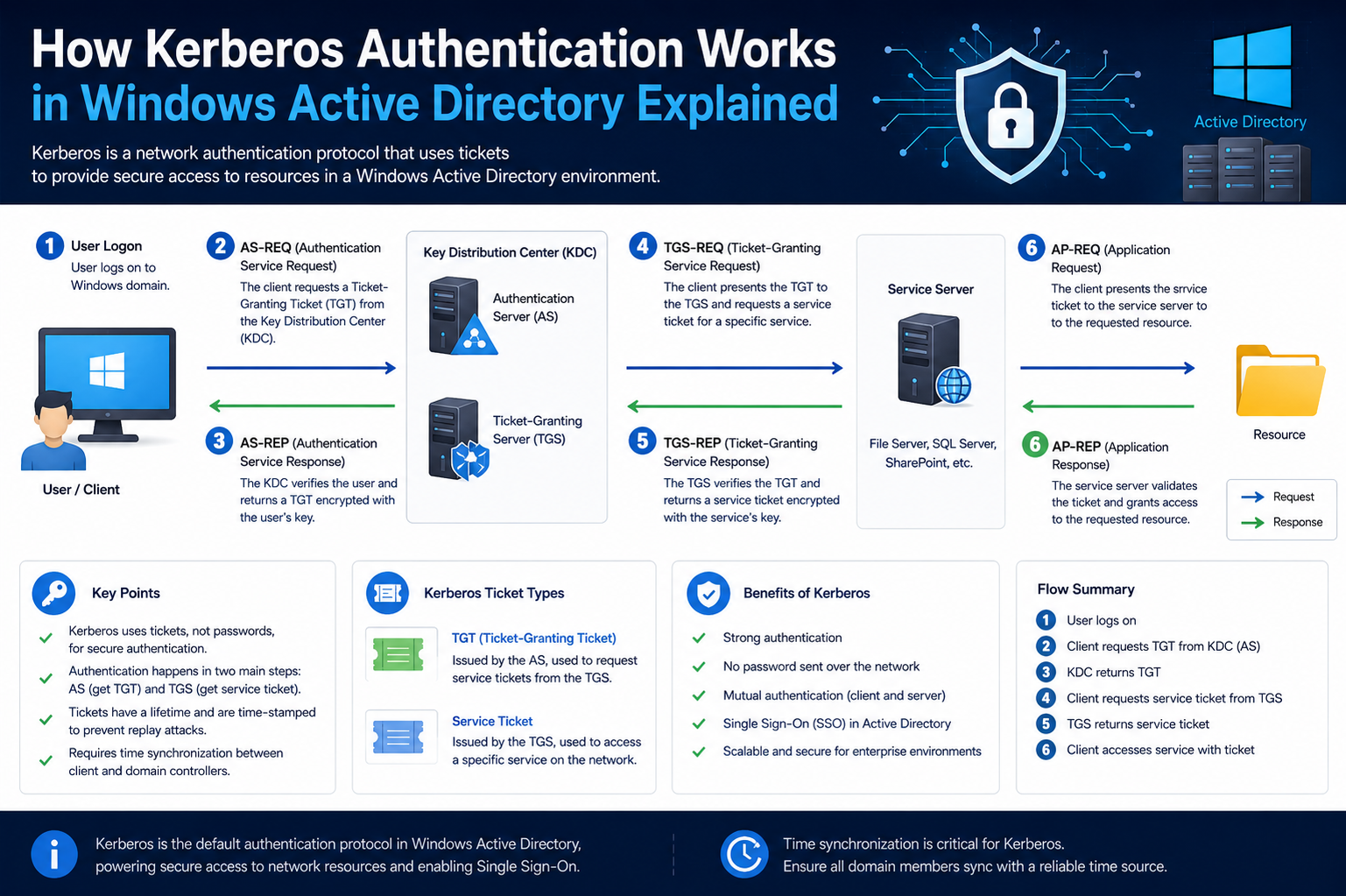
In modern enterprise networks, identity verification is one of the most important foundations that keeps systems secure and usable at the same time. Windows Active Directory relies heavily on a protocol called Kerberos to manage this process. To understand how Kerberos fits into this environment, it helps to first look at why such a system is necessary and what kind of problems it is designed to solve in the first place.
In any networked environment, users constantly attempt to access shared resources such as file servers, applications, printers, and internal services. Each time this happens, the system must confirm that the user is who they claim to be and that they are allowed to use the requested resource. Without a secure and reliable authentication system, malicious actors could easily impersonate legitimate users or intercept sensitive information during transmission.
Kerberos was designed to address these challenges by providing a secure method of authentication that works even in environments where the network itself cannot be fully trusted. This is a crucial point because many people mistakenly assume that internal corporate networks are inherently safe. In reality, any network can be compromised, monitored, or manipulated, whether the threat comes from outside attackers, compromised devices, or internal misuse.
At the core of Kerberos in Active Directory is a centralized authority known as the Key Distribution Center. In Windows environments, this role is performed by the Domain Controller. The Domain Controller is responsible for managing authentication requests and issuing security credentials that allow users to access services without repeatedly entering their passwords.
Kerberos is built around the idea of tickets rather than repeated password verification. Instead of sending a password every time a user tries to access a service, the system issues time-limited tickets that prove the user’s identity. This reduces exposure of sensitive credentials and minimizes the chances of interception.
The first major component involved in this system is the user or client device. This is the machine where the user logs in and initiates access requests. The second component is the service or resource, such as a file server or application server, which the user wants to access. The third and most critical component is the Domain Controller acting as the authentication authority.
When a user logs into a Windows domain environment, the system begins a secure negotiation process with the Domain Controller. Instead of immediately granting access to resources, the system first verifies the user’s identity and issues a special credential known as a Ticket Granting Ticket. This ticket acts like a master pass that allows the user to request additional access tickets without re-entering their password.
This approach is especially important in large organizations where users frequently access multiple services throughout the day. Without a ticket-based system, users would need to authenticate repeatedly, which would be both inefficient and less secure. Kerberos solves this by allowing a single authentication event to be reused securely for multiple service requests.
Another important concept in Kerberos is encryption based on secret keys derived from user credentials. When a user logs in, their password is not transmitted directly across the network. Instead, it is used to generate cryptographic keys that can securely validate identity without exposing the actual password. This ensures that even if network traffic is intercepted, the original credentials remain protected.
Time synchronization also plays a critical role in Kerberos authentication. Every ticket issued has a limited lifetime and is validated based on timestamps. If a device’s clock is not properly synchronized with the Domain Controller, authentication can fail because the system may interpret requests as expired or invalid. This design helps prevent replay attacks, where an attacker attempts to reuse captured authentication data.
Kerberos also introduces the concept of mutual trust between the client and server. Unlike older authentication methods where only the server verifies the client, Kerberos allows both sides to validate each other’s identity. This reduces the risk of impersonation and strengthens overall network security.
Within Active Directory, Kerberos is deeply integrated with user accounts, groups, and domain policies. This integration allows administrators to control access at a granular level while still maintaining a seamless experience for users. Once authenticated, users can move between different services without needing to repeatedly prove their identity, as long as their ticket remains valid.
This balance between security and usability is one of the reasons Kerberos has become the default authentication protocol in Windows environments. It enables secure communication across potentially untrusted networks while maintaining efficiency for everyday operations.
As the system operates, each interaction between a user and a service is carefully governed by ticket exchanges rather than direct password verification. This structure not only reduces the risk of credential theft but also provides a scalable way to manage authentication across large and complex infrastructures.
The foundational design of Kerberos makes it particularly suitable for enterprise environments where thousands of users and services must interact continuously. By centralizing authentication and decentralizing access validation through tickets, it creates a system that is both secure and efficient in practice.
Internal Mechanics of Kerberos Authentication Exchange in Active Directory
The process of Kerberos authentication in Windows Active Directory involves a series of carefully coordinated exchanges between the client, the Domain Controller, and the target service. While the overall idea is based on ticket issuance, the internal workflow is more structured and involves multiple stages that ensure both security and authenticity.
When a user initiates a login, the first interaction occurs with the Authentication Service component of the Domain Controller. At this stage, the user does not yet have permission to access any services. Instead, the system verifies the user’s credentials and issues a foundational ticket that will be used in later steps.
This initial request is commonly known as the Authentication Service Request. The client sends a request that includes the username and other identifying information, but importantly, it does not send the password itself. Instead, cryptographic transformations derived from the password are used to prove identity.
The Domain Controller then checks the user information against its internal database. If the credentials are valid, it responds with an Authentication Service Reply that contains a Ticket Granting Ticket. This ticket is encrypted and can only be used by the same user on the same device for a limited period of time.
The Ticket Granting Ticket is a critical component in the Kerberos system. It acts as a reusable proof of identity that allows the user to request access to different services without re-entering credentials. This significantly reduces authentication overhead and improves security by limiting password exposure.
Once the user has obtained this ticket, the next phase begins when the user attempts to access a specific service such as a file server. At this point, the client communicates with the Ticket Granting Service, another component of the Domain Controller responsible for issuing service-specific tickets.
The client sends a request that includes the Ticket Granting Ticket along with the identity of the service it wants to access. The system verifies the validity of the ticket and confirms that the user is authorized to request access to the specified resource.
If the request is valid, the Ticket Granting Service issues a Service Ticket. This ticket is specifically tied to the requested service and contains information that allows the service to verify the user’s identity and permissions. Each service ticket is unique and cannot be reused for other services.
The Service Ticket is then presented to the target server. At this stage, the server does not need to contact the Domain Controller directly. Instead, it validates the ticket using shared cryptographic keys that were established during the domain setup process. This decentralized validation reduces network load and improves efficiency.
Once the service verifies the ticket, it extracts information about the user’s identity and group memberships. This information is then used to determine what level of access the user should be granted. Access control decisions are made locally based on this trusted ticket data.
One of the important design features in this system is that passwords are never transmitted during the service access phase. After the initial authentication, all subsequent interactions rely on encrypted tickets. This significantly reduces the risk of credential interception.
Another important aspect is the concept of service principal names. Each service in the network is assigned a unique identity that allows Kerberos to distinguish between different resources. This ensures that tickets are issued correctly and cannot be misused across unrelated services.
The entire authentication flow is designed to minimize direct communication with the Domain Controller once the initial ticket has been issued. This reduces bottlenecks and allows the system to scale efficiently across large networks with many users and services.
Security in this process is reinforced through encryption at every stage. Tickets are encrypted using secret keys known only to the relevant components, ensuring that even if intercepted, they cannot be easily modified or reused by attackers.
Another important element is the time-based validity of tickets. Each ticket includes an expiration period, after which it becomes invalid. This ensures that even if a ticket is compromised, its usefulness is limited to a short window of time.
The interaction between authentication and service access in Kerberos creates a layered security model. Each stage of the process builds upon the previous one, ensuring that only properly authenticated users can move forward to request service-level access.
This structured exchange between client, authentication service, ticket granting service, and target server forms the backbone of secure identity management in Windows Active Directory environments.
Real-World Behavior, Security Considerations, and Operational Challenges in Kerberos Systems
In practical enterprise environments, Kerberos does not operate in isolation. It functions as part of a broader authentication ecosystem within Windows Active Directory, interacting with system policies, network conditions, and organizational structures. While its design is robust, real-world usage introduces several operational factors that influence its behavior.
One of the most important aspects affecting Kerberos functionality is time synchronization across network devices. Because tickets rely heavily on timestamps for validity, even small differences in system clocks can cause authentication failures. If a client’s system time drifts too far from the Domain Controller’s time, tickets may be rejected as invalid or expired. This makes consistent time management a critical requirement in domain environments.
Network reliability also plays a significant role. Although Kerberos reduces the need for repeated communication with the Domain Controller, initial authentication and ticket renewal processes still depend on stable connectivity. Interruptions during these exchanges can lead to authentication delays or temporary access issues.
Another factor that influences Kerberos behavior is the presence of multiple domains or trust relationships. In large organizations, it is common for different Active Directory domains to trust each other. In such cases, Kerberos tickets may need to be forwarded or validated across domain boundaries. This adds complexity to the authentication process and requires careful configuration of trust relationships.
Security considerations remain central to how Kerberos operates in practice. One of its strengths is the reduction of password exposure, but this does not eliminate all risks. Attackers may still attempt to exploit ticket-granting processes, intercept cached credentials, or perform replay-based attacks if additional safeguards are not in place.
To mitigate such risks, Kerberos relies on encryption keys derived from user credentials and system secrets. Even if network traffic is captured, the encrypted tickets cannot be easily decoded without the appropriate keys. This layered encryption model significantly increases the difficulty of unauthorized access.
Another real-world challenge is ticket caching on client devices. Once a user is authenticated, their system stores tickets locally to improve performance and reduce repeated authentication requests. While this improves usability, it also introduces a potential risk if the device is compromised. An attacker with access to cached tickets may attempt to reuse them within their valid time window.
Service availability is another factor that can influence Kerberos performance. Since services rely on validating tickets, any misconfiguration in service identities or encryption keys can result in authentication failures. These issues often appear as access denied errors even when user credentials are correct.
In environments with high user activity, ticket renewal and expiration cycles must be carefully managed. Users may remain logged in for extended periods, requiring systems to refresh tickets without interrupting active sessions. This balance between security and usability is a key operational consideration.
Kerberos also interacts closely with group membership and access control policies within Active Directory. When a service ticket is issued, it includes information about user roles and group affiliations. Changes to group membership may not take immediate effect until new tickets are issued, which can sometimes create delays in permission updates.
Comparing Kerberos with older authentication methods highlights its advantages in both security and efficiency. Unlike systems that repeatedly transmit passwords, Kerberos minimizes credential exposure and centralizes authentication decisions. However, this also means that the Domain Controller becomes a critical infrastructure component whose availability directly impacts authentication across the entire network.
Troubleshooting Kerberos-related issues often involves examining time synchronization, ticket validity, service identity configuration, and trust relationships. Since the system is highly structured, even small configuration errors can lead to widespread authentication problems.
Despite these complexities, Kerberos remains a foundational element in Windows Active Directory because it provides a scalable and secure method for managing identity in large and dynamic environments.
Advanced Kerberos Architecture, Delegation Models, and Enterprise Security Dynamics in Active Directory
As Windows Active Directory environments grow in size and complexity, Kerberos evolves from being a simple authentication mechanism into a deeply integrated identity infrastructure that supports advanced enterprise requirements. Beyond basic ticket issuance and validation, Kerberos enables sophisticated behaviors such as delegation of authority, cross-service identity propagation, and secure access across domain and forest boundaries. These advanced capabilities are essential in modern organizations where applications are distributed, services depend on each other, and users expect seamless access across multiple systems.
One of the most important advanced features of Kerberos in Active Directory is delegation. Delegation allows a service to act on behalf of a user when accessing other services. This becomes critical in multi-tier application architectures where a front-end service must retrieve data from a back-end system using the identity of the original user rather than its own system identity.
In such scenarios, Kerberos ensures that identity is preserved securely as it moves between services. Without delegation, intermediate services would need to either store user credentials or operate under a generic service account, both of which introduce security limitations and reduce traceability. Delegation solves this by allowing controlled impersonation under strict security rules.
There are multiple forms of delegation, each with different security implications. Unconstrained delegation is the oldest and least restrictive model. In this approach, a service is allowed to impersonate a user and access any downstream service without limitations. While this provides maximum flexibility, it also introduces significant risk if the service is compromised, as attackers could potentially impersonate users across the entire domain.
To address these risks, constrained delegation was introduced. This model restricts which services a delegated identity can access. Instead of unrestricted impersonation, administrators explicitly define which backend services a front-end service is allowed to interact with. This reduces the attack surface and provides more granular control over identity flow.
A more advanced variation involves resource-based constrained delegation, where the target service itself defines which services are allowed to delegate to it. This shifts control from the front-end system to the resource being accessed, creating a more secure and decentralized trust model.
Another critical concept in Kerberos within Active Directory is protocol transition. This mechanism allows a service to obtain a Kerberos ticket on behalf of a user even when the user did not initially authenticate using Kerberos. For example, a user might authenticate using a different method such as a password-based system, but still needs to access Kerberos-protected services. Protocol transition enables seamless integration without requiring the user to reauthenticate.
At the heart of Kerberos identity management is a structure known as the Privilege Attribute Certificate. This component is embedded within Kerberos tickets and contains information about the user’s identity, group memberships, and authorization data. When a service receives a ticket, it relies on this embedded information to make access control decisions without needing to query the Domain Controller again.
The Privilege Attribute Certificate is signed by the Domain Controller, ensuring that it cannot be altered by clients or intermediary systems. This integrity protection is essential because services depend on this data to enforce security policies. If the certificate were compromised, it could potentially allow unauthorized privilege escalation.
Service Principal Names play a critical role in ensuring that Kerberos tickets are correctly issued and validated. Each service in Active Directory is assigned a unique identifier that binds it to a specific network resource. This allows the Key Distribution Center to differentiate between services even if they are running under the same system account.
Incorrect or duplicate service principal name configurations can lead to authentication failures or security vulnerabilities. For example, if two services share the same identity, tickets may be issued incorrectly, potentially allowing unauthorized access or service impersonation. As environments scale, managing service principal names becomes a crucial administrative task.
Encryption algorithms used within Kerberos have also evolved significantly over time. Early implementations relied on weaker cryptographic methods, but modern Active Directory environments predominantly use stronger encryption standards such as AES. This ensures that tickets remain secure even in the presence of advanced interception techniques.
Kerberos authentication is also tightly integrated with domain and forest trust relationships in Active Directory. In multi-domain environments, users often need to access resources located in different domains. Kerberos handles this through a process known as referral authentication, where the Domain Controller redirects ticket requests across trusted domains.
When a user from one domain attempts to access a resource in another, the initial Domain Controller issues a referral ticket that points to the trusted domain. The user then interacts with the target domain’s authentication service to obtain a service-specific ticket. This process maintains security boundaries while enabling cross-domain resource access.
In forest-level trust scenarios, Kerberos extends this model even further by allowing authentication to flow across multiple interconnected domains. This is especially important in large organizations that operate segmented identity infrastructures while still requiring unified access to shared resources.
In modern hybrid environments, Kerberos has also been adapted to work alongside cloud-based identity systems. Organizations that integrate on-premises Active Directory with cloud identity platforms rely on mechanisms that allow Kerberos-based authentication to extend into cloud applications. This creates a seamless experience where users can authenticate once and access both local and cloud services without repeated sign-ins.
Despite its robustness, Kerberos is also a frequent target for sophisticated attack techniques. One of the most well-known categories of attacks involves ticket manipulation. Since Kerberos relies on tickets rather than continuous credential verification, attackers who obtain valid tickets may attempt to reuse them to gain unauthorized access.
In a pass-the-ticket scenario, an attacker extracts a valid service or authentication ticket from a compromised system and reuses it on another machine. Because the ticket is already cryptographically valid, the system may accept it without requiring additional authentication, depending on timing and configuration.
Another advanced attack involves the creation of forged tickets, often referred to as golden ticket attacks. In such cases, attackers who gain access to critical cryptographic material from the Domain Controller can generate entirely new authentication tickets that appear legitimate to the system. These attacks are particularly dangerous because they can grant long-term, domain-wide access if not detected.
A related technique targets service tickets specifically, allowing attackers to impersonate services or escalate privileges within a limited scope. While more constrained than domain-wide forgery, these attacks can still provide significant access to sensitive resources.
To counter these risks, modern Active Directory environments rely on multiple layers of defense. Regular rotation of cryptographic keys, strict control of administrative privileges, and continuous monitoring of authentication events are all essential components of Kerberos security management.
Logging and auditing play an important role in maintaining visibility over Kerberos activity. Each authentication event generates detailed records within the system, allowing administrators to track ticket issuance, service access, and potential anomalies. These logs are often analyzed to detect patterns that may indicate misuse or compromise.
From an operational perspective, troubleshooting Kerberos issues often requires a deep understanding of ticket lifecycles, encryption compatibility, and domain configuration. Common problems include service principal name mismatches, clock synchronization errors, and replication delays between Domain Controllers.
In large environments, multiple Domain Controllers share responsibility for issuing tickets. These controllers must remain synchronized to ensure consistent authentication behavior. Replication delays or inconsistencies between controllers can lead to intermittent authentication failures that are difficult to diagnose.
Kerberos performance is also influenced by network topology and traffic distribution. Since authentication depends on communication with Domain Controllers, poorly designed network structures can create bottlenecks during peak usage periods. Proper placement of authentication services within the network is therefore essential for maintaining responsiveness.
Another important aspect of enterprise Kerberos architecture is the separation of authentication and authorization responsibilities. While Kerberos confirms identity through ticket issuance, actual access decisions are enforced by individual services based on group memberships and policy configurations. This separation allows for flexible and scalable security management.
As environments become more distributed, the role of Kerberos continues to evolve. Even in systems that incorporate modern identity platforms and cloud-based authentication, Kerberos remains a foundational component for internal authentication processes. Its ticket-based model continues to provide a reliable balance between security, scalability, and performance.
Within large enterprise ecosystems, Kerberos is not just an authentication protocol but a central mechanism that binds together identity, access control, and service communication. Its integration into Windows Active Directory ensures that users can move seamlessly across complex infrastructures while maintaining a secure and verifiable identity at every step.
The depth of Kerberos functionality in Active Directory reflects the complexity of modern computing environments. From basic login authentication to advanced delegation, cross-domain trust, and hybrid identity integration, the protocol continues to serve as a cornerstone of secure enterprise operations.
As organizations expand their digital ecosystems, the importance of understanding these advanced Kerberos mechanisms becomes even more significant. The interactions between tickets, services, domains, and encryption layers form a highly structured system that underpins much of modern network security architecture.
Deep Kerberos Internals, Troubleshooting Realities, and Security Hardening in Windows Active Directory
As Kerberos operates inside Windows Active Directory environments, its behavior becomes far more intricate than the basic ticket exchange model typically described in introductory explanations. In real-world systems, authentication is not just a clean sequence of requests and responses. It is influenced by encryption standards, system policies, domain architecture, network behavior, and even subtle timing and naming dependencies. Understanding these deeper layers is essential for diagnosing issues, strengthening security, and maintaining reliable authentication across enterprise systems.
One of the most important internal aspects of Kerberos is its structured request flow between the client and the Domain Controller. Although this process is often simplified conceptually, it actually consists of distinct phases that include initial authentication, ticket-granting communication, and service-specific ticket requests. Each phase has its own validation logic and encryption dependencies.
During initial authentication, the client begins by requesting access to the authentication service component of the Domain Controller. This stage is where the system verifies identity and establishes the first secure credential. Modern Windows environments rely heavily on pre-authentication, which ensures that the client proves knowledge of the correct cryptographic key derived from the user’s password before any ticket is issued. This prevents many forms of offline password guessing attacks that were more feasible in earlier implementations.
Once pre-authentication is successful, the Domain Controller issues a Ticket Granting Ticket. This ticket is encrypted using a key that only the Domain Controller can validate, ensuring that it cannot be forged or modified by the client. The ticket is then stored locally on the client machine, typically within a protected memory area managed by the Local Security Authority Subsystem Service. This memory-based storage allows fast reuse while maintaining security boundaries.
At this stage, the client can request service-specific tickets without re-entering credentials. This is where the second major communication phase begins. The client sends a request to the ticket-granting service, presenting the Ticket Granting Ticket along with the identity of the target service. The system verifies both the ticket and the request parameters before issuing a new service-specific ticket.
Each service ticket is tightly bound to a specific service identity and includes encrypted metadata that describes the user’s privileges. This ensures that even if the ticket is intercepted, it cannot be repurposed for another service or modified without detection. The cryptographic integrity of these tickets is a fundamental strength of Kerberos.
Modern Kerberos implementations in Windows Active Directory also support multiple encryption types. Historically, weaker algorithms such as RC4 were widely used, but modern environments increasingly rely on AES-based encryption. AES provides stronger resistance against cryptographic attacks and ensures that both ticket-granting tickets and service tickets remain secure even in high-risk environments.
Despite its strength, Kerberos relies heavily on correct system configuration. One of the most common sources of authentication failure is time synchronization. Because tickets are time-sensitive, even small differences between client and Domain Controller clocks can lead to rejection. The system enforces strict time windows to prevent replay attacks, but this also means that poorly synchronized systems may experience intermittent authentication issues that appear random from a user perspective.
Another critical dependency is name resolution. Kerberos relies on correctly resolving service identities to their corresponding service principal names. When a client attempts to access a service, it must locate the correct identity for that service through directory lookups and DNS-based resolution. If DNS records are misconfigured or outdated, authentication may fail even though the underlying credentials are correct.
Service principal names themselves are a central component of Kerberos operation. These identifiers map services to domain accounts and ensure that tickets are issued to the correct destination. In complex environments where multiple services run under shared accounts, improper configuration of service principal names can result in ambiguous or invalid ticket issuance. This often leads to access denial errors that are difficult to trace without detailed directory inspection.
Kerberos also supports ticket renewal and forwardability, which allows sessions to remain active over extended periods without requiring repeated authentication. Renewable tickets extend the usability of authentication sessions beyond their initial lifetime, while forwardable tickets allow identity propagation across multiple services. These features are essential in enterprise environments where long-running sessions and multi-service workflows are common.
However, extended ticket lifetimes also introduce potential security considerations. Longer validity increases the window of opportunity for misuse if a ticket is compromised. For this reason, organizations often enforce strict policies on ticket duration, renewal limits, and reauthentication frequency.
In Windows environments, Kerberos operates closely with system-level security components. The Local Security Authority Subsystem Service plays a key role in storing and managing tickets. It ensures that credentials are protected in memory and that only authorized system processes can access them. This integration between Kerberos and operating system security is one of the reasons Windows authentication is considered tightly controlled.
From a diagnostic perspective, Kerberos issues often manifest as access failures that appear inconsistent or intermittent. One common scenario involves service principal name mismatches, where a service is accessed using a name that does not match its registered identity. In such cases, the Domain Controller cannot issue a valid ticket, resulting in authentication failure even though the user is properly authenticated.
Another frequent issue involves delegation misconfiguration. When services attempt to act on behalf of users, incorrect delegation settings can prevent ticket forwarding or cause access to fail at downstream services. These issues are often difficult to detect because the initial authentication succeeds, but failure occurs only during service-to-service communication.
Replication delays between Domain Controllers can also impact Kerberos behavior. In environments with multiple controllers, authentication data must be consistently synchronized. If replication is delayed, a user may authenticate successfully against one controller but experience inconsistencies when accessing resources governed by another. This can lead to confusing behavior where access appears to work in some cases but fail in others.
Kerberos is also sensitive to domain trust configurations. In multi-domain environments, trust relationships determine how authentication requests are forwarded across boundaries. If trust relationships are incorrectly configured or partially broken, ticket referral processes may fail, preventing cross-domain access even when individual domain authentication is functioning correctly.
Security hardening in Kerberos environments involves multiple layers of protection. One important strategy is disabling outdated encryption types that are no longer considered secure. By enforcing stronger encryption standards, organizations reduce the risk of ticket decryption through brute-force or legacy vulnerabilities.
Another key security measure involves restricting delegation capabilities. Since delegation allows identity propagation across services, limiting which services can delegate on behalf of users reduces the risk of privilege escalation. Resource-based control mechanisms are particularly effective because they place authority at the service level rather than the originating system.
Monitoring and auditing also play a critical role in maintaining Kerberos security. Authentication events are recorded in system logs, allowing administrators to track ticket issuance, service access, and potential anomalies. These logs can reveal patterns such as repeated authentication failures, unusual ticket requests, or unexpected service access behaviors.
Advanced monitoring often focuses on detecting anomalies in ticket usage patterns. For example, unusually long-lived tickets, repeated service ticket requests for uncommon services, or authentication attempts from unexpected systems may indicate compromised credentials or malicious activity.
Another important area of Kerberos behavior involves fallback authentication mechanisms. In some cases where Kerberos cannot be used, systems may revert to alternative authentication protocols. This fallback behavior can introduce security inconsistencies if not properly controlled, as alternative methods may not provide the same level of protection as Kerberos.
Kerberos authentication is also closely tied to domain controller discovery. Clients locate authentication services using directory-based queries and network-level service discovery mechanisms. If domain controllers are not properly advertised or if network segmentation restricts discovery, authentication requests may fail even if services are otherwise operational.
In high-scale environments, Kerberos performance can be influenced by authentication load distribution. Domain controllers must handle large volumes of ticket requests, especially during peak login periods. Proper load balancing and geographic distribution of controllers helps ensure consistent authentication performance.
Another subtle but important aspect of Kerberos behavior is ticket caching behavior on client systems. Cached tickets improve performance by reducing repeated authentication requests, but they also introduce complexity when changes occur in user permissions. If a user’s group membership changes, cached tickets may not immediately reflect updated permissions until renewal occurs.
Kerberos also interacts with modern security enhancements in Windows operating systems. Features such as credential protection, isolated token storage, and secure memory management further enhance the security of ticket handling. These protections reduce the risk of credential extraction from memory, which has historically been a target in advanced attacks.
From an operational perspective, understanding Kerberos requires awareness of how multiple system components interact simultaneously. Authentication is not a single event but a continuous lifecycle involving ticket issuance, renewal, validation, and expiration. Each stage depends on multiple system services working together correctly.
When issues arise, diagnosing Kerberos problems often requires analyzing several layers simultaneously, including network connectivity, DNS resolution, system time synchronization, service identity configuration, encryption compatibility, and domain trust status. Because these components are interdependent, even small misconfigurations can produce widespread authentication issues.
Ultimately, Kerberos in Windows Active Directory represents a highly structured and deeply integrated authentication system. Its strength lies in its layered design, where identity is validated through cryptographic tickets rather than repeated credential transmission. However, this same complexity means that successful operation depends on precise configuration, careful monitoring, and a clear understanding of how each component contributes to the overall authentication process.
Extended Deep Dive: Kerberos Token Behavior Inside Windows Memory Systems
When Kerberos tickets are issued in a Windows Active Directory environment, they do not simply exist as abstract credentials. They are actively managed within the operating system’s secure memory structures. The Local Security Authority Subsystem Service plays a central role in storing and protecting these tickets, ensuring they remain available for authentication while being shielded from unauthorized access.
Inside a logged-in session, Kerberos tickets exist in a structured cache that separates different ticket types, including ticket-granting tickets and service tickets. This cache is not permanent storage; it is volatile and tied to the user session lifecycle. When a user logs off or the system restarts, these cached credentials are cleared, forcing reauthentication.
This design ensures that even if a system is compromised physically or through malware, long-term persistence of authentication tickets is limited. However, in-memory attacks remain a concern in highly targeted environments. Attackers who gain elevated privileges on a system may attempt to extract cached tickets from memory for reuse.
To counter such risks, modern Windows systems implement additional protections such as credential isolation and memory encryption. These mechanisms reduce the exposure of sensitive authentication artifacts even during runtime.
Extended Behavior: How Kerberos Handles Service Chains in Multi-Tier Architectures
In enterprise environments, applications rarely operate in isolation. A single user request often flows through multiple backend systems, each requiring authentication. This creates what is known as a service chain, where identity must be securely propagated across several services.
Kerberos handles this through delegated ticket forwarding and constrained identity propagation. When properly configured, a front-end service can request a service ticket not only for itself but also on behalf of the user for downstream services.
However, this chain is strictly controlled. Each hop in the chain requires validation, and each service must explicitly trust the delegation relationship. If any link in the chain is misconfigured, authentication breaks at that point, even if earlier stages succeed.
This is one of the most common reasons why enterprise applications experience intermittent access failures that are difficult to trace. The user appears authenticated, the first service responds correctly, but downstream systems reject the request due to missing or invalid delegated identity tokens.
Extended Security Layer: Kerberos and Attack Surface Expansion in Enterprise Networks
While Kerberos significantly improves authentication security, its complexity introduces a broader attack surface that advanced threat actors may attempt to exploit.
One area of concern is ticket extraction from compromised endpoints. If an attacker gains administrative access to a workstation, they may attempt to retrieve cached Kerberos tickets and reuse them on other systems. This type of attack is particularly effective because it bypasses password-based authentication entirely.
Another risk involves privilege escalation through misconfigured delegation. If a service is incorrectly granted broad delegation rights, an attacker who compromises that service can potentially impersonate users across multiple systems.
Kerberos also becomes vulnerable when encryption downgrades are allowed. Legacy compatibility modes that support weaker cryptographic algorithms can be exploited if not properly disabled. This is why modern environments increasingly enforce strict encryption policies that eliminate outdated algorithms entirely.
Conclusion
Kerberos plays a central role in securing authentication within Windows Active Directory, forming the backbone of identity management in modern enterprise environments. Its ticket-based system replaces traditional password transmission with encrypted credentials that can be safely reused across multiple services, significantly reducing exposure to credential theft. By relying on a trusted third-party mechanism through the Domain Controller, Kerberos ensures that both users and services can verify each other’s identity in a controlled and secure manner.
One of its most important strengths lies in its balance between security and usability. Users authenticate once and gain access to multiple resources without repeatedly entering credentials, while organizations benefit from reduced authentication traffic and centralized control. At the same time, the use of time-limited tickets, cryptographic encryption, and strict validation rules ensures that security is not compromised for convenience.
However, Kerberos is not without complexity. Its dependency on accurate time synchronization, proper service configuration, and correctly managed domain infrastructure means that small misconfigurations can lead to authentication failures that are often difficult to diagnose. In large environments, replication delays, delegation misconfigurations, and service identity mismatches can further complicate troubleshooting.
Despite these challenges, Kerberos remains one of the most reliable and widely adopted authentication protocols in enterprise computing. Its deep integration with Active Directory, support for delegation, and ability to operate across distributed systems make it essential for modern network architectures. As organizations continue to evolve toward hybrid and cloud-integrated environments, the principles behind Kerberos continue to influence secure authentication design, reinforcing its long-standing importance in enterprise security ecosystems.