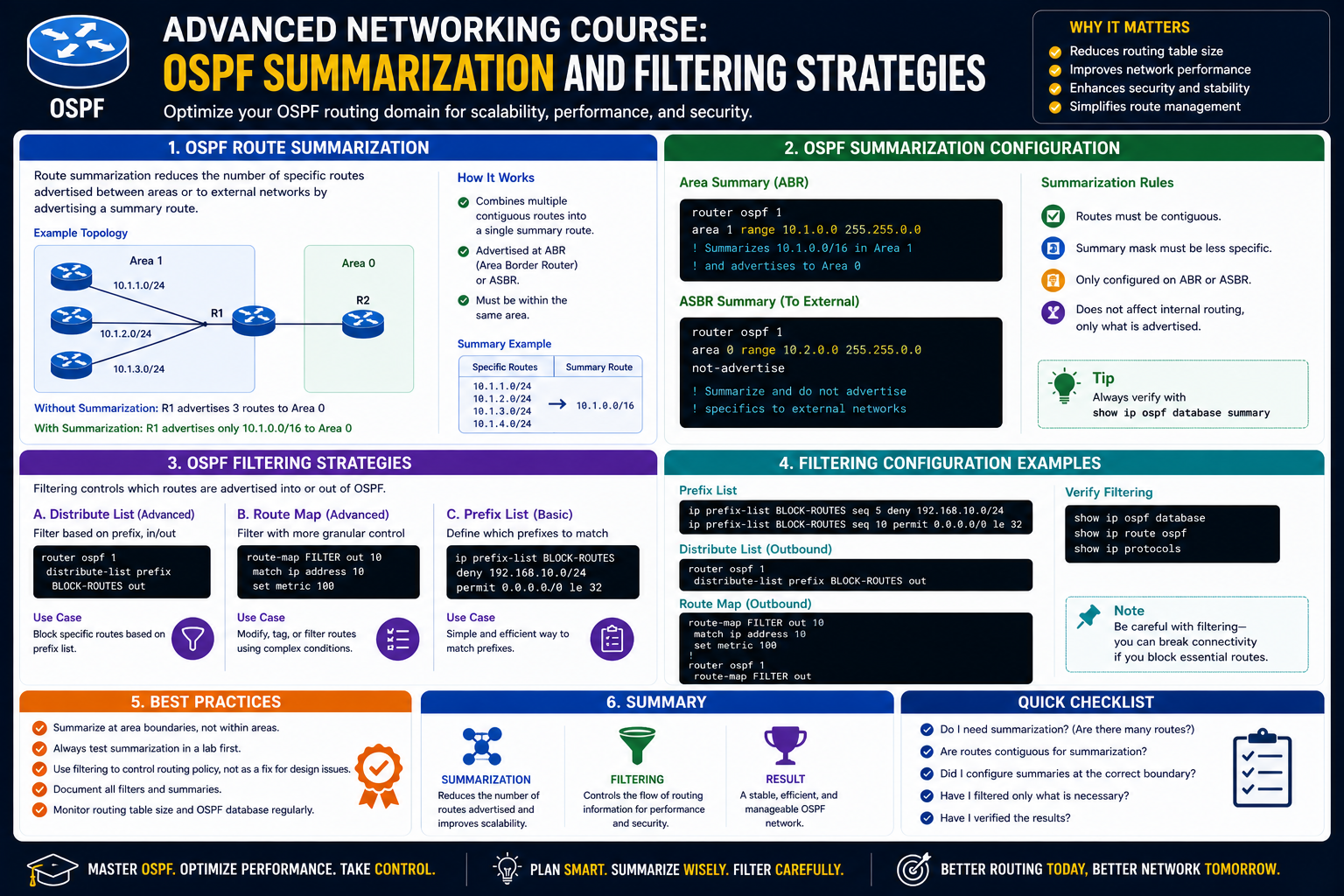
In modern enterprise networking, efficiency is not just a preference but a necessity. As networks grow in size and complexity, the amount of routing information exchanged between devices increases significantly. This growth can lead to higher CPU usage, larger routing tables, and slower convergence times when changes occur in the network. Open Shortest Path First, commonly known as OSPF, addresses many routing challenges, but without careful design, even OSPF networks can become burdened with unnecessary routing information.
Two of the most powerful techniques used to improve OSPF performance and scalability are route summarization and route filtering. These mechanisms allow network administrators to control how routing information is advertised and processed across different areas and boundaries of an OSPF domain. Understanding how and where to apply these techniques is essential for maintaining stable and efficient routing behavior.
OSPF operates as a link-state routing protocol, meaning each router builds a complete map of the network topology within its area. While this provides fast and accurate routing decisions, it also means that every change in the network can generate updates that must be processed by all participating routers. As networks expand, this constant exchange of detailed route information can become overwhelming.
Summarization helps reduce this burden by grouping multiple specific routes into a single, more general route advertisement. Instead of sending dozens or hundreds of individual network prefixes, a router can advertise a single summarized route that represents a range of networks. This reduces the size of routing tables and limits the amount of information that must be processed during updates.
Filtering, on the other hand, provides control over which routes are allowed to pass between different parts of the network. While summarization reduces the number of routes by combining them, filtering can completely block certain routes from being advertised or accepted. Together, these techniques allow for precise control over routing behavior, improving both performance and security.
The Role of OSPF in Large-Scale Network Design
OSPF is widely used in enterprise and service provider networks due to its scalability and fast convergence. It divides networks into hierarchical structures known as areas. This design helps limit the scope of routing updates and reduces unnecessary processing on routers that do not need to know the full network topology.
Within this hierarchical structure, different types of routers play specific roles. Internal routers operate within a single area, while Area Border Routers connect multiple areas together. There are also routers that connect OSPF to external routing domains, often referred to as Autonomous System Boundary Routers. Each of these roles has different responsibilities when it comes to handling and distributing routing information.
As data moves between these different roles, the importance of summarization and filtering becomes more apparent. Without these mechanisms, every router could potentially receive every route from every part of the network. This would not only waste resources but could also lead to instability in large environments.
By strategically placing summarization points at area boundaries and external connection points, network designers can significantly reduce the complexity of routing tables throughout the network. Filtering adds another layer of control by allowing administrators to decide exactly which routes should be visible in specific areas or propagated to external networks.
Why Route Summarization Matters in OSPF
Route summarization in OSPF is primarily used to reduce the size of routing tables and minimize the amount of link-state information that must be processed. When a router receives a large number of individual network routes, it must store each entry, compute the best paths, and continuously update this information as changes occur. This process consumes both memory and CPU resources.
By summarizing routes, multiple contiguous networks can be represented as a single advertisement. This significantly reduces the number of entries in the routing table and decreases the frequency and size of updates exchanged between routers.
Unlike some other routing protocols, OSPF does not support automatic summarization. This means that summarization must be explicitly configured by the network administrator. Additionally, OSPF does not allow summarization within a single area. Instead, summarization is performed at specific boundary points where different areas or routing domains connect.
This design decision ensures that detailed topology information remains consistent within each area while still allowing for aggregation at strategic points in the network. As a result, OSPF maintains its accuracy and loop-free nature while also benefiting from reduced routing overhead.
Understanding Area Border Routers in Summarization
Area Border Routers play a critical role in OSPF summarization. These routers connect multiple OSPF areas and are responsible for exchanging routing information between them. Because they sit at the boundary of areas, they are the ideal location for applying summarization techniques.
When an Area Border Router receives detailed route information from one area, it can summarize that information before advertising it into another area. This reduces the number of routes that need to be shared and simplifies the routing table of the receiving area.
For summarization to work effectively at this level, the networks being summarized must be contiguous. This means they should fall within a logical numeric range that can be represented by a single summary address. The router then advertises this single summary instead of multiple individual routes.
One important behavior of OSPF summarization is that a summary route is only advertised if at least one subnet exists within the defined range. If no matching subnet is present, the summary route will not be generated. This ensures that routing information remains accurate and prevents unnecessary or empty route advertisements.
Another key characteristic is that the cost of the summary route is determined based on the lowest cost route within the summarized range. This ensures that the most efficient path is represented in the summary, maintaining optimal routing decisions across the network.
The Importance of Autonomous System Boundary Routers
While Area Border Routers handle summarization between OSPF areas, Autonomous System Boundary Routers manage routing information between OSPF and external routing domains. These external domains may include other routing protocols or separate administrative networks.
When routes are redistributed into OSPF from external sources, the volume of routing information can increase significantly. Without summarization, every external route would be individually advertised throughout the OSPF domain, leading to unnecessary complexity.
ASBRs provide a point where these external routes can be summarized before being introduced into the OSPF environment. This helps control the size of routing tables and reduces the impact of external routing changes on internal OSPF stability.
In large-scale networks, external route summarization is especially important because it prevents the internal OSPF structure from being overwhelmed by detailed external routing information. Instead, only essential summarized routes are propagated, keeping the internal routing environment clean and manageable.
Loop Prevention and the Role of Null Interfaces
One of the critical aspects of OSPF summarization is loop prevention. When a router creates a summary route, it also generates a mechanism to ensure that traffic destined for non-existent subnets within that summary does not circulate endlessly within the network.
To achieve this, OSPF creates a null interface for the summary route. This null interface acts as a discard mechanism. If a packet arrives at the router for a destination that falls within the summary range but does not match any specific subnet, the packet is sent to the null interface and discarded.
This behavior prevents routing loops and ensures that incorrect or outdated routing information does not cause traffic to circulate indefinitely. It is a fundamental safety mechanism that supports the use of summarization in OSPF without compromising network stability.
Introduction to Route Filtering in OSPF Environments
While summarization focuses on reducing the number of routes by combining them, filtering focuses on controlling which routes are allowed to be advertised or received. Filtering provides a more granular level of control over routing information flow.
In OSPF, filtering is typically applied at key boundary points such as Area Border Routers and Autonomous System Boundary Routers. This ensures that only relevant routing information is shared between different parts of the network.
Filtering can be used for several purposes. It can prevent certain routes from being advertised into specific areas, restrict the visibility of sensitive networks, or control how external routes are integrated into the OSPF domain.
Unlike summarization, which reduces the size of routing information, filtering selectively removes routes entirely. This makes it a powerful tool for controlling network design and enforcing routing policies.
Filtering at Area Boundaries and Its Strategic Importance
When filtering is applied at Area Border Routers, it directly influences which routes are visible in each OSPF area. This allows network administrators to create isolated routing views for different parts of the network.
For example, certain areas may not need to know about specific internal subnets. By filtering those routes at the boundary, the network can reduce unnecessary routing information and improve overall efficiency.
Filtering at this level must be carefully designed, as incorrect configuration can lead to unreachable networks or incomplete routing information. Unlike summarization, which is generally additive and compressive, filtering is restrictive and can completely remove routes from the routing process.
This makes it a powerful but sensitive tool that must be used with a clear understanding of network topology and traffic requirements.
Local Route Control Within OSPF Domains
In addition to filtering at boundaries, OSPF also allows for more localized control over routing information. This includes the ability to influence how routes are processed within a single area or router.
Local filtering can be used to prevent certain routes from being installed into the routing table, even if they are received from OSPF neighbors. This provides an additional layer of control over routing behavior at the device level.
Such mechanisms are often used in complex network environments where specific routing policies must be enforced without affecting the entire OSPF domain. By combining local filtering with area-based filtering and summarization, network designers can achieve highly customized routing behavior.
Filtering at External Boundaries and Route Control
When dealing with Autonomous System Boundary Routers, filtering becomes especially important. External routes introduced into OSPF can come from a variety of sources, and not all of them may be desirable within the internal routing structure.
Filtering at this level allows administrators to control which external routes are accepted and propagated throughout the OSPF domain. This helps maintain stability and prevents unnecessary routing information from entering the internal network.
In large environments, external route filtering is often combined with summarization to ensure that only essential and compact routing information is shared. This reduces overhead and improves overall network performance.
Interaction Between Summarization and Filtering in OSPF Design
Although summarization and filtering are distinct techniques, they often work together in OSPF network design. Summarization reduces the number of routes by aggregation, while filtering ensures that only relevant routes are included in the first place.
When used together, these techniques allow for highly optimized routing structures. Summarization reduces complexity, while filtering enforces policy and control. This combination is essential for building scalable and efficient OSPF networks, especially in large enterprise or service provider environments.
Network engineers must carefully plan where to apply each technique to ensure that routing remains accurate, efficient, and predictable. Improper use of either summarization or filtering can lead to routing inefficiencies or even connectivity issues.
Foundations for Advanced OSPF Traffic Control
Understanding the fundamental concepts of summarization and filtering provides the groundwork for more advanced OSPF configurations. These include traffic engineering, route manipulation, and hierarchical network design strategies.
As networks continue to grow, the importance of controlling routing information becomes even more critical. Without proper summarization and filtering, even well-designed OSPF networks can become inefficient and difficult to manage.
The ability to strategically reduce routing complexity while maintaining accurate network connectivity is one of the key skills required in advanced network engineering.
Understanding OSPF Area Border Router Summarization in Depth
Area Border Routers sit at the core of OSPF’s hierarchical design, acting as the bridge between different OSPF areas. Their role in summarization is not just a convenience feature but a structural necessity for keeping large networks manageable. When an ABR performs summarization, it is essentially translating detailed routing information from one area into a simplified representation before passing it into another area.
Inside a single OSPF area, routers maintain a synchronized link-state database that contains very detailed information about every reachable network within that area. However, when that information is passed across an area boundary, the level of detail does not always need to remain the same. This is where ABR-based summarization becomes important.
Instead of advertising every individual subnet from one area into another, the ABR groups them into a single summarized route. This reduces the number of entries that must be installed in the receiving area’s routing tables. More importantly, it reduces the number of link-state advertisements that need to be processed, which directly improves CPU efficiency and network scalability.
The summarization process at an ABR is based on contiguous IP addressing. The router identifies a range of networks that can logically be represented as a single prefix. Once identified, it replaces multiple specific advertisements with a broader summary advertisement.
This process does not change the actual topology inside the originating area. The detailed structure remains intact locally, ensuring that intra-area routing continues to function with full precision. The summarization only affects how information is exported to other areas.
One of the most important characteristics of ABR summarization is that it is directional. A summary created in one direction does not automatically apply in the reverse direction. This allows network designers to control how information flows between areas independently, enabling more flexible routing architectures.
Behavior of Summarized Routes Between OSPF Areas
When a summarized route is advertised from one area into another, it behaves differently from a standard detailed route. Instead of pointing to multiple specific destinations, the summary route represents a broader range of possible destinations.
This abstraction simplifies routing decisions for routers in the receiving area. They no longer need to maintain individual entries for each subnet within the summarized range. Instead, they rely on a single route that represents the entire group.
However, this abstraction also introduces certain logical behaviors that must be understood. A summarized route does not guarantee that all addresses within the range are valid or actively reachable at all times. It only guarantees that at least one valid subnet exists within that range at the time of advertisement.
If that last remaining subnet becomes unavailable, the summary route will disappear. This ensures that routing information remains consistent with actual network availability.
Another important aspect of summarized routes is cost calculation. In OSPF, the cost of a summary route is not a simple average. Instead, it is derived from the lowest cost path among all contributing routes within the summary range. This ensures that traffic continues to follow the most efficient available path even after summarization.
Impact of ABR Summarization on Link-State Advertisements
OSPF relies heavily on link-state advertisements to distribute routing information. Every time a change occurs in the network, updated LSAs are flooded throughout the relevant area. In large networks, this can result in significant processing overhead.
ABR summarization helps reduce the number of LSAs that must be generated and propagated across areas. Instead of multiple LSAs representing individual networks, a single summarized LSA can represent an entire range of routes.
This reduction has a direct impact on network stability. Fewer LSAs mean fewer recalculations of the shortest path tree, which leads to faster convergence times after topology changes.
It also reduces memory usage on routers, as fewer entries need to be stored in the link-state database. Over time, this contributes to more predictable performance in large-scale OSPF deployments.
However, summarization must be carefully balanced. Over-summarization can lead to overly broad route advertisements, which may reduce routing precision and potentially lead to suboptimal path selection.
Autonomous System Boundary Router Summarization Dynamics
While ABRs handle summarization between internal OSPF areas, Autonomous System Boundary Routers handle summarization of external routing information. These external routes originate from outside the OSPF domain and are redistributed into OSPF through the ASBR.
Without summarization, each external route would be advertised individually throughout the OSPF network. In environments where multiple external routing sources exist, this can quickly overwhelm internal routing tables.
ASBR summarization allows these external routes to be grouped into broader representations before they are injected into OSPF. This significantly reduces the number of external routes that internal routers must process.
The behavior of ASBR summarization is similar in concept to ABR summarization, but its impact is often more pronounced. External routing sources can generate large volumes of routes, especially in environments with multiple upstream providers or redistribution points.
By summarizing these routes at the point of entry, the ASBR ensures that the internal OSPF domain remains stable and does not become dependent on external route volatility.
External Route Advertisement and LSA Type Behavior
When external routes are introduced into OSPF, they are typically represented using specific types of link-state advertisements designed for external information. These advertisements carry routing information that originates outside the OSPF domain but must still be integrated into its routing decisions.
Without summarization, each external route would generate its own advertisement. This increases the size of the link-state database and requires additional processing during SPF calculations.
With summarization in place, multiple external routes are combined into a single advertisement. This reduces the number of external LSAs circulating within the OSPF domain and simplifies route selection.
The ASBR plays a critical role in determining how these external routes are represented. It evaluates the range of external networks and determines whether they can be logically grouped into a single summary.
Once grouped, the ASBR generates a summarized advertisement that replaces multiple specific entries. This improves scalability and reduces routing overhead.
Filtering Mechanisms in OSPF Routing Control
Filtering in OSPF is fundamentally about controlling the visibility of routes. While summarization reduces detail by aggregation, filtering removes routes entirely from consideration.
Filtering can be applied at different points in the network, depending on the desired outcome. At ABRs, filtering can control which inter-area routes are allowed into a given area. At ASBRs, filtering determines which external routes are accepted into the OSPF domain.
One common filtering approach is based on route advertisement suppression. In this method, certain routes are prevented from being advertised beyond a specific boundary. This ensures that only relevant routing information is shared between areas or domains.
Another approach involves route acceptance control. In this case, a router may receive routing information but choose not to install it into its routing table. This allows for selective visibility without affecting the overall topology database.
Filtering must be carefully implemented because it can directly affect reachability. Unlike summarization, which preserves connectivity while reducing detail, filtering can completely remove paths from the routing system.
Not-Advertise Behavior in Route Control
One of the key filtering behaviors in OSPF is the ability to suppress route advertisement. When a route is marked for non-advertisement, it is withheld from being propagated to neighboring routers.
This is particularly useful in scenarios where certain networks should remain local to a specific area or domain. By preventing their advertisement, network administrators can enforce segmentation and control information flow.
The not-advertise behavior does not remove the route from the originating router’s knowledge base. The route still exists locally and can be used for forwarding decisions if needed. However, it will not be shared with other parts of the network.
This distinction is important because it allows for partial visibility control without disrupting local routing functionality.
Filtering at Area Boundaries Using Selective Control
At ABR points, filtering becomes more complex because it involves multiple routing domains. The ABR must decide which routes from one area should be visible in another.
Selective filtering allows specific routes to be excluded from inter-area advertisements. This is often used to enforce administrative boundaries within a network.
For example, sensitive internal networks may be kept within a specific area and not advertised to other areas. This reduces unnecessary exposure and limits routing complexity.
Filtering at this level must be designed with precision. Incorrect filtering can lead to incomplete routing tables in downstream areas, resulting in unreachable destinations.
Unlike summarization, which naturally reduces complexity, filtering introduces intentional exclusions. This makes it a more powerful but also more delicate tool in OSPF design.
Local Route Filtering Within OSPF Routers
In addition to area-level filtering, OSPF also supports local filtering mechanisms that affect how routes are installed in a router’s routing table.
Local filtering does not necessarily affect the link-state database. Instead, it controls whether a route learned through OSPF is accepted into the forwarding table.
This allows administrators to fine-tune routing behavior on a per-router basis. Even if a route is present in the network topology, it may be excluded from actual forwarding decisions.
Local filtering is particularly useful in scenarios where policy-based routing behavior is required without modifying the global network structure.
It also provides a layer of protection against unintended route propagation, ensuring that only approved routes are actively used for forwarding traffic.
Filtering at Autonomous System Boundaries
At ASBRs, filtering plays a critical role in controlling external route injection. Since external routes can come from multiple sources, not all of them are necessarily suitable for inclusion in the OSPF domain.
Filtering allows administrators to define which external routes should be accepted and which should be ignored. This ensures that only relevant external networks are integrated into the internal routing structure.
This process is especially important in multi-provider environments where external routing information may vary in quality, reliability, or relevance.
By combining filtering with summarization, ASBRs can significantly reduce the complexity of external route integration while maintaining essential connectivity.
Interaction Between ABR and ASBR Routing Policies
ABRs and ASBRs often work together in large OSPF networks to manage both internal and external routing information. While ABRs handle inter-area traffic, ASBRs manage external route injection.
The interaction between these two roles is critical for maintaining a stable routing hierarchy. Summarization at ABRs ensures that internal areas remain lightweight, while summarization and filtering at ASBRs prevent external complexity from overwhelming the network.
When properly configured, these mechanisms create a layered routing structure where information is progressively simplified as it moves through the network.
This hierarchical approach is one of the key strengths of OSPF design, enabling it to scale effectively across large and complex environments.
Control Plane Efficiency Through Summarization and Filtering
Both summarization and filtering contribute directly to control plane efficiency. The control plane is responsible for processing routing information, calculating best paths, and maintaining the network topology database.
By reducing the number of routes through summarization, the control plane has fewer entries to process. By selectively removing routes through filtering, it avoids unnecessary calculations altogether.
Together, these mechanisms reduce CPU load, memory usage, and convergence time. This results in a more stable and responsive network, especially during topology changes or link failures.
In large-scale environments, these efficiencies become critical for maintaining performance and reliability under heavy routing loads.
Advanced Interaction Between OSPF Summarization and Network Stability
In large-scale OSPF deployments, summarization and filtering are not isolated configuration choices. They directly influence how stable the network behaves under normal operation and during failure conditions. When a network is properly designed, these mechanisms work together to reduce unnecessary routing updates, limit the scope of topology changes, and ensure that instability in one part of the network does not cascade into others.
One of the most important aspects of OSPF stability is how quickly routers can recompute routes after a change occurs. This process is known as convergence. In a full-detail routing environment, every small change in topology can trigger multiple updates across the network. Each router must process these updates, update its link-state database, and recompute its shortest path tree. As the number of routes increases, convergence time also increases.
Summarization reduces the number of routes that must be recalculated. Instead of reacting to dozens of individual route changes, routers can react to a single summarized advertisement. This significantly reduces the computational load during convergence events.
However, summarization also introduces abstraction. Because multiple routes are represented as one, changes within the summarized range may not always be visible externally. This is intentional, as it prevents unnecessary recalculations in remote parts of the network.
Filtering adds another dimension to stability. By preventing certain routes from being advertised or installed, filtering reduces the overall size of the routing domain. This also reduces the number of potential recalculations triggered by topology changes.
When both techniques are combined effectively, the OSPF control plane becomes more predictable. Changes remain localized, and the impact of failures is contained within defined boundaries.
Route Aggregation Behavior During Network Convergence Events
During convergence, OSPF routers exchange link-state advertisements to inform neighbors of changes in network topology. Without summarization, each individual network change generates a separate update. In large environments, this can result in a high volume of routing updates being processed simultaneously.
When summarization is applied at Area Border Routers, these updates are aggregated before being advertised into other areas. Instead of propagating every individual change, the ABR advertises a stable summary route that represents the overall range of networks.
This behavior reduces instability in remote areas. Even if multiple internal routes change within an area, external areas may not see any change at all if the summary remains valid. This isolation effect is one of the key benefits of hierarchical OSPF design.
However, this also means that detailed visibility is intentionally reduced. Routers outside the summarized area are unaware of internal fluctuations, which is acceptable in most enterprise designs but must be carefully considered in troubleshooting scenarios.
The stability provided by summarization is especially valuable in environments where frequent changes occur, such as dynamic data centers or large branch networks. By containing the scope of updates, OSPF ensures that convergence remains efficient even under heavy change conditions.
Impact of Summarization on SPF Calculations
The Shortest Path First algorithm is at the core of OSPF routing decisions. Every time the link-state database changes, routers must run SPF calculations to determine the best path to each destination.
In a large network without summarization, the SPF algorithm must evaluate a large number of individual routes. This increases CPU utilization and extends convergence time.
When summarization is introduced, the number of destinations included in SPF calculations is reduced. Instead of evaluating many specific routes, the router evaluates fewer summarized entries.
This does not change the internal topology of an area, but it reduces the external routing complexity that the SPF algorithm must handle.
The reduction in SPF scope is particularly beneficial in backbone areas where multiple ABRs connect different parts of the network. Without summarization, backbone routers would need to process full routing details from every connected area.
With summarization, backbone routers operate with a simplified view of the network, improving both performance and scalability.
Hierarchical Design Influence on Summarization Strategy
OSPF is built around hierarchical design principles. The network is divided into areas, with Area 0 acting as the backbone. This structure is not only organizational but also functional in how routing information is processed and distributed.
Summarization fits naturally into this hierarchy. It allows each area to maintain detailed internal knowledge while presenting a simplified view externally.
Designing effective summarization requires understanding traffic flow between areas. Network engineers must identify which routes need to be visible across boundaries and which can be safely aggregated.
If summarization is too aggressive, important routing information may be hidden. If it is too conservative, the benefits of reduced routing overhead are lost.
The goal is to strike a balance where each area retains full internal visibility while external areas receive only the necessary level of detail.
This hierarchical summarization strategy is what allows OSPF to scale from small campus networks to large enterprise and service provider environments.
Suboptimal Routing Risks and Summarization Boundaries
While summarization improves scalability, it can sometimes introduce suboptimal routing if not carefully designed. Because summarized routes represent a range of destinations, routers outside the summarized area do not have visibility into individual path costs within that range.
As a result, traffic may be forwarded toward a summarized destination that is not the most optimal entry point into the destination area.
This issue is generally acceptable in hierarchical designs because the benefit of reduced routing complexity outweighs the cost of minor path inefficiencies. However, in latency-sensitive environments, engineers must carefully evaluate summarization boundaries.
Improper summarization can also lead to traffic being directed toward a less preferred ABR when multiple ABRs exist. This is because the summarized route hides internal cost differences between entry points.
To mitigate this, summarization is often combined with careful area design and controlled placement of ABRs to ensure consistent traffic patterns.
Filtering as a Policy Enforcement Mechanism in OSPF
While summarization focuses on efficiency, filtering focuses on control. It allows administrators to enforce routing policies that define which networks should or should not be visible in different parts of the OSPF domain.
Filtering can be used to implement security boundaries within the network. Sensitive networks can be restricted from being advertised beyond specific areas, reducing exposure.
It can also be used to optimize routing behavior by preventing unnecessary routes from being installed in routers that do not require them.
Unlike summarization, which is largely automatic once configured, filtering requires explicit rule definition. This makes it more flexible but also more prone to configuration errors.
Filtering policies must be carefully documented and aligned with network design objectives. Misconfigured filtering can result in missing routes and connectivity failures that are difficult to diagnose.
Route Visibility Control and Administrative Boundaries
In large organizations, different departments or regions may require different levels of network visibility. OSPF filtering allows these administrative boundaries to be enforced at the routing level.
For example, a regional network may only need to see local and backbone routes, while being unaware of other regional networks. Filtering at ABRs ensures that only relevant routes are shared.
This separation of visibility improves both security and operational clarity. Each region operates with a simplified routing view tailored to its needs.
At the same time, backbone routers maintain full visibility, ensuring that overall network connectivity is preserved.
This layered visibility model is one of the reasons OSPF is widely used in large-scale environments. It allows complex networks to be segmented logically while still functioning as a unified routing domain.
Interaction Between Filtering and Route Redistribution
Route redistribution introduces external routing information into OSPF. This process is commonly used when integrating multiple routing protocols or connecting different network domains.
However, redistribution can quickly introduce large volumes of routing information into OSPF. Without filtering, this can overwhelm internal routing tables and reduce performance.
Filtering at redistribution points allows administrators to control which external routes are accepted. Only selected routes are injected into OSPF, while others are ignored.
This ensures that external routing domains do not negatively impact internal OSPF stability.
When combined with summarization, redistribution filtering becomes even more effective. External routes can be filtered, then summarized before being propagated internally, significantly reducing routing overhead.
Preventing Routing Loops Through Summarization Logic
OSPF includes built-in mechanisms to prevent routing loops, especially when summarization is used. One of the most important mechanisms is the use of discard routes, often implemented through null interfaces.
When a summary route is created, the router installs a corresponding discard path for destinations that fall within the summary range but do not have specific matching routes.
This ensures that packets destined for non-existent subnets are not forwarded indefinitely within the network.
Without this mechanism, summarization could potentially create routing loops where traffic continuously circulates between routers believing a valid path exists.
The discard mechanism ensures that incorrect or stale routing information is safely terminated at the appropriate boundary.
Scalability Improvements Through Combined Techniques
When summarization and filtering are used together, OSPF becomes highly scalable. Summarization reduces routing table size, while filtering reduces unnecessary route propagation.
This combination allows networks to grow without proportional increases in routing complexity.
As new areas or external connections are added, summarization ensures that only aggregated information is shared, while filtering ensures that only relevant routes are included.
This layered approach is essential in large enterprise environments where thousands of routes may exist across multiple domains.
Without these techniques, OSPF would struggle to maintain performance at scale.
Traffic Engineering Considerations in OSPF Design
Although OSPF is primarily a shortest-path routing protocol, summarization and filtering introduce indirect traffic engineering capabilities.
By controlling which routes are visible and how they are grouped, network designers can influence traffic flow patterns.
Summarization can shift traffic toward specific ABRs, while filtering can restrict certain paths entirely.
These capabilities allow for controlled traffic distribution across the network without requiring complex policy-based routing mechanisms.
However, care must be taken to ensure that traffic engineering decisions do not conflict with redundancy and failover requirements.
Operational Challenges in Large OSPF Deployments
While summarization and filtering provide significant benefits, they also introduce operational complexity. Troubleshooting becomes more challenging when routes are aggregated or selectively hidden.
Network engineers must understand that the absence of a route in a routing table does not necessarily indicate a failure. It may simply be the result of summarization or filtering behavior.
Accurate documentation of summarization boundaries and filtering policies is essential for effective troubleshooting.
Without this understanding, diagnosing routing issues in large OSPF networks can become time-consuming and complex.
Conclusion
OSPF summarization and filtering represent two of the most important mechanisms for building scalable, efficient, and manageable IP routing environments. While OSPF is already designed as a robust link-state routing protocol with strong convergence characteristics, its real strength in enterprise and service provider networks comes from how effectively it can be optimized using these techniques.
Summarization plays a central role in reducing routing complexity. By combining multiple specific network routes into a single broader advertisement, it significantly reduces the size of routing tables and limits the amount of information that must be processed by routers. This reduction is not just a matter of convenience; it directly impacts performance. Smaller routing tables mean faster SPF calculations, lower CPU utilization, and reduced memory consumption. In large environments where thousands of routes may exist, these improvements become critical for maintaining stability and responsiveness.
At the same time, summarization introduces a structured abstraction layer within the network. Instead of exposing every internal detail to every router, OSPF allows network designers to hide internal complexity behind summarized boundaries. This aligns perfectly with the hierarchical nature of OSPF, where each area is designed to operate with a degree of independence while still contributing to the overall routing system. Area Border Routers and Autonomous System Boundary Routers are the key points where this abstraction is applied, ensuring that routing information is only as detailed as it needs to be at each level of the network.
Filtering complements summarization by providing precise control over which routes are allowed to exist within the routing domain. While summarization reduces detail through aggregation, filtering removes unwanted routes entirely. This makes filtering a powerful tool for enforcing routing policies, controlling information flow, and maintaining security boundaries within the network. It allows administrators to decide not just how routes are represented, but whether they should be present at all.
When used together, summarization and filtering create a highly optimized routing environment. Summarization ensures that routing tables remain compact and efficient, while filtering ensures that only relevant and approved routes are propagated. This combination reduces unnecessary routing updates, limits the impact of topology changes, and helps contain network instability within defined boundaries. The result is a more predictable and controlled routing behavior across the entire OSPF domain.
Another important outcome of using these techniques is improved scalability. As networks grow, the number of routes and routing updates can increase dramatically. Without optimization, this growth can overwhelm routers and degrade performance. Summarization ensures that growth in one part of the network does not translate into proportional complexity in other parts. Filtering ensures that only essential routing information is shared, preventing unnecessary expansion of routing tables.
However, these benefits come with responsibility. Proper design and careful planning are essential when implementing summarization and filtering. Incorrect summarization can lead to suboptimal routing decisions or hidden reachability issues. Overly aggressive filtering can result in missing routes and connectivity failures that are difficult to diagnose. Because of this, network engineers must have a clear understanding of the network topology, traffic flow patterns, and operational requirements before applying these configurations.
OSPF’s design encourages hierarchical thinking, and summarization and filtering are the tools that make this hierarchy practical. They allow complex networks to be divided into manageable segments while still functioning as a unified system. Internal details remain local, while only necessary information is shared across boundaries. This balance between visibility and abstraction is what enables OSPF to scale from small enterprise networks to large global infrastructures.
In operational terms, these mechanisms also improve network stability during change events. By limiting the scope of routing updates, they reduce the amount of recalculation required during convergence. This leads to faster recovery times after failures and more consistent network behavior during periods of change. Routers are no longer forced to react to every minor adjustment in the network, but instead respond to controlled and summarized updates.
Ultimately, OSPF summarization and filtering are not optional enhancements but foundational design tools for any well-structured OSPF deployment. They transform OSPF from a protocol that simply exchanges routing information into a highly controllable and scalable system capable of supporting complex modern networks. When applied correctly, they ensure that OSPF remains efficient, stable, and predictable even as network demands continue to grow.