Artificial intelligence has moved far beyond the stage of experimental technology. It now plays a central role in how organizations process data, make decisions, automate operations, and deliver digital services. From recommendation systems and predictive analytics to generative models and autonomous systems, AI has become deeply embedded in both enterprise and consumer environments. This rapid expansion has created a new challenge that many organizations are only beginning to fully understand: traditional network architectures were never designed for AI-scale workloads.
In earlier generations of networking, design priorities were relatively straightforward. Networks were built to connect users, support applications, and ensure reliable data exchange between systems. Even as cloud computing expanded those requirements, the underlying architecture still followed predictable patterns of traffic flow, latency expectations, and bandwidth consumption.
AI systems, however, break many of those assumptions. They do not simply transmit data between endpoints. Instead, they process enormous datasets continuously, often in real time, across distributed environments that may include on-premises data centers, cloud platforms, and specialized computing clusters. These workloads demand extremely high throughput, low latency, and highly optimized infrastructure behavior that can adapt dynamically.
As AI models grow more complex, the supporting networks must evolve alongside them. This has created a new category of infrastructure design focused specifically on AI optimization, where traditional networking principles are no longer sufficient on their own. Instead, engineers must understand how compute, storage, and networking converge into a unified system that supports machine learning at scale.
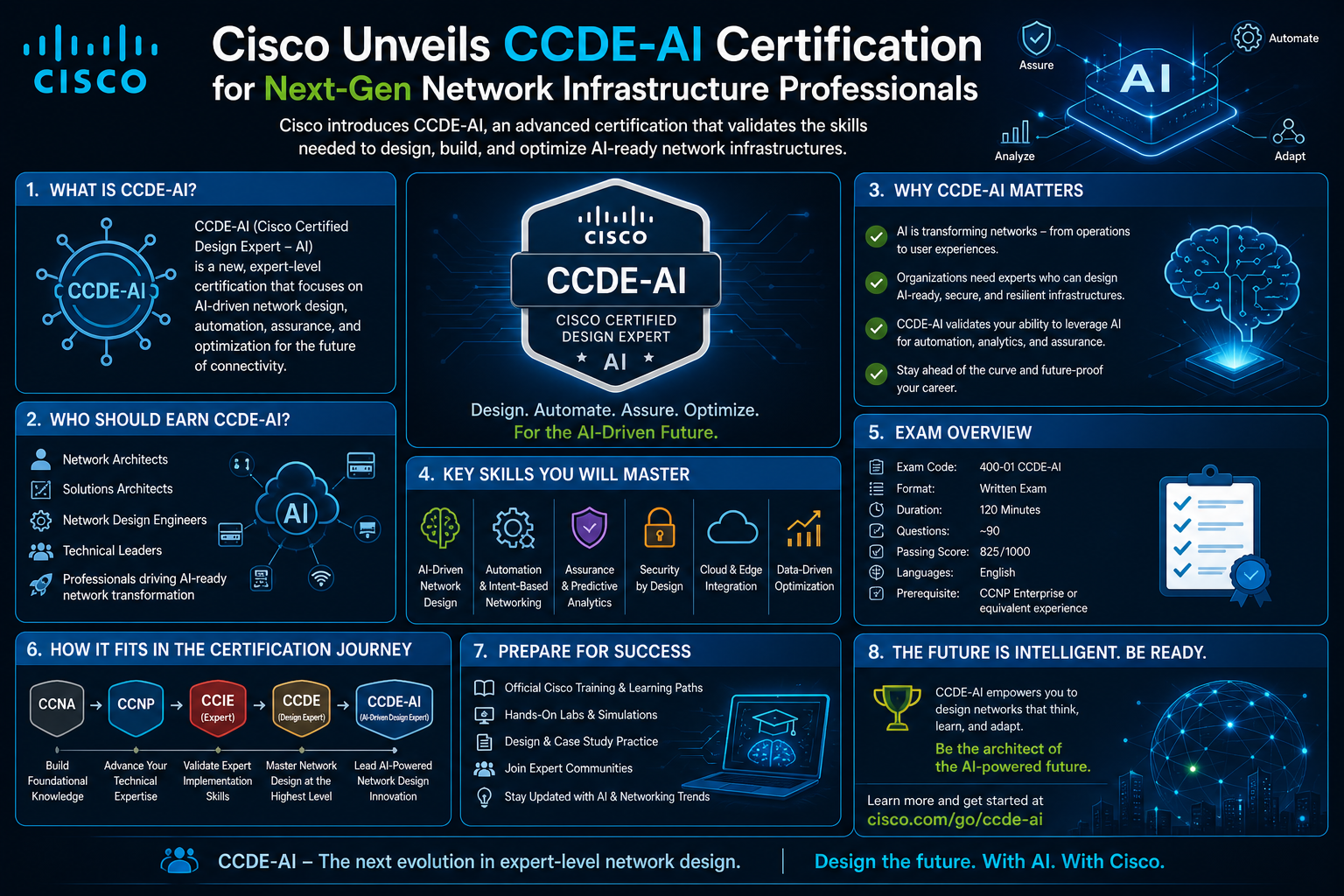
It is within this evolving landscape that Cisco has introduced a new expert-level certification focused on AI-driven infrastructure design. The CCDE-AI Infrastructure certification represents a shift toward recognizing the growing importance of AI-aware network architecture, where design decisions must account not only for connectivity but also for computation-heavy workflows, distributed processing, and large-scale data movement.
This certification reflects a broader industry transformation where network design is no longer just about maintaining connectivity, but about enabling intelligence across systems.
The Rise of AI-Centered Infrastructure Demands
To understand why AI requires a fundamentally different networking approach, it is important to examine how AI workloads operate. Unlike traditional applications that process relatively small amounts of data in predictable patterns, AI systems often rely on massive datasets that must be continuously ingested, processed, and redistributed across multiple computing nodes.
Machine learning training, for example, involves feeding large datasets into distributed compute clusters where multiple processors work in parallel. These processes generate enormous internal network traffic as data is split, synchronized, and recombined during training cycles. Even inference workloads, which are typically lighter than training, can still require rapid access to large model parameters and real-time data streams.
This introduces several challenges for network design:
First, bandwidth requirements increase significantly. AI systems often require sustained high-throughput connections rather than intermittent bursts of traffic. Traditional enterprise networks, which are designed for mixed workloads like email, web traffic, and business applications, are not always optimized for this level of constant data flow.
Second, latency becomes critical. In AI-driven environments, delays in data transmission can directly affect model performance, training efficiency, and real-time decision-making. Even small latency variations can accumulate across distributed systems, reducing overall efficiency.
Third, data locality becomes a major concern. AI systems frequently rely on geographically distributed datasets, which must be accessed and processed efficiently. Moving large datasets across long distances introduces both performance and cost challenges.
Finally, AI workloads place unique demands on infrastructure reliability and consistency. Unlike traditional applications that can tolerate occasional delays or interruptions, AI systems often require stable, predictable performance to ensure accurate outputs and efficient training cycles.
These factors combined make it clear that AI infrastructure is not simply an extension of traditional networking. It represents a distinct design domain with its own constraints, priorities, and optimization strategies.
The Shift from Traditional Networking to AI-Optimized Design
In traditional network design, engineers typically focus on layered architectures that separate concerns into physical, data link, network, transport, and application layers. While this model still provides a useful conceptual foundation, AI environments require a more integrated approach where compute and network systems are tightly coupled.
AI-optimized network design involves considering how data flows not only across devices but also across processing units, storage systems, and distributed compute clusters. This requires a deeper understanding of how workloads behave under different conditions and how infrastructure components interact under high demand.
One of the key shifts is the move from static design principles to adaptive design thinking. Traditional networks are often built with fixed configurations that remain relatively stable over time. AI systems, on the other hand, require infrastructure that can dynamically adjust to workload changes, scaling resources up or down based on demand patterns.
This introduces the concept of intelligent infrastructure, where network behavior is increasingly influenced by automated systems that monitor performance, predict congestion, and optimize routing in real time. AI itself is often used to manage these networks, creating a feedback loop where AI both consumes and improves the infrastructure it runs on.
Another major shift is the increased importance of trade-offs in design decisions. In AI environments, improving one aspect of performance often comes at the expense of another. For example, increasing redundancy may improve reliability but also increase cost and energy consumption. Optimizing for speed may reduce flexibility or scalability.
Network designers must therefore evaluate each decision in the context of multiple competing priorities, including performance, cost efficiency, security, scalability, and sustainability. This balancing act is central to modern AI infrastructure design and forms a key theme in emerging certification frameworks like Cisco’s CCDE-AI Infrastructure.
Introduction to the CCDE-AI Infrastructure Certification
Cisco’s CCDE-AI Infrastructure certification emerges as a response to the growing complexity of AI-driven networks. Positioned as an expert-level design certification, it focuses on validating the ability to design network architectures that can effectively support AI workloads at scale.
Unlike traditional certifications that focus primarily on configuration or operational tasks, this certification emphasizes architectural thinking. It is designed for professionals who are responsible for making high-level design decisions that influence how entire systems are built and optimized.
A key characteristic of this certification is its vendor-neutral approach to design principles. Rather than focusing exclusively on specific products or implementations, it emphasizes conceptual understanding of AI infrastructure design challenges. This allows candidates to develop skills that can be applied across different environments and technology stacks.
The certification reflects the growing recognition that AI infrastructure design is not limited to a single technology ecosystem. Instead, it spans multiple domains, including networking, compute architecture, storage systems, security frameworks, and cloud integration strategies.
As AI workloads continue to expand across industries, the need for professionals who can design these complex environments becomes increasingly important. The certification aims to validate not just technical knowledge, but also the ability to make informed design decisions under conditions of uncertainty and trade-offs.
Core Design Philosophy Behind AI Infrastructure
At the heart of AI infrastructure design lies a fundamental principle: every architectural decision involves trade-offs. This concept is not new in networking, but it becomes significantly more pronounced in AI environments.
For example, increasing computational performance often requires more powerful hardware, which in turn increases energy consumption and operational costs. Similarly, improving data accessibility may require duplicating datasets across multiple regions, which introduces challenges related to consistency, compliance, and storage efficiency.
These trade-offs are not isolated decisions. They interact across the entire infrastructure. A change in network design can affect storage performance, which can influence compute efficiency, which can ultimately impact AI model accuracy and training time.
This interconnected nature of AI systems requires designers to adopt a holistic perspective. Rather than optimizing individual components in isolation, they must consider how the entire system behaves as a unified entity.
Another important aspect of AI infrastructure design is scalability. AI systems often need to handle rapidly increasing workloads, especially during model training phases or when deploying new applications at scale. This requires architectures that can expand seamlessly without introducing performance bottlenecks.
Elasticity also plays a key role. Unlike traditional systems that operate under relatively stable conditions, AI environments may experience sudden spikes in demand. Infrastructure must be capable of adapting in real time to these fluctuations.
Finally, resilience is critical. AI systems often support mission-critical applications, and any disruption in network performance can have significant downstream effects. Designing for fault tolerance, redundancy, and recovery becomes an essential part of the architecture.
Domains of Knowledge in AI Infrastructure Design
The CCDE-AI Infrastructure framework organizes its focus into several key domains that reflect the interdisciplinary nature of AI network design.
One of the primary domains involves understanding how AI and machine learning workloads interact with network infrastructure. This includes analyzing how data moves through distributed systems, how models are trained across multiple nodes, and how inference workloads are delivered efficiently to end users.
Another important domain focuses on network architecture itself. This includes designing connectivity models that support high-bandwidth, low-latency communication across distributed environments. It also involves selecting appropriate topologies that can handle large-scale data flows without creating bottlenecks.
Security is another critical area of focus. AI systems introduce new security challenges because they process sensitive data at scale and often operate across multiple environments. Protecting data integrity, ensuring secure communication, and preventing unauthorized access are all essential considerations.
Hardware and infrastructure design also play a significant role. AI workloads require specialized compute resources, including GPUs, TPUs, and high-performance storage systems. Designing environments that can efficiently utilize these resources requires deep understanding of hardware capabilities and performance characteristics.
Finally, governance and compliance considerations are integrated into the design framework. AI systems must operate within regulatory boundaries related to data privacy, sovereignty, and ethical use. These requirements influence architectural decisions and must be considered from the earliest stages of design.
The Increasing Role of Trade-Off Analysis in Network Design
One of the defining aspects of AI infrastructure design is the need for continuous trade-off analysis. Unlike traditional systems where optimization goals are often clearly defined, AI environments involve competing priorities that must be carefully balanced.
For example, increasing system performance may require additional hardware investment, which raises costs and energy consumption. Alternatively, optimizing for cost efficiency may limit scalability or reduce performance under peak load conditions.
Security introduces another layer of complexity. Stronger security measures may introduce latency or reduce system flexibility, while more open architectures may increase risk exposure.
Even data management involves trade-offs. Replicating data across multiple regions improves accessibility but raises concerns about consistency and regulatory compliance. Centralizing data may improve control but can introduce latency and scalability challenges.
These trade-offs are not static. They evolve over time as workloads change, technologies improve, and business requirements shift. This means that AI infrastructure design is not a one-time task, but an ongoing process of evaluation and adjustment.
Design professionals working in this field must therefore develop strong analytical skills, enabling them to assess complex systems and make informed decisions that balance competing objectives.
Early Direction of AI Network Evolution
As AI continues to evolve, so too will the networks that support it. One emerging trend is the increasing use of automation in network management. AI systems are already being used to monitor network performance, detect anomalies, and optimize traffic flows.
In the future, these systems are expected to become even more autonomous, capable of self-configuration and self-healing. This will reduce the need for manual intervention and allow networks to adapt more quickly to changing conditions.
Another trend is the convergence of compute and networking infrastructure. Instead of treating these as separate domains, future architectures are likely to integrate them more closely, allowing for more efficient data processing and movement.
Edge computing will also play a growing role. As AI applications expand into real-time environments such as autonomous systems and industrial automation, processing will increasingly occur closer to data sources rather than centralized data centers.
These developments will continue to reshape how networks are designed, managed, and optimized, further increasing the importance of specialized knowledge in AI infrastructure architecture.
Growing Importance of Specialized Design Expertise
As AI systems become more deeply integrated into business operations, the demand for professionals who understand how to design supporting infrastructure continues to grow. This includes not only technical expertise but also the ability to think strategically about system architecture and long-term scalability.
Designing AI-ready networks requires a combination of skills that span multiple disciplines. Professionals must understand networking principles, distributed computing, data management, security frameworks, and system optimization techniques.
Equally important is the ability to evaluate business requirements and translate them into technical designs. AI infrastructure decisions often have significant financial, operational, and regulatory implications, making this a highly strategic role within organizations.
The emergence of specialized certifications in this field reflects the growing recognition of these skills as essential for future-ready infrastructure design.
The Expanding Complexity of AI Workloads in Modern Infrastructure
As organizations move deeper into artificial intelligence adoption, the complexity of workloads running across enterprise environments continues to increase. What once started as isolated machine learning experiments has now evolved into large-scale production systems that influence decision-making, automate processes, and drive customer-facing applications. This shift has placed unprecedented pressure on the underlying infrastructure, especially the networks responsible for moving and managing data at scale.
AI workloads are fundamentally different from traditional application workloads in both structure and behavior. Traditional enterprise applications typically generate predictable traffic patterns. For example, email systems, web applications, and transactional databases follow relatively stable usage patterns with defined peaks and predictable latency expectations. AI systems, however, are far more dynamic. Their resource consumption fluctuates based on training cycles, inference requests, data ingestion processes, and model updates.
One of the defining characteristics of AI workloads is their data intensity. Training modern machine learning models requires processing enormous datasets, often spanning terabytes or even petabytes of information. This data must be continuously moved between storage systems, compute clusters, and processing nodes. Unlike traditional applications where data movement is relatively localized, AI systems distribute computation across multiple nodes, creating complex internal traffic flows that can strain even high-performance networks.
Another important factor is parallel processing. AI training is typically distributed across multiple GPUs or specialized accelerators working simultaneously. Each node processes a portion of the dataset and frequently synchronizes with others to update model parameters. This synchronization process generates significant east-west traffic within data centers, which is often more demanding than external traffic entering or leaving the network.
The combination of high data volume, parallel computation, and continuous synchronization creates a unique set of challenges for infrastructure designers. Networks must not only handle large volumes of data but also ensure that communication between compute nodes remains consistent, low-latency, and highly reliable.
These demands have led to a rethinking of traditional network design principles, where AI workloads are no longer treated as just another application category but as a specialized domain requiring tailored architectural approaches.
Data Movement as the Core Challenge in AI Networks
At the center of AI infrastructure design lies one of the most critical challenges: data movement. In traditional IT environments, data typically flows between clients and servers in relatively simple patterns. In AI environments, however, data movement becomes multidimensional, involving constant interaction between storage systems, compute clusters, model repositories, and external data sources.
The scale of data movement in AI systems is significantly larger than in conventional applications. During model training, datasets must be repeatedly accessed, processed, and redistributed across compute nodes. This creates continuous pressure on network bandwidth and storage throughput.
Latency sensitivity further complicates this challenge. Many AI workloads depend on synchronized operations where multiple nodes must complete processing steps before the system can proceed. Even minor delays in data transmission can slow down the entire training process, reducing efficiency and increasing operational costs.
To address these challenges, infrastructure designers must carefully consider how data is placed, accessed, and transferred across the network. Data locality becomes a key design principle. Placing data closer to compute resources reduces latency and improves performance, but it also introduces complexity in managing consistency and replication.
Caching strategies are often used to mitigate data movement challenges. Frequently accessed datasets can be stored closer to compute nodes, reducing the need for repeated retrieval from central storage systems. However, caching introduces its own challenges, including synchronization overhead and potential data staleness.
Another important consideration is bandwidth allocation. AI workloads often require sustained high-bandwidth connections rather than short bursts of traffic. This places pressure on network infrastructure to maintain consistent throughput across extended periods.
These factors make data movement one of the most critical design considerations in AI infrastructure, influencing decisions across networking, storage, and compute layers.
Distributed Computing and Its Impact on Network Design
AI systems rarely operate on a single machine. Instead, they rely heavily on distributed computing architectures that spread workloads across multiple servers, clusters, and sometimes geographic regions. This distributed nature introduces additional complexity into network design, as communication between nodes becomes a central component of system performance.
In distributed AI training environments, each compute node processes a portion of the dataset and periodically exchanges updates with other nodes. This process, known as parameter synchronization, requires high-speed, low-latency communication between all participating systems.
As the number of nodes increases, the volume of synchronization traffic also increases. This creates scaling challenges where network performance can become a limiting factor in overall system efficiency. Even if compute resources are abundant, insufficient network capacity can slow down training processes significantly.
To address this, network designers must carefully architect communication pathways that minimize congestion and ensure efficient data exchange. This often involves designing specialized network topologies optimized for east-west traffic rather than traditional north-south traffic patterns.
Another important aspect of distributed AI systems is fault tolerance. In large-scale environments, individual nodes may fail or become temporarily unavailable. The network must be able to handle these failures gracefully without disrupting overall system performance.
Redundancy mechanisms are commonly used to ensure continuity of operations. However, redundancy also increases network overhead, as additional resources are required to maintain duplicate pathways and backup systems.
Load balancing plays a crucial role in distributed environments. Workloads must be evenly distributed across compute nodes to avoid bottlenecks and ensure optimal utilization of resources. Network infrastructure must support intelligent routing mechanisms that can dynamically adjust traffic distribution based on real-time conditions.
These requirements make distributed computing one of the most important considerations in AI infrastructure design, deeply influencing how networks are structured and optimized.
The Role of High-Performance Networking in AI Systems
High-performance networking has become a foundational requirement for AI infrastructure. Unlike traditional enterprise networks, which prioritize general-purpose connectivity, AI networks must be optimized for speed, consistency, and scalability.
One of the key characteristics of high-performance AI networks is low-latency communication. In distributed training environments, delays in data transmission can significantly impact overall processing speed. Even small latency variations can accumulate across thousands of synchronization cycles, leading to noticeable performance degradation.
Bandwidth consistency is equally important. AI workloads often require sustained data throughput over long periods of time. Networks must be capable of maintaining high performance without fluctuations that could disrupt processing pipelines.
Another important factor is network determinism. In AI environments, predictable performance is often more valuable than peak performance. Systems must behave consistently under varying loads to ensure stable training and inference processes.
High-performance networks also require advanced congestion management techniques. As multiple nodes compete for network resources, congestion can occur, leading to delays and performance bottlenecks. Intelligent traffic management systems are often used to prioritize critical data flows and prevent congestion from affecting system performance.
Hardware plays a significant role in enabling high-performance networking. Specialized network interfaces, high-speed interconnects, and optimized switching architectures are commonly used to support AI workloads.
In addition, software-defined networking techniques are increasingly being used to provide greater flexibility and control over network behavior. These systems allow dynamic adjustment of routing policies, bandwidth allocation, and traffic prioritization based on real-time conditions.
Together, these elements form the foundation of high-performance AI networking, enabling systems to meet the demanding requirements of modern machine learning workloads.
Storage Architecture Challenges in AI Environments
Storage systems play a critical role in AI infrastructure, as they are responsible for holding the massive datasets required for training and inference. Unlike traditional applications that rely on relatively small and structured datasets, AI systems often work with unstructured or semi-structured data, including images, videos, text corpora, and sensor data.
This creates unique challenges for storage architecture. First, storage systems must be capable of handling extremely high throughput to support continuous data ingestion and retrieval. Second, they must scale efficiently to accommodate rapidly growing datasets.
One of the primary challenges in AI storage design is balancing performance and capacity. High-performance storage systems are typically more expensive and may not scale efficiently for large datasets. Conversely, high-capacity storage systems may not provide the necessary performance for real-time processing.
Data replication is another important consideration. In distributed AI environments, datasets are often replicated across multiple storage locations to improve accessibility and reduce latency. However, replication increases storage costs and introduces complexity in maintaining consistency across copies.
Tiered storage architectures are commonly used to address these challenges. Frequently accessed data is stored in high-performance tiers, while less frequently used data is moved to lower-cost storage layers. This approach helps balance performance requirements with cost efficiency.
Data lifecycle management also plays a significant role in AI storage design. As datasets evolve over time, older data may need to be archived or deleted to free up storage resources. Managing this lifecycle efficiently is essential for maintaining system performance and controlling costs.
The integration of storage and compute systems is becoming increasingly important. In modern AI architectures, storage is often designed to work closely with compute clusters, reducing the distance between data and processing units.
Security Considerations in AI Infrastructure Design
Security is a critical component of AI infrastructure design, particularly because AI systems often process sensitive and high-value data. Unlike traditional systems where security is often applied as a separate layer, AI environments require security to be integrated directly into the architecture.
One of the primary challenges in securing AI systems is the distributed nature of their operation. Data may be stored, processed, and transmitted across multiple environments, including on-premises data centers, cloud platforms, and edge locations. This creates multiple potential attack surfaces that must be secured.
Data protection is a key concern. AI systems often rely on large datasets that may include personally identifiable information or other sensitive content. Ensuring that this data is protected both in transit and at rest is essential for maintaining compliance and trust.
Access control mechanisms must also be carefully designed. Only authorized systems and users should be able to access AI models and datasets. This requires robust authentication and authorization frameworks that can operate across distributed environments.
Model security is another emerging concern. AI models themselves can be targeted through techniques such as adversarial attacks or model extraction. Protecting the integrity of trained models is therefore an important aspect of infrastructure design.
Network segmentation is often used to isolate different components of AI systems, reducing the risk of lateral movement in case of a security breach. Encryption is also widely used to protect data as it moves across networks.
In addition to technical controls, compliance requirements play a significant role in security design. Organizations must ensure that their AI systems comply with regulations related to data privacy, sovereignty, and ethical use.
Early Evolution of AI-Aware Network Architectures
As AI continues to mature, network architectures are evolving to become more AI-aware. This means that networks are increasingly capable of understanding the nature of the workloads they support and adjusting their behavior accordingly.
One of the most significant developments in this area is the use of machine learning to optimize network performance. AI systems can analyze network traffic patterns in real time and make adjustments to routing, bandwidth allocation, and congestion management.
This creates a feedback loop where AI is used to manage the infrastructure that supports AI workloads. Over time, this leads to increasingly efficient and adaptive network systems.
Another important trend is the integration of automation into network operations. Many routine tasks, such as configuration management, performance monitoring, and fault detection, are being automated using AI-driven tools.
Edge computing is also playing a growing role in AI infrastructure. By processing data closer to its source, edge systems reduce the need for long-distance data transmission and improve response times.
These developments are reshaping the way networks are designed and managed, leading to more intelligent and adaptive infrastructure systems that can support increasingly complex AI workloads.
Growing Strategic Importance of Infrastructure Design Skills
As AI becomes more deeply embedded in enterprise environments, infrastructure design skills are becoming increasingly strategic. Organizations are no longer simply looking for engineers who can configure systems, but for professionals who can design complex, scalable, and efficient architectures that support AI-driven operations.
This requires a combination of technical knowledge and strategic thinking. Designers must understand how different components of the infrastructure interact and how design decisions impact overall system performance.
They must also be able to evaluate trade-offs between competing priorities, such as performance, cost, scalability, and security. These decisions often have long-term implications for organizational success and must be made with careful consideration.
As AI workloads continue to grow in scale and complexity, the demand for professionals with these skills is expected to increase significantly.
Hardware Evolution Driving AI Infrastructure Design
The rapid expansion of artificial intelligence has triggered a parallel evolution in hardware design. Traditional enterprise infrastructure was built around general-purpose servers, standard networking equipment, and predictable storage systems. AI workloads, however, have forced a shift toward highly specialized hardware optimized for parallel processing, massive data throughput, and accelerated computation.
At the core of this transformation are accelerators such as GPUs and other parallel-processing units designed to handle the mathematical intensity of machine learning workloads. Unlike traditional CPUs that process tasks sequentially, these accelerators perform thousands of operations simultaneously, making them essential for training modern AI models.
However, the presence of powerful compute hardware alone does not solve the infrastructure challenge. These components must be supported by equally advanced networking and storage systems. If data cannot be delivered to compute nodes quickly enough, even the most powerful hardware remains underutilized.
This creates a tightly coupled relationship between compute, storage, and networking layers. Infrastructure designers must consider all three as a unified system rather than independent components. This is one of the key philosophical shifts in AI infrastructure design: performance is no longer determined by a single layer but by the interaction of all layers working together.
Another important aspect of hardware evolution is the increasing use of high-speed interconnects. These specialized communication channels allow compute nodes within AI clusters to exchange data at extremely high speeds, reducing latency and improving synchronization efficiency.
Storage hardware has also evolved significantly. Traditional disk-based storage systems are increasingly being replaced or supplemented by high-speed solid-state systems that can handle the extreme read and write demands of AI workloads. In many environments, storage is no longer a passive repository but an active participant in the compute process.
This convergence of compute, storage, and networking hardware is reshaping how infrastructure is designed and deployed, requiring engineers to think beyond traditional boundaries.
The Importance of System-Level Design Thinking
One of the most significant shifts in AI infrastructure design is the move toward system-level thinking. Instead of optimizing individual components in isolation, designers must now consider how the entire system behaves as a unified entity.
In traditional network design, it was often possible to focus on specific layers or segments of the infrastructure. For example, a network engineer might optimize routing protocols without needing to deeply understand storage architecture. In AI environments, this separation no longer exists in a meaningful way.
Every component of the infrastructure influences every other component. A change in storage configuration can affect network traffic patterns, which can influence compute performance. Similarly, adjustments in network design can impact data accessibility and processing speed.
This interconnectedness requires a holistic approach to infrastructure design. Engineers must develop a deep understanding of how data flows through the entire system, from ingestion to processing to output.
System-level thinking also involves understanding workload behavior. AI workloads are not static; they evolve over time based on training cycles, model updates, and usage patterns. Infrastructure must therefore be designed to accommodate dynamic changes in demand.
This introduces the need for adaptability in design. Static architectures are no longer sufficient in environments where workloads can shift rapidly. Instead, systems must be capable of scaling, reconfiguring, and optimizing themselves in response to changing conditions.
Another important aspect of system-level thinking is the ability to model trade-offs across multiple dimensions. Decisions that improve performance in one area may negatively impact another. For example, increasing redundancy may improve reliability but also increase latency and cost.
Designers must therefore evaluate infrastructure decisions in terms of their broader impact on the entire system rather than focusing on isolated improvements.
Power Consumption and Sustainability in AI Infrastructure
One of the most pressing challenges in AI infrastructure design is energy consumption. AI workloads are computationally intensive, requiring significant amounts of power to train and run models. As organizations scale their AI deployments, energy consumption becomes a major operational and environmental concern.
Data centers supporting AI workloads often consume significantly more power than traditional enterprise environments. This is due to the combination of high-performance compute hardware, dense storage systems, and high-speed networking equipment.
Power consumption is not just a cost issue; it also has implications for infrastructure design. Cooling systems must be capable of handling increased heat output from densely packed hardware. Physical infrastructure must be designed to support higher power densities.
This introduces the need for energy-aware design principles. Infrastructure designers must consider how power is distributed across systems and how energy efficiency can be improved without compromising performance.
One approach involves optimizing workload placement. By strategically placing workloads on specific hardware configurations, it is possible to reduce unnecessary power consumption and improve overall efficiency.
Another approach involves dynamic scaling. Systems can adjust resource allocation based on current demand, reducing power usage during periods of low activity.
Renewable energy sources are also becoming increasingly important in AI infrastructure planning. As energy demands grow, organizations are exploring ways to integrate sustainable energy sources into their data center operations.
Sustainability is no longer just an environmental consideration; it has become a core design constraint that influences how AI systems are built and deployed.
Governance, Compliance, and Data Responsibility
As AI systems become more widespread, regulatory and compliance requirements are becoming increasingly important. Organizations must ensure that their AI infrastructure adheres to legal frameworks related to data privacy, security, and ethical use.
One of the key challenges in this area is data sovereignty. Many regions have strict regulations governing where data can be stored and processed. AI systems that operate across multiple geographic locations must be designed to comply with these restrictions.
This often requires careful planning of data flows and storage locations. Infrastructure must be designed to ensure that sensitive data does not cross regulatory boundaries unintentionally.
Another important consideration is data governance. AI systems often rely on large datasets that must be carefully managed to ensure accuracy, consistency, and integrity. Poor data governance can lead to biased models or inaccurate outputs.
Compliance frameworks such as privacy regulations require organizations to implement strict controls over how data is collected, stored, and processed. These controls must be integrated into the infrastructure design rather than added as an afterthought.
Auditability is also an important requirement. Organizations must be able to trace how data moves through AI systems and how decisions are made. This requires detailed logging and monitoring capabilities built into the infrastructure.
Ethical considerations are also becoming increasingly relevant. AI systems must be designed to avoid unintended biases and ensure fair treatment of users. This introduces additional design constraints that must be considered alongside technical requirements.
AI-Assisted Network Operations and Self-Optimizing Systems
One of the most transformative developments in modern infrastructure is the increasing use of AI to manage AI systems themselves. This creates a feedback loop where artificial intelligence is used to optimize the networks and systems that support it.
AI-assisted network operations involve using machine learning algorithms to analyze network behavior in real time. These systems can detect anomalies, predict potential failures, and optimize traffic flows automatically.
For example, if a network experiences congestion in a specific region, AI-driven systems can reroute traffic dynamically to maintain performance. Similarly, predictive analytics can identify hardware components that are likely to fail before they actually do, allowing for proactive maintenance.
This shift toward automation reduces the need for manual intervention in network management. It also improves system responsiveness, as AI-driven systems can react to changes faster than human operators.
Self-optimizing systems represent the next stage in this evolution. In these environments, infrastructure is capable of continuously adjusting its own configuration based on workload demands and performance metrics.
This includes dynamic scaling of compute resources, automatic adjustment of routing policies, and real-time optimization of storage access patterns.
While these systems offer significant benefits, they also introduce new challenges. Designers must ensure that automated systems behave predictably and do not introduce instability into the infrastructure.
Edge Computing and Distributed AI Deployment Models
As AI applications expand into real-time environments, edge computing is becoming increasingly important. Edge computing involves processing data closer to where it is generated rather than relying on centralized data centers.
This approach reduces latency and improves responsiveness, making it ideal for applications such as autonomous systems, industrial automation, and real-time analytics.
In edge AI environments, data is processed locally on devices or nearby edge nodes before being transmitted to central systems. This reduces the amount of data that must be transferred across long distances and improves overall system efficiency.
However, edge computing also introduces new design challenges. Infrastructure must be capable of operating in distributed environments where connectivity may be limited or inconsistent.
Data synchronization becomes more complex in edge environments, as information must be coordinated across multiple locations. This requires robust mechanisms for data consistency and conflict resolution.
Security is also a major concern in edge deployments. Edge devices are often located in less secure environments, making them more vulnerable to physical and cyber threats.
Despite these challenges, edge computing is becoming an essential component of AI infrastructure design, particularly as demand for real-time processing continues to grow.
The Future Direction of AI Infrastructure Design
The future of AI infrastructure design is likely to be defined by increasing levels of automation, integration, and intelligence. Networks will become more adaptive, capable of self-optimization and autonomous management.
Infrastructure components will become more tightly integrated, blurring the lines between compute, storage, and networking. This convergence will enable more efficient data processing and reduce overhead associated with traditional separation of concerns.
AI will continue to play a central role in managing infrastructure. Systems will become increasingly capable of predicting workload demands, optimizing resource allocation, and preventing failures before they occur.
At the same time, the complexity of these systems will continue to increase. Designers will need to develop new skills and approaches to manage highly dynamic, distributed environments.
Security, governance, and compliance will remain critical considerations, ensuring that AI systems operate responsibly and within regulatory boundaries.
As AI becomes more deeply embedded in enterprise and societal systems, the importance of robust, scalable, and intelligent infrastructure design will only continue to grow.
Conclusion
The emergence of AI-driven workloads has fundamentally reshaped how modern networks must be designed, deployed, and managed. Traditional infrastructure models, which were once sufficient for predictable enterprise applications, are no longer capable of meeting the scale, speed, and complexity required by artificial intelligence systems. Instead, network design has evolved into a highly integrated discipline where compute, storage, and connectivity must operate as a unified ecosystem.
AI infrastructure introduces challenges that extend far beyond bandwidth and latency. It demands careful coordination of distributed computing resources, efficient movement of massive datasets, and continuous optimization of performance under dynamic and often unpredictable workloads. These requirements have elevated the importance of system-level thinking, where every design decision carries implications across multiple layers of the architecture.
At the same time, considerations such as energy consumption, sustainability, governance, and regulatory compliance have become central to infrastructure planning. AI systems are not only technical constructs but also operational and ethical frameworks that must align with organizational and societal expectations.
As automation and AI-assisted management become more prevalent, networks are increasingly capable of self-optimization and adaptive behavior. This evolution points toward a future where infrastructure is not only designed for intelligence but also capable of intelligent operation.
Within this rapidly changing landscape, expertise in AI infrastructure design is becoming a defining skill set for network professionals. The ability to understand trade-offs, anticipate system behavior, and architect scalable, resilient environments is essential for supporting the next generation of AI innovation.