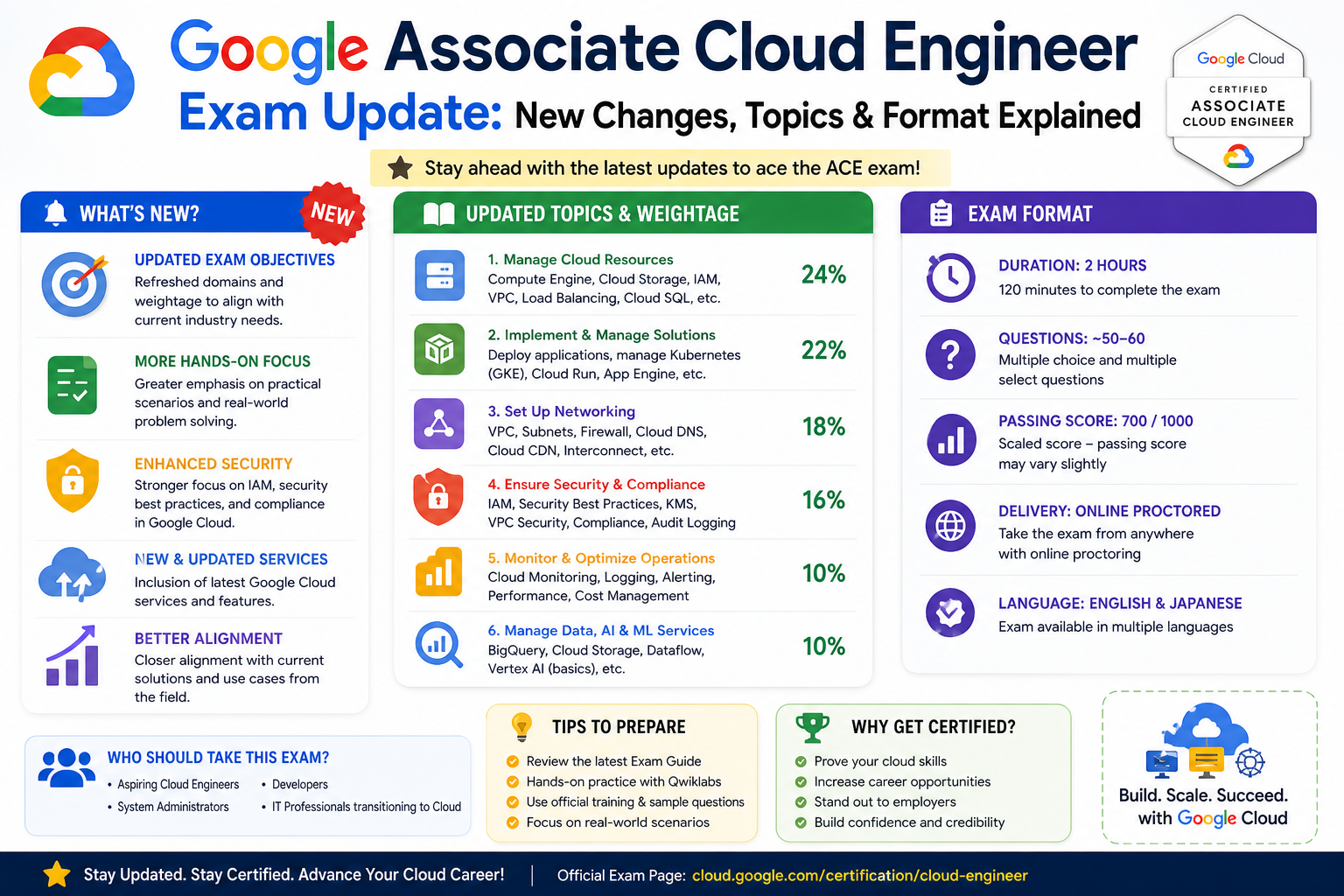
The Google Cloud ecosystem has grown rapidly over the past few years, and with that growth comes a shift in what is expected from cloud professionals. The 2025 update to the Associate Cloud Engineer (ACE) exam reflects a broader transformation happening across the industry. Rather than focusing only on foundational knowledge, the exam now emphasizes real-world capabilities—skills that can be directly applied in modern cloud environments.
For anyone stepping into cloud computing or already working with cloud technologies, this update signals something important: the expectations for entry-level cloud engineers are becoming more practical, more integrated, and more aligned with how systems operate in production today. The updated exam is not just about understanding concepts—it is about applying them effectively in real scenarios.
The Evolution of Cloud Engineering Expectations
Cloud computing has moved far beyond simple virtual machines and storage buckets. Organizations now rely on cloud platforms to run complex, distributed systems that must scale dynamically, remain secure, and adapt to changing workloads. As a result, the role of a cloud engineer has evolved significantly.
In earlier years, an associate-level certification primarily validated that a candidate could navigate a cloud platform and perform basic tasks such as deploying instances or configuring storage. While those skills are still essential, they are no longer sufficient on their own. Today’s cloud engineers are expected to understand how systems interact, how to automate processes, and how to design solutions that are resilient and secure by default.
The 2025 ACE exam update reflects this shift by placing greater emphasis on applied knowledge. Candidates are now expected to demonstrate an understanding of how different services work together in real-world scenarios. This includes recognizing patterns in architecture, troubleshooting issues across multiple services, and making decisions that align with best practices.
Why the Exam Needed to Change
The primary reason behind the update is straightforward: the cloud landscape itself has changed. New technologies, tools, and methodologies have reshaped how applications are built and deployed. Cloud providers continuously introduce new services and refine existing ones, making it necessary for certifications to stay relevant.
One of the most notable trends influencing this update is the rise of automation. Manual configuration is gradually being replaced by script-driven and template-based deployments. This approach reduces errors, improves consistency, and allows systems to scale more efficiently. As a result, cloud engineers must be comfortable working with tools that support automation rather than relying solely on graphical interfaces.
Another major factor is the increasing importance of security. As more organizations move sensitive workloads to the cloud, ensuring proper access control and data protection has become a top priority. The updated exam reflects this by requiring a deeper understanding of identity management, permissions, and secure configurations.
Additionally, the growing influence of data-driven technologies—especially those related to artificial intelligence and machine learning—has shaped the direction of cloud certifications. Even at an associate level, engineers are expected to have a basic awareness of how data flows through systems and how cloud services support modern data processing workflows.
A Shift Toward Real-World Application
One of the most significant changes in the 2025 ACE exam is the move toward scenario-based evaluation. Instead of testing isolated facts, the exam now presents situations that require candidates to apply their knowledge in context.
For example, rather than simply asking what a specific service does, a question might describe a business requirement and ask which solution best meets that need. This approach tests not only technical knowledge but also decision-making skills.
This shift mirrors the realities of working in cloud environments. In practice, engineers rarely encounter problems that have a single, straightforward answer. Instead, they must evaluate multiple options, consider trade-offs, and choose the most effective solution based on the situation.
By incorporating scenario-based questions, the exam ensures that certified professionals are better prepared for real-world challenges. It encourages a deeper level of understanding and helps bridge the gap between theory and practice.
Expanding the Scope of Foundational Knowledge
While the exam still covers core concepts, the definition of “foundational knowledge” has expanded. Topics that were once considered advanced are now becoming part of the baseline skill set for cloud engineers.
This includes areas such as containerization, automation, and distributed systems. Understanding these concepts is no longer optional, even for those at the beginning of their cloud careers. The updated exam reflects this by introducing questions that require familiarity with these technologies.
At the same time, the exam continues to emphasize essential tasks such as deploying resources, managing configurations, and monitoring systems. However, these tasks are now presented within a broader context, highlighting how they fit into larger workflows.
This approach ensures that candidates develop a well-rounded understanding of cloud environments. It also helps them build the confidence needed to handle more complex responsibilities as they progress in their careers.
The Growing Importance of Automation
Automation has become a cornerstone of modern cloud operations. In the past, engineers often relied on manual processes to configure and manage resources. While this approach can work for small-scale environments, it becomes inefficient and error-prone as systems grow.
The 2025 ACE exam places a strong emphasis on automation, reflecting its importance in real-world scenarios. Candidates are expected to understand how to use command-line tools and scripting techniques to perform tasks more efficiently.
This includes working with tools that allow for repeatable deployments, managing configurations through templates, and using scripts to streamline operations. These skills are essential for maintaining consistency across environments and reducing the risk of human error.
The shift toward automation also highlights the importance of thinking in terms of systems rather than individual components. Engineers must understand how different parts of an environment interact and how changes in one area can affect others.
By focusing on automation, the exam encourages candidates to adopt a more strategic approach to cloud management. It moves beyond simple task execution and emphasizes the value of designing processes that are scalable and reliable.
Strengthening Security Awareness
Security is no longer a specialized area that only certain professionals need to understand. In today’s cloud environments, it is a fundamental responsibility shared by all engineers.
The updated ACE exam reflects this reality by placing greater emphasis on security concepts. Candidates are expected to have a solid understanding of identity and access management, including how to assign roles, manage permissions, and enforce the principle of least privilege.
This means knowing not just what permissions are available, but also when and how to use them appropriately. Engineers must be able to design access controls that minimize risk while still allowing systems to function effectively.
In addition to access management, the exam also touches on data protection and encryption. Understanding how to secure data both at rest and in transit is an essential skill for anyone working in the cloud.
The increased focus on security ensures that certified professionals are better equipped to protect systems and data. It also reflects the growing importance of security in the broader technology landscape.
The Role of Data and AI-Adjacent Services
Although the ACE exam does not explicitly focus on artificial intelligence or machine learning, it acknowledges their growing influence by incorporating related concepts. Cloud platforms are increasingly used to process and analyze large volumes of data, and engineers must understand how these workflows operate.
This includes familiarity with services that support data storage, processing, and streaming. Engineers are expected to recognize how data moves through a system and how different services can be used to manage that flow.
For example, understanding how data can be ingested, processed in real time, and stored for analysis is becoming an essential skill. Even if an engineer is not directly working on machine learning models, they are likely to interact with systems that support these processes.
By including these topics, the exam prepares candidates for the realities of modern cloud environments. It ensures that they have a basic understanding of how data-driven systems function and how to support them effectively.
Adapting to Modern Networking Practices
Networking in the cloud has evolved significantly, moving beyond simple configurations to become a critical component of system design. The updated exam reflects this by emphasizing practical networking scenarios.
Candidates are expected to understand how to configure networks that are both secure and scalable. This includes working with concepts such as private connectivity, traffic routing, and load balancing.
The focus is not just on setting up networks, but also on understanding how they support applications and services. Engineers must be able to design networks that meet specific requirements, such as handling high traffic volumes or ensuring secure communication between components.
This shift highlights the importance of thinking holistically about system architecture. Networking is no longer an isolated task—it is an integral part of building and maintaining cloud environments.
The Increasing Relevance of Containers
Containerization has become a standard approach for deploying applications in the cloud. It allows developers to package applications along with their dependencies, making them easier to deploy and manage across different environments.
The 2025 ACE exam reflects this trend by placing greater emphasis on container-related concepts. Candidates are expected to understand how containers work and how they are managed within cloud platforms.
This includes familiarity with container orchestration systems and the ability to deploy and manage containerized applications. While the exam does not require deep expertise, it does expect a solid understanding of the basics.
The inclusion of containers highlights their importance in modern cloud environments. It also ensures that candidates are prepared to work with technologies that are widely used across the industry.
Moving Away from Outdated Practices
As technology evolves, certain tools and practices become less relevant. The updated ACE exam reflects this by removing or de-emphasizing outdated content.
This includes older monitoring tools, legacy workflows, and configurations that are no longer considered best practice. Instead, the exam focuses on newer, more integrated solutions that align with current industry standards.
The removal of outdated content helps ensure that candidates are learning skills that are actually useful in today’s environments. It also prevents confusion by eliminating topics that are no longer widely used.
By focusing on modern practices, the exam provides a more accurate representation of what it means to be a cloud engineer today.
A More Practical Approach to Certification
Overall, the 2025 update represents a shift toward practicality. The exam is designed to ensure that candidates are not just knowledgeable, but also capable of applying their knowledge effectively.
This approach benefits both individuals and organizations. For candidates, it means gaining skills that are directly relevant to their careers. For employers, it provides greater confidence that certified professionals can perform real-world tasks.
The emphasis on practical skills also makes the certification more valuable. It signals that the holder is prepared to contribute to modern cloud environments, rather than just having theoretical knowledge.
Preparing for a Changing Landscape
As the cloud industry continues to evolve, staying up to date with new developments is essential. The updated ACE exam reflects this reality by encouraging continuous learning and adaptation.
Candidates must be willing to explore new tools, understand emerging trends, and develop a deeper understanding of how systems work. This mindset is just as important as the technical knowledge itself.
The exam serves as a starting point, providing a foundation that can be built upon over time. It encourages individuals to think critically, solve problems, and approach challenges with confidence.
By aligning with current industry practices, the 2025 ACE exam ensures that candidates are better prepared for the demands of modern cloud engineering.
Deep Dive into the New Skill Domains and Practical Expectations
The 2025 update to the Associate Cloud Engineer exam under Google Cloud represents more than a surface-level refresh. It reflects a deeper restructuring of how cloud knowledge is evaluated and how professionals are expected to think when working in live environments. The shift is subtle in naming but substantial in execution. While the official domains may appear similar to previous versions, the underlying expectations within each domain have evolved significantly.
This evolution becomes especially clear when examining how different areas—such as infrastructure deployment, access control, observability, and service integration—are now framed in practical, scenario-driven contexts. Instead of viewing these as isolated skills, the updated exam expects candidates to understand how they interconnect within real systems.
Rethinking Resource Deployment in a Modern Cloud Environment
Deploying resources in the cloud used to be a straightforward process: create a virtual machine, assign storage, configure basic networking, and you were done. Today, that process has become far more nuanced. Engineers are expected to think about scalability, cost efficiency, automation, and resilience from the very beginning.
In the updated exam, resource deployment is no longer treated as a simple setup task. Instead, it is framed as part of a larger lifecycle. Candidates must understand how to choose the right compute option depending on the workload. This includes recognizing when to use virtual machines versus containerized environments or serverless solutions.
The emphasis is on decision-making. For instance, a scenario might describe an application with unpredictable traffic patterns. In such a case, the candidate must determine whether a traditional instance-based deployment is appropriate or whether a more dynamic solution would better handle scaling demands.
This requires not only knowledge of available services but also an understanding of how those services behave under different conditions. It reflects the real-world responsibility of engineers to design systems that can adapt and perform reliably.
Managing Cloud Storage with Purpose and Strategy
Storage in the cloud is no longer just about saving data. It plays a central role in application performance, data analytics, and system reliability. The updated ACE exam reflects this by placing greater importance on how storage solutions are selected and managed.
Candidates are expected to understand different storage classes and their trade-offs. This includes considerations such as latency, durability, and cost. More importantly, they must be able to match these characteristics to specific use cases.
For example, storing frequently accessed application data requires a different approach than archiving logs for long-term retention. The exam tests whether candidates can make these distinctions and choose the most appropriate solution.
Another key aspect is lifecycle management. Engineers must understand how to automate the movement of data between storage tiers, ensuring that resources are used efficiently over time. This aligns with the broader emphasis on automation and cost optimization.
Identity and Access Management as a Core Competency
Identity and access management has become one of the most critical aspects of cloud engineering. In modern environments, controlling who can access what—and under what conditions—is essential for maintaining security and compliance.
The updated exam takes a more in-depth approach to this topic. Candidates are expected to go beyond basic role assignments and understand the principles behind effective access control.
This includes applying the concept of least privilege, where users and services are granted only the permissions they absolutely need. It also involves understanding how roles can be customized to meet specific requirements.
In practice, this means evaluating scenarios where multiple users or services interact with resources. The candidate must determine how to structure permissions in a way that minimizes risk while maintaining functionality.
Service accounts play a particularly important role in this context. They are often used by applications and automated processes, and managing them correctly is essential for secure operations. The exam tests the ability to configure and use these accounts effectively.
Observability and Monitoring in Real-World Systems
Monitoring cloud systems is no longer just about checking whether a server is running. It involves collecting, analyzing, and acting on a wide range of data to ensure that applications perform as expected.
The updated ACE exam reflects this by expanding the scope of observability. Candidates must understand how to monitor not just individual resources, but entire systems.
This includes working with logs, metrics, and alerts. Engineers are expected to know how to set up monitoring tools that provide meaningful insights into system behavior.
For example, a scenario might involve diagnosing a performance issue. The candidate must determine which metrics to examine, how to interpret them, and what actions to take based on the findings.
This approach emphasizes problem-solving rather than rote memorization. It ensures that candidates are prepared to handle real-world challenges where issues are rarely straightforward.
Integrating Services for End-to-End Solutions
Modern cloud applications rarely rely on a single service. Instead, they are built from multiple components that work together to deliver functionality. The updated exam reflects this by focusing on service integration.
Candidates are expected to understand how different services interact and how data flows between them. This includes recognizing patterns such as event-driven architectures and microservices.
For instance, an application might use messaging services to handle asynchronous communication between components. The candidate must understand how this setup works and how to configure it effectively.
This level of understanding is essential for building scalable and resilient systems. It also aligns with the broader trend toward distributed architectures in cloud computing.
The Practical Use of Command-Line Tools
The command line has become an essential tool for cloud engineers. While graphical interfaces are still available, they are often insufficient for managing complex environments.
The updated ACE exam places a stronger emphasis on command-line tools, particularly those used for interacting with cloud services. Candidates are expected to understand how these tools can be used to perform tasks more efficiently.
This includes creating and managing resources, configuring settings, and automating workflows. The ability to use the command line effectively is a key skill for modern cloud engineers.
It also reflects the industry’s shift toward infrastructure as code. By using command-line tools and scripts, engineers can create repeatable processes that reduce errors and improve consistency.
Understanding the Role of Containers in Application Deployment
Containerization has transformed how applications are developed and deployed. By packaging applications with their dependencies, containers ensure consistency across environments.
The updated exam includes a stronger focus on container-related concepts. Candidates must understand how containers work and how they are managed within cloud platforms.
This includes basic knowledge of container orchestration systems and how they handle tasks such as scaling and load balancing. While deep expertise is not required, a solid understanding of the fundamentals is essential.
The inclusion of containers highlights their importance in modern cloud environments. It also prepares candidates for working with technologies that are widely used in the industry.
Networking as a Dynamic and Strategic Component
Networking in the cloud is no longer a static configuration. It is a dynamic system that must adapt to changing requirements and support a wide range of services.
The updated ACE exam reflects this by focusing on practical networking scenarios. Candidates must understand how to design networks that are secure, scalable, and efficient.
This includes working with concepts such as private connectivity, traffic routing, and load balancing. Engineers must be able to configure networks that meet specific requirements while maintaining performance and security.
The emphasis is on understanding how networking supports applications and services. This holistic approach ensures that candidates are prepared to design and manage complex systems.
Handling Data Flow and Processing Pipelines
Data has become a central component of modern applications, and managing it effectively is a key responsibility for cloud engineers. The updated exam reflects this by incorporating concepts related to data flow and processing.
Candidates are expected to understand how data moves through systems, from ingestion to processing and storage. This includes familiarity with streaming and batch processing techniques.
For example, a scenario might involve processing real-time data from multiple sources. The candidate must determine how to design a pipeline that can handle this data efficiently.
This requires an understanding of how different services can be combined to create end-to-end solutions. It also highlights the importance of designing systems that can scale with increasing data volumes.
Emphasizing Reliability and Fault Tolerance
In real-world cloud environments, failures are inevitable. Systems must be designed to handle these failures gracefully and continue operating.
The updated ACE exam places greater emphasis on reliability and fault tolerance. Candidates are expected to understand how to design systems that can withstand disruptions.
This includes concepts such as redundancy, failover, and load balancing. Engineers must be able to identify potential points of failure and implement strategies to mitigate them.
The focus is on proactive design rather than reactive troubleshooting. By building resilient systems, engineers can minimize the impact of failures and ensure consistent performance.
Cost Awareness and Resource Optimization
Managing costs is an important aspect of cloud engineering. While the cloud offers flexibility and scalability, it also requires careful planning to avoid unnecessary expenses.
The updated exam includes a stronger focus on cost awareness. Candidates must understand how to optimize resource usage and choose cost-effective solutions.
This involves selecting the right services, configuring them appropriately, and monitoring usage over time. Engineers must be able to balance performance requirements with budget constraints.
This aspect of the exam reflects the real-world responsibility of managing cloud resources efficiently. It ensures that candidates are prepared to make decisions that align with both technical and financial goals.
The Subtle Integration of AI-Related Concepts
While the exam does not explicitly focus on artificial intelligence, it acknowledges its growing presence in cloud environments. Candidates are expected to have a basic understanding of how data-driven systems operate.
This includes recognizing how data is collected, processed, and used in applications. Engineers must understand the role of cloud services in supporting these workflows.
The inclusion of these concepts reflects the broader trend toward data-centric applications. It ensures that candidates are prepared to work in environments where data plays a central role.
Developing a Problem-Solving Mindset
Perhaps the most important change in the updated exam is the emphasis on problem-solving. Candidates are no longer evaluated solely on their ability to recall information. Instead, they are tested on how they apply their knowledge in practical situations.
This requires a shift in mindset. Engineers must think critically, evaluate options, and make decisions based on the information available.
The exam presents scenarios that mirror real-world challenges, requiring candidates to analyze situations and choose the best course of action. This approach ensures that certified professionals are better prepared for the demands of modern cloud engineering.
Aligning Skills with Industry Needs
The 2025 ACE exam update aligns closely with current industry practices. It reflects the skills that organizations are looking for in cloud engineers and ensures that candidates are prepared to meet those expectations.
By focusing on practical skills, the exam provides a more accurate measure of a candidate’s abilities. It ensures that certified professionals can contribute effectively to real-world projects.
This alignment benefits both individuals and organizations. It creates a stronger connection between certification and actual job performance, making the credential more meaningful and valuable.
Building a Foundation for Future Growth
While the ACE certification is considered an entry-level credential, the updated exam sets the stage for future development. It introduces concepts and practices that are essential for more advanced roles.
By focusing on real-world skills, the exam helps candidates build a strong foundation that can be expanded over time. It prepares them for the challenges of modern cloud engineering and provides a pathway for continued growth.
This forward-looking approach ensures that the certification remains relevant in a rapidly changing industry. It encourages continuous learning and adaptation, which are essential for long-term success in the field.
Real-World Cloud Engineering Mindset in the 2025 ACE Exam
The 2025 update to the Associate Cloud Engineer exam from Google Cloud completes a clear shift in philosophy: it no longer evaluates whether someone can remember cloud concepts, but whether they can think and act like a working cloud engineer in real environments. This shift is subtle in wording but major in practice, because it changes how knowledge must be applied.
Instead of isolated tasks, the exam now reflects interconnected systems—where networking, security, automation, data flow, and deployment decisions all influence each other. This means candidates are expected to interpret situations holistically rather than solving them in fragments.
The modern cloud engineer is not just a tool user. They are a system thinker, a problem solver, and someone who understands how design choices ripple across an entire architecture.
Thinking in Systems Instead of Services
One of the biggest conceptual changes reflected in the updated ACE exam is the move from service-based thinking to system-based thinking. In earlier cloud learning stages, individuals often focus on understanding services one by one: compute, storage, networking, identity management, and so on.
However, real-world environments do not operate in isolation. A single application might depend on multiple services working together seamlessly. A change in one area—such as storage configuration or access permissions—can impact performance, security, or availability elsewhere.
The exam now reflects this reality by presenting scenarios that require candidates to understand relationships between services rather than treating them independently. For example, a deployment decision may affect scaling behavior, cost, and access control simultaneously.
This approach mirrors what engineers experience in production environments, where decisions must be evaluated across multiple dimensions rather than in isolation.
Operational Thinking and Day-to-Day Cloud Management
Another major focus in the updated exam is operational thinking—understanding how systems behave once they are running in production. While deployment is important, maintaining and operating systems is equally critical.
Cloud engineers are expected to monitor systems, respond to issues, and ensure continuous performance. The exam reflects this by emphasizing real-world operational scenarios.
Instead of asking how to create a resource, the exam may describe a situation where something is not performing correctly and ask how to diagnose or resolve the issue. This requires understanding logs, metrics, and system behavior patterns.
Operational thinking also includes anticipating problems before they occur. Engineers must understand how systems behave under load, how failures propagate, and how to design systems that recover automatically.
This mindset is essential in modern cloud environments, where downtime and inefficiency can have significant business impact.
Security as an Ongoing Responsibility
Security in cloud environments is no longer a one-time setup task. It is a continuous process that evolves as systems grow and change. The updated exam reflects this by integrating security throughout multiple domains rather than isolating it into a single section.
At the core of this shift is identity management. Understanding who can access what—and under what conditions—is fundamental. But the exam goes beyond basic access control and explores how permissions interact with real systems.
For example, candidates may need to reason about how service accounts behave in automated workflows or how role hierarchies affect access across projects. This requires understanding not just configuration, but intent and impact.
Security also extends into data protection. Engineers must understand how encryption works at rest and in transit, and how cloud services handle secure communication between components.
In addition, the exam emphasizes the importance of designing systems that are secure by default rather than secured after deployment. This reflects industry best practices, where security is built into architecture from the beginning.
Automation as a Core Engineering Skill
Automation is no longer a specialized skill reserved for advanced engineers—it is now a foundational expectation. The updated ACE exam reflects this shift by placing strong emphasis on repeatability and infrastructure automation.
In modern cloud environments, manual configuration is inefficient and error-prone. Instead, engineers are expected to design systems that can be deployed, updated, and managed through automated processes.
This includes understanding how to use command-line tools, scripts, and configuration-based deployments. More importantly, it requires understanding why automation matters: consistency, scalability, and reliability.
Automation also plays a key role in reducing human error. By defining systems in repeatable formats, engineers can ensure that environments behave consistently across development, testing, and production stages.
The exam reflects this reality by presenting scenarios where automation is the preferred solution over manual intervention. Candidates must recognize when automation improves reliability and when it is necessary for scaling operations.
Infrastructure as a Living System
One of the most important conceptual shifts in cloud engineering is the idea that infrastructure is not static—it is dynamic and constantly evolving. The updated exam reflects this by treating infrastructure as something that must be managed continuously rather than configured once.
This includes understanding how systems scale in response to demand, how resources are allocated dynamically, and how configurations change over time.
Engineers must think in terms of lifecycle management. A system is not just created and forgotten—it is monitored, adjusted, optimized, and sometimes retired.
This perspective is critical in modern cloud environments where workloads fluctuate and requirements change frequently. The exam evaluates whether candidates can adapt to this dynamic nature.
It also reinforces the importance of designing systems that are flexible and resilient. Static configurations are no longer sufficient in environments that demand adaptability.
Observability as a Decision-Making Tool
Observability has become one of the most important aspects of cloud engineering. It goes beyond traditional monitoring by providing a deeper understanding of system behavior.
In the updated exam, observability is not just about identifying whether a system is healthy—it is about understanding why it behaves the way it does.
Candidates are expected to interpret logs, metrics, and traces to diagnose issues. This requires analytical thinking and the ability to connect symptoms to root causes.
For example, a performance issue might not originate from the component experiencing the slowdown. It could be caused by upstream dependencies, network delays, or resource contention.
The exam reflects this complexity by presenting scenarios that require multi-layered analysis. Engineers must think critically about system behavior rather than relying on surface-level indicators.
This approach aligns with real-world practices, where troubleshooting often involves navigating complex interdependencies.
Containers and the Shift Toward Microservices Thinking
Containerization has reshaped how applications are built and deployed. The updated ACE exam reflects this by emphasizing container-related concepts and their role in modern architectures.
Containers allow applications to be broken into smaller, independent components. This aligns with the broader shift toward microservices-based architectures, where systems are composed of loosely coupled services.
Engineers must understand how containers are deployed, managed, and scaled within cloud environments. While deep orchestration expertise is not required at this level, a strong conceptual understanding is essential.
The exam evaluates whether candidates understand how containers contribute to flexibility, scalability, and consistency across environments.
This includes recognizing when container-based solutions are appropriate and how they interact with other cloud services.
Networking as a Foundation for Everything Else
Networking is often described as the backbone of cloud systems, and the updated exam reinforces this idea by integrating networking concepts across multiple scenarios.
Rather than treating networking as a standalone topic, the exam evaluates how it supports applications, security, and performance.
Engineers must understand how data flows between services, how traffic is routed, and how connectivity is secured.
This includes concepts such as private communication channels, load distribution, and network segmentation.
Networking decisions often influence system performance and security, making it a critical area of understanding.
The exam reflects this by presenting scenarios where networking choices directly impact system behavior.
Data Flow and Distributed Processing Thinking
Modern cloud systems rely heavily on data movement and processing. The updated exam reflects this by emphasizing how data flows through systems.
Candidates must understand how data is ingested, processed, transformed, and stored across multiple services.
This includes both real-time and batch processing scenarios. Engineers must be able to identify appropriate tools for different types of workloads.
The focus is not on memorizing service names, but on understanding how data pipelines function as integrated systems.
This reflects real-world architectures, where data is constantly moving between services and influencing application behavior.
Cost Awareness as an Engineering Responsibility
Cloud environments introduce flexibility, but they also introduce complexity in cost management. The updated exam reflects this by incorporating cost-awareness into decision-making scenarios.
Engineers must understand how design choices impact resource consumption and financial efficiency.
This includes selecting appropriate services, configuring resources efficiently, and avoiding unnecessary usage.
Cost optimization is not treated as a financial concern alone—it is an engineering responsibility.
The exam evaluates whether candidates can balance performance, scalability, and cost when designing solutions.
Reliability and Fault Tolerance Thinking
Modern systems must be designed with failure in mind. The updated exam emphasizes this by focusing on reliability and fault tolerance.
Candidates must understand how systems behave when components fail and how to design systems that continue operating under stress.
This includes concepts such as redundancy, failover mechanisms, and distributed load handling.
Rather than reacting to failures, engineers are expected to anticipate them and design systems that minimize disruption.
This mindset reflects real-world cloud engineering practices, where resilience is a core requirement.
The Growing Importance of Deployment Strategy
Deployment is no longer a simple task of launching resources. It is a strategic process that affects system stability, scalability, and maintainability.
The updated exam reflects this by emphasizing deployment strategies and their impact on system behavior.
Engineers must understand how deployment decisions affect performance, downtime, and scalability.
This includes recognizing trade-offs between different deployment approaches and selecting the most appropriate method for a given scenario.
Deployment strategy is now tightly connected to automation, observability, and system design.
Integration Thinking Across Cloud Services
One of the most important skills tested in the updated exam is integration thinking—the ability to understand how different services work together.
Cloud systems are composed of multiple interconnected services, and engineers must understand how data and control flow between them.
This includes recognizing dependencies and understanding how changes in one service can affect others.
Integration thinking ensures that engineers can design systems that are cohesive and efficient.
It also reflects real-world cloud environments, where systems are rarely built from a single service.
Preparing for Long-Term Cloud Engineering Growth
The updated ACE exam is not just a certification milestone—it is a foundation for long-term growth in cloud engineering.
By focusing on practical skills, system thinking, and real-world scenarios, the exam prepares candidates for more advanced roles.
It encourages continuous learning and adaptation, which are essential in a rapidly evolving industry.
The skills developed through this certification serve as a stepping stone toward more complex cloud engineering responsibilities.
Final Perspective on the 2025 ACE Exam Shift
The 2025 update to the Associate Cloud Engineer exam represents a clear evolution in expectations. It moves away from memorization and toward applied understanding.
Candidates are expected to think like engineers who work in real environments—where systems are dynamic, interconnected, and constantly evolving.
By emphasizing automation, security, networking, observability, and system design, the exam ensures that certified individuals are prepared for modern cloud challenges.
It is no longer enough to know what services do. Engineers must understand how to use them effectively in complex, real-world systems.
Conclusion
The 2025 update to the Associate Cloud Engineer exam from Google Cloud represents a clear shift in what it means to be an entry-level cloud professional. It is no longer enough to understand individual services or memorize definitions. The exam now measures whether a candidate can think, decide, and act like someone working in a real cloud environment where systems are interconnected, dynamic, and constantly evolving.
At its core, the update reflects how cloud computing itself has matured. Modern cloud environments are not built on isolated tasks or simple deployments. They are complex ecosystems where compute, storage, networking, security, automation, and data flow all influence one another. The exam recognizes this reality by focusing on scenario-based understanding and practical decision-making rather than theoretical recall.
One of the most important themes across the updated exam is integration. Cloud engineers are expected to understand how different services interact and how changes in one area can impact the entire system. Whether it is managing identity and access, designing scalable architectures, or handling data pipelines, the emphasis is always on the bigger picture rather than individual components.
Another major takeaway is the strong focus on automation and operational thinking. Manual processes are no longer sufficient in modern cloud environments. Engineers must be able to design systems that are repeatable, scalable, and resilient. This includes using tools and practices that support infrastructure as code, automated deployments, and continuous system management.
Security also plays a deeper role than before. Instead of being treated as a separate topic, it is embedded across all aspects of cloud engineering. From access control to data protection, candidates are expected to understand how to design systems that are secure by default and maintain that security over time.
Perhaps the most significant change is the emphasis on real-world readiness. The exam is no longer just a test of knowledge—it is a reflection of how engineers think under realistic conditions. This ensures that those who pass are better prepared for actual job roles in cloud environments.
Overall, the 2025 ACE exam update signals a more mature and practical approach to certification. It aligns closely with industry needs and prepares candidates for the realities of modern cloud engineering, where adaptability, problem-solving, and system thinking matter just as much as technical knowledge.