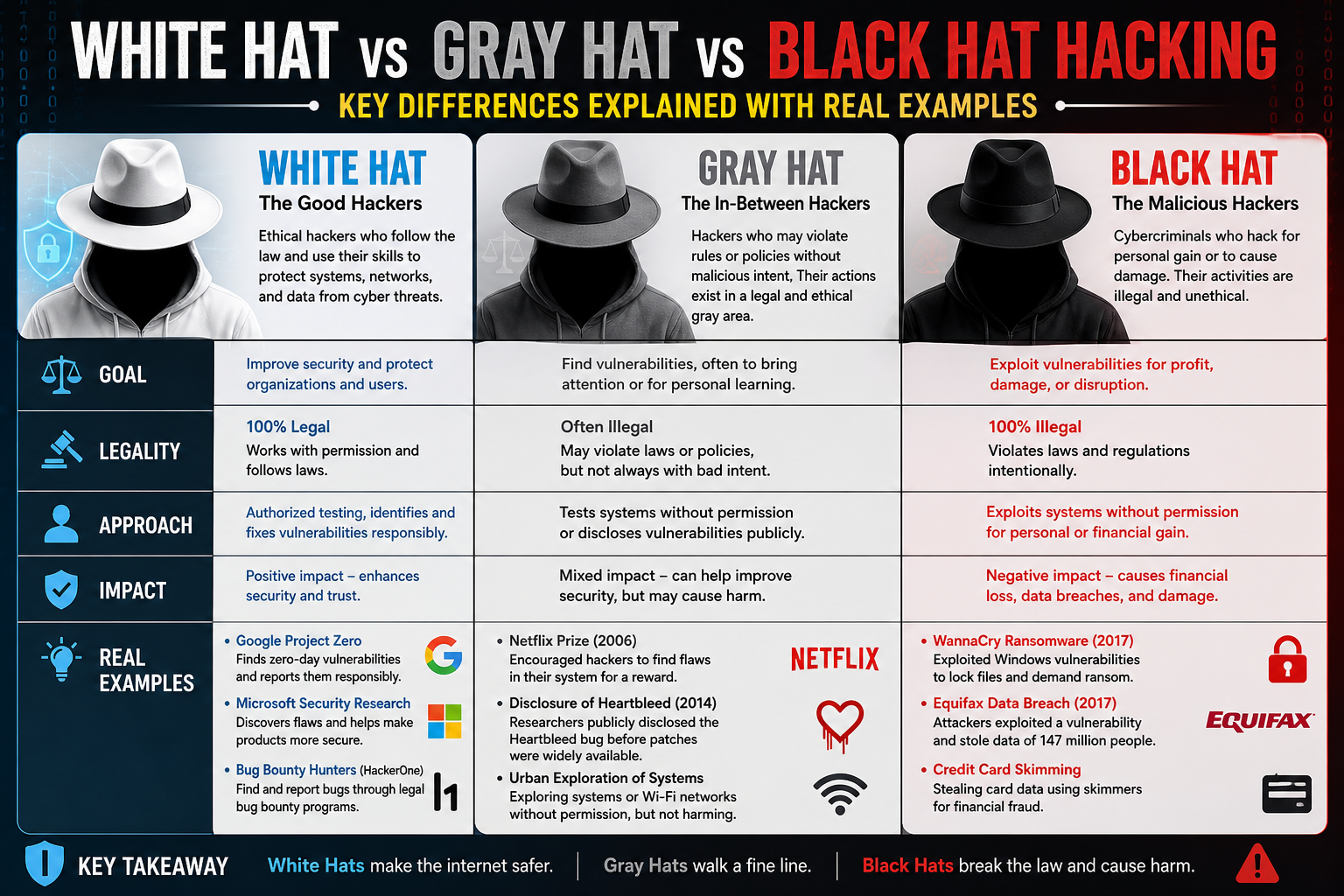
In the world of information security, the word “hacker” carries a complicated reputation. For some, it conjures images of shadowy figures typing furiously in dark rooms, breaking into systems for profit or chaos. For others, it represents highly skilled professionals who defend organizations, uncover weaknesses, and strengthen digital infrastructure. The truth lies somewhere in between, shaped by intent, legality, and the boundaries within which individuals operate.
The idea of “hats” in hacking—white, gray, and black—serves as a simple way to categorize these differences. It is not about actual clothing or disguise, but rather about ethical alignment and behavior. These categories help define whether someone is working to protect systems, exploit them, or operate in the ambiguous space in between. Yet, despite the simplicity of these labels, the reality behind them is layered, nuanced, and deeply tied to law, ethics, and human motivation.
Understanding these distinctions is essential for anyone interested in cybersecurity, whether as a career path, an academic subject, or simply as a way to better understand the digital world. The first step is to explore the foundation of hacking itself—what it means, how it evolved, and why the same set of skills can lead to vastly different outcomes depending on how they are used.
The Evolution of the Hacker Identity
Long before hacking became associated with cybercrime, it was a term rooted in curiosity and innovation. Early hackers were individuals who enjoyed exploring systems, pushing boundaries, and discovering how things worked. Their work was not about breaking laws but about expanding knowledge. They were problem solvers, often driven by a desire to improve technology or understand it at a deeper level.
As computer systems became more widespread and interconnected, the potential for misuse grew. What was once harmless experimentation began to intersect with real-world consequences. Unauthorized access to systems could lead to stolen data, disrupted services, or financial loss. This shift marked the beginning of hacking as a legally and ethically complex activity.
Over time, society began to differentiate between those who used their skills responsibly and those who did not. This distinction gave rise to the concept of “hats,” borrowed from old Western films where heroes wore white hats and villains wore black ones. In cybersecurity, these labels became shorthand for intent and behavior, helping to classify individuals based on how they applied their technical abilities.
Why Labels Matter in Cybersecurity
At first glance, categorizing hackers might seem like a simplistic approach to a complex issue. However, these labels serve an important purpose. They provide a framework for understanding actions that might otherwise appear similar on the surface. Two individuals might use the same tools, techniques, and methods, yet their intentions and the legality of their actions can be entirely different.
For example, scanning a network for vulnerabilities can be either a legitimate security practice or an unauthorized intrusion attempt. The difference lies in permission and purpose. One is conducted with the goal of strengthening security, while the other may aim to exploit weaknesses for personal gain. Without a clear way to distinguish between these scenarios, it would be difficult to enforce laws or establish ethical guidelines.
These distinctions also influence how organizations approach security. Companies must decide who they can trust to test their systems, how to respond to discovered vulnerabilities, and how to protect themselves from malicious actors. The concept of hacking “hats” helps guide these decisions, offering a way to evaluate behavior beyond technical capability.
The Role of Authorization
One of the most critical factors in determining where someone falls within the spectrum of hacking is authorization. Permission acts as a dividing line between legal and illegal activity. It defines whether an action is sanctioned or considered a violation of security and privacy.
Authorization is not just a formality; it is a structured agreement that outlines what can and cannot be done. It specifies the scope of work, the systems involved, the methods allowed, and the timeframe for activities. This clarity ensures that all parties understand the boundaries and reduces the risk of unintended consequences.
When authorization is present, security professionals can operate with confidence, knowing that their actions are both legal and beneficial. Without it, even well-intentioned actions can lead to serious legal and ethical issues. This is where the concept of gray areas begins to emerge, highlighting the importance of clear guidelines and responsible behavior.
The Spectrum of Intent
Intent plays a central role in defining hacking activities. While authorization determines legality, intent reveals motivation. Together, these factors shape how actions are perceived and judged.
On one end of the spectrum are individuals who aim to protect and improve systems. Their work is driven by a desire to prevent harm, safeguard data, and support organizations in maintaining secure environments. On the other end are those who seek to exploit vulnerabilities for personal gain, whether through financial theft, data breaches, or disruption of services.
Between these extremes lies a group whose motivations are less clear-cut. They may not intend to cause harm, but their methods and lack of authorization place them in uncertain territory. This middle ground is where ethical dilemmas arise, challenging traditional definitions of right and wrong.
Understanding this spectrum is essential for grasping the complexity of cybersecurity. It demonstrates that hacking is not inherently good or bad, but rather a tool that can be used in different ways depending on the individual behind it.
Skills That Define Modern Hackers
Regardless of their classification, hackers share a common set of skills. These abilities form the foundation of their work and enable them to interact with systems in meaningful ways. Technical knowledge is at the core, including an understanding of networks, operating systems, programming languages, and security principles.
However, technical expertise alone is not enough. Successful hackers also possess strong analytical thinking, creativity, and persistence. They must be able to identify patterns, think outside the box, and approach problems from multiple angles. This combination of skills allows them to uncover vulnerabilities that others might overlook.
Communication is another important aspect, particularly for those working in legitimate roles. Being able to explain complex issues in clear, understandable terms is crucial for helping organizations address security concerns. This ability bridges the gap between technical findings and practical solutions.
These skills are neutral in nature. They can be used to defend systems or to attack them. The distinction lies not in the skills themselves, but in how they are applied.
The Expanding Landscape of Cyber Threats
As technology continues to evolve, so too does the landscape of cyber threats. The increasing reliance on digital systems has created new opportunities for both protection and exploitation. From personal devices to large-scale infrastructure, nearly every aspect of modern life is connected in some way.
This interconnectedness brings convenience and efficiency, but it also introduces risk. Vulnerabilities can exist in software, hardware, and even human behavior. Identifying and addressing these weaknesses requires a proactive approach, making the role of skilled security professionals more important than ever.
At the same time, malicious actors are becoming more sophisticated. They develop new techniques, adapt to defenses, and exploit emerging technologies. This constant evolution creates a dynamic environment where the line between defense and offense is continually tested.
Understanding the different types of hackers helps make sense of this environment. It provides insight into the motivations behind various actions and highlights the importance of maintaining strong ethical standards in the face of growing challenges.
The Human Element in Security
While much of cybersecurity focuses on technology, the human element remains a critical factor. Decisions made by individuals—whether ethical or malicious—shape the outcomes of security efforts. This is true not only for hackers but also for organizations, policymakers, and everyday users.
Human behavior can introduce vulnerabilities, such as weak passwords or susceptibility to social engineering. At the same time, it can also be a source of strength, as awareness and education lead to better security practices. Recognizing the role of people in cybersecurity is essential for developing effective strategies.
The concept of hacking “hats” reflects this human dimension. It emphasizes that actions are driven by choices, not just capabilities. By understanding these choices, it becomes possible to encourage responsible behavior and discourage harmful actions.
Setting the Stage for Deeper Exploration
The distinctions between white, gray, and black hat hackers form the foundation for understanding modern cybersecurity. Each category represents a different approach to the same set of skills, shaped by intent, authorization, and ethical considerations.
In the sections that follow, these categories will be explored in greater detail. The focus will shift toward the specific characteristics that define each group, the roles they play in the digital ecosystem, and the challenges they present. By examining these aspects, a clearer picture will emerge of how hacking fits into the broader context of technology and society.
This exploration begins with a closer look at those who operate firmly within the boundaries of legality and ethics, using their expertise to protect and strengthen the systems that underpin our digital world.
Inside the World of Ethical Hackers: Defenders of the Digital Frontier
The modern digital landscape depends heavily on individuals who understand how systems can fail just as well as how they function. Among these individuals are ethical hackers, often referred to as white hat hackers. They operate with a clear purpose: to identify weaknesses before malicious actors can exploit them. While their methods may resemble those used by attackers, their intent, structure, and accountability set them apart in meaningful ways.
Ethical hacking is not simply about breaking into systems to prove a point. It is a disciplined, highly structured practice that requires permission, planning, and a deep sense of responsibility. Those who operate in this space are trusted with access to sensitive systems, confidential data, and critical infrastructure. Their role is not only technical but also strategic, helping organizations understand where they are vulnerable and how to improve.
The Foundation of Ethical Security Testing
At the core of ethical hacking lies a fundamental principle: controlled and authorized testing. Before any action is taken, there is a clearly defined agreement between the ethical hacker and the organization requesting the assessment. This agreement outlines the scope, objectives, and limitations of the work.
The scope defines which systems can be tested and which are off-limits. It may include specific networks, applications, or devices, along with any restrictions on methods or timing. This ensures that testing activities do not unintentionally disrupt operations or affect unrelated systems.
Objectives provide direction, focusing the work on meaningful outcomes. These might include identifying vulnerabilities, testing incident response capabilities, or evaluating the effectiveness of existing security controls. By aligning goals with organizational needs, ethical hackers can deliver results that have practical value.
Limitations are equally important. They define what actions are prohibited, such as accessing certain types of data or performing potentially disruptive attacks. These boundaries protect both the organization and the tester, ensuring that the engagement remains safe and controlled.
The Methodical Approach to Finding Weaknesses
Ethical hacking is far from random or chaotic. It follows a structured process designed to systematically uncover vulnerabilities. This process often begins with reconnaissance, where information about the target system is gathered. This might include identifying network ranges, discovering publicly available data, or mapping out the structure of applications.
Next comes scanning and enumeration, where tools and techniques are used to identify potential entry points. This phase involves analyzing systems for open ports, services, and known vulnerabilities. The goal is to build a detailed understanding of the attack surface.
Once potential weaknesses are identified, ethical hackers move into the exploitation phase. Here, they attempt to validate vulnerabilities by demonstrating how they could be used to gain access or disrupt systems. This step is carefully controlled to avoid causing damage, focusing instead on proving the existence and impact of the issue.
After exploitation, attention shifts to post-exploitation analysis. This involves understanding what an attacker could achieve after gaining access. Could they move laterally within the network? Access sensitive data? Escalate privileges? Answering these questions helps organizations assess the severity of vulnerabilities.
Finally, the process concludes with reporting. This is one of the most critical phases, as it translates technical findings into actionable insights. A well-crafted report explains vulnerabilities, their potential impact, and recommended remediation steps in clear, understandable terms.
The Importance of Trust and Confidentiality
Ethical hackers operate in environments where trust is essential. Organizations grant them access to systems that may contain sensitive information, intellectual property, or critical infrastructure components. This level of access requires a strong commitment to confidentiality and integrity.
Maintaining confidentiality means protecting any data encountered during testing. Ethical hackers must ensure that sensitive information is not exposed, misused, or retained beyond what is necessary for the engagement. This often involves secure handling practices, such as encrypting data and limiting access to authorized personnel.
Integrity involves conducting testing in a responsible manner. Ethical hackers must avoid actions that could harm systems, disrupt services, or compromise data. Even when demonstrating vulnerabilities, they must do so in a way that minimizes risk.
Trust is built not only through technical competence but also through professionalism and ethical behavior. Organizations rely on ethical hackers to act in their best interests, making decisions that prioritize security and stability.
The Role of Communication in Ethical Hacking
Technical skills are only part of what makes an effective ethical hacker. Communication plays a crucial role in ensuring that findings are understood and acted upon. Without clear communication, even the most significant vulnerabilities can go unaddressed.
Ethical hackers must be able to explain complex technical concepts in a way that is accessible to non-technical stakeholders. This includes describing vulnerabilities, outlining risks, and providing practical recommendations. The goal is to bridge the gap between technical analysis and business decision-making.
Communication also extends to collaboration. Ethical hackers often work closely with development teams, system administrators, and security personnel. By engaging with these groups, they can provide insights that help improve security practices and prevent future issues.
Effective communication fosters a culture of security awareness, encouraging organizations to take proactive steps rather than reactive measures.
The Broader Impact of Ethical Hackers
The work of ethical hackers extends beyond individual organizations. By identifying and addressing vulnerabilities, they contribute to the overall security of the digital ecosystem. Their efforts help prevent data breaches, protect user privacy, and maintain trust in technology.
In many cases, ethical hackers also play a role in shaping security standards and best practices. Their findings can highlight common weaknesses, leading to improvements in software development, system design, and security policies. This collective knowledge benefits not only the organizations they work with but also the wider community.
Ethical hackers often serve as advocates for security awareness, educating others about risks and encouraging responsible behavior. This outreach helps build a more informed and resilient digital environment.
The Challenges Faced by Ethical Hackers
Despite their important role, ethical hackers face a range of challenges. One of the most significant is the constant evolution of technology. New systems, platforms, and applications introduce new vulnerabilities, requiring continuous learning and adaptation.
Another challenge is balancing thorough testing with operational stability. Ethical hackers must identify vulnerabilities without causing disruptions, which can be difficult in complex environments. This requires careful planning and a deep understanding of system behavior.
Time constraints can also be a factor. Engagements are often limited in duration, requiring ethical hackers to prioritize their efforts and focus on the most critical areas. This can make it challenging to achieve complete coverage.
Additionally, ethical hackers must navigate the expectations of stakeholders. Organizations may have varying levels of security maturity, resources, and risk tolerance. Aligning testing efforts with these factors requires flexibility and clear communication.
Ethical Decision-Making in Practice
While ethical hackers operate within defined boundaries, they still encounter situations that require judgment and decision-making. Not every scenario is straightforward, and unexpected issues can arise during testing.
For example, an ethical hacker might discover a vulnerability that provides access to sensitive data. Even if accessing that data is technically possible, doing so may not be necessary to demonstrate the issue. In such cases, the ethical choice is to avoid unnecessary exposure and report the vulnerability responsibly.
Similarly, ethical hackers must decide how far to go in demonstrating the impact of a vulnerability. The goal is to provide enough evidence to support remediation without causing harm. This balance requires careful consideration and a strong ethical framework.
These decisions highlight the importance of professionalism and integrity in ethical hacking. Technical skills alone are not enough; ethical hackers must also possess the judgment needed to navigate complex situations responsibly.
The Relationship Between Defense and Offense
Ethical hacking often involves thinking like an attacker. By understanding how malicious actors operate, ethical hackers can anticipate potential threats and identify weaknesses more effectively. This approach blurs the line between defense and offense, creating a unique dynamic.
However, the key difference lies in purpose and control. Ethical hackers use offensive techniques as a means of strengthening defenses, not exploiting them. Their work is guided by rules, agreements, and ethical standards that ensure their actions remain constructive.
This relationship between defense and offense is central to modern cybersecurity. It reflects the reality that protecting systems requires an understanding of how they can be attacked. Ethical hackers serve as a bridge between these perspectives, applying their knowledge to improve security outcomes.
The Growing Demand for Ethical Expertise
As digital systems become more integral to daily life, the demand for ethical hacking expertise continues to grow. Organizations across industries recognize the importance of proactive security measures and seek skilled professionals to help them stay ahead of threats.
This demand is driven by several factors, including the increasing frequency of cyberattacks, the complexity of modern systems, and the regulatory requirements surrounding data protection. Ethical hackers play a key role in addressing these challenges, providing insights that help organizations navigate an ever-changing landscape.
The growth of this field also highlights the importance of education and training. Developing the skills needed for ethical hacking requires a combination of technical knowledge, practical experience, and ethical understanding. As more individuals enter this space, the emphasis on responsible behavior becomes even more critical.
A Deeper Look Ahead
The world of ethical hacking offers a compelling example of how technical skills can be used for positive impact. It demonstrates the value of structured, responsible approaches to identifying and addressing vulnerabilities. At the same time, it underscores the importance of trust, communication, and ethical decision-making.
Yet, not all individuals who possess these skills operate within such clear boundaries. Beyond the realm of ethical hacking lies a spectrum of behaviors that challenge traditional definitions of legality and intent. Some operate without permission but claim good intentions, while others pursue goals that are openly malicious.
The next stage of exploration moves into this more complex territory, examining the motivations, methods, and consequences associated with those who operate outside the structured world of ethical hacking.
The Shadow Spectrum: Gray Areas, Malicious Intent, and the Realities of Black Hat Activity
Beyond the structured and principled world of ethical hacking lies a far more complex and often unsettling landscape. This is where the lines between curiosity, opportunism, and outright malice begin to blur. While white hat hackers operate with permission and a clear purpose, and ethical boundaries guide their work, not everyone follows the same rules. Some individuals step outside those boundaries—sometimes with good intentions, sometimes without—and others reject them entirely.
This part of the spectrum is typically divided into two broad categories: gray hat hackers and black hat hackers. While they are often grouped together as “non-ethical,” the reality is far more nuanced. One operates in ambiguity, sometimes driven by curiosity or a desire for recognition. The other operates with intent to exploit, disrupt, or profit from weaknesses. Understanding the differences between these two groups is essential to grasping the full picture of cybersecurity and the challenges it faces.
The Uncertain Ground of Gray Hat Behavior
Gray hat hackers occupy a space that is difficult to define in absolute terms. They are not bound by formal permission, yet they are not always driven by harmful intent. Their actions often fall into a category that is technically unauthorized but not necessarily malicious in motivation.
A typical gray hat might scan websites, applications, or networks looking for vulnerabilities without being invited to do so. When they find a weakness, they may choose to report it to the owner, sometimes expecting recognition or compensation. In other cases, they might disclose the issue publicly if they feel ignored or dismissed.
This behavior creates a paradox. On one hand, gray hats can help organizations identify serious security flaws that might otherwise go unnoticed. On the other hand, their lack of authorization places them in violation of laws and policies designed to protect systems from unauthorized access.
The challenge lies in determining how to interpret their actions. Are they helping, or are they overstepping? The answer often depends on perspective, context, and the specific details of each situation.
Curiosity, Recognition, and the Motivation Behind Gray Hats
Unlike black hat hackers, who are typically driven by clear objectives such as financial gain or disruption, gray hat motivations are often more complex. Curiosity plays a significant role. Many gray hats are deeply interested in how systems work and are motivated by the challenge of discovering weaknesses.
Recognition is another common factor. Discovering a vulnerability can be seen as an achievement, and some individuals seek acknowledgment for their findings. This desire for recognition can lead them to disclose vulnerabilities publicly if they feel their efforts are not appreciated.
There is also a sense of perceived responsibility. Some gray hats believe they are contributing to security by exposing weaknesses, even if they do so without permission. They may view their actions as a form of public service, highlighting issues that organizations should address.
However, these motivations do not eliminate the risks associated with their actions. Unauthorized testing can lead to unintended consequences, including system disruptions, data exposure, or legal repercussions.
The Legal Tightrope
One of the defining characteristics of gray hat activity is its uncertain legal standing. Laws governing computer access are often broad, focusing on whether an action was authorized rather than the intent behind it. This means that even well-intentioned actions can be considered violations.
The concept of “unauthorized access” is central to this issue. If a person interacts with a system without explicit permission, they may be in breach of legal frameworks designed to protect digital assets. This applies regardless of whether they cause harm or attempt to help.
The ambiguity arises when considering what constitutes damage. In some cases, simply accessing a system or running tests can be interpreted as causing harm, particularly if it requires time and resources to investigate. This broad interpretation creates a challenging environment for gray hat hackers, who may not fully understand the legal implications of their actions.
As a result, individuals operating in this space often face significant risks. Even if their intentions are positive, they may encounter legal consequences that can impact their careers and reputations.
Responsible Disclosure and Its Challenges
A key concept associated with gray hat activity is responsible disclosure. This involves reporting vulnerabilities to the affected organization in a way that allows them to address the issue before it becomes public. The goal is to balance transparency with security, ensuring that vulnerabilities are fixed without exposing systems to additional risk.
However, responsible disclosure is not always straightforward. Organizations may be slow to respond, dismissive of reports, or unwilling to engage with individuals who acted without permission. This can lead to frustration and, in some cases, public disclosure of vulnerabilities.
Public disclosure can have mixed outcomes. On one hand, it can pressure organizations to take action and raise awareness of security issues. On the other hand, it can expose systems to exploitation by malicious actors who become aware of the vulnerability.
This tension highlights the complexity of gray hat behavior. While the intention may be to improve security, the methods used can create new risks and challenges.
The Transition from Gray to Black
The boundary between gray hat and black hat activity is not always clear-cut. In some cases, individuals may move from one category to the other, either gradually or suddenly. This transition is often driven by changes in motivation, opportunity, or circumstance.
For example, a gray hat who initially reports vulnerabilities might become frustrated with a lack of recognition or compensation. This frustration could lead them to exploit vulnerabilities for personal gain, crossing into black hat territory. Similarly, the discovery of valuable data might tempt someone to take actions they would not have considered otherwise.
This fluidity underscores the importance of clear ethical guidelines and legal frameworks. Without them, individuals may find themselves navigating a path that becomes increasingly risky and difficult to justify.
The World of Black Hat Hackers
At the far end of the spectrum are black hat hackers, whose actions are defined by malicious intent. Unlike gray hats, who may operate with mixed motivations, black hats are focused on exploiting systems for personal benefit or causing harm.
Their activities can take many forms, including stealing sensitive data, deploying malicious software, disrupting services, or conducting large-scale attacks. These actions often have significant consequences, affecting individuals, organizations, and even entire industries.
Black hat hackers are typically motivated by financial gain, although other factors such as political agendas, ideological beliefs, or personal satisfaction can also play a role. Regardless of the motivation, their actions are characterized by a disregard for legal and ethical boundaries.
The Economics of Cybercrime
One of the driving forces behind black hat activity is the potential for financial profit. The digital world offers numerous opportunities for monetization, from selling stolen data to conducting fraud or extortion.
Data breaches, for example, can yield valuable information such as credit card numbers, login credentials, and personal details. This data can be sold or used to carry out further attacks, creating a cycle of exploitation.
Ransomware is another common tactic, where attackers encrypt data and demand payment for its release. This approach leverages the urgency of access to critical systems, often forcing organizations to make difficult decisions under pressure.
The economics of cybercrime have evolved into a complex ecosystem, with specialized roles and services. Some individuals focus on developing tools, while others handle distribution, negotiation, or data monetization. This division of labor increases efficiency and makes it easier for individuals to participate in malicious activities.
Techniques and Tactics
Black hat hackers employ a wide range of techniques to achieve their اهداف. These methods often mirror those used by ethical hackers, but with different intentions and without restrictions.
Common approaches include exploiting software vulnerabilities, conducting phishing attacks, and using social engineering to manipulate individuals into revealing information. These tactics take advantage of both technical weaknesses and human behavior.
Advanced attackers may use sophisticated methods such as zero-day exploits, which target previously unknown vulnerabilities. They may also employ stealth techniques to avoid detection, maintaining access to systems over extended periods.
The effectiveness of these techniques highlights the importance of proactive security measures. Understanding how attacks are carried out is essential for developing defenses that can withstand them.
The Impact of Malicious Activity
The consequences of black hat hacking extend far beyond the immediate targets. Data breaches can lead to identity theft, financial loss, and erosion of trust. Service disruptions can affect critical infrastructure, impacting healthcare, transportation, and other essential services.
Organizations may face significant costs related to incident response, legal action, and reputational damage. In some cases, the effects can be long-lasting, influencing customer confidence and market position.
On a broader scale, cybercrime can undermine confidence in digital systems, slowing innovation and adoption of new technologies. This makes the fight against malicious activity a priority not only for individual organizations but for society as a whole.
Defensive Strategies and the Ongoing Battle
Addressing the challenges posed by gray and black hat hackers requires a multi-faceted approach. Technical defenses such as firewalls, intrusion detection systems, and encryption play a critical role in protecting systems.
However, technology alone is not enough. Education and awareness are essential for reducing the effectiveness of social engineering and other human-targeted attacks. Organizations must also develop strong policies and procedures to guide their security efforts.
Collaboration is another key factor. Sharing information about threats and vulnerabilities helps create a collective defense, allowing organizations to learn from each other and respond more effectively.
The battle between defenders and attackers is ongoing, with each side continually adapting to new developments. This dynamic environment requires vigilance, innovation, and a commitment to ethical principles.
Ethical Reflection in a Complex Landscape
The existence of gray and black hat hackers raises important questions about ethics, responsibility, and the use of technical skills. It highlights the reality that knowledge itself is neutral, but its application carries consequences.
For those entering the field of cybersecurity, these distinctions serve as a guide for making informed choices. Understanding the risks and implications of different actions helps individuals navigate the complexities of the digital world.
At the same time, these categories remind us that security is not just a technical challenge but a human one. It involves decisions, motivations, and values that shape the way technology is used and protected.
The exploration of gray and black hat activity reveals a landscape that is as challenging as it is fascinating. It underscores the importance of maintaining clear boundaries, fostering ethical behavior, and working collectively to build a safer digital future.
Another important dimension to consider is how quickly the boundary between experimentation and exploitation can be crossed in real-world scenarios. Many individuals who begin by casually exploring systems underestimate how easily their actions can escalate. A simple curiosity-driven action—like probing a website for weaknesses—can unintentionally trigger alarms, disrupt services, or expose sensitive data. Once that threshold is crossed, the situation is no longer theoretical; it becomes a matter of accountability. This is why even seemingly harmless activities must be approached with caution, as the consequences are not always immediately visible.
The psychological aspect of hacking behavior also plays a significant role in shaping outcomes. Gray hat and black hat hackers often justify their actions in ways that align with their personal beliefs. A gray hat might convince themselves that they are helping by uncovering flaws, even without permission. A black hat, on the other hand, might rationalize their behavior by focusing on financial reward or by minimizing the perceived impact of their actions. These internal justifications can make it easier to ignore ethical boundaries, reinforcing patterns of behavior that become increasingly difficult to reverse over time.
There is also a growing influence of online communities and underground networks that contribute to this dynamic. In some spaces, sharing exploits, tools, and techniques is normalized, creating an environment where questionable behavior is encouraged or even celebrated. For individuals who are still developing their understanding of cybersecurity, exposure to such communities can shape their perception of what is acceptable. This highlights the importance of strong ethical education and mentorship, especially for those who are new to the field and may not yet fully grasp the implications of their actions.
Another layer of complexity arises from the global nature of the internet. Laws and regulations vary widely across different countries, which can create confusion about what is permissible. An action that is considered illegal in one jurisdiction might not be clearly defined in another. This lack of consistency can lead to misunderstandings and, in some cases, deliberate exploitation of legal gaps. However, relying on these differences is inherently risky, as cross-border cooperation in cybersecurity is becoming more common, and enforcement efforts continue to evolve.
Technology itself is also reshaping the landscape in ways that amplify both risks and opportunities. The rise of automation, artificial intelligence, and interconnected devices has expanded the attack surface significantly. Systems are more complex, and vulnerabilities can exist in places that were previously overlooked. For gray and black hat hackers, this creates new avenues to explore. At the same time, it increases the potential impact of their actions, as a single vulnerability can affect thousands or even millions of users.
The role of organizations in this environment cannot be overlooked. How companies respond to vulnerability reports, whether authorized or not, can influence behavior across the spectrum. Transparent and respectful handling of disclosures can encourage responsible actions, even from those who initially acted without permission. Conversely, dismissive or overly punitive responses may push individuals toward less cooperative behavior. This does not justify unauthorized actions, but it does illustrate how responses can shape future interactions.
Ultimately, the existence of gray and black hat hackers reflects the broader reality that technology is deeply intertwined with human behavior. Skills alone do not determine outcomes; it is the choices made by individuals that define whether those skills are used constructively or destructively. As the digital world continues to expand, these choices will carry increasing weight, influencing not only individual systems but the overall trust and stability of the online environment.
Conclusion
The distinction between white hat, gray hat, and black hat hacking ultimately comes down to more than just technical ability. It reflects the choices individuals make when applying their knowledge in a world where digital systems influence nearly every aspect of daily life. While the same skills can be used across all three categories, the intent, authorization, and ethical boundaries behind those actions define their impact.
White hat hackers represent the structured and responsible side of cybersecurity. They operate within clearly defined limits, using their expertise to strengthen systems, protect data, and support organizations in navigating an increasingly complex threat landscape. Their work demonstrates that hacking, when guided by ethics and permission, can be a powerful force for good. They are not just problem solvers but also contributors to a safer and more resilient digital environment.
Gray hat hackers, on the other hand, highlight the challenges that arise when good intentions are not matched by proper authorization. Their actions often stem from curiosity or a desire to help, yet they exist in a space where legality and ethics can become uncertain. This gray area serves as a reminder that intention alone is not enough to justify an action. Without clear boundaries, even well-meaning efforts can lead to unintended consequences, both for the individual and the systems involved.
Black hat hackers represent the most harmful end of the spectrum, where skills are used deliberately for exploitation, disruption, or personal gain. Their activities expose the vulnerabilities that exist within digital systems and underscore the importance of proactive security measures. The damage caused by such actions—whether financial, reputational, or societal—reinforces the need for strong defenses, informed users, and ongoing vigilance.
Across all three categories, one principle stands out as the defining factor: authorization. It is the line that separates legal and illegal activity, responsible testing from intrusion, and constructive behavior from harmful actions. Understanding and respecting this boundary is essential for anyone engaging with cybersecurity, whether professionally or out of personal interest.
At the same time, the broader lesson extends beyond labels. The world of hacking is not static; it evolves alongside technology, shaped by new tools, emerging threats, and changing human behavior. As systems become more interconnected and complex, the opportunities for both protection and exploitation grow. This makes ethical decision-making more important than ever.
For individuals entering or exploring this field, the path they choose will determine not only their own future but also their contribution to the digital ecosystem. Developing technical skills is only part of the journey. Equally important is building a strong ethical foundation, understanding the legal landscape, and recognizing the responsibilities that come with access and knowledge.
For organizations and society as a whole, fostering a culture of security awareness and responsible behavior is key. Encouraging ethical practices, supporting transparent communication, and investing in proactive defenses can help shift the balance toward protection rather than exploitation. Collaboration between individuals, organizations, and governments will continue to play a crucial role in addressing the challenges posed by malicious activity.
In the end, hacking is neither inherently good nor bad—it is a reflection of human intent applied through technical skill. The hats we assign are simply a way of understanding those intentions. What truly matters is how those skills are used and the impact they have on the world around us.