Wireless communication is something most people use every day without thinking about it. From browsing the internet on a phone to streaming videos or connecting laptops to Wi-Fi, everything happens through invisible radio waves moving through the air. On the surface, it feels simple: data is sent, data is received, and everything works.
But underneath that simplicity is a highly structured system designed to deal with interference, limited spectrum, and constant signal disruption. Radio waves don’t travel in a clean, controlled environment. They bounce off walls, get absorbed by objects, overlap with other signals, and often arrive at the receiver in a distorted form. Because of this, engineers have developed multiple techniques to make wireless communication more reliable and efficient.
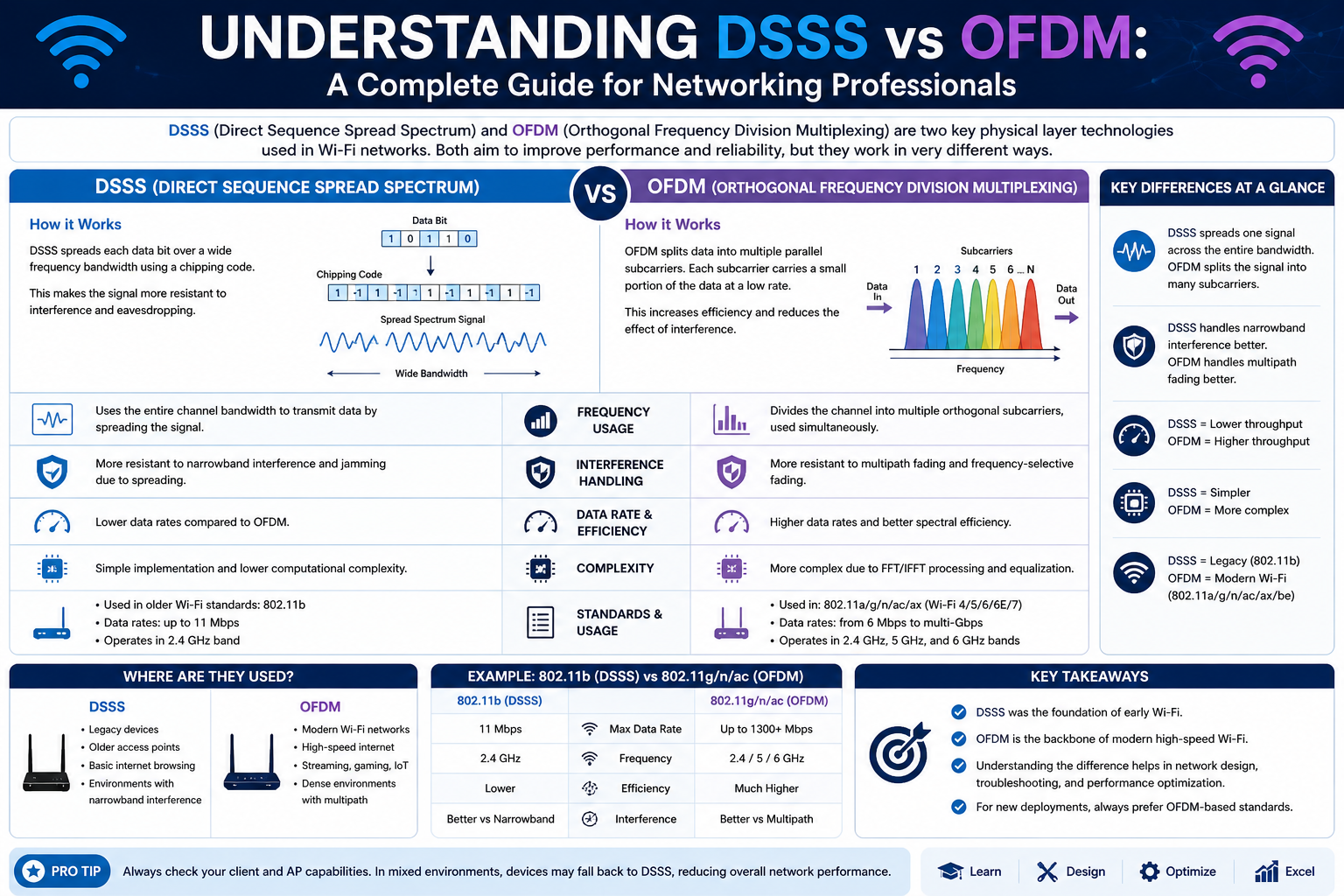
Two of the most important techniques used in modern wireless systems are DSSS (Direct Sequence Spread Spectrum) and OFDM (Orthogonal Frequency Division Multiplexing). These are not competing technologies in the way most people assume. Instead, they are different approaches to solving the same problem: how to transmit data efficiently and accurately over an unreliable medium.
To understand them properly, it helps to first understand what wireless systems are trying to achieve at a fundamental level: sending bits of information in a way that survives noise, interference, and distortion.
The Challenge of Sending Data Through the Air
When data is transmitted wirelessly, it is not sent as text, images, or video. Instead, everything is converted into binary form—streams of 1s and 0s. These bits are then encoded into radio signals, which travel through the air at the speed of light.
However, unlike a wired connection where signals travel through a controlled physical medium, wireless signals are exposed to environmental conditions. Several issues can affect them:
Signals may reflect off buildings, creating multiple delayed copies of the same transmission.
Other devices may transmit on nearby frequencies, causing interference.
Physical objects like walls, metal structures, or even weather conditions can weaken or distort signals.
Signals can overlap and collide, especially in crowded frequency bands.
Because of all these issues, a signal that leaves a transmitter is rarely identical to what arrives at the receiver. The system must therefore be designed not just for transmission, but also for recovery and correction of data.
This is where techniques like DSSS and OFDM become essential. They are both methods of structuring signals so that even in a noisy environment, the original information can still be reconstructed reliably.
The Concept Behind DSSS: Spreading Data for Reliability
Direct Sequence Spread Spectrum is based on a surprisingly simple idea: instead of sending data as a single compact signal, the system spreads it across a wider range of frequencies. This spreading makes the signal more resistant to interference and easier to recover even if parts of it are lost.
At its core, DSSS takes each bit of data and expands it into a longer sequence of bits. This expanded version is called a chip sequence. Each original bit is transformed into multiple smaller units, and these units are transmitted across a broader frequency range.
The key idea here is redundancy. Instead of relying on a single transmission of a bit, DSSS ensures that multiple representations of that bit are sent simultaneously. Even if some of them are corrupted or lost, the receiver can still determine the original value.
This method significantly improves reliability, especially in environments where signals are frequently disrupted.
Pseudonoise and Why It Is Intentionally Added
One of the most interesting aspects of DSSS is the use of pseudonoise. At first, the idea of adding noise to a signal may seem counterintuitive. In most cases, noise is something engineers try to eliminate. However, in DSSS, pseudonoise plays a very important role.
Pseudonoise is a carefully designed pattern that appears random but is actually predictable. Both the transmitter and receiver know the exact pattern being used. This shared knowledge allows the system to encode and decode signals correctly.
When data is transmitted using DSSS, each bit is combined with this pseudonoise sequence. The result is a scrambled version of the original data that looks like random noise to anyone who does not have the decoding pattern.
This serves two purposes. First, it spreads the signal across a wider bandwidth. Second, it makes the transmission more resistant to interference because the signal blends into background noise rather than standing out as a narrow, easily disrupted frequency.
At the receiver end, the same pseudonoise pattern is used to reconstruct the original signal. This process effectively “unscrambles” the data and removes the noise that was intentionally added during transmission.
Chips and the Structure of DSSS Data
In DSSS, the smallest unit of transmitted information is not a bit, but a chip. A chip is a fragment of a bit that has been expanded using the pseudonoise sequence.
For example, a single bit might be transformed into a sequence of several chips. Each chip carries part of the information, but no single chip is sufficient on its own to represent the original bit.
This structure is what makes DSSS robust. Even if some chips are lost due to interference or signal degradation, the receiver can still reconstruct the original bit by analyzing the remaining chips.
The receiver does not need to capture every chip perfectly. Instead, it looks for patterns across the received signal and uses correlation techniques to determine the most likely original value.
This tolerance for loss is one of the main reasons DSSS was widely used in early wireless systems and continues to be valuable in environments where reliability is more important than speed.
How DSSS Handles Interference in Real Environments
Wireless signals rarely travel in a straight, uninterrupted path. They reflect off surfaces, scatter in multiple directions, and sometimes arrive at the receiver through different paths at different times. This phenomenon is known as multipath propagation.
In many systems, multipath causes distortion and interference. However, DSSS is designed to handle this type of environment relatively well.
Because the signal is spread across a wide frequency range and encoded with pseudonoise, it becomes less sensitive to narrowband interference. If a portion of the frequency band is disrupted, the rest of the signal can still carry enough information for reconstruction.
Additionally, the correlation process used at the receiver helps filter out unwanted noise. Since the receiver knows the pseudonoise pattern, it can distinguish between valid signal components and random interference.
This makes DSSS particularly useful in environments where signals are weak or unpredictable, such as early wireless networks and some satellite communication systems.
The Core Idea Behind OFDM: Dividing the Spectrum Efficiently
While DSSS focuses on spreading a signal across a wide frequency range for reliability, OFDM takes a very different approach. Instead of spreading a single signal broadly, OFDM divides the available frequency spectrum into many smaller subchannels.
Each subchannel carries a portion of the data, and all subchannels operate simultaneously. This allows multiple streams of data to be transmitted in parallel.
The key advantage of this approach is efficiency. Instead of sending one large signal, OFDM sends many smaller signals at the same time. This parallel transmission significantly increases data throughput.
Each subchannel is carefully designed so that it does not interfere with the others, even though they are closely packed together in the frequency spectrum.
Orthogonality and Why OFDM Subchannels Do Not Interfere
The term orthogonal in OFDM refers to the mathematical relationship between the subcarriers. In simple terms, orthogonality ensures that even though the subchannels are close together in frequency, they do not interfere with each other.
This is achieved by precisely spacing the subcarriers so that their signal peaks and nulls align in a controlled way. At specific sampling points, each subcarrier reaches a state where it does not interfere with neighboring carriers.
This careful timing allows OFDM to pack subchannels much more tightly than traditional systems, which require buffer space between frequencies to avoid overlap.
Without orthogonality, the signals would collide and become difficult to separate at the receiver. With it, each subchannel remains distinct and recoverable.
Parallel Transmission and Spectrum Efficiency
One of the biggest advantages of OFDM is how efficiently it uses available spectrum. In older systems, frequency bands had to be separated by guard spaces to prevent interference. These unused spaces reduced overall efficiency.
OFDM eliminates much of this waste by allowing subcarriers to overlap in a controlled mathematical way. This means more data can be transmitted within the same frequency range.
Each subcarrier operates at a lower data rate, but together they create a high-capacity transmission system. This parallel structure also makes OFDM more resilient to certain types of interference, particularly narrowband noise that might only affect a few subcarriers rather than the entire signal.
Timing and Synchronization in OFDM Systems
OFDM relies heavily on precise timing. Since multiple subcarriers are transmitted simultaneously, the system must ensure that each signal arrives and is interpreted at exactly the right moment.
Even small timing errors can cause misalignment between subcarriers, leading to distortion. To prevent this, OFDM systems use synchronization techniques that align the transmitter and receiver clocks.
Cyclic prefixes are also used to reduce the impact of signal reflections. A cyclic prefix is a repeated segment of the signal added to the beginning of each transmission block. It helps absorb delays caused by multipath propagation, allowing the receiver to focus on the main portion of the signal.
This combination of timing control and redundancy allows OFDM to maintain high performance even in complex wireless environments.
How DSSS and OFDM Are Implemented in Real Wireless Systems
Once the basic ideas behind DSSS and OFDM are understood, the next step is to look at how they actually appear in real communication systems. In practice, neither DSSS nor OFDM exists in isolation as a simple theoretical concept. Instead, they are embedded into complex communication standards that include modulation techniques, error correction, synchronization systems, and hardware constraints.
Wireless technologies like Wi-Fi, cellular networks, and even some satellite systems rely on carefully engineered combinations of these methods. DSSS and OFDM are not just abstract ideas; they are deeply integrated into the way modern devices talk to each other.
To understand their real-world role, it is important to explore how signals are constructed, transmitted, and reconstructed using these techniques in practical environments.
DSSS in Practical Wireless Communication Systems
In real-world implementations, DSSS is often used as part of a broader system rather than as a standalone method. Its main role is to improve signal reliability in environments where interference is common and signal strength may be weak.
In DSSS-based systems, data is first converted into a digital bitstream. This bitstream is then combined with a high-rate pseudorandom sequence, often called a spreading code. This process increases the bandwidth of the signal significantly compared to the original data rate.
The spreading code is what allows DSSS to distribute energy across a wide frequency band. Because of this, the signal becomes less sensitive to narrowband interference. If part of the frequency band is disrupted, the signal can still be recovered using the remaining parts.
At the receiver side, the same spreading code is used to correlate the incoming signal. This correlation process is what allows the receiver to extract the original data from what may appear to be random noise.
This mechanism is heavily dependent on synchronization. If the transmitter and receiver are not aligned in terms of their spreading codes, the system fails to decode the signal correctly. This makes timing and code synchronization critical components of DSSS systems.
Modulation Techniques Used with DSSS
DSSS does not operate alone; it is combined with modulation techniques that define how the signal is physically transmitted over radio waves. One of the most common modulation methods used with DSSS is phase shift keying.
In phase shift keying, the phase of the carrier wave is altered to represent binary data. When DSSS is applied on top of this, the phase-modulated signal is further spread using the pseudorandom sequence.
This combination allows DSSS systems to achieve both robustness and moderate data rates. However, because the signal is spread over a wide bandwidth, DSSS systems are not the most efficient in terms of spectral usage.
The tradeoff is clear: DSSS prioritizes reliability and resistance to interference over raw throughput.
OFDM in Modern High-Speed Wireless Networks
Unlike DSSS, OFDM is designed for high data rate communication. It is widely used in modern systems such as Wi-Fi, LTE, and 5G. Its ability to divide the available spectrum into multiple subcarriers makes it ideal for environments where large amounts of data must be transmitted quickly and efficiently.
In OFDM systems, data is first divided into multiple parallel streams. Each stream is then mapped onto a separate subcarrier. These subcarriers are closely packed in frequency but remain mathematically independent due to their orthogonal structure.
This parallel transmission significantly increases throughput. Instead of sending data sequentially over a single channel, OFDM sends multiple streams at the same time.
This structure is particularly useful in environments with high bandwidth demands, such as video streaming, online gaming, and large data transfers.
Role of Digital Signal Processing in OFDM
One of the most important aspects of OFDM is its reliance on digital signal processing. Unlike simpler modulation techniques, OFDM requires complex mathematical transformations to convert data between time and frequency domains.
At the transmitter, data is mapped into frequency-domain symbols. These symbols are then converted into a time-domain signal using mathematical transformations that combine all subcarriers into a single waveform.
At the receiver, the reverse process is performed. The incoming signal is converted back into the frequency domain, where each subcarrier is separated and decoded individually.
This process allows OFDM systems to handle complex channel conditions, including multipath propagation and frequency-selective fading.
Because each subcarrier operates independently, damage to one part of the spectrum does not necessarily affect the entire transmission.
Handling Multipath Propagation in OFDM Systems
One of the biggest challenges in wireless communication is multipath propagation. This occurs when a signal takes multiple paths to reach the receiver due to reflections from objects such as buildings, walls, and terrain.
In traditional systems, multipath can cause interference and signal distortion. However, OFDM is specifically designed to handle this issue.
Because OFDM divides the signal into narrow subcarriers, each subcarrier experiences a relatively flat channel response. This means that even if some delay or distortion occurs, it is easier to correct within each subchannel.
Additionally, OFDM systems often use guard intervals between transmissions. These intervals help absorb delayed signals from previous transmissions, reducing the risk of overlap and interference.
This makes OFDM highly effective in urban environments where reflections are common and signal paths are unpredictable.
Error Correction and Signal Recovery in Both Systems
Both DSSS and OFDM rely on error correction techniques to ensure data integrity. However, the way they handle errors differs significantly due to their underlying structure.
In DSSS, redundancy is built directly into the signal through spreading. Each bit is represented by multiple chips, which means that partial loss of data does not necessarily result in complete failure. The receiver can still reconstruct the original bit using correlation techniques.
In OFDM, error correction is handled more at the data encoding level. Since each subcarrier carries a portion of the data, additional coding techniques are applied before transmission to detect and correct errors at the receiver.
These error correction methods may include redundancy checks and forward error correction schemes that allow the system to recover lost or corrupted data without requiring retransmission.
This difference highlights a key distinction between the two systems: DSSS builds reliability into the physical transmission, while OFDM relies more on structured data encoding and decoding.
Bandwidth Usage and Spectral Efficiency Differences
One of the most important differences between DSSS and OFDM is how they use available bandwidth.
DSSS spreads a signal across a wide frequency range. This makes it highly resistant to interference but also less efficient in terms of spectrum usage. A large portion of the frequency band is used to carry a relatively small amount of data.
OFDM, on the other hand, uses spectrum much more efficiently. By dividing the available bandwidth into tightly packed subcarriers, it maximizes the amount of data that can be transmitted in a given frequency range.
This efficiency is one of the main reasons OFDM is widely used in modern high-speed networks.
However, this efficiency comes at the cost of increased complexity. OFDM systems require precise synchronization, complex signal processing, and careful management of interference between subcarriers.
Latency and Real-Time Performance Considerations
Latency plays an important role in wireless communication systems, especially in applications such as voice calls, video conferencing, and real-time control systems.
DSSS systems tend to have simpler processing requirements, which can lead to lower system complexity. However, because DSSS spreads data over a wide spectrum and relies on correlation-based decoding, it may not always provide the fastest data throughput.
OFDM systems, while capable of very high data rates, introduce additional processing delay due to the need for signal transformations such as frequency-domain conversion. However, this delay is generally minimal compared to the gains in throughput.
In practice, OFDM is often preferred for high-speed data transmission, while DSSS may still be useful in systems where simplicity and robustness are more important than speed.
Power Consumption and Device Efficiency
Power consumption is another important factor in wireless system design, especially for mobile devices.
DSSS systems generally require less complex signal processing hardware, which can lead to lower power consumption in some scenarios. However, the wide bandwidth usage may offset some of these gains depending on implementation.
OFDM systems require more computational power due to their reliance on digital signal processing. The need for Fourier transformations and subcarrier management increases processing demands.
Modern devices, however, are optimized with specialized hardware that handles OFDM efficiently, making it practical even for battery-powered devices such as smartphones.
As a result, OFDM has become the dominant technology in most modern wireless communication standards despite its higher complexity.
Mobility and Signal Stability in Changing Environments
Wireless signals often need to maintain stability even when devices are moving. This is especially important in mobile communication systems.
DSSS systems provide good stability in low-to-moderate mobility environments because their wide spreading makes them resistant to sudden signal changes. However, they may struggle with very high-speed movement due to synchronization challenges.
OFDM systems, while more sensitive to timing and frequency shifts, are designed with adaptive techniques that allow them to handle mobility effectively. Modern implementations use channel estimation and adaptive equalization to maintain performance even when conditions change rapidly.
This makes OFDM particularly suitable for mobile networks where users are constantly moving between different signal environments.
Real-World Tradeoffs Between DSSS and OFDM Design Approaches
When comparing DSSS and OFDM in practical systems, it becomes clear that they are built around different priorities.
DSSS prioritizes reliability and resistance to interference. It spreads data widely, making it robust in noisy environments but less efficient in terms of data throughput.
OFDM prioritizes efficiency and high-speed data transmission. It divides spectrum into tightly packed subcarriers, enabling large amounts of data to be transmitted simultaneously, but requiring more complex processing.
These differences mean that each system is better suited to different types of communication challenges.
DSSS is more effective in environments where simplicity and signal resilience are critical. OFDM is more effective in environments where high data rates and spectrum efficiency are required.
Integration of DSSS and OFDM in Hybrid Systems
In many modern communication systems, DSSS and OFDM are not used in isolation. Instead, elements of both are combined to achieve a balance between reliability and efficiency.
For example, DSSS techniques may be used at the coding level to improve error resistance, while OFDM is used at the transmission level to maximize bandwidth efficiency.
This hybrid approach allows systems to benefit from the strengths of both methods while minimizing their weaknesses.
Such combinations are common in advanced wireless standards where performance requirements are extremely high and environmental conditions vary widely.
Performance Characteristics of DSSS and OFDM in Real-World Networks
When wireless engineers evaluate communication systems, they don’t look at DSSS or OFDM as isolated theoretical ideas. Instead, they judge them based on how they behave under real operating conditions: interference, distance, mobility, congestion, and hardware limitations. This is where the differences between DSSS and OFDM become more meaningful, because each technique reacts differently when the environment becomes unpredictable.
DSSS tends to behave in a more conservative but stable manner. It sacrifices spectral efficiency to maintain signal integrity even when interference is present. OFDM, in contrast, pushes much more data through the same spectrum, but depends heavily on precise synchronization and advanced signal processing to remain stable.
These performance differences shape how each technology is used in modern networks and why OFDM has become dominant in high-speed systems while DSSS still remains relevant in specific reliability-focused scenarios.
Signal Robustness and Interference Handling
One of the most important performance metrics in wireless communication is how well a system handles interference. Interference can come from many sources: overlapping networks, physical obstructions, electromagnetic noise, or even reflections from nearby surfaces.
DSSS handles interference by spreading the signal across a wide frequency band. Because the signal energy is distributed, interference affecting a narrow part of the spectrum does not destroy the entire transmission. The receiver can still reconstruct the original data using correlation with the known pseudonoise sequence.
This gives DSSS a natural resilience against narrowband interference. Even if parts of the signal are completely corrupted, the redundancy built into the chip structure allows recovery.
OFDM approaches interference differently. Instead of spreading a single signal widely, it splits data into many narrow subcarriers. Each subcarrier operates independently. If interference affects a specific frequency range, only those subcarriers are impacted while others remain unaffected.
This creates a different kind of robustness. DSSS protects against localized frequency disruption by spreading energy widely, while OFDM isolates disruption by segmenting the spectrum.
In practice, OFDM tends to perform better in environments with variable interference patterns because damage is confined to small portions of the data stream rather than affecting the entire transmission.
Multipath Performance and Signal Reflection Behavior
Multipath propagation is one of the most important challenges in wireless communication systems. It occurs when transmitted signals reflect off objects such as buildings, walls, and terrain, causing multiple delayed versions of the same signal to arrive at the receiver.
In DSSS systems, multipath can actually be partially beneficial because the correlation process can combine multiple signal paths constructively. However, severe multipath can still introduce timing uncertainty and reduce decoding accuracy if delays become too large or unpredictable.
OFDM is specifically designed to handle multipath environments more effectively. Each subcarrier operates at a lower data rate and is therefore less sensitive to time dispersion. Additionally, OFDM systems use cyclic prefixes, which act as buffer zones that absorb delayed signals from previous transmissions.
This means that even if reflections occur, they are less likely to interfere with the current data block. The system essentially isolates useful signal content from delayed reflections.
As a result, OFDM performs extremely well in urban environments, indoor networks, and dense infrastructure settings where multipath is unavoidable.
Data Throughput and Spectral Efficiency Comparison
Throughput is one of the most visible differences between DSSS and OFDM. DSSS spreads a single data stream across a wide frequency band, which limits how much information can be transmitted at any given time.
Even though redundancy improves reliability, it also reduces spectral efficiency. Much of the available bandwidth is used to carry repeated or spread versions of the same data rather than new information.
OFDM, on the other hand, maximizes throughput by dividing the spectrum into many narrow subchannels, each carrying independent data. These subchannels operate simultaneously, which dramatically increases total data capacity.
This parallel structure allows OFDM to achieve high data rates without requiring additional bandwidth expansion. Instead of spreading energy widely, it packs information more tightly into the available spectrum.
This efficiency is one of the main reasons OFDM is used in modern broadband systems where high-speed data transfer is essential.
Latency Behavior in DSSS and OFDM Systems
Latency is another key performance factor, especially for applications like voice communication, gaming, and real-time control systems.
DSSS systems tend to have simpler encoding and decoding processes, which can reduce processing delays in some cases. However, because DSSS relies on correlation over a wide spread of chips, decoding can sometimes require more time depending on implementation.
OFDM introduces additional processing steps such as Fast Fourier Transforms (FFT) and Inverse FFT operations. These mathematical transformations convert signals between time and frequency domains.
Although this adds computational complexity, modern hardware is highly optimized for these operations. As a result, OFDM systems typically achieve low latency in practice, even though the underlying processing is more complex.
In real-world deployments, OFDM is generally preferred for latency-sensitive high-speed applications because its parallel structure allows rapid data throughput once processing is complete.
Mobility and Channel Variation Handling
Wireless systems must perform reliably even when users are moving. Mobility introduces rapid changes in signal conditions, including Doppler shifts, changing multipath patterns, and fluctuating signal strength.
DSSS systems are relatively tolerant of moderate mobility because their wideband spreading reduces sensitivity to small frequency shifts. However, high-speed mobility can cause synchronization challenges between transmitter and receiver pseudonoise sequences.
OFDM systems are more sensitive to frequency shifts because each subcarrier depends on precise spacing and orthogonality. Even small Doppler shifts can disrupt subcarrier alignment.
To compensate for this, modern OFDM systems use adaptive techniques such as channel estimation and equalization. These methods continuously adjust the signal processing parameters to match changing conditions.
This allows OFDM to perform effectively even in high-mobility environments such as vehicles and trains.
Power Efficiency and Hardware Considerations
Power consumption is an important factor in wireless design, especially for battery-powered devices like smartphones and IoT sensors.
DSSS systems generally require less complex signal processing, which can result in lower computational overhead. However, because the signal is spread across a wide bandwidth, the transmission power must be managed carefully to maintain signal quality.
OFDM systems require significantly more processing power due to FFT operations and subcarrier management. However, modern hardware accelerators are specifically designed to handle OFDM efficiently.
As a result, despite higher theoretical complexity, OFDM has become practical even for mobile devices. Optimized chipsets and integrated signal processors have made it possible to support high data rates without excessive battery drain.
In modern systems, OFDM often provides a better balance between power usage and performance due to its efficiency in data transmission.
Scalability in Large Network Environments
Scalability refers to how well a communication system performs when many users are connected simultaneously.
DSSS systems can experience limitations in scalability because spreading signals across wide bandwidths can lead to increased interference when multiple users operate in the same spectrum.
OFDM, however, scales more effectively in dense environments. Since it divides spectrum into subcarriers, multiple users can be assigned different frequency-time blocks without significant interference.
This makes OFDM well-suited for large-scale wireless networks such as cellular systems and dense Wi-Fi environments.
Resource allocation techniques allow OFDM-based systems to dynamically assign subcarriers depending on demand, further improving scalability.
Error Performance and Signal Recovery Methods
Error performance is another critical area of comparison between DSSS and OFDM.
In DSSS, redundancy is embedded directly into the transmitted signal. This means that even if part of the signal is lost, the original data can often be reconstructed using correlation techniques.
In OFDM, error handling is more structured. Since data is split across multiple subcarriers, error correction coding is applied before transmission. This allows the receiver to detect and correct errors after demodulation.
Both systems are capable of maintaining high reliability, but they achieve it in fundamentally different ways. DSSS relies on redundancy in the physical signal, while OFDM relies on mathematical encoding at the data level.
Environmental Adaptability of DSSS and OFDM
Wireless environments are highly dynamic. Signals behave differently in open rural areas, dense urban environments, indoor spaces, and industrial settings.
DSSS performs well in noisy or unpredictable environments due to its wide spreading nature. It can tolerate interference and partial signal loss without complete failure.
OFDM performs exceptionally well in structured environments where channel conditions can be estimated and compensated for. It adapts dynamically to changing conditions using advanced signal processing techniques.
This makes OFDM more versatile in modern communication systems where environmental variability is high but predictable enough for adaptive algorithms to function effectively.
Integration into Modern Communication Standards
Modern wireless standards rarely rely on a single technique. Instead, they combine multiple layers of signal processing to achieve optimal performance.
OFDM is now the foundation of many high-speed communication systems due to its efficiency and scalability. DSSS principles may still appear in certain coding or spreading mechanisms, but they are not the primary transmission method in most modern broadband systems.
Instead, DSSS is often found in legacy systems or specialized applications where simplicity and robustness are more important than raw speed.
The evolution of wireless communication shows a clear trend toward OFDM-based systems, especially as demand for high-speed data continues to increase.
Long-Term Trends in Wireless Communication Design
As wireless communication continues to evolve, the focus has shifted toward maximizing spectral efficiency while maintaining reliability. OFDM aligns closely with this goal because it allows dense packing of data within limited spectrum resources.
Future systems continue to refine OFDM through enhancements such as adaptive modulation, advanced coding schemes, and improved synchronization techniques.
While DSSS remains important from a historical and conceptual perspective, its role in modern high-speed networks has become more limited.
The ongoing development of wireless systems continues to build upon OFDM principles while integrating additional layers of intelligence and adaptability to meet increasing data demands.
Advanced Optimization Techniques in DSSS and OFDM Systems
As wireless communication systems evolve, engineers continuously refine how DSSS and OFDM behave under increasingly demanding conditions. Modern networks are not just about sending data anymore; they are about maximizing efficiency, minimizing delay, and maintaining stability across highly variable environments. This has led to advanced optimization strategies being layered on top of both DSSS and OFDM principles.
In DSSS-based systems, optimization often focuses on improving synchronization between the transmitter and receiver. Since DSSS relies heavily on pseudonoise sequences, even small mismatches in timing can reduce correlation accuracy. Engineers therefore use enhanced code tracking methods that allow receivers to lock onto the correct sequence more quickly and maintain alignment even when signals fluctuate due to mobility or interference.
Another improvement in DSSS involves adaptive spreading factors. Instead of using a fixed chip rate for all conditions, some systems dynamically adjust the spreading ratio depending on channel quality. In noisy environments, higher spreading improves reliability. In cleaner environments, reduced spreading allows slightly higher throughput. This adaptability helps balance the tradeoff between robustness and efficiency.
OFDM systems, on the other hand, rely heavily on optimization in frequency allocation and modulation schemes. One of the most important enhancements is adaptive modulation and coding. This technique allows each subcarrier to adjust its modulation level based on current signal conditions. Stronger signals may use higher-order modulation schemes to transmit more bits per symbol, while weaker signals fall back to more robust but lower-capacity configurations.
This dynamic adjustment allows OFDM systems to maintain high performance even when channel conditions vary significantly across the frequency spectrum.
Channel Estimation and Equalization in OFDM
A critical component of OFDM performance is channel estimation. Since wireless signals are constantly affected by environmental factors, the receiver must estimate how the channel has modified each subcarrier. This estimation allows the system to reverse or compensate for distortions.
Channel estimation is typically performed using known reference signals embedded within the transmission. These reference signals act as benchmarks, allowing the receiver to compare expected and received values. Based on this comparison, the system calculates how each subcarrier has been affected.
Once the channel characteristics are known, equalization techniques are applied. Equalization adjusts the amplitude and phase of each subcarrier to counteract distortion introduced during transmission. This ensures that the reconstructed signal closely matches the original transmitted data.
These processes make OFDM highly resilient in complex environments, but they also add computational overhead. However, modern processors are optimized to handle these calculations efficiently, making real-time operation feasible.
Frequency Selective Fading and System Response
One of the key challenges in wireless communication is frequency selective fading, where different parts of the frequency spectrum experience varying levels of attenuation. This phenomenon is especially common in environments with multipath propagation.
DSSS handles frequency selective fading by spreading signal energy across a wide frequency range. Even if some frequencies experience deep fading, the overall signal can still be recovered using unaffected portions of the spectrum.
OFDM handles this issue differently. Since each subcarrier occupies a narrow frequency band, fading affects only specific subcarriers rather than the entire signal. This localized impact allows the system to recover lost data through error correction and interpolation techniques.
This difference highlights an important design philosophy: DSSS distributes risk across the spectrum, while OFDM isolates risk into small, manageable segments.
Signal Synchronization Challenges and Solutions
Synchronization is essential in both DSSS and OFDM systems, but the nature of the challenge differs significantly.
In DSSS, synchronization revolves around aligning pseudonoise sequences. The receiver must match the exact timing and phase of the transmitter’s spreading code. If synchronization is off, correlation fails and the signal becomes indistinguishable from noise.
In OFDM, synchronization is more complex because it involves both time and frequency alignment. The receiver must ensure that subcarriers remain orthogonal and properly spaced. Even slight frequency offsets can lead to inter-carrier interference, where subcarriers begin to overlap and distort each other.
To address this, OFDM systems use pilot tones and synchronization sequences. These known reference signals help the receiver continuously adjust timing and frequency alignment.
Despite these challenges, OFDM synchronization techniques are highly effective and have been refined over decades of research and real-world deployment.
Inter-Carrier Interference and Its Impact on OFDM
Inter-carrier interference is one of the primary issues in OFDM systems. It occurs when subcarriers lose their orthogonality due to timing errors, Doppler shifts, or frequency instability.
When this happens, subcarriers begin to overlap in unintended ways, causing distortion in the received signal. This can lead to data corruption if not properly managed.
To mitigate this, OFDM systems use guard intervals and cyclic prefixes. These additions provide a buffer that absorbs timing variations and reduces the likelihood of overlap between consecutive symbols.
Additionally, advanced signal processing techniques continuously monitor and adjust subcarrier spacing to maintain orthogonality even under challenging conditions.
Practical Deployment Considerations in Wireless Networks
When deploying DSSS or OFDM in real-world systems, engineers must consider factors beyond theoretical performance. These include hardware limitations, cost, environmental conditions, and scalability requirements.
DSSS systems are often simpler to implement in hardware, making them suitable for low-cost or low-power applications. However, their limited spectral efficiency makes them less suitable for high-density networks.
OFDM systems require more complex hardware and software support, but they offer significantly higher performance and flexibility. This makes them ideal for modern broadband systems where demand for data is constantly increasing.
In practice, most modern wireless infrastructure relies heavily on OFDM because it provides a better balance between efficiency, scalability, and adaptability.
Conclusion
DSSS and OFDM represent two important milestones in the evolution of wireless communication, each built around a different philosophy for handling data transmission over unpredictable radio environments. DSSS focuses on spreading a signal across a wider frequency range to improve reliability and resistance to interference. Its strength lies in redundancy, where information is duplicated and encoded using pseudonoise sequences so that even partial signal loss does not prevent successful recovery.
OFDM, on the other hand, takes a more efficiency-driven approach. By dividing available spectrum into multiple orthogonal subcarriers, it allows large amounts of data to be transmitted in parallel. This makes it far more suitable for modern high-speed networks where bandwidth efficiency and throughput are critical.
While DSSS prioritizes robustness in noisy or unstable environments, OFDM emphasizes performance and scalability in dense and data-heavy systems. In practice, OFDM has become the foundation of most modern wireless technologies, while DSSS remains relevant in specific use cases where simplicity and signal resilience are important.
Together, these two methods highlight how wireless communication has evolved to balance reliability, efficiency, and complexity, shaping the way modern devices connect and exchange information across increasingly crowded and demanding networks.