The world of information technology has never been static, but in recent years the pace of change has accelerated in ways that even seasoned professionals find difficult to ignore. Cloud computing, cybersecurity, automation, and virtualization have reshaped not only how organizations operate but also how professionals are trained, evaluated, and certified.
Traditionally, IT certifications were designed as structured milestones. They followed predictable cycles, often requiring renewal every few years to ensure professionals remained current with evolving technologies. Certifications from major vendors and industry bodies became benchmarks for hiring decisions, promotions, and career progression.
However, this structure is now undergoing a noticeable transformation. Several major players in the IT certification ecosystem have begun rethinking how certifications should function in a world where technology changes faster than formal recertification cycles. AWS has adjusted its certification requirements, Microsoft has retired and restructured several certifications, and Cisco has redesigned its entire certification framework.
Within this broader industry movement, VMware has also introduced significant changes, particularly affecting one of its most widely recognized credentials: the VMware Certified Professional, commonly known as VCP.
These changes are not minor administrative adjustments. They reflect a deeper shift in how certification bodies view learning, skill validation, and professional development. Instead of enforcing rigid expiration timelines, there is a growing preference for flexibility, autonomy, and continuous learning driven by the professional rather than the certification authority.
This shift sets the stage for understanding why VMware’s recent decision regarding recertification is so important, not only for VCP holders but for the IT industry as a whole.
Understanding the Role of VMware in Modern IT Infrastructure
To understand the significance of VMware’s certification changes, it is important to first understand VMware’s position in the technology ecosystem.
VMware has long been a dominant force in virtualization technology. Its solutions enable organizations to run multiple virtual machines on a single physical server, significantly improving resource utilization, scalability, and cost efficiency. Over time, VMware’s technology has become foundational in enterprise data centers around the world.
As cloud computing expanded, VMware adapted its offerings to remain relevant in hybrid and multi-cloud environments. This evolution ensured that VMware skills remained highly valuable, particularly for system administrators, infrastructure engineers, and cloud professionals.
Because VMware technology is deeply embedded in enterprise environments, certifications related to its platforms have naturally become highly respected. Employers often view VMware-certified professionals as individuals capable of managing complex virtual infrastructures that are critical to business operations.
Among VMware’s certification tracks, the VMware Certified Professional (VCP) stands out as the most widely pursued. It is often considered the entry-level professional certification in VMware’s ecosystem, even though the skills required are far from basic.
The VCP validates a professional’s ability to install, configure, manage, and troubleshoot VMware environments, particularly those built on vSphere, VMware’s flagship virtualization platform.
Given its importance, any change in how the VCP certification is maintained or renewed has a direct impact on a large segment of the IT workforce.
What the VMware Certified Professional (VCP) Represents
The VCP certification is designed to validate practical, hands-on knowledge of VMware technologies. It is not simply a theoretical qualification but a reflection of an individual’s ability to work with real-world virtualization environments.
Professionals who earn the VCP typically demonstrate competence in areas such as virtual machine management, resource allocation, networking configurations within virtual environments, and system troubleshooting.
In the enterprise environments, these skills are critical. Virtualization underpins modern data centers, cloud infrastructure, disaster recovery systems, and development environments. Without skilled professionals managing these systems, organizations risk performance issues, downtime, and inefficiencies.
Because of this, the VCP has become a widely recognized credential across the IT industry. It is often listed as a requirement or strong preference in job descriptions related to systems administration, cloud infrastructure, and virtualization engineering.
Another important aspect of the VCP is its perceived return on investment. Many professionals pursue certifications to enhance career prospects and increase earning potential. The VCP has historically been associated with strong salary outcomes, making it an attractive credential for those seeking advancement in infrastructure roles.
However, the value of any certification is closely tied to its relevance. This is where recertification policies have historically played a major role.
Traditional Certification Expiration Models in IT
For many years, IT certifications have followed a structured expiration model. The idea behind this system is simple: technology evolves rapidly, so professionals must periodically demonstrate that their knowledge remains current.
Organizations such as CompTIA, Cisco, and others have implemented certification renewal cycles ranging from two to three years. In most cases, professionals must either retake exams, complete continuing education requirements, or earn higher-level certifications to maintain active status.
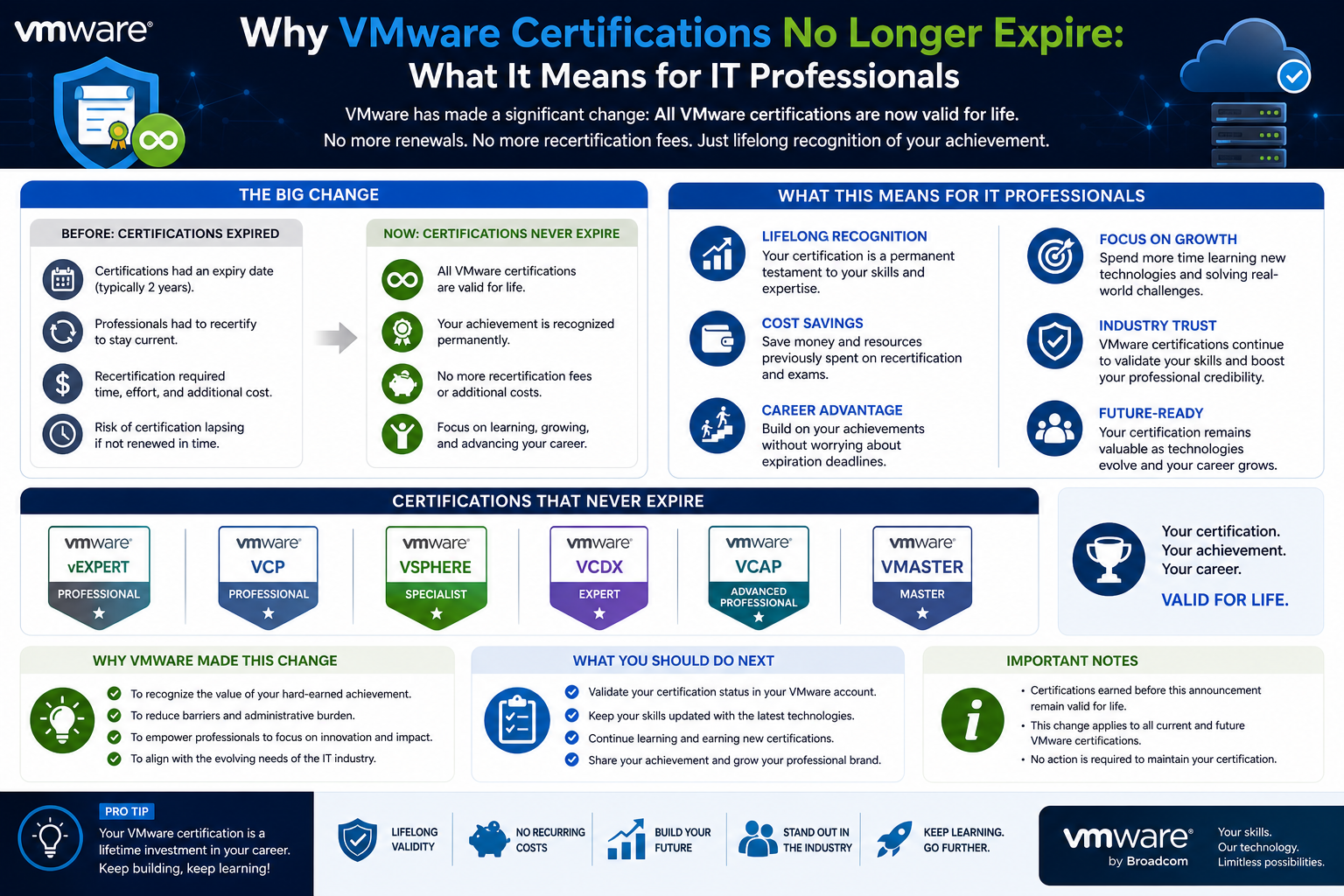
VMware previously followed a similar model. The VCP certification required recertification every two years. This meant professionals had to stay aligned with VMware’s latest technologies and pass updated exams to maintain their credential status.
On the surface, this approach made sense. Virtualization technology evolves, and outdated knowledge can lead to inefficiencies or misconfigurations in production environments. Recertification ensured that professionals remained competent with current tools and methodologies.
However, over time, this model began to show limitations. One of the primary concerns was that it imposed a uniform timeline on all professionals, regardless of their actual job requirements or exposure to new technologies.
In many organizations, infrastructure upgrades do not occur frequently. Some companies maintain stable virtualization environments for several years without significant changes. In such cases, forcing professionals to recertify on a fixed schedule may not always align with real-world needs.
Additionally, recertification often introduced pressure on professionals to prepare for exams within strict deadlines, regardless of whether their daily responsibilities required new knowledge. This created a disconnect between certification maintenance and practical job relevance.
These challenges contributed to a broader industry conversation about whether mandatory expiration truly reflects the realities of modern IT work.
VMware’s Shift in Recertification Philosophy
Against this backdrop, VMware introduced a notable change to its VCP recertification policy. The company removed the mandatory requirement to renew the certification within a fixed two-year period.
Instead of enforcing expiration, VMware now allows certification holders to decide when they want to recertify or upgrade their credential.
This change represents a significant philosophical shift. Rather than treating certification as something that automatically becomes outdated, VMware is positioning it as a credential that remains valid until the professional chooses to update it.
In practical terms, this means that a VCP certification does not expire simply because a certain amount of time has passed. The responsibility for staying current now rests more heavily on the individual and their employer rather than being dictated by a rigid timeline.
This approach introduces greater flexibility into the certification lifecycle. Professionals are no longer bound to recertify within a strict window, and they can instead align their learning and certification efforts with their actual career needs.
Why the Traditional Recertification Model Was Reconsidered
The decision to remove mandatory recertification did not happen in isolation. It reflects broader trends in how organizations think about skills validation and professional development.
One key reason for the change is the growing recognition that not all IT environments evolve at the same pace. While some organizations adopt new virtualization technologies rapidly, others maintain stable systems for extended periods.
In slower-changing environments, forcing frequent recertification can create unnecessary overhead. Professionals may be required to the study and pass exams covering features or technologies that are not yet relevant to their job roles.
Another important factor is the increasing emphasis on continuous learning rather than periodic testing. Modern IT roles often involve ongoing exposure to evolving technologies through daily work, training, and problem-solving.
In such environments, skills are maintained through practice rather than exam cycles. This makes rigid recertification schedules less aligned with actual professional development.
There is also a financial and logistical aspect. Recertification often involves exam fees, preparation time, and opportunity costs associated with studying. For both individuals and organizations, these costs can accumulate over time.
By removing mandatory expiration, VMware reduces some of this burden, allowing professionals to allocate resources more strategically.
The Role of Industry Trends in VMware’s Decision
VMware’s policy change is also influenced by broader industry dynamics. The IT certification landscape is becoming increasingly competitive, with multiple vendors offering overlapping technologies and skill validation paths.
Cloud providers, virtualization platforms, and networking vendors are all competing not only for market share but also for mindshare among IT professionals. Certifications play a key role in this competition.
By making certifications more flexible and less restrictive, organizations can increase their appeal to professionals who are evaluating where to invest their time and effort.
There is also a growing recognition that certifications are no longer the sole measure of expertise. Practical experience, real-world problem-solving, and continuous exposure to technologies are increasingly valued alongside formal credentials.
In this context, rigid expiration policies may be seen as less relevant than they once were.
VMware’s decision reflects an effort to align with this evolving mindset while maintaining the credibility of its certification program.
Early Implications of the Policy Change for Professionals
The immediate impact of removing mandatory recertification is increased flexibility for VCP holders. Professionals are no longer required to follow a fixed renewal cycle and can instead make decisions based on their own career trajectories.
For some individuals, this may mean holding a certification for longer periods without upgrading. For others, it may encourage more strategic timing of recertification, aligning updates with job transitions, promotions, or new project requirements.
This shift also changes how certifications are perceived in terms of longevity. A VCP credential is now more stable in appearance, as it does not automatically become inactive after a set period.
However, this does not eliminate the importance of staying current. The underlying technology continues to evolve, and professionals are still expected to maintain relevant skills in order to perform effectively in their roles.
The difference lies in how that expectation is enforced. Instead of being driven by certification expiration, it is now shaped by market demands, employer expectations, and individual career goals.
As the IT industry continues to evolve, this balance between flexibility and relevance will likely become an increasingly important theme in certification design.
Reframing Certification Value in a No-Expiration Model
The removal of mandatory recertification fundamentally changes how certification value is perceived over time. In traditional models, the value of a certification was partially tied to its “freshness.” Once a certification passed its expiration window, it was often considered outdated or inactive, regardless of the holder’s actual experience in the field.
With VMware’s updated approach, that automatic depreciation no longer exists. Instead, certification value becomes more closely connected to real-world relevance, experience, and context. A VCP credential remains valid indefinitely unless the professional chooses to upgrade or refresh it.
This shifts the meaning of “value” from a time-based system to a usage-based system. A certification is no longer something that simply “decays” over time; it is something that retains relevance as long as the underlying skills remain applicable in real environments.
This change has subtle but important implications. Professionals who actively work with VMware technologies may find that their certification continues to represent their capabilities accurately for years. Meanwhile, those who move away from infrastructure roles may still hold a valid credential, but its practical significance in hiring decisions may diminish depending on how long they remain disconnected from the technology.
In this way, certification value becomes more fluid and context-dependent rather than fixed and time-bound.
How the New Model Changes Career Planning for IT Professionals
One of the most significant impacts of VMware’s policy shift is on how professionals plan their careers and certification paths.
Previously, certification planning was often structured around expiration deadlines. Professionals would map out their learning and recertification cycles based on fixed intervals. This created a predictable rhythm: earn certification, maintain it, prepare for renewal, and repeat.
With the removal of mandatory recertification, this rhythm is disrupted. Instead of reacting to expiration deadlines, professionals now have to think more strategically about when and why they should upgrade.
This introduces a more personalized approach to career development. Some individuals may choose to recertify frequently to stay aligned with the latest technologies. Others may wait longer, focusing on hands-on experience before returning to formal certification updates.
This flexibility allows professionals to align certification decisions with career milestones rather than arbitrary timelines. For example, someone preparing for a promotion, job transition, or specialization shift may choose to update their certification at a strategically advantageous moment.
At the same time, this flexibility also places more responsibility on individuals. Without enforced deadlines, there is a greater need for self-assessment. Professionals must now evaluate their own skill relevance and determine when an update is necessary.
This creates a more self-directed learning environment, where certification becomes one part of a broader professional development strategy rather than a mandatory compliance requirement.
The Impact on Skill Maintenance and Continuous Learning
One of the key arguments historically used in favor of recertification is skill maintenance. The assumption was that without mandatory renewal, professionals might allow their knowledge to become outdated.
VMware’s new model challenges this assumption by shifting the emphasis from enforced testing to continuous learning. Instead of relying on exams to validate knowledge at fixed intervals, professionals are encouraged to maintain skills organically through real-world experience and ongoing exposure to technology.
In many IT environments, especially those involving virtualization and cloud infrastructure, learning is already continuous. Systems evolve, configurations change, and troubleshooting scenarios require constant adaptation.
In such environments, practical experience often provides more up-to-date knowledge than periodic exam preparation. This means that a rigid recertification cycle may not always reflect actual skill levels accurately.
However, the absence of mandatory recertification does not eliminate the need for structured learning. It simply changes its timing and motivation. Professionals must now decide when formal validation is necessary, rather than being required to do so on a fixed schedule.
This can lead to more meaningful learning experiences. Instead of studying solely to meet a deadline, individuals can focus on upgrading their knowledge when it aligns with real-world needs or career goals.
Employer Perspectives on Non-Expiring Certifications
Employers play a crucial role in how certifications are valued, and VMware’s policy change introduces new considerations for hiring and workforce planning.
In traditional certification models, expiration dates provided a simple reference point for evaluating candidates. A recent certification indicated up-to-date knowledge, while an expired one often raised concerns about relevance.
With the removal of expiration, employers must adopt a more nuanced approach. Instead of relying on certification age, they may need to place greater emphasis on experience, recent project involvement, and practical skill assessments.
This does not reduce the importance of certifications, but it changes how they are interpreted. A VCP certification now represents a validated skill set at the time of achievement, rather than a time-limited credential.
Employers may begin to view certifications as foundational indicators rather than absolute measures of current expertise. This means that while certifications still matter, they are increasingly considered alongside other factors such as hands-on experience, problem-solving ability, and familiarity with current systems.
For organizations that rely heavily on VMware infrastructure, this shift may also encourage more internal training programs and skill assessments. Rather than depending solely on certification status, employers may invest more in ongoing employee development to ensure skills remain aligned with operational needs.
The Evolution of Certification Lifecycle Thinking
The concept of a certification lifecycle has traditionally been straightforward: preparation, achievement, maintenance, and renewal. VMware’s new approach disrupts this linear model.
Instead of a fixed lifecycle, certifications now operate more like evolving credentials that professionals can choose to refresh at different stages of their careers.
This introduces multiple possible pathways. Some professionals may follow a rapid evolution model, upgrading certifications frequently to stay aligned with the latest technologies. Others may follow a stability model, maintaining a certification for longer periods while relying on hands-on experience for skill updates.
There is also a hybrid model emerging, where professionals selectively update certifications based on specific technological shifts rather than fixed timelines.
For example, a major upgrade in virtualization architecture or cloud integration may prompt a recertification decision, while smaller incremental updates may not.
This flexible lifecycle approach reflects a broader trend in IT learning: the shift from time-based validation to event-based validation. Instead of updating credentials every few years, professionals update them when meaningful changes occur in the technology landscape.
Changes in Certification Upgrade Pathways
Alongside the removal of mandatory recertification, VMware has also adjusted how certification upgrades work. These changes are particularly important for professionals who hold older versions of the VCP certification.
Previously, upgrade paths were often limited to recent certification versions. This meant that professionals who had allowed their certifications to become outdated sometimes had to restart the certification process entirely.
With the new structure, VMware has expanded the number of eligible certification versions that can be upgraded within a given track. This creates a more inclusive upgrade system that recognizes prior learning and experience rather than discarding it due to time gaps.
This change reduces redundancy in the certification process. Professionals who have already demonstrated expertise in earlier versions of VMware technologies are no longer forced to repeat foundational steps unnecessarily.
Instead, they can transition more smoothly toward current certification standards, provided they remain within a defined range of relevant versions.
This approach also reflects a more realistic understanding of how professionals engage with technology. In real-world environments, it is common for systems to remain in production for extended periods without immediate upgrades. Certification pathways that ignore this reality often create unnecessary barriers.
By allowing broader upgrade eligibility, VMware is aligning certification progression more closely with actual enterprise technology lifecycles.
The Psychological Effect of Removing Expiration Pressure
Beyond practical implications, the removal of mandatory recertification also has a psychological impact on certification holders.
Under the previous model, professionals often experienced a recurring sense of urgency as expiration dates approached. This created cycles of preparation stress, time management pressure, and exam-related anxiety.
Even experienced professionals who actively used VMware technologies in their daily work were not exempt from this pressure. The need to periodically validate skills through formal exams could feel disconnected from actual job performance.
With the new model, this pressure is significantly reduced. Professionals are no longer bound by fixed deadlines, allowing them to approach certification maintenance with greater flexibility and less time-driven stress.
This can lead to a healthier relationship with professional development. Instead of associating certification maintenance with urgency and obligation, individuals can view it as a strategic decision aligned with career growth.
However, this shift also introduces a new challenge: procrastination risk. Without deadlines, some professionals may delay updates indefinitely, even when their skills could benefit from refreshment.
This makes self-discipline and career awareness more important than before. The responsibility for maintaining relevance now lies more heavily on the individual rather than being externally enforced.
Alignment with Broader Industry Certification Trends
VMware’s decision does not exist in isolation. It reflects a broader rethinking of how certifications function across the IT industry.
Many organizations are exploring alternative models that emphasize continuous learning, modular certification structures, and skill-based validation rather than strict expiration cycles.
Cloud platforms, networking vendors, and cybersecurity organizations are all experimenting with variations of this approach. Some have introduced continuous education credits, while others have restructured certification tiers to reduce the need for full recertification.
The underlying theme across these changes is flexibility. As technology evolves faster than traditional certification cycles, rigid expiration models become increasingly difficult to maintain without creating friction for professionals.
VMware’s approach aligns with this direction by reducing structural barriers while still preserving the integrity of its certification framework.
This balance is important. Completely removing validation mechanisms would risk devaluing certifications, while overly strict systems could discourage participation. The challenge lies in maintaining credibility while allowing adaptability.
How Organizations May Adapt Their Internal Certification Policies
As VMware’s certification model evolves, organizations that rely on VMware technologies may also need to adjust their internal policies.
Many companies historically tied job roles, promotions, or compliance requirements to certification status and validity. In such systems, expiration dates played a central role in workforce planning.
With certifications no longer expiring automatically, organizations may need to redefine how they assess ongoing competency. This could involve periodic internal reviews, skills assessments, or project-based evaluations.
Some organizations may also shift toward encouraging voluntary recertification aligned with major technology changes rather than enforcing strict renewal cycles.
This creates a more dynamic relationship between certification and job performance. Instead of relying solely on external validation, employers may place greater emphasis on demonstrated capability within real operational environments.
Over time, this could lead to a more balanced evaluation system where certifications serve as one input among many in determining professional competency.
A Shift from Time-Based Credentials to Skill-Centric Validation
The removal of mandatory expiration from VMware certifications signals a deeper transformation in how professional skills are validated across the IT industry. Instead of relying on fixed timelines to determine whether knowledge is current, the focus is gradually shifting toward real-world capability and continuous relevance.
This shift reflects a growing recognition that time alone is not a reliable indicator of expertise. In fast-changing environments, some professionals remain deeply engaged with evolving technologies on a daily basis, while others may hold certifications but have limited exposure to current systems.
Under the traditional model, both groups were treated similarly once a certification expired. That approach often failed to reflect actual competency levels accurately. The newer model attempts to correct this imbalance by decoupling certification validity from time and linking it more closely to practical application.
In this evolving structure, certifications become more like long-term credentials that represent a foundational achievement rather than a temporary validation. Their relevance is maintained not through automatic expiration but through continued professional engagement with the technology.
This subtle change has wide-reaching implications for how IT skills are measured, recognized, and valued in the job market.
How VMware’s Model Aligns with Broader Certification Evolution
VMware’s decision fits into a broader shift occurring across the IT certification landscape. Many major technology providers are rethinking how they structure learning paths and validation systems.
Historically, certification programs were built around rigid tiers and renewal cycles. Professionals progressed through structured levels and were required to maintain currency through periodic reassessment. While this model provided consistency, it also introduced rigidity that often did not reflect real-world usage patterns.
As cloud computing, automation, and DevOps practices have matured, the pace of technological change has accelerated. Certification bodies are increasingly finding that static renewal cycles cannot keep up with the speed of innovation.
In response, many organizations are experimenting with alternative models that emphasize adaptability. These include modular certifications, skill-based assessments, and continuous learning frameworks that allow professionals to update specific areas of expertise without retaking entire exams.
VMware’s no-expiration approach is part of this broader movement toward flexibility. Instead of forcing a complete reset of certification status after a fixed period, it allows professionals to maintain credentials while choosing when to upgrade based on actual need.
This approach reflects a more realistic understanding of how IT professionals engage with technology over time.
The Growing Influence of Real-World Experience Over Exam Cycles
One of the most important consequences of removing certification expiration is the increased emphasis on real-world experience.
In traditional models, certification validity often served as a proxy for skill freshness. Employers and recruiters could rely on expiration dates as a quick signal of whether a candidate’s knowledge was likely up to date.
However, this approach often overlooked a critical factor: actual hands-on experience. Many professionals maintain deep expertise through daily work, even if they are not actively pursuing recertification. Others may focus heavily on exam preparation without sustained exposure to production environments.
By removing expiration dates, VMware is implicitly encouraging the industry to place greater weight on practical experience. Certification becomes one component of a broader skill profile rather than the sole indicator of competence.
This shift may gradually influence hiring practices. Employers may begin to place more emphasis on recent project involvement, system ownership, and problem-solving ability rather than relying primarily on certification validity windows.
Over time, this could lead to a more balanced evaluation framework where certifications act as foundational proof of knowledge, while experience demonstrates ongoing capability.
Impact on Certification Strategy for IT Professionals
The removal of mandatory recertification changes how professionals should think about certification strategy over the long term.
Previously, certification planning often revolved around maintaining validity. Professionals would prepare for renewal cycles and structure their learning around expiration timelines. This created a predictable but sometimes rigid development path.
With the new model, certification strategy becomes more dynamic. Professionals now have greater freedom to decide when to update their credentials based on career goals, technology shifts, or role changes.
This flexibility allows for more personalized career planning. For example, a professional working in a stable virtualization environment may choose to delay recertification while focusing on deeper specialization in adjacent areas such as cloud integration or automation.
Conversely, someone moving into a new role that requires cutting-edge VMware knowledge may choose to upgrade certifications more frequently to align with job requirements.
This flexibility encourages professionals to think strategically rather than reactively. Instead of preparing for exams because a deadline is approaching, certification decisions can be aligned with meaningful career milestones.
However, this also requires a higher degree of self-awareness. Without external deadlines, professionals must actively assess their own skill relevance and determine when updates are necessary.
The Risk of Skill Drift in a No-Expiration System
While the removal of mandatory recertification offers flexibility, it also introduces a potential challenge: skill drift.
Skill drift occurs when professionals gradually move away from the latest developments in a technology area without formally updating their knowledge. In a no-expiration model, this risk becomes more pronounced because there is no enforced reminder to refresh skills.
For professionals who remain actively engaged in their field, this may not be a significant issue. Daily exposure to evolving systems often provides continuous informal learning.
However, for individuals who shift roles, take on managerial responsibilities, or move away from hands-on technical work, skill drift can occur more easily.
Over time, this can create a gap between certification status and actual proficiency with current technologies. While the certification remains valid, its practical relevance may diminish if skills are not actively maintained.
This places greater importance on self-directed learning habits. Professionals must now take responsibility for ensuring that their knowledge evolves in line with industry changes, even in the absence of formal recertification requirements.
How Employers May Redefine Certification-Based Hiring
The shift away from expiration-based certification models is likely to influence hiring practices over time.
In traditional recruitment processes, certification status often served as a filtering mechanism. Candidates with active, recent certifications were frequently prioritized over those with older or expired credentials.
With certifications no longer expiring, employers may need to adopt more nuanced evaluation methods. Instead of relying on certification age, hiring decisions may increasingly consider factors such as project history, role relevance, and technical interviews.
This could lead to more comprehensive assessments of candidate ability. Rather than treating certifications as binary indicators, employers may view them as part of a broader competency profile.
In some cases, this may benefit experienced professionals who have maintained strong practical skills but previously lost certification status due to expiration rules. Their credentials now remain visible and valid, potentially improving their perceived market value.
At the same time, employers may place greater emphasis on verifying current knowledge through practical evaluation methods rather than relying solely on certification credentials.
The Changing Role of Certifications in Career Progression
Certifications have traditionally played a key role in career advancement, particularly in infrastructure and systems roles. They have often been used to demonstrate readiness for promotions, new responsibilities, or specialized positions.
With the removal of expiration requirements, certifications may evolve from time-sensitive milestones into long-term professional markers.
Instead of serving as short-term validation tools, they increasingly function as baseline indicators of capability. Career progression may depend less on maintaining certification currency and more on how professionals apply their skills in real environments.
This does not reduce the importance of certifications, but it changes their function. They become part of a broader narrative of professional development rather than a recurring requirement.
For many professionals, this may create more flexibility in career planning. Instead of structuring advancement around certification cycles, individuals can focus on gaining experience, developing expertise, and pursuing certifications when they align with career transitions.
Industry Competition and Certification Differentiation
As VMware adjusts its certification model, other major technology providers continue to refine their own approaches. This creates an environment of ongoing competition in the certification space.
Different organizations take different approaches to balancing validity, flexibility, and rigor. Some maintain strict expiration cycles, while others introduce continuing education requirements or modular updates.
In this competitive environment, certification design becomes part of broader talent strategy. Organizations aim to attract professionals not only through technology offerings but also through accessible and meaningful certification pathways.
VMware’s no-expiration model may influence how other providers think about certification retention and appeal. If professionals respond positively to increased flexibility, similar models may become more common across the industry.
However, there is also a counterbalancing concern: maintaining credibility. Certifications must continue to represent reliable indicators of skill, even in the absence of expiration-based enforcement.
Finding this balance between flexibility and rigor will likely remain a central challenge for certification providers moving forward.
The Role of Continuous Learning Ecosystems
As certification models evolve, continuous learning ecosystems are becoming increasingly important.
Rather than viewing certification as a one-time achievement followed by periodic renewal, many organizations are encouraging ongoing skill development through multiple channels.
These may include hands-on labs, real-world project experience, internal training programs, and informal knowledge sharing within professional communities.
In this environment, certifications serve as anchor points within a broader learning journey. They validate foundational knowledge but are supported by continuous exposure to evolving tools and practices.
VMware’s no-expiration model fits naturally within this ecosystem. It reduces pressure around formal renewal while encouraging professionals to engage in ongoing learning at their own pace.
This approach reflects a more modern understanding of how technical expertise is developed and maintained over time.
Long-Term Implications for Certification Credibility
One of the most important considerations in any certification model is credibility. Certifications must maintain trust among employers, professionals, and the broader industry.
A key question arising from no-expiration models is whether removing renewal requirements affects perceived credibility.
In practice, credibility is influenced by multiple factors beyond expiration rules. These include exam rigor, industry recognition, alignment with real-world skills, and the reputation of the certifying organization.
VMware’s certifications have historically been regarded as technically rigorous and closely aligned with enterprise needs. This foundation helps maintain credibility even as administrative policies change.
However, over time, the absence of expiration may require certification bodies to rely more heavily on other mechanisms to ensure relevance. These could include updated exam content, revised skill frameworks, and stronger alignment with current technologies.
The long-term success of a no-expiration model depends on maintaining this balance between flexibility and ongoing relevance.
Evolving Expectations for IT Professionals in a Flexible Certification Era
As certification models become more flexible, expectations for IT professionals are also evolving.
There is a growing assumption that professionals will take greater ownership of their learning journey. Instead of relying on structured recertification cycles, individuals are expected to actively monitor industry trends, update skills, and make strategic decisions about when to pursue additional certification.
This creates a more autonomous professional environment. Career development becomes less about compliance with external requirements and more about continuous adaptation to technological change.
In this environment, certifications remain important, but they are no longer the sole mechanism for demonstrating expertise. They function alongside experience, adaptability, and ongoing learning as part of a broader professional identity.
The VMware VCP recertification change reflects this shift clearly. It represents a move away from enforced cycles and toward a model where professionals and organizations share responsibility for maintaining skill relevance in a rapidly evolving industry landscape.
Extended Reflection: The Practical Reality of VMware’s No-Expiration Model
One of the most practical outcomes of VMware’s decision is the way it changes day-to-day thinking around certification ownership. Instead of treating a certification as something that “counts down” toward expiration, professionals now treat it more like a standing qualification that can be refreshed when it becomes strategically useful.
This subtle change affects behavior in real environments. Many IT professionals tend to prioritize tasks that have immediate operational impact. Under a strict expiration model, certification renewal often competes with production responsibilities, creating pressure during already busy periods. Removing that fixed deadline reduces this conflict and allows learning to be scheduled more naturally around workload demands.
It also changes how teams within organizations approach skill planning. Instead of synchronizing training cycles around certification expiry dates, teams can align learning with infrastructure changes, such as virtualization upgrades, cloud migrations, or security overhauls. This makes training more context-driven and less procedural.
At the same time, the responsibility for staying technically current becomes more distributed. Certification bodies no longer act as strict gatekeepers of currency. Instead, employers, teams, and individuals collectively determine when knowledge refresh is needed.
This distributed model works well in environments where continuous change is already part of daily operations. However, it also demands stronger professional discipline. Without structured renewal cycles, it becomes easier for outdated practices to persist unless actively corrected through experience or intentional learning.
Ultimately, VMware’s approach reflects a broader industry reality: technical relevance is no longer defined by certification timelines, but by ongoing engagement with evolving systems and real-world problem-solving.
Conclusion
VMware’s decision to remove mandatory recertification for the VCP certification represents more than a policy update—it reflects a broader transformation in how the IT industry defines knowledge, relevance, and professional credibility. In a field where technologies evolve rapidly and organizational needs vary widely, rigid expiration timelines are increasingly difficult to justify as the primary measure of competence.
By allowing certifications to remain valid until professionals choose to update them, VMware shifts responsibility from enforced compliance to personal and organizational judgment. This change acknowledges an important reality of modern IT environments: skills are not maintained solely through periodic exams, but through continuous exposure, hands-on practice, and real-world problem solving.
For professionals, this creates a more flexible and personalized career path. Instead of operating under the pressure of fixed renewal cycles, they can align certification updates with meaningful career moments such as role transitions, infrastructure changes, or strategic skill development goals. This flexibility reduces unnecessary stress while encouraging more intentional learning decisions.
At the same time, the change does not diminish the importance of staying current. If anything, it places greater emphasis on self-awareness and professional responsibility. Without expiration deadlines acting as external triggers, individuals must now actively evaluate when their knowledge needs refreshing and take initiative accordingly. This makes continuous learning less of a requirement and more of a professional habit.
For employers, the shift encourages a more holistic approach to evaluating talent. Certifications remain valuable indicators of foundational knowledge, but they are no longer sufficient on their own to determine current capability. Organizations may increasingly rely on practical assessments, project experience, and ongoing performance to complement certification records. This creates a more balanced and realistic view of employee skills.
In the long term, VMware’s model may influence how other certification providers design their programs. As the industry continues to prioritize agility and adaptability, flexible certification structures that emphasize relevance over expiration could become more common. However, maintaining credibility will remain essential, ensuring that certifications continue to represent meaningful technical achievement rather than symbolic credentials.
Ultimately, this change reflects a shift in philosophy across the IT landscape: from time-based validation to capability-based recognition. It acknowledges that expertise is not defined by how recently an exam was passed, but by how effectively knowledge is applied in evolving real-world environments.
VMware’s no-expiration approach does not eliminate the need for learning—it simply reframes it. Instead of being driven by deadlines, learning becomes driven by purpose, opportunity, and professional growth.